
Lophophora alberto-vojtechii
| Family | Cactaceae |
| Subfamily | Cactoideae |
| Tribe | Cacteae |
| Genus | Lophophora J.M.Coult., 1894 |
| Species | L. alberto-vojtechii |
| Authority | Bohata, Myšák & Šnicer, 2008 |
| Section | Diffusae |
| Native Range | N. San Luis Potosí & N. Zacatecas, Mexico |
| Habitat | Alluvial mudflats; 1,700 m |
| Mature Size | 10–25 mm crown (avg 18 mm) |
| Alkaloids | Pellotine dominant; max 1.3% mescaline |
| Conservation | CITES Appendix II |
The Littlest Lophophora · Miniature Peyote
In February 2007, Jaroslav Šnicer, Jaroslav Bohata, and Vojt?ch Myšák came across a cluster of minute, greying stems in the alluvial flats of northern San Luis Potosí and assumed they were looking at seedlings. Juvenile Lophophora williamsii, probably. They walked on, looking for adults. There were none. The tiny stems were the adults. When the flowers opened a few days later, the three understood they had found something new to science.
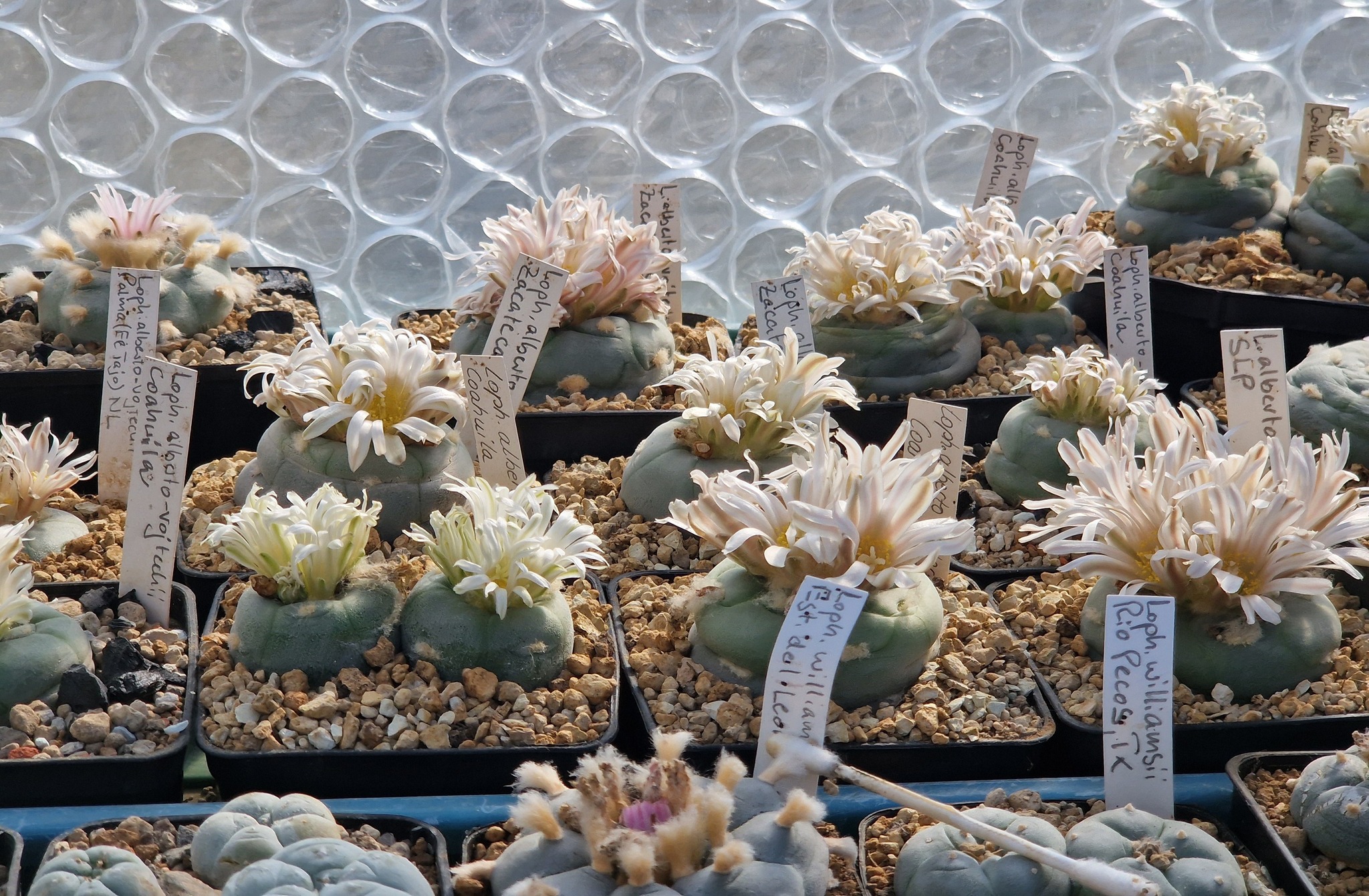
Lophophora alberto-vojtechii is the smallest Lophophora by a considerable margin. Lophophora williamsii routinely develops crowns of 5 to 12 cm. Even Lophophora koehresii, the next smallest, can reach 12 cm in large specimens. Lophophora alberto-vojtechii rarely clears 25 mm. The average adult crown measured 18 mm across. Many plants flower at 10 mm. That is a stem the diameter of a fingernail, carrying a flower that equals or exceeds it in width.
The habitat is as unusual as the scale. This species grows in flat, seasonally flooded alluvial plains that bake to cracked mud for most of the year. During drought, the stems wither and retract below the soil surface, covered by blown dust and leaf debris. The plant disappears entirely. Rain reverses it: the crown swells, pushes back above ground, and flowering follows within weeks. At the type locality, Ariocarpus kotschoubeyanus grows in the same soil, doing much the same thing.
For collectors, the appeal is simple to describe and difficult to act on. Seed grown specimens are hard to source, grow very slowly, and reward that patience with a plant that was unknown to science before 2008. The miniature scale, the outsized flowers, the disappearing act during dry season, the close relationship to Lophophora koehresii that is simultaneously obvious and imperfect: this is a plant that gives a serious collection something worth thinking about.
Conservation Status
CITES Appendix II · Extremely Restricted Range
All Lophophora are listed under CITES Appendix II, requiring documentation of legal provenance for international trade. Lophophora alberto-vojtechii is known from a small number of populations in northern San Luis Potosí and northern Zacatecas at roughly 1,700 metres. Its range is extremely restricted, wild collection is prohibited, and seed grown plants from documented propagators are the only appropriate source for collectors outside Mexico.
Taxonomy & Nomenclature
The formal description appeared in the June 2008 issue of the Italian journal Cactus & Co. (volume 12, number 2, pages 105–117), authored by Jaroslav Bohata, Vojt?ch Myšák, and Jaroslav Šnicer. An expanded English-language account followed the next year in the Cactus and Succulent Journal (volume 81, number 6, 2009), and remains the most accessible primary reference for the species. The type specimen was collected by George S. Hinton at the type locality in northern San Luis Potosí on 1 August 2007, deposited in the G.B. Hinton herbarium under collection number 28642.
The name honours two people. The first is Alberto Vojt?ch Fri? (1882–1944), a Czech traveler, ethnographer, and cactus collector who made multiple expeditions to Central and South America in the early twentieth century and was central to introducing Mexican cacti to European cultivation. The second is Vojt?ch Myšák, a living Lophophora specialist and co-author of the description. The naming ties the species to both the history of Central European cactus exploration and to one of the people who found it.
Within the genus, Lophophora alberto-vojtechii sits in section Diffusae, one of two sections in a five-species treatment. Section Lophophora holds only Lophophora williamsii. Section Diffusae holds Lophophora diffusa, Lophophora fricii, Lophophora koehresii, and provisionally Lophophora alberto-vojtechii. The two sections differ in alkaloid chemistry, epidermis structure, and maximum rib count. Within Diffusae, the closest relative is Lophophora koehresii: shared habitat, similar growth form, similar fruit and flower morphology, the same tendency to shed areole trichomes with age. What separates them is size, rib count, seed hilum shape, and the mauve-green epidermis color that Lophophora koehresii never shows.
A note on Lophophora jourdaniana: this taxon sits in section Lophophora, not Diffusae, and is treated by most current authors as a variety or color form of Lophophora williamsii rather than a distinct species. Its deeper lilac-pink flowers and more saturated midstripe led Habermann to describe it as separate in 1974, but vegetative characters overlap almost completely with the type form. It is mentioned here because serious Lophophora collectors encounter it frequently and because its taxonomic ambiguity is a useful illustration of how differently the two sections of the genus behave in terms of morphological variability.
Historical synonyms (12)
- Lophophora viridescens (Halda) Halda, 1997 basionym
- Lophophora echinata var. diffusa Croizat, 1944 heterotypic synonym
- Lophophora diffusa subsp. diffusa , 1967 heterotypic synonym
- Lophophora williamsii var. diffusa (Croizat) G.D.Rowley, 1976 heterotypic synonym
- Lophophora diffusa var. koehresii Ríha, 1996 heterotypic synonym
- Lophophora diffusa subsp. viridescens Halda, 1997 heterotypic synonym
- Lophophora williamsii var. koehresii (Ríha) Grym, 1997 heterotypic synonym
- Lophophora diffusa subsp. kubesae Halda, Kupcák & Malina, 2002 heterotypic synonym
- Lophophora diffusa var. swobodaiana Halda, Kupcák & Malina, 2002 heterotypic synonym
- Lophophora williamsii subsp. diffusa (Croizat) Scheinvar, 2004 heterotypic synonym
- Lophophora koehresii (Ríha) Bohata, Mysák & Snicer, 2005 heterotypic synonym
- Peyotl koehresii (Riha) Sotom., heterotypic synonym
Sources: POWO (Kew) · IPNI · GBIF · Wikidata
Habitat & Native Range
The type locality sits in northern San Luis Potosí at approximately 1,700 metres, in the transition zone between the southern Chihuahuan Desert and the xerophytic scrub of the Matehuala region. The terrain is flat to gently rolling alluvial sediment plain: the kind that collects runoff from surrounding hills, floods during the summer monsoon, then dries to a hard cracked surface for the bulk of the year. This is not typical cactus country. Most Mexican cacti prefer rocky, well-drained slopes. Lophophora alberto-vojtechii chose the mud.
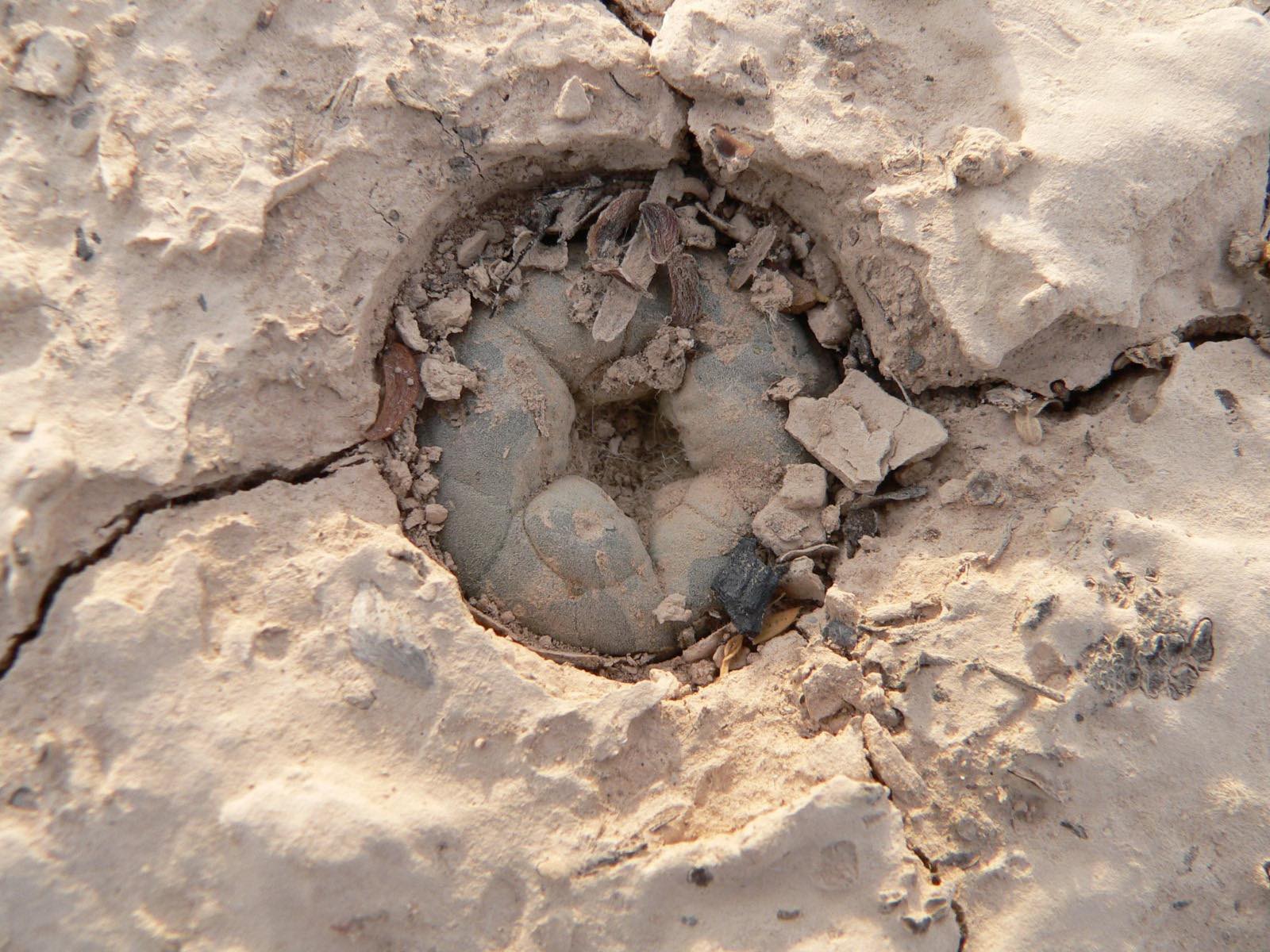
The alluvial mudflat habitat in northern San Luis Potosí. During the dry season the soil cracks and compacts; the plants retract below the surface. During the rainy season the same terrain floods briefly before draining.
The geophytic behavior follows directly from this. As drought sets in, the crown softens, shrinks, and withdraws below the soil surface. Wind covers it with dust and dry vegetation. The plant vanishes. At peak dry-season conditions a population that was clearly visible during flowering can be undetectable to anyone not already knowing where to look. Šnicer and the team described searching a site and finding far fewer plants than expected, then realizing most were buried. The first individual at the type locality was identified almost by accident by a colleague scanning ground level.
The companion flora at the type locality is notable. Ariocarpus kotschoubeyanus occupies the same alluvial flats. Mammillaria coahuilensis was found here far south of any prior record, its distribution previously thought to be restricted to distant Coahuila. Coryphantha hintoniorum also grows at the site, alongside Ferocactus hamatacanthus, Echinocereus enneacanthus, Ancistrocactus uncinatus, and Opuntia bulbispina. It is the kind of site that holds a field botanist for longer than planned.
A second population in northern Zacatecas, roughly 100 km northwest, produces lighter-colored flowers. Some Zacatecas plants carry blooms exceeding 3 cm in diameter, which on a stem rarely wider than 2.5 cm is not a subtle effect. A third locality in a second area of San Luis Potosí is referenced in the primary literature with limited documentation. Whether additional populations exist that have not yet been surveyed is an open question; the plant’s habit of disappearing into the soil during the dry season makes survey work difficult.
Morphology
The aerial crown is flat to slightly convex, typically 10 to 25 mm in diameter. Most adults measure around 18 mm. Anything over 25 mm is exceptional. The color is a greyish green with a noticeable mauve or greenish-violet tone, particularly visible at the apex and in direct light. This coloration appears in some forms of Lophophora fricii and Lophophora williamsii, but never in Lophophora koehresii, which maintains a bold, consistent dark green. The epidermis is thin and fine, consistent with all section Diffusae members.
The ribs typically number five and are often indistinct. The Fibonacci series constrains rib count in cacti relative to stem diameter, and on a crown this narrow, five ribs is about all the geometry allows. Exceptional specimens reach eight. The areoles are inconspicuous in mature plants. Trichomes form near the growing point but drop off shortly after, leaving bare, slightly raised structures rather than the woolly crown of Lophophora williamsii. Old plants look younger than they are because of this. The actual age shows in the accumulation of spent areole remnants at the stem base and in how far the subterranean stem has extended downward.
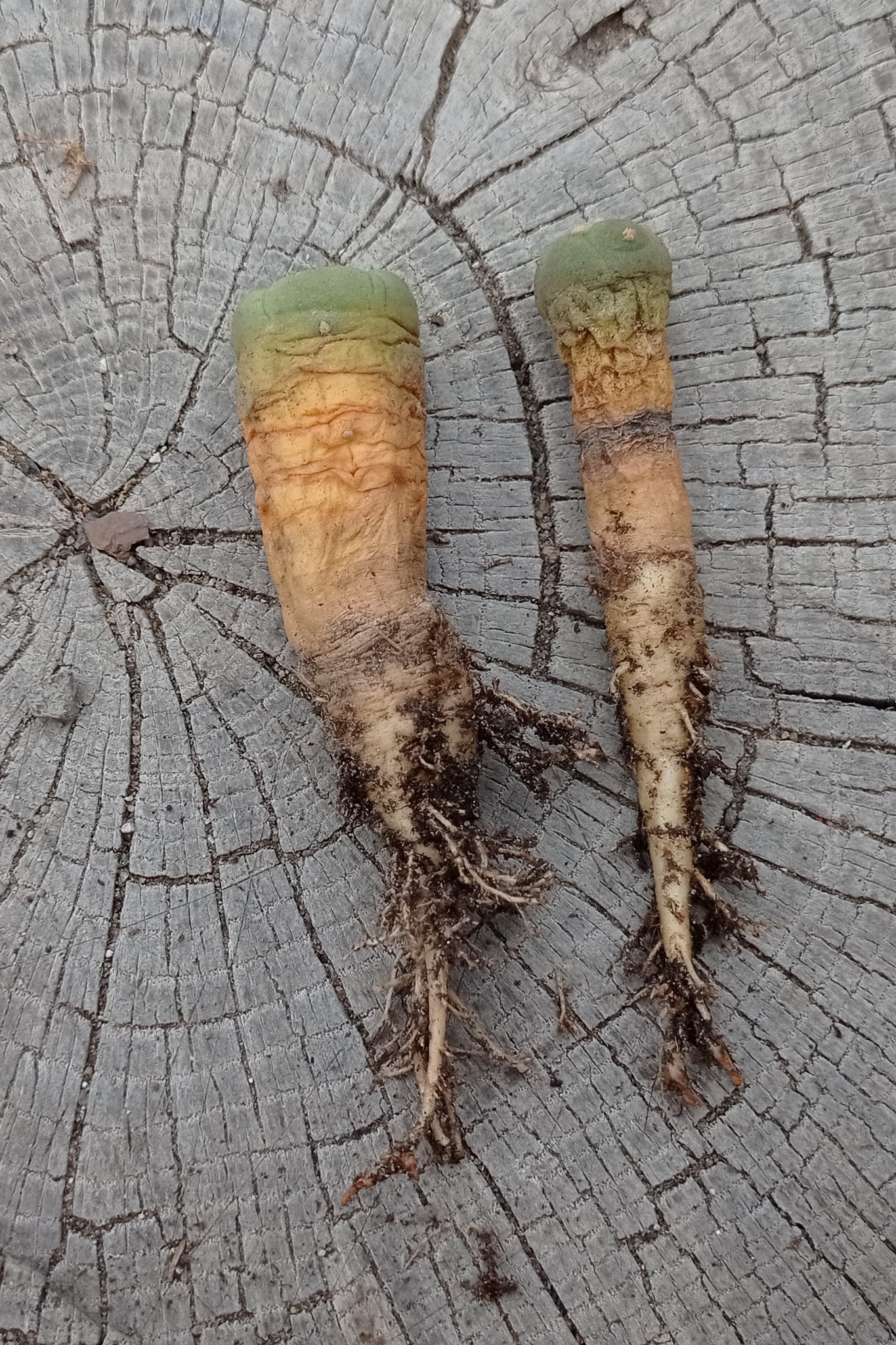
Below the crown, the subterranean stem extends about 25 mm down from the crown base in measured adults and deepens with age. Below that sits the root: thick, bulbous, napiform, smooth and creamy-white to dirty yellow, up to 30 mm long and roughly 16 mm in diameter where it joins the stem. The root mass is substantially larger than the aerial crown in a healthy, well-established plant. This is the reserve the plant draws on during the months it spends buried.
Flowering & Seed
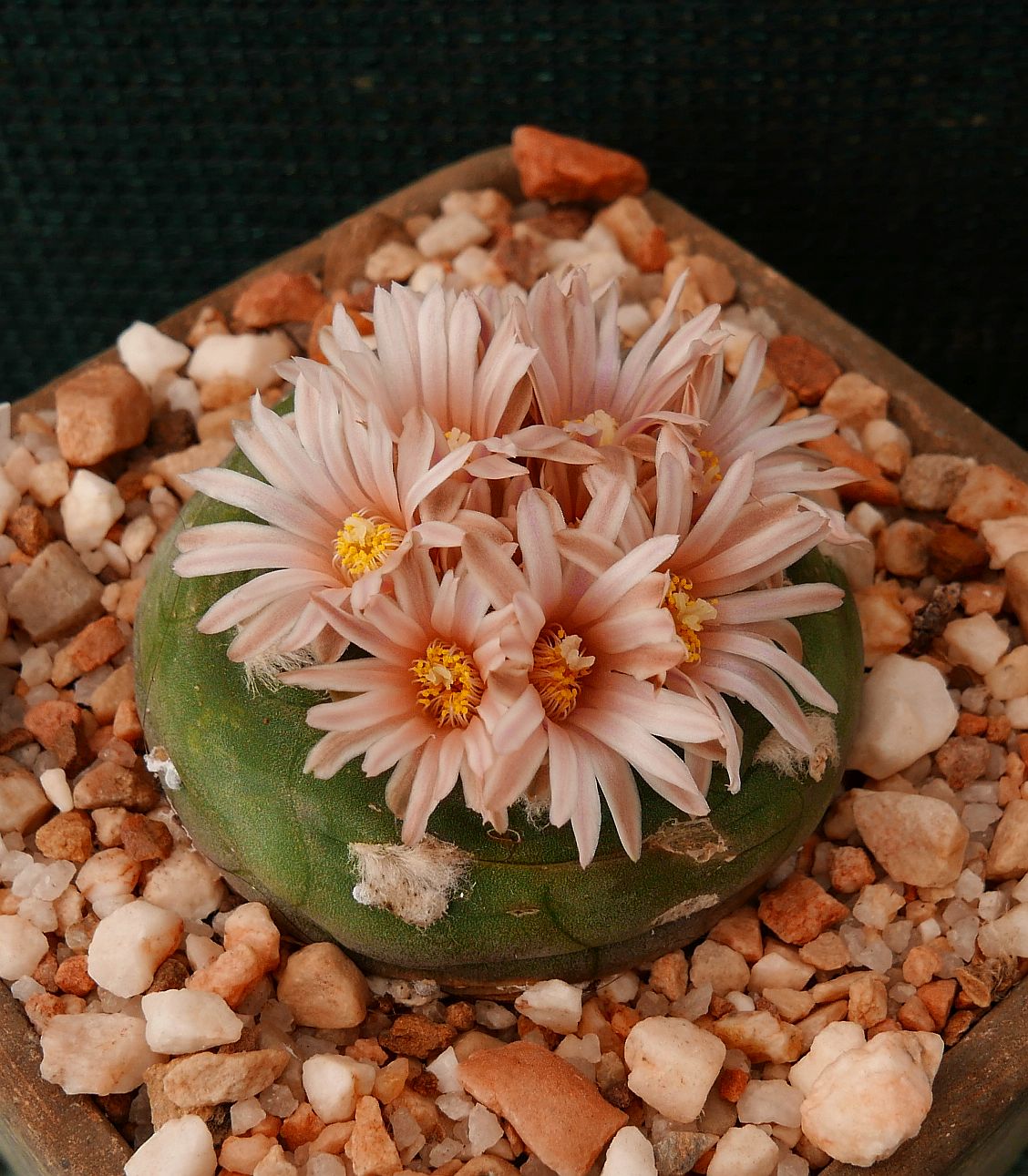
Flowers measure 15 to 35 mm in diameter, averaging around 23 mm. On an 18 mm crown, that means the flower is typically wider than the plant carrying it. In large-flowered Zacatecas individuals, blooms can exceed 3 cm, entirely obscuring the stem below. This is not subtle and it is not coincidental: the disproportionate flower size relative to crown area is one of the defining visual characters of the species.
The tepals are white to dirty pink, occasionally creamy yellowish, with a darker longitudinal stripe (brownish, salmon, or deeper pink) running along the inner surface and visible from outside. The tepal tips are unusually rounded, and in some specimens perfectly circular. This rounding is uncommon in section Diffusae and was one of the first signals to Šnicer’s team that they were not looking at a small Lophophora koehresii. The style is white and overtops the anthers noticeably. Anthers are yellowish-orange; the stigma white to yellowish or pinkish.
Plants flower from a very small size. Individuals at 10 mm in crown diameter are already mature and producing blooms, earlier than any other Lophophora. Multiple flowers may be present simultaneously, though they do not all open at once. Zacatecas plants are lighter in flower color than those at the type locality, though the structure is consistent across both sites.
At the type locality, Lophophora alberto-vojtechii and Mammillaria coahuilensis produce flowers so similar in shape, color, and size that the two species are indistinguishable at a distance, flowering at the same time. The authors note this almost certainly reflects shared pollinator orientation. Field observations recorded visits from two bee species and an unidentified dipteran.
Like all section Diffusae members, Lophophora alberto-vojtechii is self-sterile. Two genetically distinct plants flowering simultaneously are required for seed set. Lophophora williamsii can self-fertilize; none of the Diffusae species can. The fruit is small, round to slightly claviform, drying from white to pinkish at maturity. Seeds are black, round, 1.15 to 1.45 mm in length and 1.0 to 1.45 mm in width. The hilum is compressed into a broad V-shape with a pronounced perimeter edge. The testa is nodulated, outer cell walls protruding, with individual cells clearly demarcated. This seed surface structure differs from every other species in the genus and is used as a diagnostic character in the formal identification key published by Šnicer et al.
Alkaloid Chemistry
No independent alkaloid analysis of Lophophora alberto-vojtechii has been published. The species is placed provisionally in section Diffusae on morphological and taxonomic grounds, and that placement tells us what to expect.
The genus divides cleanly along alkaloid lines. Section Lophophora (containing only Lophophora williamsii) carries mescaline at 15 to 30 percent of total alkaloid content. Section Diffusae carries a maximum of 1.3 percent mescaline. Pellotine, a tetrahydroisoquinoline alkaloid, dominates the Diffusae profile. Measured data from Štarha and Kuchyn? (1996) found pellotine at 88.4 percent of total alkaloid content in Lophophora koehresii, the closest relative, with mescaline at 1.3 percent. Analysis of Lophophora fricii found pellotine at 65 to 66 percent, mescaline below 1.1 percent. The pattern holds consistently across every measured Diffusae species.
The “provisionally” in the original description is scientific caution, not doubt. Šnicer et al. state the alkaloid profile will need laboratory confirmation, but the morphological evidence for Diffusae placement is strong. Until a published analysis exists, the expected profile is pellotine-dominant with trace mescaline, consistent with the rest of the section.
The alkaloid divide also has a practical dimension: pellotine has a documented hypnotic effect in humans, studied briefly around the turn of the twentieth century, and is pharmacologically distinct from mescaline. Diffusae species are not functional equivalents of peyote. The distinction matters for anyone researching the genus chemistry, and for collectors in jurisdictions where alkaloid content affects the legal status of specific species.
Locality Diversity
Three population areas are documented in the primary literature, all in northern Mexico at elevations around 1,700 metres. The type locality in northern San Luis Potosí is the best documented. The Zacatecas population extends the known range approximately 100 km to the northwest. A second San Luis Potosí site is referenced with limited detail. Exact coordinates are withheld from public literature for conservation reasons, consistent with standard practice for restricted-range Chihuahuan Desert taxa.
Documented Localities
Lophophora alberto-vojtechii: Northern Mexico
Sources: Šnicer, Bohata & Myšák (2008, 2009); Terry (2007). Coordinates approximate; exact localities withheld for conservation.
| Code | Population | State | Elevation | Notes |
|---|---|---|---|---|
| AV-01 | Type locality | N. San Luis Potosí | ~1,700 m | Alluvial mudflat; darker-striped flowers; co-occurs with Ariocarpus kotschoubeyanus and Mammillaria coahuilensis. Holotype: Hinton 28642 (2007) |
| AV-02 | Zacatecas population | N. Zacatecas | ~1,700 m | Lighter-colored flowers; some blooms exceed 3 cm diameter. ~100 km NW of type locality |
| AV-03 | Second SLP locality | San Luis Potosí | ~1,700 m | Referenced in Šnicer et al. (2009); limited documentation. Some specimens with notably numerous tepals recorded |
From Seedling to Specimen
Field plants are older than they look. The authors noted this explicitly: age in Lophophora alberto-vojtechii shows in the accumulation of spent areole remnants at the stem base and in the depth of the subterranean stem, not in crown width. A plant at 18 mm may have been in the ground for years. This matters for anyone growing from seed: slow growth at the correct rate is normal. It is not a problem to fix.
Under good conditions (22–28°C, sterile medium, humidity cover) germination takes seven to twenty-one days. Reported strike rates in collector circles are variable and often modest. Batches at 30 to 40 percent from reputable seed are considered reasonable; some sources run lower. The seeds are small and not inexpensive, so low germination matters more than it would with a common species. Fresh seed from a documented source and consistent germination temperatures give the best odds.
Early growth is very slow. The taproot develops ahead of the crown through the first several years, which is the correct priority for a plant that will spend extended periods relying on root reserves. A seedling in its first year or two may be a 3 to 5 mm dome sitting on a root that already dwarfs it. Leave it alone. Additional water or feed at this stage tends to produce soft, etiolated growth that struggles through the first dry period.
Lophophora alberto-vojtechii care and cultivation
Lophophora alberto-vojtechii follows the section Diffusae cultivation template: slow, rot-prone if mishandled, demanding in terms of drainage and root depth, unforgiving of cold with moisture. Where it differs from its relatives is scale. The plant is smaller, the crown gives fewer visual cues before problems develop internally, and the root-to-container relationship is more critical because there is less margin for error in a very small pot.
Soil and substrate
The cultivation ratio used on this page is a house formulation: 35 per cent pumice, 15 per cent lava rock, 10 per cent zeolite, 20 per cent granite grit, 15 per cent limestone chip, and 5 per cent worm castings. No silica fraction is used for this species; silica’s role on this site is limited to mesemb top-dressing, a mechanism that does not apply to a Lophophora taproot. Zeolite supplies cation exchange without adding water-holding mass, buffering the mix toward neutral pH; the lava fraction is the drainage aggregate. No published cultivation source sets a species-specific limestone or organic share for Lophophora alberto-vojtechii; both numbers hold at the same convention applied across the genus. On hard tap water, reduce or omit the limestone fraction; on RO, distilled, or rainwater, keep it as formulated. The mix should be dry within a day or two of watering.
All four Lophophora species on this site share the same house-formulation substrate; no cultivation-specific evidence differentiates them from each other, so one ratio is published across the genus. Limestone and organic both sit at convention-register values with no per-species evidence behind them.
| Species | Pumice | Lava | Zeolite | Granite | Limestone | Silica | Organic |
|---|---|---|---|---|---|---|---|
| L. williamsii | 35% | 15% | 10% | 20% | 15% | 0% | 5% |
| L. diffusa | 35% | 15% | 10% | 20% | 15% | 0% | 5% |
| L. fricii | 35% | 15% | 10% | 20% | 15% | 0% | 5% |
| L. alberto-vojtechii (this page) | 35% | 15% | 10% | 20% | 15% | 0% | 5% |
The container must give the taproot room. A deep, narrow terracotta pot at least three to four times the crown diameter in depth is correct. For a 20 mm crown that means 6 to 8 cm of depth minimum, which looks excessive for a plant this small and is exactly right. Shallow pots force the root to curve, produce poorly anchored plants, and promote collar rot.
Watering through the growing season
Water moderately during active growth (late spring through summer) and allow the substrate to dry completely between each watering. The crown will soften slightly when the plant needs water. A firm crown does not need water, regardless of how long it has been. Stop entirely by mid-autumn and do not resume until late spring. This is where most losses happen: a plant that entered winter with any moisture in the substrate, particularly in a mix with any organic content, is at serious risk of root collar rot that shows no external symptoms until the crown separates.
Light
Full sun to bright filtered light. The type locality is open, exposed terrain at 1,700 metres with no overhead cover and intense UV. Strong light in cultivation produces compact, correctly colored crowns. Plants in low light stay greener and flatter. In very hot inland climates or unventilated greenhouses, afternoon shade during peak summer protects against scorching while still allowing the UV-driven coloration to develop. Temperate coastal climates can run full outdoor sun through the growing season without issue.
Temperature
The safe minimum is 5°C. Brief exposure near 0°C is survivable if the substrate is completely dry. Any combination of cold and moisture is not. In temperate and continental climates, a frost-free greenhouse with good ventilation and zero winter watering is standard. Summer heat is well tolerated provided the root zone does not overheat in a dark container in direct sun.
Seed grown vs. grafted plants
Seed grown Lophophora alberto-vojtechii (grown from seed, never grafted or degrafted) is the form serious collectors pursue. These plants take years to reach a size worth photographing, and longer still to flower. The result is a plant with the compact form, natural proportions, and grey-mauve coloration that mirrors field plants. That slow development is inseparable from those qualities.
Grafted plants grow faster. A scion on vigorous rootstock produces a noticeably larger crown in a fraction of the time. The trade-off is visible: grafted crowns elongate, soften, turn greener, and lose the flat compact form of a naturally grown plant. Experienced collectors recognize the difference immediately.
Degrafted plants were once grafted, then removed from the rootstock and rooted to grow on. Some graft-grown characteristics fade over time. The growth laid down during the graft period stays, and the proportions of the crown cannot be undone by subsequent slow growth. When acquiring any Lophophora alberto-vojtechii, ask directly whether it was ever grafted. Reputable specialist propagators document this clearly.
Propagation and seed production
Lophophora alberto-vojtechii is self-sterile. Two genetically unrelated plants in simultaneous flower are required for seed set. Hand-pollination is standard practice in cultivation. Coordinate flowering across two plants from different seed sources, apply pollen with a soft brush, and harvest the fruit when it is fully dry. Store seeds dry at room temperature and sow fresh. Germination mix should be very fine and pumice-heavy, with a thin grit top-dressing. Cover with humidity dome or plastic, maintain 22–28°C, and expect germination across one to three weeks. When seedlings reach 5 to 8 mm in diameter the taproot is already substantial and fragile: handle it carefully at every repotting from that point forward.
Within Section Diffusae: How the Species Compare
Section Diffusae holds four species, and Lophophora alberto-vojtechii is the newest and smallest among them. Placing it against its three section-mates clarifies what it actually is, and helps collectors understand what makes each one worth growing.
vs. Lophophora koehresii
Lophophora koehresii is the closest relative, and the comparison is worth making because it is both obvious and incomplete. Both occupy alluvial mudflat habitat in northern Mexico. Both are section Diffusae with a pellotine-dominant alkaloid profile. Both lose areole trichomes with age and carry flowers in the same color range, white to pale pink with a darker midstripe.
The differences are not subtle. Lophophora koehresii is a much larger plant: crown width to 12 cm in large field specimens, up to 13 ribs, bold and consistently dark green epidermis without any of the mauve-violet tones of Lophophora alberto-vojtechii. The two are known from localities separated by more than 100 km with no confirmed range overlap. At seed level they are distinguishable under magnification: Lophophora alberto-vojtechii has a broad V-shaped hilum with a nodulated testa and clearly demarcated cells; Lophophora koehresii has a nearly circular, open hilum with a reticulated testa. Grown side by side, these two express the same section Diffusae template at markedly different scales.
vs. Lophophora fricii
Lophophora fricii grows in Coahuila, Mexico, in rocky limestone terrain and occasional silt flat populations. It is substantially larger than Lophophora alberto-vojtechii: mature specimens reach 12 cm across, sometimes forming low clusters, and the plant carries a much heavier alkaloid load of pellotine (65 to 66 percent of total alkaloids). The body shares some of the grey-green and mauve tones found in Lophophora alberto-vojtechii, but the scale is so different that the two are not easily confused in person.
The most immediately distinguishing character is the flower. Lophophora fricii produces some of the largest flowers in the genus, reaching 40 mm across in documented specimens, and the color tends toward a deeper, more saturated pink-purple than the pale white-to-pink range of Lophophora alberto-vojtechii. The surface tubercles of Lophophora fricii are also more pronounced, giving the stem a distinctly bumpy texture compared to the softer, less defined ribbing of the miniature species. Chemically they are in the same section, both pellotine-dominant and low in mescaline, but they look like different planets in the same solar system.
vs. Lophophora diffusa
Of all the section Diffusae comparisons, Lophophora diffusa presents the sharpest visual contrast to Lophophora alberto-vojtechii. Lophophora diffusa grows in Querétaro, far south of the Chihuahuan Desert, on dry limestone hillsides with a completely different flora. Its stems are pale: a washed-out cream-yellow to greenish white that looks almost albino against the darker hues of its section-mates. The body offsets readily and can form broad, multi-headed clusters over time. There is no mauve, no grey-green, no violet. Where Lophophora alberto-vojtechii compresses itself into the ground and blends into cracked mud, Lophophora diffusa spreads and pales.
The flowers confirm the difference. Lophophora diffusa produces white to creamy yellowish blooms with little or no midstripe, quite unlike the pink-and-stripe arrangement of Lophophora alberto-vojtechii. The two are also cross-sterile, reinforcing that despite shared section membership and similar alkaloid chemistry, they represent distinct evolutionary lineages. For collectors, Lophophora diffusa and Lophophora alberto-vojtechii together illustrate how wide the Diffusae template actually stretches: from the palest, most freely offsetting species in the genus to the darkest, most compressed, and most geophytic.
Frequently asked questions
Is Lophophora alberto-vojtechii hard to grow?
Lophophora alberto-vojtechii is advanced in difficulty. It is the smallest, slowest, and most cryptic Lophophora, retracting partially into the substrate during dry months. Cultivation demands a tighter watering window than the rest of the genus and an unforgiving response to overwatering at the soil line.
Can Lophophora alberto-vojtechii be grown from seed?
Yes, and seed is the only realistic source. Fresh seed germinates at 60 to 80 percent on damp pumice-grit substrate at 20 to 30 °C, with seedling emergence in ten to fourteen days. Plants reach 1 to 2 cm and first flowering in six to ten years from sowing, which is slow even by Lophophora standards.
Is Lophophora alberto-vojtechii legal to own?
All Lophophora are listed under CITES Appendix II, requiring documentation of legal provenance for international trade. L. alberto-vojtechii carries minimal mescaline content and falls outside the specific federal scheduling that applies to L. williamsii in most jurisdictions, though the DEA Schedule I listing for peyote has been read broadly in the United States. In Mexico, NOM-059-SEMARNAT-2010 protects native populations. Nursery seed is legally available throughout the European Union, the United Kingdom, Canada, and Australia.
Where does Lophophora alberto-vojtechii grow in the wild?
Lophophora alberto-vojtechii is restricted to a small range across northern San Luis Potosí and adjacent Zacatecas in north-central Mexico, at elevations between 1,200 and 1,700 metres. Plants grow on gypsum-rich limestone soils in xeric thornscrub, typically half-buried in fine substrate beneath canopy nurse plants.
When does Lophophora alberto-vojtechii flower?
Lophophora alberto-vojtechii flowers from May through August, concentrated during the summer monsoon. Flowers are smaller than other Lophophora, measuring 1.5 to 2 cm across, pink to magenta with a darker midstripe, lasting one to two days. Cultivated plants from seed reach first flowering at six to ten years.
Related Taxa in the Genus
LophophoraLophophora williamsiiPeyote; section Lophophora; 15–30% mescaline; the most widely knownLophophoraLophophora diffusaFalse peyote; section Diffusae; pellotine dominant; Querétaro, MexicoLophophoraLophophora friciiSection Diffusae; distinctive purple-pink flowers; Coahuila, MexicoLophophoraLophophora koehresiiClosest relative; alluvial mudflat specialist; Las Tablas, San Luis PotosíLophophoraLophophora jourdanianaDebated taxon; deeper lilac-pink flowers; often treated as a form of williamsii
Sources & References
Bohata, J., Myšák, V. & Šnicer, J. (2008). Lophophora alberto-vojtechii, una nuova preziosa miniatura nel genere Lophophora. Cactus & Co. 12(2): 105–117. · Šnicer, J., Bohata, J. & Myšák, V. (2009). The Littlest Lophophora. Cactus and Succulent Journal 81(6): 294–300. · Štarha, R. (in Grym, R., 1997). Rod/Die Gattung Lophophora. Appendix: alkaloid data. · Poulie, C.B.M. et al. (2021). The Alkaloids from Lophophora diffusa and Other False Peyotes. Journal of Natural Products. · Royal Botanic Gardens, Kew. Plants of the World Online. Lophophora alberto-vojtechii Bohata, Myšák & Šnicer. Retrieved 2026. · Terry, M. (2007). Stalking the wild Lophophora, part 3. Cactus and Succulent Journal 80(6): 310–317.