
Copiapoa solaris
| Family | Cactaceae |
| Named by | (F.Ritter) F.Ritter (1980) |
| Basionym | Pilocopiapoa solaris F.Ritter (1961) |
| Native range | Antofagasta Region, Chile |
| Altitude | 600–1,000+ m |
| Stem diameter | 8–12 cm per head |
| Colony size | Up to 2.3 m across, 90 cm tall |
| Ribs | 8–12, elevated, straight |
| Flowers | Yellow, funnel-form, woolly tube |
| IUCN status | Critically Endangered |
| CITES | Appendix II |
Sun Cactus
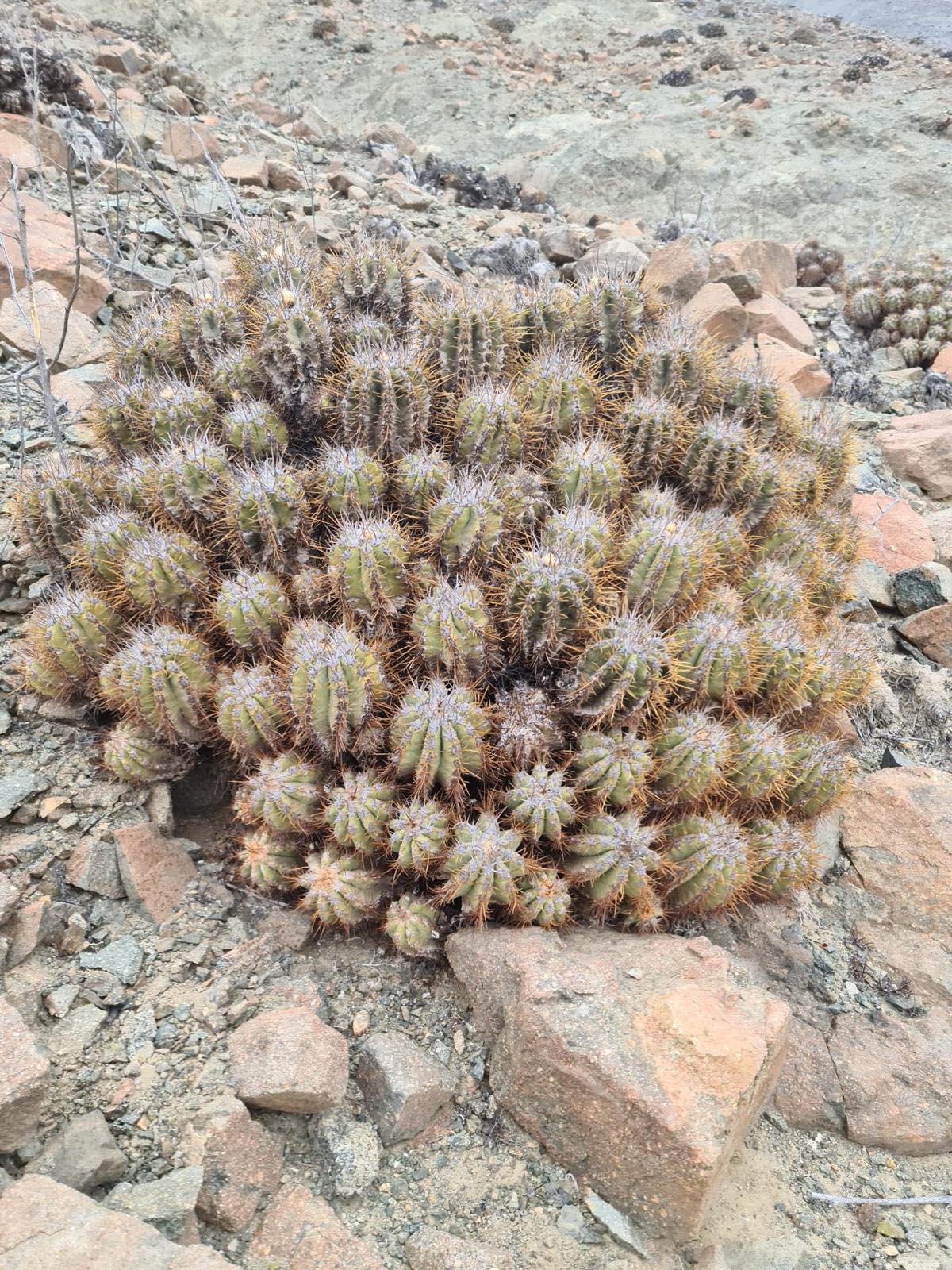
Copiapoa solaris grows where almost nothing else does. Two small populations cling to granitic hillsides above the Atacama coast in northern Chile, in a landscape that receives roughly four millimeters of rain per year. That figure is not a simplification. The Atacama is the driest non-polar desert on Earth, and the stretch of coast between Antofagasta and El Cobre is among its most extreme sections. The plant survives because of fog: the camanchaca, a marine layer driven inland by southwesterly Pacific winds, reaches these hillsides in the late afternoon and again before dawn, condensing on rock and spine. That condensation is essentially the only water Copiapoa solaris receives. It has been doing this for centuries.
The species forms enormous cushion colonies. The largest documented examples reach 2.3 meters across and 90 centimeters tall, containing hundreds of individual heads. At the growth rates recorded for this species, colonies of that scale likely represent four hundred or more years of uninterrupted development. Each head is armored in robust amber to grey spines, capped with a flat woolly apex, and coated in a waxy bloom that slows water loss between fog events. When the colony flowers, the yellow funnels appear half-buried among the apical wool and spines, easy to miss if you are looking down from above.
Friedrich Ritter first collected Copiapoa solaris near El Cobre in 1956. He initially placed it in a new genus of his own creation, Pilocopiapoa, a name that translates loosely as “hairy Copiapoa” and referred to the densely woolly flower tube that he considered distinct enough to warrant generic separation. That taxonomic experiment did not hold, and Ritter himself later transferred the species to Copiapoa. But the woolly flower tube remains a distinctive and interesting character, and the Pilocopiapoa story is worth knowing.
In cultivation, Copiapoa solaris is among the slowest cacti a collector can attempt to grow. It is slower than Aztekium from seed. Even grafted seedlings progress at a pace that tests patience. A seed grown plant that shows a recognizable adult body after a decade of careful work represents a real achievement, and the few well-grown specimens in private collections carry a quiet weight that faster-growing species do not.
Conservation status
Copiapoa solaris is listed as Critically Endangered by the IUCN Red List (Guerrero, Villalobo López & Peña, 2024). Only two confirmed locations are known. The type locality at El Cobre is threatened by copper mining operations. The species does not occur within any protected area. Few seedlings have been observed in the wild, raising concerns about long-term regeneration.
Contents
Taxonomy & Nomenclature
The taxonomic history of Copiapoa solaris begins with Friedrich Ritter, who collected the species near El Cobre in the Antofagasta Region of Chile in 1956. Ritter did not place this plant in Copiapoa. Instead, he described it in 1961 as the type species of a new genus, Pilocopiapoa, published as Pilocopiapoa solaris F.Ritter. The genus name combined the Latin pilo (hairy) with Copiapoa, referring directly to the dense wool covering the flower tube. He considered this character sufficiently distinct from other Copiapoa to justify a separate generic placement.
That separation did not survive scrutiny. By 1980, Ritter himself had reconsidered and transferred the species back into Copiapoa, publishing the combination Copiapoa solaris (F.Ritter) F.Ritter in Kakteen Südamerika, volume 3, page 1047. The woolly flower tube, while distinctive, was deemed insufficient to warrant its own genus when weighed against the many shared vegetative and reproductive characters that bind Copiapoa solaris to the rest of the genus. Most subsequent authors have accepted this transfer without reservation.
The specific epithet solaris means “of or relating to the sun.” It is an apt name for a species that inhabits some of the most sun-hammered terrain on the planet, receiving over 300 cloudless days per year at its known localities.
Synonymy is relatively contained. In addition to the basionym Pilocopiapoa solaris, the literature records Copiapoa ferox Lembcke & Backeb. as a synonym, referring to the fierce spination. Infraspecific names include Copiapoa solaris var. ferox (F.Ritter) F.Ritter and Copiapoa solaris var. fulvispina Kníže, the latter describing plants with amber-colored spines collected under Kníže’s field number KK599 from the El Cobre and Blanco Encalada area at around 400 meters elevation. A crested form, Copiapoa solaris f. cristata, circulates in the horticultural trade and is highly sought by specialist collectors, though it has no formal taxonomic standing.
Historical synonyms (4)
- Echinocactus conglomeratus Phil., 1860 basionym
- Pilocopiapoa solaris F.Ritter, 1961 homotypic synonym
- Copiapoa ferox Lembcke & Backeb., 1922 heterotypic synonym
- Copiapoa conglomerata (Phil.) Lembcke, 1966 heterotypic synonym
Sources: GBIF
Habitat & Native Range
Copiapoa solaris is endemic to a small section of the Antofagasta Region in northern Chile. Only two confirmed locations are known: El Cobre, the type locality where Ritter first collected the species in 1956, and Blanco Encalada, a second population approximately 20 kilometers to the south. The extent of occurrence has been estimated at roughly 1,500 square kilometers, though the actual occupied habitat within that envelope is far smaller, concentrated on steep granitic hillsides rising from the coastal plain.
El Cobre translates as “The Copper.” The name is not decorative. Copper mining is the dominant industrial activity in the area and represents the primary human threat to the type population. Mining operations alter drainage patterns, generate dust, build roads through habitat, and bring workers and vehicle traffic into landscapes that have otherwise been undisturbed for millennia. The Blanco Encalada population sits in similar terrain but faces somewhat less direct pressure from mining infrastructure.
Neither population occurs within any protected area.
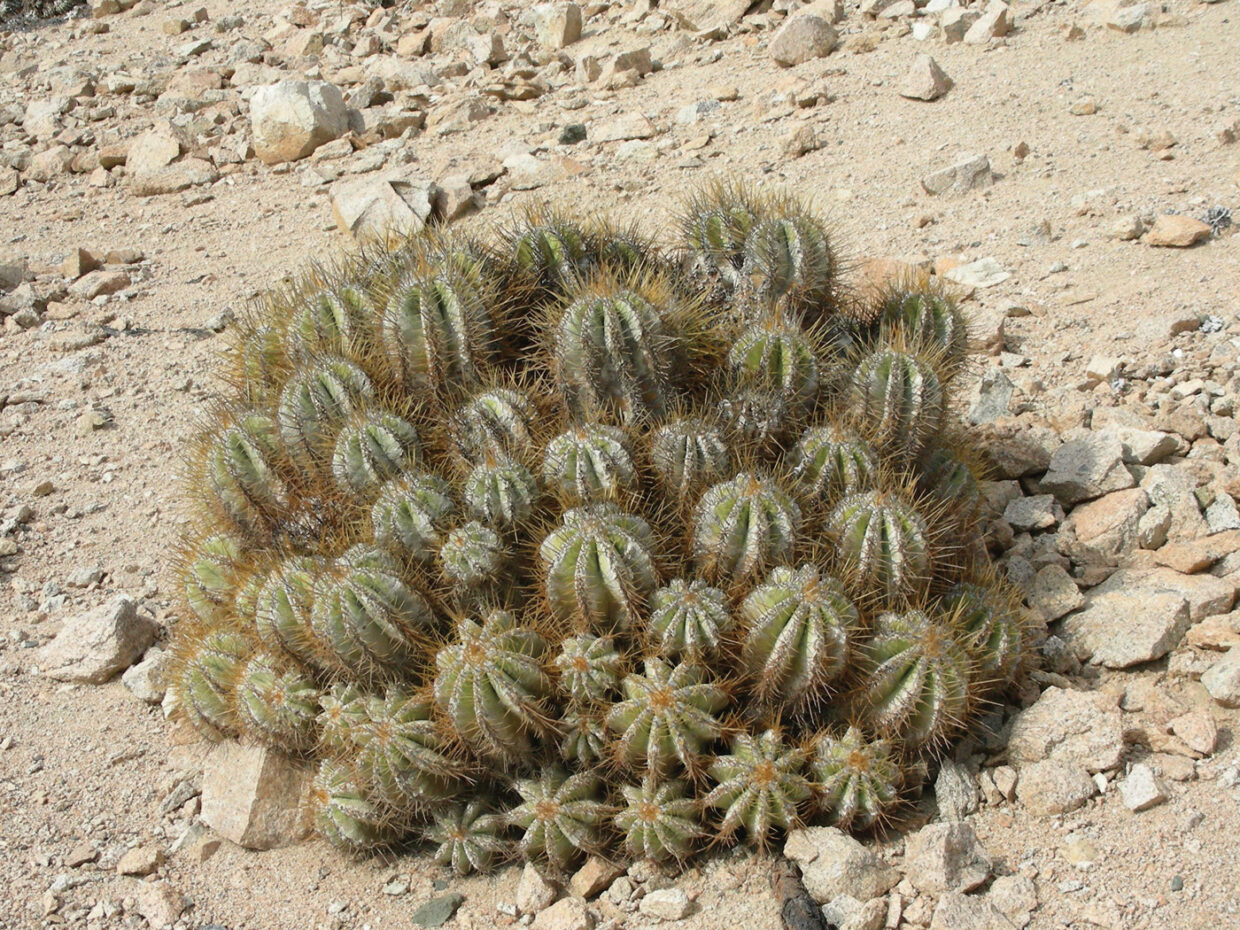
The altitude range spans approximately 600 to over 1,000 meters. The camanchaca fog belt concentrates at roughly 500 to 850 meters along this coast, which overlaps almost exactly with the densest concentration of plants. Fog arrives from the southwest, driven by dominant Pacific winds. It typically condenses on the hillsides in the late afternoon and persists through the night, dissipating by late morning as solar heating strengthens. That daily cycle delivers the only reliable moisture these plants receive. Rainfall averages around 4 millimeters per year. Mean annual temperature is approximately 17.2 degrees Celsius. Frost does not occur at these latitudes and altitudes.
The substrate is granitic. These are not the limestone or gypsum flats that support Chihuahuan Desert cacti; the hillsides are composed of hard, acidic rock with thin mineral soils accumulating in fractures and sheltered pockets. The slopes face predominantly south and southwest, receiving the fog-bearing winds directly. Plants root into cracks and crevices where moisture lingers longest after a fog event.
The dead plant phenomenon
First-time visitors to Copiapoa solaris habitat often come away alarmed. A large proportion of the cushion colonies encountered appear to be dead: blackened, shrunken, dessicated. Photographs from field trips frequently show these darkened masses alongside living green colonies, and the visual impression can suggest a population in collapse.
The reality is less dramatic and more ecologically interesting. In the hyper-arid conditions of the Atacama coast, bacterial decomposition proceeds at an extremely slow rate. Dead clumps do not rot away. They persist in place for decades, possibly centuries, drying and darkening but retaining their overall form. A field that appears to be half-dead is more accurately described as a field in which dead material is preserved alongside living material because the conditions that kill a colony are the same conditions that prevent the dead colony from decomposing.
These dead cushions are not ecologically inert. They shelter insects, provide microclimates for reptiles, and trap windblown organic debris that may eventually contribute to the thin soil pockets used by living plants. They are part of the habitat, not evidence of its failure.
Morphology
Copiapoa solaris is a cushion-forming cactus that grows by slowly producing offsets from the base and sides of established heads. Individual stems are cylindrical, 8 to 12 centimeters in diameter, with a flat to slightly depressed apex covered in dense white to yellowish wool and partially concealed by the interlocking spines of the uppermost areoles. The epidermis is green to grey-green, overlaid with a waxy coating that gives the stems a glaucous, almost powdery appearance. That wax layer is functional: it reduces transpiration between fog events, and plants in full sun develop heavier coatings than those in partial shade.
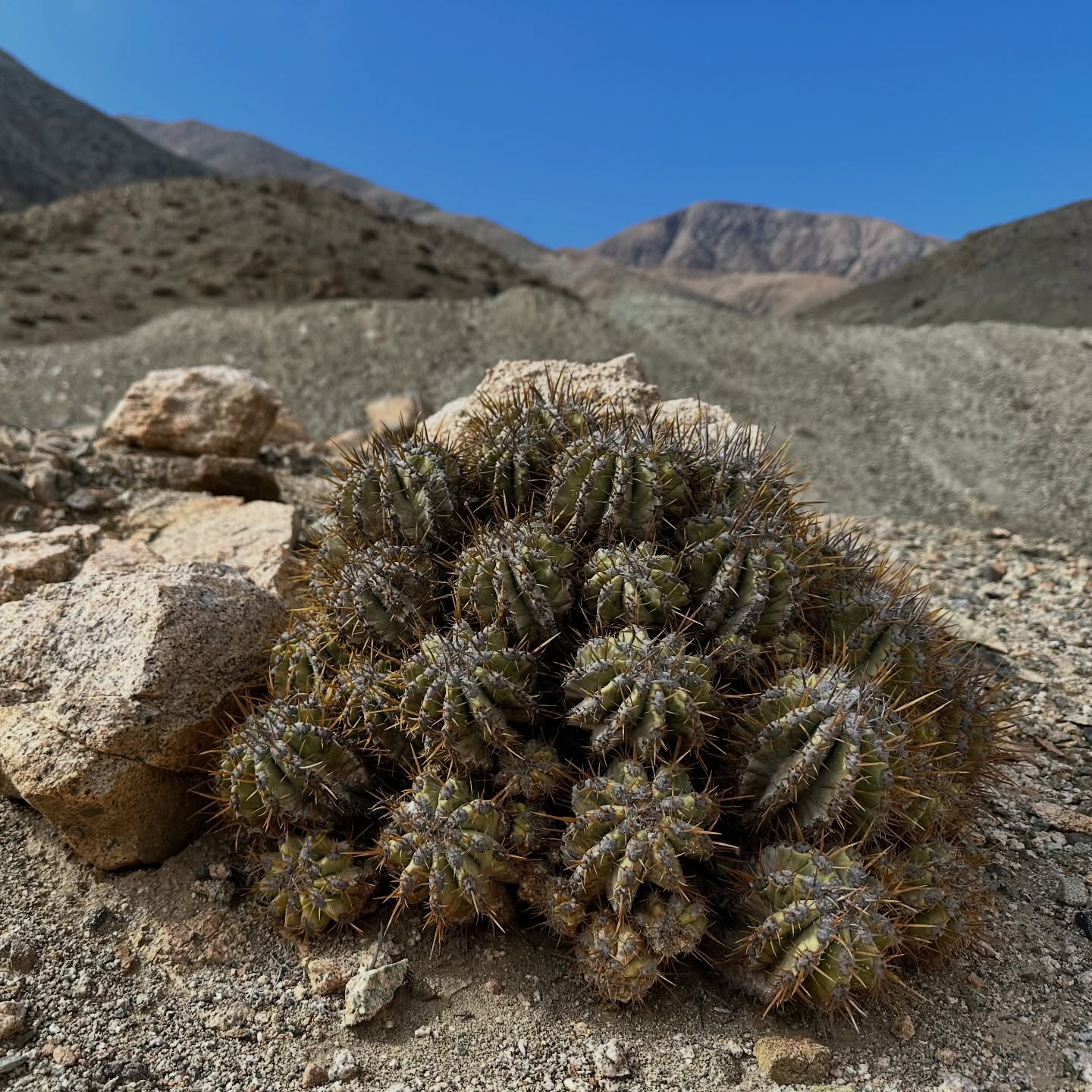
Amber spines interlock across the woolly apex. The areoles carry conspicuous yellow felt. New offsets first appear as white blobs of wool among the upper areoles and take approximately six months to produce their first spines.
The ribs number 8 to 12. They are straight, elevated up to 3.5 centimeters above the stem surface, and not tuberculate. This gives the stem a strongly architectural profile, with deep channels between the ribs. Areoles are large and carry conspicuous yellow felt that darkens with age.
Spines are the defining visual character. Young spines emerge amber to golden, sometimes with reddish-brown tones, and age to chalky grey over several years. They are robust, straight or slightly bent, and interlock across the apex to form a protective cage. Central spines number 2 to 5, reaching 2 to 6 centimeters in length. Radials number 7 to 10, at 2 to 3 centimeters. The spines of adjacent heads in a large colony overlap and interweave, giving old colonies the appearance of a fortified mound.
New offsets appear at the base or shoulders of existing heads. They first emerge as small white blobs of apical wool, featureless except for a slight swelling. Spine production on new offsets takes approximately six months to begin, and the first spines are noticeably softer and shorter than those of the mature head from which the offset originated.
Ancient colonies reach extraordinary dimensions. The largest documented example measured 2.3 meters across and 90 centimeters tall, comprising hundreds of individual heads packed into a single mound. Growth estimates for this species suggest that a colony of that size is unlikely to be younger than four centuries.
Flowers are yellow, funnel-shaped, up to 3 centimeters long and across, with a densely woolly flower tube (the character that prompted Ritter’s original Pilocopiapoa placement). They appear at the apex of individual heads, often partially concealed among the wool and spines. Some plants produce flowers with a pinkish or reddish throat. Flowering in habitat requires strong sunlight and is seasonal; in greenhouse cultivation outside the Atacama, flowering is unreliable and many growers never see their plants bloom. Fruits are woolly, spherical to slightly elongated, up to 15 millimeters in diameter.
The Pilocopiapoa Question
When Friedrich Ritter described this plant, he did something that taxonomists rarely do lightly: he created a new genus. His Pilocopiapoa, published in 1961, was built around a single species and a single character: the dense wool covering the flower tube. In most Copiapoa, the flower tube carries scattered hairs or scales, but in Copiapoa solaris the wool is conspicuously thick, visible to the naked eye, and unlike anything found on the flowers of related species. Ritter judged this character sufficient to separate the plant generically.
The argument had a certain logic. Flower characters carry significant weight in cactus taxonomy because they tend to be more conserved than vegetative features. A markedly different flower tube might signal a deeper evolutionary divergence than differences in body shape, rib count, or spination. Ritter was not working with molecular data; he was working with morphology, field observation, and a strong intuition shaped by decades of fieldwork across South America.
The counterargument was simpler and, ultimately, more convincing. In every character other than the woolly flower tube, Pilocopiapoa solaris looked like a Copiapoa: the body form, the rib structure, the spine arrangement, the fruit morphology, the habitat ecology. Maintaining a monotypic genus on the basis of a single floral character, when all other evidence pointed to a clear relationship with Copiapoa, was increasingly difficult to defend as taxonomic standards shifted toward broader genus concepts in the latter half of the twentieth century.
Ritter recognized this himself. In 1980, he published the transfer to Copiapoa, effectively dissolving his own genus. That act of self-correction stands out because it is uncommon in a field where taxonomists frequently defend their novelties past the point of reason. The woolly flower tube remains a genuine distinguishing feature of the species, worth examining closely when a plant flowers, but it is now understood as a species-level character within Copiapoa rather than evidence of a separate lineage.
Locality Diversity
Unlike the broadly distributed species of the genus such as Copiapoa cinerea, which occurs along hundreds of kilometers of Chilean coastline, Copiapoa solaris is restricted to a tiny geographic envelope. Two locations account for all confirmed wild populations.
Confirmed Copiapoa solaris localities
El Cobre (type locality)
- Ritter FR collection, 1956
- Granitic coastal hillside, ~600–1,000 m
- Copper mining activity nearby
- var. fulvispina KK599 (~400 m)
- Primary fog-belt population
Blanco Encalada
- ~20 km south of El Cobre
- Confirmed by Ritter on later expedition
- Similar granitic substrate and altitude
- Less mining pressure than El Cobre
Collector forms: var. fulvispina Kníže (amber-spined, KK599); f. cristata hort. (crested, no formal standing).
The two known sites differ subtly. El Cobre sits in closer proximity to active copper mining infrastructure and has experienced more direct disturbance. Blanco Encalada is less developed but occupies similar terrain and supports colonies of comparable size and density. Between the two sites, the intervening 20 kilometers of coastline includes steep, barren hillsides that may contain additional undocumented colonies, though systematic surveys have not confirmed this.
The var. fulvispina material collected by Karel Kníže under his field number KK599 originates from the El Cobre and Blanco Encalada area at a lower elevation of approximately 400 meters. These plants are characterized by warmer amber-toned spines that retain their color longer before fading to grey. Whether this represents a genuine infraspecific distinction or simply a local expression of the broader morphological variation within the species remains debated. In cultivation, seed grown plants from KK599 material consistently produce the amber spine color, suggesting a heritable component.
Copiapoa solaris care and cultivation
Soil and substrate
Copiapoa solaris is the largest-growing species in the genus, clustering into mounds up to six feet across in habitat. Its cultivation substrate follows the same genus-wide convention as its smaller relatives: 33 per cent pumice, 12 per cent lava rock, 10 per cent zeolite, 25 per cent granite grit, 5 per cent limestone chip, 10 per cent coarse silica, and 5 per cent worm castings. No cultivation source gives this species an organic or mineral requirement different from the rest of the genus; the granite and silica shares are structural, sized for drainage speed and particle durability rather than for any rock the plant grows on. The zeolite handles pH buffering and trace-mineral exchange. Drainage must be fast; stagnant moisture around the root zone threatens this species like the rest of the genus.
All ten Copiapoa species on this site share a genus-flat 95/5 mineral-organic cultivation mix. Limestone stays at the low end of an indeterminate carbonate band and organic at the class-prior 5 percent; neither figure is a per-species finding. The only value that varies by species is lava, sized to container depth: the tuberous-rooted trio (hypogaea, hypogaea var. barquitensis, laui) gets a deeper pot allowance than the rest of the genus.
| Species | Pumice | Lava | Zeolite | Granite | Limestone | Silica | Organic |
|---|---|---|---|---|---|---|---|
| C. laui | 27% | 18% | 10% | 25% | 5% | 10% | 5% |
| C. humilis | 33% | 12% | 10% | 25% | 5% | 10% | 5% |
| C. humilis subsp. tenuissima | 33% | 12% | 10% | 25% | 5% | 10% | 5% |
| C. solaris (this page) | 33% | 12% | 10% | 25% | 5% | 10% | 5% |
| C. cinerea | 33% | 12% | 10% | 25% | 5% | 10% | 5% |
| C. cinerea subsp. cinerea | 33% | 12% | 10% | 25% | 5% | 10% | 5% |
| C. cinerea subsp. krainziana | 33% | 12% | 10% | 25% | 5% | 10% | 5% |
| C. esmeraldana | 33% | 12% | 10% | 25% | 5% | 10% | 5% |
| C. hypogaea | 27% | 18% | 10% | 25% | 5% | 10% | 5% |
| C. hypogaea var. barquitensis | 27% | 18% | 10% | 25% | 5% | 10% | 5% |
Drainage must be fast. Water should pass through the pot and exit within minutes of application. Stagnant moisture around the root zone will rot this species reliably and quickly.
Watering
The temptation with a fog-dependent species is to mist it. Resist this for pot culture. A better approach is to water lightly but regularly during the growing season (spring through early autumn), allowing the substrate to dry completely between waterings. Each application should be modest compared to what you would give a Chihuahuan Desert cactus; these plants are adapted to trace moisture from fog condensation, not episodic desert downpours. In winter, keep the substrate bone dry.
The fog ecology of the habitat provides a useful mental model. The plant receives small amounts of water frequently rather than large soaks infrequently. In cultivation, this translates to lighter waterings at shorter intervals during warm weather, with complete dryout between sessions. Some growers report good results with overhead misting in the morning during summer, simulating the condensation cycle, but conventional pot watering with rapid drainage works well for most growers.
Light
Despite the specific epithet and the relentless sun of its native habitat, Copiapoa solaris benefits from partial shade in cultivation. This is counterintuitive but well established among experienced growers. The waxy coating that protects the epidermis in habitat is produced more slowly in cultivation, and the atmospheric conditions of a greenhouse or growing bench do not replicate the UV-filtering effect of the coastal fog layer. Plants exposed to intense direct sun without adequate acclimatization can scorch. Morning sun with afternoon shade, or filtered light through shade cloth at around 30 to 40 percent, provides a reasonable baseline for most situations.
Temperature
Frost does not occur in the natural habitat and should be avoided in cultivation. Minimum winter temperatures should remain above 5 degrees Celsius, with 8 to 10 degrees a safer target for extended cold periods. Summer heat is tolerated well provided ventilation is adequate and watering is adjusted downward during extreme heat.
Seed grown versus grafted
Seed grown plants are the collector standard, as with all serious Copiapoa cultivation. A seed grown Copiapoa solaris that has reached adult proportions represents years of careful, patient growing and carries a presence that grafted specimens lack.
Grafting accelerates development, but expectations should be tempered. Even grafted onto vigorous rootstock such as Pereskiopsis or Trichocereus, Copiapoa solaris grows slowly. It will not behave like a grafted Ariocarpus that suddenly doubles in size. Growth remains deliberate, producing only a few new spines per year even under ideal grafted conditions. Grafting is not a shortcut to specimen quality in this species.
Degrafted plants can be rooted and grown on, though the transition carries risk of rot at the graft junction. Clean cuts, thorough drying, and a purely mineral rooting medium give the best odds.
Variants worth collecting
The var. fulvispina (KK599) is the most commonly encountered named variant. Its amber spine color is distinctive and breeds true from seed, making it a reliable selection for collectors who want visual contrast alongside the type form. The crested form, f. cristata, appears occasionally in the trade and commands high prices when it does. Any well-documented seed grown plant from either known locality is worth having.
Comparing Copiapoa solaris to Related Species
Copiapoa cinerea is the most widely known species in the genus, distributed along a much larger stretch of the Chilean coast from Taltal to Chañaral. It shares the grey waxy coating and the cushion-forming habit with Copiapoa solaris, but the body form is different: Copiapoa cinerea produces taller, more columnar stems with a chalky white surface, and its spination is typically darker and more contrasting against the pale body. In cultivation, Copiapoa cinerea grows considerably faster and is far more forgiving. It is the species most beginners encounter first when entering the genus.
Copiapoa laui rivals Copiapoa solaris for the title of the most restricted species in the genus. It is known from a single location near Esmeralda, south of the Copiapoa solaris range, and produces small, densely clustering bodies with fine white spination. Its growth rate is comparably slow. The two species occupy similar fog-dependent ecological niches but differ sharply in body size and spine character: Copiapoa laui heads are miniature compared to the robust, heavily armed stems of Copiapoa solaris.
Copiapoa krainziana is the genus’s visual showpiece. Its long, flexible, hair-like white spines cover the body in a shaggy mane that is unlike anything else in the cactus family. It occurs near Taltal, well south of the Copiapoa solaris range, and in cultivation it is moderately slow but not in the same league of difficulty. The two species would never be confused in person, but both demonstrate the remarkable diversity of spine form that the genus has produced across its coastal range.
Copiapoa humilis occupies a broader range and shows far more morphological variation than Copiapoa solaris. Its numerous subspecies and varieties span from Paposo to Chañaral, producing small bodies with variable spination, coloring, and clustering habit. Copiapoa humilis subsp. tenuissima is particularly fine in cultivation: compact, dark-bodied, with delicate spination. It grows faster than Copiapoa solaris and tolerates a wider range of conditions, making it a better starting point for growers new to the genus who want to work toward the more demanding species.
Frequently asked questions
How difficult is Copiapoa solaris to grow?
How is Copiapoa solaris propagated from seed?
Is Copiapoa solaris legal to own?
Where does Copiapoa solaris grow in the wild?
When does Copiapoa solaris flower?
Related Taxa in the Genus
Copiapoa humilis subsp. tenuissimaA compact, dark-bodied form from the Paposo coast with fine, delicate spination. Faster growing and more forgiving, it is an excellent entry point for collectors working into the genus.Copiapoa humilisThe parent species of the humilis complex. Miniature clustering habit, highly variable across its range. Two accepted subspecies span from Paposo to Chañaral.Copiapoa cinereaThe chalky-white giant of the genus, distributed broadly along the northern Chilean coast. Taller, faster, and far more widely cultivated, it is the species that defines Copiapoa for most collectors.Copiapoa cinerea subsp. krainzianaThe shaggy-spined showpiece from near Taltal. Long, hair-like white spines cover the body in a mane unique in the cactus family. Collector demand is documented as an extinction driver.Copiapoa cinerea subsp. cinereaThe classic silver form around Taltal. The most available member of the cinerea complex and a strong starting point for collectors entering the group.Copiapoa lauiA miniature species from a single site near Esmeralda, rivaling Copiapoa solaris for restricted range and slow growth. Tiny, densely clustering heads with fine white spines.Copiapoa esmeraldanaEsmeralda coast. Best habitat condition of any Copiapoa but range extremely narrow. Affinities to the cinerea complex; treated by some as a geographic form.Copiapoa hypogaeaPartially subterranean. The most unusual growth form in the genus, with the stem largely buried below the soil surface. An inland fog-shadow specialist.Copiapoa hypogaea var. barquitensisDistinct variety from Barquito. Flatter, more tuberculate stems than the type. Sought by specialist collectors for its unusual surface texture.
Sources & References
Ritter, F. (1961). Pilocopiapoa solaris sp. nov. · Ritter, F. (1980). Kakteen Südamerika, vol. 3, p. 1047. · Schulz, R. & Kapitany, A. (1996). Copiapoa in Their Environment: Chañaral to El Cobre. · Guerrero, P.C., Villalobo López, A. & Peña, C. (2024). Copiapoa solaris. IUCN Red List 2024: e.T152759A212497624. · Walter, H.E. et al. (2013). Copiapoa solaris. IUCN Red List. · Hunt, D. (2013). The New Cactus Lexicon. · Hoffmann, A. & Walter, H. (2004). Cactáceas en la Flora Silvestre de Chile, 2nd ed. · Royal Botanic Gardens, Kew. Plants of the World Online. Copiapoa solaris (F.Ritter) F.Ritter. Retrieved 2026.