
Copiapoa cinerea
| Family | Cactaceae |
| Named by | (Phil.) Britton & Rose (1922) |
| Basionym | Echinocactus cinereus Phil. (1860) |
| Native range | Antofagasta to Atacama, Chile |
| Altitude | Sea level to ~950 m |
| Stem size | Up to 100 × 18 cm |
| Ribs | 12–26, obtuse |
| Spines | Black, turning grey; <10 total |
| Flowers | Yellow, 2.5–3.5 cm, red-tipped |
| Subspecies | 3 accepted |
| IUCN status | Least Concern (species level) |
| CITES | Appendix II |
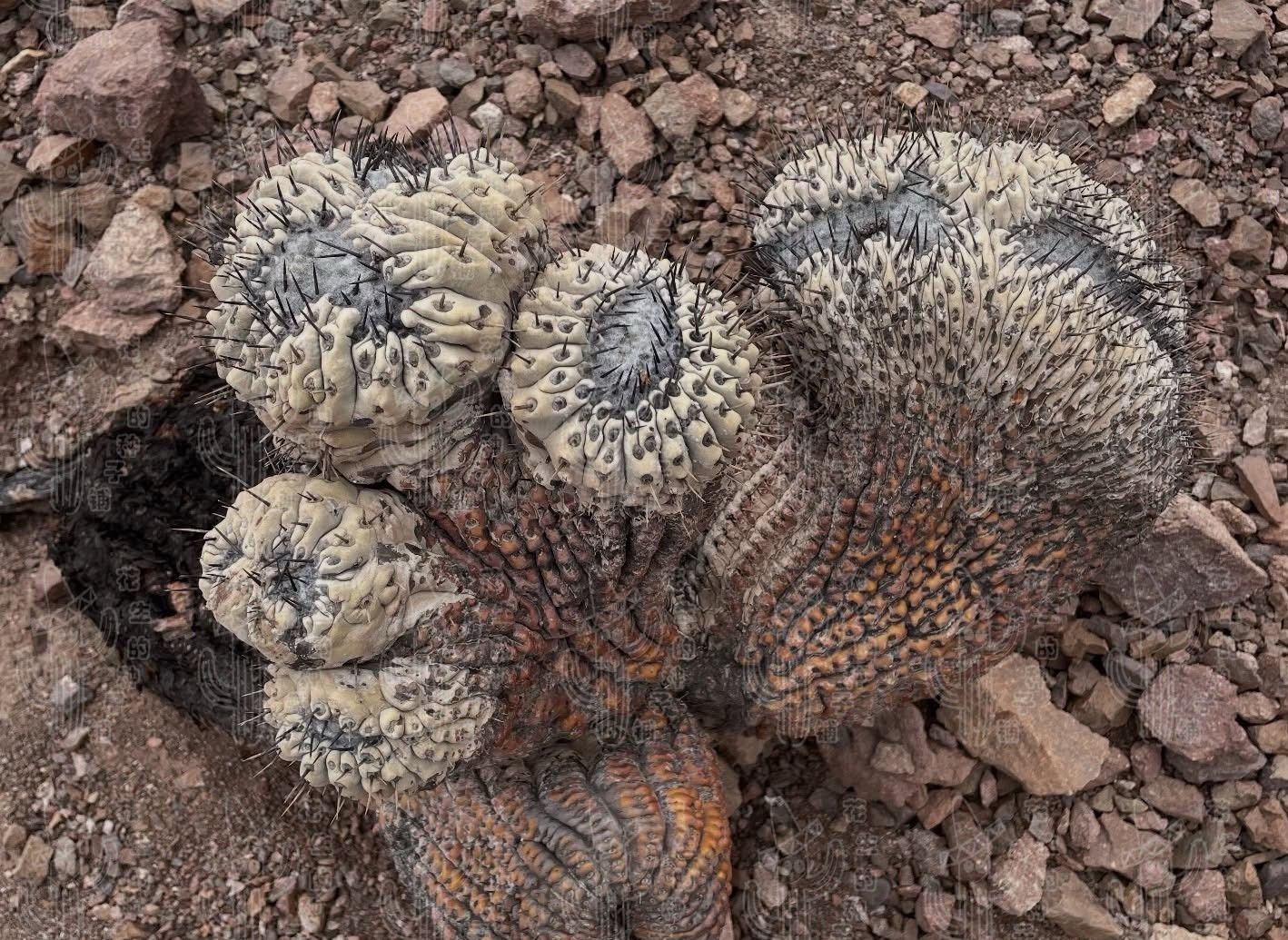
If you have seen a photograph of a cactus from the Atacama Desert, there is a strong chance it was Copiapoa cinerea. No species in the genus is more widely photographed, more frequently collected, or more immediately recognizable. The silver-white body, the dark spines, the woolly crown perched atop a columnar stem that may have been growing since before the colonial era: this is the plant that defines Copiapoa for most of the world. It is also the plant that, more than any other, drives the collector market that now threatens the genus as a whole.
Rodolfo Amando Philippi described the species in 1860 from material collected near Taltal, publishing it as Echinocactus cinereus in his Flora Atacamensis. The epithet cinerea is Latin for ash-grey, a reference to the distinctive epicuticular wax that coats the epidermis and gives wild plants their ghostly pallor. Britton and Rose transferred the species to Copiapoa in 1922 when they erected the genus, citing the Taltal material on page 86 of their monumental Cactaceae, volume 3.
The species occupies a long stretch of the Chilean Pacific coast, from south of Quebrada Izcuña near Caleta Colorado in the north to the hills above Chañaral in the south, a linear range of roughly 200 kilometers. Three geographically segregated subspecies divide this range: Copiapoa cinerea subsp. cinerea around Taltal, Copiapoa cinerea subsp. krainziana in the quebradas north of Taltal, and Copiapoa cinerea subsp. columna-alba from south of Taltal down to Chañaral. Where their ranges meet, the subspecies intergrade and hybridize, producing transitional forms that have fueled decades of taxonomic argument.
In the collector market, mature Copiapoa cinerea specimens with well-developed farina and decades of character are among the most valuable cacti in private hands. Exceptional seed grown plants with documented provenance regularly sell for several thousand dollars. The largest, oldest examples, plants that have been in cultivation for 30 or 40 years and show the full development of the silver coating and black spine contrast, can command prices exceeding $10,000 from specialist dealers. This is a species where patience is both a virtue and a financial strategy: every year of careful growing adds measurable value.
Conservation status
Copiapoa cinerea is listed as Least Concern by the IUCN Red List (Guerrero, Peña, Villalobo López, Faundez, Walter & Saldivia, 2024). The species-level assessment reflects the relatively large and stable populations of subsp. columna-alba in the south. Subspecies-level trends are less encouraging: subsp. cinerea around Taltal shows low seedling recruitment and a high proportion of senile individuals. The 2024 Guerrero et al. reassessment found that 77% of all Copiapoa taxa are now Critically Endangered or Endangered, driven by trade pressure and habitat degradation.
Contents
Taxonomy & Nomenclature
The species was first described by Rodolfo Amando Philippi in 1860 as Echinocactus cinereus, published in his Flora Atacamensis on page 23. The lectotype, designated by Paul Hutchison in 1953, is housed at the Santiago herbarium (SGO barcode 052667) and was collected by Philippi himself from Quebrada Taltal, at a locality called Hueso Parado, in 1854. Philippi was a German-Chilean naturalist who spent decades documenting the flora and fauna of Chile, and his Atacama material remains foundational for the taxonomy of several Chilean cactus genera.
Nathaniel Britton and Joseph Rose transferred the species to their newly erected genus Copiapoa in 1922, publishing the combination Copiapoa cinerea (Phil.) Britton & Rose in The Cactaceae, volume 3, page 86. The genus name derives from Copiapó, a city and province in the Atacama Region of Chile.
Synonymy within Copiapoa cinerea is extensive, a consequence of the species’ morphological variability across its range. Friedrich Ritter described Copiapoa cinerea var. albispina in 1963 for plants with pale spines. At the species level, the most significant taxonomic shift in recent decades has been the separation of Copiapoa gigantea Backeb., which was previously treated as Copiapoa cinerea subsp. haseltoniana (Backeb.) N.P.Taylor. Molecular work by Larridon et al. (2015, 2018) demonstrated that Copiapoa gigantea is not closely related to Copiapoa cinerea and should be treated as a valid species in its own right.
The Three Subspecies
Modern taxonomy recognizes three subspecies within Copiapoa cinerea, each occupying a distinct segment of the species’ coastal range. They are largely allopatric (geographically separated), but their distributions overlap at the boundaries, and hybridization occurs where ranges meet.
Copiapoa cinerea subsp. cinerea is the nominotypical form, centered around Taltal. It branches laterally and basally, sometimes forming loose mounds. The ribs are fewer than 30, wide and deep, barely undulating. The perianth segments are tipped red, with the outer segments showing a reddish mid-stripe. This is the form that most collectors picture when they hear the name Copiapoa cinerea: silver body, dark spines, the classic Atacama icon. It is also the subspecies with the most concerning population trends, showing low seedling recruitment and a high proportion of dead and senile individuals.
Copiapoa cinerea subsp. krainziana is the most morphologically distinctive of the three. It grows in the quebradas (ravines) north of Taltal, in areas with heavy fog influence and dense accompanying vegetation. Its defining character is the numerous slender, filiform (thread-like) spines that give the plant a shaggy, almost mane-like appearance unlike anything else in the cactus family. Only a single active population is confirmed. The IUCN lists it as Critically Endangered.
Copiapoa cinerea subsp. columna-alba (F.Ritter) D.R.Hunt occupies the southern portion of the range, from south of Taltal down to the hills north of Chañaral. It is typically solitary, rarely branching, with up to 40 or even 50 narrow, flat, undulating ribs. The perianth segments lack the red tips and mid-stripes of subsp. cinerea. Seeds are smaller. This is the most abundant and widespread of the three subspecies, with some populations containing thousands of individuals, including healthy numbers of seedlings. Pan de Azúcar National Park provides in-situ protection for some of its populations.
Why cinerea subsp. cinerea Exists
Collectors encountering the name Copiapoa cinerea subsp. cinerea for the first time sometimes assume it is a mistake, a redundant doubling of the epithet. It is not. The repeated name is a product of botanical nomenclature rules and carries real taxonomic meaning.
When Philippi described Echinocactus cinereus in 1860, there was just one species. No subspecies existed because no one had yet recognized that the populations along the coast were different enough to warrant subdivision. That changed when Friedrich Ritter described Copiapoa columna-alba in 1959, recognizing the southern populations as morphologically distinct. When columna-alba was later transferred to subspecific rank within Copiapoa cinerea, the International Code of Nomenclature required that the “original” population, the one containing the type specimen, automatically receive the autonym: the subspecies name that repeats the species epithet.
This is not a taxonomist’s decision. It is a mechanical consequence of the code. The moment a species is divided into subspecies, the subspecies containing the type specimen must bear the repeated name. No one “described” Copiapoa cinerea subsp. cinerea; it came into existence automatically. The purpose is clarity: it tells you that when you see this name, you are looking at the form from the type locality, the original population that Philippi collected near Taltal in the 1850s, distinguished from the other named forms that were recognized later.
For collectors and growers, the practical consequence is clear. If a plant is labeled Copiapoa cinerea subsp. cinerea, it refers specifically to the Taltal-area form with wide ribs, dark spines, and red-tipped perianth segments. If a plant is labeled simply Copiapoa cinerea without a subspecific epithet, it could refer to any of the three subspecies or to the species in a broad sense.
Historical synonyms (2)
- Echinocactus cinereus Phil., 1860 basionym
- Copiapoa cinerea var. albispina F.Ritter, 1963 homotypic synonym
Sources: POWO (Kew) · IPNI · GBIF · Wikidata
Habitat & Native Range
Copiapoa cinerea occupies the coastal Atacama Desert of northern Chile, from south of Quebrada Izcuña near Caleta Colorado (approximately 24°38?S) in the north to the hills above Chañaral (approximately 26°17?S) in the south. The extent of occurrence is estimated at roughly 1,577 square kilometers, though the actual occupied habitat is far smaller, concentrated on rocky hillsides, coastal cliffs, and valley floors within this envelope.
As with all Copiapoa, fog is the primary water source. The camanchaca rolls in from the Pacific driven by southwesterly winds, condensing on rock and vegetation at elevations between roughly 500 and 850 meters. Copiapoa solaris, the most fog-dependent species in the genus, shares this ecological reliance but occupies a much smaller and more northerly fragment of the coast. Copiapoa cinerea shows more ecological flexibility: subsp. cinerea grows mainly inland at elevations up to 950 meters, while subsp. columna-alba favors sandy coastal valleys closer to sea level.
The substrate varies across the range. Rocky granitic slopes predominate in the Taltal area, while the southern populations of subsp. columna-alba often grow on sandier valley floors with somewhat deeper soil pockets. Rainfall is negligible everywhere: the Atacama interior near Taltal receives roughly 1 to 5 millimeters of precipitation annually, and in some years none at all.
Threats include mining activity, road construction, and illegal collection. The 2024 reassessment by Guerrero et al. identified trade and poaching pressure as the primary driver of extinction risk across the genus. Operation Atacama in 2021 resulted in the seizure of illegally collected Copiapoa specimens, some of which were subsequently repatriated to Chile. Despite these enforcement efforts, the demand for wild-origin plants in the international collector market remains a persistent threat.
Morphology
Copiapoa cinerea is a globose to elongated-cylindrical cactus, reaching up to one meter tall and 18 centimeters in diameter in old specimens. Young plants are spherical; with age, the stem elongates and may branch laterally or basally, though branching is more common in subsp. cinerea than in the typically solitary subsp. columna-alba.
The epidermis is hard, grey-green, and covered in a pruinose (waxy) coating that ranges from light grey to brilliant silver-white depending on sun exposure, age, and subspecies. This farina is the species’ signature character. In habitat, decades of intense UV exposure produce a thick, opaque white layer that makes old plants appear almost painted. In cultivation, the coating develops more slowly and less intensely, leaving greenhouse-grown plants noticeably greener than their wild counterparts. The difference is not a deficiency in the cultivated plant; it is a reflection of how much less UV stress a greenhouse provides compared to the Atacama at 25 degrees south latitude.
Ribs number 12 to 26 across the species, obtuse, up to 2 centimeters broad and 1.5 centimeters high, slightly tuberculate. Rib count and form vary significantly between subspecies: subsp. columna-alba can produce up to 40 or even 50 narrow ribs, while subsp. cinerea typically has fewer than 30, wider and deeper.
Spines are variable but generally few, numbering fewer than 10 total. They are usually subulate (awl-shaped), black when young, weathering to grey over time. Radial spines number 0 to 6, usually under 2 centimeters. Central spines number 0 to 4, somewhat thicker and longer. The black-on-silver contrast of fresh spines against the farina-coated body is the visual character that makes Copiapoa cinerea strikingly photogenic.
Flowers are funnel-shaped, pale yellow, 2.5 to 3.5 centimeters across. The interior perianth segments are often tipped red, and the outer segments frequently show a reddish mid-stripe, a character most pronounced in subsp. cinerea and absent in subsp. columna-alba. Flowers emerge from the woolly apex, which produces white or grey wool. The fruit ripens among the apical wool and is often not visible until fully mature.
Locality Diversity
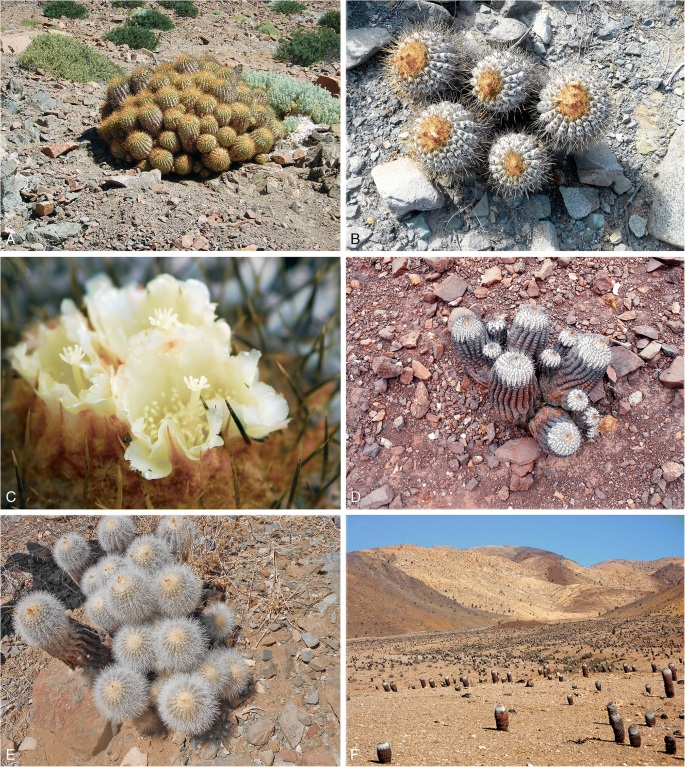
The three subspecies divide the coastal range into approximate zones. From north to south:
Copiapoa cinerea: subspecific distribution
subsp. krainziana
- North of Taltal
- Quebrada de San Ramón
- Single active population
- IUCN: Critically Endangered
subsp. cinerea
- ~10 km N to ~20 km S of Taltal
- Inland to 950 m (Cerro Perales)
- Low seedling recruitment
- Type locality: Hueso Parado
subsp. columna-alba
- S of Taltal to N of Chañaral
- Sandy coastal valleys
- Most abundant subspecies
- Partly in Pan de Azúcar NP
The boundaries between subspecies are not sharp lines on a map. Where subsp. krainziana meets subsp. cinerea north of Taltal, plants show intermediate spine characters. Where subsp. cinerea grades into subsp. columna-alba south of Taltal, rib counts increase and the red perianth tipping fades. Schulz and Kapitany (1996) documented these transitional zones extensively, and Larridon et al. (2018) confirmed with molecular data that gene flow occurs across subspecific boundaries, driven by shared pollinators (bees and hoverflies) and overlapping flowering periods.
Copiapoa cinerea care and cultivation
Soil and substrate
A mineral-dominated substrate with fast drainage is essential. The canonical ratio is 33 per cent pumice, 12 per cent lava rock, 10 per cent zeolite, 25 per cent granite grit, 5 per cent limestone chip, 10 per cent coarse silica, and 5 per cent worm castings. Limestone sits at the low end of an indeterminate carbonate band: no source establishes this species as calcicole or calcifuge, and the small fraction only reflects that a typical grower mix carries incidental lime, not a documented pH preference. Silica plays the same structural, particle-durability role as the granite grit and carries no chemistry claim of its own. The zeolite buffers pH and paces nutrients between waterings. Organic content above 5 per cent produces soft, rot-prone growth that lacks the tight body character of well-grown plants; no published cultivation source states a higher ceiling for this genus.
All ten Copiapoa species on this site share a genus-flat 95/5 mineral-organic cultivation mix. Limestone stays at the low end of an indeterminate carbonate band and organic at the class-prior 5 percent; neither figure is a per-species finding. The only value that varies by species is lava, sized to container depth: the tuberous-rooted trio (hypogaea, hypogaea var. barquitensis, laui) gets a deeper pot allowance than the rest of the genus.
| Species | Pumice | Lava | Zeolite | Granite | Limestone | Silica | Organic |
|---|---|---|---|---|---|---|---|
| C. laui | 27% | 18% | 10% | 25% | 5% | 10% | 5% |
| C. humilis | 33% | 12% | 10% | 25% | 5% | 10% | 5% |
| C. humilis subsp. tenuissima | 33% | 12% | 10% | 25% | 5% | 10% | 5% |
| C. solaris | 33% | 12% | 10% | 25% | 5% | 10% | 5% |
| C. cinerea (this page) | 33% | 12% | 10% | 25% | 5% | 10% | 5% |
| C. cinerea subsp. cinerea | 33% | 12% | 10% | 25% | 5% | 10% | 5% |
| C. cinerea subsp. krainziana | 33% | 12% | 10% | 25% | 5% | 10% | 5% |
| C. esmeraldana | 33% | 12% | 10% | 25% | 5% | 10% | 5% |
| C. hypogaea | 27% | 18% | 10% | 25% | 5% | 10% | 5% |
| C. hypogaea var. barquitensis | 27% | 18% | 10% | 25% | 5% | 10% | 5% |
Watering
Water lightly and regularly during the growing season (spring through early autumn), allowing complete dryout between applications. The fog-adapted ecology of the species means it responds better to frequent, modest moisture than to heavy, infrequent soaking. In winter, keep the substrate dry. Resume watering gradually in spring as temperatures rise and new growth appears at the apex.
Light
Bright light is essential for developing the farina coating that defines the species’ appearance. Plants grown in insufficient light remain green and lack the silver-white character of well-lit specimens. Full sun is tolerated once acclimatized, but some afternoon shade during the hottest months prevents scorching, particularly for recently repotted or imported plants. Morning sun with filtered afternoon light is a safe default. Copiapoa solaris requires more shade than Copiapoa cinerea; the cinerea complex is generally more sun-tolerant among the fog-dependent species.
Temperature
No frost. Minimum winter temperatures should remain above 5 degrees Celsius; 8 to 10 degrees is safer for extended cold periods. The natural habitat experiences no frost, with mean annual temperatures around 16 to 18 degrees Celsius and modest seasonal variation. Summer heat is well tolerated with adequate ventilation and appropriate watering adjustment.
Seed grown versus grafted
Seed grown plants are the collector standard and command the highest prices. A seed grown Copiapoa cinerea that has developed its full silver coating over a decade or more of careful cultivation carries a presence and a market value that grafted or degrafted plants cannot match. Grafting onto vigorous rootstock such as Trichocereus or Pereskiopsis accelerates early development and is useful for building up seedlings past their most vulnerable phase, but the resulting growth tends to be softer and greener than seed grown plants raised without a graft from the start.
Degrafted plants can be rooted and grown on, though the graft junction requires careful monitoring for rot. The best degrafted specimens, allowed to develop natural roots and exposed to high light for several years after degrafting, eventually develop body character approaching that of seed grown plants, but the process takes time and the distinction in the market remains.
The Collector Market
Copiapoa cinerea occupies a unique position in the rare cactus market. It is the most widely recognized species in a genus that has become synonymous with high-end cactus collecting, and its pricing reflects that status. Seedlings and young plants are relatively accessible, with seed grown specimens under five years old typically selling for $30 to $150 depending on subspecies and provenance. The value curve steepens dramatically with age.
A well-grown seed grown plant of 10 to 15 years, showing developed farina, established spination, and a body diameter of 8 to 12 centimeters, regularly sells for $500 to $2,000 from specialist dealers. At 20 to 30 years, with the full silver coating, weathered spine character, and the beginning of stem elongation from globose toward cylindrical, prices reach $3,000 to $7,000. The most exceptional specimens, plants that have been in cultivation for 30 to 40 years or more and display the complete development of the species’ adult character, can exceed $10,000 in private transactions.
These prices are driven by the intersection of extreme slow growth, high demand, and limited supply of mature material. A Copiapoa cinerea cannot be rushed. The farina develops on its own schedule. The spines weather at their own pace. No amount of fertilizer or grafting produces a 30-year-old plant in 10 years. Collectors who buy young and grow patiently are, in a real sense, building equity in living material that appreciates over time. Those who compare this to Copiapoa laui or Copiapoa hypogaea will find that cinerea holds its value more consistently because the demand pool is broader and the visual payoff at maturity is more dramatic.
Provenance matters enormously. A seed grown plant with documented parentage from a known wild-origin collection (KK, JN, or KPCL field numbers) commands a premium over plants of uncertain origin. This is not snobbery; it is conservation-relevant record-keeping. The seed trade connects cultivated plants to their wild source populations, and that connection has botanical, genetic, and ethical value that the market increasingly recognizes.
Frequently asked questions
How difficult is Copiapoa cinerea to grow?
How is Copiapoa cinerea propagated from seed?
Is Copiapoa cinerea legal to own?
Where does Copiapoa cinerea grow in the wild?
When does Copiapoa cinerea flower?
Related Taxa in the Genus
Copiapoa solarisThe sun cactus of the Atacama. Restricted to two fog-dependent localities near El Cobre and Blanco Encalada. Slower than Aztekium from seed.Copiapoa humilis subsp. tenuissimaA compact, dark-bodied form from the Paposo coast. Faster growing and more forgiving than the cinerea complex, it is an excellent entry point for collectors new to the genus.Copiapoa humilisThe parent species of the humilis complex. Miniature clustering habit, highly variable across its range from Paposo to Chañaral.Copiapoa cinerea subsp. krainzianaThe shaggy-spined showpiece from the quebradas north of Taltal. Hair-like white spines are unique in the cactus family. A single known population.Copiapoa cinerea subsp. cinereaThe classic Taltal form. The nominotypical subspecies with the most iconic silver farina, dark spines, and the form most collectors picture when they hear the name.Copiapoa lauiA miniature species from a single site near Esmeralda. Tiny, densely clustering heads with fine white spines. Rivals Copiapoa solaris for restricted range.Copiapoa esmeraldanaEsmeralda coast. Best habitat condition of any Copiapoa but range extremely narrow. Affinities to the cinerea complex.Copiapoa hypogaeaPartially subterranean. The most unusual growth form in the genus, with the stem largely buried below the soil surface.Copiapoa hypogaea var. barquitensisDistinct variety from Barquito. Flatter, more tuberculate stems. Sought by specialist collectors for its unusual surface texture.
Sources & References
Philippi, R.A. (1860). Flora Atacamensis, p. 23. · Britton, N.L. & Rose, J.N. (1922). The Cactaceae, vol. 3, p. 86. · Hutchison, P.C. (1953). Studies of South American Cactaceae 2. Cactus and Succulent Journal. · Ritter, F. (1963). Copiapoa cinerea var. albispina. Taxon 12: 30. · Schulz, R. & Kapitany, A. (1996). Copiapoa in Their Environment: Chañaral to El Cobre. · Schulz, R. (2006). Copiapoa. · Hunt, D. (2013). The New Cactus Lexicon. · Larridon, I. et al. (2015). An integrative approach to understanding the evolution and diversity of Copiapoa. American Journal of Botany 102: 1506–1520. · Larridon, I. et al. (2018). Investigating taxon boundaries in Copiapoa subsection Cinerei. Kew Bulletin 73: 55. · Walter, H.E. & Guerrero, P.C. (2022). Towards a unified taxonomic catalogue for the Chilean cacti. Phytotaxa 550(2): 79–98. · Guerrero, P.C. et al. (2024). Copiapoa cinerea. IUCN Red List 2024: e.T212479449A212480302. · Villalobo-López, A. et al. (2024). Effects of trade and poaching pressure on extinction risk for cacti in the Atacama Desert. Conservation Biology 38: e14353. · Royal Botanic Gardens, Kew. Plants of the World Online. Retrieved 2026.