
Echinopsis pachanoi
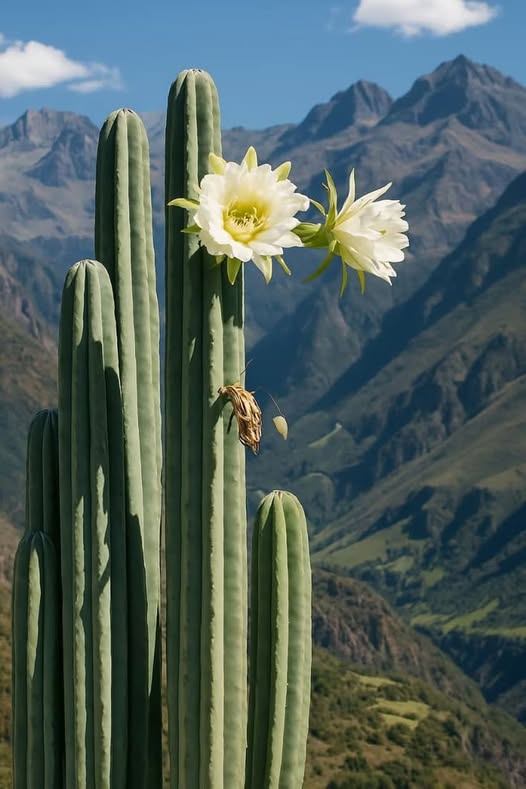
Echinopsis pachanoi is the San Pedro cactus of the northern Andes, a fast columnar tree of the inter-Andean valleys of Ecuador and Peru that carries one of the longest continuous ceremonial records of any plant in the Americas. The type material was collected by J.N. Rose in 1918 at Cuenca, Azuay Province, Ecuador, in the company of Prof. Abelardo Pachano Lalama of the Quinta Normal de Agricultura at Ambato; Britton and Rose formally described the plant in 1920 as Trichocereus pachanoi, honouring Pachano in the Latin genitive.
The species is still almost universally sold as Trichocereus pachanoi in the collector and horticultural trade. Kew POWO currently accepts the Friedrich & Rowley 1974 transfer to Echinopsis, but that treatment is actively contested: Albesiano & Kiesling argue for resurrecting Trichocereus and sink the species into T. macrogonus var. pachanoi, and the molecular phylogeny of Schlumpberger & Renner (American Journal of Botany 99(8), 2012) finds that Echinopsis sensu lato is not monophyletic under any of its previous circumscriptions. This page uses the POWO accepted name and explicitly retains the Trichocereus epithet in the synonymy and in every trade-facing context.
In cultivation the species is the most forgiving columnar cactus of Andean origin, notably more tolerant of regular summer water and winter frost than the Atacama-adapted genera. It is also the most commonly mistaken for its Peruvian sister, E. peruviana: on cultivated stock without provenance the only reliable field separation is spine length and density, since the blue-green glaucous colour peruviana keeps at maturity is also present on juvenile pachanoi before it fades. The near-spineless Bolivian trade plant E. lageniformis and the long-spined Urubamba drainage E. cuzcoensis round out the most-confused shortlist.
The cultural and chemical record on this species is exceptional in Cactaceae. Iconographic evidence from the Chavin horizon at Chavin de Huantar places ceremonial use before the Common Era by at least eight centuries, and the mesa healing tradition of northern coastal Peru, centred on Lambayeque and La Libertad, has continuous material evidence in the Cupisnique and Moche ceramic record from roughly 1500 BCE forward. The plant’s principal alkaloid, mescaline, was the template against which Alexander Shulgin measured every compound in the subsequent phenethylamine research programme. Peru’s Ministry of Culture declared the northern San Pedro healing tradition Patrimonio Cultural de la Nación in November 2022. The Cultural and chemical history section below covers the archaeological, ethnographic, and chemistry record in detail; the cultivation and identification sections come first, as on every other specimen page.
Echinopsis pachanoi quick reference
A robust Andean columnar cactus of Ecuadorian and northern Peruvian inter-Andean valleys, native to the 2,000–3,000 m elevation band with summer-rainfall climate and regular light winter frosts. Values calibrated for seed grown plants in cultivation, drawn from habitat data and specialist grower sources including trichocereus.net, the ICEERS San Pedro reference, and llifle.
Taxonomy & nomenclature
Echinopsis pachanoi (Britton & Rose) H.Friedrich & G.D.Rowley was published in IOS Bulletin 3(3): 96 (1974), the nomenclatural transfer of the 1920 basionym Trichocereus pachanoi Britton & Rose into the older genus Echinopsis Zucc. The basionym appeared in The Cactaceae volume 2, pages 134–135 with figure 196, based on material collected by J.N. Rose, A. Pachano and George Rose between September 17 and 24, 1918 at Cuenca, Ecuador. The transfer by Friedrich and Rowley followed Friedrich’s 1974 argument that Trichocereus and Echinopsis flowers are structurally indistinguishable and that Echinopsis, being the older name, holds nomenclatural priority. Kew POWO currently accepts the Friedrich & Rowley combination.
The generic circumscription is contested across current cactus systematics. Albesiano & Kiesling argue for resurrecting Trichocereus as a valid genus distinct from Echinopsis, and sink pachanoi into T. macrogonus as var. pachanoi. The companion paper of Albesiano & Terrazas presents a cladistic analysis of morphological and chloroplast markers (rpl16, trnL-F) supporting the monophyly of Trichocereus under a broad circumscription. The molecular phylogeny of Schlumpberger & Renner (American Journal of Botany 99(8): 1335–1349, 2012), based on 3,800 nucleotides of chloroplast DNA from 144 species, cuts against both positions: they recover Echinopsis s.l. as polyphyletic at every level, find that growth habit and pollination mode are evolutionarily labile and unreliable for genus circumscription, and explicitly defer realignment pending analysis of more conserved characters. None of the three positions is unopposed; this page follows POWO on the accepted name while retaining Trichocereus pachanoi in the synonymy and in every trade-facing context where the older epithet remains the common coin.
The species epithet honours Professor Abelardo Pachano Lalama (1885–1958) of Ambato, Ecuador, a Cornell-trained agronomist who directed the Quinta Normal de Agricultura and served as Rose’s field companion on the 1918 Ecuadorian expedition. The genus Echinopsis combines Greek echinos (hedgehog) and opsis (appearance); the older genus Trichocereus combines trichos (hair) with cereus, a reference to the dense black-grey hairs on the floral tube that remain a distinctive genus-level character in what used to be the Trichocereus group. Vernacular names include San Pedro, huachuma, wachuma, achuma, aguacolla, hahuacollay, gigantón, and San Pedrillo; the Saint Peter attribution is attested in the colonial period and was probably a syncretic cover for continued ceremonial use under Spanish religious scrutiny.
POWO lists ten heterotypic and homotypic synonyms under the species. The most frequently encountered are Trichocereus pachanoi Britton & Rose (basionym; homotypic), Cereus pachanoi (Britton & Rose) Werderm., Echinopsis santaensis (Rauh & Backeb.) H.Friedrich & G.D.Rowley, Echinopsis schoenii (Rauh & Backeb.) H.Friedrich & G.D.Rowley, Trichocereus santaensis Rauh & Backeb., and Trichocereus schoenii Rauh & Backeb. A 2024 combination Trichocereus macrogonus subsp. pachanoi (Britton & Rose) Lodé in Cactus-Aventures International 36: 144 is published but is not currently accepted at POWO. The sister Peruvian species E. scopulicola, another near-spineless Bolivian columnar, and E. chiloensis of central Chile are the sibling taxa treated elsewhere in this encyclopedia.
Historical synonyms (9)
- Trichocereus pachanoi Britton & Rose, 1920 basionym
- Cereus pachanoi (Britton & Rose) Werderm., 1931 homotypic synonym
- Trichocereus chalaensis Rauh & Backeb., 1956 heterotypic synonym
- Trichocereus santaensis Rauh & Backeb., 1956 heterotypic synonym
- Trichocereus schoenii Rauh & Backeb., 1958 heterotypic synonym
- Echinopsis chalaensis (Rauh & Backeb.) H.Friedrich & G.D.Rowley, 1974 heterotypic synonym
- Echinopsis santaensis (Rauh & Backeb.) H.Friedrich & G.D.Rowley, 1974 heterotypic synonym
- Echinopsis schoenii (Rauh & Backeb.) H.Friedrich & G.D.Rowley, 1974 heterotypic synonym
- Trichocereus torataensis F.Ritter, 1981 heterotypic synonym
Sources: POWO (Kew) · IPNI · GBIF · Wikidata
Habitat
E. pachanoi is an Andean inter-Andean-valley columnar cactus, growing on the western slopes of the Andes in Ecuador and northern Peru at 2,000–3,000 m elevation, occasionally to 3,300 m at the upper margin. The Cuenca basin in Azuay Province is the type locality and canonical habitat reference; the Cuenca basin sits at approximately 2,550 m. The plant occupies a dry-montane zone between the hot coastal plain and the cold puna/paramo, where Amazonian moisture advection during austral summer produces a distinct summer-rainfall climate unlike anything on the Pacific-facing Atacama coast.
Annual precipitation in the core habitat runs approximately 500–800 mm, with the wet season falling November through April and a pronounced dry winter May through October. Mean annual temperature at 2,500 m is 12–16°C with diurnal swings of 10–15°C; nighttime winter temperatures regularly dip below 5°C and episodic frosts to −5 to −8°C occur at the higher end of the elevation range. This seasonal cold combined with winter dryness is the mechanism that produces the reported −9.4°C cold floor for dry established plants in cultivation.
Substrate is rocky and mineral-rich: volcanic and granitic derived grit and thin calcareous soils on valley sides, road cuts, and cliff faces. The plant shows a broader substrate tolerance than Chilean coastal genera, and field accounts from the Pan-American highway corridors in Ecuador consistently describe near-monoculture stands on steep exposed slopes with minimal soil development. Associated vegetation of the inter-Andean monte espinoso includes Agave species (notably A. americana and native Andean agaves), Opuntia soederstromiana in Ecuador, terrestrial bromeliads in Puya, Baccharis and Buddleja shrubs, and at lower elevations Acacia and Prosopis. The upper margin transitions to paramo grasslands dominated by Calamagrostis and Festuca.
The native range per POWO is restricted to Ecuador and Peru. Introduced and naturalised populations exist in Bolivia, central Chile, Colombia, the Canary Islands, and mainland Spain. Field sources (trichocereus.net, llifle) and ICEERS extend the native range to northern Bolivia and northern Argentina; POWO is more conservative. The sidebar uses the POWO-consistent Cuenca, Ecuador for the type locality and the 2,000–3,000 m band for elevation. Broader field figures are noted in body text where relevant.
Morphology
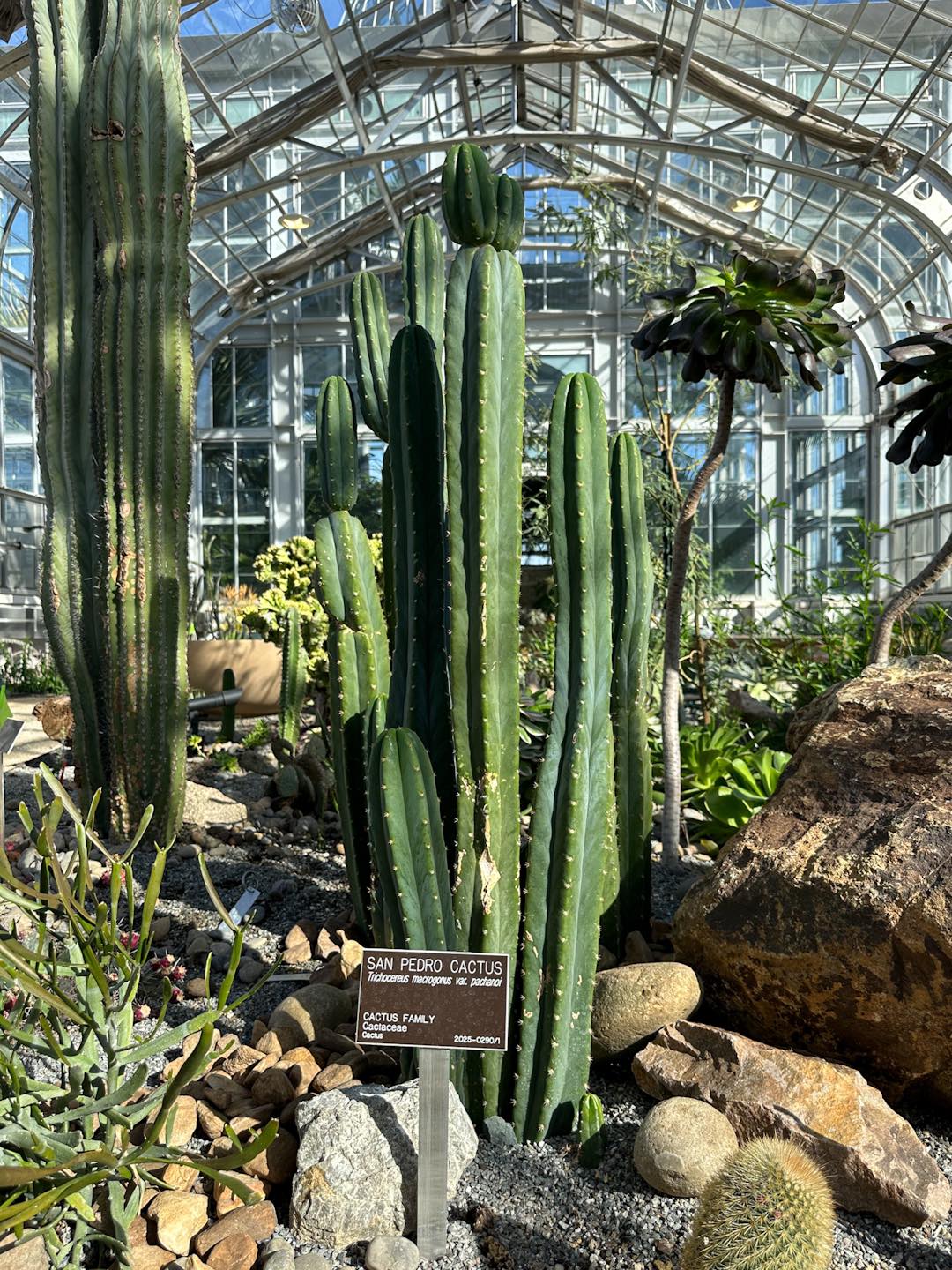
E. pachanoi is a robust columnar tree cactus, typically 3–6 m tall in habitat and occasionally exceeding 7 m, with a recorded cultivation height of 12.2 m. Multiple branches extend from the base and from the main stem after damage or natural branching, producing a candelabra-to-small-tree habit by maturity. Stem diameter runs 6–15 cm, with mature cultivated plants occasionally reaching 20 cm. Skin colour is bright green to pale blue-green, often with a waxy glaucous bloom on young growth that fades on mature stems; the contrast with the persistently frosted blue-glaucous E. chiloensis and particularly with E. peruviana is strongest on older material.
Ribs number 6–8 in typical wild material (range 4–9 across the species, with a cultivated four-rib form f. quadricostatus). Ribs are broad and rounded with a notched horizontal groove between each areole pair, giving a distinctive scalloped silhouette from the side. This rounded notched profile is a key separation from the more sharply V-shaped ribs of E. peruviana. Areoles are felted, white to grey, spaced approximately 2 cm apart along the rib midline. Spines number zero to seven per areole, typically short (under 2 cm, often under 5 mm), yellow to pale brown. The near-spineless character on most cultivated stock is the single fastest field character at any growth stage.
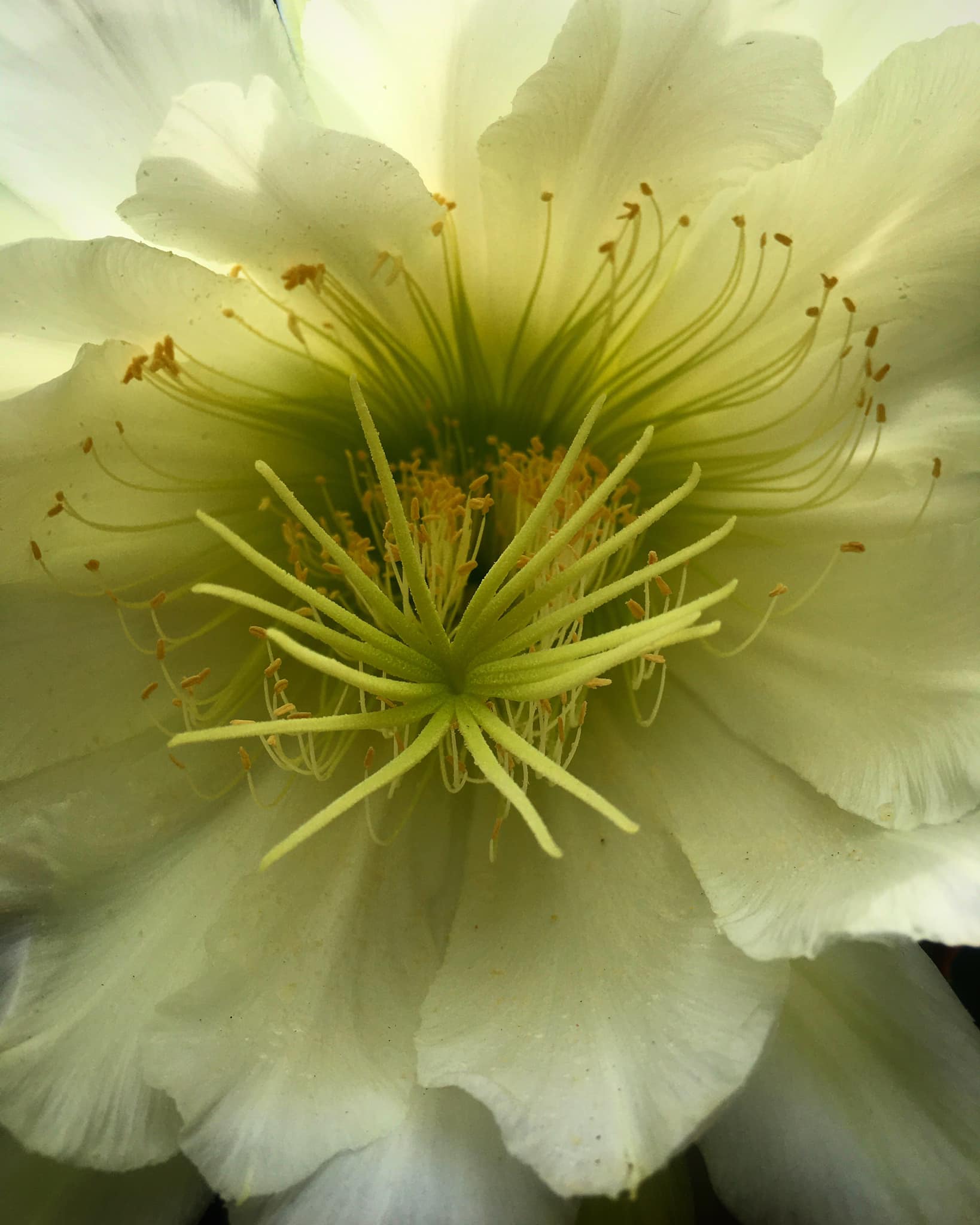
Flowers are terminal to subterminal, nocturnal, 19–24 cm long and up to 20–22 cm across when fully open, white with brownish-red outer segment bases, sweet-scented. The floral tube is distinctively covered with dense grey to black hairs, a genus-level character of the former Trichocereus group and part of what anchors the older generic name. Flowers open at dusk, remain open into the following day, and last approximately two days. The species is self-sterile; fruit set requires cross-pollination. Fruit is oblong, dark green, roughly 3 cm in diameter by 5–7 cm long, with a hairy surface; it dehisces at maturity to reveal white flesh and small black seeds.
The “Predominant Cultivar” or PC clone widely propagated from cuttings in North American and Australian trade is morphologically distinct from verified wild pachanoi in several characters documented by Trout (troutsnotes.com/pachanoi-pachanot): the PC clone typically carries 6–7 ribs with a sawtooth rather than notched rounded profile, white (not black) tube hairs, and differences in ovary, areole, and spine expression. Trout uses the informal designation pachanot for the PC clone to flag the distinction. A hybrid origin (pachanoi x bridgesii) has been suggested but remains unresolved in the absence of published DNA data; a candidate Ritter collection (FR856 from Río Mizque, Bolivia) is unconfirmed. The implication for identification is that a plant labelled “pachanoi” in commercial trade may differ from wild-type material in both morphology and alkaloid chemistry.
Locality detail
The native distribution runs from southern Ecuador (Azuay, Cañar, Loja) through the inter-Andean valleys of northern, central, and southern Peru. Cuenca in Azuay Province is the type locality and the canonical habitat reference. In Peru the species occupies the western Andean slopes of the departments of Ancash, Cajamarca, La Libertad, Lima, Ayacucho, Apurímac, and Cuzco, with overlapping range relative to E. peruviana in the Rimac-Matucana drainages south of Lima. Markers on the map sit at regional and archaeological centroids rather than sharp GPS coordinates: San Pedro is CITES Appendix II, and while poaching pressure is low compared to narrow-range Mexican cacti, the convention is consistent with the rest of the encyclopedia.
The map also marks the principal archaeological reference points treated in the Cultural and chemical history section below: Chavín de Huántar in the Ancash highlands, where the Stela of the Cactus Bearer anchors the Chavin-horizon iconography, and the Trujillo-Chiclayo corridor of the northern Peruvian coast, which hosted the Cupisnique, Moche, and Lambayeque material record and remains the geographic centre of the modern mesa healing tradition declared Patrimonio Cultural de la Nación in 2022.
Echinopsis pachanoi care and cultivation
E. pachanoi is the most forgiving columnar cactus of Andean origin in cultivation, a direct consequence of its summer-rain biome genetics rather than the perpetual aridity of the Atacama-adapted genera. Specialist grower sources (trichocereus.net, cactusculture.com.au, llifle) describe it as suitable for any cultivation level, and its vigour makes it the standard columnar grafting rootstock in the trade. The one reliable failure mode is wet-cold rot when a moist root zone encounters above-freezing cold; replicating the Andean winter-dry regime is the single most important cultivation lever.
Substrate
Highly mineral and fast-draining, with more feed than the genus baseline. Keeper Trout’s cultivation notes call for a rich, well-fed medium for this species specifically, and LLIFLE independently describes it as needing fertile, well-drained soil to sustain its heavy annual growth. The canonical ratio is 31 per cent pumice, 18 per cent lava rock, 5 per cent zeolite, 21 per cent granite grit, 5 per cent limestone chip, and 20 per cent organic matter, the top of what the site’s coir-and-castings ingredient list can build safely; treat that ceiling as an open question rather than a settled number. The zeolite buffers pH and paces nutrients through the watering cycle; the lava fraction is the structural drainage aggregate. Limestone stays at a modest, unproven 5 per cent: no source establishes a lime preference for this species, so treat it as a house convention and reduce or omit it on hard tap water. The species survives in less precise substrates than most rare columnar cacti, but the canonical ratio remains the target for long-term container culture.
Organic share is set from cultivation evidence, not from geology at each type locality. Grower literature for the Trichocereus-type torches favors a richer mix than a bare-minimum blend; the site holds each species at the constructible ceiling its own evidence supports, from 8 per cent on the winter-rain E. chiloensis up to 20 per cent on E. pachanoi. Limestone sits at 0 or a modest 5 per cent across the group. No species here is established as calcicole or calcifuge, so the fraction is a house convention that growers on hard tap water can reduce or drop entirely.
| Species | Pumice | Lava | Zeolite | Granite | Limestone | Silica | Organic |
|---|---|---|---|---|---|---|---|
| E. chiloensis | 38% | 22% | 5% | 27% | 0% | 0% | 8% |
| E. cuzcoensis | 33% | 19% | 5% | 23% | 5% | 0% | 15% |
| E. pachanoi (this page) | 31% | 18% | 5% | 21% | 5% | 0% | 20% |
| E. scopulicola | 35% | 20% | 5% | 25% | 5% | 0% | 10% |
| E. peruviana | 33% | 19% | 5% | 23% | 5% | 0% | 15% |
Watering and light
Water regularly March through October, matching the austral summer rainfall of the native range. Weekly summer watering in warm climates is tolerated without root issues, which is unusual for a columnar cactus and reflects the 500–800 mm annual rainfall of the habitat. Reduce to dry or near-dry October through March for the winter rest. This dry rest is less stringent than for Atacama-origin genera, but it is what confers the reported −9.4°C cold tolerance; plants given continued winter moisture lose cold hardiness rapidly and fail at temperatures well above freezing.
Light tolerance is flexibly wide. The species grows on exposed valley sides and cliff faces where aspect-driven partial shade is common, and established plants in tropical and subtropical gardens take full sun year-round without etiolation. In temperate collections under glass it performs well on south-facing benches without supplemental lighting. Young plants benefit from gradual acclimation to full sun; direct exposure on unacclimated indoor-grown material can produce epidermal burning, especially in the first summer outdoors.
Propagation
Cuttings are the standard propagation method in both commercial and collector contexts. A fresh cut section calluses and roots within three to six weeks, producing a plant genetically identical to the parent. Seed is viable and germinates readily under warmth and humidity; seed grown material represents the full genetic diversity of the species and is the only route to wild-type chemotypes, since the widely circulated PC clone is a single cutting-propagated genotype with documented morphological and alkaloid-profile differences from wild pachanoi. Seedlings can be grafted onto Pereskiopsis for accelerated early growth, though pachanoi itself is vigorous enough unaided that grafting is rarely necessary except for collector-grade slow-growing scions. The species is the standard columnar alternative to Pereskiopsis as rootstock: mature stem sections callus cleanly and accept scions readily.
Cultural and chemical history
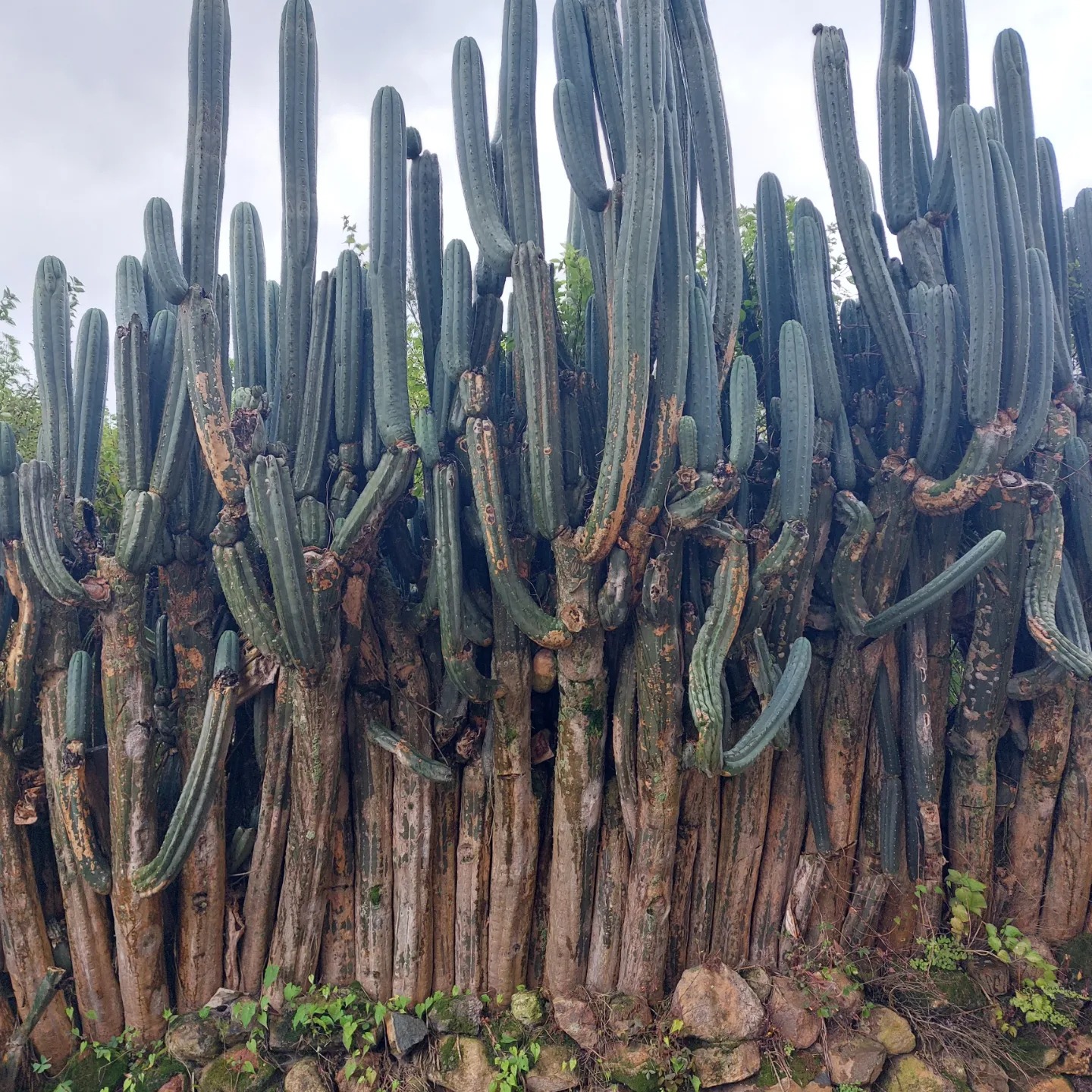
Among rare cacti on this site, E. pachanoi carries the longest continuous cultural record and the deepest cross-disciplinary literature. The archaeological iconography, the ethnographic monograph record of modern Peruvian curanderismo, and the 20th-century phenethylamine chemistry programme form a single documented thread from the Chavin horizon forward. The material below is distilled from the primary anthropology of Sharon, Joralemon, and Glass-Coffin, from Burger and Rick on Chavin archaeology, and from the alkaloid chemistry lineage running Heffter → Spaeth → Poisson → Agurell → Ogunbodede.
Pre-Columbian use and the Chavin horizon
The earliest substantiated iconographic evidence comes from the Chavín culture of the northern Peruvian highlands (1500–500 BCE, Middle-to-Late Formative Period). The reference monument is the Stela of the Cactus Bearer, an 80-cm granite monolith discovered by Luis Guillermo Lumbreras on 14 November 1972 in the northwest quadrant of the semi-sunken Circular Plaza at Chavín de Huántar (Ancash, 3,177 m). The stela depicts an anthropomorphic figure with serpent hair, fanged mouth, two-headed serpent belt, and feline and eagle attributes, holding a four-ribbed columnar cactus identified as the Trichocereus macrogonus group by the ribbed columnar form. In 2001 John Rick’s Stanford Chavín project recovered a mirror-image fragment of a second stela in the same plaza, suggesting an original four-stela arrangement oriented toward the stairway leading into the gallery of the Lanzón. Burger places the Circular Plaza construction in the Chakinani ceramic phase, approximately 800–700 BCE.
The Cupisnique culture of the northern coastal zone, broadly contemporary with Chavín, has produced more than thirty ceramic representations of the San Pedro cactus across sites including Tembladera and Cupisnique, typically paired with spotted felines, serpents, and raptors in the same shamanic-transformation triad. The Moche tradition (100–750 CE) that followed on the same coastal zone produced the most visually detailed corpus: Recent ethnobotanical scholarship identifies ceramic figures called achumeras across Moche stirrup-spout vessels and at Huaca de la Luna, figures holding San Pedro sections in a ritual context. Lambayeque (750–1375 CE) and Chimú (900–1470 CE) show continuous material evidence through the Inca-period (1438–1533 CE) ethnohistoric record. Cieza de León (1553), Polo de Ondegardo (ca. 1560), and Bernabé Cobo document the colonial-period survival under the names achuma, wachuma, and aguacolla.
Pre-pottery-period evidence from Guitarrero Cave (tentatively 6800–6200 BCE) is cited in the secondary literature as possibly the earliest association, though the specific identification of the plant remains as E. pachanoi is inferential rather than certain and should be read as preliminary. The Chavin stela remains the clearest fixed point in the pre-Common-Era record.
Modern curandero tradition
The extensively documented modern ceremonial tradition is the mesa healing practice of northern coastal Peru, centred on the departments of Lambayeque, La Libertad, Piura, and adjacent Cajamarca highlands. The practitioner is the curandero, maestro, or specifically huachumero when San Pedro is the primary ceremonial medium. The mesa itself is a ritual altar covered with a cloth on which the curandero arrays artes: pre-Columbian ceramic and metal huacas, carved staffs, Spondylus shells, swords, Catholic santos, crystals, and organic materials, organised into a tripartite field (left campo ganadero, central campo de balance, right campo justiciero) described by Eduardo Calderón and documented by Sharon.
A ceremony typically runs from dusk to dawn. Elements, as documented in the ethnographic literature (Wizard of the Four Winds; Sorcery and Shamanism; The Gift of Life), include preparación of the San Pedro decoction in advance by the curandero; singado, the administration of tabaco negro as a nasal rinse (from Quechua singa, nose); sequential administration of the San Pedro decoction to the curandero and participants; continuous ícaros (power songs or magical melodies) throughout the night; diagnosis and treatment in the heightened perceptual state for the northern Peruvian illness categories susto, mal de ojo, daño, and envidia; and conclusion at sunrise. The ícaros are the primary diagnostic and therapeutic instrument; the decoction is framed as the vehicle that opens the patient to the curandero’s intervention rather than as the agent of healing itself.
The anthropological monograph literature is built on the fieldwork of four principal researchers. Douglas Sharon began apprenticeship with don Eduardo Calderón Palomino in Trujillo in 1970 and produced the 1978 Wizard of the Four Winds and the 2000 Shamanism and the Sacred Cactus (San Diego Museum of Man Papers No. 37), the latter the reference text bridging archaeological and ethnographic evidence. Donald Joralemon’s 1993 Sorcery and Shamanism documents twelve curanderos and more than one hundred patient accounts in the comparative study. Bonnie Glass-Coffin’s 1998 The Gift of Life, based on fieldwork from 1982 forward, examines female healers in northern Peru and the gendered dimensions of healing authority, correcting the male-practitioner focus of the earlier literature. Marlene Dobkin de Rios (1939–2012) was the foundational generation: her 1972 Visionary Vine and subsequent articles in the 1970s and 1980s established the academic literature on Peruvian healing plant use. In November 2022 Peru’s Ministerio de Cultura issued Vice-Ministerial Resolution No. 000252-2022-VMPCIC/MC, formally declaring the traditional knowledge, wisdom, and ritual use of San Pedro in northern Peruvian curanderismo a Patrimonio Cultural de la Nación across seven departments.
Mescaline chemistry and research history
The principal psychoactive alkaloid in E. pachanoi is mescaline (3,4,5-trimethoxyphenethylamine), a serotonin 5-HT2A receptor agonist in the phenethylamine chemical class. The research lineage begins with Arthur Heffter (Leipzig), who isolated and identified mescaline from peyote (Lophophora williamsii) in 1896–1897 by systematic self-experimentation, and Ernst Späth (University of Vienna), who completed the first total synthesis in 1919 via reductive amination of 3,4,5-trimethoxybenzaldehyde. Identification of the voucher plant behind the Peruvian San Pedro was resolved in 1959 by Claudio Friedberg, after which Jacques Poisson was the first to isolate mescaline from a taxonomically certain Trichocereus pachanoi specimen.
The subsequent survey chemistry is anchored by early survey work in Lloydia, which characterised eight phenethylamines across Trichocereus species including tyramine, hordenine, 3-methoxytyramine, 3,4-dimethoxyphenethylamine, 3-hydroxy-4,5-dimethoxyphenethylamine, and mescaline itself; by early analytical work, which crystallised mescaline hydrochloride and 3-methoxytyramine hydrochloride from T. pachanoi specifically; and by a parallel study for the profile of T. peruvianus. The current quantitative reference is the 2010 Journal of Ethnopharmacology study, which measured mescaline in cortical chlorenchyma across 14 Echinopsis taxa and cultivars by Soxhlet methanol extraction followed by HPLC. Reported concentrations span 0.053 to 4.7 percent by dry weight, two orders of magnitude, with the study maximum returned by a Peruvian pachanoi accession.
The scaffold chemistry flows forward through Alexander Shulgin’s structure-activity research programme of the 1960s through 1980s. Mescaline is Entry 96 in PiHKAL, where it is framed as the central reference against which every subsequent phenethylamine was measured. The 2C series (2C-B, 2C-E and relatives) emerged from systematic substitution on the mescaline aromatic ring. The collector-grade chemotype literature, parallel to the academic record, runs through Keeper Trout’s Sacred Cacti editions (1997, 1999, 2001, 2015 in preparation) and the 2006 San Pedro With Pachanoi Pachanot Addendum; Trout is a co-author on the Ogunbodede 2010 paper, which links the academic and practitioner traditions directly.
PC clone variation and chemotype context
Two orders of magnitude of chemotype variation is the practical headline of the Ogunbodede data. Commercial cutting-propagated stock in North American and Australian trade overwhelmingly derives from the PC (Predominant Cultivar) clone, which Trout documents as dramatically lower in mescaline content than wild-type material sourced in Peru and identified ceremonially. The PC clone is also morphologically distinct (sawtooth rib profile rather than rounded-notched, white rather than black tube hairs, different areole and spine expression), which is why Trout uses the informal designation pachanot. The cultivation and identification implications carry through this page: a plant purchased as “San Pedro” from retail nursery stock is statistically most likely to be PC clone, which means its rib profile, tube-hair colour, and alkaloid chemistry all deviate from the wild-type reference used in the ethnobotanical and chemistry literature. Seed grown plants from documented wild-type provenance are the only practical route to the wild-type chemotype in cultivation.
Comparison
The principal identification question for E. pachanoi is its separation from E. peruviana, which is treated with a character table in the FAQ section below. In summary: spine length and density are the fastest field character (near-spineless versus 2–4 cm spines), rib profile separates rounded-notched from sharply V-shaped cross-section, and provenance separates Ecuadorian and northern Peruvian from central and southern Peruvian material. Skin colour on mature plants (pale green-glaucous versus persistent frosted blue) is reliable on older specimens but misleads on juveniles, since young pachanoi is also strongly glaucous until the bloom fades with age.
E. lageniformis (Bolivian torch, still widely sold as Trichocereus bridgesii) is the second most common trade confusion, particularly in short-spined forms. The separators are rib count and edge profile: lageniformis typically carries only 4–6 ribs with sharper rib edges, giving a boxier cross-section than the 6–8 broad rounded ribs of pachanoi. Spine count is similarly sparse in many lageniformis forms, so spine armature alone does not separate the two. Native range (Bolivia versus Ecuador/Peru) is definitive on provenance-documented plants.
E. cuzcoensis of the Urubamba drainage in southern Peru is sometimes mixed with pachanoi in trade. It is a stouter plant with substantially longer and darker spines (often 3–5 cm) and a characteristically knobbed spine base that separates it from both pachanoi and peruviana. A further complication specific to pachanoi identification is the PC clone versus wild-type distinction discussed in the Cultural and chemical history section: nursery “pachanoi” is statistically dominated by the PC clone, which differs from wild-type pachanoi in rib profile, tube-hair colour, and alkaloid chemistry, so a plant can be correctly identified to species yet differ materially from the ethnobotanical and chemistry reference material.
Frequently asked questions
How do you tell Echinopsis pachanoi apart from Echinopsis peruviana?
Both species are columnar Andean cacti formerly placed in Trichocereus and widely cross-labelled in trade. Drag the slider to compare mature specimens, then read down the character table. Spine length is the single fastest field character at any growth stage; skin colour is reliable only on mature plants.


Spine length plus armature is the most reliable separator at any size. E. peruviana never shows the near-spineless character common on cultivated pachanoi; wild-type pachanoi never shows the consistent 2–4 cm spination of peruviana. Mescaline content is not a reliable character: published data show overlapping ranges across both species, with individual chemotype variation swamping any species-level mean.
How fast does San Pedro (Echinopsis pachanoi) grow?
Fast. Published figures give 30–60 cm of vertical growth per year under good conditions (trichocereus.net; llifle confirms “up to 30 cm per year” as a conservative estimate), with warm-climate specimens in deep containers reaching annual increments near the upper end of that range. In habitat, plants reach 3–6 m tall with multiple basal branches; a recorded cultivated specimen exceeded 12 m. This vigour is why pachanoi is the standard columnar grafting rootstock in the trade.
How cold hardy is Echinopsis pachanoi?
Notably hardy for a columnar cactus, reflecting its Andean high-elevation origin. Published minimum for established dry plants is −9.4°C (15°F) for short duration, multiply attested across grower sources and consistent with the episodic −5 to −8°C winter frosts documented at 2,500–3,000 m in the Cuenca basin and analogous Peruvian inter-Andean valleys. USDA zones 8b–10 are suitable for safe outdoor cultivation. The load-bearing condition is substrate dryness: plants with a moist root zone lose cold tolerance rapidly and can fail at temperatures well above freezing, so the Andean winter-dry regime must be replicated in cultivation for the published cold floor to apply.
Is San Pedro used in traditional ceremonies?
Yes, continuously for over 3,000 years in Andean cultures. The earliest clear iconographic evidence is the Stela of the Cactus Bearer at Chavín de Huántar (Ancash, Peru), dated to the Chakinani ceramic phase roughly 800–700 BCE by Burger’s chronology. The Cupisnique, Moche, Lambayeque, and Chimú cultures of the northern Peruvian coast show continuous material evidence into the Inca and colonial periods. The modern tradition is the mesa healing practice of northern coastal Peru, centred on Lambayeque and La Libertad, with a ceremony that runs dusk to dawn and combines the San Pedro decoction with tobacco singado, continuous ícaros (healing songs), and a ritual altar of power objects. In November 2022 Peru’s Ministry of Culture formally declared this tradition Patrimonio Cultural de la Nación across seven northern departments.
What is the difference between San Pedro and peyote?
Different species, different geography, and unrelated within Cactaceae. E. pachanoi is a fast-growing Andean columnar tree cactus of Ecuador and Peru at 2,000–3,000 m; peyote, Lophophora williamsii, is a small spineless globose cactus of the Chihuahuan Desert in north-central Mexico and south Texas. Both contain mescaline as the primary psychoactive alkaloid, but the two genera are not closely related within the family. Legal status differs in most jurisdictions: peyote carries specific additional scheduling in the United States and several other countries, while San Pedro is sold broadly as an ornamental columnar cactus with CITES Appendix II documentation but no species-specific controlled-substance scheduling attached to the living plant in most jurisdictions.
Can Echinopsis pachanoi be grown from seed?
Yes, readily. Seeds germinate within days to a few weeks under warmth and humidity and produce plants genetically representative of the full species diversity. Cuttings are the commoner commercial propagation route because a fresh cut section calluses and roots within three to six weeks, producing a plant genetically identical to the parent. This cutting economy is the mechanism behind the dominance of the PC clone in North American and Australian nursery trade: a single vigorous cutting-propagated genotype that differs morphologically and chemically from wild-type Peruvian material. Seed grown plants from documented wild-type provenance are the only practical route to non-PC chemotype and morphology in cultivation.
Sources & further reading
Britton, N.L. & Rose, J.N. (1920). The Cactaceae volume 2: 134–135, fig. 196. Carnegie Institution of Washington. [Protologue; type Rose 22806, Cuenca, Ecuador] · Friedrich, H. & Rowley, G.D. (1974). Echinopsis pachanoi. IOS Bulletin 3(3): 96. [Transfer to Echinopsis; POWO accepted combination] · Kew POWO (2024). Echinopsis pachanoi (Britton & Rose) H.Friedrich & G.D.Rowley. LSID urn:lsid:ipni.org:names:88444-2 · IPNI (2024). Echinopsis pachanoi. International Plant Names Index n/88444-2 · Schlumpberger, B.O. & Renner, S.S. (2012). Molecular phylogenetics of Echinopsis (Cactaceae): polyphyly at all levels. American Journal of Botany 99(8): 1335–1349 · Albesiano, S. & Terrazas, T. (2012). Cladistic analysis of Trichocereus based on morphological data and chloroplast DNA sequences. Haseltonia 17: 3–23 · Albesiano, S. & Kiesling, R. (2012). Identity and neotypification of Cereus macrogonus, the type species of Trichocereus. Haseltonia 17: 24–34 · IUCN Red List (2017). Echinopsis pachanoi Least Concern; Taxon ID 152445. Assessors: Ostalaza, Caceres & Roque. DOI 10.2305/IUCN.UK.2017-3.RLTS.T152445A121474583.en · CITES Checklist of Cactaceae (2024). Appendix II (family-wide listing, effective 1 July 1975) · Ministerio de Cultura del Perú (2022). Resolución Viceministerial No. 000252-2022-VMPCIC/MC. [San Pedro tradition Patrimonio Cultural de la Nación; seven northern departments] · Ogunbodede, O., McCombs, D., Trout, K., Daley, P. & Terry, M. (2010). New mescaline concentrations from 14 taxa/cultivars of Echinopsis spp. Journal of Ethnopharmacology 131(2): 356–362 · Crosby, D.G. & McLaughlin, J.L. (1973). Cactus alkaloids XIX. Crystallization of mescaline HCl and 3-methoxytyramine HCl from Trichocereus pachanoi. Lloydia 36(4): 416–418 · Agurell, S., Bruhn, J.G., Lundström, J. & Svensson, U. (1971). Cactaceae alkaloids X: alkaloids of Trichocereus species and some other cacti. Lloydia 34(2): 183–187 · Pardanani, J.H., McLaughlin, J.L., Kondrat, R.W. & Cooks, R.G. (1977). Cactus alkaloids XXXVI: mescaline and related compounds from Trichocereus peruvianus. Lloydia 40(6): 585–590 · Poisson, J. (1960). Note sur le Trichocereus pachanoi. Annales Pharmaceutiques Françaises 18: 764–765. [First valid mescaline isolation from identified T. pachanoi] · Shulgin, A.T. & Shulgin, A. (1991). PiHKAL: A Chemical Love Story. Transform Press, Berkeley. [Mescaline entry 96; phenethylamine scaffold] · Sharon, D. (1978). Wizard of the Four Winds: A Shaman’s Story. Free Press, New York. [Standard monograph on the mesa tradition; don Eduardo Calderón] · Sharon, D. (2000). Shamanism and the Sacred Cactus: Ethnoarchaeological Evidence for San Pedro Use in Northern Peru. San Diego Museum of Man Papers No. 37 · Joralemon, D. & Sharon, D. (1993). Sorcery and Shamanism: Curanderos and Clients in Northern Peru. University of Utah Press · Glass-Coffin, B. (1998). The Gift of Life: Female Spirituality and Healing in Northern Peru. University of New Mexico Press · Dobkin de Rios, M. (1972). Visionary Vine: Psychedelic Healing in the Peruvian Amazon. Chandler Publishing · Burger, R.L. (1992, reissued 2011). Chavín and the Origins of Andean Civilization. Thames & Hudson; Cambridge University Press · Lumbreras, L.G. (1972, 1989). Excavations at Chavín de Huántar; Stela of the Cactus Bearer, Circular Plaza northwest quadrant · Rick, J.W. (2006, 2013). Stanford Chavín Archaeological Research Project. [Four-stela configuration; 2001 mirror-image fragment] · Scher, S. (2021). The Achumera: gender, status, and the San Pedro cactus in Moche ceramic motifs and iconography. In Andean Foodways, Springer. DOI 10.1007/978-3-030-51629-1_9 · Trout, K. (1997/1999/2001/2015). Sacred Cacti: Botany, Chemistry, Cultivation & Utilization. Mydriatic Productions / Better Days Publishing · Trout, K. (2006). San Pedro 2006 with Pachanoi Pachanot Addendum. [PC clone versus wild-type chemotype and morphology] · Cassels, B.K. (2019). Alkaloids of the Cactaceae, the classics. Natural Product Communications 14(1): 3–9 · trichocereus.net (2024). Trichocereus pachanoi / Echinopsis pachanoi. [Morphology; PC clone history; grower notes] · llifle Encyclopedia of Living Forms (2024). Echinopsis pachanoi (Britton & Rose) H.Friedrich & G.D.Rowley