
Aztekium Care: How to Grow the Slowest Cactus on Earth
All ArticlesAztekium care means bright shade, a sharply drained alkaline mineral substrate, and a bone-dry winter rest. These Nuevo León cliff-dwellers from Mexico are the slowest cacti in cultivation: a seed grown plant needs seven to ten years to flower. Water spring through summer, keep them dry below 5 degrees Celsius, and never let the neck sit wet.
What makes Aztekium so hard to grow?
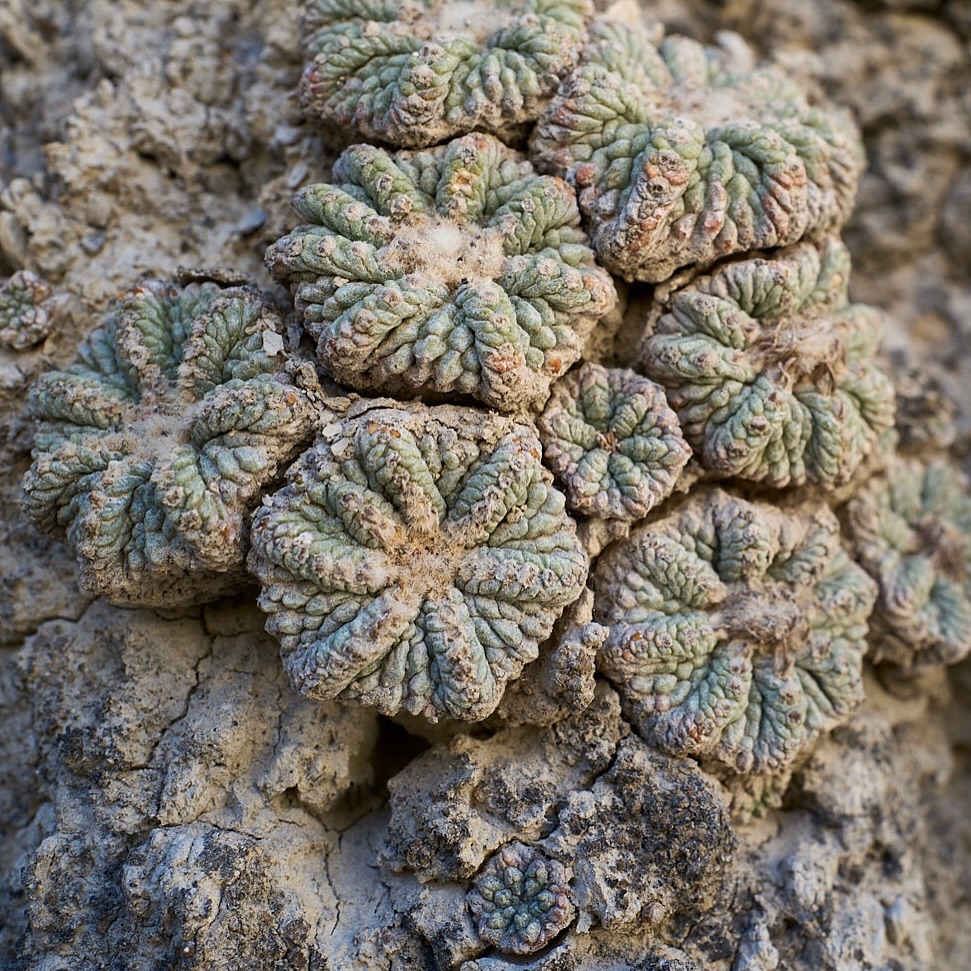
Aztekium are cliff-face specialists, not flat-desert cacti, and almost every care mistake comes from treating them like the latter. The genus holds three accepted species, all from the Sierra Madre Oriental of northeastern Mexico, where they root in fine clay packed into near-vertical gypsum and limestone crevices with almost no organic matter and no standing water.
Two habitat facts frame everything else. The substrate is raw mineral rock that drains in seconds, so a peaty potting mix is a death sentence. And the aspect is north-facing and shaded: field measurements of Aztekium ritteri found only about 20 percent of the stem surface in direct sun at any moment, the rest self-shaded by the corrugated rib and furrow geometry that gives the genus its carved-stone look.
The other defining trait is speed, or the lack of it. Aztekium are very likely the slowest-growing cacti in the family. A seed grown plant takes seven to ten years to reach flowering size, and some stay below flowering age past twenty years. That pace is why provenance matters so much here, and why the gap between a slow seed grown plant and a fast grafted one is so obvious on the bench. The full species accounts and identification notes live on the Aztekium genus hub.
How much light does Aztekium need?
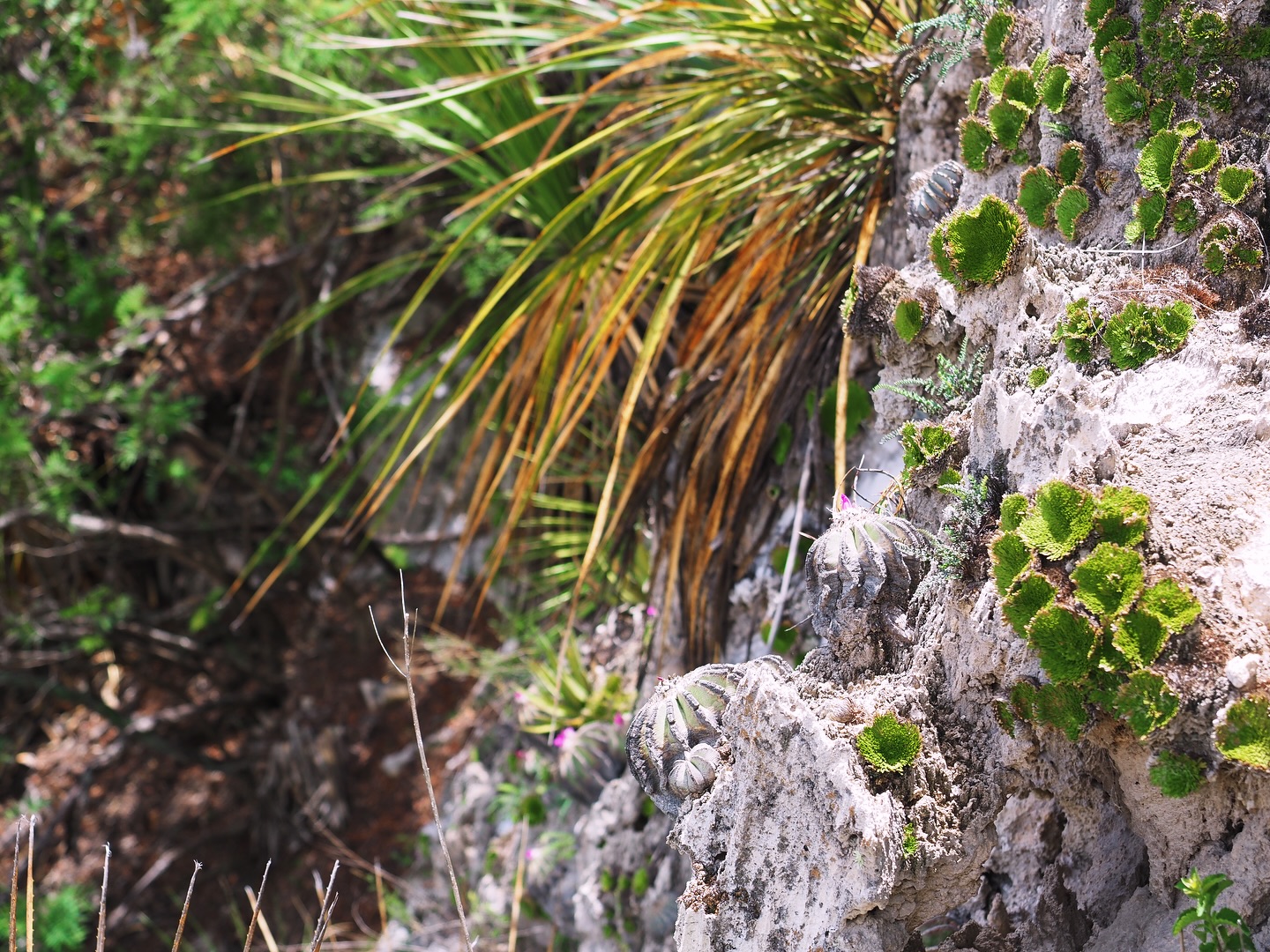
Aztekium want bright shade, not full sun. In habitat the plants sit on north-facing cliff walls and shade themselves with their own ribs, so peak midday sun in cultivation bleaches the grey-green body and burns tissue that has not hardened to the season.
The practical translation is a bright spot with direct sun only in the soft hours: early morning or late afternoon. Under glass that means a position behind light shade cloth through the strongest summer weeks. On a windowsill, an east or west aspect suits them better than a baking south window, which is the reverse of the advice most desert cacti get. Too little light still causes problems, since a starved plant etiolates and loses the tight flat habit collectors prize, so the target is bright but filtered, never dark and never scorching. Indoors, a supplemental grow light on a twelve to fourteen hour cycle keeps the body compact through winter.
What soil mix does Aztekium need?
Aztekium need a fast, almost entirely mineral substrate with a built-in calcium source and an alkaline pH of 7.0 to 8.0, matching the gypsum and limestone rock they grow on. Organic-heavy mixes hold water at the neck and rot the plant.
A working blend is roughly 60 to 70 percent pumice and granite grit for drainage and aeration, 20 to 25 percent decomposed granite or crushed limestone chip to supply mineral structure and the alkaline pH the genus wants, and 5 to 10 percent calcined diatomaceous earth as drainage insurance at the rot-prone root neck. Use no peat, no standard potting soil, and none of the ingredients that popular guides still push: perlite floats and breaks down, builder’s sand packs and holds water, and peat collapses into an airless mush. Our mineral cactus soil mix guide covers the components and the reasoning in full.
Pot small. The root system is tiny and an oversize pot holds moisture long after the plant has finished drinking, which is exactly the condition Aztekium cannot survive. Small unglazed terracotta or clay composite dries quickly and protects the neck; a thin gravel top-dressing keeps the collar dry between waterings.
How often should you water Aztekium?
Water Aztekium thoroughly from spring through summer, but only once the substrate has dried out completely, then stop entirely through winter. In warm indoor conditions a full soak usually falls every two to three weeks during growth; in winter the plant takes no water at all.
The reason for the hard winter drought is the root neck. Aztekium anchor on a short napiform taproot in a tiny crevice, and water sitting around that neck in cool weather is the single most common way growers kill them. A bone-dry, bright, cool rest also lets the plant harden and sets it up to grow in the following warm season. Use rainwater or soft water where you can; if the tap is hard, let it stand and keep the pH at or below 7 so it does not skew too alkaline over time.
On temperature, the safe sustained winter minimum is 5 degrees Celsius. Some growers report brief dips toward freezing surviving when the plant is completely dry, but that is an edge case, not a target. Warmth plus winter water produces soft, swollen, rot-prone growth, the opposite of the hard grey body that marks a well-grown plant.
Is Aztekium legal to own, and how do you buy it safely?
Owning a nursery-propagated Aztekium is legal in most countries; the legal weight falls on wild collection and undocumented international movement. CITES controls vary within the genus: Aztekium ritteri sits on Appendix I, the strictest tier, while A. hintonii and A. valdezii fall under Appendix II like the rest of the cactus family.
Appendix I bans commercial international trade in wild-collected plants outright; nursery-propagated stock can still move with the right artificial-propagation paperwork and proof of cultivated origin. The genus shows why the controls exist. Aztekium valdezii was described only in 2013 from a single canyon of roughly two square kilometres, and publication triggered immediate heavy looting despite the authors withholding the locality. A. hintonii populations were hit by documented mass poaching between 2019 and 2021. Each wild plant taken had grown for decades. Our guide to CITES Appendix I cacti explains what the documentation looks like in practice.
For a buyer, the defensible plant is a seed grown one from a documented source. At rarecactus.com we grow our Aztekium from seed precisely because a seed grown plant carries a known nursery history, while a wild plant can be decades old when ripped from a cliff and shows it. The premium serious collectors pay for seed grown stock is partly about the hard compact habit and partly about being able to show exactly where a plant came from.
Aztekium species, and how their care differs
Care is broadly shared across the three species, since all are slow cliff-dwellers on gypsum and limestone in Nuevo León. The differences that matter to a grower are size, flower colour, and how rare and rot-prone each one is. The genus hub covers each taxon in full; the notes below cover the care-relevant points.
Aztekium ritteri is the original, described by Boedeker in 1929 and named for the field collector Friedrich Ritter. It is tiny, 2 to 5 cm across, grey-green, with 9 to 11 corrugated primary ribs and a system of secondary false ribs folded between them. Flowers are white to pale pink and under 10 mm. It grows between roughly 800 and 1,060 m and is the species most growers meet first. IUCN rates it Least Concern across its range, yet it remains the one Aztekium on CITES Appendix I because of collecting pressure.
Aztekium hintonii was discovered in 1991 and formally described in 1992 from gypsum canyon walls in the Galeana area, and it is the giant of the genus, reaching up to 10 cm with sharp-edged ribs and curved spines as long as 13 mm. Its flowers are deep magenta, up to 3 cm across, with none of the pale tones of ritteri. Care is the same in principle, just on a slightly larger plant. It is assessed as Critically Endangered in the wild, following mass poaching, and falls under CITES Appendix II.
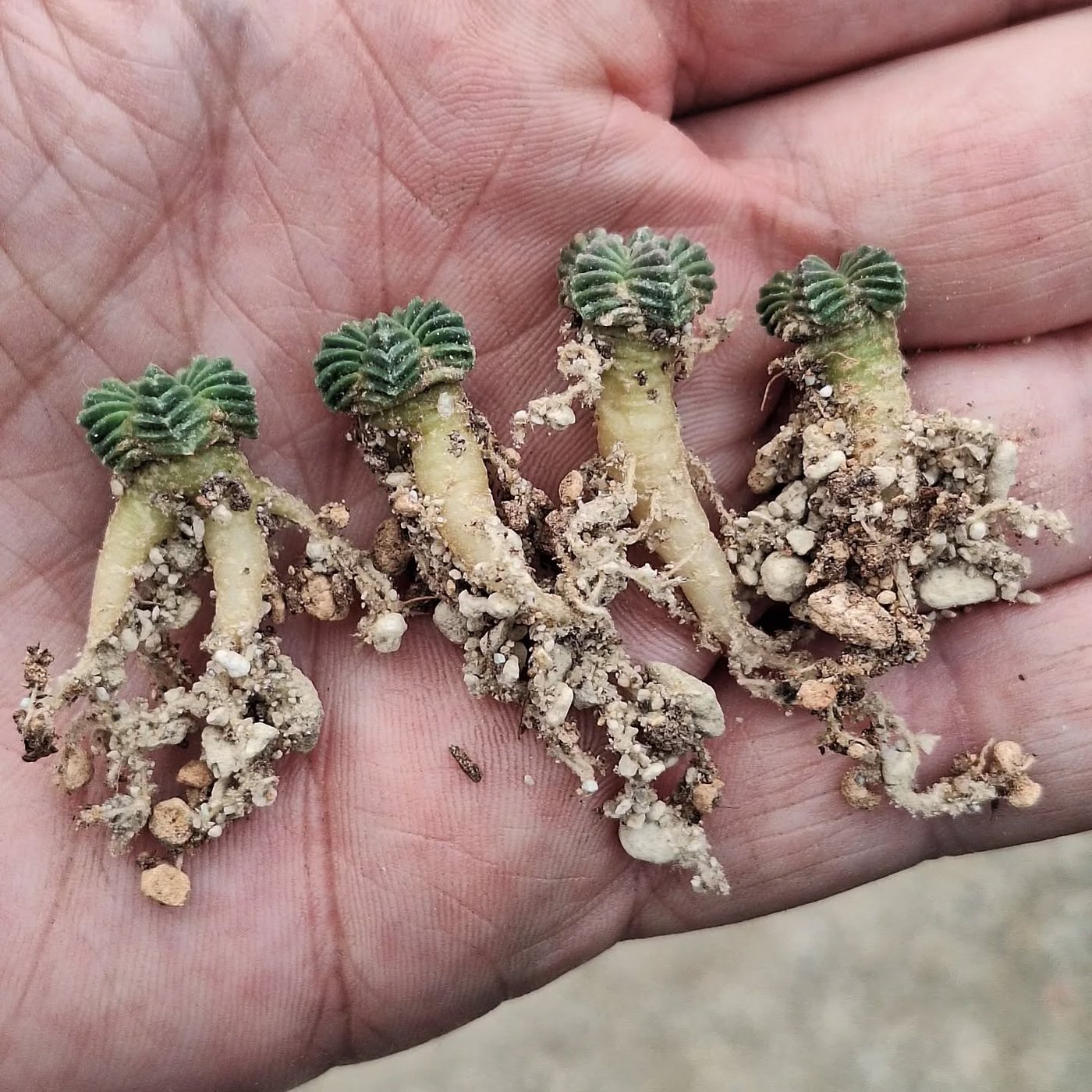
Aztekium valdezii, described in 2013, is the rarest and most demanding. It is a small five-ribbed star with no secondary false ribs at all, the easiest vegetative tell in the genus, and it carries white-centred flowers that grade to bright magenta, 15 to 25 mm across, in late spring and early summer. With a single-canyon range near two square kilometres and almost no legal cultivated supply built up yet, a documented seed grown plant is the only responsible way to grow it. It appears on our rarest cacti ranking.
When does Aztekium flower?
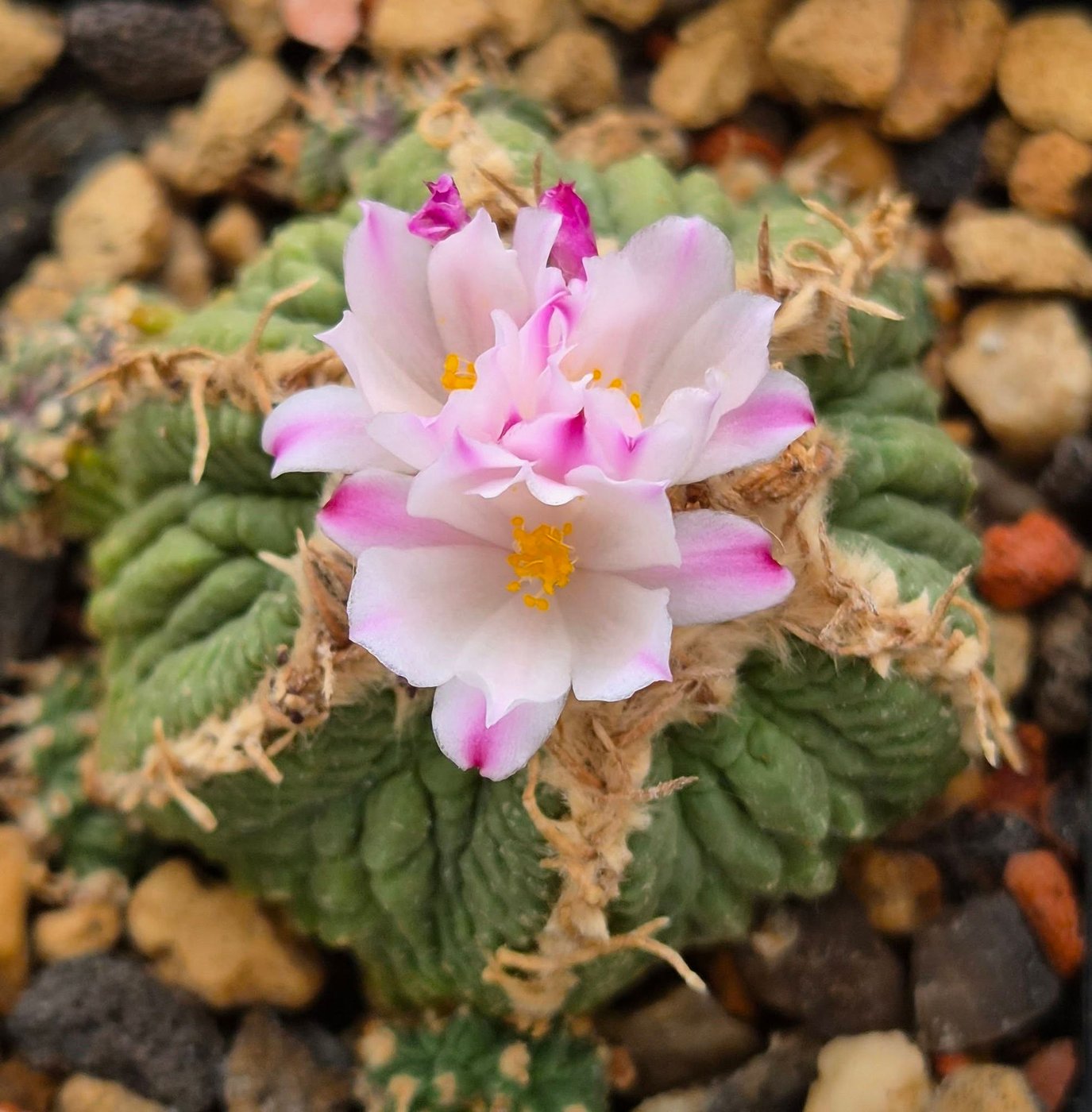
Aztekium flower in the warm season, pushing small funnel-shaped blooms up through the woolly apex. Aztekium ritteri opens white to pale pink flowers under 10 mm through summer, A. hintonii carries magenta flowers up to 3 cm, and A. valdezii shows white-to-magenta flowers of 15 to 25 mm in late spring and early summer.
Flowering is earned through age, not coaxed with feed. A seed grown plant typically needs seven to ten years before its first bloom, and the cool, dry winter rest of the preceding season is what hardens it toward flowering. Grafted plants reach flowering far faster by growing soft and green, which is the trade many collectors decline. Seed set usually needs two unrelated plants in flower together, since the genus does not reliably self-pollinate.
What kills Aztekium, and how do you prevent it?
Root and neck rot is the leading cause of death, and it almost always traces to water sitting in the substrate, usually from winter watering or a mix that holds moisture. Rot starts at the neck and travels up, often hidden until the body softens. If you catch it, cut back into clean uniform tissue, dry the cut hard, and re-root in dry mineral mix. Even a trace of stained tissue left behind keeps spreading. Our broader diagnostic guide walks through telling rot from a plant that is simply contracting in drought.
Root mealybugs are the other main threat, hidden in the substrate on the roots where they are easy to miss until a plant stalls. At the first sign, bare-root, wash, treat, and repot into fresh sterile mineral mix. Keep the plant lean, bright, and bone-dry in winter and you remove the conditions both rot and mealybugs need. One thing that is not a problem: dry, firm brown tissue creeping up from the base of an old plant is natural corking. Corking is hard and dry; rot is soft and wet.
Frequently asked questions about Aztekium care
How often should you water Aztekium?
Water Aztekium only in the growing season, from spring through summer, and only once the substrate has dried out completely, which in warm conditions usually means every two to three weeks. Stop watering entirely through winter and keep the plant at a minimum of 5 degrees Celsius. The dry winter rest protects the rot-prone root neck.
Is Aztekium hard to grow?
Aztekium are advanced. They are not fussy day to day, but they are unforgiving of two mistakes: winter watering, which rots the neck, and an organic substrate that holds moisture. Get the alkaline mineral mix and the bone-dry winter right and the plant is durable. The hardest part is patience, since a seed grown plant takes seven to ten years to flower.
Why is Aztekium so slow-growing?
Aztekium are very likely the slowest cacti in the family, adapted to nutrient-poor cliff crevices where fast growth is impossible. A seed grown plant needs seven to ten years to reach flowering size, and some stay below flowering age past twenty years. Grafting onto a rootstock speeds growth dramatically but costs the hard compact grey habit collectors want.
Does Aztekium need full sun?
No. Aztekium grow on shaded north-facing cliffs and shade most of their own body with their rib architecture, so peak midday sun bleaches and burns them. Give bright shade with direct sun only in early morning or late afternoon. An east or west window suits them better than a hot south one, the reverse of most desert cacti.
What soil mix does Aztekium need?
Aztekium need a fast, alkaline mineral mix: roughly 60 to 70 percent pumice and granite grit, 20 to 25 percent decomposed granite or crushed limestone for the calcium and a pH of 7.0 to 8.0, and 5 to 10 percent calcined diatomaceous earth. No perlite, no builder sand, no peat, all of which hold water and rot the root neck. Pot small.
Plants of the World Online (POWO), Royal Botanic Gardens Kew, Aztekium ritteri · CITES Appendices I, II, III (current) and the CITES species database, Aztekium ritteri and Aztekium hintonii · IUCN Red List assessments for Aztekium ritteri (2013) and Aztekium hintonii · NOM-059-SEMARNAT-2010, Mexican federal protected-species list · Velazco Macías, Alvarado Vázquez & Arias, original description of Aztekium valdezii (2013) · Glass & Fitz Maurice, original description of Aztekium hintonii (1992) · Boedeker, original description of Echinocactus ritteri (1928) and transfer to Aztekium (1929) · Anderson, E.F., The Cactus Family (Timber Press) · Hunt, D., The New Cactus Lexicon (DH Books) · llifle, Encyclopedia of Living Forms · British Cactus and Succulent Society, cultivation notes on Aztekium