
Christmas Cactus vs Thanksgiving Cactus vs Easter Cactus: How to Tell Them Apart
All ArticlesChristmas cactus vs Thanksgiving cactus comes down to leaf shape and bloom time: a Thanksgiving cactus (Schlumbergera truncata) has sharp, claw-like leaf teeth and blooms in late November, while a true Christmas cactus (Schlumbergera x buckleyi) has rounded, scalloped segments and blooms from December into January. The Easter cactus is a third, spring-blooming species.
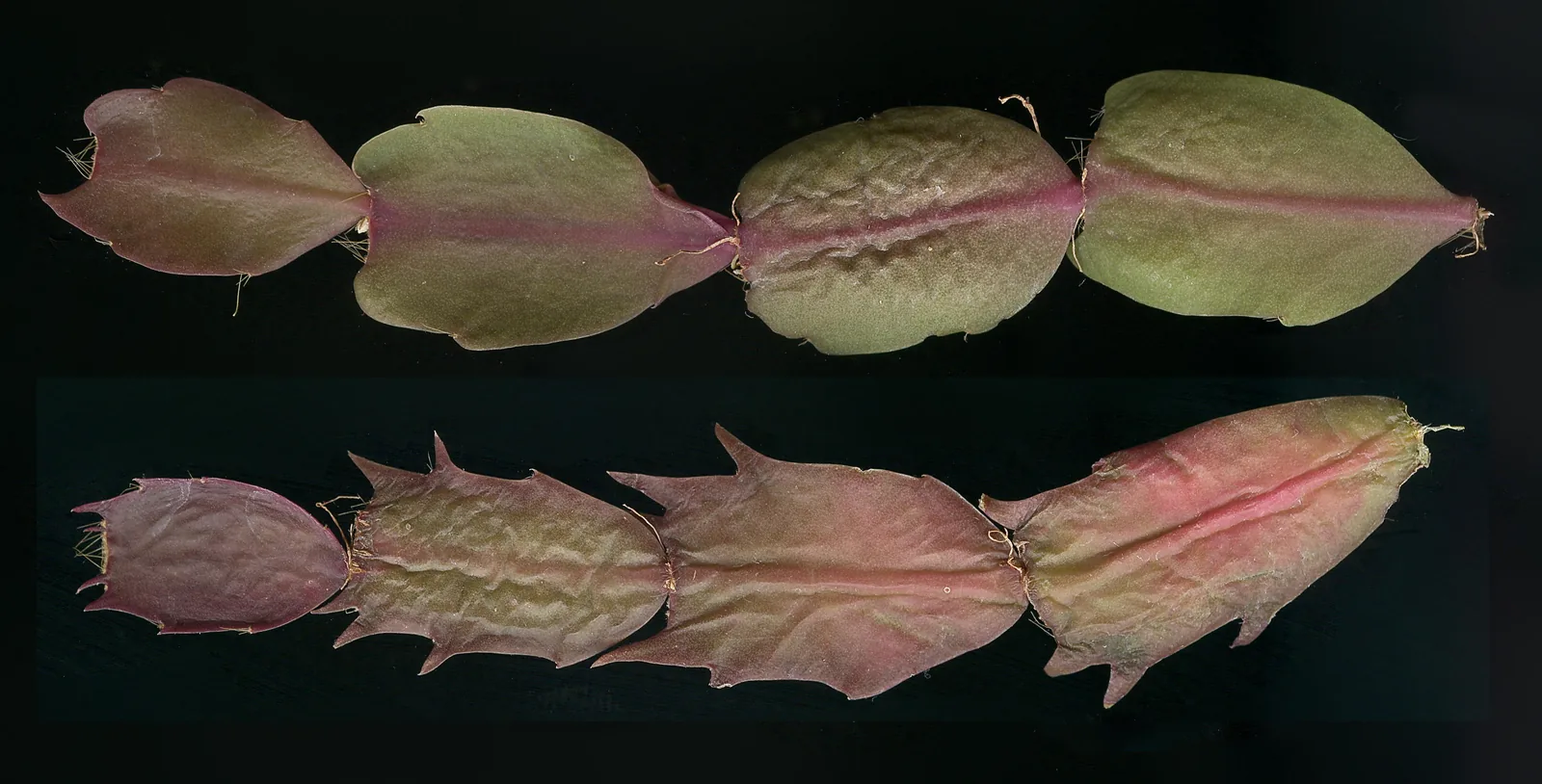
What is the difference between a Christmas and a Thanksgiving cactus?
The fastest way to separate a Christmas cactus from a Thanksgiving cactus is to look at one leaf segment and note when the plant flowers. Both belong to the genus Schlumbergera, both are winter-flowering forest cacti from Brazil, and both get sold every autumn under the single label holiday cactus. The plant most garden centres tag as a Christmas cactus is almost always the Thanksgiving species, Schlumbergera truncata, because it blooms first and reaches the shelves in November. The table below lines up all three holiday cacti on the features that actually tell them apart.
| Feature | Thanksgiving cactus | Christmas cactus | Easter cactus |
|---|---|---|---|
| Common trade name | Crab cactus, false Christmas cactus | True Christmas cactus | Whitsun or spring cactus |
| Botanical name | Schlumbergera truncata | Schlumbergera x buckleyi | Rhipsalidopsis gaertneri |
| Leaf segment edge | Sharp, pointed, claw-like teeth | Rounded, scalloped edges | Rounded with a small bristle at the tip |
| Bloom time | Late November | December to January | Early spring (March to May) |
| Flower shape | Held horizontal, tilted, asymmetrical | Hangs down, symmetrical, pendant | Star-shaped, symmetrical, daisy-like |
| Pollen (anther) color | Yellow | Pinkish to purple-brown | Reddish |
Leaf-segment edge and bloom time are the two tells that work even on an unlabeled plant. Swipe the table sideways on a phone to compare all three.
How can you tell which holiday cactus you have?
Pick up a single leaf segment and read its edge. A Thanksgiving cactus has two to four sharp, forward-pointing teeth along each side, so the segment looks like a claw or a crab leg, which is where the nickname crab cactus comes from. A true Christmas cactus has smooth, rounded, scalloped edges with no points at all. An Easter cactus sits between the two: its segments are rounded like the Christmas cactus, but each one carries a tiny bristle at the very tip and in the small notches along the margin.
If the plant is in flower, the pollen gives you a second check. Thanksgiving cactus anthers are yellow, Christmas cactus anthers are pinkish to purple-brown, and Easter cactus anthers are reddish. Flower posture helps too. A Thanksgiving bloom is held out sideways and looks lopsided, a Christmas bloom hangs straight down in a neat symmetrical tube, and an Easter bloom opens flat and star-shaped like a small daisy.
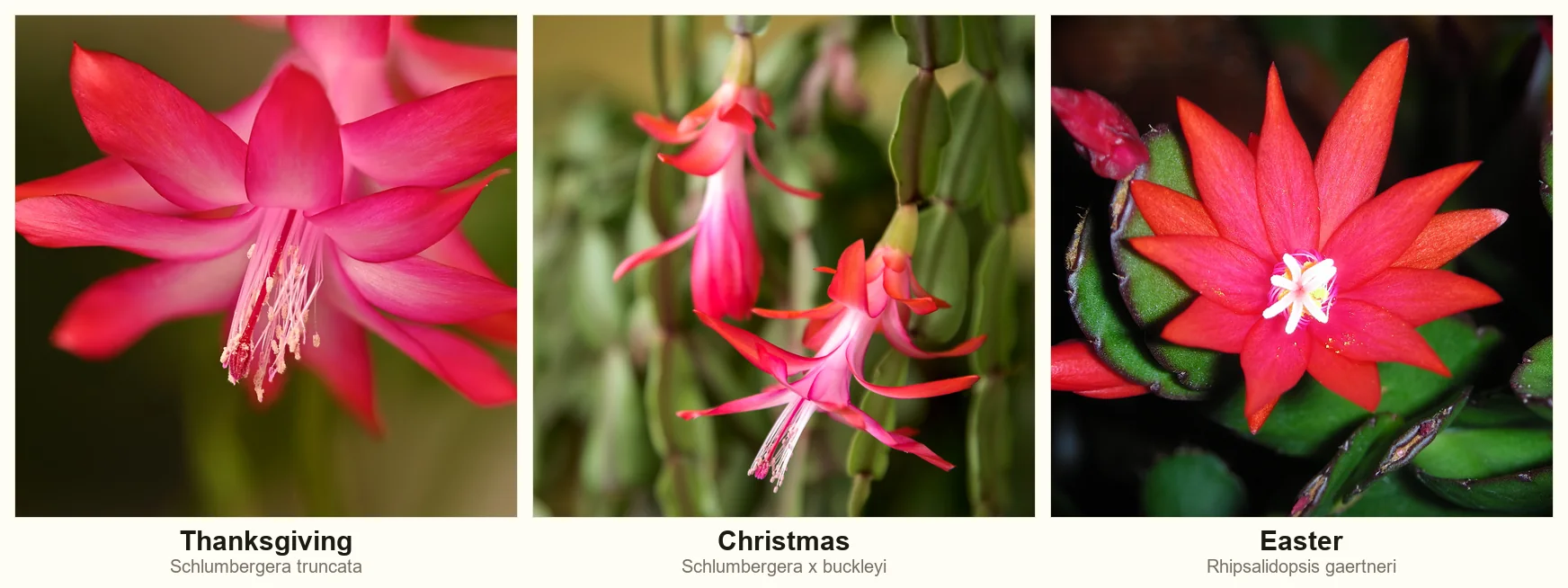
The leaf-segment edge is the single most reliable test, because a plant out of bloom still shows it. That edge is really all you need to know how to tell christmas vs thanksgiving cactus without waiting months for flowers, and it is the heart of christmas cactus identification for anyone naming an inherited or unlabeled plant.
When does each holiday cactus bloom?
Bloom time is the clue the plants were named for. A Thanksgiving cactus opens in late November, a Christmas cactus opens from December into January, and an Easter cactus opens in early spring, roughly March to May. In the wild each species tracks its own daylength and temperature triggers, and indoors they hold to the same order, so the flowering month is a strong second confirmation once the leaf edge has narrowed things down.
This staggered calendar is why store labels drift. The Thanksgiving species blooms first, so growers push it out for the earliest holiday sales and print Christmas cactus on the tag to match the season shoppers expect. Searching thanksgiving cactus vs christmas cactus turns up the same two plants for exactly this reason, because the true Christmas cactus, Schlumbergera x buckleyi, is slower, harder to mass-produce, and far less common on shelves than the plant sold in its name.
Is a Thanksgiving cactus the same as a false Christmas cactus?
Yes, a Thanksgiving cactus and a false Christmas cactus are the same plant, Schlumbergera truncata. False Christmas cactus is the common name for the Thanksgiving cactus, Schlumbergera truncata, and it earns the false because it is the plant most often sold as a Christmas cactus even though it is a different species. The true Christmas cactus is the hybrid Schlumbergera x buckleyi, a cross of Schlumbergera truncata with Schlumbergera russelliana first raised in cultivation in the 1840s.
At rarecactus.com we build every plant entry from its POWO-accepted name up, so this guide names the true species behind each holiday-cactus label across both genera, Schlumbergera truncata, Schlumbergera x buckleyi, and Rhipsalidopsis gaertneri, rather than the interchangeable nicknames the trade prints on the tag. You can see that name-first approach across our rare cactus encyclopedia.
The Easter cactus adds one more naming wrinkle. Kew POWO accepts it as Rhipsalidopsis gaertneri, but the plant has been shuffled among three genera over the years and is still widely sold as Hatiora gaertneri or Schlumbergera gaertneri. Both of those are synonyms of the accepted Rhipsalidopsis name, so the Easter cactus is the odd one out: the Thanksgiving and Christmas cacti are true Schlumbergera, while the Easter cactus is not. Whatever the tag says, the leaf edge and the bloom season settle which plant you actually have.
Are holiday cacti true cacti?
Yes, all three holiday cacti are true cacti, members of the family Cactaceae and the epiphytic forest-cactus tribe Rhipsalideae, but they are nothing like the desert plants most people picture. That shared tribe, not a single genus, is what actually unites them: the Thanksgiving and Christmas cacti are Schlumbergera, the Easter cactus is Rhipsalidopsis. They are forest epiphytes from the coastal mountains of southeastern Brazil, where they grow in leaf litter and moss on tree branches and shaded rock, watered by regular rain and humidity rather than long drought. That habitat is why a holiday cactus wants more water, more shade, and a richer mix than a desert cactus ever would.
What makes them cacti is the areole, the small felted cushion that every cactus grows its flowers and bristles from. If you are unsure whether a plant qualifies as a cactus at all, the areole is the feature to check, and our is-it-a-cactus tool walks through it in a minute. These are true cacti, but forest epiphytes from Brazil, which is why our encyclopedia files them apart from the desert genera we grow.
Meet the three holiday cacti
Three holiday cactus types sit behind the label, listed here in the order they bloom. For where each one sits among the wider family, see our guide to the types of cactus by growth form.
Thanksgiving cactus (Schlumbergera truncata)
The earliest and most common holiday cactus, and the one usually sold as a Christmas cactus. Sharp, claw-like leaf teeth, yellow pollen, and lopsided flowers held out to the side. Blooms in late November. Also sold as crab cactus or false Christmas cactus.
Christmas cactus (Schlumbergera x buckleyi)
The true Christmas cactus and the hardest of the three to find. Rounded, scalloped segments with no teeth, pink to purple-brown pollen, and pendant flowers that hang straight down. Blooms December into January.
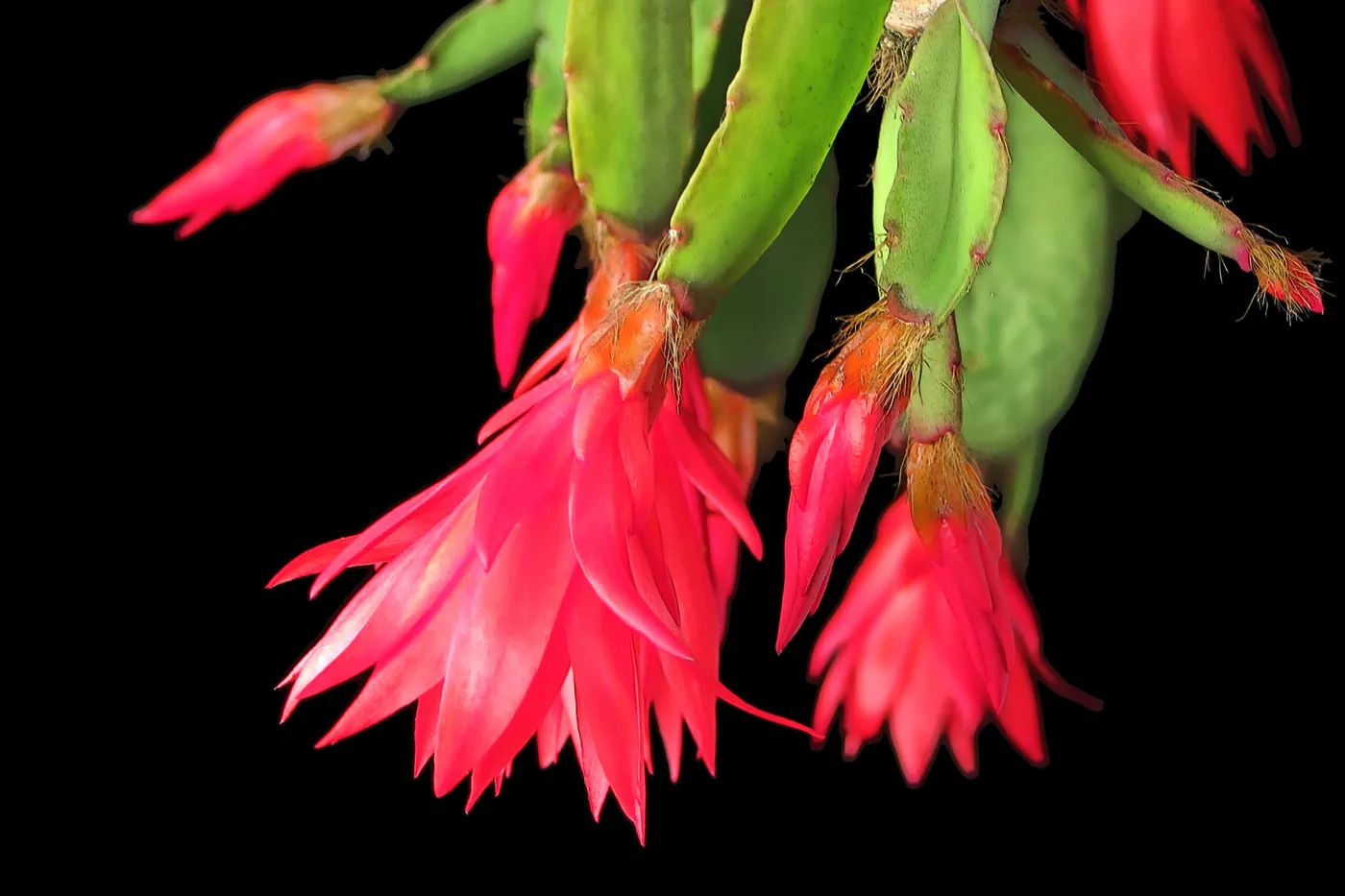
Easter cactus (Rhipsalidopsis gaertneri)
The spring bloomer and the one plant here that is not a Schlumbergera: POWO accepts it as Rhipsalidopsis gaertneri, though it is still often sold as Hatiora gaertneri or Schlumbergera gaertneri. Rounded segments with a small bristle at the tip, reddish pollen, and flat, star-shaped flowers. Blooms March to May.
Frequently Asked Questions
What is the difference between a Christmas cactus and a Thanksgiving cactus?
The Thanksgiving cactus (Schlumbergera truncata) has sharp, claw-like teeth on its leaf segments and blooms in late November. The true Christmas cactus (Schlumbergera x buckleyi) has rounded, scalloped segment edges and blooms from December into January. Leaf edge and bloom time settle it even on a plant that is out of flower.
How do I know if I have a true Christmas cactus?
A true Christmas cactus has smooth, rounded, scalloped leaf segments with no pointed teeth, blooms from December into January, and carries pendant flowers that hang straight down with pink to purple-brown pollen. If the segments have sharp claw-like teeth instead, you have a Thanksgiving cactus sold under the Christmas name.
What is a false Christmas cactus?
False Christmas cactus is the common name for the Thanksgiving cactus, Schlumbergera truncata. It is sold under the Christmas-cactus name because it blooms first, in November, so growers push it out for the earliest holiday sales even though it is a different species.
Is an Easter cactus the same plant?
No. The Easter cactus is a different genus: POWO accepts it as Rhipsalidopsis gaertneri, though it is still often sold as Hatiora gaertneri or Schlumbergera gaertneri, both synonyms of the accepted name. It blooms in spring rather than winter, and its flowers open flat and star-shaped instead of the tubular blooms of the Christmas and Thanksgiving cacti.
Are holiday cacti true cacti?
Yes. All three are true cacti in the family Cactaceae, defined by the areole, the felted cushion their flowers and bristles grow from. They are forest epiphytes from Brazil rather than desert cacti, which is why they want more water and more shade than a desert species.
Kew Plants of the World Online (POWO), Schlumbergera and Rhipsalidopsis accepted names · Anderson, E.F., The Cactus Family (Timber Press) · Hunt, D., The New Cactus Lexicon (DH Books) · McMillan & Horobin, Christmas Cacti: The Genus Schlumbergera and Its Hybrids · Royal Horticultural Society, holiday cactus (Schlumbergera) profiles · University extension horticulture guides on Thanksgiving, Christmas and Easter cactus identification
Photographs via Wikimedia Commons: stem-segment comparison by Peter coxhead (CC BY-SA 3.0); Thanksgiving flower by Krzysztof Ziarnek, Kenraiz (CC BY 4.0); Christmas flower by Joe deSousa (CC0); Easter flower by Enrique Dans (CC BY 2.0); Easter plant by John Rusk (CC BY 2.0).