
Cleistocactus colademononis
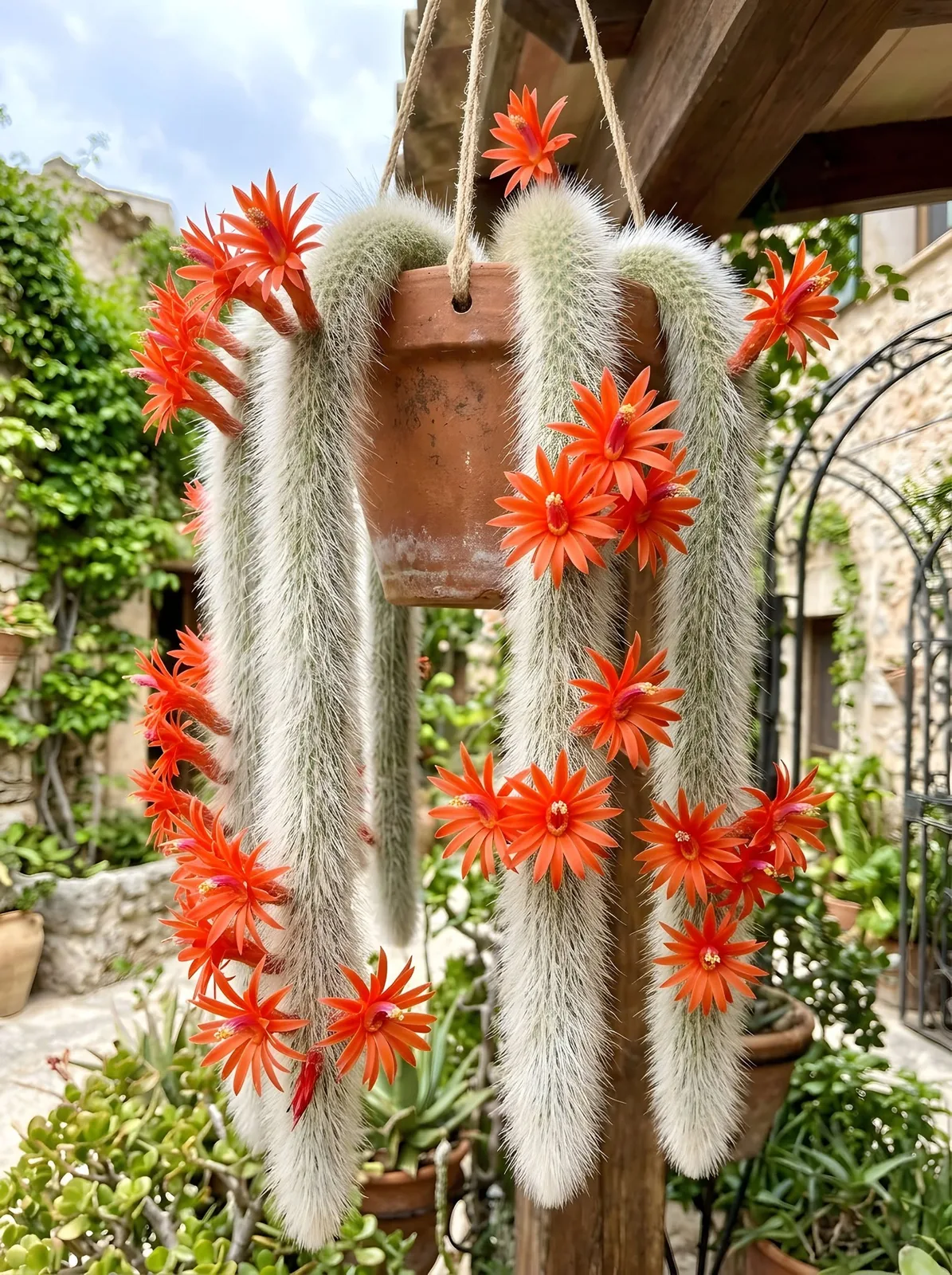
The monkey tail cactus, Cleistocactus colademononis, is the softest-looking cactus most growers will ever meet. Its long pendant stems hang in cascading ropes, each one buried under a coat of fine, soft, snow-white hair-like spines that you can stroke without harm. The Spanish name cola de mono, monkey’s tail, describes it exactly: a mature plant in a basket spills a curtain of pale tails two metres long.
It is also one of the few cacti that is at once a trade staple and a true range-restricted endemic. In cultivation it is everywhere, easy from cuttings and quick to reward a grower with vivid flowers. In the wild it is known from a single Bolivian mountain. That split is the whole story of the plant, and it is why the responsible way to own one is a nursery-propagated specimen rather than anything taken from habitat.
The trade still sells it almost universally under the old name Hildewintera colademononis, and it has been shuffled through several genera since its 2003 description. Kew POWO now treats it as a full species of Cleistocactus, close to the golden-haired Cleistocactus winteri, the Golden Rat Tail, which it was for a time folded into as a subspecies.
To care for a monkey tail cactus, hang it in a basket in full sun to bright light, water thoroughly through the growing season and let the mix dry out completely between waterings, pot it in a fast-draining mineral mix, and keep it cool and mostly dry through winter. Every one of those habits copies the humid cliff face it grows on in the wild, where it roots in crevices rather than soil, never sits in standing water, and rests dry before the red-magenta flowers open in spring and summer.
Cleistocactus colademononis quick reference
A pendant cliff-dweller from a single humid Bolivian mountain, grown almost universally in a hanging basket so its hair-clad tails can cascade. Values calibrated for seed grown plants in cultivation, drawn from habitat and specialist grower experience.
Taxonomy & nomenclature
The accepted name is Cleistocactus colademononis (Diers & Krahn) Mottram, raised to species rank in 2006. The basionym is Hildewintera colademononis Diers & Krahn, the name under which the plant was first described in 2003 and the name the trade still uses today. Between the two came the combination Cleistocactus winteri subsp. colademono D.R.Hunt (2005), which sank it as a subspecies of the Golden Rat Tail. Note the slight spelling shift along the way: Hunt’s subspecies epithet is colademono, while the accepted species epithet is colademononis. The epithet is simply the Spanish cola de mono, monkey’s tail, latinised.
Because the plant has bounced between segregate genera, it carries a thick synonymy. Beyond the Hildewintera and Cleistocactus winteri subsp. colademono names, it has been combined as Winterocereus colademononis, Bolivicereus colademononis and Borzicactus colademononis. Kew POWO keeps all of these in synonymy under C. colademononis. A genuine taxonomic disagreement remains: some treatments still sink the taxon under C. winteri rather than recognising it as a separate species, and the IUCN assessment is filed under that older name. This page follows POWO and leads with the full-species treatment while surfacing the trade and subspecies names as synonyms.
Within Cleistocactus, a genus of mostly erect South American columnar cacti, this species and the Golden Rat Tail are the outliers in habit: both trail rather than stand, a trait that once supported the small segregate genus Hildewintera. The familiar upright members, such as the Silver Torch Cleistocactus strausii, show the more typical pillar form. The shared Cleistocactus signature is the narrow, almost closed tubular flower, and the monkey tail carries it clearly.
Historical synonyms (11)
- Cleistocactus aureispinus (F.Ritter) D.R.Hunt, 1928 basionym
- Hildewintera colademononis Diers & Krahn, 2003 homotypic synonym
- Winterocereus colademononis (Diers & Krahn) Metzing & R.Kiesling, 2007 homotypic synonym
- Borzicactus colademononis (Diers & Krahn) Lodé, 2013 homotypic synonym
- Winteria aureispina F.Ritter, 1962 heterotypic synonym
- Winterocereus aureispinus (F.Ritter) Backeb., 1966 heterotypic synonym
- Hildewintera aureispina (F.Ritter) F.Ritter ex G.D.Rowley, 1968 heterotypic synonym
- Loxanthocereus aureispinus (F.Ritter) Buxb., 1974 heterotypic synonym
- Cleistocactus winteri D.R.Hunt, 1988 heterotypic synonym
- Cleistocactus winteri subsp. colademono D.R.Hunt, 2005 heterotypic synonym
- Bolivicereus simius-cauda Lodé, heterotypic synonym
Sources: POWO (Kew) · IPNI · GBIF · Wikidata
Habitat
Cleistocactus colademononis is endemic to Bolivia, in the Florida province of the Santa Cruz department, on the single mountain of Cerro el Fraile roughly 30 km east of the town of Samaipata. It is a lithophyte: rather than rooting in flat ground it hangs from humid, steep to vertical rock faces, anchored in crevices and the thin debris that gathers in them. The stems dangle in the open air off the cliff, which is the literal model for growing the plant in a basket.
The elevation is modest, commonly given as about 1,300 to 1,500 m, so despite the dramatic cliff setting this is not a high-altitude alpine cactus and should not be treated as one. The setting is humid for a cactus, with moisture moving across the rock faces, but the vertical habit means water never lingers at the roots: it drains away or evaporates fast. That combination, damp air with instant root drainage, is exactly what a cultivated plant needs reproduced.
The same corner of Bolivia is home to several of the species’ upright relatives, including the slender, scarlet-flowered Cleistocactus samaipatanus, named for the Samaipata area. Where those grow as pillars on slopes and among rocks, the monkey tail took the cliff face and the pendant habit, the two siblings solving the same dry Bolivian uplands in opposite postures.
Morphology
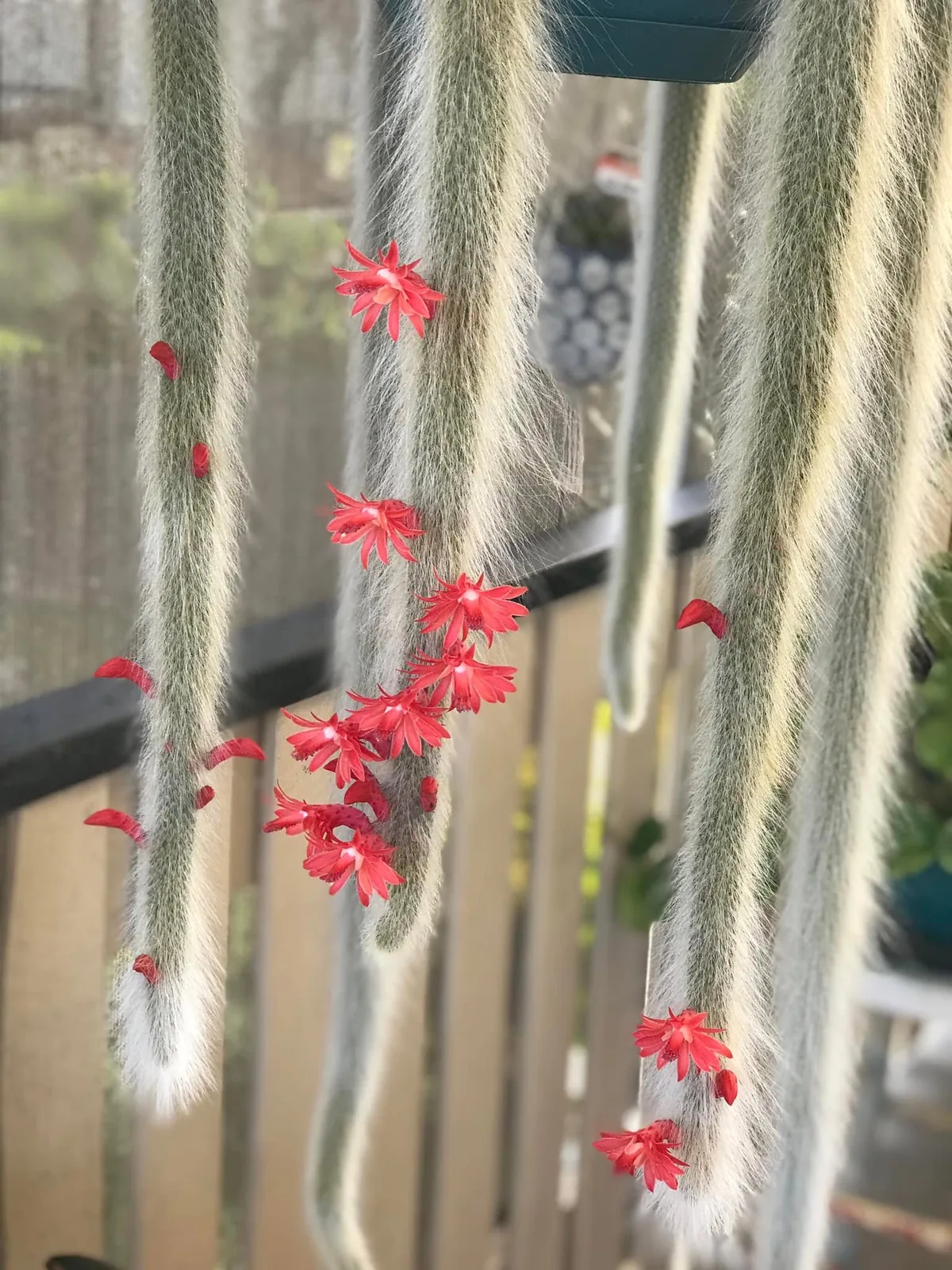
The stems are pendant and trailing, branching from the base and reaching up to about 2.5 m long on a mature plant, each one 3 to 7 cm thick. Beneath the hair the body is pale green and low-ribbed, with roughly 14 to 20 shallow ribs and areoles set about 3 to 6 mm apart. Left to itself the plant builds a cascade of many tails rather than a single stem.
The defining feature is the spination, and it comes in two kinds. Each areole carries 20 to 50 soft, white, hair-like spines, commonly 4 to 8 cm long and occasionally to 12 cm, and these are the tails: fine enough to stroke, dense enough to hide the stem completely. Tucked beneath them are a few shorter bristle spines, zero to four and sometimes more, pointing downward and tinged yellow, and these are the ones that actually prick. The soft outer coat over a harder inner guard is what makes the plant read as friendly while still being a cactus. The hair regenerates over time, so an old plant stays clad.
Flowers are pure Cleistocactus: narrow, tubular and zygomorphic, about 7 to 8 cm long, projecting nearly horizontally out of the hair. The colour runs vivid red to magenta, a hard, bright contrast against the white, and the slim tube suits the hummingbirds that work the genus. The fruit is a small spherical reddish berry, 8 to 12 mm, splitting lengthwise as it dries, with slightly curved black seeds about 1.1 to 1.4 mm long. The upright C. strausii wears a similar white coat but holds it on a rigid pillar, the clearest way to see how far the monkey tail has gone toward a hanging form.
Locality detail
The species is endemic to one mountain, Cerro el Fraile, in the Florida province of Santa Cruz, Bolivia, roughly 30 km east of Samaipata. The map below shows a regional centroid only. Sharp coordinates are withheld here as standard practice for a range-restricted endemic that has been directly targeted by collectors.
Because the wild plants hang from humid vertical rock faces on a single peak, the entire global population is small and concentrated, which is what makes its conservation assessment so cautious. It also means the plant is trivially easy to source legitimately as a cutting, so any specimen offered without clear cultivated origin should be refused on principle.
Cultivation
Two facts from the cliff drive everything. The plant trails, so it wants to hang; and it roots in fast-draining crevices in humid air, so it rots the moment it sits wet. A hanging basket, a sharp mineral mix and a dry winter cover almost the entire job, which is why the monkey tail has a reputation as an unusually rewarding cactus for a newer grower.
Substrate
Grow it in a free-draining, mineral-dominant mix of roughly 45 per cent pumice, 20 per cent decomposed granite, 15 per cent crushed lava and 20 per cent low-nutrient organic base, with no zeolite, no limestone and no silica sand. The organic fraction is higher than a desert cactus would take because this is a crevice plant that meets a little humus in habitat, but it stays a minority of the mix so water still drains through in seconds. A coarse, open blend also keeps air moving to the roots inside a basket, where stale wet compost is the usual killer.
Every Cleistocactus on this site runs a sharply drained, mineral-dominant mix. As a humid-cliff lithophyte rooting in crevice detritus, C. colademononis carries a higher share of low-nutrient organic matter than the desert columnars, while still sitting at four-fifths mineral for instant drainage.
| Species | Pumice | Lava | Zeolite | Granite | Limestone | Silica | Organic |
|---|---|---|---|---|---|---|---|
| C. colademononis (this page) | 45% | 15% | 0% | 20% | 0% | 0% | 20% |
| C. winteri | 50% | 10% | 0% | 20% | 0% | 0% | 20% |
| C. strausii | 50% | 20% | 0% | 25% | 0% | 0% | 5% |
| C. brookeae | 50% | 15% | 0% | 25% | 0% | 0% | 10% |
| C. samaipatanus | 50% | 15% | 0% | 20% | 0% | 0% | 15% |
Watering and light
Through spring, summer and into early autumn, water on a soak-and-dry rhythm: wet the mix thoroughly, then wait until it has dried out before watering again. Direct the water at the substrate rather than over the hair, which holds moisture against the stem and can mat. In winter keep the plant cool and largely dry; a rest near 10°C does double duty, preventing rot and setting the next season’s flower buds. Give it full sun to very bright light, ideally outdoors or in a bright greenhouse, with only the harshest summer midday glare softened. Hold it above about 4 to 5°C, and treat any sub-freezing dip as brief, bone-dry and risky rather than something the plant enjoys.
Propagation is mostly vegetative and easy, which is the real reason wild collection is indefensible. Take a stem segment, let the cut callus over several days, then set it in dry mineral mix to root; the trade builds its whole supply this way. Seed is viable but slow and far less common in commerce. At rarecactus.com we grow every specimen from seed in our greenhouse, so the plants we offer carry no wild-collection footprint, and seed grown stock holds the natural proportions and vigour of the species.
Comparison
The plant the monkey tail is most often set beside is its close relative the Golden Rat Tail, C. winteri. The two share the trailing habit and the segregate-genus history, and were treated as one species for a time. The quickest separation is colour and texture of the coat: C. winteri wears shorter, stiffer golden to yellow spines, while C. colademononis wears longer, softer, pure white hair, denser and more obviously tail-like. The monkey tail’s flowers also run more deeply red-magenta against that white.
Against the upright members of the genus the contrast is immediate. C. strausii, the Silver Torch, carries a comparably white woolly coat but on a stiff vertical column that never trails, and Cleistocactus brookeae is a shorter Bolivian pillar with orange-red blooms. C. samaipatanus from the same district stands slender and scarlet-flowered. None of these hang, so habit alone separates the monkey tail from the rest of Cleistocactus at a glance.
For a buyer the practical advice is simple. The monkey tail is widely and cheaply available as cuttings, so there is no reason to accept a wild-collected plant or to overpay for scarcity that does not exist in the trade. Choose a specimen with long, clean, dense white hair and healthy firm stems, and buy the exact plant you can see, since hair length and fullness vary from cutting to cutting. Collectors who like the monkey tail’s novelty look often also grow the boobie cactus, a similarly playful columnar prized for its bumpy crested form rather than hair.
Frequently asked questions
How do you care for a monkey tail cactus?
Give it full sun to bright light, water thoroughly through the growing season and let the mix dry out completely before watering again, plant it in a fast-draining mineral mix, and keep it cool and mostly dry through winter. Hang it in a basket so the pendant stems can trail freely. Cleistocactus colademononis is an unusually forgiving cactus and a good choice for a newer grower; the only thing that reliably kills it is overwatering.
Can the monkey tail cactus be grown from cuttings or seed?
Both, but cuttings are the usual route and they are easy. Take a stem segment, let the cut callus for several days, then set it in dry mineral mix to root; this is how the trade propagates it. Seed is viable but slow, so it is far less common commercially. Our own stock is grown from seed in the greenhouse, which keeps the natural form of the species.
Is the monkey tail cactus legal to own?
Yes. Like every cactus it sits on CITES Appendix II, not the stricter Appendix I, so nursery-propagated plants are freely owned and traded with the right paperwork for crossing borders. It is also an Endangered wild plant, which is exactly why wild collection is indefensible when cuttings are so easy. Buy cultivated, cutting-grown or seed grown plants only.
Where does the monkey tail cactus grow in the wild?
It is endemic to a single Bolivian mountain, Cerro el Fraile, in the Florida province of Santa Cruz, about 30 km east of Samaipata. There it hangs from humid, near-vertical rock faces at roughly 1,300 to 1,500 m, rooting in crevices rather than soil. That tiny, concentrated range is why it is assessed as Endangered despite being common in cultivation.
When does the monkey tail cactus flower, and what colour are the flowers?
Flowering comes in spring into summer, generally after a cool, dry winter rest that sets the buds. The flowers are narrow tubular trumpets about 7 to 8 cm long, vivid red to magenta, projecting nearly horizontally from the white-haired stems for a striking contrast. Plants flower once they have built enough mature stem length, so a young cutting may take a season or two.
Sources & further reading
Diers, L. & Krahn, W. 2003. Hildewintera colademononis (original description) · Mottram, R. 2006. Combination Cleistocactus colademononis (Diers & Krahn) Mottram · Kew POWO, Cleistocactus colademononis (Diers & Krahn) Mottram, powo.science.kew.org · Hunt, D.R. 2005. Cleistocactus winteri subsp. colademono (subspecies combination) · IUCN Red List of Threatened Species, assessment carried under Cleistocactus winteri (Endangered) · Royal Horticultural Society, Cleistocactus colademononis (Award of Garden Merit) · British Cactus & Succulent Society, Cleistocactus winteri ssp. colademono cultivation notes · World of Succulents, Cleistocactus colademononis (Monkey’s Tail): morphology and care · Succulents Network, Cleistocactus colademononis care guide (light, temperature, propagation) · CITES Appendices, Cactaceae spp. listed on Appendix II (whole-family listing)