
Myrtillocactus geometrizans (crested)
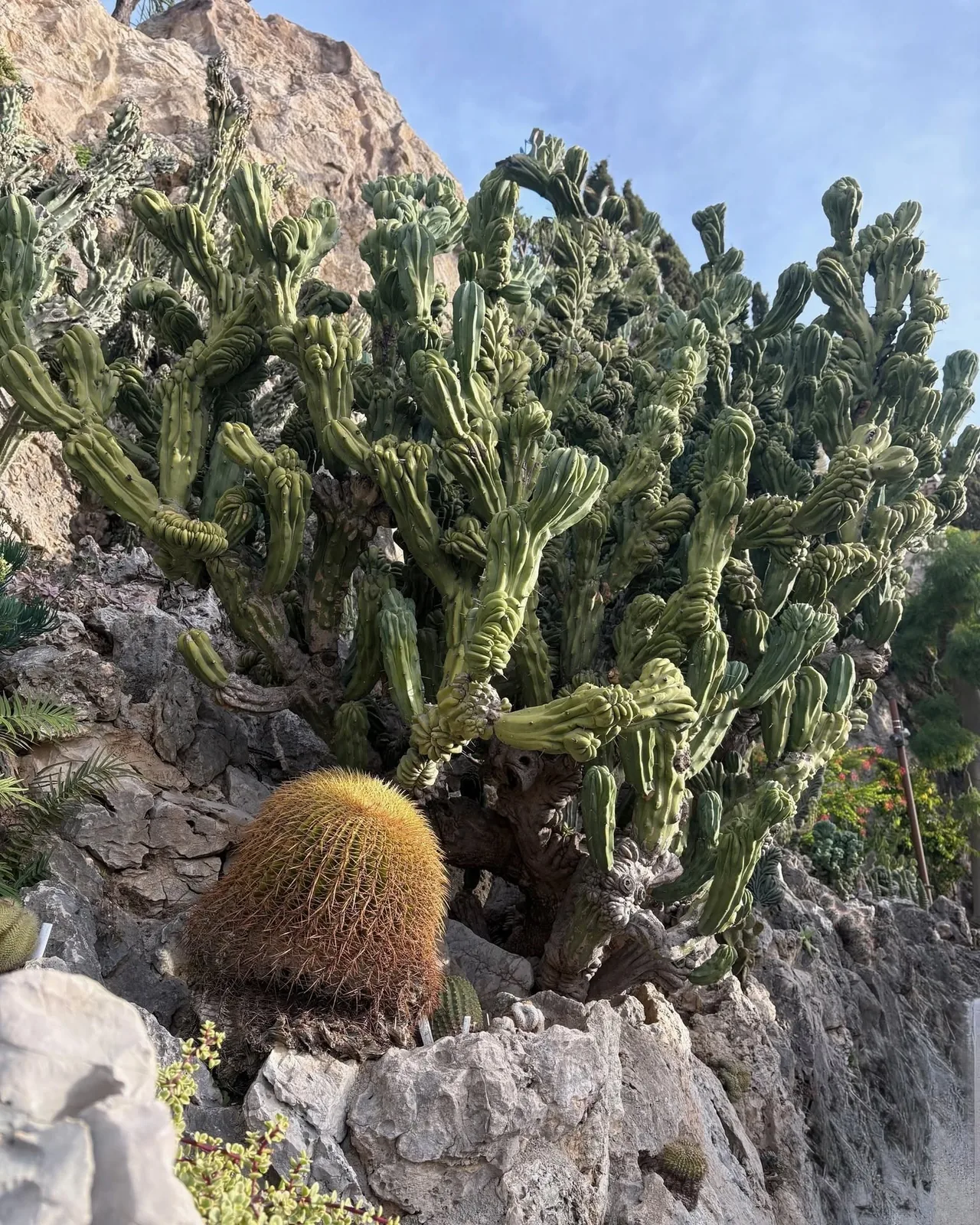
Myrtillocactus geometrizans is the species behind the viral boobie cactus, also sold as the breast cactus or titty cactus, a novelty whose rounded, sagging tubercles read unmistakably as a row of breasts down the stem. The plant people photograph and pass around online is not a separate species at all. It is a vegetative oddity of the common Mexican blue myrtle, the same powder-blue columnar cactus that lines dry hillsides across central Mexico and carries the sweet little fruit Mexicans call garambullo.
Two different mutations get sold under the boobie nickname. The literal breast look belongs to the monstrose Japanese cultivar ‘Fukurokuryuzinboku’, in which the areoles bulge into soft, rounded bumps. The crested or cristate form is the other novelty, a fan-shaped fasciated crest also traded as the Dinosaur Back Plant or crested blue flame. Neither is an accepted botanical taxon: Kew POWO files the crest, M. geometrizans f. cristatus, as a synonym of the ordinary species rather than a name in its own right.
The parent species is a big, fast, shrubby columnar that builds a woody trunk and a candelabra of blue stems up to four or five metres tall. It is abundant across central Mexico, not a habitat rarity, and its scarcity is purely horticultural: the crest and the monstrose forms grow slowly and propagate only the hard way. It shares its dry-country range with desert miniatures such as Mammillaria humboldtii in the limestone barrancas of Hidalgo.
What follows treats both halves of the plant honestly: the wild blue myrtle as botany, and the crest as the novelty it is. The single most important fact for a buyer is that the boobie crest cannot be grown from seed. It is a cutting-or-graft cultivar, and we say so plainly. Browse the wider rare cactus encyclopedia for more Mexican columnars and their novelty forms.
Myrtillocactus geometrizans quick reference
A vigorous columnar from the tropical deciduous forest and xerophilous scrub of central Mexico, roughly 1,000 to 2,000 m, where it grows fast in heat and bright light and shrugs off drought. The crested and monstrose forms are slower and a little more tender than the wild column, especially when grafted. Values below cover the cultivated plant, crest or column alike; note that the crest is a vegetative cultivar, not a seed grown plant.
Taxonomy & nomenclature
The accepted name is Myrtillocactus geometrizans (Mart. ex Pfeiff.) Console, the type of a small genus Console erected in 1897. The basionym is Cereus geometrizans Mart. ex Pfeiff., and the species carries a long synonymy from the era when columnar cacti were lumped in Cereus: Cereus pugionifer, Myrtillocactus pugionifer and others all fall here. Kew POWO and the world checklist treat sixteen names as synonyms of this one species.
The crest matters for this page. POWO lists Myrtillocactus geometrizans f. cristatus P.V.Heath as a synonym, not an accepted taxon, so the correct way to write the plant is as the accepted species with a parenthetical note that it is the crested or monstrose form. The viral breast look is most precisely the monstrose cultivar ‘Fukurokuryuzinboku’; the fan crest is the cristate form. Treating either ‘f. cristata’ as though it were a rank-bearing botanical name overstates it.
The genus is small and all-American. Besides the blue myrtle it holds the Baja California Myrtillocactus cochal, the southern Mexican Myrtillocactus schenckii and the Guatemala-ranging Myrtillocactus eichlamii, all blue-stemmed candelabra cacti with edible berry-like fruit; the Myrtillocactus genus hub sets the four species side by side. M. geometrizans is the widest-ranging and the one in every garden centre.
Habitat
Myrtillocactus geometrizans is endemic to Mexico, despite the occasional loose claim that it ranges through Central America. It is spread across the centre and north of the country, through Hidalgo, Querétaro, San Luis Potosí, Guanajuato, Puebla, Oaxaca, Zacatecas and beyond, and has naturalised in parts of Spain. It grows in tropical deciduous forest and xerophilous scrub, usually between about 1,000 and 2,000 m, and is frequently one of the dominant plants on the slope.
The signature powder-blue is a glaucous wax bloom on the epidermis, a sunscreen against fierce highland light that rubs off at a touch and fades as stems age. In the same dry barrancas it stands over desert miniatures wedged into the limestone, the kind of cliff habitat that shelters white-spined snowball cacti higher up the rock face.
Where it is abundant the plant is part of daily life. Its sweet purple fruit, the garambullo, is gathered fresh and dried, and the fast blue columns are cut and rooted as living fences. This is a workhorse cactus of the Mexican countryside, not a jewel of a remote cliff.
Morphology
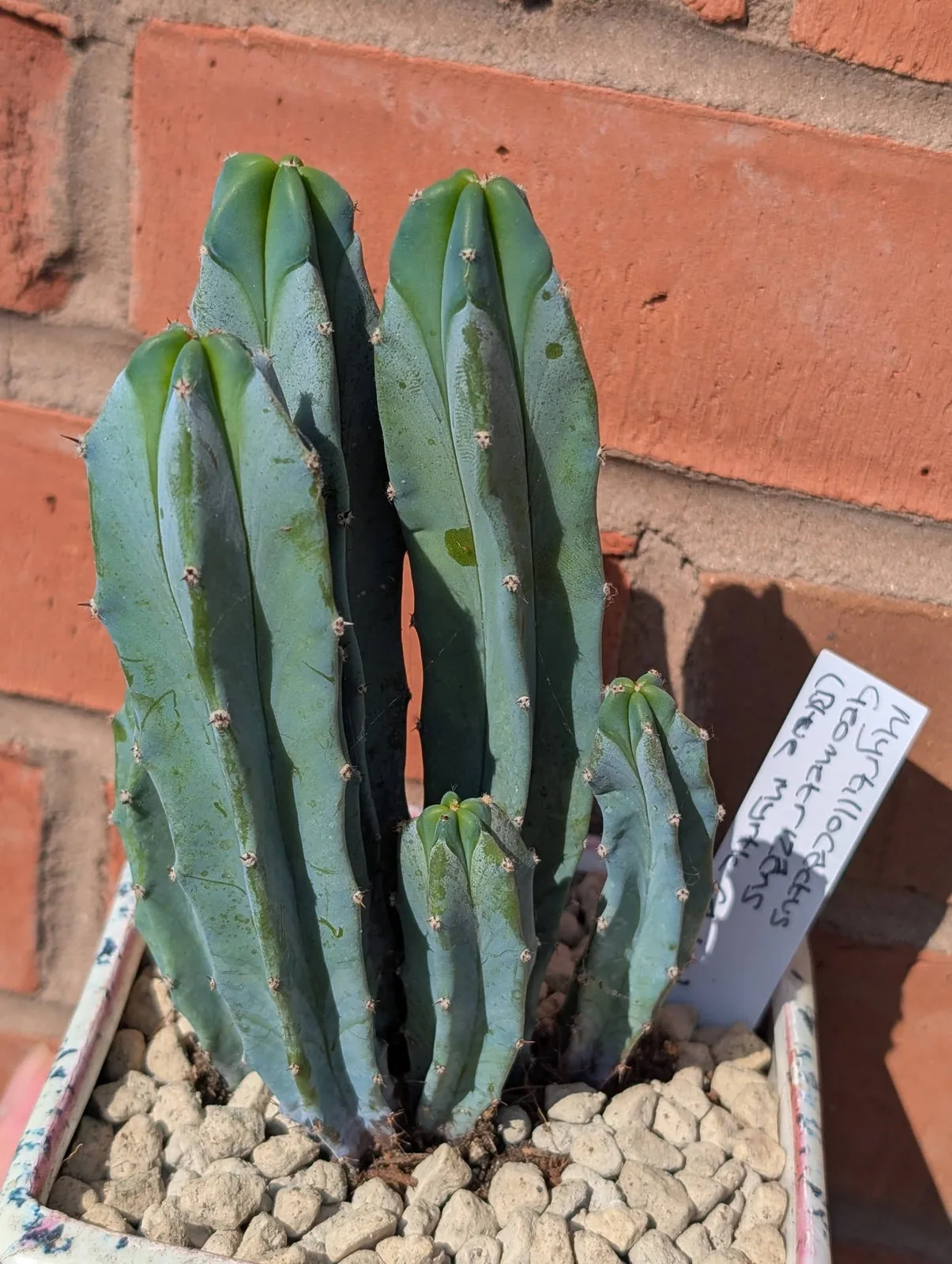
The wild plant is a large shrubby to tree-like cactus, branching into a candelabra from a short woody trunk and reaching four to five metres. Stems are distinctly blue to blue-green, usually with five or six ribs, carrying short spines: one stubby central and a few radials per areole. Small creamy to greenish flowers open several to an areole, followed by the round garambullo fruit, eight to twenty millimetres across, blue-bloomed and sweet like a tiny bilberry.
The boobie forms rework that plain geometry. In the monstrose ‘Fukurokuryuzinboku’ the ribs and areoles swell into soft, rounded, drooping tubercles, the breast-like bumps the nickname is built on. In the cristate form the single growing tip multiplies into a line of points that crowd and fuse into an undulating fan, a brain-like or dinosaur-back crest. Both keep the blue colour and both grow slowly. Neither flowers or fruits with any reliability, because the mutation that makes them collectible also disrupts the normal flowering geometry.
Underlying every form is a vigorous, accommodating vascular system, which is why M. geometrizans is the premier grafting rootstock for the hobby. It roots fast, takes a wide range of scions, and stays compatible longer than dragon-fruit stock. A great many of the oddities in cultivation, including most boobie crests offered for sale, ride on a Myrtillocactus column.
Locality detail
The species ranges across central and northern Mexico rather than from any single point, so the map below marks a regional centroid in the central highlands rather than a locality. There is no conservation reason to redact it; the plant is abundant and widely cultivated. The marker simply anchors the broad endemic range.
From that core the blue myrtle reaches north toward Nuevo León and Zacatecas and south into Oaxaca, always in warm, dry, bright country between roughly 1,000 and 2,000 m. Naturalised stands in Spain sit outside the native range and are not mapped here.
Cultivation
Two things make this plant easy where its rare relatives are hard: it is fast and it is tough. The wild blue column asks only for heat, light, sharp drainage and restraint with the watering can. The crest and the graft want the same, with a gentler hand on light while young and extra care to keep frost off.
Substrate
Grow it in a free-draining, mineral-dominant mix of roughly 45 per cent pumice, 20 per cent lava rock, 20 per cent decomposed granite and 15 per cent low-nutrient organic matter, with no limestone, zeolite or silica sand. The wild column is vigorous and tolerates a touch more organic matter than a cliff miniature would, but drainage still comes first; the point is a mix that wets and dries fast and never stays soggy at the base. Our full cactus soil mix recipe scales the same principle up for bigger pots.
The blue myrtle is a vigorous lowland-to-midland grower, not a cliff plant, so its mix runs gritty and free-draining but carries a little more organic matter than the rot-prone miniatures. Pumice leads, with lava and granite for structure and a light organic fraction for the fast roots.
| Species | Pumice | Lava | Zeolite | Granite | Limestone | Silica | Organic |
|---|---|---|---|---|---|---|---|
| M. geometrizans (crested) (this page) | 45% | 20% | 0% | 20% | 0% | 0% | 15% |
Watering and light
Through the warm months water only when the mix has gone bone dry, then soak and let it dry again; this plant would far rather be too dry than too wet. In winter keep it nearly dry, giving a splash only if the stems visibly shrivel. Full sun brings out the deepest blue on an established plant, but young columns and freshly grafted or cut crests sunburn easily, so introduce them to strong light slowly and shade them through the first fierce afternoons. Hold the plant above about 4°C and keep all frost off the blue skin.
Here the two halves of the plant part ways. The wild blue myrtle grows readily from seed and from stem cuttings, fast and true to type, and good seed grown columns are the honest, sustainable way to own the species. The boobie crest and the monstrose form are a different matter: they are vegetative cultivars that do not come true from seed, so a sown seed simply gives back an ordinary column. The novelty is kept going only by rooting cuttings of crested tissue or by grafting the crest onto a columnar rootstock, which is why so much of the trade sells these forms grafted. At rarecactus.com we grow our cacti from seed in our own greenhouse, and we are transparent that crested and monstrose novelties like this one are not seed grown at all but propagated vegetatively. If you want the curiosity, buy it as exactly that, a grafted or rooted crest, and reserve the seed grown label for the wild column where it is true. For the trade-offs behind the choice, see our guide to grafted versus seed grown cacti.
Comparison
The boobie cactus is really a comparison between three things wearing one name: the wild blue column, the monstrose ‘Fukurokuryuzinboku’ with its breast-like bumps, and the fan-shaped cristate crest. The monstrose is the one that earns the nickname most literally; the cristate is the Dinosaur Back Plant; the plain column is the garambullo of Mexican fields. A buyer should be clear which of the three a listing is actually selling.
Against its own genus the species is the giant and the generalist. The Baja M. cochal stays shorter and denser, the Oaxacan M. schenckii runs to finer ribs and darker fruit, and the southern M. eichlamii is more slender and reaches into Guatemala. All share the blue stems and edible berries, but M. geometrizans is the one with the range, the trunk and the fame.
Because the crest and the monstrose are slow, sculptural and usually grafted, two specimens are never quite alike. Anyone buying one should choose the exact plant in front of them for the shape of its crest, the health of the graft union and the depth of the blue, rather than ordering a novelty sight unseen. For another cactus bred more for personality than orthodox form, see the trailing, shaggy monkey tail cactus.
Frequently asked questions
How do you take care of a boobie cactus?
Give it full sun once established, a fast-draining mineral mix, and water only when the pot has gone bone dry, holding back almost entirely in winter. Keep it above about 4°C, since frost damages the blue skin, and shade young plants or fresh grafts while they acclimate to strong sun.
Is a boobie cactus rare?
No. The boobie cactus is a nursery novelty of Myrtillocactus geometrizans, a common, Least Concern species that grows abundantly across central Mexico. The only real scarcity is horticultural: the crested and monstrose forms grow slowly and can only be propagated by cuttings or grafting, never from seed.
Are boobie cactus hard to grow?
No. The underlying plant, Myrtillocactus geometrizans, is one of the easier cacti: fast, tough and forgiving as long as it gets sharp drainage, bright light and a dry winter. The only real cautions are frost, which damages the blue skin, and overwatering, which rots the base. Grafted crests want a gentler introduction to strong sun, but once settled they are no harder than the wild column.
Do boobie cacti like full sun?
Yes, once established. Full sun deepens the blue color of the stem, but young plants and freshly grafted or rooted crests scorch easily in hard sun, so acclimate them gradually and shade them at first.
Why is it called the boobie cactus?
Because of a mutation. In the monstrose cultivar ‘Fukurokuryuzinboku’ the areoles and ribs swell into soft, rounded, sagging tubercles that line up down the stem and read unmistakably as breasts, which is how the boobie, breast or titty cactus nickname stuck. The fan-crested form is sometimes sold under the same name too. It is a quirk of Myrtillocactus geometrizans, not a separate species.
Sources & further reading
Console, M. 1897. Myrtillocactus Console (genus established) · Kew POWO, Myrtillocactus geometrizans (Mart. ex Pfeiff.) Console, accepted name with 16 synonyms, powo.science.kew.org/taxon/urn:lsid:ipni.org:names:135710-1 · Kew POWO, Myrtillocactus geometrizans f. cristatus P.V.Heath, listed as a synonym of the species · IPNI, International Plant Names Index, urn:lsid:ipni.org:names:135710-1 · LLIFLE, Encyclopedia of Living Forms, Myrtillocactus geometrizans and Cereus geometrizans · Monaco Nature Encyclopedia, Myrtillocactus geometrizans (morphology, range, 1,000–2,000 m, fruit 8–20 mm) · World of Succulents, Myrtillocactus geometrizans f. cristatus (Dinosaur Back Plant) · Henry Shaw Cactus and Succulent Society, Plant of the Month: Myrtillocactus geometrizans (February 2020) · Trex Plants, Care Diary: Myrtillocactus geometrizans and cultivars (cold tolerance, light, water, grafting, monstrose form) · Tula House, Myrtillocactus geometrizans f. crestata (light, water, soil, minimum temperature, propagation) · Royal Botanic Gardens Kew, CITES Cactaceae Checklist; family Cactaceae on CITES Appendix II since 1975 · IUCN Red List of Threatened Species, Myrtillocactus geometrizans (Least Concern)