
Aztekium ritteri
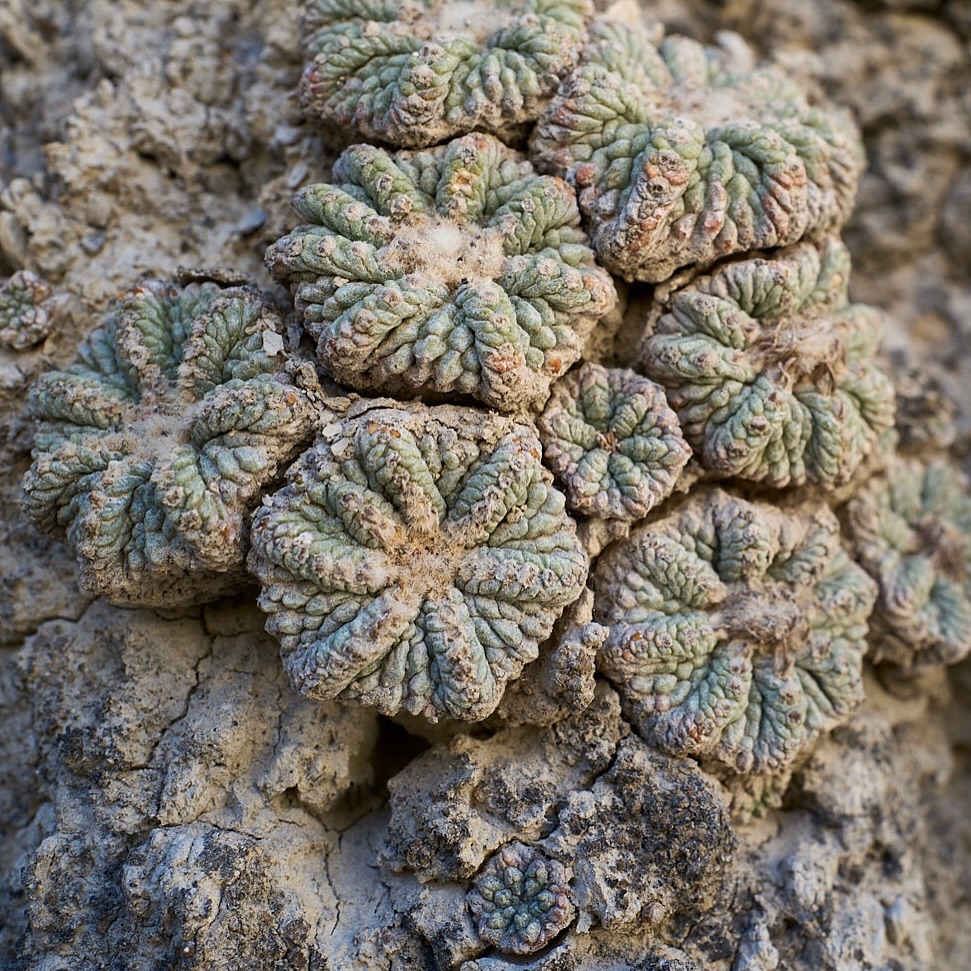
Aztekium ritteri is a cactus of extreme specialization, rooted in near-vertical gypsum and limestone cliff crevices in the Sierra Madre Oriental of Nuevo León, Mexico. The body grows to 2–5 cm in diameter, grey-green, with deeply corrugated primary ribs crossed by transverse furrows. Between those ribs runs a secondary system of compressed tubercle bases that form fold-like false ribs not extending the full stem height. This secondary rib character and the pronounced transverse furrows inspired both the genus name Aztekium (resembling Aztec carved stone) and the plant’s outsized reputation among collectors relative to its tiny body.
Friedrich Boedeker described the species as Echinocactus ritteri in 1928 in the Zeitschrift fur Sukkulentenkunde, naming it for Friedrich Ritter, the German field botanist who collected the type specimen in the Valley of Rayones. One year later Boedeker established the new genus Aztekium and simultaneously transferred his species into it, making him both original author and combining author; the authority reads (Boed.) Boed. The genus remained monotypic for more than six decades until Aztekium hintonii was described in 1992 by Glass & Fitz Maurice from a second Nuevo León canyon system, and a third species, Aztekium valdezii, followed in 2013.
The accepted distribution centres on Nuevo León at the type locality and surrounding Sierra Madre Oriental canyons. Kew POWO additionally records Coahuila and San Luis Potosí from the broader herbarium-record backbone; those records likely reflect herbarium occurrences or peripheral range interpretations rather than confirmed Aztekium population centres. Specialist field literature places documented populations squarely in Nuevo León. The microhabitat is consistent: nearly vertical canyon walls, gypsum and limestone parent rock, fine clay in crevice gaps, minimal organic content, and north-facing or heavily shaded aspect.
Growth is among the slowest of any cactus in cultivation. Seed grown plants require 7 to 10 years to reach first flowering size without grafting, and some growers report plants older than 20 years still pre-flowering. Grafted specimens accelerate dramatically but lose the characteristic grey compact habit that defines collector-grade material.
Aztekium ritteri quick reference
A cliff-face specialist from gypsum and limestone canyons in Nuevo León at 800–1,060 m, with north-facing shaded aspect and periodic surface-runoff moisture. Values calibrated for seed grown plants in cultivation, drawn from habitat data and specialist grower experience.
Taxonomy & nomenclature
The accepted name is Aztekium ritteri (Boed.) Boed., published in Monatsschrift der Deutschen Kakteen-Gesellschaft 1: 52 (1929; IPNI LSID urn:lsid:ipni.org:names:27781-2). The basionym is Echinocactus ritteri Boed., published in the Zeitschrift fur Sukkulentenkunde 3(14): 305–306, with figure (1928; IPNI LSID urn:lsid:ipni.org:names:87667-2). Boedeker described the species as an Echinocactus in 1928 and transferred it to his newly erected genus Aztekium the following year, making him both the original author and the combining author.
The specific epithet honors Friedrich Ritter, the German field botanist and cactus collector who gathered the type specimen in the Valley of Rayones, Nuevo León, in the late 1920s. The genus name Aztekium references the resemblance of the deeply corrugated, transversely furrowed rib surface to Aztec carved-stone relief work. The genus contains only three accepted species: A. ritteri, A. hintonii, and A. valdezii. No subgenus or section has been formally established. Tribal placement within Cacteae is morphologically based; the genus has not been subject to published molecular phylogenetic revision.
The primary synonym is the basionym Echinocactus ritteri Boed. (1928), which appears in pre-1930 literature and older collector references but carries no current taxonomic standing. A second synonym, Aztekium ritteri var. rotundum Snicer & Kunte, published in Kaktusy (Brno), Special 1: 20 (2019; IPNI LSID urn:lsid:ipni.org:names:77201998-1), was described from cultivated material and is treated by POWO as a synonym of the species rather than an accepted taxon. Its status as a true variety versus a cultivation-induced phenotype is not resolved in the specialist literature. Some secondary sources erroneously list Aztekium valdezii as a synonym of A. ritteri; POWO and the CITES species database both recognise A. valdezii as an independent accepted species.
POWO follows the broader herbarium-record backbone, which lists Coahuila and San Luis Potosí alongside the field-confirmed Nuevo León populations. Field-documented populations in specialist cactus literature are all placed in Nuevo León; the Coahuila and San Luis Potosí records likely represent herbarium occurrences or peripheral range interpretations rather than confirmed Aztekium population centres.
Historical synonyms (3)
- Echinocactus ritteri Boed., 1928 basionym
- Aztekium ritteri var. rotundum Snicer & Kunte, 2019 homotypic synonym
- Aztekium valdezii Velazco, M.A.Alvarado & S.Arias, 2013 heterotypic synonym
Sources: POWO (Kew) · IPNI · GBIF · Wikidata
Habitat
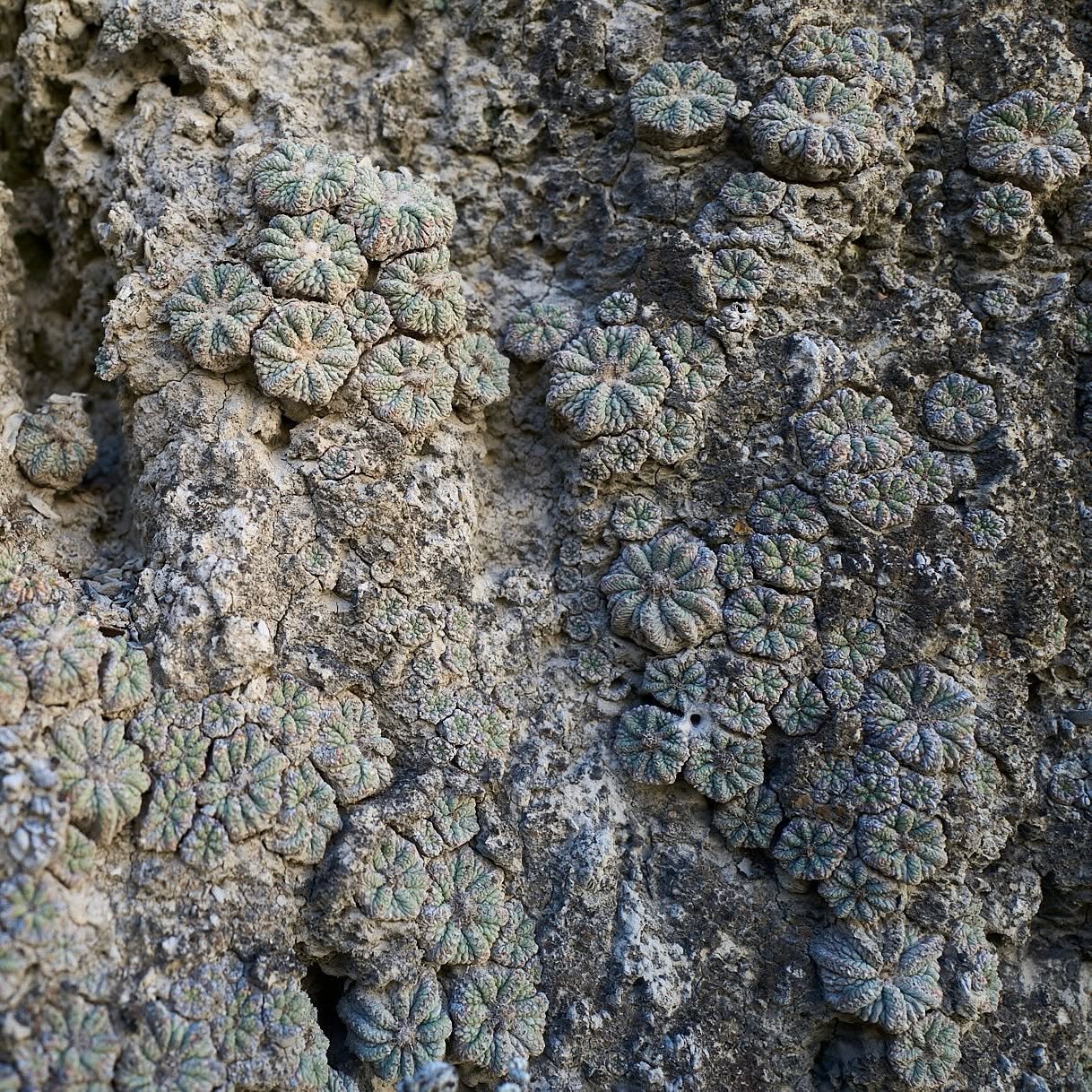
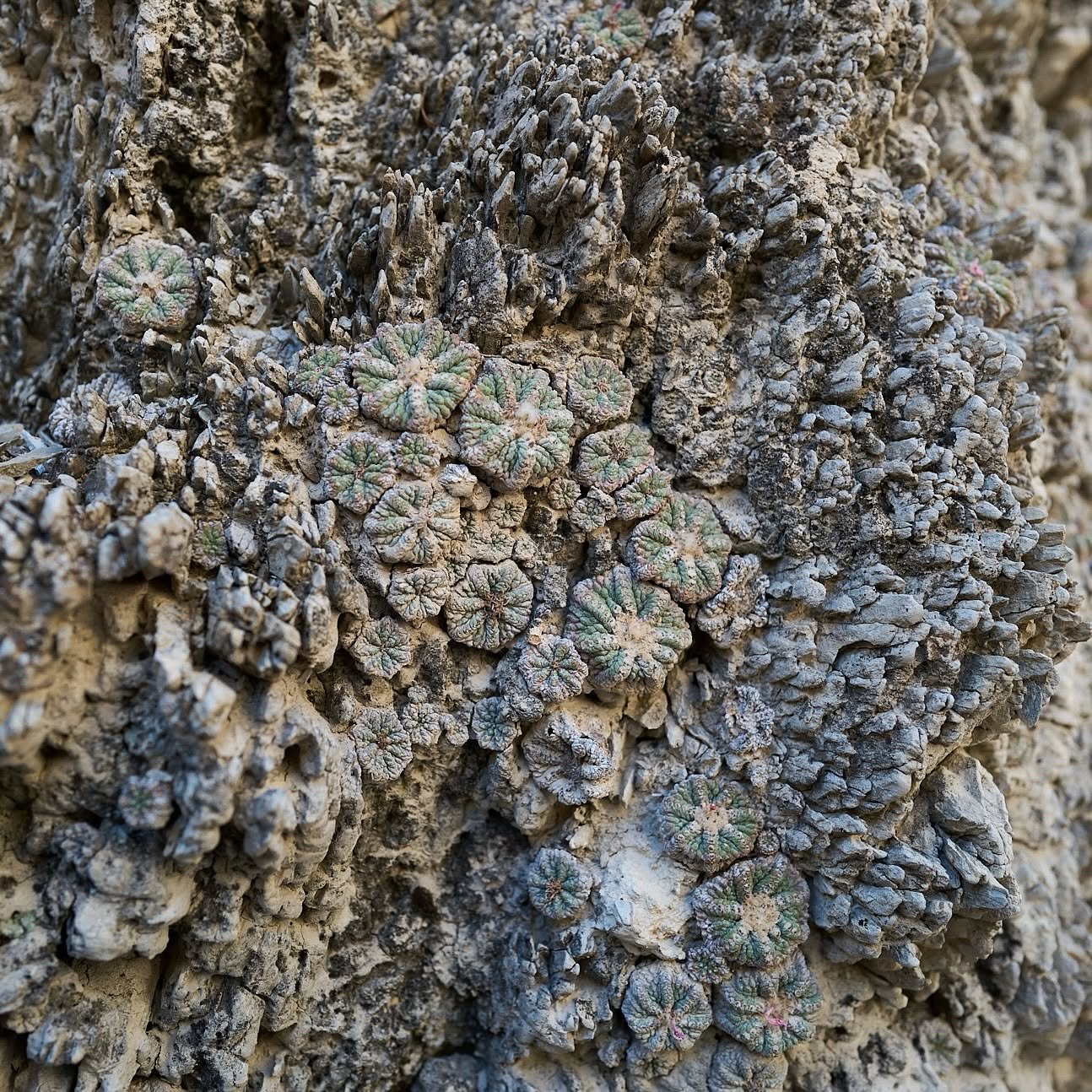
Aztekium ritteri occupies a microhabitat unmatched in the cactus family for its constraints: near-vertical canyon walls of incised gypsum and limestone chasms in the Sierra Madre Oriental of Nuevo León. The parent rock is Jurassic gypsum and middle-to-lower Cretaceous limestone, with some Tertiary conglomerate. Plants root in fine clay that accumulates in crevices, with minimal or no organic content. The slope angle approaches 90 degrees; standing water never forms around the root zone, yet surface runoff crosses the rock face after rain events, giving plants episodic moisture access from above.
Peer-reviewed measurements of the rib architecture quantify its functional role in shading and gas exchange. The transverse furrows and crypt-set stomata increase the stem surface-to-volume ratio by more than ten-fold compared to a smooth sphere of equal size. Only about 20 percent of the stem surface is exposed to direct sunlight at any time; the rest is self-shaded by the rib and furrow geometry. During drought, the furrows collapse inward over the stomatal crypts, cutting water loss further.
Aspect is consistently reported as north-facing or heavily shaded. The canyon microclimate is more humid than open exposures at the same elevation, with condensation on cool canyon walls contributing to moisture between rainfall events. The species occurs between 800 and 1,060 m on gypsum-cliff faces. Annual precipitation in the Sierra Madre Oriental is 300–800 mm, a wide range reflecting orographic variability; the canyon microhabitat intercepts runoff rather than open rainfall.
Associated flora at Rayones-area populations includes Neolloydia conoidea, Mammillaria candida, Mammillaria pilispina, Epithelantha micromeris, Opuntia stenopetala, Thelocactus bueckii subsp. matudae, and several Echinocereus taxa. Selaginella lepidophylla, the resurrection plant, co-occurs at Rayones sites and is hypothesised to assist Aztekium germination, though the mechanism is not documented in the primary literature. The vegetation community is submontane scrub and rosetophilous desert scrub.
Morphology
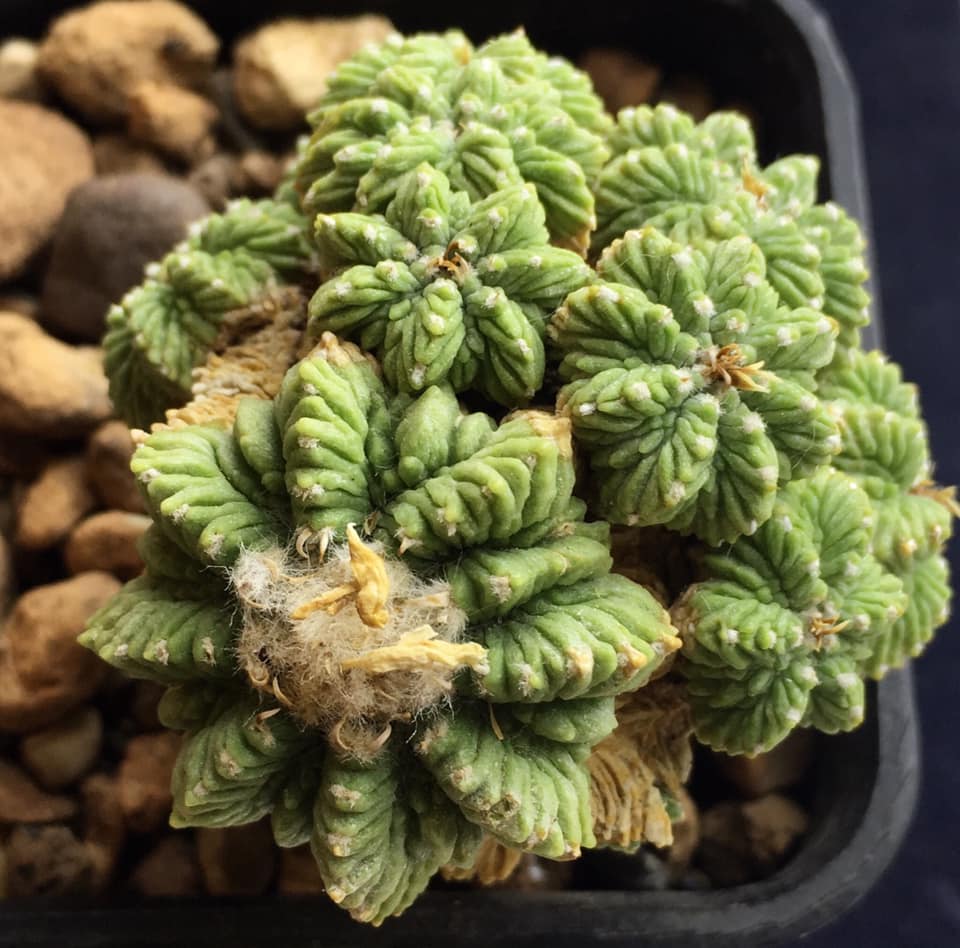
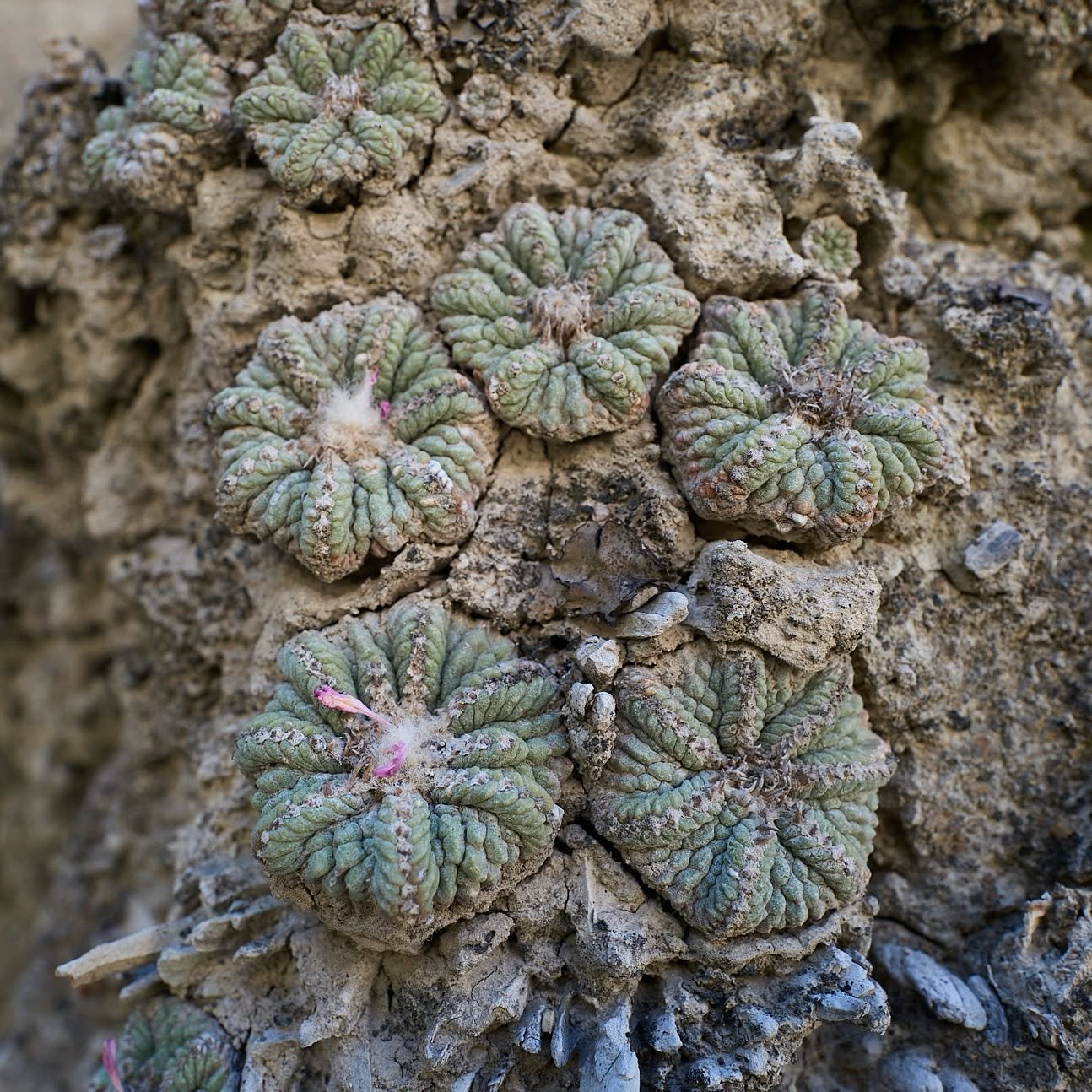
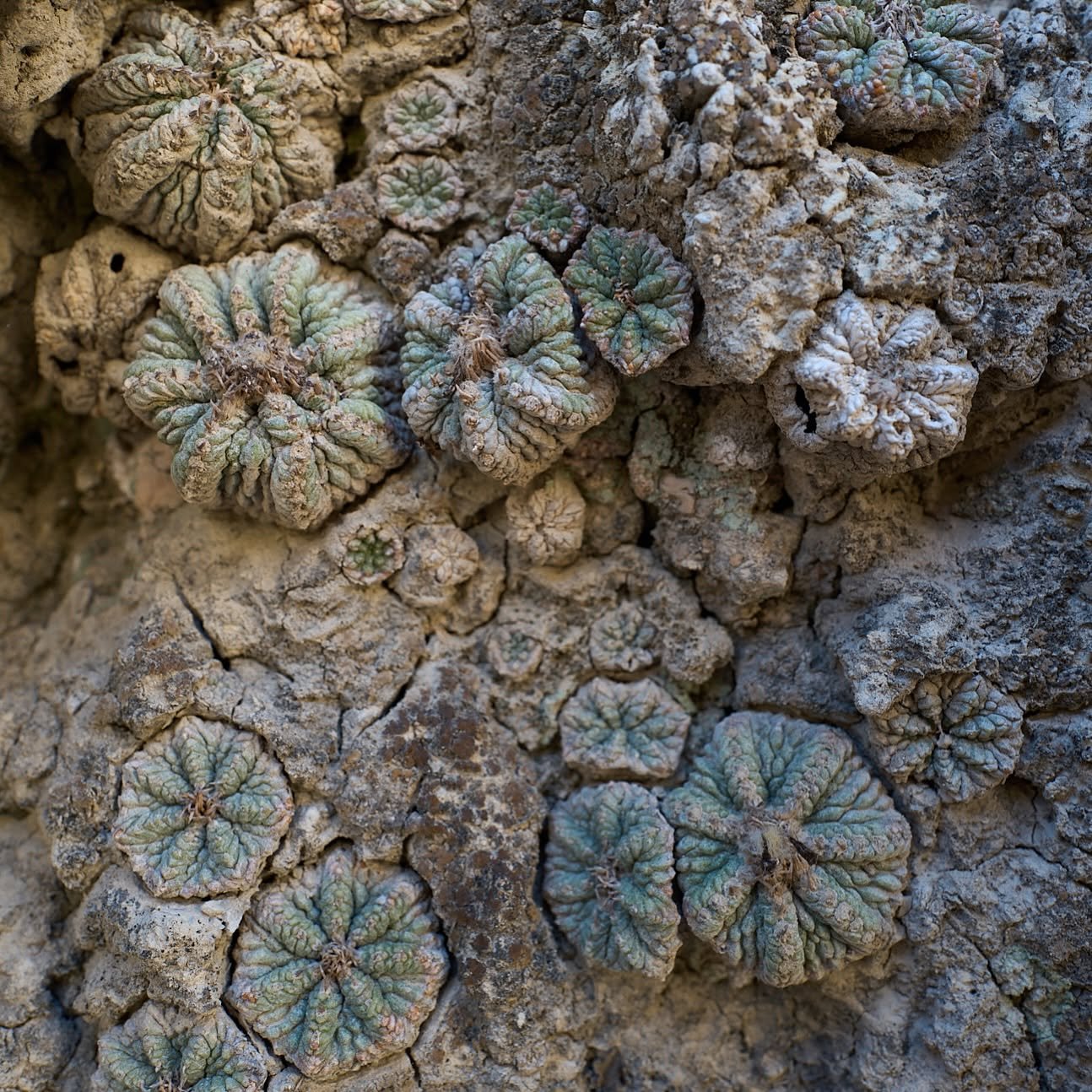
Aztekium ritteri is initially solitary, globular to broadly depressed-globular, with a sunken woolly apex. With age it produces offsets from the base, forming low clumps; grafted specimens offset more readily and faster than slow-grown ungrafted plants. Mature plants reach 2 to 5 cm in diameter, with the largest specimens approaching 6 cm. Height is 3–5 cm. Colour is grey-green to grey; younger growth is paler yellowish-green. Grafted specimens remain noticeably greener than old slow-grown plants.
Peer-reviewed morphometric work documents a full intraspecific range of 8 to 15 ribs, with 9 to 11 typical. The ribs are rounded in cross-section, 5–9 mm high and 3–10 mm wide. Each rib is crossed by numerous horizontal transverse furrows, producing the corrugated stone-carving appearance. Between the primary ribs, the compressed bases of adjacent tubercles form secondary false ribs that do not extend the full stem height. The secondary-rib feature is the diagnostic vegetative character separating A. ritteri from A. valdezii, which lacks them entirely, and from A. hintonii, on which they are absent or weakly expressed.
Areoles are closely spaced, with white felt at maturity; apical areoles carry heavy white wool. Spine count is 1–3 per areole, present mainly on young apical areoles. Lower and older areoles are typically spineless or carry only vestigial traces. The spines are flattened, soft, non-pungent, whitish, 3–4 mm long, and somewhat bent or contorted. This brief, soft spination contrasts sharply with the strongly curved spines reaching 13 mm in A. hintonii.
Flowers emerge from the apical woolly areoles throughout summer, with two main flushes: early summer and midsummer. Flower diameter is under 10 mm, cross-verified across multiple specialist sources. Petals are white to pale pink; outer petals carry a darker mid-stripe. Fruit is a small pink berry that opens when ripe. Seeds are approximately 0.5 mm long, black, pyriform, with a thickly tuberculated testa; germination rates in cultivation are under 5 percent by most specialist accounts. A short napiform taproot anchors the plant in the cliff crevice.
Locality detail
The type collection was made by Friedrich Ritter in the Valley of Rayones (Cañón de Rayones), Municipality of Rayones, Nuevo León, Mexico, in the late 1920s. No confirmed published centroid exists for the Rayones valley locality in primary sources consulted; the map below shows a regional centroid only. Sharp GPS coordinates are withheld from this page following standard practice for CITES Appendix I taxa under active collecting pressure.
All field-documented populations in specialist literature are placed in Nuevo León; POWO additionally records Coahuila and San Luis Potosí but these are not corroborated by specialist field studies. Wild-collected specimens cannot legally enter international trade under CITES Appendix I; any plant without complete documentation of cultivated origin must be treated as suspect.
Aztekium ritteri care and cultivation
Aztekium ritteri grows in habitat on fine clay in gypsum and limestone crevices with essentially no organic content and zero standing water. Its aspect is north-facing or heavily shaded, with only about 20 percent of the stem surface ever in direct sun, and those two facts frame every cultivation decision. Replicating both in cultivation determines whether the plant thrives or declines.
Substrate
The canonical ratio is 43 per cent pumice, 10 per cent lava rock, 5 per cent zeolite, 20 per cent granite grit, 12 per cent limestone chip, 5 per cent coarse silica, and 5 per cent worm castings. No published cultivation source addresses substrate proportions for Aztekium ritteri specifically. The limestone share follows the carbonate-convention pairing shared with Ariocarpus, a group-level guideline rather than a species-specific finding; reduce or omit it on hard tap water. The organic share holds at the low end of the taprooted-globular group’s rot-averse range, with zero organic content beyond the worm castings. The lava fraction is the drainage aggregate at the base of the root zone; zeolite buffers pH and paces cation exchange through the summer watering cycle. Pumice, lava rock, zeolite, granite grit and coarse silica are the site’s declared house formulation for particle structure and drainage, carrying no lithology claim. The mix must pass water through immediately; any substrate that holds moisture at the neck promotes rot.
All three Aztekium species on this site grow on near-vertical gypsum and limestone cliff crevices in Nuevo León, but that habitat fact does not set the recipe below. The substrate ratios are effectively identical across the genus: a house formulation carrying a carbonate-convention limestone share paired with the published Ariocarpus finding, plus the site’s standard drainage aggregates. No published cultivation source treats Aztekium substrate at species level.
| Species | Pumice | Lava | Zeolite | Granite | Limestone | Silica | Organic |
|---|---|---|---|---|---|---|---|
| A. ritteri (this page) | 43% | 10% | 5% | 20% | 12% | 5% | 5% |
| A. hintonii | 43% | 10% | 5% | 20% | 12% | 5% | 5% |
| A. valdezii | 43% | 10% | 5% | 20% | 12% | 5% | 5% |
Container size should match the plant’s small root system. An oversize pot retains excess moisture long after watering, which the species cannot tolerate. Small unglazed terracotta or clay composite dries quickly and suits the rot-prone neck; some specialist growers prefer slightly slower-drying ceramic in very dry climates. The napiform taproot is short, so container depth is not critical beyond standard cactus proportions.
Watering and light
From spring through summer, water thoroughly once the substrate is completely dry; in warm indoor conditions this typically means every two to three weeks. Rainwater or soft water is preferred; if using tap water, allow it to stand 24 hours and ensure pH does not exceed 7. Reduce progressively in autumn. From late autumn through winter, withhold water entirely. Zero winter watering is the consistent grower-community recommendation. Some growers report brief near-freezing exposure surviving when the plant is completely bone-dry; the safe sustained overwinter minimum for most cultivation situations is 5°C.
Light recommendations for this species depart significantly from generic cactus advice. In its Nuevo León canyon habitat, the stem is self-shaded by its own rib architecture and the cliff aspect, with only about 20 percent of the surface in direct sun at any time. In cultivation, bright indirect light with morning or very late afternoon sun is the practical translation. Peak midday sun bleaches and stresses the grey-green body; specimens grown in full summer sun frequently show sunburn and lose the characteristic weathered appearance. Indoor growers benefit from a supplemental grow light on a 12–14 hour cycle during winter.
Propagation
Germination rates are low in cultivation, under 5 percent by most specialist accounts, making large seed quantities necessary for meaningful seedling numbers. Germination occurs within a few weeks at warm temperatures under a humid cover. Growth from seed to first flower without grafting takes 7 to 10 years; some plants take considerably longer. Grafting onto Trichocereus (notably T. arboricola and T. spachianus) or Pereskiopsis for seedlings is the dominant commercial approach. Grafted plants reach flowering within two years and grow at a pace that makes the genus accessible, but the trade-off is real: grafted specimens remain greener, offset more aggressively, and never develop the compact flat-to-depressed habit that defines collector-grade seed grown material grown slowly over years.
Seed is the primary legal acquisition route outside Mexico. European specialist nurseries sell CITES-documented seed from cultivated stock. Seed imports may still require permits depending on the destination country; verify applicable regulations before any cross-border purchase.
Comparison
Within the three-species genus, the most collector-relevant identification challenge is A. ritteri versus A. hintonii at small sizes. Both grow on gypsum canyon walls in Nuevo León and share the deeply corrugated grey-green body with woolly areoles and weakly spined tips on young growth. Unlabeled nursery seedlings of the two are difficult to separate without provenance data.
On flowering material the separation is unambiguous: white to pale pink flowers under 10 mm (A. ritteri) versus magenta flowers 1–3 cm (A. hintonii), no overlap. On vegetative specimens, check the secondary false ribs between the primary ribs: present in A. ritteri, absent or weakly expressed in A. hintonii. Spine length reinforces this: soft 3–4 mm spines versus curved spines to 13 mm.
Separating A. ritteri from A. valdezii is simpler: A. valdezii has only 5 primary ribs (versus 9–11 in A. ritteri) and lacks the false-rib system entirely. Rib count separates them even in photographs at small sizes.
Frequently asked questions
How do you tell Aztekium ritteri apart from Aztekium hintonii?
The most-confused pair in the genus at juvenile and small sizes. Both grow on gypsum-cliff canyon walls in Nuevo León with the same corrugated grey-green body; the differences become clear only on mature specimens or in flower. Drag the slider to compare both plants, then consult the character table.


Flower colour is the single most reliable character when plants are in bloom: white to pale pink in A. ritteri versus magenta in A. hintonii, with no overlap. On vegetative specimens, check for the secondary false ribs between the primary ribs: present in A. ritteri, absent or weakly expressed in A. hintonii. Spine length reinforces this: soft 3–4 mm in A. ritteri versus curved spines to 13 mm in A. hintonii.
Is Aztekium ritteri difficult to grow?
Advanced rather than beginner territory. Two non-negotiable requirements: bright indirect light (not full sun) and a completely dry winter rest. The substrate must drain instantly and carry essentially no organic content. Established plants on those terms are stable. The greater challenge is patience: 7 to 10 years to first flower from seed is the norm.
Is Aztekium ritteri legal to own, and what does CITES Appendix I mean?
Aztekium ritteri is listed on CITES Appendix I, the highest level of international trade protection. Commercial trade in wild-collected specimens is prohibited; cross-border movement of any specimen requires CITES export and import permits. Within national borders, ownership of nursery-propagated plants is legal under applicable domestic legislation. Seed imports into the US require CITES documentation even from cultivated sources. Purchase only from sellers who document cultivated origin. The species is also subject to Mexican federal protection under NOM-059-SEMARNAT-2010.
Where does Aztekium ritteri grow in the wild?
The confirmed type locality is the Valley of Rayones (Cañón de Rayones) in Nuevo León, Mexico, at elevations of 800–1,060 m. Plants grow on near-vertical gypsum and limestone canyon walls in fine clay-filled crevices, with north-facing or heavily shaded aspect and essentially no organic substrate. The vegetation community is submontane scrub and rosetophilous desert scrub. The 2013 IUCN assessment noted that more populations across a broader range had been discovered since the prior assessment; the geographic extent of those additional populations is not precisely quantified in publicly available sources. Exact GPS coordinates are withheld from this page per standard practice for CITES Appendix I taxa under collecting pressure.
How long does Aztekium ritteri take to flower from seed?
Without grafting, 7 to 10 years is the specialist consensus for first flowering. The upper tail is longer: at least one documented case of a 23-year-old plant still pre-flowering. Grafted plants flower within two years because the rootstock forces growth at many times the natural pace. For collectors who want the genuine plant character, seed grown is the target despite the wait; grafted plants remain greener, offset more aggressively, and lose the compact depressed habit that develops only through slow years of growth.
Can Aztekium ritteri be grown from seed?
Yes, and seed is the primary legal path for collectors outside Mexico. Germination is low in cultivation, under 5 percent by specialist accounts, so meaningful seedling numbers require large starting quantities. Sow in spring at warm temperatures under a humid cover. Seedlings are extremely slow and benefit from a Pereskiopsis graft before being degrafted onto mineral substrate. Legal cultivated seed is available from European specialist nurseries with CITES documentation; verify import permit requirements before purchasing.
Sources & further reading
Boedeker, F. Zeitschrift fur Sukkulentenkunde 3(14): 305–306, fig. (1928); basionym Echinocactus ritteri · Boedeker, F. Monatsschrift der Deutschen Kakteen-Gesellschaft 1: 52 (1929); accepted combination Aztekium ritteri · IPNI, International Plant Names Index, urn:lsid:ipni.org:names:27781-2 · Kew POWO, Aztekium ritteri (Boed.) Boed., powo.science.kew.org/taxon/urn:lsid:ipni.org:names:27781-2 · Porembski, S. 1996. Functional morphology of Aztekium ritteri (Cactaceae). Botanica Acta 109: 167–171. DOI: 10.1111/j.1438-8677.1996.tb00557.x · Fitz Maurice, B. & Fitz Maurice, W.A. 2013. Aztekium ritteri. IUCN Red List of Threatened Species, version 2014.2 · CITES Secretariat, species database, Aztekium ritteri, cites.org/eng/taxonomy/term/8111 · Villaseñor, J.L. 2016. Checklist of the native vascular plants of Mexico. Revista Mexicana de Biodiversidad 87(3): 559–902 (cited in POWO for three-state distribution) · llifle Encyclopedia of Cacti, Aztekium ritteri entry, llifle.com · Trout’s Notes, Sacred Cacti, Aztekium ritteri, sacredcacti.com · Henry Shaw Cactus & Succulent Society, Plant of the Month: Aztekium ritteri, hscactus.org · Desert Plants of Avalon, How to Care for Aztekium Cactus, desertplantsofavalon.com · BCSS, British Cactus and Succulent Society, Cultivation Notes on Aztekium, bcss.org.uk · Botanico Hub, Aztekium ritteri, botanicohub.com (NOM-059 protection, pH) · Wikidata Q135125, Aztekium ritteri regulatory data including 2022.2 IUCN assessment · Glass, C.E. & Fitz Maurice, W.A. 1992. Aztekium hintonii, a new species of Cactaceae from Nuevo León. Cactac. Syst. Init. 3: 9–10 (for A. hintonii morphological data in comparison section) · Snicer & Kunte, Kaktusy (Brno), Special 1: 20 (2019); Aztekium ritteri var. rotundum (synonym, POWO LSID urn:lsid:ipni.org:names:77201998-1) · desert-tropicals.com, Aztekium ritteri