
Epithelantha bokei
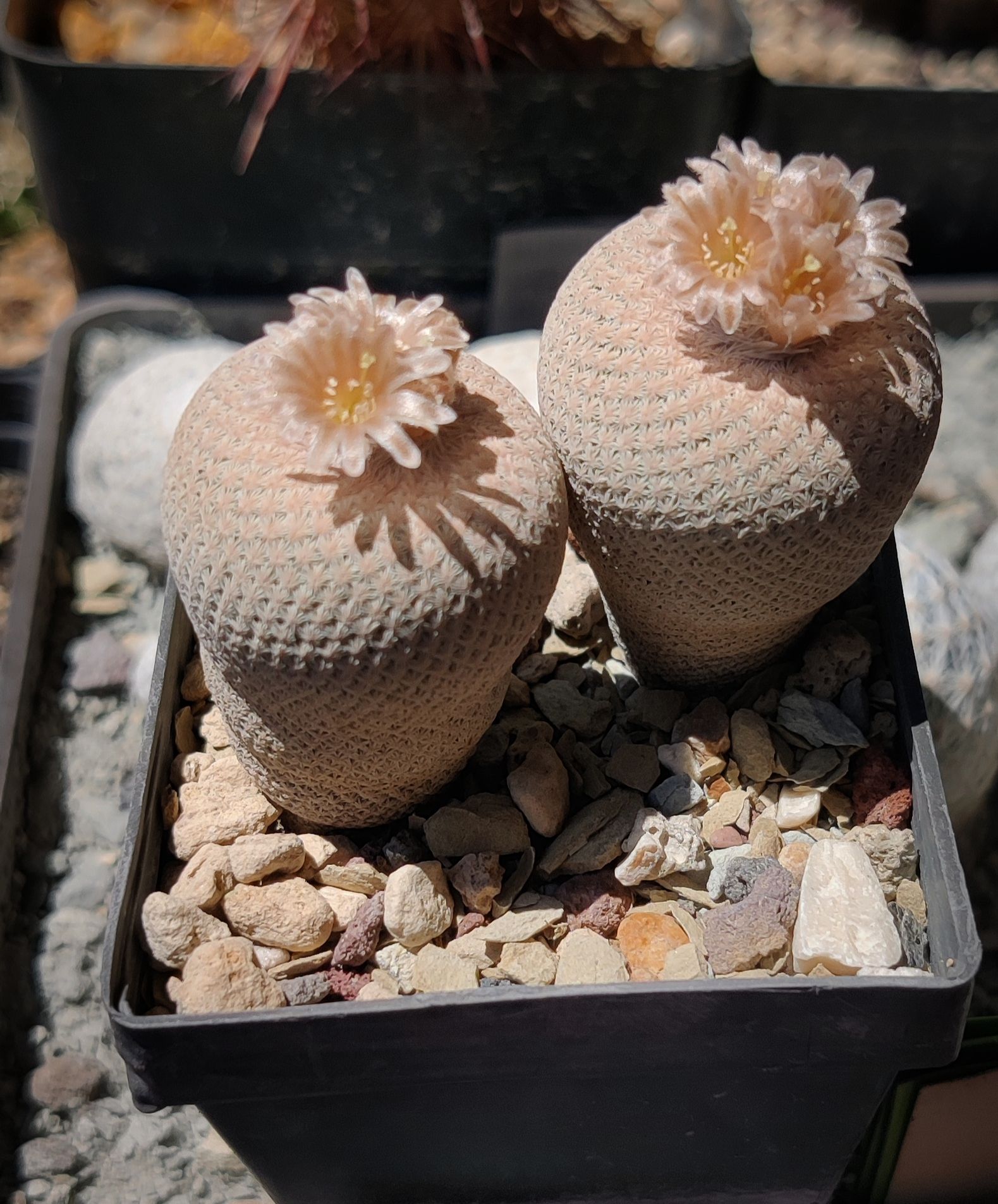
Epithelantha bokei L.D.Benson is the chalk-white button cactus of Brewster County, Texas, and adjacent Coahuila, described in the Cactus and Succulent Journal (Los Angeles) in 1969 and named for Norman H. Boke, the University of Oklahoma plant anatomist whose mid-century work on cactus meristem and areole development underpinned much of the structural framework Benson drew on when separating this taxon from the broader Epithelantha micromeris concept. The species is accepted at species rank by Kew POWO, following the molecular phylogeny published by Aquino et al. in 2019.
The name has had a complicated century. Glass & Foster demoted bokei to a variety of Epithelantha micromeris in 1978, and Guzmán further demoted it to subspecific rank in 2003. The Aquino et al. phylogenetic revision rejected both demotions, reaffirming species rank on morphological and chloroplast-DNA evidence. Older horticultural literature still circulates the var. and subsp. bokei combinations, which is the main source of naming confusion in the trade.
Among the five Epithelantha covered on this site, E. bokei occupies the middle ground in body size, sitting above the miniature Epithelantha cryptica of Coahuila and well below the large-bodied Epithelantha greggii endemic to the Saltillo region. Its closest morphological comparison is Epithelantha pachyrhiza, which shares similar aerial spination but carries a swollen turnip-shaped taproot beneath a proportionally smaller above-ground stem.
In habitat the species grows entirely on Cretaceous limestone outcrops and does not cross onto igneous substrates within its range. The densely appressed chalk-white spination conceals the green body completely and gives mature plants the smooth sphere appearance that drives the pingpong ball common name. The species is self-sterile, requiring cross-pollination from a genetically distinct individual to set viable seed, a practical constraint with direct consequences for seed production in cultivation.
Epithelantha bokei quick reference
A miniature of the Chihuahuan Desert, growing on Cretaceous limestone outcrops between 700 and 1,500 m in southwestern Texas and northern Coahuila. Values calibrated for seed grown plants in cultivation, drawn from species-specific habitat data and grower sources rather than genus-level extrapolation.
Taxonomy & nomenclature
The accepted name is Epithelantha bokei L.D.Benson, published in Cactus and Succulent Journal (Los Angeles) 41: 185, fig. (1969), with the protologue figure as the iconographic reference for the type. IPNI lists Brewster County, Texas as the type origin; POWO and Tropicos agree on the accepted name and authorship (IPNI record 92858-2).
POWO recognises two homotypic synonyms, both representing demotions to infraspecific rank under E. micromeris that have since been reversed. Glass & R.A.Foster reduced bokei to Epithelantha micromeris var. bokei in 1978, and U.Guzmán further demoted it to Epithelantha micromeris subsp. bokei in 2003. Aquino et al. (2019) rejected both demotions in their phylogenetic revision of the genus, citing morphological separation in radial spine count, body proportion, and flower colour, supported by chloroplast-DNA divergence from E. micromeris. POWO follows the Aquino et al. treatment. Older horticultural and society literature still circulates the var. and subsp. bokei combinations.
The epithet honours Norman H. Boke (1913–1984), the University of Oklahoma plant anatomist whose detailed work on Cactaceae meristem development and areole morphogenesis built much of the structural framework Benson drew on when characterising this taxon. The Aquino et al. revision recognised ten species in the genus and treated E. bokei as the Brewster-Coahuila axis representative, phylogenetically distinct from the broader and more northerly E. micromeris clade.
Historical synonyms (2)
- Epithelantha micromeris var. bokei (L.D.Benson) Glass & R.A.Foster, 1978 heterotypic synonym
- Epithelantha micromeris subsp. bokei (L.D.Benson) U.Guzmán, 2003 heterotypic synonym
Sources: POWO (Kew) · IPNI · GBIF · Wikidata
Habitat
Epithelantha bokei ranges across the Chihuahuan Desert ecoregion in two countries: southwest Texas (USA) and northern Mexico (Coahuila and Chihuahua). In Texas, populations concentrate in Brewster and Presidio counties, with the type locality and most documented sites inside or adjacent to Big Bend National Park and Big Bend Ranch State Park. The range extends south into the Sierra del Carmen escarpment and the limestone country around Ocampo and Cuatro Ciénegas in Coahuila, with additional populations reported from adjacent Chihuahua. Elevation runs from 700 to 1,500 m across the full range, with most sites in the 800 to 1,200 m band.
Plants grow in shallow gravelly pockets on Cretaceous limestone outcrops, on barren rocky hills, on bedrock ledges, and in gritty calcareous flats with thin soil over rock. The species does not occur on igneous substrates within its range. Plant community is open Chihuahuan Desert scrub with Larrea tridentata, Agave lechuguilla, Hechtia spp., and Jatropha dioica. Dwarf cacti on the same limestone benches include Mammillaria lasiacantha, Coryphantha spp., Epithelantha micromeris (sympatric in places), and Ariocarpus fissuratus. The two button cacti occasionally share the same rock surface, making field identification by spine characters essential.
Climate at population level is hot semi-arid, BSh/BWh transition, with summer monsoon rainfall of 200 to 350 mm concentrated July through September, mild dry winters with occasional frost, and high diurnal temperature swing. Exposures are open or south-facing, often unshaded on bare rock. The plants contract deeper into the substrate during prolonged drought.
Morphology
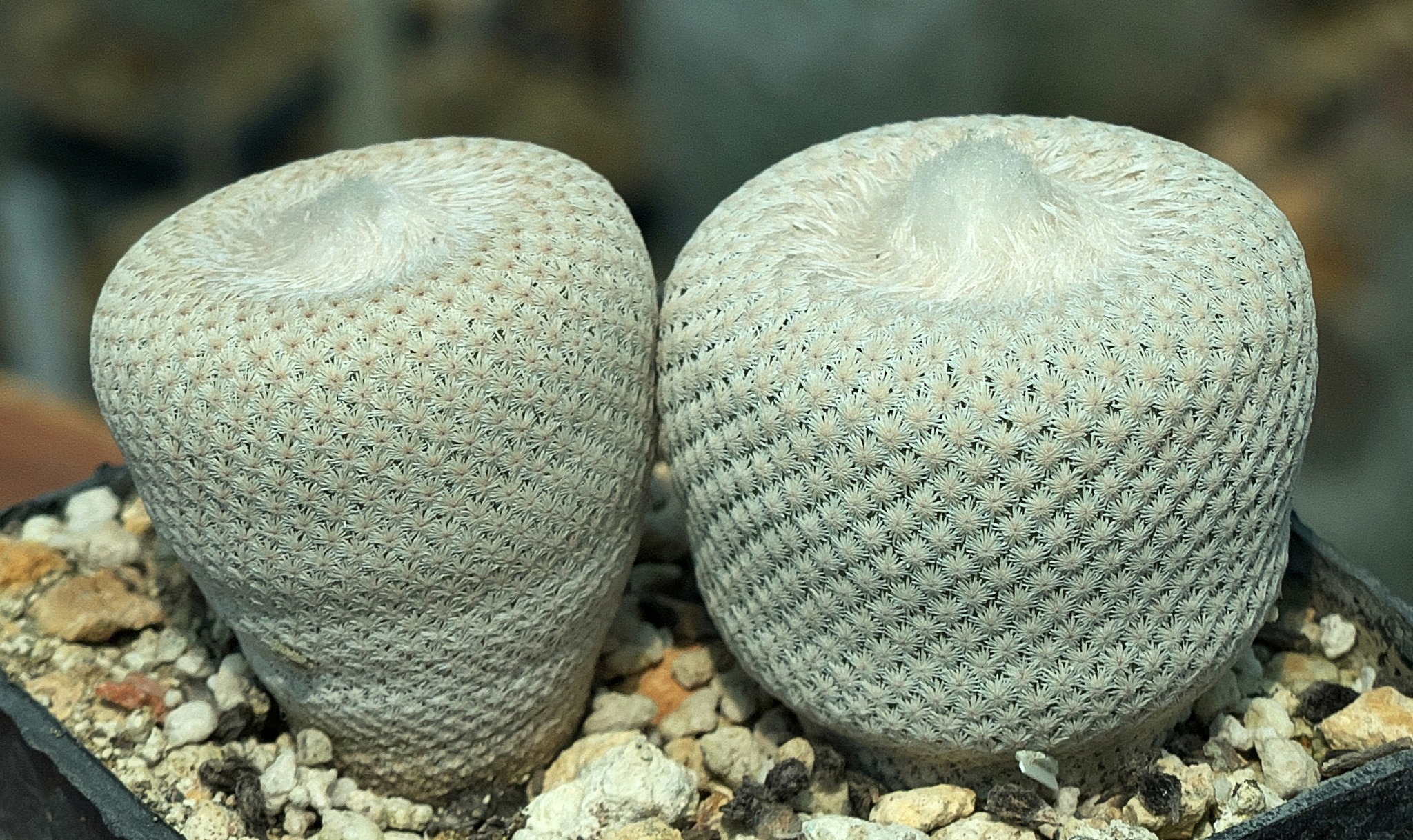
Body solitary, very rarely branched. Stems flat-topped, disk-shaped to short cylindric, 2 to 5 cm in diameter and typically 2 to 3 cm tall above the substrate, with much of the body sitting flush with or recessed into the limestone. The root is a stout, slightly thickened taproot; not the dramatically swollen structure seen in Epithelantha pachyrhiza.
Spination: 50 to 90 spines per areole, arranged in more than three superimposed series. All spines are radial in interpretation; no true central differentiated. Mature lateral spine clusters are 2 to 2.5 (rarely 4) mm in diameter. Longest intact spines reach 4.5 to 7 mm; older worn spines weather to 0.1 to 2 mm. Colour uniformly chalk-white to creamy yellow, never pink-tipped. This absence of any pink or reddish apical colouring is the cleanest field separator from E. micromeris, whose spines carry a pink to reddish apex on fresh growth. Spines are tightly appressed and pectinate, completely concealing the green stem and giving the plant its smooth sphere appearance.
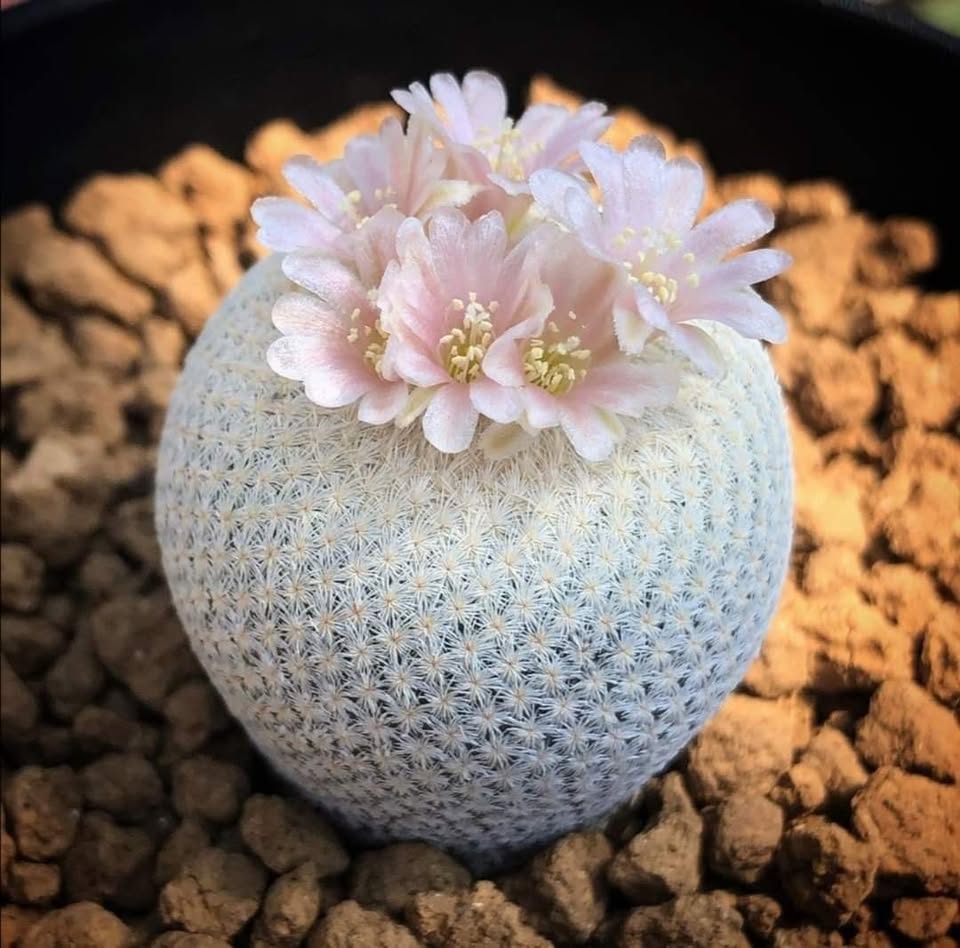
Flowers borne at the apex from areoles inside the spine cluster, exserted beyond the longer apical spines. Dimensions 1 to 1.7 cm in length and diameter. Inner tepals 13 to 21 per flower, 5 to 6 (rarely 9) mm long. Stamens 20 to 40. Colour pale pink to whitish-pink, occasionally yellowish in some Coahuilan populations. Flowering May through July, with initial flowers triggered by warming temperatures in late spring and a secondary flush possible after monsoon onset. E. bokei is self-sterile; cross-pollination from a genetically distinct individual is required to set viable seed. This contrasts with E. micromeris, which is autogamous. Fruit smooth, bright red, club-shaped, about 1 cm long, edible and dispersed by birds and ants. Seed small and black.
Locality detail
The type locality is Brewster County, Texas, within the Big Bend region. The protologue figure (Benson 1969) is the iconographic reference; IPNI lists Texas as the type origin without a precise grid reference, and no formal lectotypification has been published in the literature consulted here.
The map marks three regional centroids rather than point-level population coordinates. For a poaching-prone CITES-listed miniature cactus, publishing precise locality data would facilitate collection rather than conservation; regional centroids convey the range without exposing individual populations. The US range sits almost entirely within the boundary of Big Bend National Park and Big Bend Ranch State Park, where collection is prohibited under federal and state park regulations. The Coahuilan range covers the Sierra del Carmen escarpment and limestone country near Ocampo and Cuatro Ciénegas, extending into adjacent Chihuahua.
Epithelantha bokei care and cultivation
Epithelantha bokei is among the slower-growing dwarf cacti in serious cultivation. The two cultivation requirements that account for the species’s intermediate-to-advanced rating are the limestone substrate and the very slow ungrafted growth rate. Both are manageable with the right setup; neither is forgiving of shortcuts.
Substrate
No cultivation source establishes this species as calcicole or calcifuge. Target composition: 40% pumice (3 to 6 mm), 10% lava rock, 15% zeolite, 25% crushed limestone or limestone gravel (3 to 8 mm), 10% worm castings. Target pH 7.5 to 8.5. The limestone fraction follows house convention rather than a documented species requirement. No granite, peat, or coir.
All five Epithelantha species on this site share a 90/10 inorganic-to-organic baseline; limestone percentage is the key variable, rising with each species’s calcareous dependence in the wild.
| Species | Pumice | Lava | Zeolite | Granite | Limestone | Silica | Organic |
|---|---|---|---|---|---|---|---|
| E. bokei (this page) | 40% | 10% | 15% | 0% | 25% | 0% | 10% |
| E. micromeris | 35% | 15% | 10% | 10% | 15% | 5% | 10% |
| E. greggii | 35% | 20% | 10% | 10% | 15% | 0% | 10% |
| E. pachyrhiza | 30% | 20% | 10% | 10% | 25% | 0% | 5% |
| E. cryptica | 40% | 15% | 10% | 10% | 20% | 0% | 5% |
Watering and light
Keep the substrate dry from October through March. A single light overhead misting once a month during this period prevents root-shrivel but is not mandatory below 10°C. First spring watering waits for visible warmth in March or early April: one thorough soak, then allow complete drying over 14 to 21 days before the next. From late April through mid-September, water when the substrate is dry to the pot base; typical interval 14 to 21 days at moderate temperatures, 10 to 14 days during peak summer heat under glass. The winter dry rest triggers spring flowering; growers who water through winter report failure to bud the following season.
Full sun is required for the diagnostic dense white spination to develop fully. Specimens grown at lower light intensities produce thinner, more open spine coverage and lose the compact sphere silhouette. Indoor growers need a south-facing window with supplemental LED to match outdoor intensity; outdoor summer growing in temperate climates is preferred.
Growth rate and propagation
Seed grown plants reach 2 cm body diameter in roughly 8 to 12 years and a flowering 4 cm body in 15 or more years. This slow growth is why the trade leans on grafted material: seedlings grafted to Pereskiopsis for 12 to 18 months accelerate establishment dramatically, then either degrafted onto mineral substrate or kept on a permanent Hylocereus or Trichocereus rootstock for collector display. Grafted plants reach saleable size in roughly a quarter of the seed-grown timeline but produce softer spination that does not match the chalk-white tightness of habitat material. Seed grown specimens command a significant premium.
Propagation from seed is the only practical sexual route, and because the species is self-sterile two genetically distinct individuals must be hand-pollinated to set viable fruit. Sow on a sterile mineral-heavy mix in spring, bottom-water, germination in 7 to 21 days at 22 to 28°C. Vegetative offsetting is rare; the species is stubbornly solitary.
Comparison
The primary identification challenge for E. bokei is separation from Epithelantha micromeris, the type species and closest sister. The key character is spine colouring: E. bokei has 50 to 90 spines per areole, all uniformly chalk-white to creamy yellow with no pink apical tips. E. micromeris carries 20 to 35 spines per areole, each with a distinct pink to reddish apex on fresh growth. Self-fertility is a second separator: E. micromeris is autogamous; E. bokei is self-sterile. Range overlaps in the Big Bend corridor, where both species can share the same limestone bench.
Epithelantha greggii presents no practical confusion in the field. It is the largest-bodied accepted Epithelantha, with stems reaching 6 to 10 cm diameter, ashy-grey rougher spination, and a flat-topped open apex. E. bokei is half its size at maturity with tight chalk-white spination and a closed dome-like apex.
The most common false identification in the field pairs E. bokei with Mammillaria lasiacantha. Both share chalk-white pectinate spination, limestone substrate, and the Chihuahuan Desert range. The genus separator is decisive: Mammillaria flowers emerge from the axils between tubercles in a ring around the body; Epithelantha flowers emerge from the apex itself, embedded in the apical spine cluster at the crown. M. lasiacantha produces milky latex when cut; Epithelantha does not. Spine count overlaps (40 to 60 in M. lasiacantha, 50 to 90 in E. bokei), so spine count alone is not a reliable separator.
Frequently asked questions
Is Epithelantha bokei hard to grow?
Intermediate to advanced. The house mix targets pH 7.5 to 8.5 with a crushed limestone fraction, carried as grower convention for the genus rather than as a species requirement. Hard tap water already supplies calcium and bicarbonate at every watering; rainwater and RO water supply neither. The very slow ungrafted growth rate is the main challenge. A seed grown plant takes 8 to 12 years to reach 2 cm diameter; growers used to faster cacti can find the pace discouraging. The dry winter rest is uncompromising: keep the substrate bone dry from October through March and temperatures cool if possible; wet roots at any sub-zero temperature are fatal.
Can Epithelantha bokei be grown from seed?
Yes, though two complications make it harder than most cacti. First, the species is self-sterile, requiring pollen transfer between two genetically distinct individuals to set viable seed. Without at least two unrelated plants in the same collection, no seed is possible regardless of care. Second, germination to first flower takes 15 or more years under ungrafted conditions. Grafting seedlings to Pereskiopsis for the first 12 to 18 months compresses that timeline considerably, after which the plant can be degrafted or kept on the rootstock. Sow in spring on a moist sterile mineral mix at 22 to 28°C; germination typically inside 7 to 21 days.
Is Epithelantha bokei legal to collect or own?
Epithelantha bokei falls under CITES Appendix II by the blanket Cactaceae listing, which permits international commercial trade with proper permits: export documentation from the country of origin and import permits where required. It is not listed under the US Endangered Species Act; USFWS ECOS records the taxon with no ESA listing. The practical legal constraint on US populations is not statute but park regulation: most of the species’s US range sits inside Big Bend National Park and Big Bend Ranch State Park, where all plant collection is prohibited under federal and state park law regardless of listing status. Nursery-propagated material from documented seed-grown provenance is the legally and ethically defensible source for collectors.
Where does Epithelantha bokei grow in the wild?
On Cretaceous limestone outcrops in the Chihuahuan Desert, across two countries. The US range covers Brewster and Presidio counties in Trans-Pecos Texas, with the type locality and most documented populations inside or adjacent to Big Bend National Park and Big Bend Ranch State Park. The Mexican range extends south into the Sierra del Carmen escarpment and the limestone country near Ocampo and Cuatro Ciénegas in Coahuila, with additional populations reported from adjacent Chihuahua. Elevation: 700 to 1,500 m, with most sites in the 800 to 1,200 m band. The species does not occur on igneous substrates anywhere in its range.
When does Epithelantha bokei flower?
May through July in habitat and in cultivation at typical Northern Hemisphere latitudes. Initial flowers open in May or June as temperatures warm; a secondary flush can follow monsoon onset in July. Individual flowers are 1 to 1.7 cm across, pale pink to whitish-pink, borne at the apex from within the apical spine cluster. The species is self-sterile, so visible flower production does not guarantee fruit without a second genetically distinct plant and deliberate hand-pollination. Fertilised flowers produce club-shaped bright red edible fruit roughly 1 cm long, taken by birds and ants in habitat.
Sources & further reading
Benson, L.D. (1969). Epithelantha bokei sp. nov. Cactus and Succulent Journal (Los Angeles) 41: 185, fig. · International Plant Names Index (IPNI). Epithelantha bokei L.D.Benson, record 92858-2. ipni.org · Plants of the World Online (Kew POWO). Epithelantha bokei L.D.Benson, taxon urn:lsid:ipni.org:names:92858-2. powo.science.kew.org · Aquino, D., Cervantes, R.C., Gernandt, D.S. & Arias, S. (2019). Species Delimitation and Phylogeny of Epithelantha (Cactaceae). Systematic Botany 44(3): 600–615. DOI 10.1600/036364419X15620113920635 · Flora of North America Editorial Committee. Epithelantha bokei treatment. Flora of North America online; efloras.org taxon_id 242415340 · IUCN Red List of Threatened Species. Epithelantha bokei L.D.Benson, taxon 152453, assessed by Heil, K., Terry, M. & Corral-Díaz, R. (2013), category Least Concern, criteria v3.1. iucnredlist.org/species/152453 · US Fish and Wildlife Service ECOS. Species profile: Boke’s button cactus, Epithelantha bokei, entity ID 7920 (no ESA listing). ecos.fws.gov/ecp/species/7920 · llifle.com Encyclopedia of Living Forms. Epithelantha bokei, record 12641. llifle.com · Henry Shaw Cactus and Succulent Society (2018). Epithelantha (plants of the month). hscactus.org · Donati, D. & Zanovello, C. (2011). Epithelantha F.A.C.Weber ex Britton & Rose: revision of the genus. Self-published monograph; superseded for species circumscription by Aquino et al. 2019. academia.edu/5888805 · Hernández, H.M. & Gómez-Hinostrosa, C. (2011, 2015). Mapping the cacti of Mexico, parts I and II. Succulent Plant Research / DH Books