
Epithelantha greggii
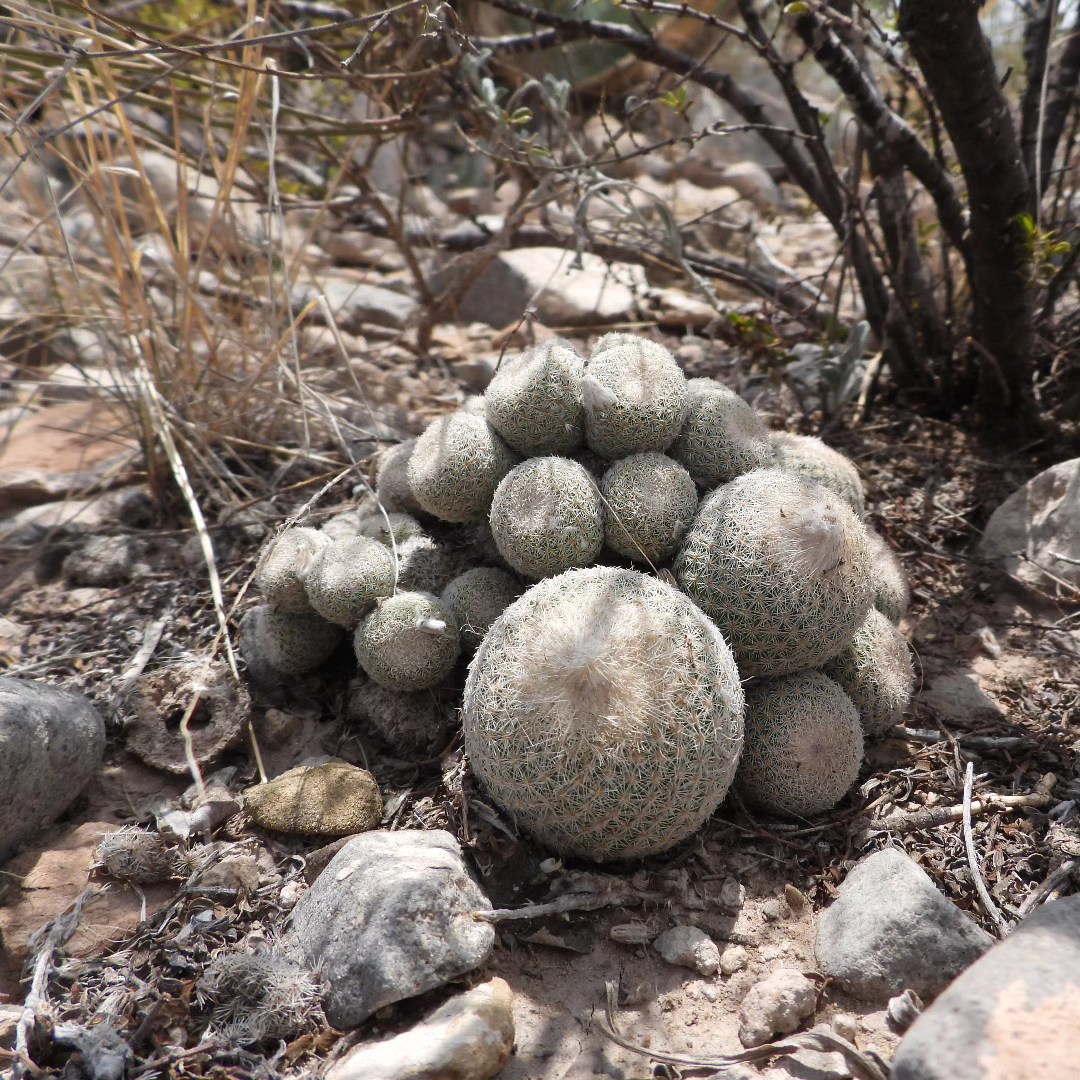
Epithelantha greggii (Engelm.) Orcutt is the largest-bodied accepted species in the genus, a compact button cactus of the Coahuilan limestone piedmont first collected near Saltillo by Josiah Gregg around 1848 and described by George Engelmann in his Synopsis of the Cactaceae in 1856 as Mammillaria micromeris var. greggii. Charles Russell Orcutt elevated it to species rank in his 1926 serial Cactography, the combination now accepted by Plants of the World Online. The taxon’s career has been long and contested: Backeberg and Borg treated it as a subspecific variant of E. micromeris, and N.P. Taylor’s combination E. micromeris subsp. greggii in the 2006 New Cactus Lexicon remains the name on most nursery labels in Europe. POWO’s current species-rank acceptance is supported by molecular phylogenetic work placing E. greggii in a distinct clade from the type species.
Among the five Epithelantha taxa covered on this site, E. greggii stands apart in size and spine character. Where Epithelantha micromeris and Epithelantha bokei rarely exceed 3 to 4 cm in diameter, E. greggii reaches 5 to 7.5 cm at maturity and occasionally 8 cm, and its spines are ashy grey and radiate outward at a slight angle rather than lying flat in the snow-white silkier pattern of its relatives. The body is slightly flat-topped with a depressed apex, giving the plant a distinctly concrete or weathered-pebble look that makes identification reliable with brief experience.
The range is strict: Coahuila, Mexico, centred on the Saltillo region and the limestone foothills of the Sierra Madre Oriental. Older literature occasionally placed E. greggii in Nuevo León, Texas, and New Mexico, but those records conflated the species with populations now assigned to Epithelantha pachyrhiza and E. polycephala under the narrower current species concept. POWO lists native distribution as Mexico Northeast (Coahuila) only, and GBIF occurrence data supports that restriction.
Cultivation is intermediate in difficulty. The main variables are drainage, a dry winter rest, and a lean mineral substrate. In the wild, E. greggii grows on haplic kastanozem soils overlying calcareous bedrock in the limestone piedmont. In the pot, the house mix carries a limestone component and a house pH target of 7.5 to 8.2; the limestone is grower convention for the genus, not a proven requirement of the species. Whether that suits your plants depends heavily on your water: hard tap water already supplies calcium and bicarbonate at every watering, while rainwater and RO water supply neither.
Epithelantha greggii quick reference
A calcareous limestone piedmont endemic of the Coahuilan Chihuahuan Desert, growing on haplic kastanozem soils at 700 to 1,300 m elevation. Values calibrated for seed grown plants in cultivation, drawn from species-specific habitat data and specialist grower sources for E. greggii.
Taxonomy & nomenclature
The accepted name is Epithelantha greggii (Engelm.) Orcutt, published by Orcutt in Cactography in 1926 (POWO taxon urn:lsid:ipni.org:names:92860-2). The basionym is Mammillaria micromeris var. greggii Engelm., described by Engelmann in his Synopsis of the Cactaceae in 1856 from material Josiah Gregg collected near Saltillo, Coahuila in 1848. The taxon has circulated under species, subspecies, and variety rank since Engelmann’s original description: Backeberg and Borg held it at varietal or subspecific rank through the mid-20th century, Orcutt elevated it as a full species in 1926, and N.P. Taylor’s 2006 combination E. micromeris subsp. greggii is still the name carried on most European nursery labels. POWO’s current species-rank acceptance follows the morphological work of Donati and Zanovello (2010) and is the name this page leads with.
Molecular phylogenetic analysis placed E. greggii in clade E2 alongside E. pachyrhiza, E. polycephala, and E. pulchra. That clade is phylogenetically distinct from clade E1, which contains the type species E. micromeris and E. bokei. The E1/E2 split supports treating E. greggii at species rank rather than as a subspecies of E. micromeris; the two are not as closely related as the subspecies treatment implied.
Principal synonyms (POWO): seven homotypic synonyms tracing back to Engelmann’s 1856 basionym at varietal, subspecific, and species rank under Mammillaria, Cactus, Cephalomamillaria, and Epithelantha; and four heterotypic synonyms including E. densispina and E. rufispina (both Backeberg names originally described as separate species and now subsumed). Cristate and variegated mutations occur in cultivation and are propagated by graft; these use parenthetical notation per project taxonomy convention, for example E. greggii (cristate), and never f. cristata or f. variegata.
Historical synonyms (12)
- Mammillaria greggii (Engelm.) Saff., 1909 basionym
- Cephalomamillaria greggii (Engelm.) Fric, 1925 homotypic synonym
- Cephalomammillaria greggii (Engelm.) Frič, 1925 homotypic synonym
- Mammillaria micromeris var. greggii Engelm., 1856 heterotypic synonym
- Cactus micromeris var. greggii (Engelm.) J.M.Coult., 1894 heterotypic synonym
- Cephalomamillaria micromeris var. greggii (Engelm.) Fric, 1924 heterotypic synonym
- Cephalomammillaria micromeris var. greggii (Engelm.) Frič, 1924 heterotypic synonym
- Epithelantha micromeris var. greggii (Engelm.) Borg, 1937 heterotypic synonym
- Epithelantha densispina Bravo, 1951 heterotypic synonym
- Epithelantha rufispina Bravo, 1951 heterotypic synonym
- Epithelantha micromeris var. densispina (Bravo) Backeb., 1954 heterotypic synonym
- Epithelantha micromeris var. rufispina (Bravo) Backeb., 1954 heterotypic synonym
Sources: GBIF
Habitat
Epithelantha greggii is a Coahuila endemic. The core range is the Saltillo region of southern Coahuila, including the limestone foothills of the Sierra Madre Oriental flanking the city to the west and south. POWO lists native distribution as Mexico Northeast (Coahuila) only. Older E. micromeris sensu lato treatments extended the mapped range into Nuevo León, Texas, and New Mexico, but those records are now attributed to E. polycephala and E. pachyrhiza under the current narrow species concept.
Elevation runs from 700 to 1,300 m, consistent with the Saltillo plateau and its limestone-backed piedmont slopes. Habitat is hills, low ridges, and piedmont landforms on coarse gravels overlying calcareous sedimentary bedrock: limestone with chert and dolomite. The soil type is haplic kastanozem, with calcareous substrate identified as an obligate association in the molecular-phylogenetic ecology work. Plants grow wedged into crevices or flush with the rock surface among accumulated eroded gravel, often invisible in the field without targeted searching. Annual precipitation at recorded localities runs 254 to 302 mm, a semi-arid regime concentrated in summer months.
Co-occurring vegetation is Chihuahuan Desert scrub: Larrea tridentata, Agave lechuguilla, Yucca, and Hechtia. Roadside accessibility near Saltillo makes this population more exposed to illegal collection than many Chihuahuan endemics; plants flush with gravel and easily overlooked in habitat become desirable targets once located.
Morphology
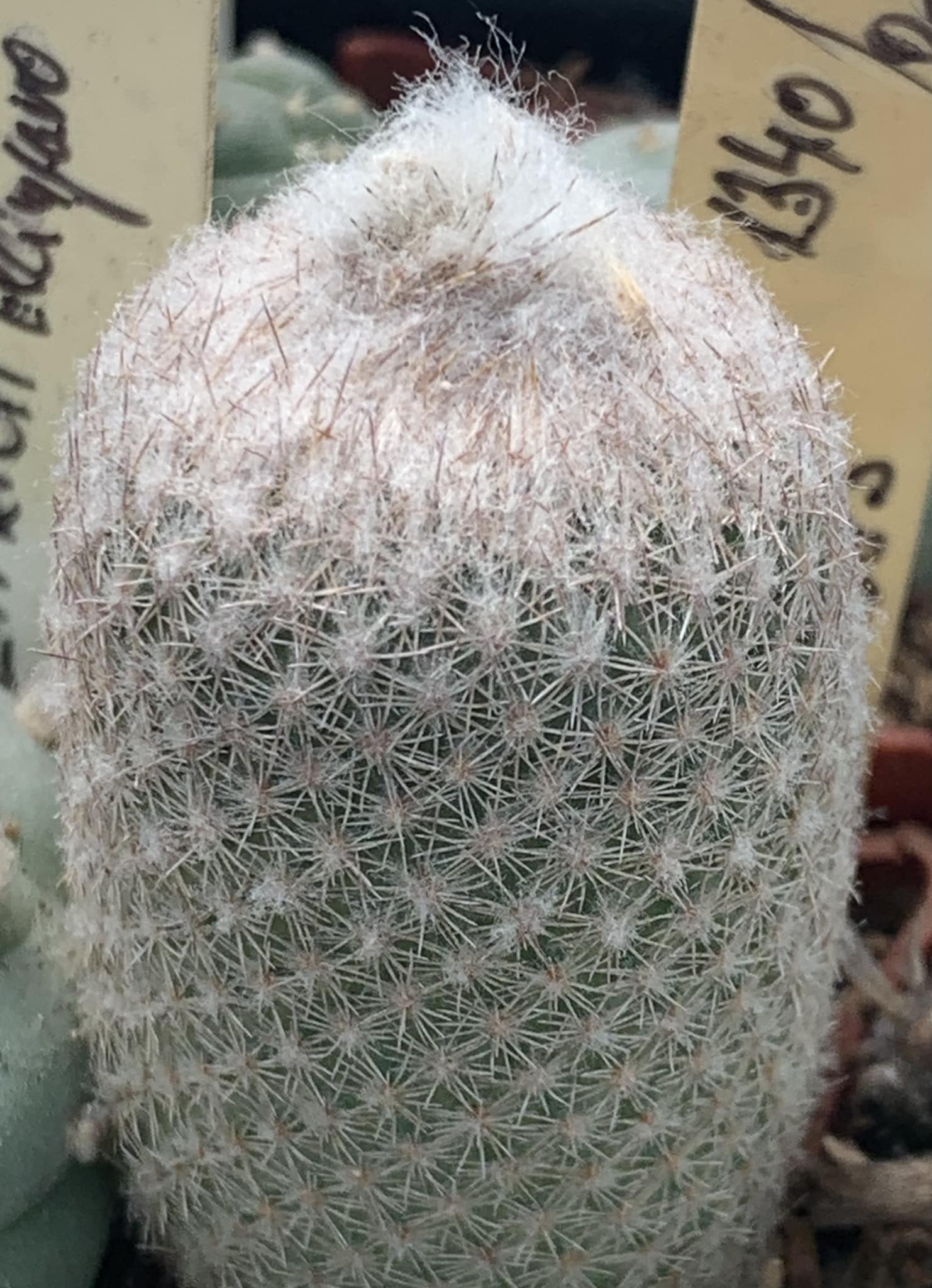
Stems are solitary at first, branching basally with age into small clumps of two to twelve heads. Individual stems are spheric to obovoid with a depressed apex and a slightly flat-topped profile at maturity, reaching 5 to 7.5 cm in diameter as typical adults; reliably documented specimens approach 8 cm, making E. greggii the largest-bodied accepted species in the genus. Epithelantha micromeris and E. bokei rarely exceed 3 to 4 cm. Body colour is pale ashy grey-green, nearly concrete-toned under the dense spine overlay.
Tubercles are tiny, 1 to 2 mm, densely packed in low spirals, each carrying a single areole. The genus name reflects the areole position: flowers emerge from areoles slightly displaced from the tubercle apex (epi– on top of, anthos flower). Spines number twenty or more per areole, all radial with no central. They are 3 to 5 mm long, chalky white to ashy grey, grading to reddish-brown at the apex on new growth. The spines radiate outward at a slight angle rather than lying fully appressed, giving the plant a bristly silhouette that is distinct from the silkier, flatter presentation of E. micromeris and the porcelain finish of E. bokei.
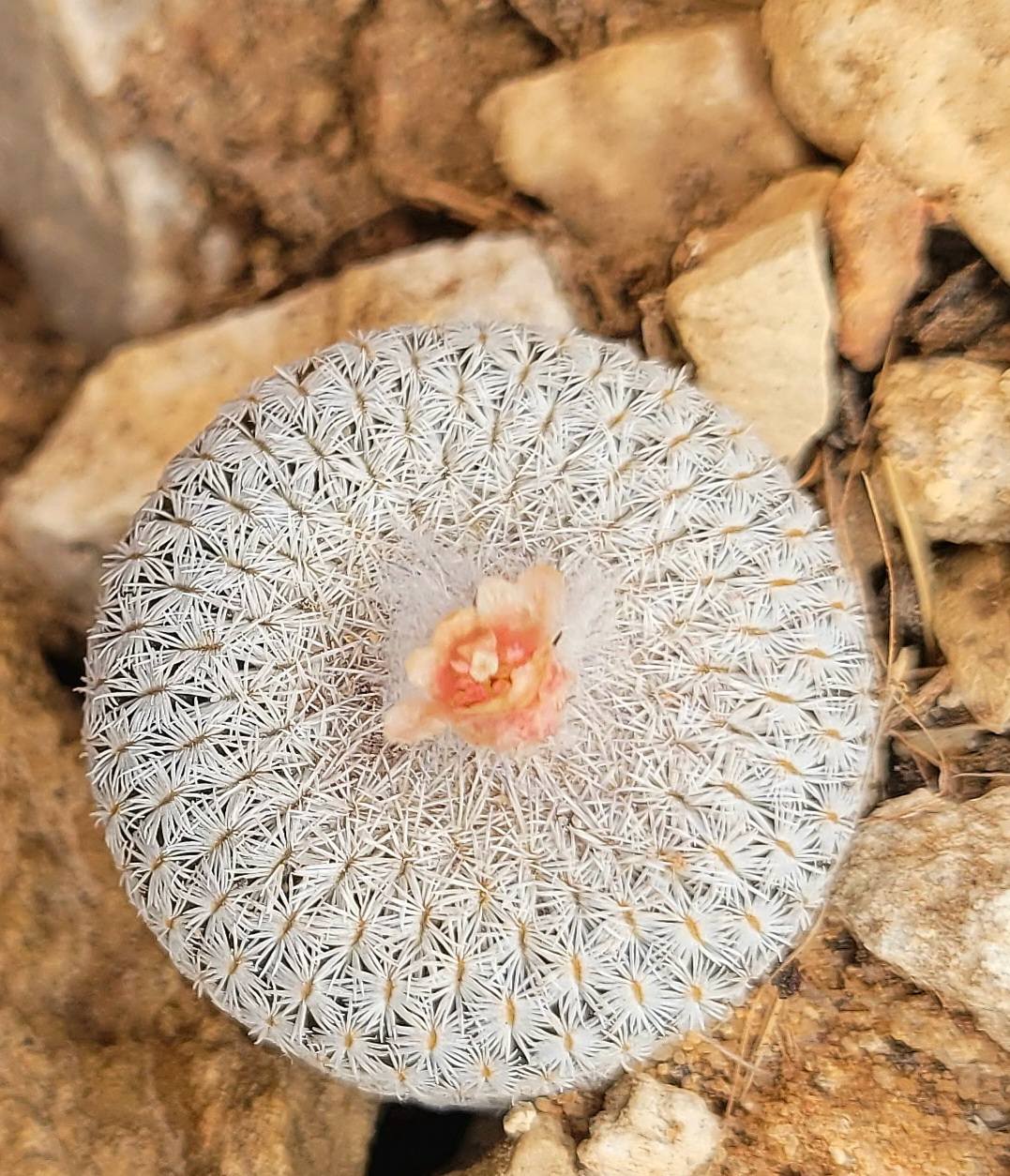
Flowers are inconspicuous, funnel-shaped, 5 to 7 mm in diameter, pale pink to deeper pink, opening in the woolly apex from May into June in habitat and April to July in cultivation. They are diurnal, self-fertile, and barely project above the apical wool. Fruits are bright red, narrowly cylindric, 18 mm by 2 to 5 mm, weakly succulent then drying papery and dehiscing by ground-level decay to scatter small brown seeds at the base of the parent plant. Roots consist of a short stout taproot in young plants, branching and fleshy in adults.
Locality detail
The type locality is Saltillo, Coahuila, from material Josiah Gregg collected in 1848, the basis for Engelmann’s 1856 description. The limestone foothills of the Sierra Madre Oriental flanking Saltillo to the west and south remain the best-documented part of the range, consistent with georeferenced iNaturalist observations and GBIF occurrence records. The distribution within Coahuila tracks calcareous outcrops broadly across the central and southern parts of the state.
Marker coordinates above are regional centroids rather than population-level GPS points, a deliberate redaction for a species that is CITES-listed, subject to illegal collection, and roadside-accessible near the Saltillo metropolitan area. The general locality information is sufficient for cultivation context and does not compromise plant security.
Epithelantha greggii care and cultivation
Epithelantha greggii is intermediate in cultivation difficulty. The species is undemanding on most fronts but specific on two: the winter rest must be completely dry, and the substrate must stay lean and mineral. Both are achievable once understood, and the failure modes that account for most losses are winter rot from retained moisture and slow growth on over-organic mixes. The limestone component in the house mix is grower convention for the genus, not a proven requirement of the species; hard tap water already supplies calcium and bicarbonate at every watering, while rainwater and RO water supply neither.
Substrate
The target mix is a 90% inorganic / 10% organic ratio tilted toward the alkaline limestone-mimic side of the project’s general substrate philosophy. Per-species mix: 35% pumice (3–5 mm), 20% lava rock (3–5 mm), 10% granite grit (3–5 mm), 15% crushed limestone (2–4 mm horticultural limestone or oyster shell chip), 10% zeolite (clinoptilolite, 4–6 mm), 10% worm castings. Total 100%. Target pH is 7.5 to 8.2. The limestone fraction is the load-bearing variable; do not omit it. Pumice can be substituted with horticultural scoria one-for-one if pumice is unavailable. No peat, no sand, no coir. A top dressing of small limestone or granite chips reinforces the alkaline signal and reduces apical moisture splash.
All five Epithelantha species on this site share a 90/10 inorganic-to-organic baseline; limestone percentage is the key variable, rising with each species’s calcareous dependence in the wild.
| Species | Pumice | Lava | Zeolite | Granite | Limestone | Silica | Organic |
|---|---|---|---|---|---|---|---|
| E. bokei | 40% | 10% | 15% | 0% | 25% | 0% | 10% |
| E. micromeris | 35% | 15% | 10% | 10% | 15% | 5% | 10% |
| E. greggii (this page) | 35% | 20% | 10% | 10% | 15% | 0% | 10% |
| E. pachyrhiza | 30% | 20% | 10% | 10% | 25% | 0% | 5% |
| E. cryptica | 40% | 15% | 10% | 10% | 20% | 0% | 5% |
Watering and light
Cease scheduled watering from late October through early March. The substrate must be bone dry through this period; combined moisture and cool temperatures is the universal cause of root collapse and catastrophic loss in this species. First spring watering waits for visible bud emergence, typically March: one thorough soak, then allow full drying over 10 to 14 days before the next. From April through October, water when the substrate is fully dry at the pot base, roughly every 10 to 14 days for an established plant in a 10 cm pot. Direct water at the substrate; the dense spination traps moisture against the apex if watered from above.
Light requirements are full sun, 6 to 8 hours of direct daily exposure. Plants in shade lose the flat-topped silhouette, etiolate, and produce pallid washed-out spines that forfeit the visual character that distinguishes the species from the rounder, softer-looking button cacti of the genus. Acclimate gradually to direct outdoor sun in spring; a 50% shade cloth through midsummer peak intensity at temperate latitudes is appropriate.
Cold tolerance and repotting
The safe cultivated cold floor is −7°C, on the condition that the plant is completely dry at that temperature. Llifle records survival to −12°C in full dormancy; −7°C is the conservative figure to plan cultivation around. Wet cold at −3°C is more dangerous than dry cold at −7°C. Repot every three to four years in late spring, allowing seven to ten days dry before resuming water. The pot should be roughly as deep as wide to accommodate the modest taproot.
Comparison
Within Epithelantha, the closest comparison for E. greggii is E. micromeris, the type species and the most common source of confusion. E. micromeris is a smaller plant (rarely above 3 cm), with snow-white spines that lie almost flat against the body and are silkier in texture rather than the rougher ashy-grey radiating spines of E. greggii. Range is the other separator: E. micromeris extends north through Texas and New Mexico; E. greggii does not cross the border under the current species concept.
Epithelantha bokei is the porcelain-white extreme of the genus: tighter, more appressed spination than even E. micromeris, a polished-marble finish, and a range centred on Big Bend Texas and adjacent Coahuila near Cuatro Ciénegas. The Cuatro Ciénegas edge overlaps loosely with northern Coahuila populations of E. greggii; the two separate immediately on spine character. Epithelantha pachyrhiza is the sister taxon in clade E2 and the closest relative phylogenetically. It is distinguished by a swollen carrot-like taproot, a slightly elongated body, and a southern Coahuila / northern San Luis Potosí range; above-ground morphology can converge with E. greggii in older specimens, and the definitive separator is the root.
Epithelantha cryptica, described from Coahuila in 2019, grows almost subterranean and flush with the limestone surface; its hyper-cryptic habit and distinct locality mean confusion with E. greggii is unlikely in the field. Outside the genus, small-bodied Mammillaria with white radial spines (for example M. lasiacantha or M. lenta) can resemble juvenile E. greggii at distance, but the fruit separates the genera definitively: Epithelantha fruits emerge from the apical wool as bright red cylinders, Mammillaria fruits sit lower on the body and project as small clubs or beads.
Frequently asked questions
Is Epithelantha greggii hard to grow?
Intermediate. The plant is undemanding on most fronts: full sun, sharp drainage, and a bone-dry winter rest cover most of the requirements. The key specificity is the substrate. E. greggii grows on alkaline calcareous limestone in the wild, and cultivation mixes without a crushed limestone component produce slower growth and less vivid spine character than limestone-supplemented mixes. Beyond that, the worst failure mode is winter watering: the substrate must be completely dry from late October through early March. Moisture combined with cool temperatures causes rapid root collapse and is the most common cause of losses in this species.
Can Epithelantha greggii be grown from seed?
Yes, and seed grown plants are the target for serious collectors. Seed germinates in 10 to 21 days at 22 to 28°C on sterile pumice and limestone. Seedlings are extremely slow: three to four years to a 1 cm body, eight to twelve years to flowering size under good cultivation. Grafting onto Hylocereus, Pereskiopsis, or Echinopsis understocks accelerates this to two to three years to flowering, but grafted plants never settle into the flat-topped seed grown habit and lose the root architecture that makes an aged specimen interesting. Specialist seed lists carry E. greggii (often filed under E. micromeris subsp. greggii); verify POWO taxonomy before purchasing.
Is Epithelantha greggii legal to own?
Yes, with documentation for international movement. E. greggii falls under the CITES Appendix II blanket listing for Cactaceae, which permits international commercial trade with an export permit from the country of origin (Mexico) and an import permit where the receiving country requires one. SEMARNAT does not currently list Epithelantha on NOM-059-SEMARNAT-2010, so there is no additional Mexican federal protection layer beyond CITES. Domestic trade in nursery-propagated material within a single country does not require CITES permits. The legally and ethically defensible source is documented seed grown nursery stock; wild-collected plants are not legally tradeable without CITES documentation, which is not issued for wild-collected material under the standard regime.
Where does Epithelantha greggii grow in the wild?
Coahuila, Mexico, centred on the Saltillo region and the limestone foothills of the Sierra Madre Oriental. The type locality is Saltillo itself, from Josiah Gregg’s 1848 collections. Elevation runs from 700 to 1,300 m on haplic kastanozem soils overlying calcareous limestone bedrock, with annual precipitation of 254 to 302 mm. Older literature mapped the species into Nuevo León, Texas, and New Mexico, but those records are now attributed to E. polycephala and E. pachyrhiza under the current narrow POWO species concept. Plants grow flush with or slightly below the rock surface in Chihuahuan Desert scrub among Larrea, Agave lechuguilla, and Yucca.
When does Epithelantha greggii flower?
May to June in habitat; April to July in cultivation at typical northern-hemisphere latitudes. Flowers are funnel-shaped, 5 to 7 mm in diameter, pale pink to deeper pink, emerging from the woolly apex. They are diurnal, self-fertile, and barely project above the apical wool. The colour is slightly more saturated than the off-white to pale pink blooms of E. micromeris. Fruits follow as bright red narrowly cylindric bodies 18 mm long that persist until they dry and dehisce, scattering small brown seeds at the base of the parent plant. Flowering-size plants from seed typically take eight to twelve years; grafted plants can flower within two to three years.
Sources & further reading
Engelmann, G. (1856). Mammillaria micromeris var. greggii sp. nov. In: Synopsis of the Cactaceae of the Territory of the United States and Adjacent Regions. Proceedings of the American Academy of Arts and Sciences 3: 261 · Orcutt, C.R. (1926). Epithelantha greggii comb. nov. Cactography 2: 8 · Plants of the World Online (POWO), Royal Botanic Gardens, Kew. Epithelantha greggii (Engelm.) Orcutt. Taxon urn:lsid:ipni.org:names:92860-2. powo.science.kew.org · Aquino, D., Moreno-Letelier, A., González-Botello, M.A., & Arias, S. (2021). The importance of environmental conditions in maintaining lineage identity in Epithelantha (Cactaceae). Ecology and Evolution 11(9): 4520–4531. DOI: 10.1002/ece3.7347 · Donati, D. & Zanovello, C. (2010). Knowing, Understanding, Growing: The Genus Epithelantha. Cactus Trentino Südtirol, Trento · Hunt, D., Taylor, N., & Charles, G. (eds.) (2006). The New Cactus Lexicon, Volumes 1 and 2. dh Books, Milborne Port, UK · Henry Shaw Cactus and Succulent Society (2018). Plant of the Month: Epithelantha. hscactus.org · Llifle, Encyclopedia of Living Forms. Epithelantha micromeris subsp. greggii. llifle.com · CITES Appendices. Convention on International Trade in Endangered Species. Cactaceae spp. (Appendix II, except those on Appendix I). cites.org · GBIF Backbone Taxonomy. Epithelantha greggii (Engelm.) Orcutt, GBIF taxon 174829424. gbif.org/species/174829424