
Pelecyphora strobiliformis
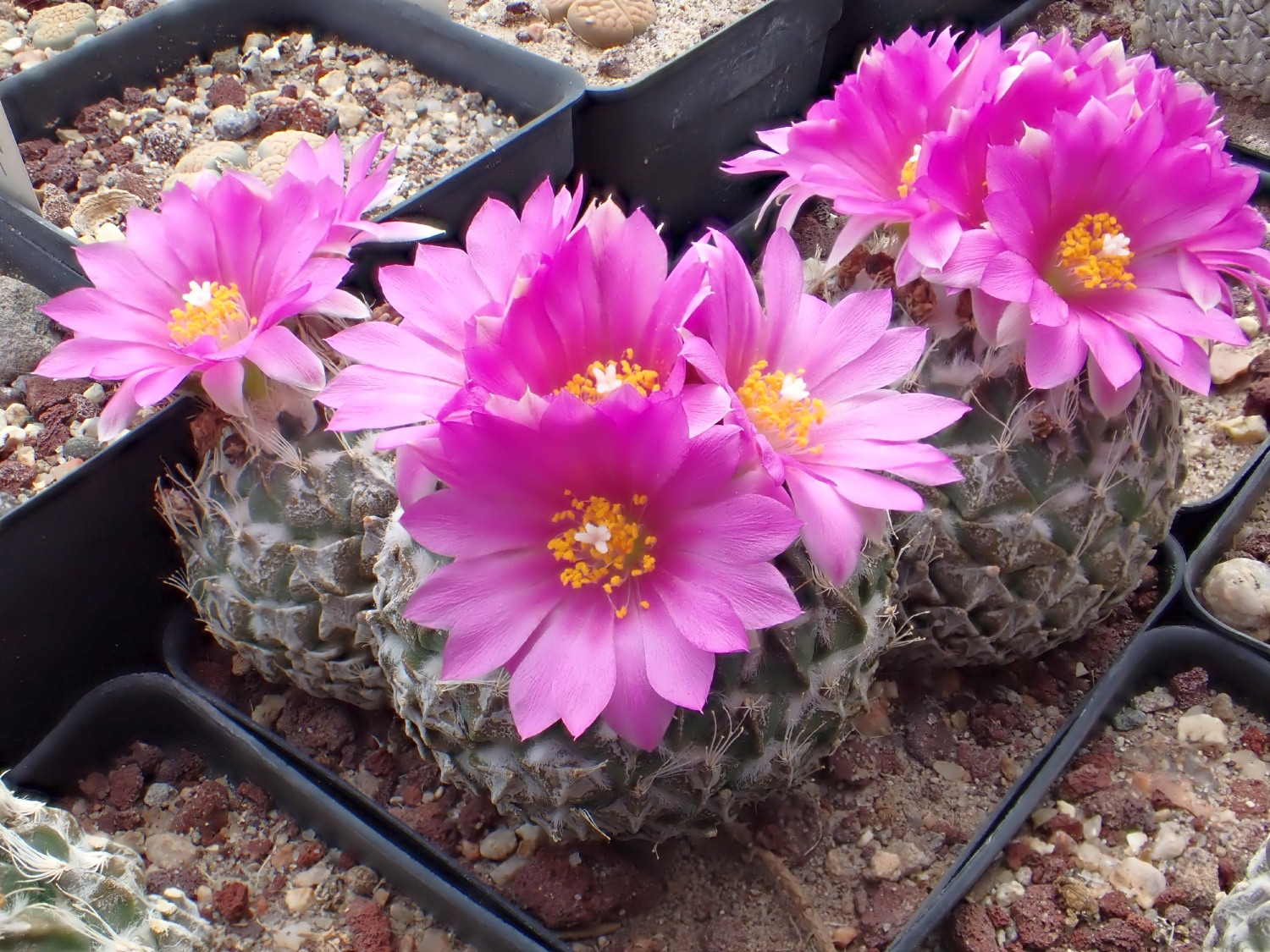
Pelecyphora strobiliformis (Werderm.) Frič & Schelle ex Kreuz. is the pinecone cactus of Mexico’s southeastern Chihuahuan Desert, one of only two species in a genus that remained taxonomically contested for nearly a century. The species has the most architecturally striking body in the tribe Cacteae: tightly imbricate triangular tubercles, keratinous and persistent, arranged in a spiral stack that produces an uncanny resemblance to a closed spruce or fir cone. At ground level, resting on angular limestone chips of identical colour and texture, the plant disappears completely from view outside the brief spring flowering window.
The accepted name carries a three-step nomenclatural history. Erich Werdermann described it in 1927 as Ariocarpus strobiliformis, then Alwin Berger erected the monotypic Encephalocarpus around it in 1929. Karel Frič and Ernst Schelle, published through Kreuzinger’s 1935 Verzeichnis, transferred it to Pelecyphora, where it sits today. For decades, Encephalocarpus survived in horticultural literature as a valid genus name because the pinecone tubercle architecture looked so different from the woodlouse-spine architecture of Pelecyphora aselliformis, the sister species. Molecular phylogenetics settled the argument in 2022: a Bayesian analysis of five chloroplast regions published by Sánchez et al. in PhytoKeys embedded Encephalocarpus firmly inside Pelecyphora, and Kew POWO adopted the single-genus treatment.
In habitat the species occupies a narrow arc of calcareous terrain across three Mexican states: Tamaulipas (the type locality state, with the neotype designated near Miquihuana in 1969), Nuevo León (the Doctor Arroyo and Galeana zone), and northern San Luis Potosí (the Catorce, Cedral, and Vanegas zone, partly overlapping the Wirikuta protected area). Elevation runs from 1,200 m at the lowest Tamaulipan stations to 2,140 m on the calcareous sedimentary hills west of the Sierra de Catorce. POWO, IUCN, and the Caryophyllales Network all confine the range to these three states; retail sources that add Coahuila appear to be in error.
Companion species across the range include Turbinicarpus schmiedickeanus, Mammillaria albicoma, Ariocarpus retusus, and Astrophytum capricorne. The IUCN assessment (Fitz Maurice, Fitz Maurice & Sotomayor, 2017) places the species at Least Concern, citing more than 100,000 mature individuals; the Bradleya 24 (2006) field study found 2 to 3 million plants in the San Luis Potosí subpopulation alone. The primary documented threat is not collection but quarrying: a 2014 Xerophilia study recorded a rescue translocation of 477 plants from a flagstone extraction site within Wirikuta, with 97 per cent adult survival at five months.
Pelecyphora strobiliformis quick reference
A miniature of the southeastern Chihuahuan Desert, growing on calcareous slopes and gypsum-influenced sedimentary hills between 1,200 and 2,140 m across three Mexican states. Values calibrated for seed grown plants in cultivation, drawn from habitat data and specialist grower experience.
Taxonomy & nomenclature
The accepted name is Pelecyphora strobiliformis (Werderm.) Frič & Schelle ex Kreuz., published in Kreuzinger’s 1935 Verzeichnis amerikanischer und anderer Sukkulenten, page 9. Kew POWO accepts this combination and treats two homotypic synonyms: Ariocarpus strobiliformis Werderm. (1927), the basionym, and Encephalocarpus strobiliformis (Werderm.) A.Berger (1929).
The nomenclatural journey of this species spans three genera and just over a century. Erich Werdermann described it in 1927 in Zeitschrift für Sukkulentenkunde 3: 126 as Ariocarpus strobiliformis, noting the imbricate scale-like tubercles. Alwin Berger, in his 1929 Kakteen (p. 332), argued that the keratinous spruce-cone architecture separated the species from Ariocarpus sensu stricto and erected the monotypic genus Encephalocarpus to contain it. Two years later Karel Frič and Ernst Schelle, through Kreuzinger’s Verzeichnis, transferred it to Pelecyphora; that 1935 combination has the best claim to valid publication. Anderson and Boke designated a neotype in 1969 from a plant collected near Miquihuana, Tamaulipas, on 22 January 1961 (POM), because Werdermann’s original material had been lost.
Morphologists debated the genus boundary between Encephalocarpus and Pelecyphora for decades, because the pinecone tubercle architecture looks so different from the woodlouse-spine areole pattern of P. aselliformis. Molecular evidence settled the question in 2022. Sánchez, Vázquez-Benítez, Vázquez-Sánchez, Aquino & Arias published a Bayesian analysis of five chloroplast regions (matK, rbcL, psbA-trnH, rpl16, trnL-F) in PhytoKeys 188: 115–165. Their tree recovered Encephalocarpus nested firmly inside a recircumscribed Pelecyphora that also absorbed Escobaria and Coryphantha macromeris. The paper proposed 25 new combinations; POWO and the Caryophyllales Network adopted the single-genus treatment.
The generic epithet comes from Greek pelecys (axe) and phora (bearing), referencing the axe-shaped tubercles of P. aselliformis. Strobiliformis is Latin for “shaped like a pine cone.” Older horticultural and society literature still frequently uses the Encephalocarpus genus name; collectors encountering that name should treat it as a synonym of Pelecyphora strobiliformis.
Historical synonyms (2)
- Ariocarpus strobiliformis Werderm., 1927 basionym
- Encephalocarpus strobiliformis (Werderm.) A.Berger, 1929 homotypic synonym
Sources: POWO (Kew) · IPNI · GBIF · Wikidata
Habitat
Pelecyphora strobiliformis is confined to the southeastern Chihuahuan Desert in three Mexican states: Tamaulipas, Nuevo León, and northern San Luis Potosí. In Tamaulipas the type-locality state, populations concentrate in the Sierra Madre Oriental foothills around Miquihuana, Bustamante, Jaumave, and Tula. Nuevo León plants occupy the Doctor Arroyo and Galeana zone further west. The northernmost San Luis Potosí records place the species in the Catorce, Cedral, and Vanegas zone described by Sotomayor et al. in Bradleya 24 (2006), partially within the Wirikuta protected area. Elevation runs from approximately 1,200 m at the lowest Tamaulipan stations to 2,140 m on the calcareous sedimentary hills west of the Sierra de Catorce.
Substrate is uniformly calcareous: weathered limestone slopes, gypsum-influenced sedimentary hills, and fine gravel pockets between exposed bedrock. Plants sit half-buried, with the apical crown level with or slightly below the surrounding limestone chips. The glaucous grey-green body colour and angular tubercle profile match the calcareous gravel so precisely that the species is effectively invisible during the long dry season. Annual rainfall is 300 to 500 mm, summer-dominant (June through September), with winter dry and cool and brief frosts to −4°C at the higher Tamaulipan stations. Open exposures on south-facing slopes predominate; shade from nurse plants provides the microhabitat where seedlings establish.
The companion flora underlines the calcareous character of the habitat. Ariocarpus retusus, Astrophytum capricorne, Echinocactus horizonthalonius, Mammillaria albicoma, and Turbinicarpus schmiedickeanus all share the same limestone gravel pockets across portions of the range. The Wirikuta biome, where the San Luis Potosí population overlaps with Lophophora williamsii habitat, is the most botanically diverse sector of the range and the most densely documented.
Morphology
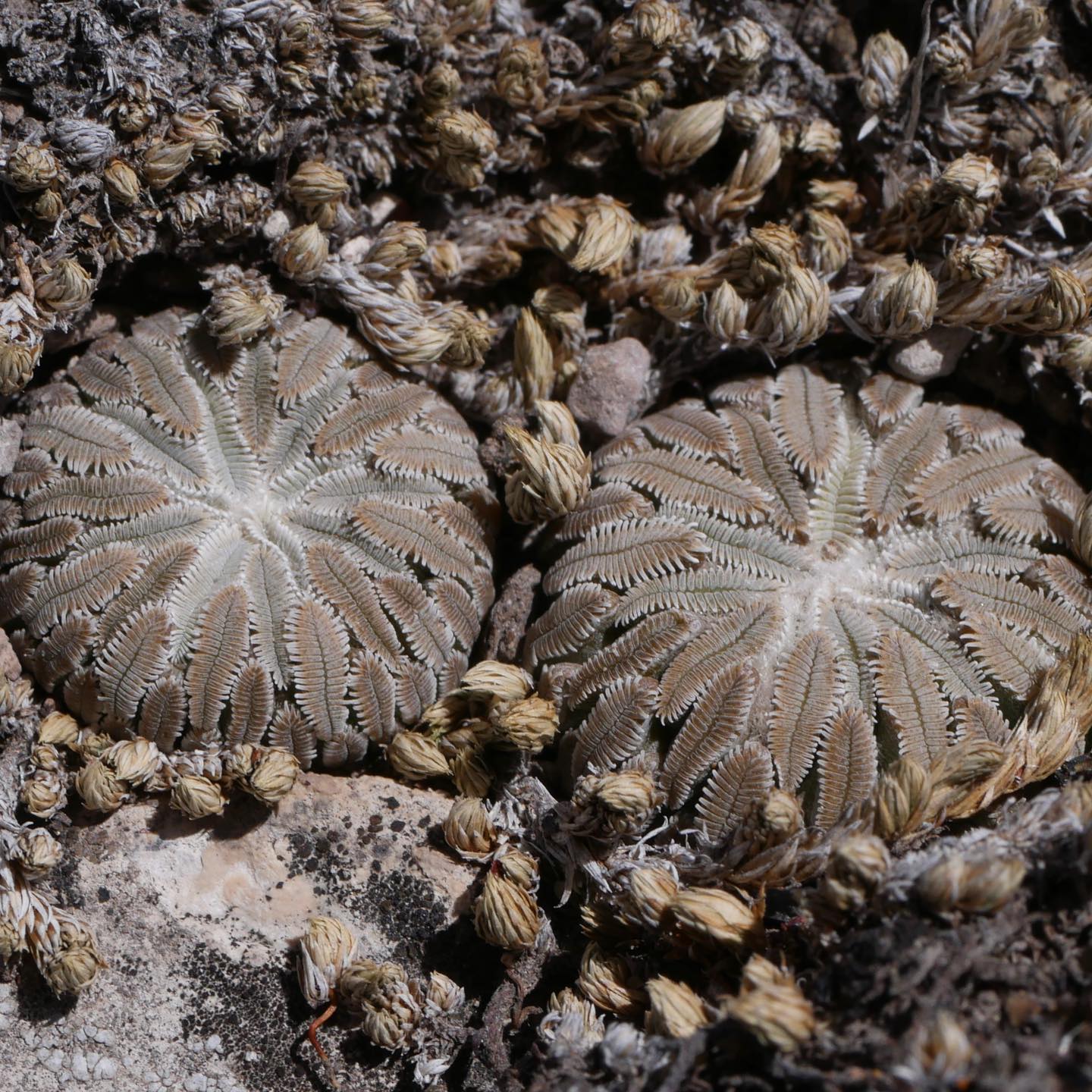
Body solitary, globose to flattened-globose, 2 to 4 cm tall and 4 to 6 cm in diameter; old plants can reach 7 cm across and produce slow basal offsets, but the species is essentially solitary through most of its life. The stem colour ranges from yellowish green through dull green to a glaucous grey-green that mirrors surrounding limestone. A stout spindle-shaped taproot contracts seasonally, drawing the body almost to ground level during prolonged drought.
The defining feature is the tubercle architecture. Tubercles are imbricate, spirally arranged, scale-like, triangular in outline, slightly keeled on the outer face and flat to convex on the inner, 8 to 12 mm long and 7 to 12 mm wide at the base. They stack tightly enough that the body reads as a closed spruce or fir cone, with older tubercles persistent and keratinous rather than deciduous. Areoles are dimorphic: young tubercles near the apex carry short, soft, pectinate spines 1 to 3 mm long, white to greyish, comb-arranged across the upper edge. These spines are deciduous, absent from older parts of the body. The absence of persistent aerial spines on mature tissue is one of the characters that most visibly sets the species apart from spinose cacti of similar size.
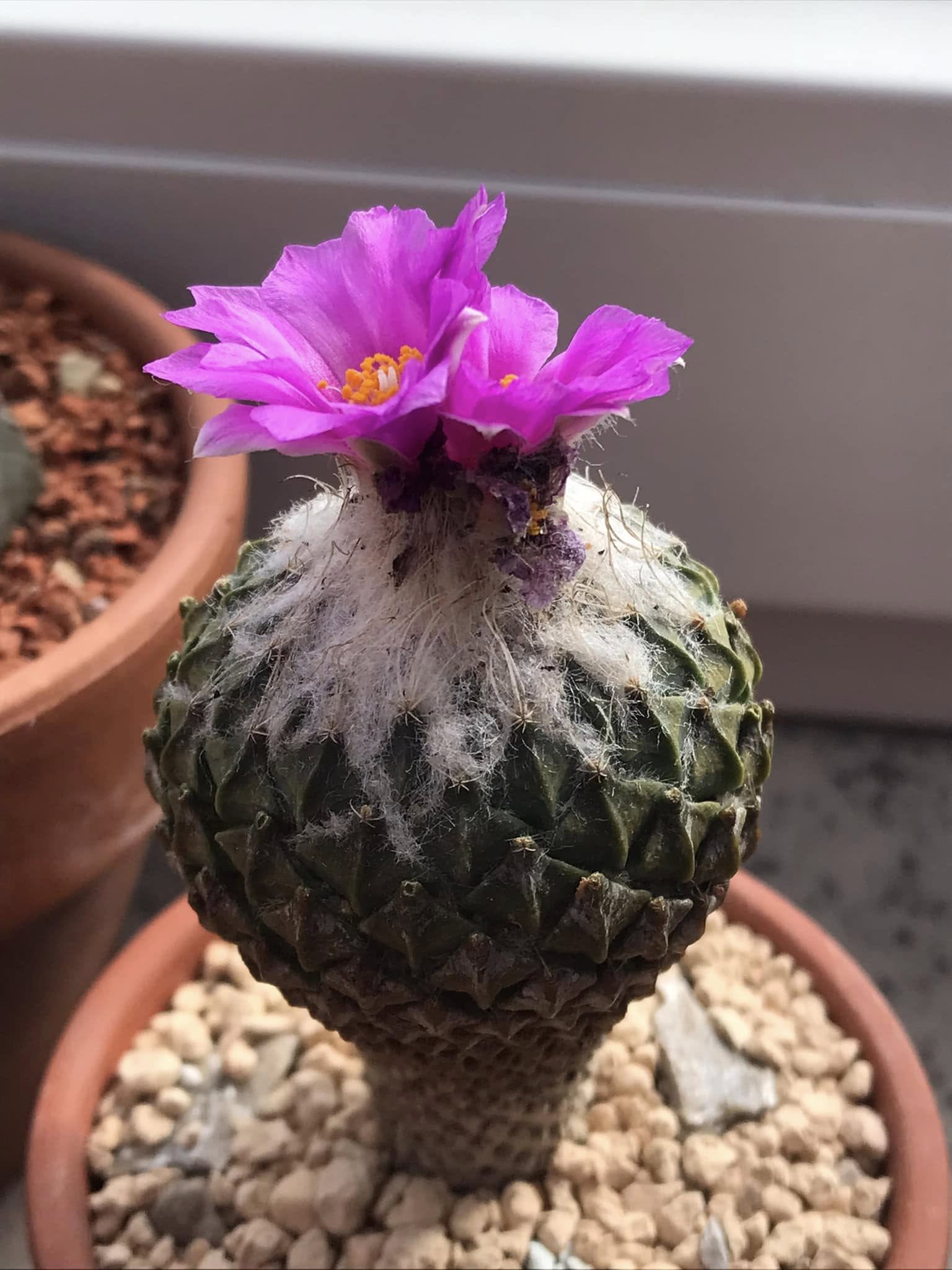
Flowers are apical, produced from the woolly crown of the youngest tubercles in spring (March through May in habitat; occasionally into early summer in cultivation). Each is bell-shaped, 1.5 to 3 cm long and roughly the same in diameter, with brilliant magenta to reddish-purple inner tepals, paler greenish to bronze outer tepals, and yellow stamens around a pale multi-lobed stigma. Several flowers can open simultaneously on a mature plant. The fruit is a small dry naked berry that ripens inside the tubercle wool and dehisces by tubercle abscission once dry; seeds are minute, black, and finely tuberculate.
Locality detail
The neotype locality is near Miquihuana, Tamaulipas, Mexico, from a specimen collected 22 January 1961 (POM), designated by Anderson and Boke in 1969 because Werdermann’s 1927 original type material had been lost. Three Mexican states hold confirmed populations: Tamaulipas (the type-locality state), Nuevo León (the Doctor Arroyo and Galeana region), and northern San Luis Potosí (the Catorce–Cedral–Vanegas zone, partly overlapping the Wirikuta biosphere reserve).
The map marks three state centroids rather than point-level GPS coordinates. Precise locality data for a CITES Appendix I species in active demand facilitates collection; regional centroids convey the range without exposing individual populations. The Wirikuta protected area, within which the San Luis Potosí populations partly overlap, affords some legal protection under Mexican law, but quarrying pressure documented in the 2014 Xerophilia translocation study shows that protection is incomplete in practice.
Pelecyphora strobiliformis care and cultivation
Pelecyphora strobiliformis sits at the intermediate to advanced level in the difficulty spectrum: more forgiving than Ariocarpus or Aztekium, but less predictable than most Mammillaria. Three requirements account for the rating: a fast-draining mineral substrate, intolerance of wet cold, and an extremely slow growth rate from seed. All three are manageable; none tolerate shortcuts.
Substrate
The locked seven-component recipe is 35 per cent pumice, 15 per cent lava rock, 10 per cent zeolite, 10 per cent granite grit, 18 per cent crushed limestone, 5 per cent silica grit, and 7 per cent worm castings, summing to 100. The 18 per cent limestone fraction follows house convention rather than a documented species requirement; the species is documented on calcareous parent rock across all three states in its range, and the mix holds substrate pH at 7.0 to 8.0. Pumice carries the aerated matrix; lava and granite grit add structural sharpness without breaking down; zeolite (clinoptilolite at 4 to 6 mm) buffers cation exchange and protects against salt accumulation from limestone dissolution; silica provides angular drainage insurance. The 7 per cent organic fraction, as worm castings, follows house convention; seedlings establish in gravel-and-litter pockets under nurse plants in habitat per the Bradleya 24 (2006) locality notes, a plain habitat fact.
Both Pelecyphora species on this site carry a limestone share by house convention, and no cultivation source shows either to be a calcicole; the P. strobiliformis share follows that convention rather than any measured need.
| Species | Pumice | Lava | Zeolite | Granite | Limestone | Silica | Organic |
|---|---|---|---|---|---|---|---|
| P. strobiliformis (this page) | 35% | 15% | 10% | 10% | 18% | 5% | 7% |
| P. aselliformis | 38% | 15% | 10% | 10% | 12% | 5% | 10% |
Watering and light
Water sparingly from March through October. During the active growing season (April through September), water once each time the substrate is fully dry through the entire root volume: roughly weekly in summer in a small pot under bright glasshouse conditions, or every 10 to 14 days in cooler or more humid climates. Reduce sharply in autumn and keep the plant bone dry from November through February, or whenever night temperatures remain below 10°C. Wet cold is the leading killer in cultivation; the taproot rots quickly if the substrate stays damp below that threshold. Brief exposure to −4°C is tolerated when the plant is completely dry, but the routine winter floor should be 5 to 8°C.
Light should be strong throughout the growing season: full sun outside the hottest summer hours, or full sun all day under glass with ventilation. Plants grown at lower intensities etiolate, lose the tight pinecone silhouette, and fail to develop the apical woolly crown that produces flowers. The compact growth habit and flowering output are both dependent on high light levels.
Propagation
Serious cultivation is almost entirely from seed. Germination is reliable at 22 to 25°C on a sterile mineral mix under 70 to 80 per cent humidity for the first three weeks, dropping to ambient thereafter. Seedlings are extremely slow: a 2 cm plant takes five to seven years from sowing; first flowering arrives eight to twelve years out. Grafting seedlings onto Pereskiopsis for the first 12 to 18 months compresses establishment dramatically. Degrafted plants acclimate well to mineral substrate; the trade also supplies permanent grafts on Hylocereus or Trichocereus rootstock for collectors who prefer faster display.
Published tissue-culture work (Pérez-Molphe-Balch & Dávila-Figueroa, 2002) on Murashige and Skoog medium with cytokinin supplementation reports 136.3 shoots per explant after three proliferation cycles and 87 per cent rooting success. This is the documented commercial route for the CITES-paperworked nursery stock that reaches European and Japanese collectors without field-collected provenance.
Comparison
The most important identification pairing is with the sister species Pelecyphora aselliformis. Both species share the same small-bodied profile, magenta apical flowers, and dimorphic areoles. The body architecture is the definitive separator: P. aselliformis carries laterally elongated tubercles arranged like the segments of an isopod, with paired comb-pectinate spines that are persistent on mature tissue. P. strobiliformis has triangular imbricate tubercles stacked into the pinecone outline, with deciduous spines absent from older parts of the body. The two species do not overlap in range: P. aselliformis is endemic to the San Luis Potosí Valley floor, well west of the Chihuahuan Desert fringe that P. strobiliformis occupies.
Small Ariocarpus species, especially Ariocarpus kotschoubeyanus, come up in the same limestone habitats and can produce superficially similar compact flat-topped bodies at the same elevation band. The tell is the tubercle surface: Ariocarpus tubercles are flat-topped, leathery, and woolly only in the central groove, lacking the keratinous keeled profile. The pinecone silhouette is unambiguous on any mature specimen.
Strombocactus disciformis is occasionally sold under the “miniature pinecone” descriptor, and young plants can look similar to juvenile P. strobiliformis. Strombocactus tubercles are smaller and more rounded, carry persistent fine bristly apex spines rather than deciduous soft pectinate ones, and the species is endemic to Querétaro and Hidalgo, south of the P. strobiliformis range. Juvenile Aztekium hintonii on gypsum can also show a faintly imbricate appearance, but adults carry vertical rib-wall wrinkling and never produce the triangular keratinous tubercle stack.
Frequently asked questions
Is Pelecyphora strobiliformis hard to grow?
Intermediate to advanced. The mineral mix is held at pH 7.0 to 8.0 by house convention. The three compounding challenges are the need for a fast-draining mineral substrate, intolerance of wet cold (the taproot rots quickly below 10°C with any moisture in the substrate), and the extremely slow growth from seed. A dry winter rest and strong light are non-negotiable. Growers who can meet those three conditions reliably find the species rewarding; those who cannot will lose plants.
Can Pelecyphora strobiliformis be grown from seed?
Yes, and seed grown material is the correct target for collectors who care about documentation. Germination is reliable at 22 to 25°C on a sterile mineral mix under high humidity for the first three weeks. The main challenge is time: a 2 cm plant takes five to seven years from sowing, and first flowering arrives eight to twelve years out. Grafting seedlings to Pereskiopsis for the first year compresses the early-growth stage and produces plants that can be degrafted onto mineral substrate. Tissue-culture propagation (136.3 shoots per explant, 87 per cent rooting) is the commercial route for legal nursery stock reaching the European and Japanese trade.
Is Pelecyphora strobiliformis legal to own?
Pelecyphora strobiliformis is listed on CITES Appendix I, where the Pelecyphora genus has sat since 1 July 1975 and remained at CoP19 (2022). Commercial international trade in wild-collected specimens is prohibited outright. Legal nursery stock requires either an Article VII pre-Convention certificate or an Article IV artificial-propagation certificate plus a non-detriment finding from the country of export. Under Mexican federal law, the species is additionally listed as Sujeta a protección especial (Pr) under NOM-059-SEMARNAT-2010, making any in-situ disturbance or collection without SEMARNAT authorisation unlawful regardless of CITES status. Nursery-propagated material of documented seed-grown or tissue-culture origin with full CITES paperwork is the only legally defensible source for collectors.
Where does Pelecyphora strobiliformis grow in the wild?
On calcareous limestone slopes and gypsum-influenced sedimentary hills across three Mexican states: Tamaulipas (type locality at Miquihuana), Nuevo León (Doctor Arroyo and Galeana zone), and northern San Luis Potosí (Catorce, Cedral, and Vanegas zone, partly within the Wirikuta biosphere reserve). Elevation runs from 1,200 m at the lowest Tamaulipan stations to 2,140 m on the calcareous sedimentary hills west of the Sierra de Catorce. The IUCN assessment (2017) cites over 100,000 mature individuals; the Bradleya 24 (2006) field study found 2 to 3 million plants in the San Luis Potosí subpopulation alone.
When does Pelecyphora strobiliformis flower?
March through May in habitat; the season can extend into June in cultivation at typical Northern Hemisphere latitudes. Flowers are brilliant magenta to reddish-purple, bell-shaped, 1.5 to 3 cm across, and produced apically from the woolly crown of the youngest tubercles. Several can open simultaneously on a mature plant, forming a magenta ring around the apex. The dry winter rest is the physiological trigger; plants kept wet through winter typically fail to bud the following spring.
Sources & further reading
Werdermann, E. (1927). Ariocarpus strobiliformis protologue. Zeitschrift für Sukkulentenkunde 3: 126. · Berger, A. (1929). Kakteen: 332. Engelmann, Stuttgart (Encephalocarpus protologue; Biodiversity Heritage Library). · Plants of the World Online (Kew POWO). Pelecyphora strobiliformis (Werderm.) Frič & Schelle ex Kreuz., accepted name; Ariocarpus strobiliformis and Encephalocarpus strobiliformis as homotypic synonyms. powo.science.kew.org · Sánchez, D., Vázquez-Benítez, B., Vázquez-Sánchez, M., Aquino, D. & Arias, S. (2022). New combinations in Pelecyphora: plastid phylogeny subsuming Encephalocarpus, Escobaria and Coryphantha macromeris. PhytoKeys 188: 115–165. · IUCN Red List of Threatened Species. Fitz Maurice, B., Fitz Maurice, W.A. & Sotomayor, M. (2017). Pelecyphora strobiliformis: Least Concern. Red List criteria v3.1. iucnredlist.org · Sotomayor, M., Arredondo Gómez, A., Sánchez Barra, F.R. & Martínez Méndez, M. (2006). New locality for Pelecyphora strobiliformis in San Luis Potosí. Bradleya 24: 95–100. · Nájera Quezada, P., Jaime Hernández, J. & López Martínez, C. (2014). Rescue translocation of Pelecyphora strobiliformis. Xerophilia III(4). · CITES Secretariat. Appendices I, II and III valid from 14 February 2021; Checklist of CITES Species, CoP19 (2022). cites.org · NOM-059-SEMARNAT-2010 (DOF, 30 December 2010). Pelecyphora strobiliformis listed as Sujeta a protección especial (Pr). · Pérez-Molphe-Balch, E. & Dávila-Figueroa, C.A. (2002). Micropropagation of Pelecyphora strobiliformis. In Vitro Cellular & Developmental Biology–Plant 38(1): 73–78. · Anderson, E.F. (2001). The Cactus Family. Timber Press: pp. 538–539. · Hunt, D., Taylor, N. & Charles, G. (2006; 2013 update). The New Cactus Lexicon. dh Books. · llifle.com Encyclopedia of Living Forms and cactus-art.biz. Cultivation cross-check on tubercle dimensions, substrate, and cold tolerance.