
Cochemiea poselgeri
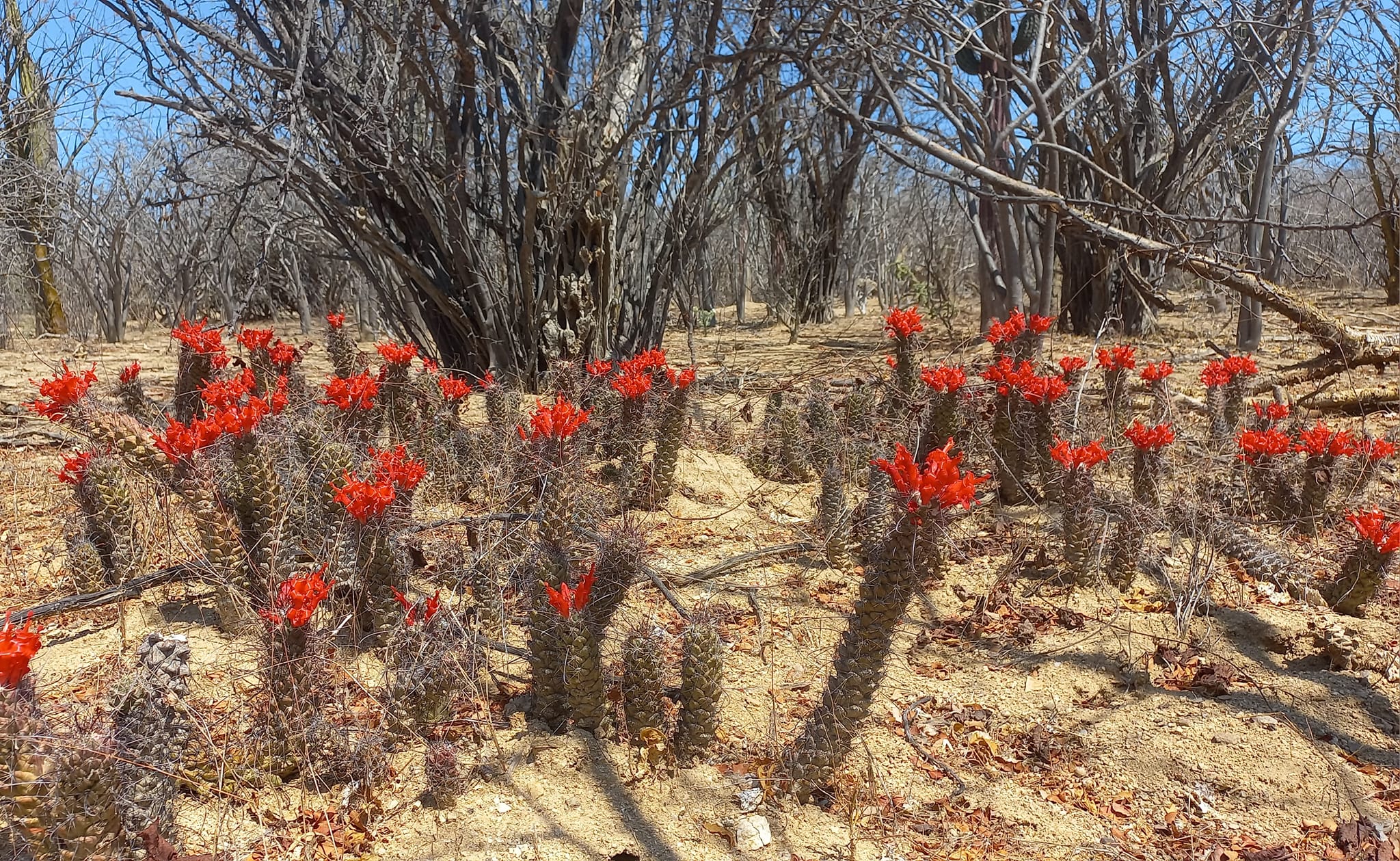
Cochemiea poselgeri (Hildm.) Britton & Rose is the type species of Cochemiea, the nomenclatural anchor for a genus that has grown from four Baja California shrubs to roughly 36 accepted species since Breslin, Wojciechowski & Majure’s 2021 molecular revision absorbed Mammillaria sect. Cochemiea, Bartschella, and parts of Mammilloydia and Neomammillaria. Heinrich Hildmann described the basionym Mammillaria poselgeri in Garten-Zeitung 4: 559 (1885) from living plants introduced to European cultivation by German botanist and collector Heinrich Poselger, for whom the epithet is named. Britton & Rose transferred it to Cochemiea in their Cactaceae 4: 22 (1923), establishing the combination that stands today under Kew POWO.
In the field, C. poselgeri is the sprawling shrub of southern Baja California Sur: stems cylindrical, up to 200 cm long but rarely more than 4 cm across, decumbent to hanging off cliff faces and ridge edges in wide colonies. No other member of the pre-revision Cochemiea s.s. clade approaches this stem length. The species ranges from around San Ignacio (roughly 27°N) south to the Cape Region near La Paz, with additional records from Gulf of California islands including El Pardito and San José Island, at elevations from sea level to 120 m in coastal Vizcaino Desert, Gulf Coast Desert, and Magdalena Plains ecoregions.
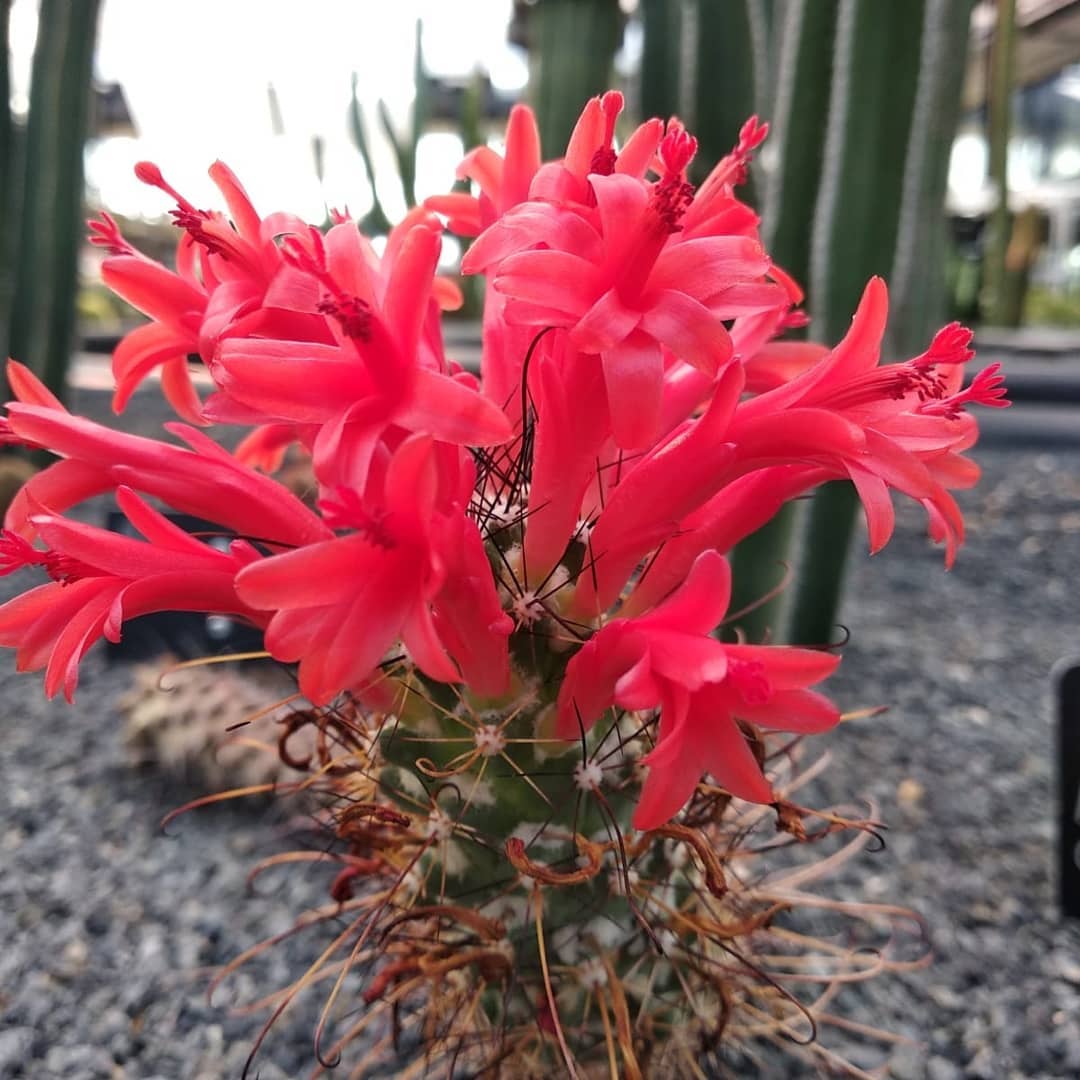
The flowers are what originally defined the old genus. Deep scarlet-red, zygomorphic (bilaterally symmetrical), with a long tubular hypanthium and reflexed perianth tips, they are built precisely for hummingbird pollination. This floral syndrome is shared only with Cochemiea setispina among the taxa in this genus covered on this site; the other five all carry actinomorphic flowers with entirely different pollinator syndromes. Anthesis is diurnal. Plants are self-sterile at the genus level, as documented by Breslin et al. (2022).
Populations across Baja California Sur are described as relatively common within the range. The wide distribution from San Ignacio to the Cape Region and across several Gulf islands provides a buffer that most other Cochemiea do not have. The species sits on CITES Appendix II through the blanket Cactaceae listing, making documented nursery-propagated provenance the legally required basis for collector specimens.
Cochemiea poselgeri quick reference
A low-elevation coastal desert shrub from southern Baja California Sur, inhabiting sandy flats, rocky slopes, and cliff faces from sea level to 120 m with intense sun and hyper-arid conditions moderated by Pacific maritime influence. Values calibrated for seed grown plants in cultivation, drawn from habitat data and specialist grower sources.
Taxonomy & nomenclature
The accepted name is Cochemiea poselgeri (Hildm.) Britton & Rose. The basionym Mammillaria poselgeri Hildm. was published in Garten-Zeitung (Berlin) 4: 559 (1885); Heinrich Hildmann named the species after Heinrich Poselger (1818–1883), the German botanist and collector who introduced living material from Baja California to European cultivation. Britton & Rose transferred it to Cochemiea in Cactaceae 4: 22 (1923). Kew POWO accepts the Britton & Rose combination as the current name, with Mammillaria poselgeri as the homotypic basionym and four additional heterotypic synonyms: Cochemiea roseana (Brandegee) Walton (1899), Mammillaria roseana Brandegee (1891), Mammillaria radleana K.Schum. (1892), and Mammillaria radliana Quehl (1892). Some older literature places these zygomorphic-flowered Baja species in Mamillopsis; POWO does not accept this combination.
Cochemiea poselgeri is the type species of the genus Cochemiea. The genus was first elevated to genus rank by Frederick Arthur Walton in Cactus Journal (London) 2: 51 (1899) from Thomas Edward Brandegee’s 1897 subgenus within Mammillaria. It was widely accepted as a genus by Britton & Rose but later submerged into Mammillaria by some authors. The 2021 molecular revision by Breslin, Wojciechowski & Majure (Taxon 70: 308–323) re-established and greatly expanded Cochemiea, demonstrating that Mammillaria as broadly circumscribed was non-monophyletic. The expanded genus now encompasses roughly 36 species, absorbing Mammillaria sect. Cochemiea, Bartschella, and portions of Mammilloydia and Neomammillaria. As type species, C. poselgeri is the nomenclatural foundation for that expanded circumscription.
Within the post-revision genus, C. poselgeri sits in the Cochemiea s.s. five-taxon core clade alongside C. halei, C. maritima, C. pondii, and Cochemiea setispina. This core clade represents the historic anchor of the pre-revision genus: all five share zygomorphic, scarlet, tubular, hummingbird-pollinated flowers and Pacific Coast Baja California origin at roughly 5–4 million years ago (Breslin et al. 2022 American Journal of Botany). The remaining ~31 species of the expanded genus, including the other taxa covered on this site, do not share this hummingbird-pollination syndrome and have entirely different flower forms and pollination ecologies.
Historical synonyms (5)
- Mammillaria poselgeri Hildm., 1885 basionym
- Mammillaria roseana Brandegee, 1891 heterotypic synonym
- Mammillaria radleana K.Schum., 1892 heterotypic synonym
- Mammillaria radliana Quehl, 1892 heterotypic synonym
- Cochemiea roseana (Brandegee) Walton, 1899 heterotypic synonym
Sources: POWO (Kew) · IPNI · GBIF · Wikidata
Habitat
Cochemiea poselgeri occupies the widest documented range of any member of the pre-revision Cochemiea s.s. clade. The species ranges from around San Ignacio (approximately 27°N) southward through the entire Baja California Sur peninsula to the Cape Region near La Paz, with records from Gulf of California islands including El Pardito and San José Island. One significant specimen was documented 40 km south of La Paz. Kew POWO recognises Baja California Sur as the sole Mexican state in the accepted range; records under “Baja California” in some sources may reflect range-boundary confusion with the closely related C. pondii and C. maritima further north, or population records near the state boundary around San Ignacio.
Elevation is uniformly low: sea level to 120 m. This is a coastal and semi-coastal lowland species, not a montane one. The four ecoregions it occupies are the Vizcaino Desert, Gulf Coast Desert, Magdalena Plains, and Cape lowland ecoregions of Baja California Sur. Habitat ranges from flat sandy plains and gravelly flats through rocky slopes to cliff faces, where stems drape vertically over the rock edge. Native substrate is a mix of granitic basement, marine sediments, and volcanic material typical of the central and southern Baja Peninsula; there is no documented affinity for limestone or calcareous rock in this species.
Annual precipitation is hyper-arid: approximately 50–100 mm along the Pacific coast, rising toward 300 mm in interior hills. The climate is bimodal: a dry Mediterranean-type winter pulse (November–March) and a late-summer tropical storm contribution (July–October). Maritime fog and humidity from the Pacific moderate temperature extremes at coastal elevations and contribute supplemental moisture during dry periods. The flowering period of August–September coincides with this late-summer moisture pulse and with the southward migration of hummingbird species through the Baja Peninsula. Associated vegetation includes Pachycereus pringlei (cardón), Stenocereus gummosus, Fouquieria columnaris (cirio), Pachycormus discolor, and Brahea armata in wetter microhabitats.
Morphology
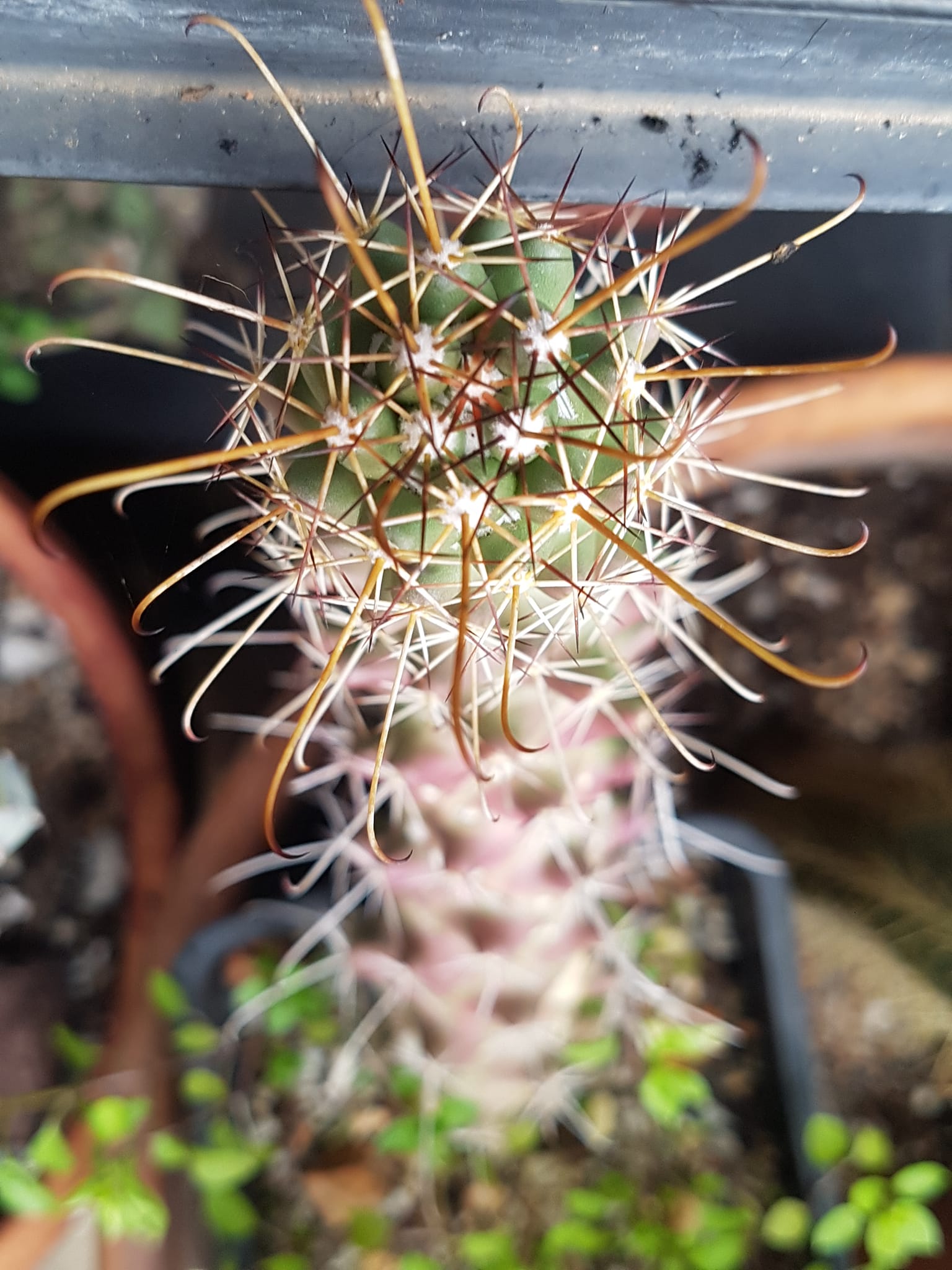
Cochemiea poselgeri is a clump-forming, multi-stemmed shrub. Stems are cylindrical, up to 200 cm long and 4 cm in diameter, decumbent to sprawling in open ground and draping or hanging over cliff edges in exposed positions. Old colonies can spread 2 m or more across as stems branch from the base and lean across surrounding rock and vegetation. This elongated decumbent habit is the defining vegetative character of the species and immediately separates it from every other taxon in the expanded genus, including C. setispina, which reaches only 30 cm in length and maintains an upright to semi-prostrate compact cluster.
Tubercles are triangular in cross-section, slightly rounded at the apex, and spaced apart with woolly axillae bearing a few bristles. Areoles are white and woolly. Each areole carries one hooked central spine, 1.5–2 cm long, dark-tipped to brownish overall, and up to eight radial spines, each approximately 1 cm long, brown with white tips. The single hooked central is a key identification character: C. setispina carries one to four centrals (the longest hooked, 2–5 cm), while C. poselgeri has a single, shorter hook. The radials of C. poselgeri are fewer (up to 8) and darker than those of C. setispina (10–12, white and bristly).
Flowers are the defining character of the pre-revision Cochemiea s.s. clade and the trait that originally distinguished this group from the broader Mammillaria. In C. poselgeri they are deep scarlet-red, approximately 3 cm long, and zygomorphic (bilaterally symmetrical), with a long tubular hypanthium, flaring segments, and reflexed petal tips that expose the stamens and style for pollen transfer by visiting hummingbirds. Yellow anthers and elongated red stigmas protrude from the flower. Flowers are diurnal and self-sterile at the genus level. They appear in the axils of tubercles near the stem apex in a ring around the growing tip, predominantly in late summer (August–September). Fruit is spherical to broadly elongated, red, 6–8 mm in diameter.
Locality detail
The type of Cochemiea poselgeri was described from plants introduced from “Lower California” (Baja California) by Heinrich Poselger; the 1885 Hildmann protologue does not record a precise collection locality or coordinates. No lectotypification designating a sharper type locality has been published in the literature consulted for this page. The general type provenance is therefore the Baja California Peninsula without narrower designation.
The map above marks the northern range limit near San Ignacio (approximately 27°N) and the southern range around La Paz and the Cape Region. The centroid for Gulf island records represents documented occurrences on San José Island and El Pardito in the Sea of Cortez. Exact population coordinates are not published in available sources; state-level and ecological-zone centroids are used here rather than population points for a species with no coordinated locality data in the primary literature.
Cochemiea poselgeri care and cultivation
Cochemiea poselgeri is an accessible Cochemiea for the collector who can provide the two non-negotiable conditions: full sun and a completely dry winter dormancy. The species evolved in the hyper-arid coastal desert systems of the Pacific slope of Baja, and its cultivation requirements track that origin directly. Given correct conditions it grows steadily, offsets reliably, and flowers in late summer when the tropical storm moisture pulse reaches the peninsula in habitat.
Substrate
The native substrate is a mixed coastal lowland desert: granitic basement, marine sediments, and volcanic material without any documented limestone affinity. The recommended substrate is 40% pumice, 15% lava rock (scoria), 10% zeolite (clinoptilolite 4–6 mm), 15% granite grit, 10% horticultural silica grit (1–3 mm), and 10% worm castings, with limestone at 0% throughout. The total is 90% inorganic and 10% organic, matching the standard Cactaceae baseline for a temperate greenhouse. Pumice carries the primary drainage function; granite at 15% adds weight and aggregate structure; zeolite stabilises pH and provides cation exchange capacity; silica at 10% keeps the mix open and fast-draining. These shares and the absence of limestone are house formulation, not a copy of the habitat geology; no cultivation source shows a lime requirement or a lime aversion for this species. In hot dry climates (Phoenix, inland California), bump organic to 15% by dropping pumice to 35% to retain moisture during fast-drying summers. In cool humid climates (UK, Pacific Northwest), keep organic at 5–8% to reduce rot risk.
All seven Cochemiea species on this site are potted in mixes that range from limestone-free to a nonzero limestone fraction. C. guelzowiana and C. theresae carry 20% limestone as a house choice, with no proven species requirement; the Baja coastal and granite-slope species carry 0% limestone, while C. albicans sits at 10% by the same house-choice default, not as a reflection of habitat geology. Hard tap water already supplies calcium and bicarbonate, while rainwater and RO water supply neither.
| Species | Pumice | Lava | Zeolite | Granite | Limestone | Silica | Organic |
|---|---|---|---|---|---|---|---|
| C. poselgeri (this page) | 40% | 15% | 10% | 15% | 0% | 10% | 10% |
| C. setispina | 40% | 15% | 10% | 20% | 0% | 5% | 10% |
| C. guelzowiana | 35% | 15% | 10% | 10% | 20% | 5% | 5% |
| C. saboae | 45% | 15% | 10% | 15% | 0% | 10% | 5% |
| C. theresae | 32% | 12% | 10% | 12% | 20% | 6% | 8% |
| C. blossfeldiana | 40% | 10% | 10% | 20% | 0% | 10% | 10% |
| C. albicans | 40% | 10% | 10% | 15% | 10% | 10% | 5% |
Watering and light
The native climate is hyper-arid: 50–100 mm annual precipitation along the coast, with rain arriving in late summer tropical storm pulses (July–October) and sparse winter rains. The plant is effectively dry from October through June in habitat. In cultivation: no watering November through February. Resume with minimal water every 3–4 weeks in March to wake roots. Increase gradually through spring (April–June, every 2–3 weeks allowing the substrate to dry completely between waterings). Water every 1–2 weeks July through September, coinciding with the late-summer tropical storm pulse and the flowering window. Reduce in October and transition to dormancy. Always water to runoff, then withhold until the substrate is completely dry throughout; never allow sustained moisture at the root neck, which is the primary rot site.
Full sun is mandatory. The species grows at sea level in an intensely solar Baja desert and has no shade tolerance worth cultivating for. Filtered or dappled light produces etiolated stems and inhibits the late-summer flowering that is the central ornamental event of the year. In very hot summer climates exceeding 40°C, some midday shade on young unacclimated plants reduces sunburn risk; established plants in coastal or temperate climates tolerate full sun without acclimation.
Cold tolerance and propagation
Brief cold tolerance to −4°C has been recorded for completely dry plants by specialist growers; the recommended safe minimum for any sustained cold exposure is 5°C. Below 5°C combined with any moisture, stem spotting and crown rot become serious risks. The coastal Baja origin does not expose the species to prolonged hard freezes in habitat, and cold hardiness is lower than many mainland Mexican cacti. Repot every 2–3 years in spring before first watering, when roots are at their driest.
Seed grown specimens are the collector target for natural sprawling habit; grafted plants on upright rootstocks suppress the decumbent character that defines the species in the field. Germination from seed germinates reliably at 21–27°C in a lightly moistened mineral mix, typically within 7–14 days. Seedlings are slow-growing; the sprawling multi-stem habit develops over several years. Plants are self-sterile at the genus level; two genetically distinct individuals are needed for fruit set.
Comparison
The clearest collector confusion for C. poselgeri is with Cochemiea setispina, the only other member of the pre-revision Cochemiea s.s. clade in this genus’s encyclopedia coverage. Both are Baja Peninsula endemics with hooked central spines and the scarlet zygomorphic hummingbird-pollinated flowers that made the old genus stand out in the broader mammilloid clade. The confusion risk is real: the two species share the flower syndrome historically used to define the genus, and any collector familiar with the pre-revision concept will encounter them both as “true Cochemiea.”
The separation is unambiguous once stems are compared. C. poselgeri reaches 200 cm in length; C. setispina reaches 30 cm. The two do not overlap geographically in documented ranges: C. poselgeri occupies the coastal and semi-coastal lowlands of Baja California Sur from San Ignacio southward, while C. setispina is restricted to the interior granitic mountain ranges of central Baja (Sierra de San Borja, Sierra La Asamblea, Sierra de San Francisco) at 0–400 m. The radial spines also differ: C. setispina carries 10–12 white bristly radials (the basis of the epithet setispina, “bristly-spined”) up to 34 mm long, against C. poselgeri’s up to 8 shorter (ca. 10 mm) brown-tipped radials. The flowers of C. setispina run 5–6 cm long, significantly larger than C. poselgeri’s 3 cm. In cultivation, flowering season provides a reliable secondary character: C. setispina blooms in spring (March–April); C. poselgeri blooms in late summer (August–September).
The five other taxa covered in this genus are not realistic confusion candidates with C. poselgeri. Cochemiea blossfeldiana is a compact globose Baja species with bicoloured pink-and-white actinomorphic flowers, nothing like the sprawling scarlet-flowered shrub. Cochemiea albicans is a white-spined clustering columnar species with white-pink actinomorphic flowers; again, completely different in spine palette and flower symmetry. The mainland miniatures Cochemiea guelzowiana, C. saboae, and C. theresae are radically different in scale, range, and flower form from the sprawling Baja shrub. The post-Breslin expanded genus contains remarkable morphological diversity precisely because it absorbed taxa from multiple previously separate genera.
Frequently asked questions
Is Cochemiea poselgeri hard to grow?
Intermediate. The species asks for full sun, a completely dry November-to-February dormancy, and sharp drainage; given those three it grows and flowers without difficulty. The hardest aspect is the winter dry rest: any moisture at the root neck during cool temperatures causes rapid crown rot. In cultivation, stem etiolation from insufficient light and root rot from winter watering account for most losses. The sprawling multi-stem habit also means mature plants need more horizontal pot space than most cacti of comparable body diameter.
Can Cochemiea poselgeri be grown from seed?
Yes. Seed germinates readily at 21–27°C in a lightly moistened well-draining mineral mix, typically within 7–14 days. Seedlings are slow-growing; the sprawling multi-stem decumbent habit takes several years to develop from a compact juvenile. Seed grown plants are the collector target because grafting on an upright rootstock suppresses the drooping elongated stem character that defines the species in the field. The species is self-sterile at the genus level; two genetically distinct individuals are required for seed set.
Is Cochemiea poselgeri legal to own?
Yes, with documentation. All Cactaceae are listed on CITES Appendix II under the whole-family listing (annotation #4 since 1977), which permits international trade with CITES export and import permits from the appropriate national authorities. Nursery-propagated specimens with documented seed-grown provenance are the legally defensible collector source. Wild-collected plants from Mexico require CITES documentation that is not routinely issued for wild specimens; the acquisition of undocumented plants is both illegal and counter to conservation practice. Domestic trade in nursery-propagated stock within a single country does not require CITES permits.
Where does Cochemiea poselgeri grow in the wild?
Across the coastal and semi-coastal lowlands of Baja California Sur, Mexico, from around San Ignacio (approximately 27°N) south to the Cape Region near La Paz, including several Gulf of California islands. Elevation is sea level to 120 m. Habitat is flat sandy plains, rocky slopes, and cliff faces in the Vizcaino Desert, Gulf Coast Desert, Magdalena Plains, and Cape lowland ecoregions. It is a lowland coastal desert species that grows alongside cardón (Pachycereus pringlei), cirio (Fouquieria columnaris), and other Baja peninsula desert vegetation.
When does Cochemiea poselgeri flower?
Late summer, primarily August through September. This timing coincides with the late-summer tropical storm moisture pulse that provides most of the annual precipitation to the coastal Baja peninsula, and with the southward migration of hummingbirds through Baja California, the documented pollinators for the pre-revision Cochemiea s.s. clade. Flowers are deep scarlet-red, approximately 3 cm long, zygomorphic, and tubular with reflexed perianth tips. They appear in a ring near the growing tip of each stem from the axils of tubercles. Plants are self-sterile; cross-pollination by a hummingbird carrying pollen from another individual is required for fruit and seed set.
Sources & further reading
Hildmann, H. (1885). Mammillaria poselgeri sp. nov. Garten-Zeitung (Berlin) 4: 559 · Britton, N.L. & Rose, J.N. (1923). Cochemiea poselgeri comb. nov. Cactaceae 4: 22. Carnegie Institution, Washington · Walton, F.A. (1899). Cochemiea. Cactus Journal (London) 2: 51 · Kew POWO. Cochemiea poselgeri (Hildm.) Britton & Rose. powo.science.kew.org/taxon/urn:lsid:ipni.org:names:62441-2 · Breslin, P.B., Wojciechowski, M.F. & Majure, L.C. (2021). Molecular phylogeny of the Mammilloid clade (Cactaceae) resolves the monophyly of Mammillaria. Taxon 70(2): 308–323 · Breslin, P.B., Wojciechowski, M.F. & Majure, L.C. (2022). Remarkably rapid, recent diversification of Cochemiea and Mammillaria in the Baja California, Mexico region. American Journal of Botany 109(10): 1472–1487 · IUCN Red List. Mammillaria poselgeri (assessed under former name). Status: Least Concern (ca. 2010). iucnredlist.org/species/152493/643065 · GBIF. Cochemiea poselgeri (Hildm.) Britton & Rose. gbif.org/species/3959963 · Henry Shaw Cactus and Succulent Society (2010). Cochemiea (Plant of the Month). hscactus.org · Giromagi Cactus and Succulents. Cochemiea poselgeri. giromagicactusandsucculents.com · llifle, Encyclopedia of Living Forms. Cochemiea setispina (comparator). llifle.com/Encyclopedia/CACTI/Family/Cactaceae/9645 · Wikipedia. Cochemiea poselgeri. en.wikipedia.org/wiki/Cochemiea_poselgeri