Lithops Care: The Inverted Watering Guide
All ArticlesLithops care inverts the standard cactus calendar: these southern African living stones grow in autumn and winter and rest completely through summer. In Northern Hemisphere cultivation, water from September through February and stop entirely from May through July. This guide covers the watering calendar, 95/5 substrate recipe, and five common fatal mistakes.
Why is Lithops care so different from cactus care?
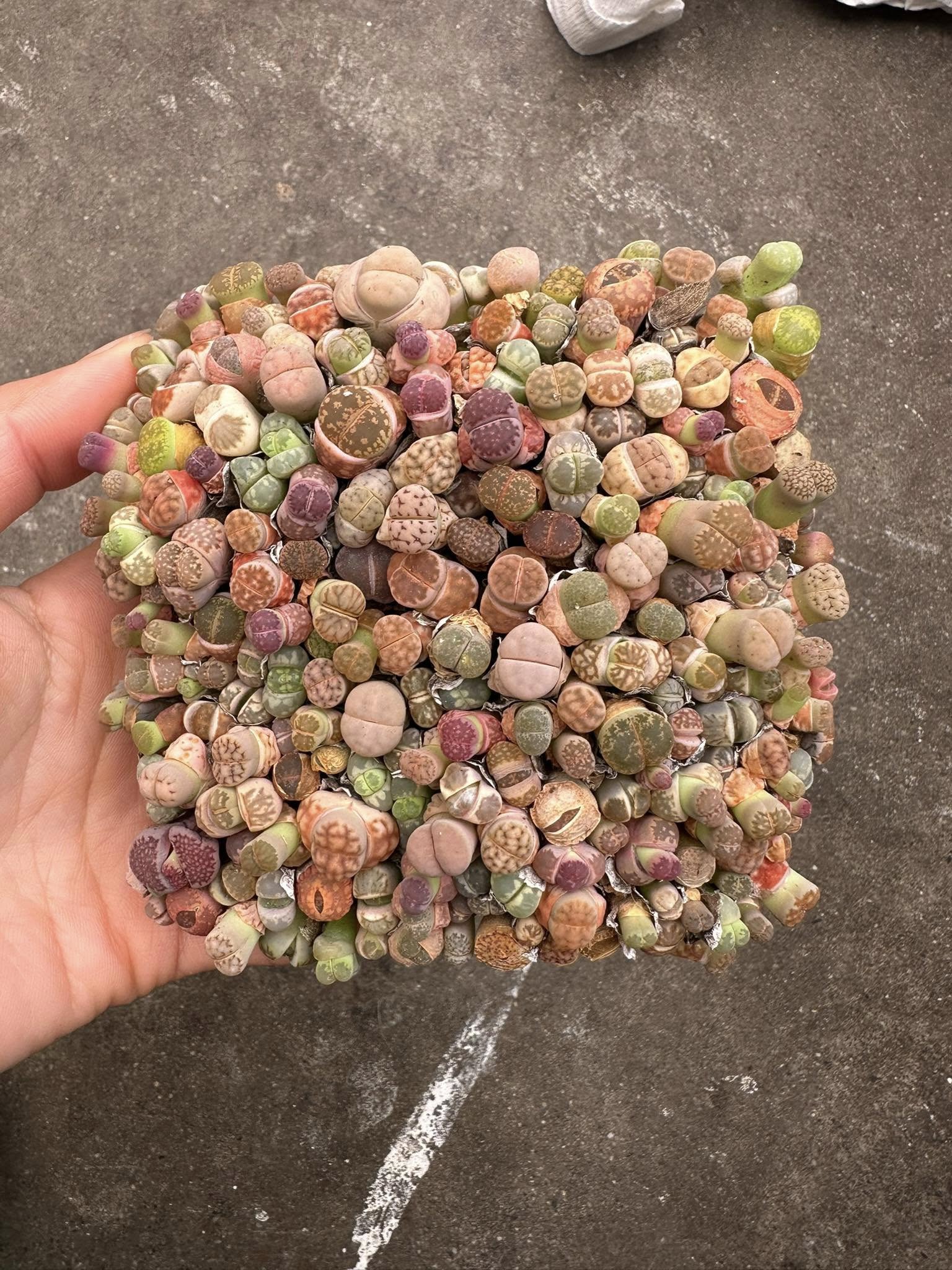
Lithops belong to Aizoaceae, the mesembryanthemum family from southern Africa, not Cactaceae. The two families converged on similar succulent shapes but evolved opposite seasonal calendars. Most cacti grow in spring and summer when warmth and rainfall coincide in the Americas. Lithops grow in autumn and winter when the dry heat of the southern African summer breaks and the first cool moisture arrives. Treating a Lithops on a cactus schedule means watering it during dormancy and withholding water during active growth. Both errors are fatal.
The genus comprises roughly 37 accepted species native to Namibia and South Africa’s Northern Cape, Western Cape, and Free State provinces. Most populations sit on quartz fields or ferruginous laterite plains with negligible organic content, instant drainage, and intense daily temperature swings. The cultivation calendar in this guide reproduces that environment in container culture. Water at the wrong time and the buried body rots from the collar inward, often without any visible external warning until the plant collapses.
Browse the full Lithops species index and identification guide for the 16 species, subspecies, and cultivars covered in detail on this site.
The annual leaf-pair cycle: the defining biology
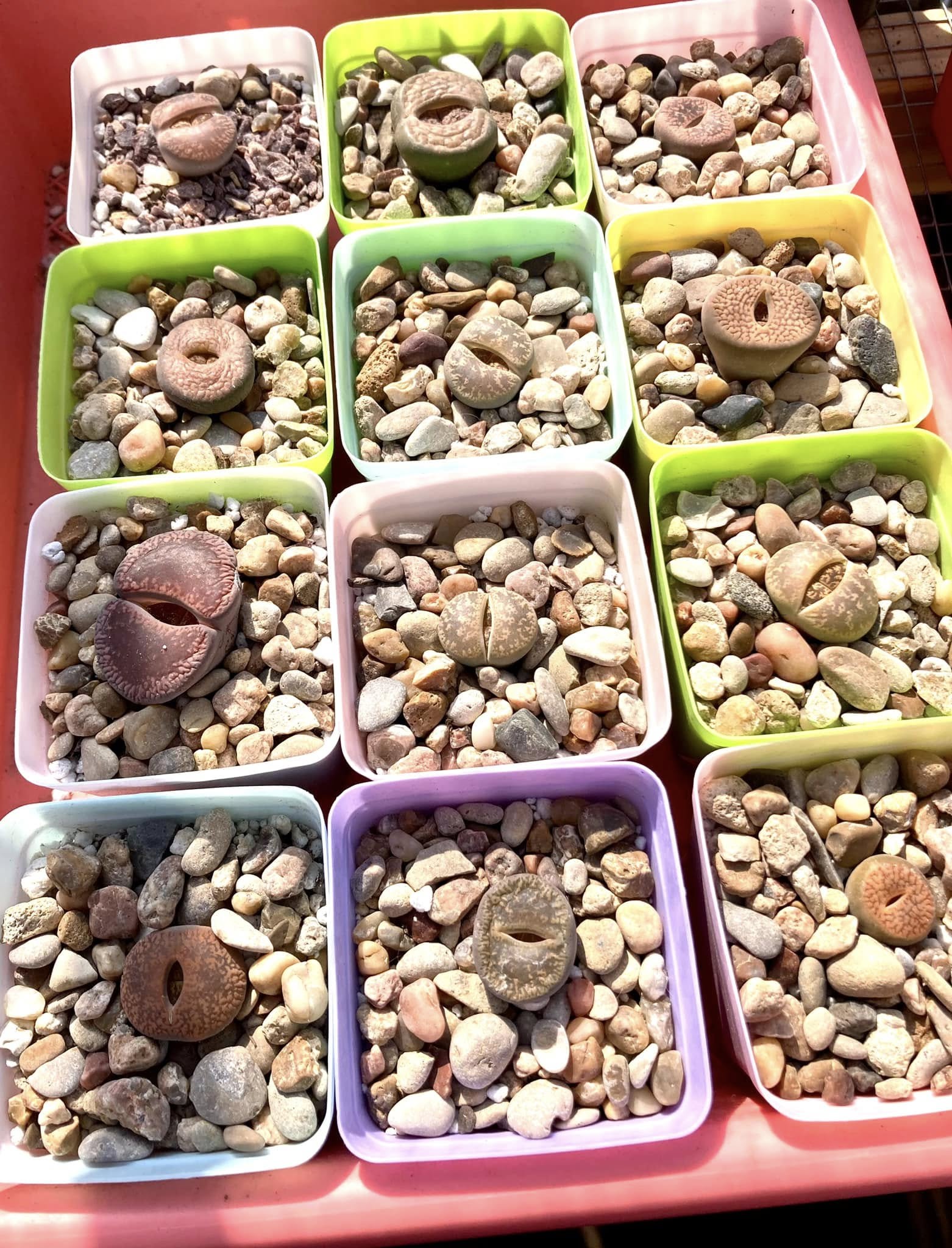
Every Lithops above ground is a single pair of fused leaves with a central fissure. Each year that pair is replaced. The mechanism is internal water and nutrient transfer: a new pair initiates inside the old one in late summer, then draws down the stored moisture and dissolved nutrients from the surrounding old tissue as it grows. The old leaves shrivel, turn papery, and eventually peel away to reveal the new pair beneath. No other genus on the rarecactus.com encyclopedia undergoes this annual full-body replacement.
The cycle dictates the watering calendar absolutely. If you water during the transfer window (late winter into early spring in the Northern Hemisphere), the old leaves refill with water and cannot complete their reserves transfer. The new pair is starved. In the worst cases the new pair is physically constricted inside the still-turgid old leaves and cannot push through. Rotting and death follow. Most first-year Lithops losses trace back to ill-timed watering during this window, not to summer dormancy errors.
Healthy papering looks like progressive desiccation from the outer edges inward, both old leaves drying at the same rate, and clean separation from the new pair beneath. Erratic or partial papering, one old leaf drying while the other stays partly turgid, or old leaves remaining attached weeks beyond the expected window, all point to watering that interrupted the transfer phase.
When should you water Lithops?
The Lithops watering year breaks into five phases: full summer dormancy with no water at all, a watch-and-wait month before active season restarts, an active autumn watering window during flowering, a winter taper, and a final spring water before dormancy resumes. The calendar is regional. Northern Hemisphere growers and Southern Hemisphere growers run six months out of phase from each other, and subtropical growers (Queensland, northern New South Wales, Florida) need an extended dormancy beyond either calendar.
Northern Hemisphere watering calendar
| Period | Plant phase | Watering |
|---|---|---|
| May to July | Full summer dormancy. Body firm or lightly wrinkled. | No water. None. |
| August | Watch-and-wait. New pair may be visible at the fissure base. | Optional very light water at month-end if temperatures have clearly broken. |
| September to November | Active growth and flowering. New pair pushes upward. | Water to runoff every 10 to 14 days. Let mix dry completely between. |
| December to February | Taper phase. Old leaves desiccating; new pair emerging. | Water every 3 to 4 weeks. Stop entirely while old leaves are mid-peel. |
| March to April | New pair fully exposed; preparing for dormancy. | One final water in early March, then stop by early May. |
Southern Hemisphere watering calendar
Southern Hemisphere growers (Australia, South Africa, New Zealand) shift the entire calendar by six months. The biology is identical; only the months change. SANBI Pretoria’s plant-of-the-week notes give March, April, and May as the flowering window in South Africa, which is the SH equivalent of the Northern Hemisphere September-to-November active period.
| Period (SH) | Plant phase | Watering |
|---|---|---|
| November to January | Full summer dormancy. | No water. |
| February | Watch-and-wait. | Optional light water at month-end. |
| March to May | Active growth and flowering. | Water every 10 to 14 days. |
| June to August | Winter taper phase. | Every 3 to 4 weeks. |
| September to October | Final water; preparing for dormancy. | One final water in early September, then stop. |
Subtropical climates need an extended dormancy
Growers in subtropical zones with hot, humid summers (Queensland, northern New South Wales, Florida, southern Texas, the Gulf Coast) face the hardest Lithops climate. Summer rainfall and high humidity actively oppose the dormancy that Lithops require. In these zones, shelter plants from summer rain absolutely, use unglazed terracotta to accelerate substrate drying, and extend dormancy further than the calendar above suggests. The active season may not safely restart until April or May rather than February or March. Mediterranean Southern Hemisphere zones (Perth, Adelaide) align cleanly with the calendar above and need no further adjustment.
What substrate do Lithops actually need?
Lithops grow in 95% inorganic substrate, the highest mineral ratio used on the rarecactus.com encyclopedia. The 5% organic fraction is worm castings, the only organic component this site uses for the genus. Standard cactus potting mix kills Lithops because it retains too much moisture against the buried collar zone, where rot starts. We covered why Miracle-Gro cactus mix fails for cacti generally. Lithops make the failure faster.
The Lithops substrate recipe:
- 40% pumice (sifted, 3 to 5 mm): primary aggregate, sharp drainage, excellent air pore space
- 25% coarse silica grit (1 to 3 mm horticultural grade angular crystalline quartz): inert weight and structure, holds no water
- 15% granite grit (3 to 5 mm): structure, mineral slow-release
- 10% zeolite (clinoptilolite, 4 to 6 mm): cation exchange capacity, pH buffering around 7
- 5% worm castings: the sole organic component, slow nitrogen, microbial inoculant
Banned ingredients site-wide: perlite, coarse rounded sand, peat moss, standard potting soil, akadama, Turface. These bans hold for Lithops absolutely. For the broader collector substrate philosophy applied across all rare cacti and succulents, see our five-mineral cactus soil recipe; Lithops are the highest-mineral application of that approach.
Top-dress the surface with the same coarse mineral grit. The dressing keeps the buried collar dry between waterings, mimics the natural quartz-field surface, reflects light back onto the dorsal face, and stops algae and moss colonising the substrate surface.
Light, pot, and container depth
Lithops are full-sun plants adapted to the highest UV environments in Africa. Six or more hours of direct sun daily is the minimum for compact, well-coloured plants. A south-facing windowsill in the Northern Hemisphere is adequate provided it gets 5 or more hours of direct sun. East and west windowsills are marginal and produce etiolation. North-facing windowsills are unsuitable. In the Southern Hemisphere, north-facing is the bright side; reverse the orientations.
Plants grown in strong light develop hard, densely coloured skins that resist rot mechanically. Plants grown in low light develop soft elongated bodies with stretched fissures and washed-out face patterns that are highly susceptible to fungal disease and rot. Etiolation is the most common cosmetic-to-fatal problem in indoor Lithops cultivation.
Greenhouses with glass cover need shade cloth (30 to 40%) during the worst of summer heat when interior temperatures push above 40°C. This is heat management, not light management: Lithops want the light but cannot transpire to cool themselves while buried in hot substrate.
Pot choice: Lithops have substantial root systems relative to the exposed body. Roots extend well below the apparent pot volume. Use a moderately deep pot of 10 to 12 cm with the 95/5 mix; this drains fast enough to prevent rot while giving roots adequate depth. Unglazed terracotta or clay composite is preferred for the porosity (accelerates drying) and the thermal mass (moderates temperature swings). Avoid glazed ceramic. Shallow pans of 2 to 3 cm depth restrict the root run and dry out unevenly; reserve them for seedling stages only.
Cold tolerance: dry cold survives, wet cold kills
The genus-level conservative cold floor for Lithops is 2°C kept dry. Most species tolerate brief exposure to light frost down to −2 to −5°C when bone dry, in good condition, and not freshly watered. No Lithops will survive being wet during frost. A wet plant at 0°C is a dead plant. A dry plant at −3°C for a night or two is survivable for most species.
Per-species variation matters. Lithops optica from the fog-moderated coastal zone near Lüderitz is frost-free in habitat; treat conservatively as cold-sensitive with a 5°C minimum in wet-climate cultivation. Lithops karasmontana from the Karas Mountains above 1,600 metres encounters genuine frost in habitat; −3°C dry is credible. Lithops lesliei from the Free State grassland is the most frost-experienced species; −2 to −3°C dry is reasonable.
The danger is almost never temperature alone. The danger is temperature plus moisture. A Lithops in a greenhouse during a wet winter, receiving rain or high humidity at near-freezing temperatures, will rot from the collar down within days. Keep them dry from late autumn onward and cold is rarely a problem in most European or North American climates.
How long can Lithops go without water?
A healthy Lithops in a deep, well-draining mineral pot can go 10 to 14 weeks without water during summer dormancy (May through July in the Northern Hemisphere, November through January in the Southern). Four months is acceptable for large, firm-bodied specimens. The plant stores moisture in its leaf bodies; the outer surface wrinkles but this is not an emergency. Six months without water is too long only if the plant has completely desiccated and collapsed inward.
Distinguishing healthy summer wrinkling from genuine dehydration distress: the dorsal face is the diagnostic surface. A healthy dormant Lithops has a flat or slightly convex dorsal face and fine, evenly distributed surface wrinkles. The body retains its overall shape. A severely dehydrated Lithops has a concave dorsal face that caves inward like a deflated cushion, with the body losing structural firmness and the skin pulling away from its own interior volume. Flat or convex face is fine. Concave face in late dormancy means the first watering of the active season is due.
The five mistakes that kill Lithops
Most first-year Lithops losses trace to five errors, listed in approximate order of frequency.
- Watering during summer dormancy. Watering in June or July is the single most common fatal error. The plant is dormant; the buried collar cannot dry; rot starts within days. Wrinkled bodies in summer mean a healthy dormant plant, not a thirsty one.
- Watering during the leaf-pair transfer window. In late winter and early spring, the old leaves are transferring reserves into the new pair. Watering at this point refills the old leaves with water and starves the new pair. The new pair may be physically constricted inside the still-turgid old leaves.
- Standard cactus or potting mix. Substrates with more than 10% organic matter retain moisture against the collar zone where rot enters. The 95/5 mineral mix is non-negotiable for long-term Lithops survival.
- Insufficient light. Less than 5 hours of direct sun produces etiolated, soft-bodied plants with thin skins that cannot resist rot mechanically and lack the diagnostic colour and pattern of well-grown specimens.
- Repotting at the wrong time. Repotting during active growth or during the leaf-pair transfer disrupts the root system at the moment when the plant most needs continuous water uptake. Repot only after the new pair is fully exposed and the old leaves are gone, just before summer dormancy starts.
Common pests and diseases
Rot is by far the most common Lithops killer, covered above. Beyond rot, four pest classes cause meaningful damage in cultivation, plus fungal pathogens that the literature documents at treatment level without consistently naming the causal organisms.
Root mealybugs (Rhizoecus spp.): the most damaging Lithops pest. Live in the soil with no obvious filaments; appear as white patches on the roots when the plant is repotted. Damage is slow: poor growth and apparent thirst-stress despite adequate watering. Treatment: bare-root the plant, wash roots under water jet, repot in fresh sterile substrate. Systemic insecticides applied as soil drench (imidacloprid, dinotefuran) reach root mealybugs without surface contact. Schedule the treatment at the post-molting repotting window, not during dormancy when roots are fragile.
Aerial mealybugs: the fissure between the leaf pair is the only sheltered cavity on the plant body and the primary infestation site. White waxy masses appear in the fissure or between the leaves. Dab with 70% isopropyl alcohol on a cotton swab. Insecticidal soap and neem oil work but must not be left pooled in the fissure; rinse after treatment.
Spider mites: mesemb-attacking mites often appear dark or black rather than the red colour of typical cactus mites. Peak risk is hot, dry summer dormancy, precisely when the plant is not being watered. Look for fine stippling on the dorsal face and faint webbing at the fissure line. Treat with horticultural oil or abamectin when the plant is not in direct hot sun. Do not spray-rinse a dormant Lithops; the wetting carries rot risk that outweighs the mite damage.
Snails and slugs: attack the exposed dorsal face at night, leaving rasped irregular surface wounds. Use ferric phosphate baits (safer around other wildlife than metaldehyde) or copper tape barriers around pots. Outdoor and open-greenhouse growers are most exposed.
Fungal pathogens beyond crown rot: the specialist literature documents treatment but is sparse on naming specific fungal genera attacking Lithops. The traditional approach is to cut away diseased tissue with a sterile blade and dust the cut surface with flowers of sulphur (powdered elemental sulphur as a fungistatic dust). Commercial growers add a mild fungicide or weak horticultural sulphur to autumn watering as preventive. Specific pathogen identification typically requires lab culture; at the home-collection scale, treat any soft, discoloured, or fluid-leaking tissue as infected and remove it immediately.
When to repot Lithops
The safe repotting window is just after the new leaf pair is fully exposed and the old leaves are completely gone, right before summer dormancy starts. In Northern Hemisphere cultivation that means April or early May; in Southern Hemisphere cultivation, October or early November. Repotting at this point means any root disturbance is followed by a rest period rather than an immediate demand for water uptake.
Frequency: solitary specimens in adequately sized pots stay stable for 3 to 5 years between repottings. Actively clumping plants need attention every 2 years; Lithops karasmontana subsp. bella can produce 60-plus heads per clump and outgrow its container faster than other species.
What fails when you repot at the wrong time: during active growth (autumn), root disturbance interrupts water uptake at the critical moment the new pair is swelling and the flower may be developing; result is failed flowering, body stress, and crown-level entry points for rot. During the old-leaf papering phase (late winter), root disturbance can interrupt reserve transfer, leaving the new pair under-resourced. During summer dormancy itself, root tips are fragile and susceptible to desiccation damage if bare-rooted in high heat. The post-molting window is the only stress-tolerant phase in the Lithops year.
Choosing your first Lithops
Two species carry the trade for beginners and will tolerate the small calendar errors of a first year. Both hold an RHS Award of Garden Merit and are widely available as nursery-propagated stock.
Lithops aucampiae is the most forgiving species in the genus and the standard first-Lithops recommendation. Native to the Postmasburg-Kuruman ironstone belt of South Africa’s Northern Cape, it tolerates a wider substrate range than most Lithops and recovers from minor watering errors better than the connoisseur species. Body colour ranges from deep red-brown to rust, with a continuous dark dorsal panel.
Lithops lesliei is the most widely cultivated species in the genus. Native to Free State and adjacent summer-rainfall grassland provinces of South Africa with marginal Botswana records, it is the most frost-experienced Lithops and the only major species growing in summer-rainfall habitat, which makes its cultivation calendar slightly more permissive than most. Body colour is typically grey-green to brown with a finely patterned dorsal face.
Stepping up: connoisseur Lithops
After two or three successful years with the beginner species, three taxa reward the increased cultivation precision required.
Lithops optica is the species most associated with Lithops collecting at the high end. The 2024 IUCN Red List assessment classifies it Critically Endangered, upgraded from Near Threatened in the 2022 assessment; the cultivar ’Rubra’ selected for intense purple-red anthocyanin pigmentation dominates trade, though the nominate grey-green form is available from specialist nurseries. Cultivation is more demanding than the beginner species: coastal fog-belt origin near Lüderitz means the species expects winter moisture and frost-free winters, with a flowering window that lands later than other species (after the winter solstice in habitat).
Lithops karasmontana from the Karas Mountains of southern Namibia is the species collectors choose for face-pattern variation. The selected cultivar ’Top Red’ carries a dense red network of channels across the dorsal face that intensifies under bright light. Habitat is montane (above 1,600 metres) and frost-experienced, making this the most cold-tolerant connoisseur species when kept dry.
Lithops julii carries the most intricate dorsal face patterning in the genus, an interconnected network of fine raised lines on a grey-pink ground. Native to southern Namibia. Less forgiving of watering errors than the beginner species but rewards collectors who have locked the calendar.
Frequently asked questions about Lithops care
When do Lithops actually need water?
Lithops are watered in autumn and early winter, not in summer. In Northern Hemisphere cultivation, the active watering window runs September through November with a taper through February. No water at all from May through July. Wrinkled plants in summer are dormant, not thirsty. Watering in summer kills Lithops from rot, not from dehydration.
Why is my Lithops splitting but not producing a new leaf pair?
A Lithops splits from its central fissure to produce one new leaf pair per year, completing the annual replacement cycle in late winter. If the split is not progressing or is splitting at an unusual time, watering during the mid-transfer period is the most common cause: refilled old leaves cannot complete reserves transfer and the new pair stalls. Stop watering until the old leaves complete papering.
What substrate do Lithops need?
Lithops grow in 95% inorganic substrate: pumice, coarse silica grit, granite grit, and zeolite, with 5% worm castings. No peat, no perlite, no standard potting mix. The buried body is in continuous contact with the substrate; slow-draining mixes cause rot at the collar zone before any surface symptoms appear.
How long can Lithops go without water?
A healthy Lithops in a deep, well-draining mineral pot can go 10 to 14 weeks without water during summer dormancy (May through July in the Northern Hemisphere). Four months is acceptable for large firm-bodied specimens. The plant stores moisture in its leaf bodies; the outer surface wrinkles but this is not an emergency.
Are Lithops cacti?
Lithops are not cacti. They belong to Aizoaceae, the ice plant and mesembryanthemum family, native to southern Africa. Cacti belong to the unrelated family Cactaceae and are native to the Americas. Lithops have no areoles, the spine-bearing structures that distinguish all cacti. The convergent stone-mimicry shape is not a family trait.
How much light do Lithops need?
Six or more hours of direct sun daily is the minimum for compact, well-coloured Lithops. A south-facing windowsill in the Northern Hemisphere is adequate; east and west windowsills produce etiolation; north-facing is unsuitable. Greenhouse plants need 30-40% shade cloth in peak summer to prevent overheating, but full sun exposure for the rest of the year.
Sources · verified May 2026
Cole, D.T. and Cole, N.A. Lithops: Flowering Stones (Cactus & Co., 2005) · South African National Biodiversity Institute (SANBI), Plant of the Week: Lithops, pza.sanbi.org/lithops · Plants of the World Online, Royal Botanic Gardens Kew, Lithops N.E.Br. · IUCN Red List, Lithops optica (Marloth) N.E.Br., 2024 assessment (Critically Endangered, upgraded from Near Threatened 2022) · University of California Statewide Integrated Pest Management Program, Pest Notes: Mealybugs (UC IPM Pub 74174) · North Carolina State Extension, Lithops profile (plants.ces.ncsu.edu/plants/lithops/) · The Royal Horticultural Society, Award of Garden Merit citations for L. aucampiae and L. lesliei