
Lithops lesliei
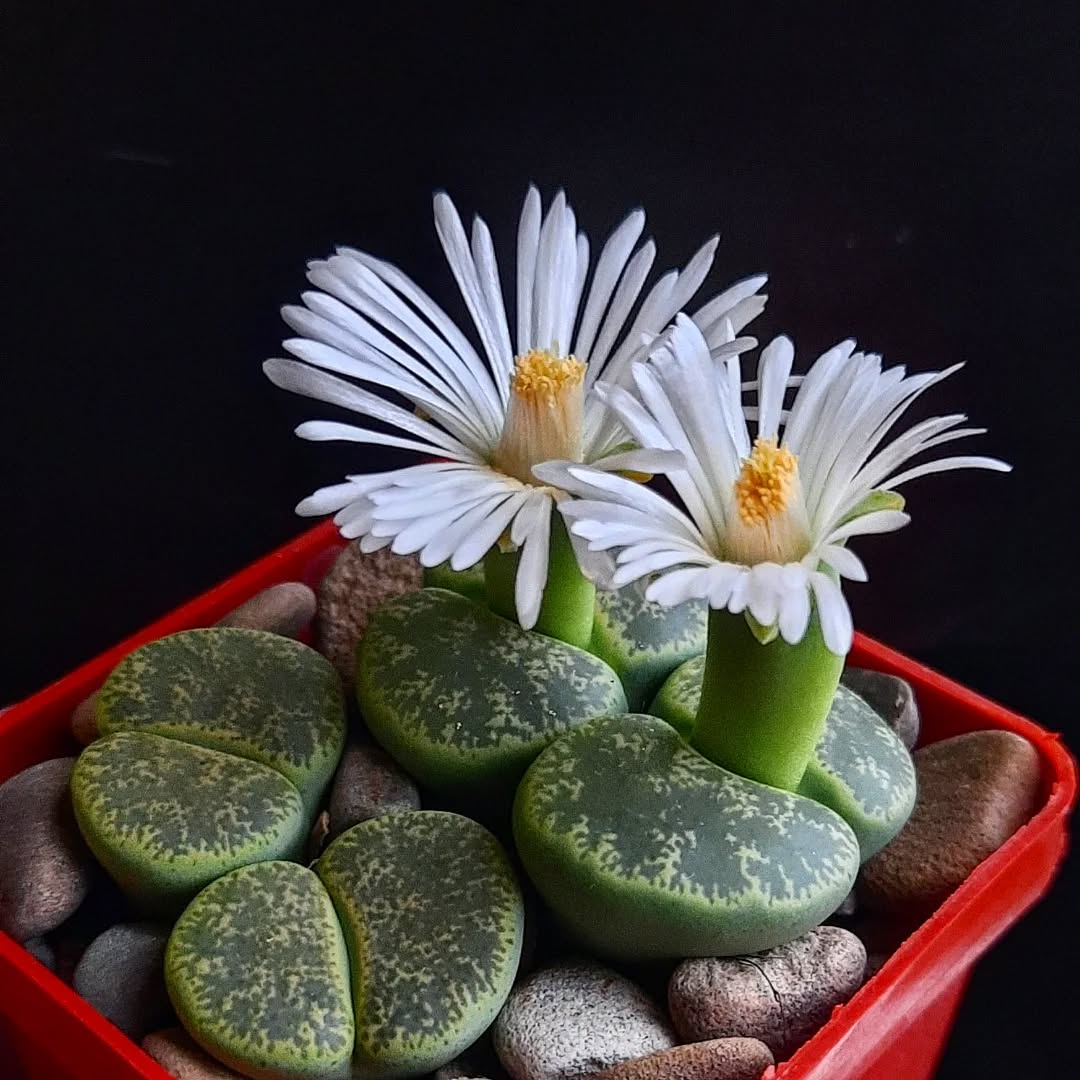
Lithops lesliei (N.E.Br.) N.E.Br. is the type species of the living-stones genus and the most widely cultivated Lithops in the global trade. Nicholas Edward Brown described it first as Mesembryanthemum lesliei in 1908 and then transferred it to his new genus Lithops in the same 1922 publication that established the genus, so the basionym and the combination share his author abbreviation. The specific epithet honours T.N. Leslie, father of the youngest Leslie son who collected the original specimen on a Dwyka Conglomerate outcrop above the Vaal River at Vereeniging in August 1908.
The species is the most widely distributed Lithops on the eastern side of the genus range, occupying the summer-rainfall Highveld grasslands of the Free State, Gauteng, Northern Cape, North West Province, and southern Botswana. This is unusual for the genus: most other Lithops sit in the winter-rainfall Namibian and Sperrgebiet zones to the west. The summer-rainfall calendar of L. lesliei shifts its cultivation rhythm a few weeks later than the western species, but the inverted Lithops growth schedule still holds in cultivation: active in autumn and winter, dormant in summer. This is the opposite of every cactus on the rest of this site, and the most common cause of catastrophic loss for growers carrying their cactus watering instincts into a Lithops pot.
Among the taxa covered on this site, L. lesliei sits alongside its taxonomic neighbour Lithops burchellii, which Cole originally treated as L. lesliei subsp. burchellii in 1988 and which Jainta elevated to species rank in 2019 on the basis of substrate (calcrete rather than ironstone), face character, and range disjunction. The anthocyanin-free L. lesliei ‘Albinica’ is the cream-bodied selection of lesliei from C036A, and L. lesliei ‘Storm’s Albinigold’ is the parallel C036B selection from Ed Storms, vegetatively indistinguishable from ‘Albinica’ but with yellow rather than white flowers. Both cultivars run on the same care calendar as the wild-type species.
L. lesliei earned the Royal Horticultural Society Award of Garden Merit in 2002 and is the standard reference plant for anyone learning the genus. The body face runs from pinkish grey through olive green to rust orange depending on form and growing conditions, with a lacework of darker translucent windows etched across the dorsal surface. Flowers are golden yellow, daisy-form, around 3 cm across, and emerge from the central fissure in autumn. Compare against the white-flowered Lithops karasmontana of the Namibian Karas Mountains and the smaller-bodied Lithops julii with its red-brown lip-smear face markings to place this species in the genus context.
Lithops lesliei quick reference
A summer-rainfall Highveld grassland mesemb that grows actively in the cool months and rests dry through summer; the calendar is inverted relative to every cactus on this site. Values calibrated for seed grown plants in cultivation, drawn from L. lesliei-specific habitat data and grower consensus across multiple specialist Lithops sources rather than genus-level extrapolation.
Taxonomy & nomenclature
The accepted name is Lithops lesliei (N.E.Br.) N.E.Br., with the basionym Mesembryanthemum lesliei N.E.Br. published in 1908. The combination into the new genus Lithops appeared in Gardeners’ Chronicle Series III, 71: 65 (1922), the same publication in which Brown established the genus. Kew POWO accepts the 1922 combination as the current name (IPNI lsid urn:lsid:ipni.org:names:362458-1). The species is the type of the genus Lithops.
POWO does not accept any infraspecific taxa under L. lesliei. The varieties named by de Boer and consolidated in Cole’s 1988 monograph (L. lesliei var. hornii, var. mariae, var. minor, var. rubrobrunnea, var. venteri) are treated by POWO as heterotypic synonyms of the nominate. They remain widely used in the trade and on specialist locality-form sites such as llifle, where collectors buy and sell plants under their var. names; the on-page treatment here defers to POWO synonymy while flagging the trade names where they appear.
The taxon formerly treated as L. lesliei subsp. burchellii D.T.Cole (Cole, Lithops Flowering Stones, 217, 1988) was elevated to species rank by Jainta in 2019: Lithops burchellii (D.T.Cole) Jainta, in Avonia 37(1): 6 (2019). POWO carries the elevation; burchellii has its own page on this site at L. burchellii and is no longer a subspecies of lesliei. Principal heterotypic synonyms of L. lesliei proper are limited to the basionym Mesembryanthemum lesliei and the de Boer / Cole varieties listed above.
Historical synonyms (12)
- Mesembryanthemum lesliei N.E.Br., 1912 basionym
- Lithops lesliei var. minor de Boer, 1961 homotypic synonym
- Lithops lesliei var. venteri (Nel) de Boer & Boom, 1961 homotypic synonym
- Lithops lesliei var. luteoviridis de Boer, 1962 homotypic synonym
- Lithops lesliei var. maraisii de Boer, 1962 homotypic synonym
- Lithops lesliei var. rubrobrunnea de Boer, 1962 homotypic synonym
- Lithops lesliei var. hornii de Boer, 1966 homotypic synonym
- Lithops lesliei var. mariae D.T.Cole, 1970 homotypic synonym
- Lithops lesliei f. albiflora Cole, homotypic synonym
- Lithops lesliei subsp. albiflora D.T.Cole, homotypic synonym
- Lithops lesliei subsp. albinica D.T.Cole, homotypic synonym
- Lithops lesliei var. applanata de Boer, homotypic synonym
Sources: POWO (Kew) · IPNI · GBIF · Wikidata
Habitat
Lithops lesliei has one of the largest ranges in the genus, following the Vaal River basin and its tributaries. The range runs from Kimberley north and east to Polokwane (formerly Pietersburg), to Bethlehem in the Free State, into southern Botswana around Gaborone, and as far south as the Zastron district. The species occupies the central and eastern parts of the Free State, the eastern districts of the Northern Cape, most of Gauteng, the eastern part of North West Province, and the south and south-east of Botswana. The historical Transvaal records fall today across Gauteng, Limpopo, and North West.
The climate is summer-rainfall: most precipitation arrives between October and March in habitat, with cold dry winters from April through September. This is the climate envelope that drives the Lithops cultivation calendar and is the reason L. lesliei is active in the Northern Hemisphere autumn and winter rather than in summer like a desert cactus. Highveld elevation runs roughly 1,200–1,800 m across the Gauteng and Free State range, dropping to 1,100–1,200 m around Kimberley and to about 1,000 m in the Botswana populations.
The substrate is variable across the wide range, consistent with a generalist habit: rust-brown ferruginous quartzite and ironstone soils at most localities, conglomeritic and feldspathic sandstone, brown shaly siltstone, pegmatitic granite, amygdaloidal lava at some Gauteng and Limpopo sites, and alkaline calcite-rich pans in the rare cases where the species drops into pan margin habitat. The diversity of substrate makes L. lesliei the most substrate-tolerant Lithops in cultivation. Plants grow in gravel pockets between Highveld grasses, where the dry winter grass litter conceals them so completely that field surveys are difficult outside the autumn flowering window.
Morphology
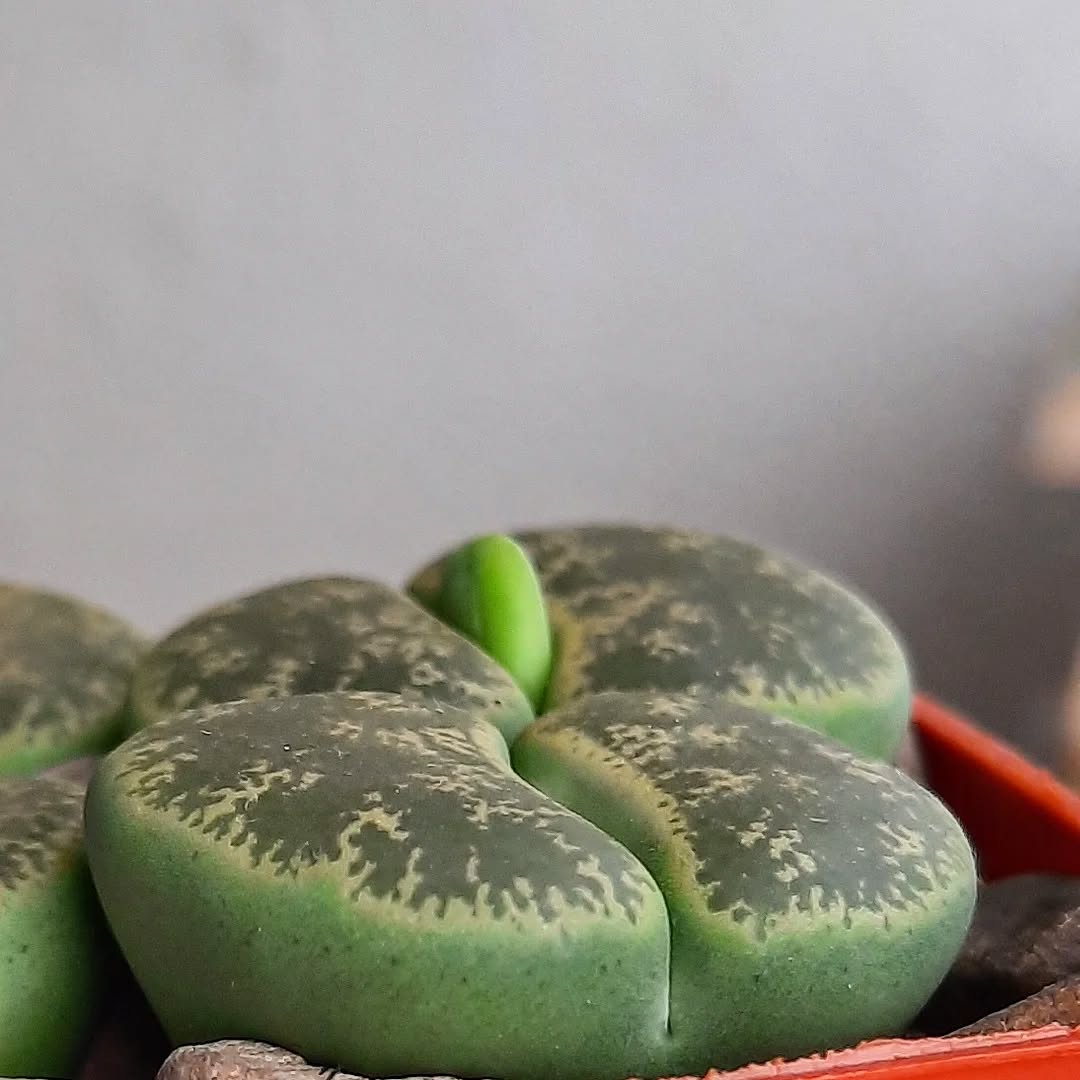
Body form is the standard Lithops architecture: a single pair of fused leaves forming an inverted cone that sits flush with or slightly below the soil surface, with only the flat to slightly convex dorsal face exposed. The plant is essentially stemless. L. lesliei bodies are larger than the average Lithops, which contributes to the beginner-friendly reputation: a mature pair reaches roughly 25–35 mm across, with the fissure approximately 5 mm deep, large enough to read and handle without the fiddly precision the smaller western species demand. Bodies form clumps of multiple heads over time.
Face colour and pattern are the diagnostic feature and the source of the named varieties. The ground colour runs from pinkish grey through olive green to rust orange depending on locality form, light intensity, and seasonal hydration. Across the face lies a network of darker translucent windows in a fine lacework, with channelled lines of brown, coffee, grey-green, or rusty orange. The Kimberley forms tend toward olive-green ground with finer markings; the Warrenton forms tend greyer; the rust-orange ground of var. rubrobrunnea-type stocks gives the strongest contrast. The window lacework is the photosynthetic lens that admits filtered light to the chlorophyll-packed tissue inside the buried body, the convergent adaptation that defines the genus.
Flowers are golden yellow with pink shading on the underside of the petals, daisy-form, around 3 cm in diameter, single per body, emerging from the central fissure in autumn. Yellow is the default flower colour and the primary character separating L. lesliei from the white-flowered L. karasmontana and L. julii. Flowers open in the early afternoon and close in the late afternoon, following a consistent daily cycle across the bloom period. The species is an obligate outcrosser; flowers do not self-pollinate, and seed production in cultivation requires hand pollination between two genetically distinct plants. Pollinators in habitat are insect species consistent with the daisy-form yellow flower, most probably native solitary bees of the Highveld grassland; no specific pollinator study for the species was located. The anthocyanin-free L. lesliei ‘Albinica’ selection produces white-cream flowers from a cream body, the trade-defining anthocyanin-loss form.
Locality detail
The type locality of Lithops lesliei is the Vaal River bank at Vereeniging, on a Dwyka Conglomerate outcrop. The original specimen was collected on 9 August 1908 by the youngest son of T.N. Leslie and passed via Burtt Davy to the 4th meeting of the Transvaal Biological Society in Pretoria for an initial sterile description; in the absence of flowers the description was not formally published, and N.E. Brown subsequently published the valid description as Mesembryanthemum lesliei in 1908, then transferred the species to Lithops in 1922. Vereeniging was in the Transvaal at the time and now sits inside Gauteng province.
The map above marks the type locality at Vereeniging, two Northern Cape range centroids near Kimberley and Warrenton, the Boshof type form for var. mariae, the Limpopo outlier near Polokwane, and the southern Botswana range. C-number localities documented by Cole and curated on llifle include C036 and C096 around Warrenton, C141 at Boshof (var. mariae), C341 and C354 around Kimberley, and C352 east of Polokwane. The Gauteng subpopulations carry the largest single stand at roughly 3,620 mature individuals; Northern Cape and Free State stands are smaller, with none exceeding 250 mature plants. Local extirpations have been recorded across all provinces, primarily from the medicinal harvesting trade and from urban and agricultural land conversion across the Highveld.
Lithops lesliei care and cultivation
Lithops lesliei is the most forgiving species in the genus in cultivation and the standard plant on which growers learn the Lithops calendar. The species tolerates imprecise watering more than its western siblings, recovers from mild overwatering events that would kill a coastal winter-rainfall Lithops, and produces autumn flowers reliably from year four onwards under good light. The cultivation framework is still the genus framework: 95% mineral substrate, the inverted seasonal calendar, full sun, and dry winter cold. The tolerance is in degree, not in kind.
Substrate
The house mesemb formulation for lesliei is 33% pumice (3–5 mm), 12% lava rock (5–10 mm, structural drainage aggregate), 10% zeolite (clinoptilolite, 4–6 mm), 20% granite grit (3–5 mm), 0% limestone, 20% coarse silica grit (1–3 mm angular crystalline quartz), and 5% worm castings as the sole organic component. The 95/5 inorganic-to-organic ratio is the Lithops genus baseline, higher than the cactus-default 90/10 used elsewhere on this site; it is a class-prior figure, not a per-population finding, because the named-grower sources on file for the genus disagree by more than the site’s resolution threshold. Limestone is omitted: no source, for lesliei or for the genus generally, reports a lime preference in either direction, and the zeolite already buffers the mix toward neutral. The lava fraction aerates the lower pot volume and supports fast drainage during the active autumn-winter growing season. Pot in unglazed terracotta or clay composite, 10–12 cm deep, never glazed ceramic; the porosity of unglazed clay accelerates drying between the widely spaced waterings the inverted mesemb calendar demands.
All 16 Lithops on this site use one flat mineral formulation: the 95/5 mesemb baseline (95% inorganic, 5% organic), higher than the 90/10 cactus default used elsewhere on this site. No cultivation source at any tier distinguishes substrate practice between Lithops species, so every row below carries the same house formulation rather than sixteen separate findings. Silica sits at 20% and limestone at 0% as continuity conventions, not evidenced per-species figures.
| Species | Pumice | Lava | Zeolite | Granite | Limestone | Silica | Organic |
|---|---|---|---|---|---|---|---|
| L. lesliei (this page) | 33% | 12% | 10% | 20% | 0% | 20% | 5% |
| L. karasmontana | 33% | 12% | 10% | 20% | 0% | 20% | 5% |
| L. karasmontana subsp. bella | 33% | 12% | 10% | 20% | 0% | 20% | 5% |
| L. karasmontana subsp. amicorum | 33% | 12% | 10% | 20% | 0% | 20% | 5% |
| L. karasmontana ‘Top Red’ | 33% | 12% | 10% | 20% | 0% | 20% | 5% |
| L. burchellii | 33% | 12% | 10% | 20% | 0% | 20% | 5% |
| L. lesliei ‘Albinica’ | 33% | 12% | 10% | 20% | 0% | 20% | 5% |
| L. lesliei ‘Storm’s Albinigold’ | 33% | 12% | 10% | 20% | 0% | 20% | 5% |
| L. pseudotruncatella | 33% | 12% | 10% | 20% | 0% | 20% | 5% |
| L. dendritica | 33% | 12% | 10% | 20% | 0% | 20% | 5% |
| L. optica | 33% | 12% | 10% | 20% | 0% | 20% | 5% |
| L. optica ‘Rubra’ | 33% | 12% | 10% | 20% | 0% | 20% | 5% |
| L. aucampiae | 33% | 12% | 10% | 20% | 0% | 20% | 5% |
| L. aucampiae subsp. koelemanii | 33% | 12% | 10% | 20% | 0% | 20% | 5% |
| L. julii | 33% | 12% | 10% | 20% | 0% | 20% | 5% |
| L. julii subsp. fulleri | 33% | 12% | 10% | 20% | 0% | 20% | 5% |
Watering and light
The watering calendar is inverted relative to every cactus on this site. L. lesliei grows actively in the cool months and rests dry through summer. In Northern Hemisphere cultivation: full dormancy May through July (no water at all, wrinkled bodies are normal and not a watering signal), watch and wait through August (first light water at the end of the month if temperatures are clearly trending down), active watering September through November (water thoroughly to runoff, then let the mix dry completely over 10–14 days; this is the flowering window), tapered watering December through February (every 3–4 weeks maximum, and never while the old leaf pair is mid-transfer to the new pair), final water March or April, then stop. Six-month total dormancy is normal and survivable for healthy plants in a deep pot.
Light requirements are the genus default: bright direct sun, minimum 5–6 hours daily for compact body shape and rust-brown face colour. Highveld grassland insolation is the habitat baseline. A south-facing windowsill in the Northern Hemisphere is the indoor minimum; outdoor summer growing under unglazed glass or shade cloth is preferred where climate allows. Plants under chronically low light etiolate, stretch their fissures, lose face contrast, and split their skins on the next watering. The summer dormancy requirement is light-independent: bright sun through summer is fine provided the substrate is bone dry.
Cold tolerance and the leaf-pair cycle
The dry cold floor for cultivation is −2°C; the Highveld winter delivers genuine frost in the species’ habitat, which the plant survives only because it is bone dry across the cold months. A wet plant at any temperature near freezing is a dead plant. The danger is moisture, not cold. Keep the substrate dry from late autumn through the end of winter and the species rides out conditions far harder than anything a typical European or North American grower has on offer. The species’s defining biological event is the annual leaf-pair replacement: the new pair grows inside the old one over winter, draws moisture and nutrient from it, and emerges in spring as the old pair desiccates to paper. Do not water while the old pair is mid-transfer. Watering during the January-February transfer window refills the old leaves, starves the new pair, and kills the plant from inside.
Comparison
Within the eastern summer-rainfall arm of the genus, the closest comparison is L. burchellii, which Cole originally treated as a subspecies of lesliei and which Jainta elevated to species rank in 2019. L. burchellii sits on calcrete rather than ironstone, has a pinker face with finer meshlike markings rather than the rust-brown lacework of lesliei, and has a narrower Northern Cape range. The two were lumped under lesliei in older trade material; current POWO and the on-site treatment carry them as separate species.
Across the broader genus, the white-flowered L. karasmontana of the Namibian Karas Mountains and the lip-smear-faced L. julii of Namibia and the Northern Cape are the next most-encountered species in the trade. Both flower white rather than yellow, both sit in the winter-rainfall western half of the genus range, and both are marginally less forgiving in cultivation than lesliei. The Sperrgebiet endemic Lithops optica is the opposite cultivation extreme: coastal fog-belt habitat, frost-free in habitat, flowers after the winter solstice rather than in autumn, and IUCN Critically Endangered. L. lesliei is the easy species; optica is the demanding one.
The anthocyanin-free L. lesliei ‘Albinica’ and ‘Storm’s Albinigold’ selections are vegetatively indistinguishable from each other but separated by flower colour: ‘Albinica’ produces white-cream flowers from C036A stock (Cole 1968), ‘Storm’s Albinigold’ produces yellow flowers from C036B stock (Cole 1985, Ed Storms). Both run on the same care calendar as the wild-type species, but the lack of anthocyanin pigmentation means the cream body never develops the rust face contrast of the standard plant; the cultivars are grown for the colour-loss novelty and the white-yellow flower options, not for face character.
Frequently asked questions
Is Lithops lesliei hard to grow?
Beginner. L. lesliei is the most forgiving species in the genus and the standard plant for anyone learning Lithops cultivation. The substrate is undemanding within the 95% mineral mesemb framework, the species tolerates imprecise watering better than any of its western siblings, and it flowers reliably from year four onwards under good light. The single hardest thing is the inverted seasonal calendar: Lithops grow in autumn and winter and rest dry through summer, the opposite of every cactus. Growers carrying their cactus watering instincts across to a Lithops pot kill plants in the first June. Learn the calendar on lesliei, then move to fussier western species.
Can Lithops lesliei be grown from seed?
Yes, and seed is the only standard propagation route for the species. Seeds germinate in 1–3 weeks at 20–25°C day with cooler nights around 10–15°C, surface-sown without cover on a moist mineral-dominant seedling mix. Time to first flower is 3–4 years under good cultivation with respected dormancy, sometimes 4–5 years for the first reliable bloom. Grafting is not standard practice for Lithops in the way it is for rare cacti; the genus is grown almost exclusively from seed in the global trade, and grafted Lithops are essentially unknown in collector circles. L. lesliei is the most widely seed-propagated species in the genus and is carried by every Lithops specialist seed list.
Is Lithops lesliei legal to own?
Yes, with no CITES paperwork. L. lesliei is not listed on any CITES appendix because the family Aizoaceae is not covered by the Cactaceae blanket Appendix II listing; the no-CITES status is the load-bearing legal distinction between Lithops and most of the other rare succulents on this site. Wild collection inside South Africa requires a TOPS permit under the National Environmental Management: Biodiversity Act (NEMBA, Act 10 of 2004), plus conformance with provincial ordinances; the SANBI Sensitive Species system tracks the species. The illegal harvest pressure for the traditional medicine trade is real and is cited by SANBI as the leading driver of the documented 15% population decline. Nursery-propagated material with documented seed-grown provenance is the legally and ethically defensible source for collector specimens worldwide; international trade in nursery stock is unrestricted by CITES.
Where does Lithops lesliei grow in the wild?
Across the summer-rainfall Highveld of South Africa and into southern Botswana. The South African range covers the Free State, Gauteng, the eastern Northern Cape, the eastern part of North West Province, and a Limpopo outlier near Polokwane; the Botswana range extends across the south and southeast of the country around Gaborone. Elevation runs 1,200–1,800 m on the Gauteng and Free State Highveld, dropping to 1,100–1,200 m around Kimberley and to roughly 1,000 m in Botswana. Habitat is rocky grassland on ferruginous quartzite, ironstone, granite, sandstone, or amygdaloidal lava, with plants growing in gravel pockets among Highveld grasses that conceal them outside the autumn flowering window. The type locality is on a Dwyka Conglomerate outcrop above the Vaal River at Vereeniging.
When does Lithops lesliei flower?
Autumn. In Northern Hemisphere cultivation the flowering window runs October to November, corresponding to Southern Hemisphere April in habitat. Flowers are golden yellow with pink shading on the underside of the petals, daisy-form, around 3 cm in diameter, single per body, emerging from the central fissure between the two fused leaves. Yellow is the default colour and is the primary character separating L. lesliei from white-flowered Lithops such as L. karasmontana and L. julii. Individual flowers open in the early afternoon and close in the late afternoon, following a consistent daily cycle across a 2–4 week bloom period as successive heads in a clump come into flower. The species is an obligate outcrosser; flowers do not self-pollinate, so seed production in cultivation needs hand pollination between two genetically distinct plants.
Sources & further reading
Brown, N.E. (1922). Lithops lesliei (N.E.Br.) N.E.Br. Gardeners’ Chronicle Series III, 71: 65 · Kew POWO. Lithops lesliei (N.E.Br.) N.E.Br., IPNI lsid urn:lsid:ipni.org:names:362458-1. powo.science.kew.org · Kew POWO. Lithops burchellii (D.T.Cole) Jainta. powo.science.kew.org/taxon/77197154-1 · IPNI. Lithops lesliei, urn:lsid:ipni.org:names:362458-1 · Cole, D.T. and Cole, N.A. (2005). Lithops: Flowering Stones (2nd ed.). Cactus & Co · Jainta, H. (2019). Lithops burchellii (D.T.Cole) Jainta comb. et stat. nov. Avonia 37(1): 6 · SANBI Red List of South African Plants. Lithops lesliei Near Threatened, assessed 2008 by Williams, V.L., Raimondo, D., Crouch, N.R., Cunningham, A.B., Scott-Shaw, C.R., Lötter, M., Ngwenya, A.M. and Mills, L. redlist.sanbi.org/species.php?species=85-50 · llifle, Encyclopedia of Living Forms. Lithops lesliei and locality entries C036, C096, C141, C341, C352, C354. llifle.com · World of Succulents. Lithops lesliei (Leslie’s Living Stone). worldofsucculents.com · World of Succulents. How to Grow Lithops from Seed. worldofsucculents.com · Flora of Botswana. Lithops lesliei. botswanaflora.com · Royal Horticultural Society. Lithops lesliei AGM 2002. rhs.org.uk · cactus-art.biz. Lithops lesliei C36. cactus-art.biz · GBIF. Lithops lesliei (N.E.Br.) N.E.Br. occurrence dataset. gbif.org/species/7329207 · Wikipedia. Lithops; Lithops lesliei. en.wikipedia.org