
Lithops optica
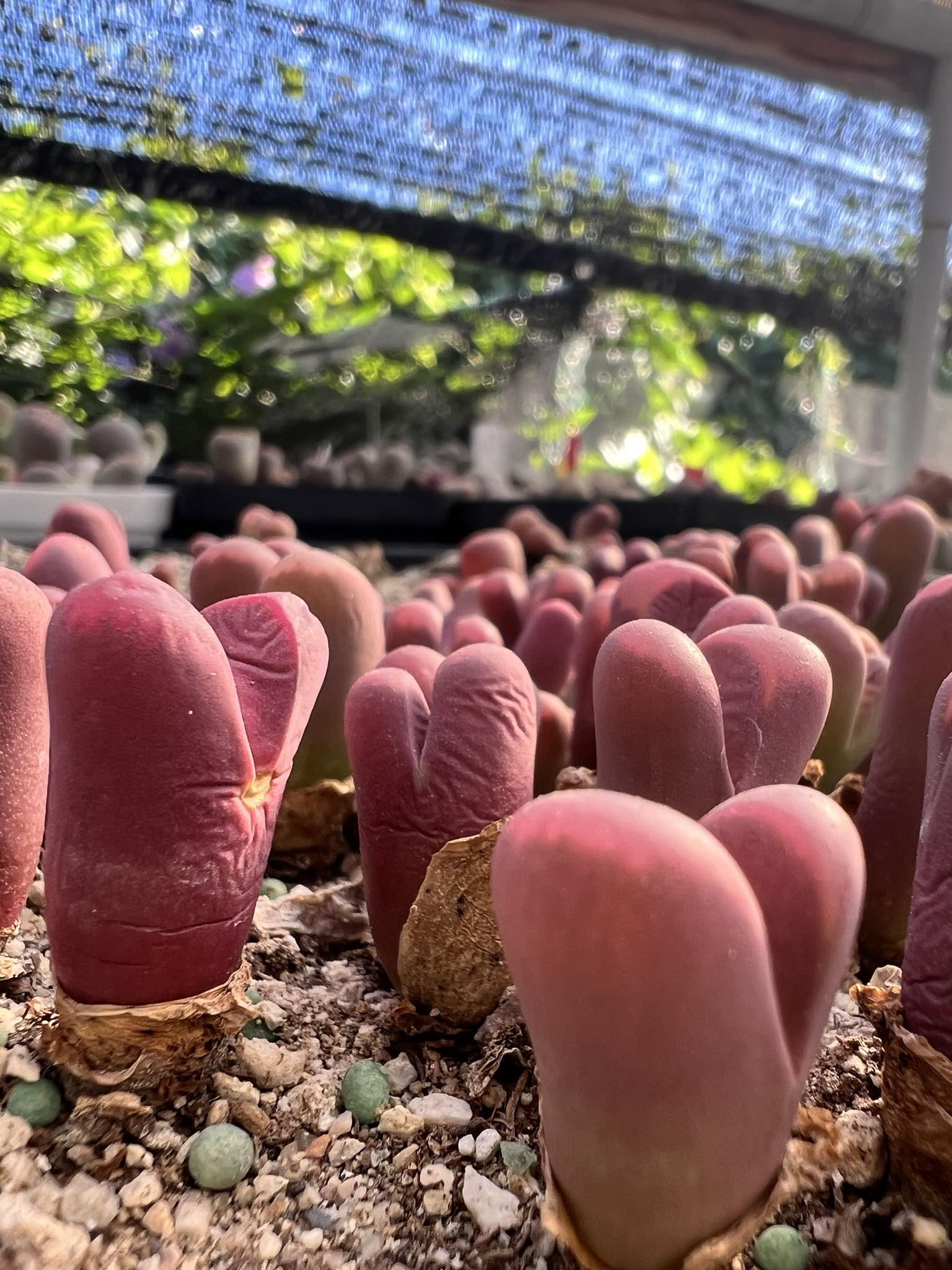
Lithops optica (Marloth) N.E.Br. is the Sperrgebiet endemic of coastal Namibia and carries the most extreme window expression in the entire genus. The dorsal face of each leaf pair is occupied by a near-clear, nearly unpatterned fenestra that covers most of the body and admits filtered light through to the chlorophyll-packed tissue inside; in well-lit specimens the green interior is visible looking down through the window as though through ice. Rudolf Marloth collected the first specimens in 1909 in the coastal desert between Lüderitz Bay and Buntfeldschuh, and N.E. Brown formally transferred the epithet from Mesembryanthemum opticum when he established the genus Lithops in 1922. The specific epithet optica is from Latin and Greek roots meaning “of the eye” or “eye-like” and describes those windows directly: they look like eyes looking up from the soil.
The species is endemic to a single short stretch of the Lüderitz coast in southwestern Namibia, with all known localities falling within or immediately adjacent to the Sperrgebiet, the diamond-restricted forbidden zone declared off-limits in 1908 and redesignated as the Tsau //Khaeb National Park in June 2004. The Cole field numbers C275 through C311 trace a tight cluster within roughly 100 km of Lüderitz, all on flat coastal plains and low hills at near sea level. The IUCN reassessed L. optica from Near Threatened (2022) to Critically Endangered in 2024, the most significant single conservation fact on this page and the reason every sourcing decision a collector makes for the species carries weight beyond the usual rare-plant calculus.
Climatically, L. optica is the launch outlier. The Lüderitz coastal zone is moderated year-round by the cold Benguela Current upwelling: temperatures typically run 9–20°C with no severe summer spike and no frost in habitat, and the 20–50 mm of annual rainfall is offset by more than 180 days a year of Atlantic fog that condenses on plant and substrate surfaces and supplies most of the available moisture. This is a fundamentally different envelope from the Highveld grassland habitat of Lithops lesliei or the high-elevation Karas Mountains habitat of Lithops karasmontana, and it shifts both the cold floor and the flowering window: L. optica is frost-sensitive in cultivation (5°C minimum, dry) and flowers later than the rest of the genus, with the white autumn flush running into November and December in Northern Hemisphere cultivation rather than the standard September–November Lithops window.
The trade-defining form of L. optica is the ruby-windowed cultivar L. optica ‘Rubra’, selected by Tischer in 1925 from a wild-collected red-pigmented individual and propagated commercially since long before the Sperrgebiet was hardened against access. ‘Rubra’ dominates Lithops trade awareness so completely that the nominate grey-green form is much less commonly offered, despite being the wild-type plant. Cultivar morphology and selection-history detail belong on the ‘Rubra’ page and are not duplicated here. Compare the white-flowered lip-marked Lithops julii for the cooler Namibian palette family the species sits in. What follows here covers the nominate L. optica only: the clear-windowed grey-green wild type and its cultivation.
Lithops optica quick reference
A coastal Sperrgebiet mesemb that grows in cool wet winter conditions and rests through the summer; the calendar is inverted relative to every cactus on this site. Values calibrated for seed grown plants in cultivation, drawn from L. optica-specific habitat data and grower consensus across multiple specialist Lithops sources rather than genus-level extrapolation. The frost-free Lüderitz origin sets the cold floor warmer than the genus default, and the late flowering window pushes the active season further into winter than for most Lithops.
Taxonomy & nomenclature
The accepted name is Lithops optica (Marloth) N.E.Br., with the basionym Mesembryanthemum opticum Marloth (1909). The combination into the new genus Lithops was published by N.E. Brown in The Gardeners’ Chronicle series III, vol. 71, p. 80 (18 February 1922), the same year Brown formally established the genus. Kew POWO carries the 1922 combination as the current name (IPNI lsid urn:lsid:ipni.org:names:362474-1) and World Flora Online (wfo-0001435540) confirms the same treatment.
POWO does not accept any infraspecific taxa under L. optica. The principal heterotypic synonyms are Lithops elevata L.Bolus, Lithops rubra N.E.Br., Mesembryanthemum marginatum Haw. (non L.Bolus), and Lithops optica var. nova Triebner. The two former names that touch the red-pigmented form, Lithops optica f. rubra (Tischer) Jacobsen and Lithops optica subsp. rubra (Tischer) H.Jacobsen, are treated by POWO as synonyms of the nominate; the red-pigmented plant survives in horticulture as the cultivar ‘Rubra’ rather than as a formally ranked botanical taxon. The cultivar has its own page on this site and is not discussed further here.
The etymology is unusually direct for a Lithops epithet. Optica derives from the Greek and Latin roots for “eye” or “sight” and refers to the rounded, transparent windows that occupy the dorsal face of each leaf pair. Marloth and Brown both used the windowed face as the diagnostic character in their original treatments, and the name has held without controversy through every subsequent Lithops monograph including Cole and Cole (2005).
Historical synonyms (10)
- Mesembryanthemum marginatum Haw., 1795 basionym
- Mesembryanthemum opticum Marloth, 1910 homotypic synonym
- Mesembryanthemum opticum var. rubrum Tischer, 1925 homotypic synonym
- Lithops optica var. rubra (Tischer) Tischer, 1926 homotypic synonym
- Lithops optica var. nova Triebner, 1955 homotypic synonym
- Lithops optica f. rubra (Tischer) Jacobsen, homotypic synonym
- Lithops optica subsp. rubra (Tischer) H.Jacobsen, homotypic synonym
- Lithops rubra (Tischer) N.E.Br., 1926 heterotypic synonym
- Lithops elevata L.Bolus, 1932 heterotypic synonym
- Lithops schlechteri G.D.Rowley, 1952 heterotypic synonym
Sources: POWO (Kew) · IPNI · GBIF · Wikidata
Habitat
Lithops optica is endemic to a single short coastal strip of southwestern Namibia, all known populations within or immediately adjacent to the Sperrgebiet (Tsau //Khaeb National Park). The Cole field numbers trace a tight cluster around Lüderitz: C275 at 10 km north of the town, C276 and C277 10 km south and southwest, C288 at 40 km south-southeast, C290 at 65 km south, C291 at 100 km south-southeast (the maculate form), and C311 at 45 km southeast (also maculate). The total linear extent of the known range is on the order of 100 km; the area of occupancy is much smaller. The Sperrgebiet itself covers roughly 26,000 km² (about 3 percent of Namibia’s land area) and supports approximately 1,050 plant species, the northernmost extension of the Succulent Karoo biome and among the richest arid floras on earth. The restricted access regime in force since 1908 produced a century of de facto protection for the entire endemic flora before the area was formally proclaimed a national park in June 2004.
The climate is cool coastal mist-belt, fundamentally different from the inland Lithops envelopes. The cold Benguela Current upwelling moderates coastal temperatures year-round to roughly 9–20°C, with no severe summer spike and no frost in habitat. Annual rainfall runs 20–50 mm, predominantly in winter, but the working moisture supply is fog rather than rain: the coast experiences more than 180 days of Atlantic fog per year, with condensation accumulating on plant and substrate surfaces and supplying most of the available water. Plants in habitat sit in this wet-cool fog overnight and through the morning, then dry out under the afternoon sun. The combination of cool temperatures, fog moisture, and rapid drying is what shapes the cultivation calendar and the cold floor for the species in cultivation.
Substrate is sandy gravel with rocks. Sources describe the habitat as “very sandy” with plants growing scattered in small colonies on desolate coastal plains and low hills among rocks and gravel; the parent rock is Precambrian basement (granites, schists, quartzites) with some calcareous beach sediment but predominantly siliceous. The grey-green body colour camouflages the plants against the local gravel so completely that they are very difficult to spot in the field outside the brief flowering window. Associated mesemb genera of the Sperrgebiet quartz fields include Conophytum and other Aizoaceae point endemics; the species pool is characterised by extreme range fragmentation and high local endemism rather than by widespread shared communities.
Morphology
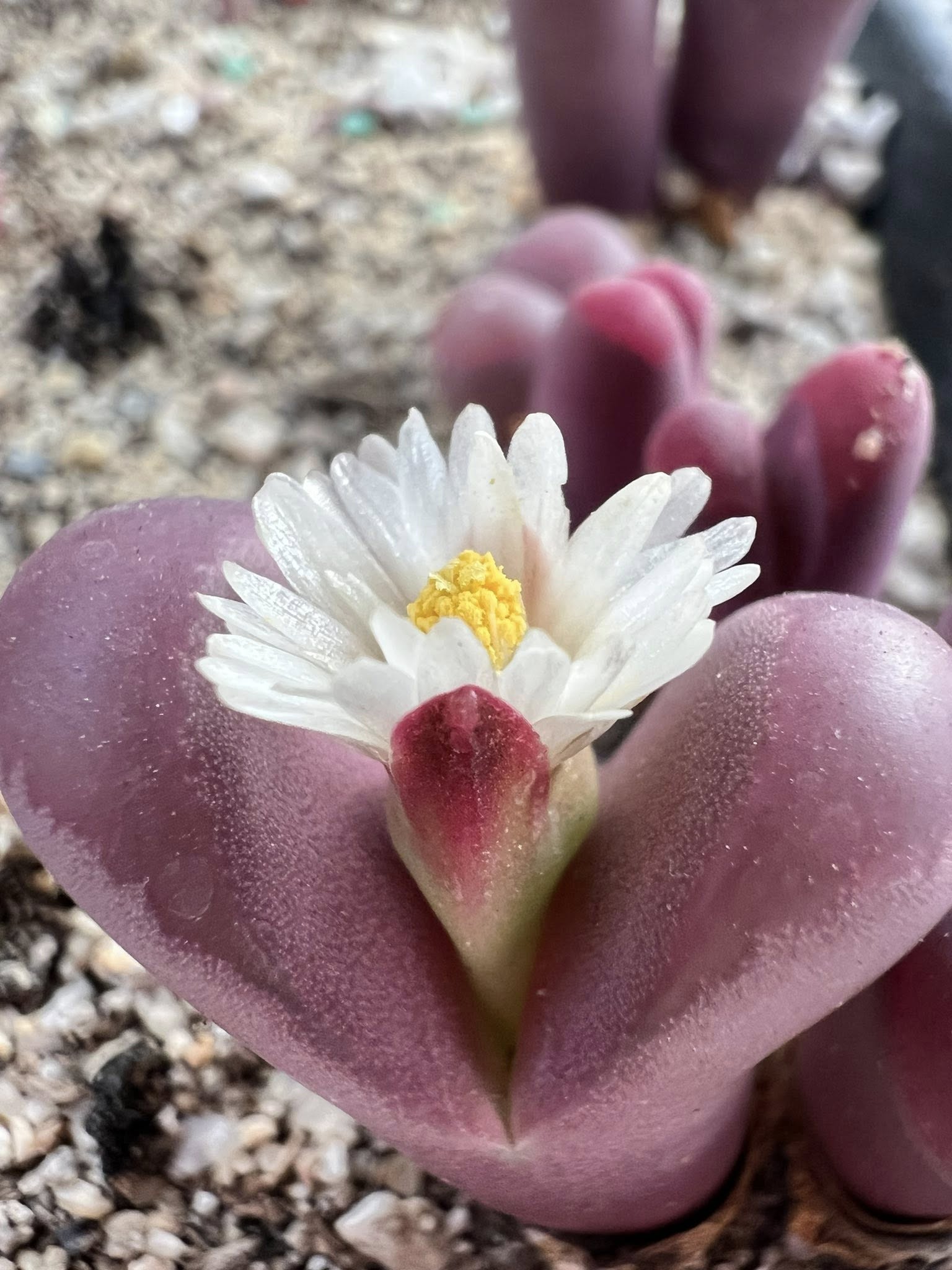
Body form follows the standard Lithops architecture but is smaller and flusher than most launch siblings. A single pair of fused leaves forms an oblong to obconical (almost club-shaped) body that sits nearly flush with the substrate, with only the dorsal face exposed and the leaf pair often slightly unequal in length. Habitat plants reach roughly 20 mm long and 12 mm wide, with the fissure exceeding 10 mm in depth; old well-grown specimens in cultivation can grow larger and clump into clusters of 16 or more heads up to 80 mm across. Surface texture is smooth, with no tubercles or papillae. The body is the smallest and most flush of the Lithops launch set on this site, well under the 40 mm height of L. karasmontana.
Body colour is whitish-grey to grey-green, cool-toned and pale; some individuals show a faint pinkish cast under stress. The diagnostic character of the species and the source of the epithet is the window. The dorsal face is occupied by a large translucent fenestra that covers most of the surface and is predominantly clear, with minimal internal patterning beyond a subtle greener tone where the photosynthetic tissue sits directly under the epidermis. The window is described in the specialist literature as “mostly without islands, only a little greener than the sides,” and in healthy well-lit specimens the green interior is visible looking down through it. This near-complete translucency is the most extreme expression of the windowed-face adaptation in the entire genus, distinct from the dense red-brown channelled lines of L. karasmontana, the continuous dark red-brown panel of Lithops aucampiae, or the intricate raised-line lip pattern of L. julii.
Flowers are white, sometimes with pink-tipped petals, 12–25 mm in diameter, daisy-form, and emerge singly from the central fissure between the two fused leaves. Opening is diurnal, late in the afternoon, with closure at dusk and a consistent daily cycle through a 1–2 week bloom period as individual flowers reopen on successive afternoons. The species is self-sterile; cross-pollination between two genetically distinct plants is required for seed set, so single isolated specimens flower but produce no viable seed. The capsule contains predominantly five chambers in the Aizoaceae pattern. The white nominate flower is the wild-type expression; the ‘Rubra’ cultivar carries the same white flower despite its strikingly different body colour, a useful tell that ‘Rubra’ is a horticultural selection rather than a separate species.
Locality detail
The type locality of Lithops optica is the coastal desert between Lüderitz Bay and Buntfeldschuh near Prince of Wales Bay, in southwestern Namibia. Rudolf Marloth collected the first specimens in 1909, predating the formal establishment of the genus by N.E. Brown in 1922; Marloth’s original publication was as Mesembryanthemum opticum, with Brown later transferring the epithet into the new genus. The type area sits inside what was already by 1909 the Sperrgebiet, the diamond-restricted forbidden zone declared off-limits to unauthorised entry in 1908 and redesignated as the Tsau //Khaeb National Park in June 2004.
The map above shows the type locality at Lüderitz and a selection of Cole field-number localities. C275 sits 10 km north of Lüderitz with shiny green windows and variable face pattern; C276 lies 10 km south and forms clumps from a young age; C288 is 40 km south-southeast and produces large cluster habit in cultivation; C290 lies 65 km south with translucent pale green bodies; and C291 marks the maculate form near the southern range edge at 100 km south-southeast. The complete known range is contained within roughly 100 km of Lüderitz, entirely within the Sperrgebiet, and is much smaller in actual area of occupancy. The 2024 IUCN reclassification from Near Threatened to Critically Endangered reflects deteriorating conservation outlook within this very limited geographic envelope; the public assessment summary categorises the threat as habitat destruction without naming the specific mechanism.
Lithops optica care and cultivation
Lithops optica is intermediate in difficulty for an experienced grower and challenging for beginners. The genus framework still applies (95 percent mineral substrate, inverted seasonal calendar, full sun, dry winter cold), but two species-specific shifts make the species less forgiving than the summer-rainfall workhorses. The flowering window runs later than the rest of the genus and pushes the active season deep into winter; growers who default to a generic Lithops calendar (water Sept–Nov, taper Dec onward) cut off watering before the flowers have run their course. The cold floor is warmer than the genus default because the Lüderitz coast is frost-free in habitat under Benguela Current moderation; growers who treat the species as cold-hardy at −2°C kill plants in cold-wet climates.
Substrate
The house mesemb formulation for optica is 33% pumice (3–5 mm), 12% lava rock (5–10 mm, structural drainage aggregate), 10% zeolite (clinoptilolite, 4–6 mm), 20% granite grit (3–5 mm), 0% limestone, 20% coarse silica grit (1–3 mm angular crystalline quartz), and 5% worm castings as the sole organic component. No cultivation source distinguishes optica from any other Lithops on silica share, granite share, or lime preference; all three are house continuity figures rather than species-specific findings, and limestone is omitted outright because no source reports a lime preference for the species in either direction. The lava fraction aerates the lower pot volume. Pot in unglazed terracotta or clay composite, 10–12 cm deep (the species has a substantial taproot relative to its small body), never glazed ceramic and never a shallow bonsai dish; the depth gives the root the run it needs.
All 16 Lithops on this site use one flat mineral formulation: the 95/5 mesemb baseline (95% inorganic, 5% organic), higher than the 90/10 cactus default used elsewhere on this site. No cultivation source at any tier distinguishes substrate practice between Lithops species, so every row below carries the same house formulation rather than sixteen separate findings. Silica sits at 20% and limestone at 0% as continuity conventions, not evidenced per-species figures.
| Species | Pumice | Lava | Zeolite | Granite | Limestone | Silica | Organic |
|---|---|---|---|---|---|---|---|
| L. lesliei | 33% | 12% | 10% | 20% | 0% | 20% | 5% |
| L. karasmontana | 33% | 12% | 10% | 20% | 0% | 20% | 5% |
| L. karasmontana subsp. bella | 33% | 12% | 10% | 20% | 0% | 20% | 5% |
| L. karasmontana subsp. amicorum | 33% | 12% | 10% | 20% | 0% | 20% | 5% |
| L. karasmontana ‘Top Red’ | 33% | 12% | 10% | 20% | 0% | 20% | 5% |
| L. burchellii | 33% | 12% | 10% | 20% | 0% | 20% | 5% |
| L. lesliei ‘Albinica’ | 33% | 12% | 10% | 20% | 0% | 20% | 5% |
| L. lesliei ‘Storm’s Albinigold’ | 33% | 12% | 10% | 20% | 0% | 20% | 5% |
| L. pseudotruncatella | 33% | 12% | 10% | 20% | 0% | 20% | 5% |
| L. dendritica | 33% | 12% | 10% | 20% | 0% | 20% | 5% |
| L. optica (this page) | 33% | 12% | 10% | 20% | 0% | 20% | 5% |
| L. optica ‘Rubra’ | 33% | 12% | 10% | 20% | 0% | 20% | 5% |
| L. aucampiae | 33% | 12% | 10% | 20% | 0% | 20% | 5% |
| L. aucampiae subsp. koelemanii | 33% | 12% | 10% | 20% | 0% | 20% | 5% |
| L. julii | 33% | 12% | 10% | 20% | 0% | 20% | 5% |
| L. julii subsp. fulleri | 33% | 12% | 10% | 20% | 0% | 20% | 5% |
Watering and light
The watering calendar runs late in the genus rhythm. In Northern Hemisphere cultivation: full dormancy May through August (no water at all, wrinkled bodies are normal and not a watering signal), watch and wait at the very end of August (first light water if temperatures are clearly trending down), active watering September through December (water thoroughly to runoff, then let the mix dry completely over 10–14 days; this is the late-flowering window, with white flowers appearing November and December rather than the standard Lithops Oct–Nov), tapered watering January through April (every 3–4 weeks maximum, never while the old leaf pair is mid-transfer to the new pair), and a final water in April before the May dormancy. The deep window risks concentrating direct midday sun on interior tissue if a plant is moved abruptly from shade to full bench, so harden new stock off carefully; grey-green body colour is somewhat more sun-tolerant than anthocyanin-rich species but acclimation is still load-bearing.
Light requirements are the genus default: bright direct sun, minimum 5–6 hours daily for compact body shape and appropriate window translucency. The Lüderitz coastal fog belt produces diffuse light in habitat, but high autumn insolation is needed to trigger flowering, so cultivation should default to full sun on a south-facing bench or outdoors where climate allows. The summer dormancy requirement is light-independent: bright sun through summer is fine provided the substrate is bone dry.
Cold tolerance and the leaf-pair cycle
The dry cold floor for cultivation is 5°C, warmer than the 2°C genus-wide conservative default. The Lüderitz coast is frost-free year-round and the species has no frost experience in habitat; treating it as cold-hardy in the manner of Highveld L. lesliei or Karas-mountain L. karasmontana kills plants in cold-wet European or North American winters. A wet plant at any temperature near freezing is a dead plant. The species’s defining biological event remains the annual leaf-pair replacement: the new pair grows inside the old one over winter, draws moisture and nutrient from it, and emerges in spring as the old pair desiccates to paper. Do not water while the old pair is mid-transfer. Watering during the January–February transfer window refills the old leaves, starves the new pair, and kills the plant from inside. Seed grown plants reach first flower at 3–4 years; grafting is not practised with Lithops in any form.
Comparison
Within the genus, the visually closest comparator on this site is Lithops karasmontana, the other Namibian grey-toned species. Both share the cool mineral palette that separates them from the warm-brown L. lesliei and L. aucampiae. The single most diagnostic character separating them is window clarity: L. optica has a near-clear, nearly unpatterned window covering most of the dorsal face, while L. karasmontana carries a dense network of red-brown channelled lines across its window. L. optica is also markedly smaller (up to 20 mm long versus 40 mm in L. karasmontana) and considerably flusher with the substrate. Habitat is the second clean separator: L. optica is a coastal sea-level fog-belt endemic in the Sperrgebiet, while L. karasmontana occupies the Karas Mountains above 1,000 m with reliable winter frost. Trade form differs too: nominate L. optica is uncommon in commerce because the ruby-windowed ‘Rubra’ cultivar dominates trade, while in L. karasmontana the trade-defining selection is ‘Top Red’.
Across the broader launch set, L. optica sits at the demanding extreme. The summer-rainfall L. lesliei and L. aucampiae are the easiest in cultivation: warm Highveld and Postmasburg habitat, frost-tolerant when dry, standard September–November flowering, forgiving of imprecise watering. The Namibian winter-rainfall species (L. karasmontana, L. julii, L. pseudotruncatella) occupy the middle ground: less forgiving than the eastern species but still inside the genus norm. L. optica compounds difficulty by adding the late-flowering window (November–December rather than October–November), the warmer cold floor (5°C minimum), and the rot risk of an extended active season in cool wet conditions. It is the Lithops most likely to teach a confident intermediate grower where their calendar discipline breaks down.
The cultivar ‘Rubra’ deserves a separate note for buyers approaching L. optica for the first time. ‘Rubra’ is propagated by Tischer’s 1925 selection from a wild-collected red-pigmented plant and has been in commercial nursery production for a century; it is the single most photographed Lithops cultivar in the world. Cultivation behaviour follows the wild-type calendar above (the cultivar runs the same active season, the same frost-sensitive cold floor, the same self-sterile flowers), but the deeply pigmented red-purple body and ruby window produce a visual identity so distinct from the nominate grey-green plant that the two are easy to mistake for different species. They are not. ‘Rubra’ is a horticultural selection of the same species; cultivar morphology and selection-history detail belong on the cultivar page.
Frequently asked questions
Is Lithops optica hard to grow?
Intermediate. L. optica is harder than the summer-rainfall workhorses such as L. lesliei and L. aucampiae but not the most demanding species in the genus. The two cultivation hazards specific to optica are the late flowering window (November–December in Northern Hemisphere cultivation, deeper into winter than the standard Lithops calendar) and the warmer cold floor (5°C minimum, because the Lüderitz coast is frost-free in habitat). Growers who default to the standard September–November Lithops watering window cut off water before flowering finishes; growers who treat the species as cold-hardy in the manner of Highveld lesliei kill plants in cold wet winters. Beyond those two species-specific calendar shifts, the genus framework applies: 95% mineral substrate, full sun, no summer water, and respect for the annual leaf-pair replacement cycle.
Can Lithops optica be grown from seed?
Yes, and seed is the only standard propagation route for the species. Seeds germinate in 2–3 weeks at 20–25°C day with cooler nights around 10–15°C, surface-sown without cover on a moist near-sterile mineral-dominant seedling mix, with fungicide treatment recommended because high humidity at germination invites damping-off. Time to first flower is 3–4 years under good cultivation with respected dormancy. Grafting is not practised with Lithops in any form: the buried body habit makes scion attachment impractical, and seed grown is the only path to serious cultivation of this species. The nominate grey-green form is less commonly available than the ‘Rubra’ cultivar in commerce because trade demand favours the red-windowed selection, but specialist Lithops nurseries (Mesa Garden, Köhres, and the specialist mesemb houses) carry seed of the wild-type plant.
Is Lithops optica legal to own?
Nursery-propagated Lithops optica is fully legal to own and trade worldwide, including the ‘Rubra’ cultivar which has been in commercial production since 1925. The species is not on any CITES appendix because the family Aizoaceae is not covered by the Cactaceae blanket Appendix II listing, so no import or export permits are required for cultivated material crossing international borders. Wild collection from habitat is a different matter entirely. Every known population of L. optica sits inside or immediately adjacent to the Sperrgebiet (Tsau //Khaeb National Park) in Namibia, and removing plants from the park is illegal under three stacking layers of Namibian law: the Nature Conservation Ordinance 4 of 1975 (collection inside national parks), the Forest Act 12 of 2001 (protected plants, with penalties up to N$4,000 or 12 months imprisonment), and the Prevention of Organised Crime Act 24 of 2004 (organised trade, with penalties up to N$20,000 or 5 years). Namibia’s Protected Plants Task Team, established in 2023, actively prosecutes succulent poaching with 37 arrests and 4,128 plants confiscated between January 2021 and April 2024. Wild-collected L. optica is illegal at source, ethically indefensible given the 2024 Critically Endangered status, and unwelcome in any serious collection. Buying nursery-propagated stock from a specialist supplier is the only ethical path and actively supports ex-situ conservation by reducing the economic signal that drives poaching.
Where does Lithops optica grow in the wild?
L. optica is endemic to the Lüderitz coastal zone of southwestern Namibia, with all known populations within or immediately adjacent to the Sperrgebiet (Tsau //Khaeb National Park). The Cole field numbers C275 through C311 trace a tight cluster within roughly 100 km of Lüderitz, on flat coastal plains and low hills at near sea level (30–100 m). Habitat is sandy gravel with rocks, predominantly siliceous parent rock (Precambrian granites, quartzites, schists). Climate is cool coastal mist-belt: temperatures 9–20°C year-round under Benguela Current moderation with no frost in habitat, 20–50 mm of annual winter rainfall, and more than 180 days of Atlantic fog per year that supplies most of the available moisture. This is one of the few Eastern-Hemisphere coastal mist-belt habitats in the succulent world, and the entire known range sits inside a single restricted-access Namibian national park.
When does Lithops optica flower?
Late autumn to early winter. The species flowers later than most Lithops, with the main flush in Northern Hemisphere cultivation falling in November and December rather than the standard September–November window of the rest of the genus; the underlying habitat timing is the equivalent post-winter-solstice run in the Southern Hemisphere. Flowers are white, sometimes with pink-tipped petals, 12–25 mm in diameter, daisy-form, and emerge singly from the central fissure between the two fused leaves. Opening is diurnal, late in the afternoon, with closure at dusk and a consistent daily cycle through a 1–2 week bloom period. The species is self-sterile: cross-pollination between two genetically distinct plants is required for seed set. The ‘Rubra’ cultivar produces the same white flowers as the nominate, despite the strikingly different body colour.
Sources & further reading
Brown, N.E. (1922). Lithops optica (Marloth) N.E.Br. The Gardeners’ Chronicle Series III, 71: 80 · Marloth, R. (1909). Mesembryanthemum opticum Marloth (basionym) · Kew POWO. Lithops optica (Marloth) N.E.Br., IPNI lsid urn:lsid:ipni.org:names:362474-1. powo.science.kew.org · World Flora Online. Lithops optica wfo-0001435540. worldfloraonline.org · Cole, D.T. and Cole, N.A. (2005). Lithops: Flowering Stones (2nd ed.). Cactus & Co · IUCN Red List of Threatened Species 2025.2. Lithops optica Critically Endangered, assessed 2024 by Loots, S., Van Wyk, P.C.V., Mannheimer, C., Burke, A. and Rugheimer, S. iucnredlist.org · PlantZAfrica / SANBI. Lithops optica (Lüderitz Living Stone). pza.sanbi.org/lithops-optica · llifle, Encyclopedia of Living Forms. Lithops optica and Cole-number locality entries C275, C276, C277, C288, C290, C291, C311. llifle.com · Conservation Namibia. Plant poaching in Namibia (2024); legal framework and Protected Plants Task Team enforcement statistics. conservationnamibia.com · Conservation Namibia. Nowhere else on earth: the Sperrgebiet’s endemic flora. conservationnamibia.com · Encyclopaedia Britannica. Sperrgebiet (Diamond Coast restricted area). britannica.com · Wikipedia. Tsau //Khaeb (Sperrgebiet) National Park; Namib; Lithops optica. en.wikipedia.org · travaldo.blogspot.com. Lithops optica (cultivation notes supplement)