
Avonia dinteri
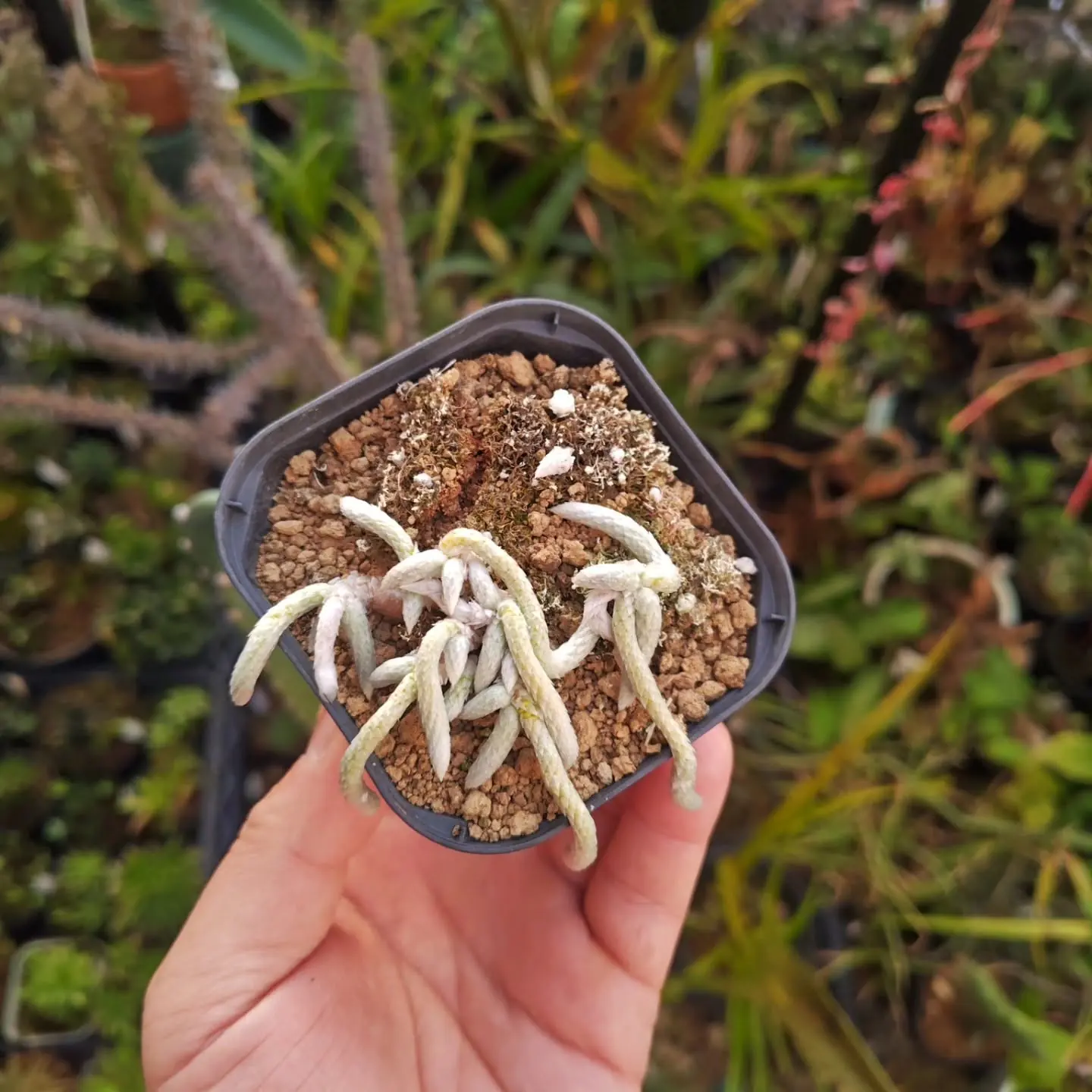
Avonia dinteri is a Namibian dwarf that spends most of itself underground. What shows above the gravel is a low mat of erect cylindrical stems no more than 5 cm tall, each one spiralled with silver-green triangular scales that overlap to a point, so closely ranked that the leaves beneath them never see daylight. The scales have been likened to the plating on a snake’s tail, and once you have seen that comparison it is hard to unsee.
Under the mat sits the reason collectors want the plant: a woody, tuber-shaped caudex reported at 5 to 10 cm across, disproportionate to the small growth it carries. That caudex is the drought organ, the storage bank the stems draw on, and the part of the plant that decides whether a specimen lives or dies in cultivation.
The species belongs to the papery-scaled group that Rowley split out of Anacampseros as Avonia, alongside Avonia albissima, Avonia papyracea and Avonia quinaria. It is the only one of them confined to Namibia, and it sits in the granite and marble country of the central interior rather than on the white quartz its relatives are famous for matching.
That geography matters more than any other single fact about the species. A. dinteri takes its rain in the southern summer, which puts it on the opposite calendar to most of the genus and makes the standard Avonia care advice actively dangerous here.
Avonia dinteri quick reference
A summer-rainfall caudex plant from the granite, pegmatite and marble country of north-central Namibia, at around 1300 m, where the rain arrives as convective storms between September and April and the winter is dry. Values calibrated for seed grown plants in cultivation, drawn from habitat and from the one published grower account of the species.
Taxonomy & nomenclature
The accepted name is Avonia dinteri (Schinz) G.D.Rowley, the combination Rowley made in Bradleya 12 in 1994. Kew does not accept that name. Plants of the World Online sinks Avonia into Anacampseros and accepts Anacampseros dinteri Schinz, published in the Bulletin de l’Herbier Boissier in 1901, treating Rowley’s name as a homotypic synonym. Both names are in current use.
The disagreement is real and it runs between authorities rather than between an authority and a shop. The GBIF backbone reaches the opposite verdict from Kew: it accepts Avonia dinteri and files Anacampseros dinteri underneath it as the synonym, exactly inverting POWO’s arrangement. Kew’s own bibliography concedes the alternative, citing Govaerts’s 1995 world checklist under the Avonia name. Google, for what it is worth on a question of nomenclature, indexes Avonia. Two major backbones point in opposite directions on this species, and neither name can be called settled.
The basionym is Anacampseros dinteri Schinz, and this species is mercifully free of the E.Mey. ex Fenzl authorship tangle that snarls A. quinaria, A. papyracea and Avonia ustulata. Nine synonyms attach, and POWO and the GBIF synonymy service return an identical set of them. Three carry Namibian place names into the record. Anacampseros omaruruensis points at Omaruru in Erongo and A. ombonensis at the Ombonde, which is useful corroboration of where the plant actually lives. There are no accepted infraspecific taxa.
Three of those synonyms are contested rather than settled. POWO and GBIF put Anacampseros neglecta, A. schmidtii and A. quinaria var. schmidtii here; SANBI puts the same three names in A. albissima. Two national-scale authorities cannot agree which historical herbarium material belongs to which species, and that unresolved argument is not academic housekeeping. It is the reason this species’s occurrence record is unusable, as the locality section explains. The family, incidentally, is Anacampserotaceae, and that is how the CITES appendices render it. Older sources still say Portulacaceae, which is the pre-split arrangement rather than an error; Namibia’s 1975 statute is one of them, and files the genus under the old family name to this day.
Historical synonyms (8)
- Anacampseros dinteri Schinz, 1901 basionym
- Portulaca dinteri Schinz, homotypic synonym
- Anacampseros wischkonii Dinter & Poelln., 1929 heterotypic synonym
- Anacampseros ombonensis Dinter & Poelln., 1933 heterotypic synonym
- Anacampseros wischkonii var. levis Poelln., 1933 heterotypic synonym
- Anacampseros omaruruensis Dinter, heterotypic synonym
- Anacampseros ombonenis Dinter, heterotypic synonym
- Anacampseros wischkonii var. laevis Poelln., heterotypic synonym
Sources: GBIF
Habitat
Avonia dinteri is endemic to north-central Namibia, growing on open sunny rocky slopes in desert and dry shrubland, with the credible records clustered in the Erongo and Otjozondjupa regions. That is Kew’s native range for the species, and the localities behind it agree: near the Roessing mine, around Karibib and Otjosondu, at Grootfontein, and in the Omaruru country that one of the synonyms is named for. Dinter himself, whom the species honours and who collected much of the early material, worked out of Okahandja in the same belt. One record carries an elevation, 1300 m. That is a single figure, not a range: no elevation range has been published for the species.
The rainfall season is the fact that reorganises this whole page. Almost all Namibian rain falls between September and April, arriving as convective summer storms; the single exception is the southwest, which sits in the winter-rainfall belt. A. dinteri lives in the central interior, nowhere near that exception. It is a summer-rainfall plant taking somewhere around 250 to 400 mm a year, which is generous by the standards of a genus better known from Namaqualand, and it goes dormant through the dry southern winter from June to August.
The rock is mixed and it is not quartz field. The core localities sit in the Central Zone of the Damara Belt, where Pan-African granites and the pegmatite fields around Usakos alternate with the Karibib Formation marbles, and Grootfontein sits near Otavi dolomite. So the plant is recorded from acid granite and from carbonate country both, and no lime requirement has been published for it either way. That geology is regional mapping of the district rather than a measurement of the soil the species stands in. Nobody has published that measurement.
The quartz-field habit that defines Avonia herreana and its Richtersveld neighbours is simply not this plant’s story. Neither is their winter rain. Two of the genus’s defining traits fall away at the Namibian border, and what is left is a sunny rocky slope, high summer heat, and a wet season that runs when the northern hemisphere is asleep.
Morphology
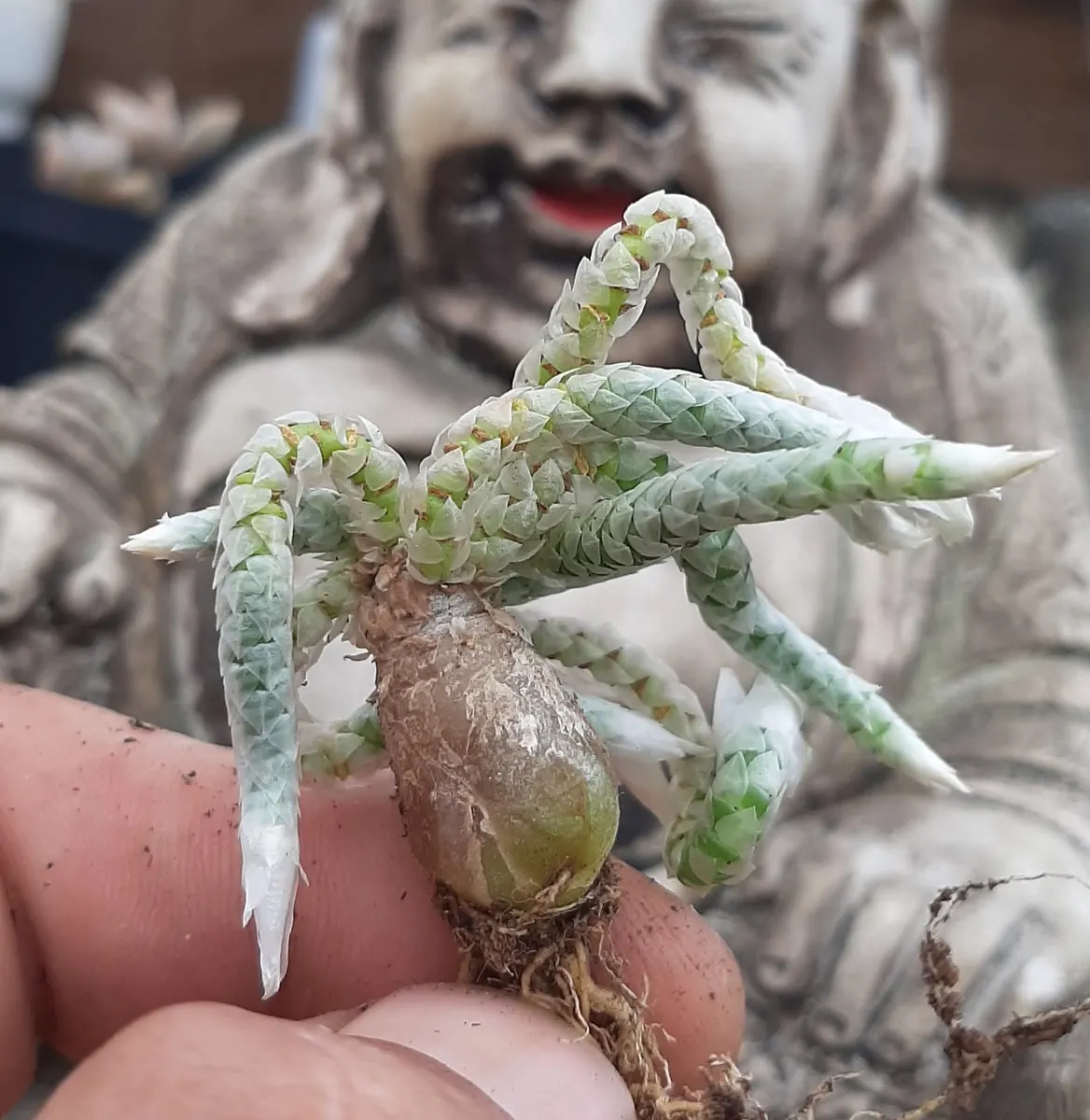
Avonia dinteri is a dwarf Namibian caudiciform that forms a dense mat of erect cylindrical stems reaching about 5 cm, arranged in a spiral over a woody tuber-shaped caudex given as 5 to 10 cm in diameter. Each stem is sheathed in stipular scales that are the diagnostic feature: silver-green, triangular, drawn to an acute point, papery and smooth rather than hairy, and overlapping tightly enough that the tiny true leaves underneath are invisible.
The evidence behind those measurements is thin, and the species deserves to be read with that in mind. Schinz’s 1901 protologue has never been digitised and Gerbaulet’s 1992 revision of the genus remains print-only, so no modern botanical redescription of A. dinteri is in general circulation. Every figure quoted for the plant traces back to a single European trade sheet. One nursery, described once, is the whole of the measured record.
The roots are described as shallow. That combination, a broad storage organ over a shallow root run, is the whole of the container problem.
Flowers open at the stem tips, white to pale purple, and they are self-fertile, which matters to anyone keeping a single plant: it can set seed without a partner. They last a few hours. Fruit and seed have never been described, and no flower diameter has been published for this species. Both remain gaps in the record.
The caudex is often called the largest in the genus, and the size makes that easy to believe. Nobody has compared caudex diameters across these species in print, so the claim rests on impression rather than on measurement. The photograph shows a substantial caudex. That is as far as the evidence goes.
Locality detail
Every accepted locality for Avonia dinteri lies inside Namibia, concentrated in Erongo and Otjozondjupa across the Karibib, Usakos, Omaruru, Otjosondu and Grootfontein belt. The map shows regional centroids. Sharp coordinates are withheld for a plant that Namibian law protects by name, and the one Namibian record that does carry coordinates is a rounded gazetteer centroid rather than a GPS fix in any case.
The open occurrence databases appear to contradict that, and the contradiction has a known cause. Search the aggregators for this species and most of the returned records sit in South Africa: the Eastern Cape, the Karoo, Bushmanland, the Richtersveld fringe. Those records are an artefact of the synonymy argument described in the taxonomy section. They are old herbarium sheets, collected between the 1930s and the 1970s under a broad mid-century species concept and determined as neglecta or schmidtii. POWO assigns those names to A. dinteri, so the sheets are swept into this species’s occurrence set automatically. SANBI assigns the same names to A. albissima instead, and A. albissima does grow at Aggeneys and Steinkopf, which is precisely where those sheets were collected.
The decisive check is simpler than the argument. SANBI’s list of South African Anacampseros runs to 43 taxa and includes every Namibian species that crosses the border. A. dinteri is not on it. A plant with dozens of South African herbarium sheets would appear on the list of the South African flora, and it does not. The occurrence counts for this species are contaminated, and they carry no weight as a range.
Cultivation
Grow Avonia dinteri on a summer-rainfall calendar: water it through the northern growing months of roughly March to October, keep it dry and frost-free through the northern winter, and pot it in about 90 per cent mineral grit in full sun. That one decision carries the whole section, because the plant takes its rain in the southern summer. Most published Avonia advice is written for the winter-rainfall species, and applying it here puts the plant six months out of phase with its own biology, which is the fastest way to lose the caudex. Get the calendar right and the rest is unremarkable.
Substrate
Use a sharply drained mineral soil of 35 per cent pumice, 20 per cent lava, 20 per cent granite grit, 10 per cent zeolite, 10 per cent silica grit, 5 per cent worm castings and no limestone. That is 95 per cent mineral against 5 per cent organic, the rot-class figure this genus runs on. Granite, silica, lava and zeolite are house-formulation figures here rather than a reading of this species’ own rock; no published source ties a mineral proportion to A. dinteri specifically, and the granite-heavy split on this page is a working convention, not a finding. The zeolite carries the nutrition-holding job through cation exchange without adding water-holding mass, which matters more on a summer-watered plant than on a winter-dry one.
The limestone reads zero, and that zero marks an absence of cultivation evidence rather than a reading of the rock at any locality. No source in the literature for this genus recommends lime for A. dinteri or for any Avonia. Nobody has demonstrated that it dislikes lime either, so a grower on hard water should not read this row as a warning.
Organic and limestone are the two components with cultivation evidence behind them, and both are held to the same values across all seven Avonia: organic at 5 per cent, set by the rot-class evidence for arid caudiciform succulents, and limestone at 0 per cent, because no cultivation source in the literature recommends lime for any Avonia. The remaining columns (pumice, lava, zeolite, granite, silica) are house-formulation figures that set drainage and particle size in the pot; they vary from page to page as a growing convention, not because any source ties a percentage to a species’ own rock.
| Species | Pumice | Lava | Zeolite | Granite | Limestone | Silica | Organic |
|---|---|---|---|---|---|---|---|
| A. quinaria | 41% | 8% | 10% | 8% | 0% | 28% | 5% |
| A. papyracea | 37% | 18% | 10% | 10% | 0% | 20% | 5% |
| A. albissima | 30% | 15% | 8% | 15% | 0% | 27% | 5% |
| A. herreana | 28% | 15% | 8% | 12% | 0% | 32% | 5% |
| A. ustulata | 50% | 15% | 15% | 10% | 0% | 5% | 5% |
| A. dinteri (this page) | 35% | 20% | 10% | 20% | 0% | 10% | 5% |
| A. mallei | 30% | 20% | 12% | 20% | 0% | 13% | 5% |
Watering and light
Water through the growing season, which under northern skies runs roughly March to October and mirrors the September to April wet season in Namibia. Water properly when you water: this is not a coastal plant sipping fog, it is an interior one adapted to convective storms, and it wants a thorough soak followed by a complete dry-out rather than a constant trickle. The caudex is the drought organ and the plant is built for pulses. Through the northern winter keep it dry and let it rest, which is the dormancy the southern winter imposes at home.
Give it full sun, with shade only through the worst of the summer heat. On cold, the number in circulation, a minimum near -5°C, comes from one horticultural sheet and has not been corroborated; the genus is reported to take some frost in habitat while needing protection in cultivation, which is a direction rather than a threshold. Keep it frost-free and bone dry in winter and the question does not arise. Pot it wide rather than deep, but with enough depth to seat the caudex properly. The shallow pans recommended for the mat-forming Avonia are the wrong container for a plant carrying a storage organ this size.
The plant is self-fertile, so a single specimen can set its own seed, and seed is the route this species should travel. Sow into a gritty mineral surface under humidity and warmth. Cuttings root at around 20°C. Expect slow work in both directions: the one society grower to write the genus up reported struggling to set seed even with hand pollination, and reported that seed-raised plants need patience before they amount to anything. Nobody grafts these. This family has no rootstock tradition, and none has been described for it.
At rarecactus.com we grow Avonia dinteri from seed, and on every page in this genus we print Kew’s Anacampseros name beside the Avonia one instead of quietly picking whichever suits us. Both habits come from the same instinct. A plant with no readable original description, no published type locality and two major authorities pointing in opposite directions is a plant where the grower is owed the working, not just the conclusion. The seed part is also the legal part: every wild plant of this species leaves Namibia only on a minister’s permit, and seed of artificially propagated stock is the one link in the chain that the CITES annotation exempts.
Comparison
Avonia dinteri is confused with one sibling and only one, A. albissima, and the two are paired here for a reason that has nothing to do with a casual resemblance: the literature cannot cleanly separate them. A. albissima is the only Avonia whose range overlaps this one in Namibia, and it is the species SANBI assigns the very synonyms that POWO assigns to A. dinteri. When two national authorities disagree about which of two species a drawer of herbarium sheets belongs to, that is confusability documented in the record rather than asserted by a shop.
The separators that hold up are the ones that come from independent sources. A. dinteri stops at the Namibian border; A. albissima runs from southern Angola through Namibia to the Richtersveld and east through Bushmanland to Griqualand West, and reaches South Africa, which this plant never does. A. dinteri lives on sunny rocky slopes in the summer-rainfall interior; A. albissima is a plant of rock outcrops and quartz flats across the Nama and Succulent Karoo, and is edaphically catholic enough to sit on the dolomite and calcrete of the Ghaap Plateau, which is why its soil row carries limestone and this one does not.
On the plant itself the characters are softer, and they all come from the same publisher, so treat them as a consistent description rather than as two independent confirmations. The stipular scales run silver-green here against whitish there, papery and smooth against hairy, triangular and sharply pointed against not. The stems form an erect spiralled mat here, where A. albissima throws unbranched growth that has been likened to tentacles. Flowers are white to pale purple here and white there. Caudex size does not belong on that list: a seedling has no caudex worth measuring, so it cannot separate two plants at any stage but the last, however good it looks in a photograph.
Against the rest of the genus the separation is easier. Avonia mallei and A. herreana are winter-rainfall plants of the Northern Cape and the Richtersveld, so they want the opposite calendar. A. papyracea sprawls flat in thick white snake-like branches that nothing here resembles. A. ustulata is the genus’s other outlier, camouflaged against grey Karoo shale rather than white quartz. Two of these seven refuse the family script, and this is the Namibian one.
Frequently asked questions
How do you grow Avonia dinteri?
Sun, a sharply drained mineral soil, and above all the right calendar. Give it full sun with shade only through peak summer heat, pot it in about 90 per cent mineral grit over 10 per cent organic matter, water it thoroughly through the growing months and let it dry out completely between soakings. Keep it dry and frost-free in winter. It is an intermediate plant rather than a hard one, and it is slow: the stems stop at 5 cm and the caudex takes years.
When does Avonia dinteri grow, and when is it dormant?
It grows from roughly March to October in the northern hemisphere and rests through the northern winter. That mirrors its habitat, north-central Namibia, where almost all rain falls between September and April and only the far southwest of the country sits in the winter-rainfall belt. This is the one thing to get right, because much of the genus grows on the opposite schedule, and a grower who applies the Namaqualand winter-growing routine to this species waters it hard while it is dormant and rots the caudex.
How do you propagate Avonia dinteri?
From seed, and a single plant can supply it: the flowers are self-fertile, so no partner is needed. Sow onto a gritty mineral surface with warmth and humidity; cuttings also root, at around 20°C. Expect it to be slow and expect setbacks, since the one society grower to publish on the genus reported struggling to set seed even with hand pollination. Seed is also the legal route. Namibia protects this plant by name and wild material leaves the country only on a permit, while CITES exempts seed of artificially propagated plants from the Appendix II controls.
What is the common name for Avonia dinteri?
It does not have one. No vernacular name has been recorded for this species, and the occurrence databases return none either. Some of its relatives have picked up trade names, but this plant is known by its botanical name only, either as Avonia dinteri or, under the Kew arrangement, as Anacampseros dinteri. Inventing a common name to fill the gap would be doing the reader a disservice.
Can Avonia dinteri be grown indoors?
Only with real light. This is a full-sun plant from open rocky slopes at around 1300 m, and a windowsill that suits a houseplant will draw the stems and slacken the scale ranks that make the species worth having. A bright south-facing window or supplementary lighting is the minimum. Indoors the watering risk also rises, because pots dry slowly in still air: pot wide rather than deep, keep the neck of the caudex in sharp grit, and let the soil dry out completely before watering again.
Sources & further reading
Schinz, H. 1901. Anacampseros dinteri. Bulletin de l’Herbier Boissier, sér. 2, 1: 873 · Rowley, G.D. 1994. Anacampseros and allied genera, a reassessment. Bradleya 12: 105–112 · IPNI, International Plant Names Index, urn:lsid:ipni.org:names:978180-1 (Avonia dinteri) and urn:lsid:ipni.org:names:698254-1 (Anacampseros dinteri) · Kew POWO, Anacampseros dinteri Schinz, powo.science.kew.org/taxon/urn:lsid:ipni.org:names:698254-1 (accepted name, native range, synonymy) · GBIF Secretariat, GBIF Backbone Taxonomy, Avonia dinteri key 5646658 (accepted) and Anacampseros dinteri key 4023224 (synonym); synonymy, distribution and occurrence services · Govaerts, R. 1995. World Checklist of Seed Plants 1(1, 2) (cited as Avonia dinteri) · Gerbaulet, M. 1992. Die Gattung Anacampseros L. (Portulacaceae). I. Untersuchungen zur Systematik. Botanische Jahrbücher für Systematik 113(4): 477–564 · von Staden, L. 2015. Anacampseros albissima Marloth. National Assessment: Red List of South African Plants, SANBI · SANBI, Red List of South African Plants, genus account for Anacampseros (43 taxa) · Loots, S. 2005. Red Data Book of Namibian Plants. Southern African Botanical Diversity Network Report No. 38, SABONET, Pretoria and Windhoek · Nature Conservation Ordinance 4 of 1975 (Namibia), Schedule 9 (Protected plants) and sections 73–76; Legal Assistance Centre annotated statute · CITES, Appendices to the Convention: Anacampseros spp., Appendix II, in force 01/07/1975, with the annotation including Avonia spp.; annotation #4 adopted at CoP15 (23/06/2010) · Atlas of Namibia, Chapter 3: Rainfall patterns · Driskill, E. 2009. Avonia, Plant of the Month. Henry Shaw Cactus and Succulent Society · Giromagi Cactus and Succulents, species accounts for Avonia dinteri and Avonia albissima (morphology and cultivation)