
Avonia albissima
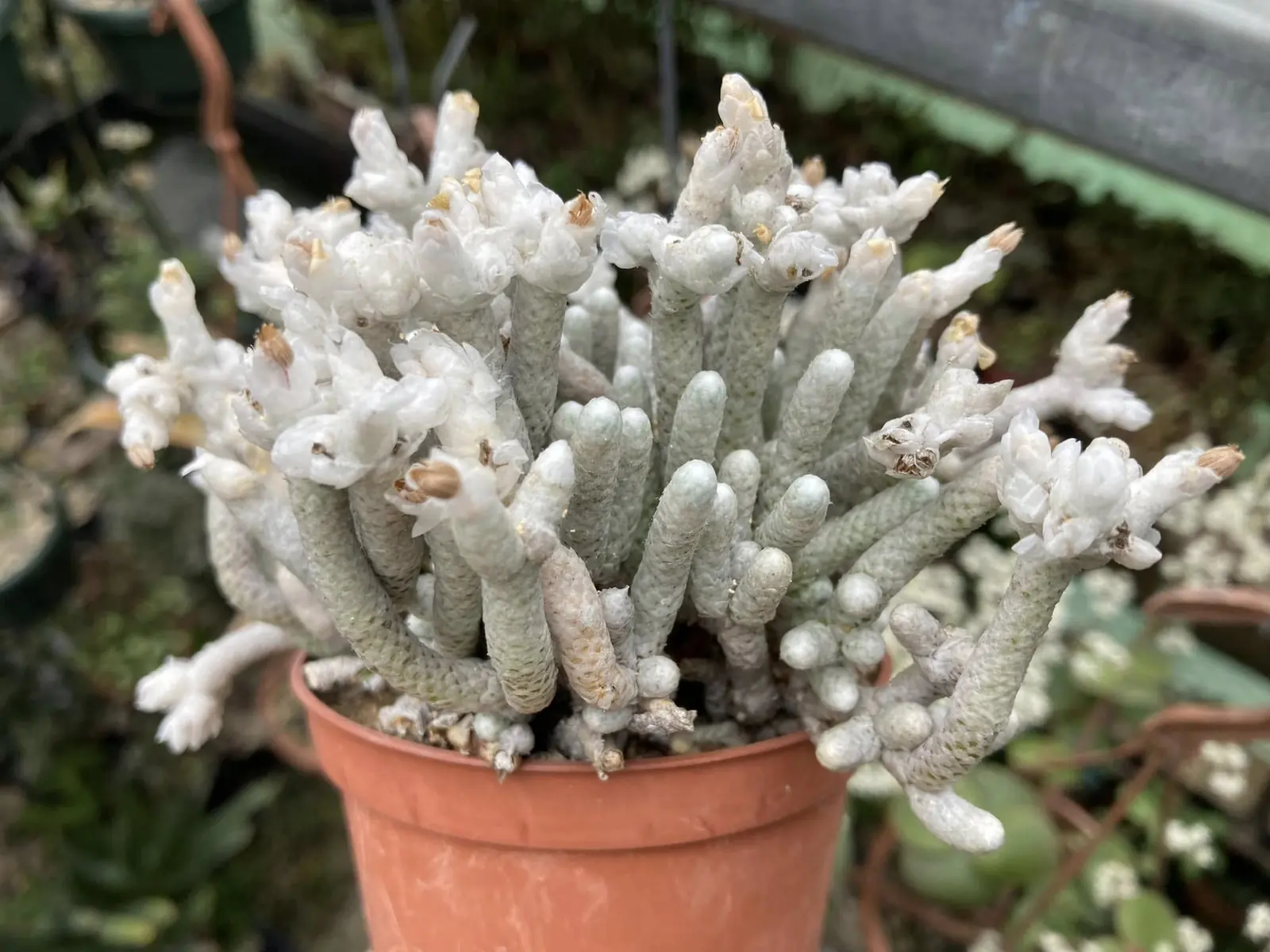
Avonia albissima is the traveller of its genus. Where its relatives hold single mountains or single river valleys, this one runs from southern Angola down through Namibia to the Richtersveld, then swings east across Bushmanland to Griqualand West. Herbarium collections trace it across roughly 1,500 km of latitude and 1,200 km of longitude, which is a startling footprint for a plant whose stems stop at 5 cm.
The stems are the reason anyone grows it. Each is 3 to 5 mm thick and erect, rising in a low tuft, and every one is sheathed in pure white stipular scales packed so tightly against the axis that the leaves beneath them never see daylight. From a few paces the whole plant reads as a scatter of bird droppings on gravel, which is precisely the point.
Rudolf Marloth described the plant in 1912 as Anacampseros albissima. George Rowley moved it to Avonia in 1994 when he split off the papery-scaled species from the naked-leaved Anacampseros proper, putting it alongside Avonia papyracea and Avonia quinaria. Kew has since reversed that split. The name is a live disagreement between two major authorities, and both positions are set out under Taxonomy below.
It is also the member of the genus that refuses to fit the habitat story. The others are quartz-field plants, and so is this one across its western range. But its eastern populations sit on the dolomite and surface calcrete of the Ghaap Plateau, which is a different rock chemistry altogether, and that single awkward fact rewrites the soil recipe below.
Avonia albissima quick reference
A rainfall generalist of quartz flats, granite outcrops and calcrete plateaus, spanning both the winter-rainfall west and the summer-rainfall east. Roots run to 30 cm through a matrix of 1 to 4 cm stone. Values calibrated for seed grown plants in cultivation, drawn from habitat data and specialist grower experience.
Taxonomy & nomenclature
The accepted name is Avonia albissima (Marloth) G.D.Rowley, Bradleya 12(prepr.): 111 (4 July 1994). Kew’s Plants of the World Online does not accept that name. POWO sinks Avonia wholesale back into Anacampseros and treats Anacampseros albissima Marloth, Trans. Roy. Soc. South Africa 2: 238 (1912), as the accepted name. The GBIF backbone takes the opposite view and accepts the Avonia combination, with the Anacampseros name as its homotypic synonym. Both are current, both are major authorities, and they disagree: the GBIF backbone accepts Avonia albissima while Kew’s POWO sinks it into Anacampseros.
The vendor trade splits the same way, which is worth knowing before you buy: some sellers list this species as Avonia albissima and others as Anacampseros albissima, and they are the same plant. Rowley’s distinction, and the reason the segregate genus exists at all, is the stipular scale. In Avonia the leaves are tiny and completely buried under papery stipules; in Anacampseros proper the leaves are larger and naked.
Marloth is the sole basionym author, confirmed across IPNI, GBIF, the Caryophyllales Network and LLIFLE. That matters because the parallel question is badly tangled elsewhere in the genus: A. quinaria, A. papyracea and A. ustulata carry a basionym-author conflict between POWO and IPNI. This species has none. The family renders as Anacampserotaceae under both SANBI and GBIF; IPNI and LLIFLE still file it under the legacy Portulacaceae, which is a database-currency artifact rather than a real dispute, and CITES still uses the old family name too.
The synonymy is long and mostly the work of Karl von Poellnitz, who described the same plant from different corners of its range: Anacampseros avasmontana for material from the Avasberge near Windhoek, A. neglecta, A. schmidtii and several varieties besides. A wide-ranging species collected piecemeal across two thousand kilometres tends to accumulate names that way. One caution: material once treated as Avonia albissima var. grisea is now the accepted species Anacampseros grisea (G.Will.) Dreher, so this species has no accepted infraspecific taxa. GBIF and LLIFLE both still sink grisea here and are lagging on that specific point.
On the regulatory side the plant sits on CITES Appendix II, and the route it takes there is worth spelling out because it is widely misreported. There is no Avonia listing. There is a single genus listing of Anacampseros spp., in force since 1 July 1975, whose annotation reads that it includes Avonia spp. Annotation #4, which exempts seed, pollen, in-vitro cultures and cut flowers of artificially propagated plants, came later, at CoP15 in 2010. Only A. quinaria has since been moved to Appendix I. Every other species in the genus, this one included, remains on Appendix II with annotation #4 intact.
Habitat
Avonia albissima grows on rock outcrops and quartz flats, and on the sandy gravel between them, across the Desert, Nama Karoo and Succulent Karoo biomes of Namibia and the Northern Cape. SANBI describes that habitat in exactly those first four words, rock outcrops and quartz flats; LLIFLE adds the gravel, and notes that plants grow in the open, in shade, or at the base of rocks without apparent preference. The vegetation units the species has been recorded from run from Aggeneys Gravel Vygieveld and Rooiberg Quartz Vygieveld through Namaqualand Klipkoppe Shrubland and Eastern Gariep Rocky Desert to Northern Upper Karoo.
That list contains a problem, and it is the most consequential fact about this species. Ghaap Plateau Vaalbosveld is on it, and the Ghaap Plateau is a carbonate platform: dolomite with an abundance of surface calcrete, host to the Lime Acres limestone deposit and to at least one plant described as a limestone endemic. The occurrence records agree. The eastern cluster sits squarely on that platform, at Postmasburg, Kuruman, Griquatown, Campbell, Olifantshoek and Prieska. One of the collection localities is a farm called Kalkfontein, which is Afrikaans for lime spring.
So a plant that grows on white quartz in the west also grows on calcrete in the east. It cannot be a calcifuge and simultaneously occupy a dolomite plateau across six recorded districts. The reading that survives the evidence is that this species is indifferent to parent-rock chemistry and keyed instead to drainage and stone size, and that its edaphic tolerance is precisely how it got the range it has. Two field notes from herbarium labels sketch the western picture directly: one plant on quartz boulders beside a rivulet, another on red-brown earth between granite boulders and up into quartz gravel plains.
The range crosses a second boundary that matters more to growers than the rock does. Namaqualand and the Richtersveld are winter-rainfall country. Bushmanland and Griqualand West, where the bulk of the collections come from, are summer-rainfall Nama Karoo. The lower Orange River sits in between and takes its rain as summer thunderstorms. This is a rainfall generalist, which sets it apart from strictly winter-rainfall relatives like Avonia herreana and Avonia mallei, and it is the fact that makes the cultivation calendar work.
Roots run to about 30 cm through a matrix of small stones, 1 to 4 cm across. Hold that number: it is the single most useful piece of habitat data for cultivation, and it contradicts what the plant looks like it wants.
Morphology
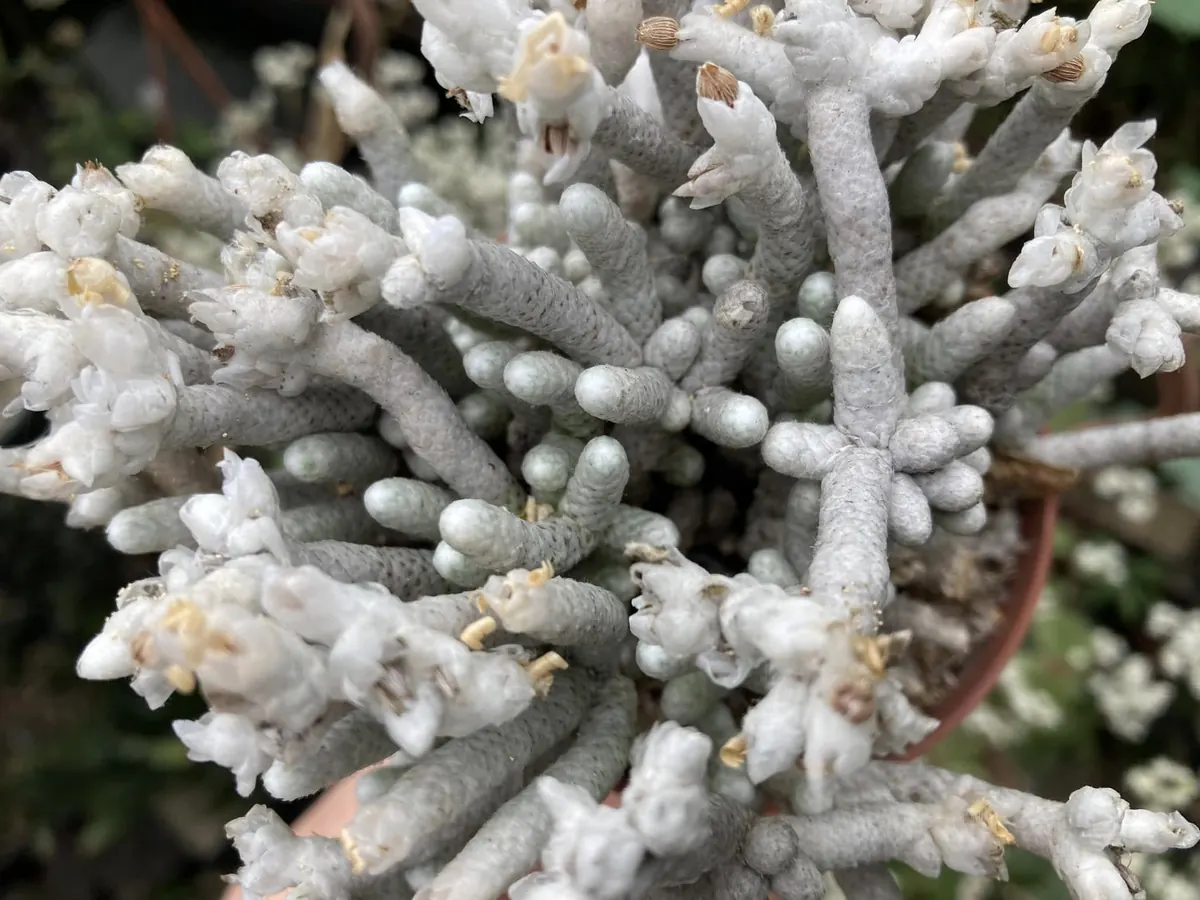
Avonia albissima is a small whitish plant forming a tuft of erect stems branched low down, each sheathed in pure white papery stipules. The branches are numerous, spreading or erect, up to 5 cm long and 3 to 5 mm in diameter, and each one is itself almost unbranched, so the plant divides at the base and then runs straight. Overall height in cultivation stays under 10 to 15 cm. Below ground sits a short, fleshy, somewhat woody rootstock carrying fleshy roots that reach far deeper than the plant above suggests.
That asymmetry is the geometry to understand. The caudex is short and modest, nothing like the turnip of A. quinaria or the substantial tuber of Avonia dinteri. No caudex diameter has been published for it. But the roots below it run 30 cm. Short neck, deep roots, and the neck is where the plant dies.
The leaves are tiny and completely concealed. What you see instead are the stipules: broadly ovate, obtuse, tightly imbricate, pressed flat against the shoot axis, sometimes with a recurved tip, the margin entire or irregularly toothed, hairy within at the axils, and pure white without an evident midrib. They can carry a brown tip or brown dots. That last detail matters, because A. ustulata is often said to be the only species here with a non-white scale apex, and it is not quite that simple. The real distinction is that ustulata’s rusty apex is spreading and confined to fertile stems.
Flowers come 1 to 3 per branch, terminal, 12 mm across, with whitish sepals and ovate white petals that open widely. They are scented, which neither A. papyracea nor A. ustulata is reported to be. The stamens number 8 to 10, and that count is the most useful diagnostic character for the species: see the comparison below. Fruit is subglobose and 3 mm across; the seed is subglobose, beaked and colliculate with white papillae. Chromosome number is 2n = 18.
No flowering season, flower duration or self-fertility statement has been published for A. albissima. Both congeners flower for only a few hours in afternoon sun and papyracea is self-pollinating, so the pattern is very likely shared, though nothing published confirms it for this species.
Locality detail
Avonia albissima ranges from southern Angola through Namibia to the Richtersveld, then eastwards through Bushmanland to Griqualand West, which is SANBI’s published range and the widest of any species in the genus. The occurrence data backs it up rather than merely echoing it: 187 records, 122 of them georeferenced, 84 from South Africa, 37 from Namibia and 1 from Angola. Seventy-four are preserved herbarium specimens against 47 field observations, so this is a range built from vouchered material rather than from photographs of uncertain plants.
The Angolan record deserves its caveat. It is a single 2007 collection from the Cunene River near the mouth, by a specialist collector, lodged at three herbaria. That is a good record. It is still one record, so the species reaches southern Angola but is not widespread there. Two collections also sit well south of the published range, near Loeriesfontein and in the Fraserburg district, one of them by a credible field botanist. They may be a real extension or a misidentification, and they fall outside the range SANBI publishes.
Cultivation
Avonia albissima is an intermediate plant to grow, and two habitat facts set the whole regime: the roots run 30 cm through coarse stone, and the stems are wrapped in a papery scale mat that holds water against the axis above a short caudex. Depth below, bone dry at the neck. Everything else follows.
Substrate
Grow it in a sharply drained mineral mix of roughly 27 per cent silica grit, 25 per cent pumice, 15 per cent lava, 15 per cent granite grit, 8 per cent zeolite, 5 per cent crushed limestone and 5 per cent worm castings. The silica tracks the quartz flats it grows on and the granite tracks the boulder outcrops. The limestone is the interesting one, and it is there on evidence: this species occupies the dolomite and calcrete of the Ghaap Plateau across its eastern range, so a token calcareous fraction matches the plant honestly, where a zero would claim a calcifuge habit it does not have. The pumice and lava carry the 30 cm root run without collapsing, and the organic fraction stays lean because these are plants of poor soils. Top-dress with coarse quartz gravel at habitat grade, 1 to 4 cm, which keeps the root neck dry and looks like where it came from.
There is no Avonia soil baseline. Limestone in this genus is a per-species question, and it runs from 0 to 15 across the seven species below. A. albissima carries limestone because its eastern range is calcrete, and heavy silica because its western range is quartz flats.
| Species | Pumice | Lava | Zeolite | Granite | Limestone | Silica | Organic |
|---|---|---|---|---|---|---|---|
| A. quinaria | 34% | 8% | 10% | 8% | 0% | 28% | 12% |
| A. papyracea | 32% | 18% | 10% | 10% | 0% | 20% | 10% |
| A. albissima (this page) | 25% | 15% | 8% | 15% | 5% | 27% | 5% |
| A. herreana | 28% | 15% | 8% | 12% | 0% | 32% | 5% |
| A. ustulata | 30% | 15% | 15% | 10% | 15% | 5% | 10% |
| A. dinteri | 30% | 20% | 10% | 20% | 0% | 10% | 10% |
| A. mallei | 30% | 20% | 12% | 20% | 0% | 13% | 5% |
Watering and light
Water normally through the growing season, March to October, letting the mix dry between soaks, and keep the plant dry in winter. That is a conventional Northern-Hemisphere warm-season cycle, and for once the received wisdom is right: two independent sources agree on it verbatim, and it is coherent because a species spanning both rainfall zones has no obligate season to fight. Do not invert this calendar on the assumption that a Namaqualand plant must be a winter grower. The core of the range is summer-rainfall Bushmanland.
One caveat that nobody has tested: material of Richtersveld or Namaqualand provenance comes from the winter-rainfall side and may keep a winter rhythm, while Bushmanland stock should suit March to October exactly. This has not been tested, so watch the plant rather than the calendar. If it plumps up in November, believe it.
Light shade to full sun, with high light needed for flowering and for growth that stays tight. The habitat text supports the shade tolerance directly, since plants grow at the base of rocks as readily as in the open. Feed sparingly in summer with a high-potassium, low-nitrogen liquid feed, at around half the dose you would give anything else; excess nitrogen produces soft etiolated growth on a plant adapted to poverty. Frost to about -5°C is survivable only when the plant is bone dry, and that conditional is the entire rule rather than a footnote to it.
Container and propagation
Use a deep clay pot. Clay helps the mix dry between waterings, and the depth is not optional: vendor advice to use a shallow pan reasons from the 5 cm stems and ignores the 30 cm roots underneath them. Repot into depth, not width.
Propagation is by seed, which germinates at 15 to 21°C. That band is materially cooler than cactus seed wants, and sowing this at cactus temperatures is a common way to get nothing. Grafting is not documented for this species, and nothing about it invites the practice: the caudex is the point of the plant, and the plant is not scarce. At rarecactus.com we raise our Avonia from seed rather than buying in collected stock, and this species is the argument for why that works. Its seed moves openly and cheaply across borders under the CITES annotation that exempts artificially propagated seed, and its wild populations are not under collecting pressure. Those two facts are connected. A plant that is easy to raise from seed is a plant nobody needs to dig up.
Comparison
Avonia albissima has exactly one serious lookalike, Avonia papyracea, the only other pure snow-white, papery-stipuled species in the genus, and the two grow together rather than merely resembling one another. The subspecies namaensis occupies southern Namibia and Bushmanland, which is the core of this species’ range, so they overlap across hundreds of kilometres and this is a field problem rather than a catalogue problem. Every other candidate is excluded on appearance alone, since A. dinteri is silver-green with triangular pointed scales, A. ustulata is silvery-grey with a rusty apex, A. herreana wears its scales loosely instead of appressed, and A. quinaria ranks its stipules in fives over a turnip caudex.
Count the stamens. A. albissima carries 8 to 10; papyracea carries 16 to 20. That is a count rather than a measurement, roughly a twofold difference, it cannot be explained away by the age of the plant, and it is checkable on any open flower. Without a flower in front of you, use branch diameter together with orientation: 3 to 5 mm and erect here, 6 to 8 mm or more and growing flat on the ground in papyracea. Both traits are proportions and architecture rather than absolute sizes, so they hold from juvenile plants onward. The hero image above and the papyracea page show the contrast directly.
One tempting character is misleading. The absent midrib is a well-sourced description of this species’ stipules, but papyracea’s midrib is unrecorded either way, so it cannot separate the two. Absence of evidence is not a diagnostic. What the stipules will tell you is surface texture: papyracea’s carry transverse wrinkles and run tongue-shaped, where these are smooth and broadly ovate. Geography settles it outside the overlap zone, since a white Avonia in Griqualand West or Angola is not papyracea, whose typical subspecies is an Eastern Cape endemic. Inside Bushmanland, geography is useless and only the plant itself can answer.
Frequently asked questions
How do you care for Avonia albissima?
Give it a sharply drained mineral mix in a deep clay pot, bright light with light shade tolerated, water through the growing season from March to October, and keep it bone dry all winter. Feed sparingly in summer with a low-nitrogen, high-potassium feed. The one thing that kills it is water lodging at the root neck under the scale mat, so top-dress with coarse quartz gravel and never water over the stems.
How do you grow Avonia albissima from seed?
Seed is the only propagation route anyone documents for this species, and it works. Sow onto a mineral surface and germinate at 15 to 21°C, which is notably cooler than cactus seed wants; sowing it at cactus temperatures is a common reason for failure. Seedlings develop slowly and want careful, sparing water. Seed is traded openly and cheaply because CITES annotation #4 exempts seed of artificially propagated plants from the Appendix II controls that apply to live plants.
What is the common name for Avonia albissima?
It does not have one. No Afrikaans, English or trade vernacular is recorded for this species by any taxonomic authority, and the epithet is doing the work instead: albissima means whitest. What it does have is two competing botanical names. Kew POWO accepts Anacampseros albissima and sinks the genus Avonia entirely, while the GBIF backbone accepts Avonia albissima. Sellers use both. They are the same plant.
How often do you water Avonia albissima?
Water normally through the March to October growing season, soaking the mix and then letting it dry out before the next one, and stop completely for the winter rest. Direct water at the soil, because the tightly overlapping scales hold droplets against the stem. The published cold tolerance of about -5°C applies only to a bone-dry plant, so winter wet is doubly dangerous: it rots the neck and it voids the frost figure at the same time.
When does Avonia albissima go dormant?
In winter. It grows from March to October on the calendar most growers keep and rests dry through the cold months, which is a conventional warm-season cycle rather than the inverted one that mesembs from the same quartz fields follow. That surprises people, and the reason is that this species spans both the winter-rainfall west and the summer-rainfall Bushmanland core, so it has no obligate season. Plants of Richtersveld provenance may lean winter; watch the plant rather than the calendar.
Sources & further reading
Marloth, R. 1912. Anacampseros albissima. Transactions of the Royal Society of South Africa 2: 238 · Rowley, G.D. 1994. Anacampseros and allied genera: a reassessment. Bradleya 12: 105–112 · Gerbaulet, M. 1992. Die Gattung Anacampseros L. (Portulacaceae). I. Untersuchungen zur Systematik. Botanische Jahrbücher für Systematik 113(4): 477–564 · IPNI, International Plant Names Index, urn:lsid:ipni.org:names:698235-1 · GBIF Secretariat, GBIF Backbone Taxonomy, Avonia albissima (key 5646659; 187 occurrence records, 122 georeferenced) · Kew POWO, Plants of the World Online, Anacampseros albissima Marloth · Caryophyllales Network, name record for Anacampseros albissima Marloth · von Staden, L. 2015. Anacampseros albissima Marloth. National Assessment: Red List of South African Plants, SANBI · Williamson, G. 2009. Avonia albissima var. grisea. Aloe 46(3): 70 · Snijman, D.A. 2013. Plants of the Greater Cape Floristic Region 2: The extra Cape flora. Strelitzia 30. SANBI, Pretoria · CITES Appendices, Anacampseros spp. (Appendix II, 01/07/1975, annotation includes Avonia spp.; annotation #4 from CoP15, 23/06/2010) · LLIFLE, Encyclopedia of Living Forms, Avonia albissima (description, cultivation, habitat) · LLIFLE, Encyclopedia of Living Forms, Anacampseros papyracea (comparison: stamens, branch diameter, habit) · Mucina, L. & Rutherford, M.C. (eds) 2006. The Vegetation of South Africa, Lesotho and Swaziland. Strelitzia 19. SANBI, Pretoria (Ghaap Plateau Vaalbosveld)