
Coryphantha hintoniorum
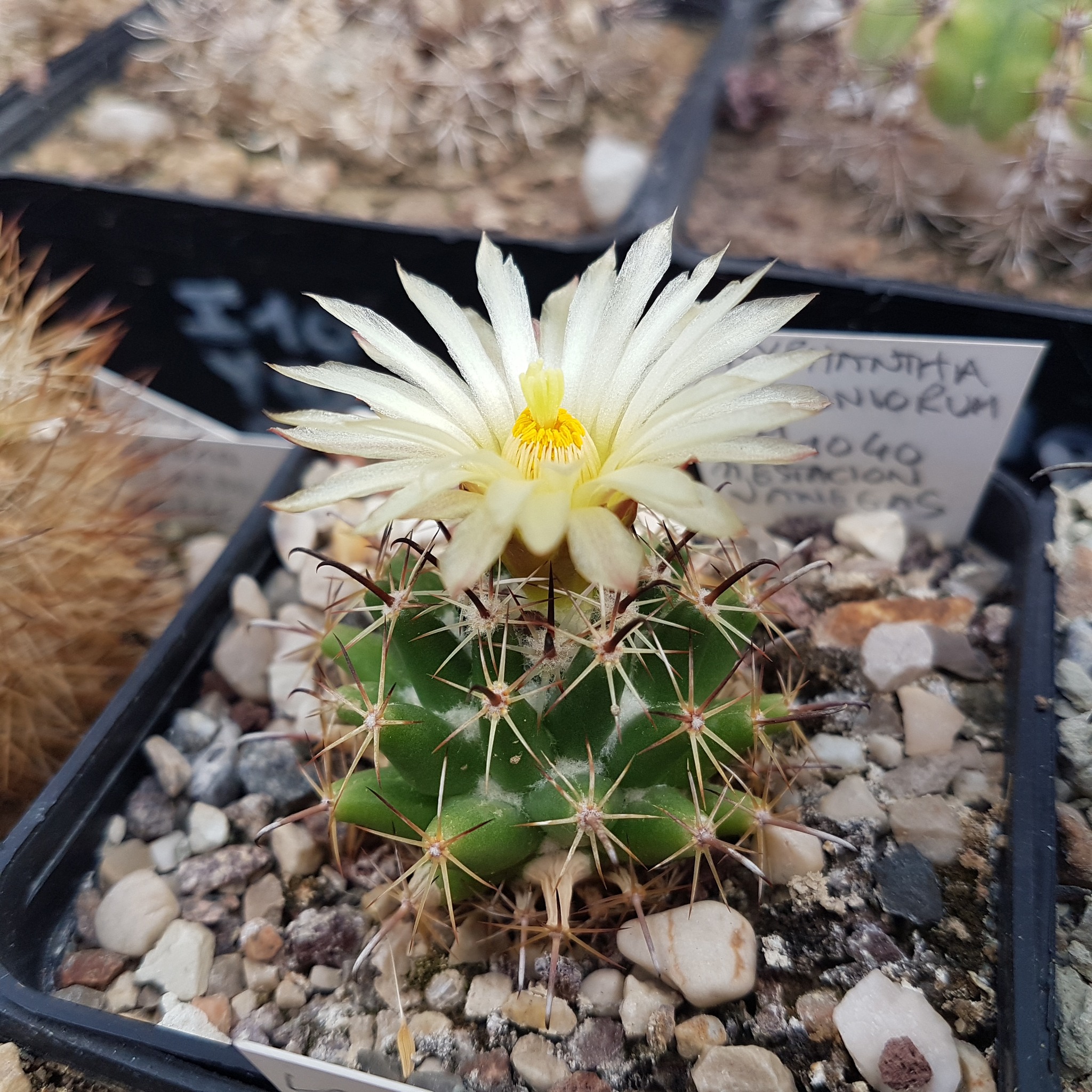
Coryphantha hintoniorum Dicht & A.Lüthy is a compact highland cactus of the southern Sierra Madre Oriental, described in 1999 from a holotype collected by G. B. Hinton and family at San Gerardo near Galeana in southern Nuevo León. The publication appeared in Kakteen und andere Sukkulenten 50(1): 13–17 and was fully figured, with the protologue citing holotype number 27111 from the Hinton Herbarium. The epithet hintoniorum is a Latin genitive plural honouring the multi-generational Hinton family of British-Mexican botanical collectors, whose private archive from the Sierra Madre Oriental remains exceptionally comprehensive for the region.
Two subspecies are accepted by Kew POWO. The nominate subsp. hintoniorum is the typical lowland form on alluvial limestone flats around the Galeana valley, growing as a spherical to short-cylindrical clumping plant with fibrous roots. Subsp. geoffreyi, named by the same authors in KuaS 54(2): 44 in 2003 for George Hinton’s son Geoffrey, is a flat-globose dwarf barely 2 cm tall in habitat with a tuberous root and smaller tubercles; it sits higher on the Sierra de las Mazmorras, climbing to 2,300–2,400 m. The horticultural label “f. alpina” circulates for plants from Huachichil, Arteaga, Coahuila but has not been validly published and is treated as an informal trade name only.
Among the five Coryphantha on this site, C. hintoniorum sits closest in overall character to the Coahuilan cliff-dweller Coryphantha werdermannii, the only Appendix I species in the genus, but the two diverge on body scale, spine count, and conservation profile. The volcanic-slope giant Coryphantha elephantidens is the showpiece flowering species of the genus and shares no meaningful identification ambiguity with the compact C. hintoniorum. Plants traded under collector field numbers with GBH, GH, and JFH prefixes from the Hinton family collections are the primary provenance for European and North American specialist material.
The molecular phylogeny of Sánchez et al. (2022) places C. hintoniorum inside Coryphantha sensu stricto, allied to the small-bodied northern Mexican species rather than to the large-tubercled central-Mexican C. elephantidens group. POWO records the species from three states: Nuevo León, Coahuila, and San Luis Potosí, with the Galeana valley and the Cerro Potosí massif of Nuevo León as the population centre.
Coryphantha hintoniorum quick reference
A highland Coryphantha of the southern Sierra Madre Oriental, growing on calcareous alluvium and limestone hillsides between 1,700 and 2,400 m. Values calibrated for seed grown plants in cultivation, drawn from species-specific habitat data and specialist grower experience with C. hintoniorum. No published source gives a limestone proportion for this species.
Taxonomy & nomenclature
The accepted name is Coryphantha hintoniorum Dicht & A.Lüthy, first published in Kakteen und andere Sukkulenten 50(1): 13–17 (1999), with the protologue fully figured. IPNI records the combination at lsid urn:lsid:ipni.org:names:317307-2. The holotype is G. B. Hinton et al. 27111, gathered at San Gerardo near Galeana, Nuevo León, at approximately 1,850 m and deposited in the Hinton Herbarium. POWO and IPNI both accept the name without dispute; the species sits in Cactaceae, subfamily Cactoideae, tribe Cacteae.
The same authors published Coryphantha hintoniorum subsp. geoffreyi in KuaS 54(2): 44 in February 2003, creating the autonym subsp. hintoniorum at the same time. POWO recognises both subspecies. A 2001 note in Cactus Adventures proposed that C. hintoniorum might be conspecific with Coryphantha roederiana Bödeker, but Dicht and Lüthy’s 2005 monograph Coryphantha: Cacti of Mexico and Southern USA (Springer) rejected the synonymy on body proportions, spine number, root structure, and geography; POWO continues to recognise both as accepted species.
The wider genus Coryphantha (Engelm.) Lem. holds 43 accepted species on POWO. The molecular phylogeny of Sánchez et al. (2022) in PhytoKeys 188: 115–165 supports a monophyletic Coryphantha once C. macromeris is excluded, with Escobaria, Pelecyphora, and C. macromeris as the sister clade. C. hintoniorum sits inside Coryphantha sensu stricto, allied to the small-bodied northern Mexican species.
Habitat
Coryphantha hintoniorum is a narrow endemic of the southern Sierra Madre Oriental. POWO records it from Nuevo León, Coahuila, and San Luis Potosí; the bulk of confirmed populations sit inside Nuevo León west of Cerro Potosí, especially around Galeana and the San Roberto basin south to the Coahuila state line. Conservation literature describes approximately 21 fragmented subpopulations across roughly 7,000 km², spanning two distinct elevation bands: the nominate subspecies on alluvial flats and limestone foothills between 1,700 and about 2,100 m, and subsp. geoffreyi higher on rocky mountain slopes of the Sierra de las Mazmorras from about 2,000 to 2,400 m.
The primary substrate for the nominate subspecies is calcareous alluvium derived from the surrounding limestone uplift; in places the topsoil is silty alluvium rather than bare rock. Subsp. geoffreyi grows more directly on rocky limestone slopes. Across the range the parent rock is the Cretaceous limestone formation of the Sierra Madre Oriental, and the substrate pH is consistently alkaline at 7.5–8.5. Both subspecies fall within the Chihuahuan Desert ecoregion and experience the monsoon-driven summer rainfall pattern with cold, dry winters. The Coryphantha ramillosa of Brewster County, Texas and adjacent Coahuila shares the limestone-hill habitat type; the two species do not overlap geographically.
Field plants grow in xerophyllous scrub and open grassland communities. Llifle records “extensive farming” across the Galeana flats as the primary active threat, with several subpopulations already destroyed by ploughing and irrigation. The type gathering at San Gerardo sits at the low end of the elevation range for the nominate subspecies, where the valley floor grades into the surrounding limestone hills that carry the bulk of surviving populations.
Morphology
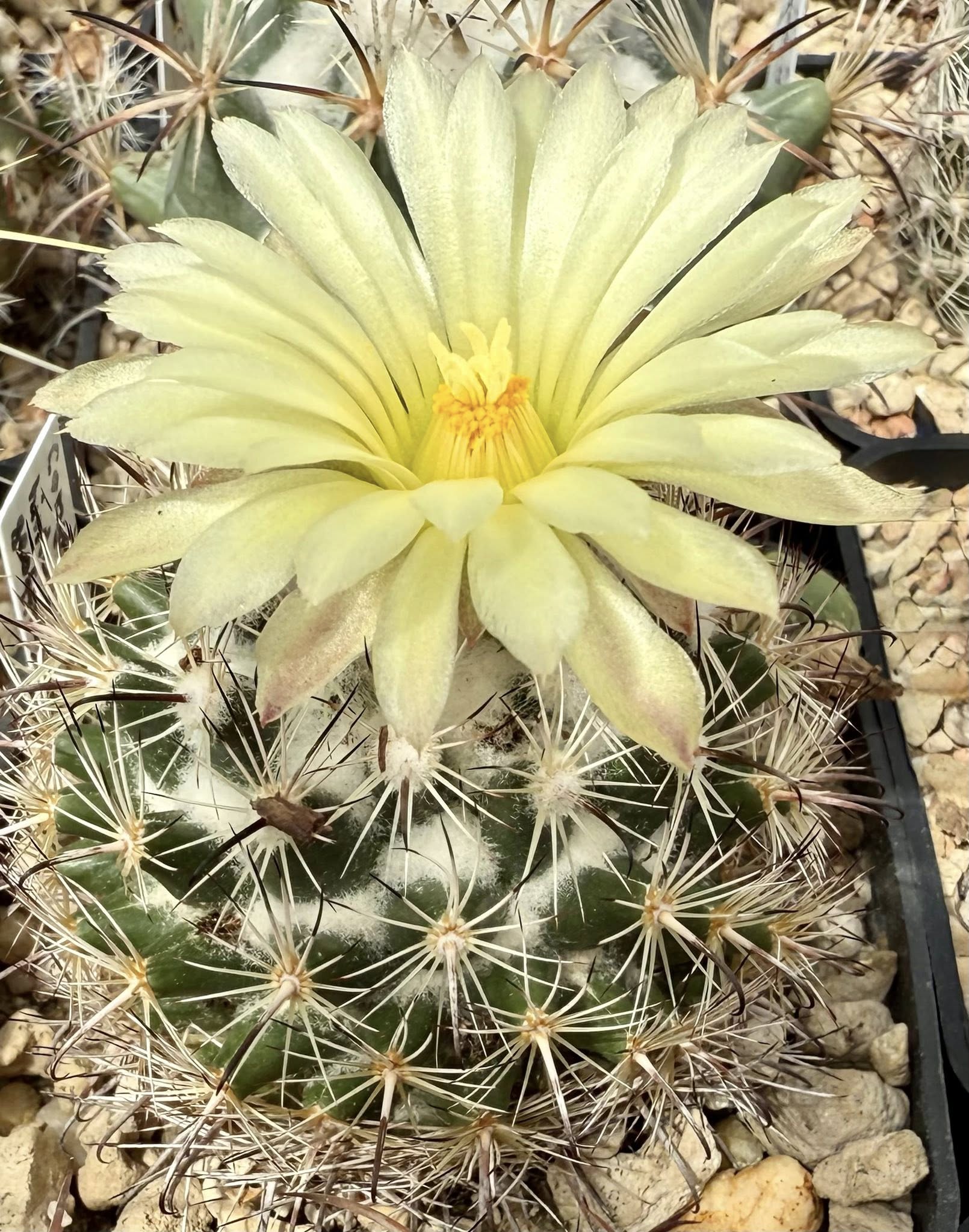
The body of subsp. hintoniorum is spherical to short-cylindrical, deep matt green, 9–15 cm tall and 5–9 cm in diameter. Plants begin solitary and clump with age by stolons from the lower areoles, producing modest clusters in habitat. The fibrous root system of the nominate subspecies contrasts with the tuberous taproot of subsp. geoffreyi, and no wild intermediates between the two forms have been documented.
Tubercles are conical-cylindrical, almost circular in cross-section, up to 22 mm long, arranged in 13 and 21 spiral series. Young axils carry white wool; adult tubercles lack extrafloral nectar glands, which separates the species cleanly from Coryphanthas that produce nectaries on mature tubercles. Each areole carries 11–12 radial spines, greyish-white to horn-coloured with darker tips, 10–18 mm long. Mature plants add a single hooked (occasionally straight) central spine per areole, grey, 14–18 mm long with a swollen base. Juvenile plants pass through a radial-spined phase for several years before centrals appear; the mature spine cluster produces the sea-urchin silhouette that is the field tell for adult plants.
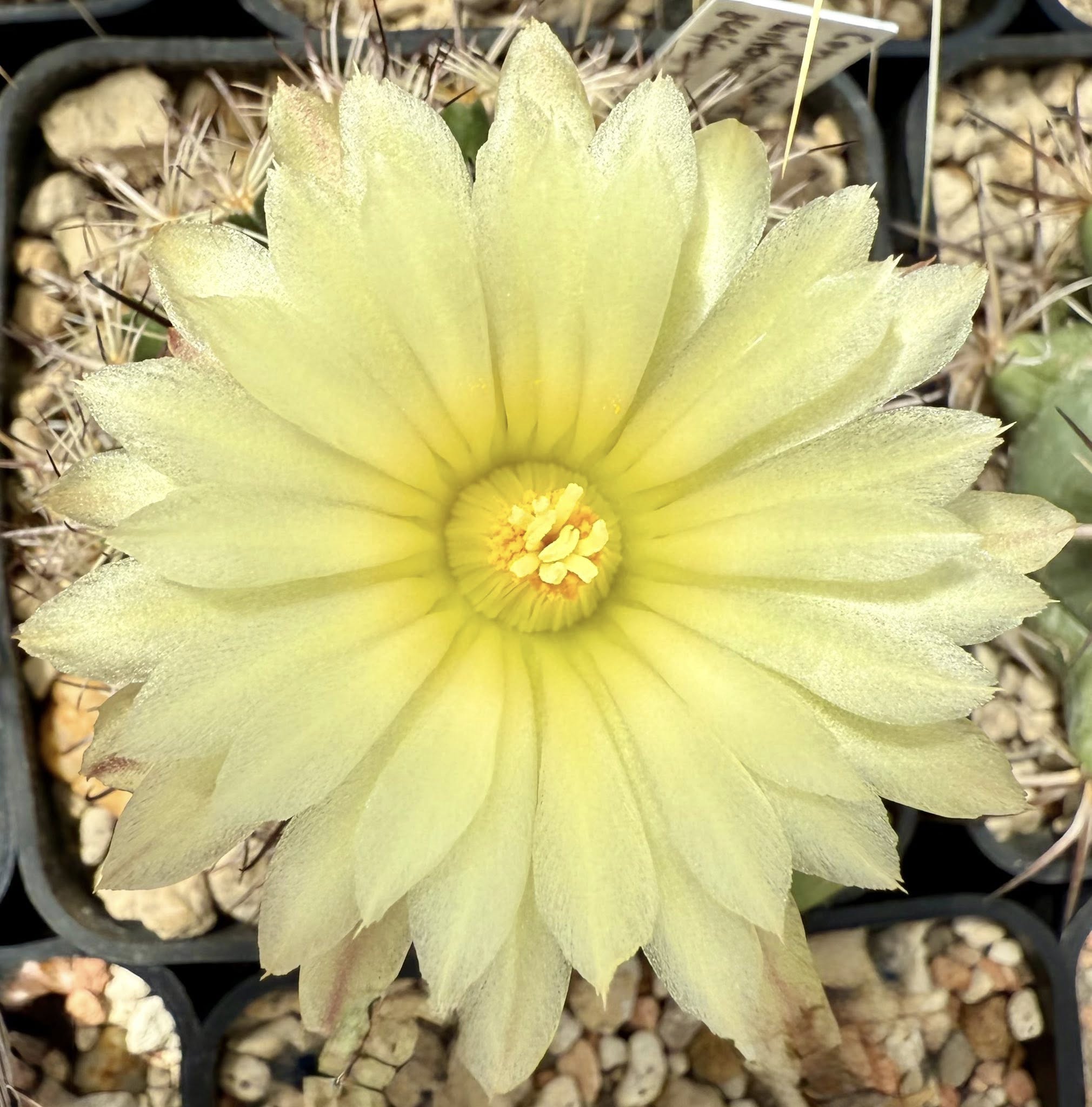
Flowers open at the apex on young areoles, whitish through pale gold, never red in the throat, up to 4.5 cm long and 4 cm across. Outer perianth segments carry a darker brownish midstripe; filaments are greenish-white, anthers yellow, stigma green-white with about ten yellow lobes. Plants flower precociously from a small size. Fruits are acidulous, juicy, and green, up to 27 mm long, with the dried perianth retained; seeds are reniform and red-brown with the finely reticulate testa typical of the genus.
Locality detail
The type locality is San Gerardo, Galeana, in the southern part of Nuevo León, at approximately 1,850 m on the alluvial flats west of the Cerro Potosí massif. The Hinton family hacienda lies inside the species’ range, which is how the collection material reached Dicht and Lüthy. Collector codes GBH, GH, and JFH from successive Hinton generations are the standard provenance markers for this species in European and North American specialist collections; the Mesa Garden code KKR813 from Köhres enters the trade as subsp. geoffreyi.
The map above marks regional centroids near the type locality and the Cerro Potosí massif rather than precise GPS points. Population-level coordinates for CITES-listed cacti with limited subpopulations are deliberately not published on this site; the type-locality data from the protologue (San Gerardo, Galeana, 1850 m) is the authoritative public record. The broader POWO range encompasses Coahuila and San Luis Potosí in addition to Nuevo León, but field records and conservation assessments consistently identify the Galeana watershed as the population centre for the nominate subspecies.
Coryphantha hintoniorum care and cultivation
Coryphantha hintoniorum is a patient grower that rewards attention to substrate chemistry above most other cultivation variables. The two failure modes are crown rot from water in the apex during cool weather, and acidic substrate pH that suppresses root activity and produces progressively weaker spine clusters. Both are avoidable.
Substrate
The recommended mix is: 35% pumice, 15% lava, 10% zeolite, 15% granite grit, 15% crushed limestone chips (3–6 mm horticultural limestone or oyster shell), and 10% worm castings. The 90/10 inorganic-to-organic ratio holds; the limestone fraction follows house convention rather than a documented species requirement. Target substrate pH is 7.5–8.5 by house convention; no cultivation source establishes this species as calcicole or calcifuge. A limestone topdress on the surface helps maintain apex-level pH. Widely circulated generic Mammillaria-type acidic mixes do not suit this species.
Substrate chemistry varies across the genus. C. elephantidens is volcanic with no limestone; the Chihuahuan desert species require alkaline limestone fractions.
| Species | Pumice | Lava | Zeolite | Granite | Limestone | Silica | Organic |
|---|---|---|---|---|---|---|---|
| C. werdermannii | 35% | 10% | 20% | 0% | 25% | 0% | 10% |
| C. elephantidens | 30% | 30% | 10% | 20% | 0% | 0% | 10% |
| C. hintoniorum (this page) | 35% | 15% | 10% | 15% | 15% | 0% | 10% |
| C. ramillosa | 30% | 20% | 10% | 15% | 15% | 0% | 10% |
| C. tripugionacantha | 35% | 20% | 10% | 20% | 5% | 0% | 10% |
Watering and light
Watering is moderate during the May-to-September warm season, with full soak-and-dry cycles every two to three weeks once temperatures sit above 20°C. Morning waterings that allow the crown to dry by nightfall are safer than evening soaks; the body is rot-prone if water sits in the apex through cool nights. From October the rhythm tapers; through December, January, and February the plant should be kept dry and bright. Bloom opens in late spring on freshly watered plants, with a possible second flush after summer rain.
Light requirements are bright, with full sun in habitat. Strong morning and afternoon exposure is preferred in cultivation, with light shading through the hottest hours of mid-summer to prevent apex scorch. Cold tolerance is conditional: dry plants take short drops to about −5°C without damage, matching the winter floor at 1,850–2,300 m on the Galeana plateau. Wet cold below freezing kills quickly. Growth is slow; 8–12 years from a 1 cm seedling to a central-spined adult in full character.
Comparison
Four other small northern Mexican Coryphanthas cause the most trade confusion with C. hintoniorum. The diagnostic feature to check first is the central spine. Adult C. hintoniorum almost always carries one hooked grey central per areole with a swollen base. Plants that lack a central or carry only straight centrals are almost certainly not hintoniorum.
Coryphantha potosiana (Jacobi) Glass & R. A. Foster overlaps in body size and pale-flower colour and shares part of the San Luis Potosí range. The central spine is the tell: most C. potosiana lack one entirely, and when one appears it is straight and yellowish rather than grey and hooked. Coryphantha delicata L. Bremer is roughly a quarter the size of an adult C. hintoniorum, topping out around 5–6 cm, with 17–22 tighter white radials and no heavy hooked central. Coryphantha echinoidea (Quehl) Britton & Rose is globose to egg-shaped, about 6 cm across, with 20–24 radials and 1–3 porrect but straight central spines; it also remains solitary rather than clumping.
The historical comparison is Coryphantha roederiana Bödeker. A 2001 Cactus Adventures note proposed that C. hintoniorum might be conspecific with C. roederiana, but the 2005 monograph by Dicht and Lüthy rejected the synonymy on body proportions, spine number, root structure, and geography; POWO continues to recognise both as accepted species. C. roederiana is the relevant comparator for any labelled “hintoniorum” plant that lacks hooked centrals at adult size.
Within the five Coryphantha on this site, neither Coryphantha tripugionacantha nor C. elephantidens presents real identification overlap with C. hintoniorum. C. tripugionacantha has an unmistakable three-dagger central cluster from Zacatecas; C. elephantidens is a large-tubercled volcanic-slope plant with rose-pink to magenta flowers up to 11 cm across, an order of magnitude more spectacular than the pale gold bloom of C. hintoniorum.
Frequently asked questions
Is Coryphantha hintoniorum hard to grow?
Intermediate. The species asks for two things above all else: a fast-draining mineral substrate and a bone-dry rest from December through February. The house mix targets pH 7.5–8.5, though the species has not been shown to need lime. Hard tap water already supplies calcium and bicarbonate; rainwater and RO water supply neither. The dry winter rest is non-negotiable; crown rot from moisture in cool conditions is the most common cause of loss. Beyond those two requirements, C. hintoniorum is patient and forgiving of minor cultivation variation.
Can Coryphantha hintoniorum be grown from seed?
Yes. Fresh seed germinates well at 22–26°C on a sterile pumice-surface mix kept humid for the first three to four weeks. Expect 8–12 years from a 1 cm seedling to a central-spined adult in full character; the hooked centrals that make the plant recognisable take several years to appear. Grafted plants on Pereskiopsis grow faster but lose the compact proportions and tight spine cluster that define the species at collector scale. Seed grown plants are the target for any serious collection.
Is Coryphantha hintoniorum legal to own?
Coryphantha hintoniorum is listed on CITES Appendix II through the blanket Cactaceae family listing. International commercial movement of wild plants requires an export permit from the country of origin; nursery-propagated material with documented provenance is handled under simplified CITES provisions and is the legally defensible source for collector specimens. Mexico’s NOM-059-SEMARNAT-2010 covers many narrow-endemic Coryphanthas of the Chihuahuan Desert; growers should verify current NOM-059 status before making commercial claims about this species’ national protection category. Unlike Coryphantha werdermannii, which sits on CITES Appendix I, C. hintoniorum is not subject to the near-total commercial trade ban of an Appendix I listing.
Where does Coryphantha hintoniorum grow in the wild?
The species is a narrow endemic of the southern Sierra Madre Oriental in northeastern Mexico. The core range is in Nuevo León, centred on the Galeana valley and Cerro Potosí massif, with additional populations in Coahuila and San Luis Potosí. The nominate subspecies grows on calcareous alluvial flats and limestone foothills between 1,700 and about 2,100 m; subsp. geoffreyi climbs to 2,300–2,400 m on rocky mountain slopes. Conservation literature records approximately 21 fragmented subpopulations across roughly 7,000 km², with several already lost to agricultural conversion.
When does Coryphantha hintoniorum flower?
Bloom typically opens in late spring at cultivation latitudes in Europe and North America, on freshly watered plants after the first proper spring soak. Flowers are whitish to pale gold, up to 4.5 cm long and 4 cm across, with a darker brownish midstripe on the outer perianth segments and green-white stigma lobes. They are smaller than the showpiece blooms of Coryphantha elephantidens but substantial relative to the body size. A second flush is possible after summer rain. Plants flower precociously from a small size, though 8–12 years are needed for the full adult body and spine cluster.
Sources & further reading
Dicht, R. F. & Lüthy, A. D. (1999). Coryphantha hintoniorum sp. nov. Kakteen und andere Sukkulenten 50(1): 13–17 · Dicht, R. F. & Lüthy, A. D. (2003). Coryphantha hintoniorum subsp. geoffreyi subsp. nov. Kakteen und andere Sukkulenten 54(2): 44 · Dicht, R. F. & Lüthy, A. D. (2005). Coryphantha: Cacti of Mexico and Southern USA. Springer-Verlag, Berlin/Heidelberg · Kew POWO. Coryphantha hintoniorum Dicht & A.Lüthy. Plants of the World Online. powo.science.kew.org/taxon/urn:lsid:ipni.org:names:317307-2 · IPNI. Coryphantha hintoniorum Dicht & A.Lüthy. urn:lsid:ipni.org:names:317307-2. ipni.org/n/317307-2 · Villarreal-Quintanilla, J. A. et al. Checklist of Hinton’s collections of the flora of south-central Nuevo León and adjacent Coahuila. ResearchGate / institutional copy · Llifle, Encyclopedia of Living Forms. Coryphantha hintoniorum. llifle.net · Llifle. Coryphantha hintoniorum subsp. geoffreyi. llifle.com · Sánchez, D., Vázquez-Benítez, B., Vázquez-Sánchez, M., Aquino, D. & Arias, S. (2022). Phylogenetic relationships in Coryphantha and implications on Pelecyphora and Escobaria (Cacteae, Cactoideae, Cactaceae). PhytoKeys 188: 115–165. doi:10.3897/phytokeys.188.75739 · SEMARNAT. NORMA Oficial Mexicana NOM-059-SEMARNAT-2010. Diario Oficial de la Federación · U.S. Fish and Wildlife Service. Coryphantha hintoniorum ssp. hintoniorum species profile (CITES administration). fws.gov · CITES Appendix II Cactaceae blanket listing. cites.org · Anderson, E. F. (2001). The Cactus Family. Timber Press. ISBN 0-88192-498-9