
Coryphantha elephantidens
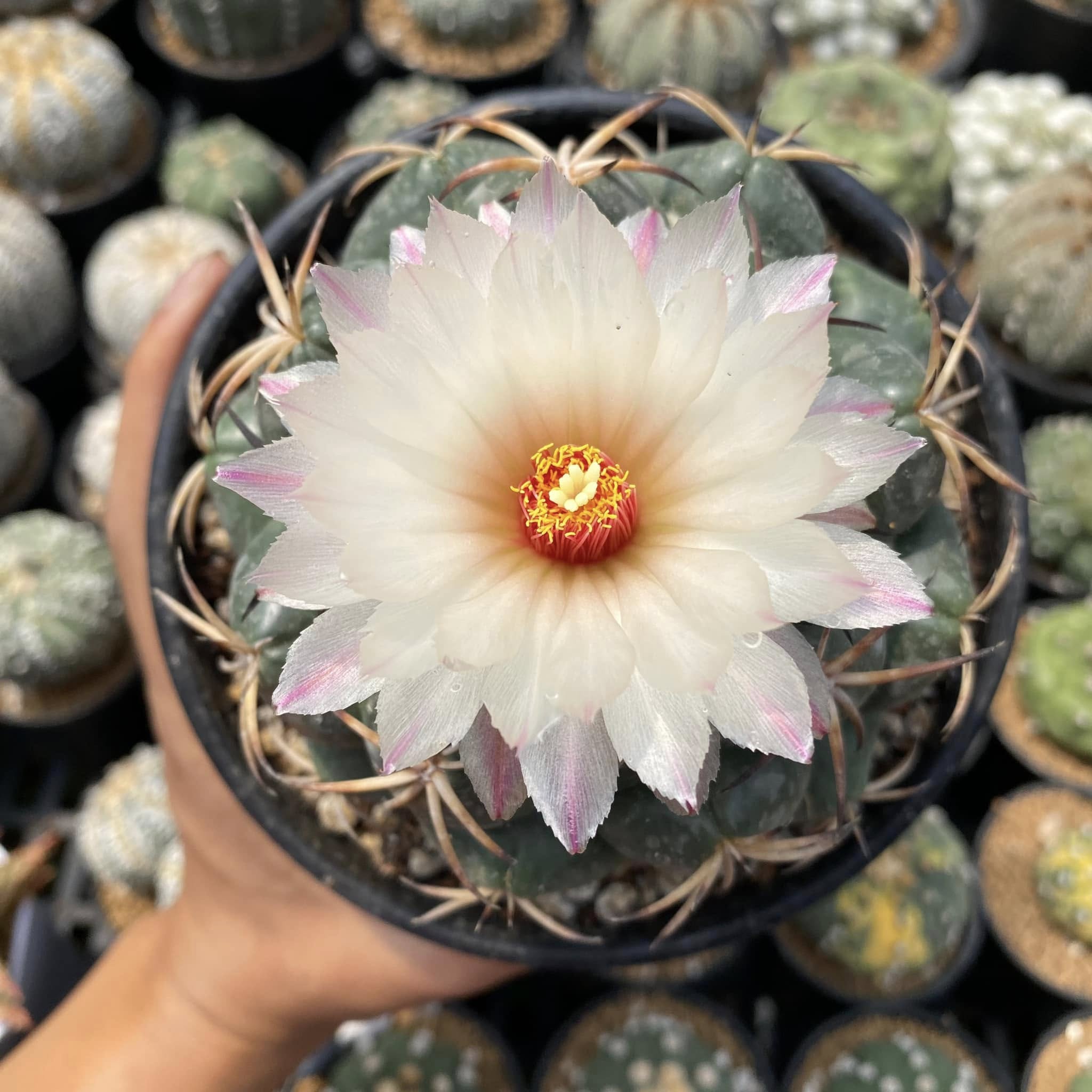
Coryphantha elephantidens (Lem.) Lem. is the largest species in the genus and the showpiece of the family when it flowers. Charles Lemaire described it in 1838 from cultivated material in the Monville collection in Paris, naming it Mammillaria elephantidens after the massive blunt tubercles that suggest an elephant’s tusk at scale. He moved it into Coryphantha thirty years later, in 1868, on page 35 of Les Cactées, making both author abbreviations Lemaire and producing the "(Lem.) Lem." authority string the name carries today.
The body reaches 25 cm wide by 15 cm tall, flat-topped and depressed-globose, and stays solitary through most of its life. Tubercles are the largest in Coryphantha, up to 30 mm wide at the base on the nominate subspecies and up to 60 mm on subsp. bumamma. The flower is the diagnostic feature that fixes this species in any collection: 6 to 11 cm wide, rose-pink to deep magenta, and the only magenta flower in a genus where every other species opens yellow. Late summer and autumn blooms, large enough to stop movement at a show bench.
The species grows on the Trans-Mexican Volcanic Belt, not on the Chihuahuan limestone that hosts Coryphantha werdermannii, Coryphantha hintoniorum, and Coryphantha ramillosa. The substrate difference is load-bearing for cultivation: volcanic andesite and basalt soils are neutral to mildly acidic (pH 6.0 to 7.0), not the alkaline limestone gravel the desert species require. A substrate built for the Chihuahuan species will suppress this plant. The habitat distinction also drives cold tolerance: Michoacán and Morelos winters are mild, and the species handles only brief exposures below -3°C, far less cold-hardy than C. werdermannii or C. ramillosa, which take -10°C without damage.
Plant of the World Online (POWO) and Kew’s Catalogue of Life accept two infraspecific taxa in addition to the nominate: subsp. bumamma (Ehrenb.) Dicht & Lüthy, from Guerrero and Oaxaca, and subsp. greenwoodii (Bravo) Dicht & Lüthy, restricted to the Piedras Blancas area of central Veracruz. Both names still circulate in the trade as full species under their pre-2005 binomials. They are not synonyms; they are accepted subspecies within the C. elephantidens complex, and they are addressed fully in the Taxonomy section.
Coryphantha elephantidens quick reference
A volcanic-belt species from Michoacán, Morelos, and Guerrero, growing on andesitic and basaltic soils between 1,100 and 2,000 m. Values calibrated for seed grown plants in cultivation, drawn from species-specific habitat data and grower consensus for C. elephantidens rather than genus-level extrapolation.
Taxonomy & nomenclature
The accepted name is Coryphantha elephantidens (Lem.) Lem., with the basionym Mammillaria elephantidens Lem. published in 1838 in Cactearum aliquot novarum ac insuetarum in Horto monvilliano cultarum accurata descriptio, working from cultivated material in the Monville collection in Paris. Lemaire moved the plant into Coryphantha in 1868 on page 35 of Les Cactées. Both POWO and IPNI record the same protologue and combination, with no competing typification. The type material never had a wild locality attached: the 1838 protologue is a horticultural description, not a field collection, which is why the sidebar records the type as a cultivated Monville collection specimen.
POWO lists fourteen heterotypic and homotypic synonyms inside Coryphantha elephantidens subsp. elephantidens. The most frequently encountered in older literature and nursery catalogues are Cactus recurvispinus (de Vriese) Kuntze, Coryphantha garessii L.Bremer, Coryphantha recurvispina (de Vriese) L.Bremer, Coryphantha sulcolanata (Lem.) Lem., Mammillaria cornimamma N.E.Br., and Mammillaria retusa Scheidw. (not to be confused with the modern Coryphantha retusa (Pfeiff.) Britton & Rose, a separate species). POWO also treats Coryphantha elephantidens var. barciae L.Bremer as a synonym at species level.
Two names still treated as full species in commercial trade sit at subspecies rank in the current Kew classification. Coryphantha elephantidens subsp. bumamma (Ehrenb.) Dicht & Lüthy and subsp. greenwoodii (Bravo) Dicht & Lüthy were formally subordinated in the 2005 Dicht and Lüthy monograph Coryphantha: Cacti of Mexico and Southern USA, and POWO follows that treatment. Subsp. bumamma concentrates in Guerrero and Oaxaca with fatter, more pronounced tubercles up to 60 mm wide and shorter, chunkier spination. Subsp. greenwoodii is the smallest of the three and is restricted to the Piedras Blancas area of central Veracruz with longer spines and a much narrower range. The trade sells all three under their pre-2005 binomials; plants labelled Coryphantha bumamma or Coryphantha greenwoodii in Western collections are formally C. elephantidens subspecies by the current accepted taxonomy.
A third name often quoted alongside this complex in horticultural sources, Coryphantha andreae Purpus & Boed., does not belong to C. elephantidens. POWO places C. andreae as a synonym of Coryphantha pycnacantha (Mart.) Lem., a separate species with smaller yellow flowers and a partly overlapping range. The mislabelling of C. andreae material as C. elephantidens subsp. bumamma is the commonest nursery-trade identification error in the genus.
Phylogenetically, Coryphantha sits inside tribe Cacteae in the Mammilloid clade alongside Mammillaria, Cochemiea, Cumarinia, and Pelecyphora. A 2022 chloroplast-region phylogeny in PhytoKeys sampled 44 Coryphantha species across five chloroplast regions and recovered the genus as monophyletic once C. macromeris was excluded. Coryphantha elephantidens falls inside the core clade.
Historical synonyms (2)
- Coryphantha greenwoodiae Bravo, heterotypic synonym
- Mammillaria recurvispina DeVriese, heterotypic synonym
Sources: POWO (Kew) · IPNI · GBIF · Wikidata
Habitat
Coryphantha elephantidens is endemic to Mexico. POWO records native occurrence across Mexico Central, Mexico Gulf, and Mexico Southwest. At state level the species is documented from Aguascalientes, Guanajuato, Guerrero, Hidalgo, Jalisco, México, Michoacán, Morelos, Oaxaca, Puebla, Querétaro, Veracruz, and Zacatecas. The footprint runs across the Trans-Mexican Volcanic Belt and into the Sierra Madre del Sur.
The ecology is the part that matters for cultivation. The species occupies tropical dry forest (bosque tropical caducifolio) and xerophytic scrub on volcanic-belt soils between 1,100 and 2,000 metres, a band of seasonally dry slopes south of the Chihuahuan Desert proper. The substrate is derived from andesitic and basaltic volcanic flows, not the Cretaceous limestone that dominates the range of Coryphantha tripugionacantha and the other northern desert species. Target pH is 6.0 to 7.0, neutral to slightly acidic.
The contrast with the Chihuahuan Coryphantha species is sharp. The desert species sit on alkaline limestone gravel at 800 to 1,500 metres in winter-cold rain-shadow scrub with pH above 7.0. C. elephantidens sits on mildly acidic volcanic soils at 1,100 to 2,000 metres in monsoonal dry forest with a pronounced summer rainy season and milder winters. The Trans-Mexican Volcanic Belt records a distinct summer monsoon (June to September) and a long dry winter, matching the watering calendar the species responds to in cultivation. Subspecies bumamma concentrates in the southern end of this range in Guerrero and Oaxaca; subsp. greenwoodii is restricted to central Veracruz around Piedras Blancas.
Morphology
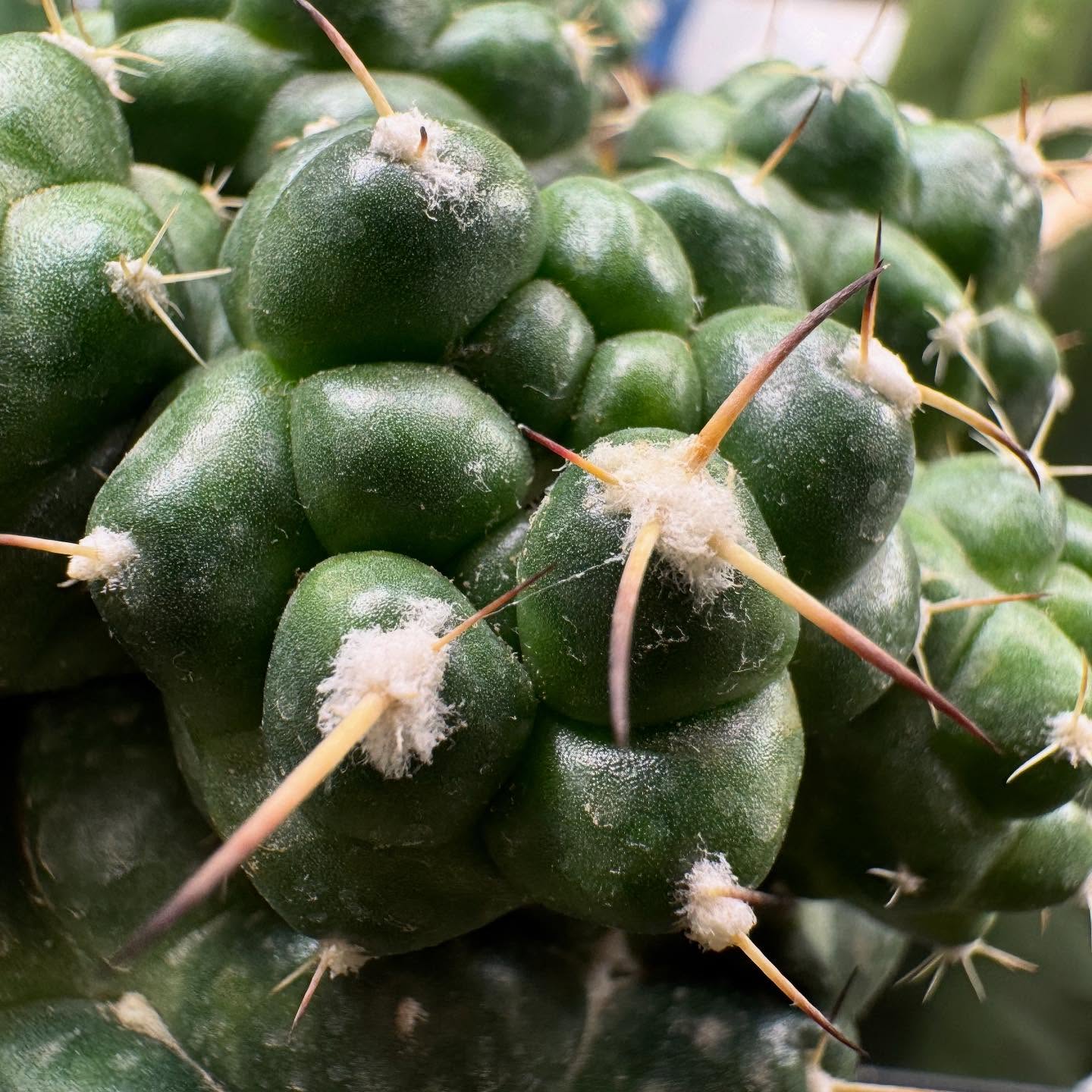
The plant body is depressed-globose to subglobose, flat-topped, up to 25 cm wide and 15 cm tall in robust cultivation specimens, with most wild plants running 14 to 19 cm wide and around 14 cm tall. Stem epidermis is glossy dark green during active growth and darker grey-green in the dry season. Most individuals stay solitary through their lives; a small fraction offset slowly with age, producing a low cluster of two to four heads, but the textbook adult is a single dome.
The tubercles are the diagnostic character. They are the largest of any Coryphantha: 20 to 30 mm wide at the base on the nominate subspecies, somewhat flattened on top, blunt at the apex, and arranged in 8 to 13 spiral ranks. Each tubercle carries a deep adaxial groove running from apex to axil that holds the extra-floral nectaries typical of the genus. Radial spines are stout and reflexed, 18 to 26 mm long, in groups of 2 to 5 per areole; the central spine is often absent on mature plants. Spine colour runs from pale horn through grey to black-tipped.
The flower is the showpiece. It is the largest in Coryphantha and the only one in the genus that opens magenta. Diameter runs 6 to 11 cm; perianth segments are narrow, oblong, and apiculate; colour ranges from soft rose-pink through deep magenta to white with a red throat (a yellow-flowered form is reported but very rare). Flowering runs from late summer into autumn, with individual flowers staying open for two days.
Pollination biology in this species is the most precisely documented in the genus: protandric, herkogamous, gynodioecious, nectarless. Pollination operates by deceit: native solitary bees, Augochlorine halictids, Ashmeadiella opuntiae, and the introduced Apis mellifera are the main visitors, and A. opuntiae is the most effective cross-pollinator across approximately 15 native bee species documented visiting the flowers. The fruit is a club-shaped pale green to yellowish berry ripening in spring, holding kidney-shaped pitted dark brown seeds.
Locality detail
Coryphantha elephantidens has no wild type locality. Lemaire’s 1838 protologue described the plant from horticultural material in the Monville collection in Paris and did not designate a field site; no formal lectotypification has been published in the literature consulted for this page. The Mexican range is wide: thirteen states from Aguascalientes and Zacatecas in the north to Oaxaca and Guerrero in the south, with the core of the nominate subspecies centred on the volcanic-belt states of Michoacán, Morelos, Hidalgo, and Querétaro.
The map marks state-level centroids for the three most botanically documented volcanic-belt states rather than population coordinates. Morelos populations are the best-studied, having been the subject of the 2021 Martínez-Peralta pollination study. Subsp. bumamma concentrates in Guerrero and Oaxaca; subsp. greenwoodii is restricted to Piedras Blancas, central Veracruz, and is not shown with a separate marker here because the locality is narrow enough that a centroid would obscure rather than represent the range.
Coryphantha elephantidens care and cultivation
Substrate chemistry is where most growers go wrong with this species. C. elephantidens comes off volcanic soils, not limestone. The standard Chihuahuan desert substrate built for C. werdermannii or C. hintoniorum is wrong here: alkaline pH and a limestone fraction will suppress this plant. Build the inorganic 90% from pumice, lava rock, granite grit, zeolite, and silica with no crushed limestone. Target pH 6.0 to 7.0.
Substrate
Working recipe: 30% pumice, 30% lava rock, 20% granite grit, 10% zeolite, and 10% worm castings. No silica, no crushed limestone. Sieve to 2 to 6 mm. Pot depth matters: the species has a slowly growing taproot, and a 15 cm body needs a pot at least 15 cm deep. Drainage holes must be large enough to dump water in seconds.
Substrate ratios vary significantly across the genus. C. elephantidens is the only volcanic-belt species here and is the only one with no limestone fraction.
| Species | Pumice | Lava | Zeolite | Granite | Limestone | Silica | Organic |
|---|---|---|---|---|---|---|---|
| C. werdermannii | 35% | 10% | 20% | 0% | 25% | 0% | 10% |
| C. elephantidens (this page) | 30% | 30% | 10% | 20% | 0% | 0% | 10% |
| C. hintoniorum | 35% | 15% | 10% | 15% | 15% | 0% | 10% |
| C. ramillosa | 30% | 20% | 10% | 15% | 15% | 0% | 10% |
| C. tripugionacantha | 35% | 20% | 10% | 20% | 5% | 0% | 10% |
Watering and light
Water tracks the wild summer monsoon. The Trans-Mexican Volcanic Belt has a distinct June to September rainy season and a long dry winter. Water deeply once a week from late spring through early autumn, letting the substrate dry fully between soakings. Taper in October, give one rescue watering in midwinter if the body shrinks visibly, and resume in April. Bottom-watering keeps the dense apical wool clean.
Light is high but tempered. The species grows in open tropical dry forest and on exposed volcanic slopes, so summer sun is intense in habitat, but wet-season cloud cover softens it. Under glass, plants tan to darker green and flower more reliably than those in deep shade. A body turning yellow is signalling sunburn and needs more shade quickly.
Cold tolerance
Habitat winters in Morelos and Michoacán bottom out around 0 to +5°C in the lowlands and dip below freezing only briefly at higher elevations. The species is hardy to -3°C for short, dry exposures; sustained sub-zero nights cause spotting and corky scarring on the apex. Protect plants below -3°C with a cold frame, frost cloth, or move under glass once temperatures forecast below +2°C. This is a meaningful contrast with the desert Coryphanthas: C. werdermannii and C. ramillosa take -10°C in the wild without damage.
Flowering and propagation
Flowering is triggered by photoperiod and the post-summer drying signal. Plants with a hot, bright summer, regular deep watering, and a sharp autumn taper set buds in late August to October. Bud abortion is almost always a watering issue: either a midsummer drought stretched too long, or autumn watering that ran too late. Plants under five years rarely flower; main flowering size is around 8 cm body diameter, reached in years six to eight from seed.
Propagation is from seed. Sow on a sieved 50/50 pumice and worm castings mix, mist, cover, and germinate at 24 to 28°C. Germination is fast, 10 to 14 days, but seedlings are slow: 3 cm bodies at end of year three is typical. Offsets, where they form, can be detached and rooted dry on the adult mix. Grafting shortcuts time-to-flower to two or three years but produces the bloated, soft body and weak spination that collectors of seed grown plants find unacceptable; the species roots well from seed and needs no graft support.
Comparison
Four taxa cause most of the identification problems around C. elephantidens.
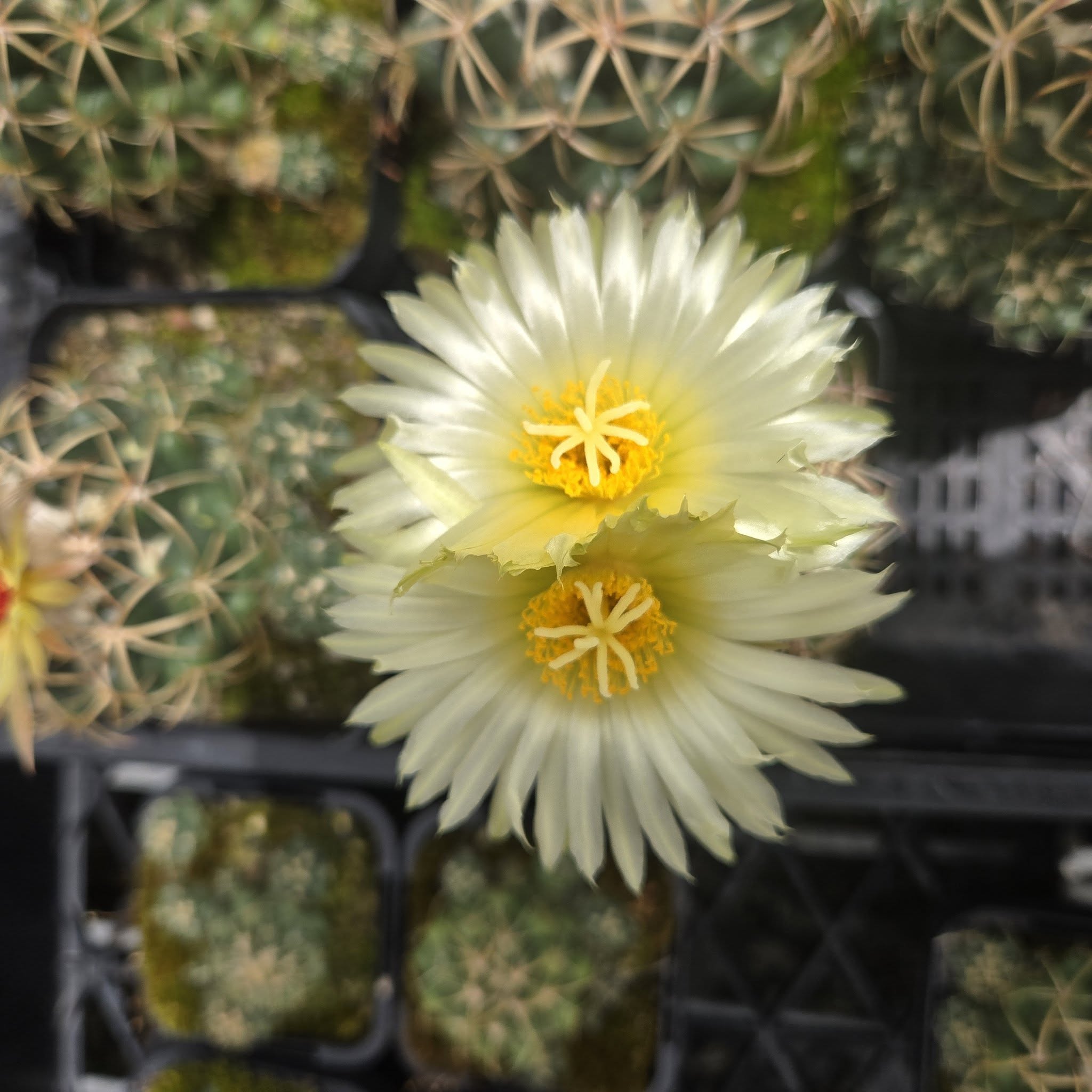
Coryphantha retusa (Pfeiff.) Britton & Rose. Similar flat-topped silhouette and short retuse tubercles, but smaller (8 to 12 cm wide) with bright yellow flowers 4 to 6 cm wide. Range overlaps in Oaxaca. The retuse-tipped tubercles have a notched apex rather than the rounded blunt tip of elephantidens. Flower colour is the instant tell.
Coryphantha cornifera (DC.) Lem. Conical sharper-pointed tubercles, usually with a single down-curved central spine on adults, and yellow to pale yellow flowers 4 to 6 cm wide. Body up to 12 cm, taller than wide, in contrast to elephantidens which is wider than tall. Range partly overlaps in Hidalgo and Querétaro.
Coryphantha pycnacantha (Mart.) Lem. This is the genuine source of the Coryphantha andreae nursery-trade name. C. andreae is a synonym of pycnacantha, not of elephantidens, but the two are sold interchangeably in commerce wherever subsp. bumamma and pycnacantha overlap in Guerrero. C. pycnacantha has densely packed shorter spines, a more pyramidal silhouette, and pale yellow flowers 4 to 5 cm wide. The clean tell is flower colour: any large magenta flower is elephantidens; any smaller yellow flower in the same shape complex is almost always pycnacantha.
Subsp. bumamma and subsp. greenwoodii. These are the absorbed taxa, not separate species. Subsp. bumamma has fatter, more pronounced tubercles (up to 60 mm wide), shorter and chunkier spination, and a more southerly range in Guerrero and Oaxaca. Subsp. greenwoodii is the smallest of the three, with longer spines and a range restricted to Piedras Blancas, Veracruz. Western nursery collections still sell all three under their pre-2005 binomials, and many labelled “C. bumamma” plants are intermediate hybrids that no longer fit any subspecies cleanly.
Frequently asked questions
Is Coryphantha elephantidens hard to grow?
Intermediate. The species asks for three things: a volcanic substrate at neutral to mildly acidic pH (not alkaline limestone gravel), a genuine summer monsoon watering schedule, and protection from temperatures below −3°C. The last point surprises growers familiar with other Coryphanthas: the desert species take −10°C without damage, but this volcanic-belt species is much less cold-tolerant. Get those three variables right and the plant is undemanding.
Can Coryphantha elephantidens be grown from seed?
Yes, and seed grown plants are the collectors’ target. Sow on a sieved pumice and worm-castings mix at 24 to 28°C; germination is fast, usually 10 to 14 days. Seedlings are slow: expect 3 cm bodies at end of year three. Main flowering size, around 8 cm diameter, arrives in years six to eight from seed. Grafting onto Hylocereus or Pereskiopsis shortens time-to-flower to two or three years but produces the bloated, soft body and weak spination that collectors of seed grown plants find unacceptable.
Is Coryphantha elephantidens legal to own?
Yes, with standard CITES documentation. The entire family Cactaceae sits on CITES Appendix II, so international commercial trade requires export permits from Mexico and import permits where the receiving country demands them. This species has no Appendix I listing and no species-specific export prohibition. Mexico’s NOM-059-SEMARNAT-2010 does not list it at species level. Domestic trade in nursery-propagated material within a single country does not require CITES paperwork. Documented seed grown nursery stock is the legally and ethically defensible source.
Where does Coryphantha elephantidens grow in the wild?
Across the Trans-Mexican Volcanic Belt and into the Sierra Madre del Sur, in tropical dry forest and xerophytic scrub on andesitic and basaltic volcanic soils between 1,100 and 2,000 metres. Thirteen Mexican states carry populations: Aguascalientes, Guanajuato, Guerrero, Hidalgo, Jalisco, México, Michoacán, Morelos, Oaxaca, Puebla, Querétaro, Veracruz, and Zacatecas. The habitat is seasonally dry with a pronounced June to September monsoon, and the soils are neutral to mildly acidic, distinctly different from the alkaline limestone gravel of the Chihuahuan desert Coryphanthas.
When does Coryphantha elephantidens flower?
Late summer to autumn, August to October in cultivation at temperate latitudes, triggered by the post-monsoon drying signal. The flower is the largest in Coryphantha and the only magenta one in the genus: 6 to 11 cm wide, rose-pink to deep magenta, with narrow apiculate perianth segments and a sweet scent. Individual flowers stay open for two days. Bud abortion is almost always a watering timing problem. Plants under five years rarely flower; the main flowering size is 8 cm body diameter, reached in years six to eight from seed.
Sources & further reading
Lemaire, C. (1838). Cactearum aliquot novarum ac insuetarum in Horto monvilliano cultarum accurata descriptio. Paris. (Protologue of Mammillaria elephantidens) · Lemaire, C. (1868). Les Cactées: Histoire, Patrie, Organes de Végétation, Inflorescence, Culture, etc. Paris, p. 35. (Combination Coryphantha elephantidens) · Kew POWO, Coryphantha elephantidens (Lem.) Lem., IPNI lsid urn:lsid:ipni.org:names:131246-1. powo.science.kew.org · Kew POWO, Coryphantha elephantidens subsp. elephantidens, lsid urn:lsid:ipni.org:names:77229581-1 · IPNI, urn:lsid:ipni.org:names:131246-1 · Hernández, H.M., Gómez-Hinostrosa, C., Guadalupe Martínez, J., Sánchez, E., Dicht, R.F. & Lüthy, A.D. (2013, amended 2017). Coryphantha elephantidens. IUCN Red List 2017: e.T152554A121480690. iucnredlist.org · Sánchez, D., Vázquez-Benítez, B., Vázquez-Sánchez, M., Aquino, D. & Arias, S. (2022). Phylogenetic relationships in Coryphantha and implications on Pelecyphora and Escobaria (Cacteae, Cactoideae, Cactaceae). PhytoKeys 188: 115–165 · Martínez-Peralta, C., Gómez-Martínez, A., Vázquez-Santana, S. & Mandujano, M.C. (2021). Flower biology of the cactus Coryphantha elephantidens in the tropical dry forest of central Mexico. Plant Species Biology 36(1) · Dicht, R.F. & Lüthy, A.D. (2005). Coryphantha: Cacti of Mexico and Southern USA. Springer, Berlin. (Establishes subsp. bumamma and subsp. greenwoodii) · Vázquez-Sánchez, M., Terrazas, T., Arias, S. & Ochoterena, H. (2013). Molecular phylogeny, origin and taxonomic implications of the tribe Cacteae (Cactaceae). Systematics and Biodiversity 11(1): 103–116 · Anderson, E.F. (2001). The Cactus Family. Timber Press, Portland. ISBN 0-88192-498-9