
Coryphantha tripugionacantha
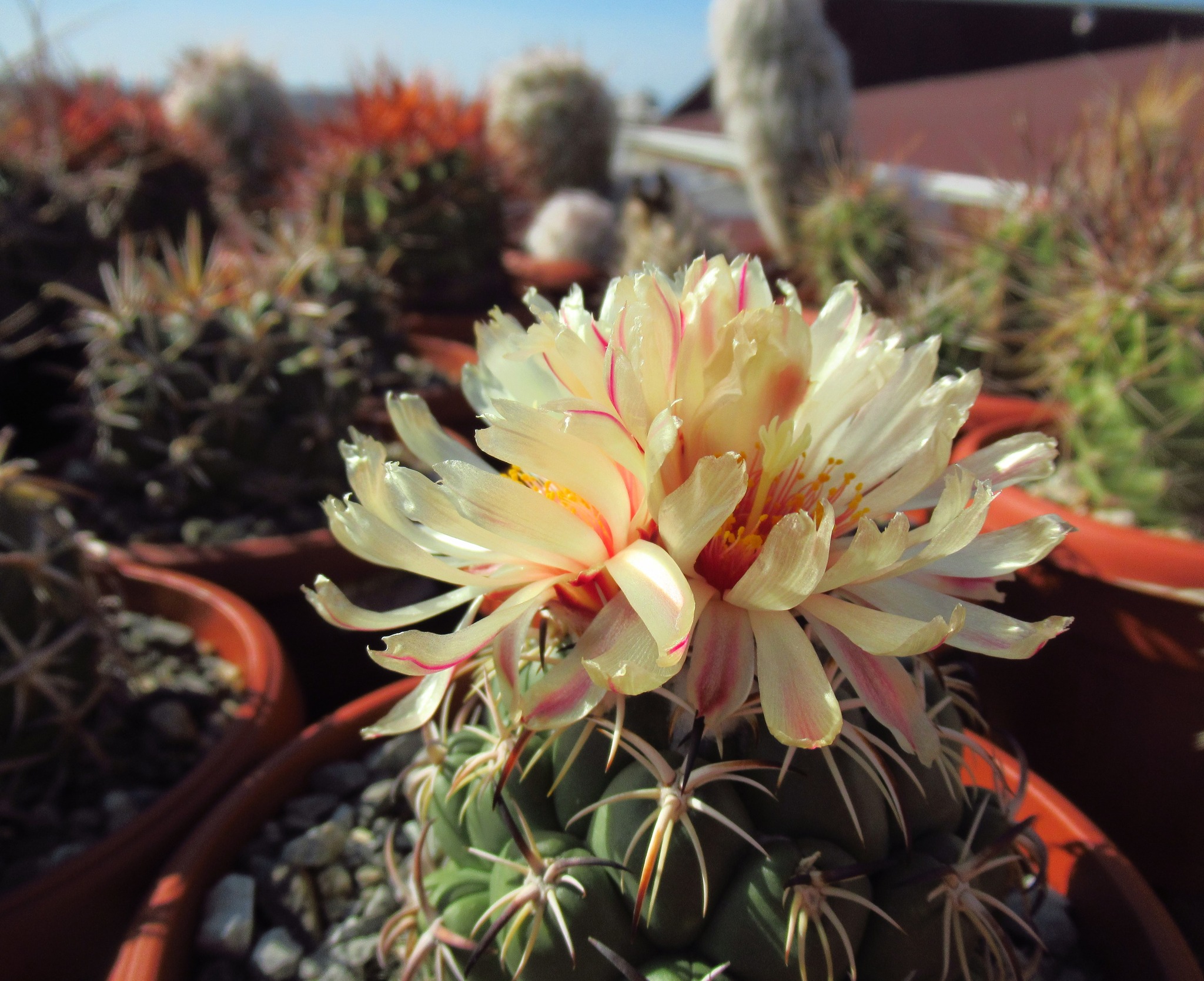
Coryphantha tripugionacantha A.B.Lau is the three-dagger pincushion of far western Zacatecas, described in 1988 by Alfred Bernhard Lau in volume 33 of Cactaceas y Suculentas Mexicanas. The epithet is built from Greek tri (three), Latin pugio (dagger), and Greek acantha (spine): three projecting dagger-like central spines per areole, black on fresh growth, stout-based and flattened in cross-section. That geometry is the entire reason for the name, and it remains the single most useful field mark on a mature plant.
The protologue rests on material Lau collected from the canyon country of Mezquital del Oro municipio in 1983, distributed under field number L 1517. The type locality, San Juan Capistrano at approximately 1000 m, is the most-cited site. A second cluster of records at Puente Tepetatita on the Jalisco side of the same drainage system extended the known range across the state line in the early 2000s. Kew POWO and GBIF both accept the Zacatecas and Jalisco occurrence; older popular literature lists Zacatecas only.
Within the genus, C. tripugionacantha sits in series Pycnacanthae alongside heavily spined relatives. The most visually similar species in cultivation are Coryphantha werdermannii, the CITES Appendix I endemic of Cuatrociénegas with chalk-white spines, and Coryphantha elephantidens, the volcanic-slope giant of Michoacán with elephant-tusk tubercles and large pink flowers. Both differ from tripugionacantha in spine architecture, body size, and habitat; the three-dagger centrals of tripugionacantha set it apart within the genus at a glance.
Among serious collectors, the species carries added cachet from its Lau provenance. Plants traceable to documented L 1517 lineage or to the Tepetatita records command a premium in the specialist seed trade simply because accurate locality data is scarce and the population is not large. Vague provenance claims should be treated with scepticism; any plant offered as C. tripugionacantha outside Zacatecas-Jalisco material should be viewed as suspect.
Coryphantha tripugionacantha quick reference
A canyon and mesa cactus of far western Zacatecas and adjacent Jalisco, growing on volcanic-derived soils between 1000 and 1100 m under a summer monsoon-driven climate. Values calibrated for seed grown plants in cultivation, drawn from habitat data and grower consensus for C. tripugionacantha.
Taxonomy & nomenclature
The accepted name is Coryphantha tripugionacantha A.B.Lau, published in Cactaceas y Suculentas Mexicanas 33(1): 21 (1988). The protologue describes plants collected by Lau from San Juan Capistrano in the Mezquital del Oro municipio of Zacatecas during 1983 fieldwork, distributed as L 1517. Kew POWO and IPNI both accept the species at full rank under Lau’s 1988 publication; IPNI identifier is 936092-1, GBIF backbone ID is 3954766. No synonyms are in current use.
Family placement is Cactaceae, subfamily Cactoideae, tribe Cacteae. Within Coryphantha, the species sits in series Pycnacanthae as treated by Dicht & Lüthy (2005), alongside heavily spined relatives including C. pycnacantha from Puebla and C. pulleineana from Tamaulipas and San Luis Potosí. The diagnostic adaxial groove running from the spine-bearing areole to the flower-bearing axil on mature tubercles separates the genus cleanly from Mammillaria, where the groove is absent or rudimentary. Molecular phylogenetic work by Vázquez-Sánchez et al. (2022) confirms the Coryphantha placement and the relationships within Cacteae.
No infraspecific taxa and no synonyms are listed by POWO, IPNI, or the CITES Checklist. Older classifications occasionally placed densely-spined Coryphanthas loosely within Lepidocoryphantha or treated them as Mammillaria-allied forms, but tripugionacantha was described after those rearrangements and has only ever appeared at species rank within Coryphantha. No vernacular name is formally established; “three-dagger coryphantha” is descriptive, and “tres puñales” circulates informally in the Spanish-language trade.
Habitat
Coryphantha tripugionacantha occupies a narrow band of arid canyon and mesa habitat in far western Zacatecas, with a small extension into adjacent eastern Jalisco where the Tepetatita drainage cuts the state line. The named localities are San Juan Capistrano in the Mezquital del Oro municipio of Zacatecas (the type site, ca. 1000 m) and Puente Tepetatita in Jalisco, the post-2000 discovery that extended the known range across the watershed. Beyond those two clusters of records, published locality data is sparse.
The terrain is broken volcanic mesa and canyon wall where the Sierra Madre Occidental drops east toward the Mezquital basin. Elevation across the known range runs from approximately 1000 to 1100 m. The primary substrate is volcanic-derived, low-organic soil; the thin rocky profiles typical of exposed canyon rims drain quickly and support the xeric shrub communities this species grows within. Climate is the northern Mexican summer monsoon pattern: summer rain arrives July through September and triggers the main growth flush; winter is cold and dry.
iNaturalist carries only a handful of public observations for the taxon, and field-number databases hold the Lau records without sharp GPS coordinates. The vagueness is partly deliberate. Populations are small and the species has visible appeal to poachers given the striking spine arrangement. The working assumption among growers is that the bulk of the wild population sits within roughly 30 km of San Juan Capistrano. Any record outside Zacatecas-Jalisco material should be treated with scepticism.
Morphology
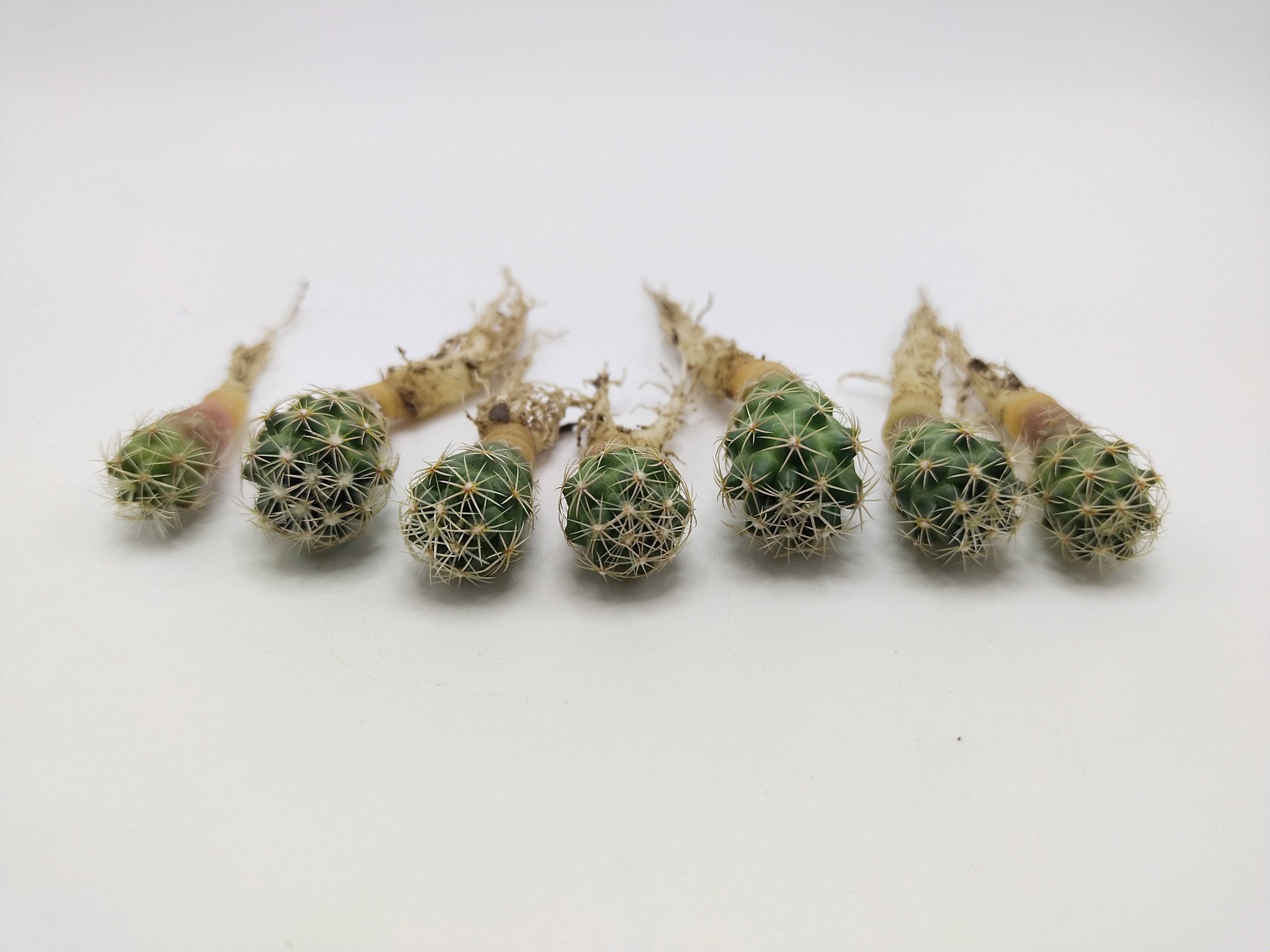
Bodies are solitary, depressed-globose to short-cylindric, dark grey-green, reaching approximately 9 cm in diameter and 7 to 9 cm tall at maturity. The plant stays single-headed through life; offsetting is rare and usually a sign of apex damage rather than natural clustering. Tubercles are conical, prominent, arranged in eight and thirteen spirals, with the diagnostic adaxial groove running from the spine-bearing areole at the tip to the flower-bearing axil at the base on mature flowering tubercles.
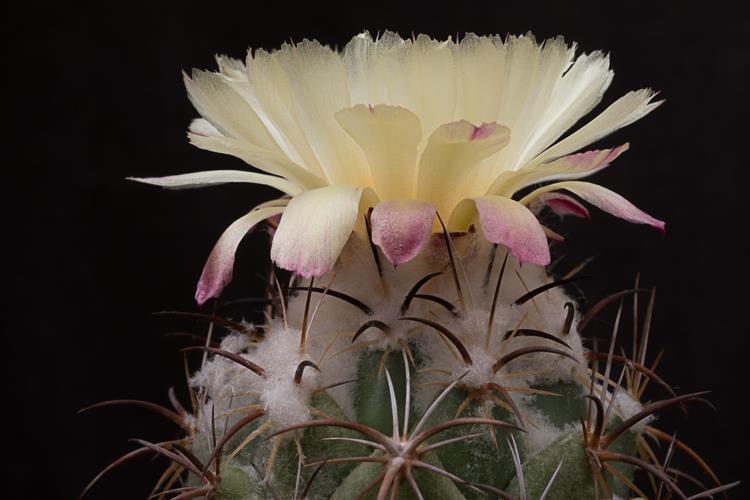
The spine cluster is the defining feature of the species and the basis for its name. Each areole carries roughly twelve to sixteen pale, slender radial spines arranged in a regular flat pectinate ring against the body, and three (occasionally four) heavy central spines projecting outward. The lower central is the longest, 25 to 40 mm, curving downward and slightly inward. The two upper centrals diverge to either side at a shallower angle and run 18 to 30 mm. All three centrals are stout-based, sharp, and dagger-flat in cross-section rather than round; they emerge jet black with chestnut tips and fade with age to dark tan, then grey on old areoles low on the body. The apical fresh spines hold close to black through the first growing season after they harden. Among Coryphanthas, this combination of three flattened dagger-centrals on a small, otherwise compact body is unique and constitutes the field mark.
Flowers open at the apex from August through mid-October, occasionally into the first week of November in cultivation. Single blooms, sometimes paired, 6 to 7 cm across, pale lemon yellow. Outer tepals carry a faint red midstripe that flushes pink by the second day of opening. Stamens are yellow; stigma lobes pale green to yellow-green. Fruit is small, fleshy, light green, drying as the seeds mature and releasing through the base. Seeds are pale brown and reticulate-pitted, consistent with the genus pattern.
Locality detail
The type locality is San Juan Capistrano in the Mezquital del Oro municipio of Zacatecas, at approximately 1000 m elevation. The protologue published by Lau in 1988 cites this location, and it remains the most-cited site in the subsequent literature. Herbarium and collector data are consistently vague at the sub-municipio level; sharp GPS coordinates do not appear in publicly accessible databases, and this is deliberate. The populations are small, the terrain is remote, and the striking spine arrangement makes the species visible from a distance to anyone who knows what to look for.
The Tepetatita locality in eastern Jalisco was established by post-2000 collections and extended the known range across the state line where the Tepetatita drainage cuts westward from the Zacatecas escarpment. POWO and GBIF both carry the Jalisco occurrence. The two site clusters are separated by roughly 20 to 30 km of rugged terrain; whether the populations are continuously distributed across that gap or truly disjunct has not been resolved in the published literature. The map above marks approximate centroids rather than precise GPS points.
Coryphantha tripugionacantha care and cultivation
Coryphantha tripugionacantha is an intermediate-level cultivation subject. It tolerates the mineral-dominant substrates appropriate to northern Mexican canyon cacti, flowers reliably when winter dormancy is respected, and shows no particular sensitivity to humidity beyond the standard Mexican Highland requirement for sharp drainage. The two failure modes that account for almost all losses are root rot from winter watering and failure to flower the following season after a warm wet winter. Both are avoided by respecting the cool dry November-to-March rest.
Substrate
The correct mix is 35% pumice, 20% lava, 10% zeolite, 20% granite grit, 5% crushed limestone, and 10% worm castings. The habitat substrate is volcanic-derived (Mezquital del Oro volcanic terrain), but the slight limestone-compatible pH range of 6.8 to 7.2 justifies a small limestone fraction rather than the strongly alkaline recipe used for dedicated Chihuahuan limestone-hill species. No silica addition is called for. Root rot is the species’ most reliable killer in cultivation; any mix that retains moisture more than three to four days after a soak is unsuitable.
The house mix varies across the genus. C. tripugionacantha sits between C. elephantidens, whose house mix carries no limestone, and the species carrying larger limestone shares. Every limestone share in this table is house convention, not a species requirement; hard tap water already supplies calcium and bicarbonate, while rainwater and RO water supply neither.
| Species | Pumice | Lava | Zeolite | Granite | Limestone | Silica | Organic |
|---|---|---|---|---|---|---|---|
| C. werdermannii | 35% | 10% | 20% | 0% | 25% | 0% | 10% |
| C. elephantidens | 30% | 30% | 10% | 20% | 0% | 0% | 10% |
| C. hintoniorum | 35% | 15% | 10% | 15% | 15% | 0% | 10% |
| C. ramillosa | 30% | 20% | 10% | 15% | 15% | 0% | 10% |
| C. tripugionacantha (this page) | 35% | 20% | 10% | 20% | 5% | 0% | 10% |
Watering and light
Drench thoroughly from late March through early October when the pot is bone dry. Complete dry-down between waterings is required; the canyon habitat this species occupies drains rapidly after monsoon rain, and the root system is calibrated to cycles of saturation and desiccation rather than sustained moisture. Cut watering sharply from mid-October as nights cool. Hold the plant cold and dry through winter; cool dry conditions through winter are essential for flowering the following season.
Light requirements are full sun. Spine colour and spine length both improve with maximum light exposure; the jet-black fresh centrals that define the species’ visual appeal require strong UV to develop and hold their colour. A south-facing position is the indoor minimum; outdoor summer growing in temperate climates produces better results. Light shade only at the highest summer angles in low-latitude greenhouses to prevent apex scorch.
Cold tolerance and propagation
The cold floor in cultivation is approximately 5°C with the plant bone dry. The species was collected at roughly 1000 m elevation by Lau, a range where winter temperatures are cool rather than hard-freezing; it is not in the class of high-altitude Coryphanthas that tolerate sustained frost. Frost-free conditions are preferred. Brief excursions near freezing are tolerated if the substrate is fully dry; ice in the pot is fatal. USDA hardiness zones 9b through 11b cover the safe outdoor range.
Propagation in cultivation is from seed. Germination is rapid, typically within six to ten days at 22 to 28°C on a moist sterile mix. Seedlings are slow but trouble-free; diagnostic spination appears at three to four years and first flower at six to eight years under good conditions. Grafting is unnecessary for vigour and flattens the body habit; serious collectors keep this one seed grown. Lau-provenance seed from documented L 1517 lineage or from the Tepetatita records carries the collector premium that makes documented provenance worth establishing and maintaining across generations of cultivation.
Comparison
The closest visual match in the genus is Coryphantha hintoniorum from Nuevo León, which also carries prominent dark central spines on a small solitary body. The distinction is spine geometry: hintoniorum centrals are hooked at the tip, not dagger-straight, and the lateral centrals do not form the flat-bladed triad that characterises tripugionacantha. Habitat also separates the two; hintoniorum is a limestone-exposure plant from the San Pablo area of Nuevo León, well east of the Sierra Madre Occidental range of tripugionacantha.
Coryphantha pulleineana from Tamaulipas and San Luis Potosí is the second confusable species in the Pycnacanthae series. It also carries three to five long, dark projecting central spines on a small solitary body, but the centrals are round in cross-section rather than flattened, run longer in old plants, and emerge from a different spiral pattern with fewer and coarser radials. Range separates them cleanly: pulleineana is a Sierra Madre Oriental plant and tripugionacantha a Sierra Madre Occidental plant with no range overlap.
Coryphantha ramillosa, the US-listed Threatened bunched cory of Brewster County, Texas and adjacent Coahuila, offers a different comparison: similar small body, similar conservation-priority status, but a clustering habit rather than the solitary form of tripugionacantha, and pink rather than yellow flowers. Legally defensible plants of ramillosa come only from seed-grown stock given the US Threatened listing; the same documentation discipline applies to tripugionacantha under CITES Appendix II.
Frequently asked questions
Is Coryphantha tripugionacantha hard to grow?
Intermediate. The species asks for sharp drainage, full sun, and a strict cool dry winter rest; beyond those three disciplines it is undemanding. The hardest single thing is the winter rest. Substrate must be bone dry from mid-October through late March, with temperatures between 5 and 10°C. Winter moisture combined with cool temperatures causes root collapse reliably and rapidly. The slow growth rate adds patience to the list, but it is not a fragile species once the winter-dry rule is internalised.
Can Coryphantha tripugionacantha be grown from seed?
Yes, and it is the correct cultivation route for any collector. Germination is rapid at 22 to 28°C, typically within six to ten days on a moist sterile seed mix. Seedlings are slow: diagnostic spination appears at three to four years, first flower at six to eight years under good conditions. Grafting is not required for vigour and produces a bloated body that loses the compact habit seed grown plants keep. Lau-provenance seed traceable to documented L 1517 lineage or to the Tepetatita records commands a premium in the specialist seed trade; documented provenance is worth tracking and maintaining.
Is Coryphantha tripugionacantha legal to own?
Yes, with documentation. The species falls under the CITES Appendix II blanket listing for Cactaceae, which permits international commercial trade with proper permits: an export permit from the country of origin and an import permit where the receiving country requires one. Mexican law prohibits export of wild-collected plants regardless of CITES status. The species is not separately listed under NOM-059-SEMARNAT-2010 as of the 2017 assessment cycle, which reflects coverage gaps in the Mexican standard rather than a positive assurance of safety. Domestic trade in nursery-propagated material within a single country does not require CITES permits. Documented seed grown stock from a known specialist nursery is the legally and ethically defensible source.
Where does Coryphantha tripugionacantha grow in the wild?
Far western Zacatecas and adjacent eastern Jalisco, Mexico. The type locality is San Juan Capistrano in the Mezquital del Oro municipio of Zacatecas, at approximately 1000 m elevation. A second cluster of records at the Tepetatita locality on the Jalisco side of the same drainage system extends the known range across the state line. Elevation runs from 1000 to 1100 m across the known sites. The habitat is arid canyon and mesa on volcanic-derived soils under the northern Mexican summer monsoon climate. Total range is microendemic; the bulk of the wild population likely sits within 30 km of the type locality.
When does Coryphantha tripugionacantha flower?
August through mid-October under typical cultivation conditions, occasionally extending to the first week of November. Flowers are pale lemon yellow, 6 to 7 cm across, with outer tepals carrying a faint red midstripe that flushes pink by the second day. Stigma lobes are pale green to yellow-green; stamens yellow. Single blooms, sometimes paired, open at the apex. Species-specific pollinator data has not been published; bee pollination is probable given the flower colour and the genus pattern, but no peer-reviewed pollinator study for tripugionacantha has been located.
Sources & further reading
Lau, A.B. (1988). Coryphantha tripugionacantha sp. nov. Cactaceas y Suculentas Mexicanas 33(1): 21 · Kew Plants of the World Online. Coryphantha tripugionacantha A.B.Lau. IPNI lsid urn:lsid:ipni.org:names:936092-1 · International Plant Names Index. IPNI record 936092-1, Coryphantha tripugionacantha A.B.Lau · GBIF Backbone Taxonomy. Coryphantha tripugionacantha A.B.Lau, GBIF ID 3954766. gbif.org/species/3954766 · IUCN Red List of Threatened Species. Coryphantha tripugionacantha, taxon ID 151784, Least Concern, version 2022.2. iucnredlist.org/species/151784 · Dicht, R.F. & Lüthy, A.D. Coryphantha: Cacti of Mexico and Southern USA. Springer-Verlag, Berlin, 2005 (English edition). Treatment in series Pycnacanthae · Vázquez-Sánchez, M. et al. (2022). Phylogenetic relationships in Coryphantha and implications on Pelecyphora and Escobaria. PhytoKeys. phytokeys.pensoft.net/article/75739 · Ruth Bancroft Garden & Nursery. Coryphantha tripugionacantha species page. ruthbancroftgarden.org · British Cactus and Succulent Society Field Number Finder. Coryphantha tripugionacantha records, Lau series. fieldnos.bcss.org.uk · CITES Appendix II Cactaceae blanket listing; Coryphantha spp. entry. cites.org