
Echinocereus knippelianus
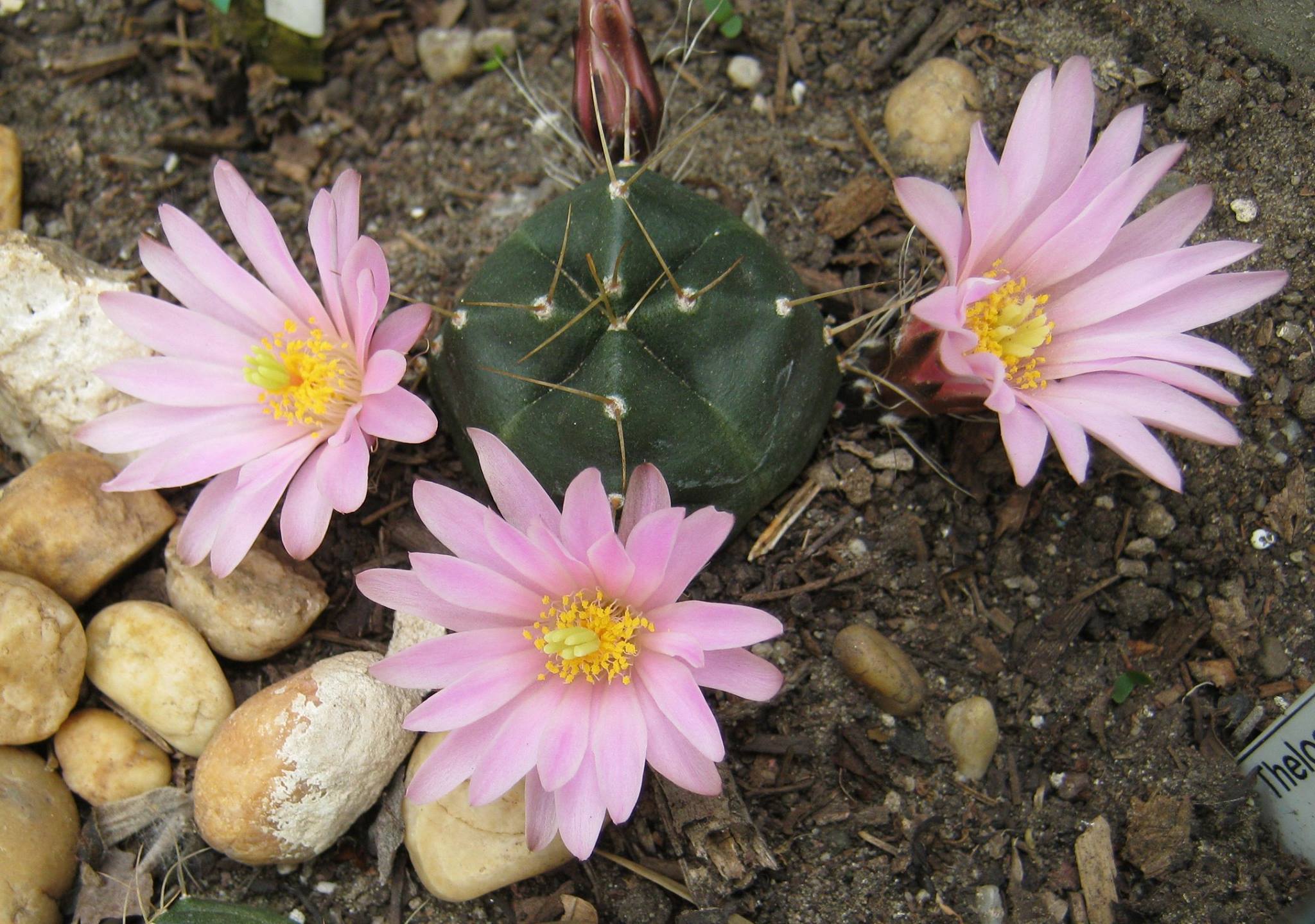
Echinocereus knippelianus Liebner is the soft-bodied dwarf hedgehog of the limestone grasslands and pine-oak transition of the Sierra Madre Oriental, described in 1895 in Monatsschrift für Kakteenkunde and named for Carl Knippel, the late-nineteenth-century German cactus dealer in Halberstadt who supplied material to European botanical gardens and private collectors. The species departs from the genus norm at almost every diagnostic axis: where most Echinocereus are stiffly cylindrical with dense pectinate or projecting spines, knippelianus is near-spineless, soft-textured, dark green to blackish, and rarely raises its crown more than a few centimetres above the ground.
The trade name “peyote verde” refers to the morphological resemblance between this dwarf and Lophophora williamsii: both are flat-globose, soft, and nearly spineless, and both grow with the crown sitting at or near the soil surface. The resemblance is purely visual; E. knippelianus is a true Echinocereus with no mescaline or psychoactive alkaloids and no taxonomic relationship to Lophophora. The likeness ends with the flower, which in knippelianus is a magenta to deep pink funnel up to 6 cm in diameter with bright yellow stamens and the green stigma lobes diagnostic of the genus.
Among the five Echinocereus on this site, E. knippelianus sits at the opposite extreme from Echinocereus rigidissimus of the Sonoran borderlands. Where rigidissimus is densely pectinate, sun-loving, and built for full UV exposure, knippelianus is soft, weakly spined, and shade-tolerant under pine canopy at 2,000-2,200 m. The closest comparison in habitat is Echinocereus pectinatus, which also grows on Mexican limestone but sits at lower elevations and carries the dense pectinate spination characteristic of the genus.
POWO recognises one infraspecific taxon: var. reyesii A.B.Lau, the Nuevo León form, treated at variety rank rather than subspecies. The nominate is centred on Coahuila and especially the Sierra de Parras; var. reyesii carries stouter darker bodies with stiffer spines and deeper pink flowers from Nuevo León. Cultivation requirements are not materially different between the two forms, and without locality data the trade frequently treats material as “knippelianus” without subspecific qualification. Neither form should be confused with the claret-cup Echinocereus triglochidiatus of the US Southwest, which is a clumping species with stout projecting spines and scarlet hummingbird-pollinated flowers.
Echinocereus knippelianus quick reference
A soft-bodied dwarf hedgehog of the limestone grasslands and pine-oak transition at 2,000-2,200 m in Coahuila and Nuevo León. Values calibrated for seed grown plants in cultivation, drawn from species-specific habitat data and grower consensus across multiple specialist sources for E. knippelianus rather than genus-level extrapolation. The cold floor is reasoned from USDA zone 9b placement and habitat elevation rather than a specialist-stated minimum; treat as conservative.
Taxonomy & nomenclature
The accepted name is Echinocereus knippelianus Liebner, published in Monatsschrift für Kakteenkunde 5: 170 (1895). The specific epithet honours Carl Knippel, a German cactus dealer and cultivator based in Halberstadt who supplied European collectors and botanical gardens with imported Mexican material in the late nineteenth century. Kew POWO accepts the Liebner name as the current binomial (IPNI lsid urn:lsid:ipni.org:names:132371-1).
POWO recognises one infraspecific taxon at variety rank: Echinocereus knippelianus var. reyesii A.B.Lau, the Nuevo León form distinguished by stouter, darker green bodies, slightly stiffer and more prominent spines, and larger deeper-pink to magenta flowers. Earlier literature elevates this form to subspecies as E. knippelianus subsp. reyesii (A.B.Lau) W.Blum & Mich.Lange, but POWO does not accept the subspecific elevation and retains the variety rank. The subsp. kruegeri Glass & R.A.Foster (1978) and subsp. kaplani Halda & Sladk. (2000) combinations are subsumed as synonyms of the nominate.
Principal heterotypic synonyms include Cereus knippelianus (Liebner) Orcutt 1902, the combination into Cereus sensu lato that predated the modern circumscription of Echinocereus and is still used as the entry header on llifle.com. The trade vernacular “peyote verde” (Spanish for “green peyote”) is widely used in collector circles in reference to the visual resemblance with Lophophora williamsii; it carries no taxonomic weight and the two species are not closely related. Subtribe placement is Echinocereinae within tribe Phyllocacteae per de Vos and colleagues 2025.
Historical synonyms (8)
- Echinocereus inermis Haage ex Hirscht, 1898 basionym
- Cereus knippelianus (Liebner) Orcutt, 1902 homotypic synonym
- Echinocereus knippelianus var. kruegeri Glass & R.A.Foster, 1978 homotypic synonym
- Echinocereus knippelianus var. reyesii A.B.Lau, 1980 homotypic synonym
- Echinocereus knippelianus subsp. kruegeri (Glass & R.A.Foster) C.E.Glass, 1998 homotypic synonym
- Echinocereus knippelianus subsp. reyesii (A.B.Lau) W.Blum & Mich.Lange, 1998 homotypic synonym
- Echinocereus knippelianus subsp. kaplani Halda & Sladk., 2000 homotypic synonym
- Echinocereus knippelianus subsp. klapanii Halda & Sladk., 2000 homotypic synonym
Sources: POWO (Kew) · IPNI · GBIF · Wikidata
Habitat
Echinocereus knippelianus is endemic to the eastern escarpment and interior valley ranges of the Sierra Madre Oriental in northeastern Mexico. POWO records the native range across four states: Coahuila (the heart of the distribution and the Sierra de Parras type area), Nuevo León (the range of var. reyesii), Tamaulipas, and San Luis Potosí. The core documented populations are concentrated in Coahuila and Nuevo León; the Tamaulipas and San Luis Potosí records likely represent extensions along the southern and eastern slopes of the same range system at comparable elevations.
Elevation across the species range is 2,000-2,200 m, placing the populations in the cool Mexican highland zone where limestone grassland transitions into open pine-oak forest. Substrate is alkaline limestone-derived soil; populations grow either in shallow limestone pockets in open grassland or under partial pine canopy where afternoon shade is available. Annual rainfall at this elevation band in Coahuila is roughly 400-600 mm, delivered primarily as summer Gulf moisture from June through September; winters are cold and dry with occasional snow at the higher edge of the range.
Microsite biology in habitat is unusual within the genus. Field workers have documented colonies of up to fifty shoots growing semi-submerged in shallow limestone soil pockets, with the crown sitting at or just below the soil surface. During the dry season the body can retract partially below the surface on the strength of the tuberous taproot, leaving only the top of the crown visible. This subterranean habit is consistent with survival under periodic grazing and makes the plant nearly invisible out of flower; in the spring flowering window the magenta funnels are the only reliable field indicator that a population is present.
Morphology
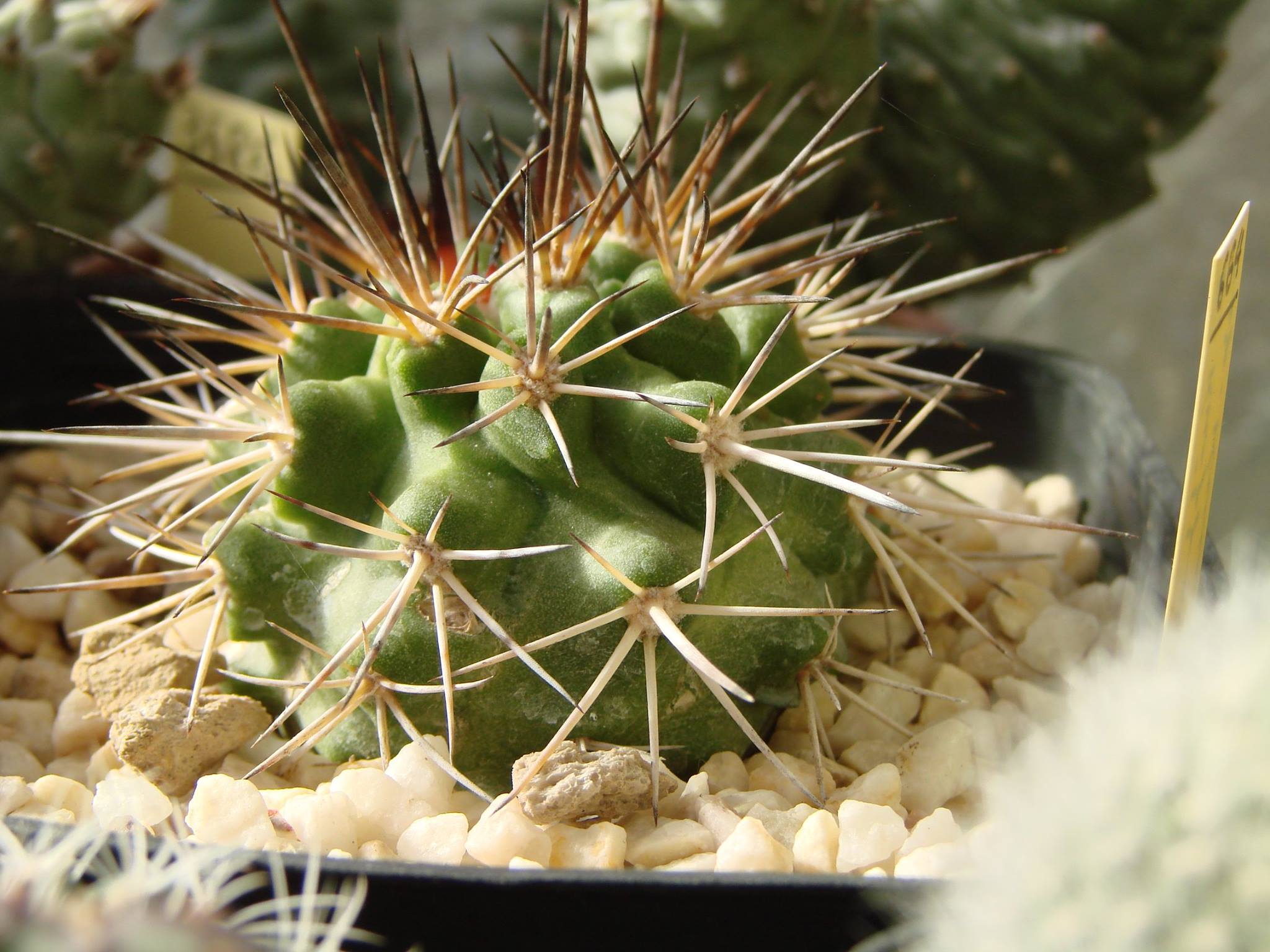
Body plump, soft-textured, flattened-globose to short-cylindric, compressing under moderate finger pressure in a way no other Echinocereus on this site does. Mature dimensions reach 3–8 cm in stem diameter and up to 10 cm tall, with the crown sitting near or at ground level rather than raised on a neck. Epidermis is dark green to blackish-green; the surface has a slightly waxy quality and absorbs heat efficiently, which is why direct midday summer sun causes sunscald on cultivated plants. Habit is solitary to weakly clustering; habitat colonies of up to fifty shoots have been documented but the typical cultivated specimen is solitary or a clump of two to five stems.
Ribs number 5–7, low and wide, somewhat tuberculate or wavy, without the sharp definition of the pectinate-spined species in the genus. Areoles are widely spaced along the rib margins. Spination is the most reduced of any Echinocereus in general cultivation: 1–4 (occasionally absent) straight to slightly twisted yellow to pale yellow spines per areole, 1.5–6 cm long, with no clear differentiation between radials and centrals. The near-spineless silhouette is the first field character that separates knippelianus from every other hedgehog cactus. The thick tuberous taproot is the second diagnostic feature; it serves as the primary water reserve and allows the plant to retract partially into the soil during dormancy.
Flowers are funnel-shaped, 2.5–4 cm long and up to 5–6 cm in diameter when fully open, pink to magenta in the nominate and deeper pink to magenta in var. reyesii. Stamens are bright yellow and form a prominent central column against the magenta petals; stigma lobes are green, the diagnostic genus character. Flower position is unusual within Echinocereus: rather than emerging laterally from the lower ribs in the typical erumpent pattern of E. pectinatus or E. rigidissimus, the buds in knippelianus emerge near the crown and open at or close to the apex of the stem. The flowering window is April through June, with three to five days open per flower under typical conditions. Pollination is most probably by solitary native bees of the Mexican highland; no pollinator study specific to E. knippelianus has been published. Fruit is spherical, purple-coloured, spiny, splitting vertically when ripe in the genus pattern.
Locality detail
The 1895 protologue by Liebner does not record a precise field site for Echinocereus knippelianus; subsequent workers relocated the species in the Sierra de Parras of Coahuila, and that range is treated as the effective type area in collector and cultivation literature. No formal lectotypification has been published in the sources consulted for this page, and no holotype specimen information was recoverable from publicly accessible herbarium databases. Type information defers to country-level Mexico with the Sierra de Parras as the conventional reference area.
The map above marks the Sierra de Parras as the type area for the nominate form, the Monterrey region as the centroid for the Nuevo León range of var. reyesii, and the POWO-listed extensions into Tamaulipas and San Luis Potosí for which specific locality data was not recovered. The core documented populations sit in the Coahuila and Nuevo León highlands of the Sierra Madre Oriental at 2,000-2,200 m, on alkaline limestone soils in open grassland or partial pine canopy. The 2013 IUCN assessment estimates a population greater than one million individuals across the entire native range, supported by the species’ capacity to form clusters of up to fifty shoots per plant.
Echinocereus knippelianus care and cultivation
Echinocereus knippelianus is the most demanding of the Echinocereus on this site at the level of microclimate control, even though the species is undemanding on substrate and watering frequency once those are set correctly. Two failure modes account for almost every loss in cultivation. First, sunscald on the dark soft body during summer midday sun above 30°C ambient bleaches the epidermis and scars the body permanently. Second, wet cold at any temperature above freezing rots the tuberous taproot from the crown down. Both are operator errors against the habitat profile, and both are avoidable by respecting the partial-shade summer microsite and the bone-dry November-to-February rest.
Substrate
The mix rebalances the genus baseline with a limestone fraction while retaining enough lava for drainage and crown aeration: 40% pumice, 10% lava rock, 10% crushed limestone (3–6 mm horticultural limestone or oyster shell chip), 15% granite grit, 10% zeolite, 5% coarse silica, and 10% worm castings. The 90/10 inorganic-to-organic ratio is unchanged from the genus baseline; the limestone fraction supplies slow calcium release. That limestone share is house convention, not a species requirement. Hard tap water already supplies calcium and bicarbonate at every watering; rainwater and RO water supply neither. Pot depth matters more than pot diameter for this species: the tuberous taproot needs 15-20 cm of depth on a stem-diameter-10-cm plant to develop without bending. A shallow wide pot of the kind that suits E. pectinatus would constrain the root reserve that knippelianus uses for dormancy water storage.
All five Echinocereus species on this site share the genus 90/10 mineral-organic baseline. The load-bearing variable is limestone: E. pectinatus and E. knippelianus carry limestone in the mix by house convention; E. rigidissimus, E. triglochidiatus and E. viridiflorus carry none.
| Species | Pumice | Lava | Zeolite | Granite | Limestone | Silica | Organic |
|---|---|---|---|---|---|---|---|
| E. pectinatus | 40% | 5% | 10% | 15% | 15% | 5% | 10% |
| E. rigidissimus | 40% | 20% | 0% | 25% | 0% | 5% | 10% |
| E. triglochidiatus | 40% | 20% | 10% | 15% | 0% | 5% | 10% |
| E. knippelianus (this page) | 40% | 10% | 10% | 15% | 10% | 5% | 10% |
| E. viridiflorus | 40% | 20% | 10% | 15% | 0% | 5% | 10% |
Watering and light
Cease scheduled watering from November through February. The substrate must be bone dry at the pot base through this period. Wet substrate combined with cool temperatures is the single most-cited cause of catastrophic loss for this species, and the failure mode is irreversible: rot begins at the root crown, climbs into the tuberous taproot, and reaches the visible body only when the plant is already lost. The effective cold floor shifts above freezing the moment the substrate is wet; the −5°C dry-cold tolerance assumes complete substrate dryness with no exceptions. First spring watering should wait for visible bud emergence in March, with a single thorough soak followed by complete drying. From April through June water once the top 3–5 cm of substrate is fully dry, every 12 to 16 days at temperate latitudes. Reduce to once every 3-4 weeks from July through September; the species is not a summer-rainfall Sonoran plant and does not have an August monsoon flush. In hot climates above 35°C ambient, withhold entirely until temperatures moderate.
Light requirements are 4-6 hours of direct sun per day, with shade or filtered light during the hottest hours, approximately 11:00 to 15:00 in summer. This is the most shade-tolerant of the launch set: morning sun on a south-facing or east-facing windowsill, or a lightly shaded glasshouse position that admits direct sun in the morning and blocks the harshest midday angle, suits the species. The dark green epidermis absorbs heat efficiently, and direct afternoon sun above 30°C ambient bleaches and scars the body within a single growing season. A plant that turns pale yellowish-green in summer is under heat and light stress, not responding positively. An outdoor summer position with 30-40% shade cloth from midday onward works in climates below 35°C summer maximum; above that threshold the plant should be moved indoors or under deeper shade for the hottest weeks.
Cold tolerance and repotting
The dry cold floor is −5°C, reasoned conservatively from the species’s USDA zone 9b placement and habitat elevation rather than from a specialist-stated minimum. No specialist nursery (Mesa Garden, Kohres, Kakteen-Haage) publishes an explicit minimum temperature for this species in the sources consulted. The llifle entry cites −12°C for short periods, but that figure is not cross-verified and is most plausibly extrapolated from the genus-level resilience of densely spined species (E. reichenbachii, E. rigidissimus) rather than from grower trials on the soft-bodied knippelianus. The −5°C floor allows a narrow frost margin below USDA 9b without extrapolating into territory that requires specialist verification. Repot every three to four years in spring after the first watering of the season; the tuberous taproot grows slowly but the pot must be deep enough not to constrain it. Handle the fleshy root with care because breaks introduce rot entry points; a dry substrate at repotting reduces handling damage.
Comparison
Among the five Echinocereus on this site, E. knippelianus stands apart from every other species at the level of body morphology and habitat preference. Where the four other launch species are stiffly cylindrical with dense or projecting spines, knippelianus is soft, weakly spined, and ground-hugging. The closest visual analogue is not another Echinocereus at all but Lophophora williamsii, the source of the “peyote verde” trade name. The botanical relationship is non-existent; the morphological convergence is restricted to body habit and reflects parallel evolution toward partial-shade, ground-hugging, drought-buffered survival in semi-arid limestone grasslands.
E. pectinatus also grows on Mexican limestone but at lower elevations (400-1,900 m versus 2,000-2,200 m) and with the dense pectinate spination characteristic of the genus. The two species do not co-occur in any documented locality and their field-identification profiles are entirely distinct: pectinatus is a comb-spined cylinder with lateral magenta funnel flowers; knippelianus is a soft dark dome with apex-borne magenta funnels and near-absent spination. E. rigidissimus of the Sonoran borderlands is the opposite extreme of knippelianus on every diagnostic axis: dense pectinate spines, full-sun habit, igneous substrate, and a body silhouette that holds itself well above the soil surface.
E. triglochidiatus presents no real identification challenge against knippelianus: the claret cup is a clumping species with stout projecting spines, scarlet hummingbird-pollinated flowers, and a hardiness floor near −25°C that places it in a different cultivation tier altogether. E. viridiflorus of the US Great Plains has small greenish yellow-green lemon-scented flowers, an order of magnitude colder hardiness floor (−20°C dry), and the body silhouette of a small bristly cylinder rather than the soft flat dome of knippelianus. Within the knippelianus complex, the practical distinction between the nominate and var. reyesii is geographic (Coahuila versus Nuevo León) and morphological in the sense that reyesii carries stouter darker bodies with stiffer spines and deeper pink flowers; cultivation values are shared between the two forms and the trade frequently treats material without subspecific qualification.
Frequently asked questions
Is Echinocereus knippelianus hard to grow?
Intermediate. The species is the most demanding of the Echinocereus on this site at the level of microclimate control, even though it is undemanding on substrate and watering frequency once those are set correctly. Two failure modes account for almost every loss. First, sunscald on the dark soft body during summer midday sun bleaches the epidermis and scars the body permanently. Second, wet cold at any temperature above freezing rots the tuberous taproot from the crown down. Both are operator errors against the habitat profile, and both are avoidable by respecting the partial-shade summer microsite and the bone-dry November-to-February rest.
Can Echinocereus knippelianus be grown from seed?
Yes, and seed grown plants are the target for serious collectors. Seed germinates reliably at 20-28°C substrate temperature, typically inside one to three weeks under standard top-sown conditions on a fine mineral grit. Time to first flower from seed runs approximately five to eight years for ungrafted plants under good cultivation with a respected dry winter rest. Grafting onto Trichocereus or Harrisia rootstocks is popular in the trade because the species is slow as a young seedling and the tuberous taproot is difficult to establish in cultivation substrates that differ from the limestone habitat; grafted stock flowers in two to three years. Grafted plants lose the ground-hugging compact habit and the diagnostic flattened crown that habitat plants and good seed grown plants show.
Is Echinocereus knippelianus legal to own?
Yes, with documentation. The species sits on CITES Appendix II by default through the blanket Cactaceae listing, which permits international commercial trade with the standard documentation: an export permit from the country of origin and an import permit where the receiving country requires one. Mexican federal law lists E. knippelianus under NOM-059-SEMARNAT-2010 as a species subject to federal protection; the specific category was not confirmed in the sources consulted for this page. The 2013 IUCN Least Concern status and population estimate of greater than one million individuals make this a low enforcement-priority taxon, but documentation is still legally required for cross-border movement. The defensible source is documented seed grown nursery stock from a registered European or North American specialist nursery.
Where does Echinocereus knippelianus grow in the wild?
In limestone grassland and pine-oak forest at 2,000-2,200 m on the eastern escarpment and interior valley ranges of the Sierra Madre Oriental in northeastern Mexico. The core documented populations are in Coahuila (centred on the Sierra de Parras type area) and Nuevo León (the range of var. reyesii); POWO additionally lists Tamaulipas and San Luis Potosí in the native range as extensions along the Sierra Madre Oriental at comparable elevations. Substrate is alkaline limestone-derived soil. The 2013 IUCN assessment estimates a population greater than one million individuals across the entire range, supported by the species’ capacity to form colonies of up to fifty shoots per plant in shallow limestone soil pockets.
When does Echinocereus knippelianus flower?
April through June is the primary window for both habitat and cultivation, with the peak in mid spring to early summer at the 2,000-2,200 m highland elevation. Individual flowers are funnel-shaped, 2.5-4 cm long, up to 5-6 cm in diameter when fully open, pink to magenta with bright yellow stamens and the diagnostic green stigma lobes of the genus. Flower position is unusual: the buds emerge near the crown and open at or close to the apex of the stem, rather than laterally from the lower ribs as in most other Echinocereus. Each flower persists three to five days; a well-grown plant carries several open simultaneously through the peak. A cold dry winter rest of at least sixty days is required for reliable spring flowering; plants kept warm and moist through winter typically fail to bud.
Sources & further reading
Liebner (1895). Echinocereus knippelianus sp. nov. Monatsschrift für Kakteenkunde 5: 170 · Kew POWO, Echinocereus knippelianus Liebner, IPNI lsid urn:lsid:ipni.org:names:132371-1 · IPNI, urn:lsid:ipni.org:names:132371-1 · World Flora Online, Echinocereus knippelianus Liebner, wfo-0000661314 (var. reyesii: wfo-0000661317) · Fitz Maurice, B. & Fitz Maurice, W.A. (2013). Echinocereus knippelianus assessment, IUCN Red List (Least Concern). iucnredlist.org/species/152355/119348793 · Anderson, E.F. (2001). The Cactus Family. Timber Press. ISBN 0-88192-498-9 · de Vos, J.M. et al. (2025). Phylogenomics and classification of Cactaceae based on hundreds of nuclear genes. Plant Systematics and Evolution · llifle, Encyclopedia of Living Forms, Echinocereus knippelianus (as Cereus knippelianus). llifle.com · GBIF, Echinocereus knippelianus occurrence dataset. gbif.org/species/7283749 · Giromagi Cactus and Succulents, Echinocereus knippelianus. giromagicactusandsucculents.com · DavesGarden, Echinocereus knippelianus. davesgarden.com · indoor-plant-care.com, Echinocereus knippelianus (Peyote verde). indoor-plant-care.com · viridis.net, Cacti in Mexico: Echinocereus knippelianus var. kruegeri fa. reyesii. viridis.net · BCSS, Cultivation notes on Echinocereus. British Cactus and Succulent Society. bcss.org.uk · CITES Appendix II Cactaceae blanket listing; Echinocereus knippelianus entry. cites.org · Wikipedia. Echinocereus knippelianus. en.wikipedia.org