
Echinocereus viridiflorus
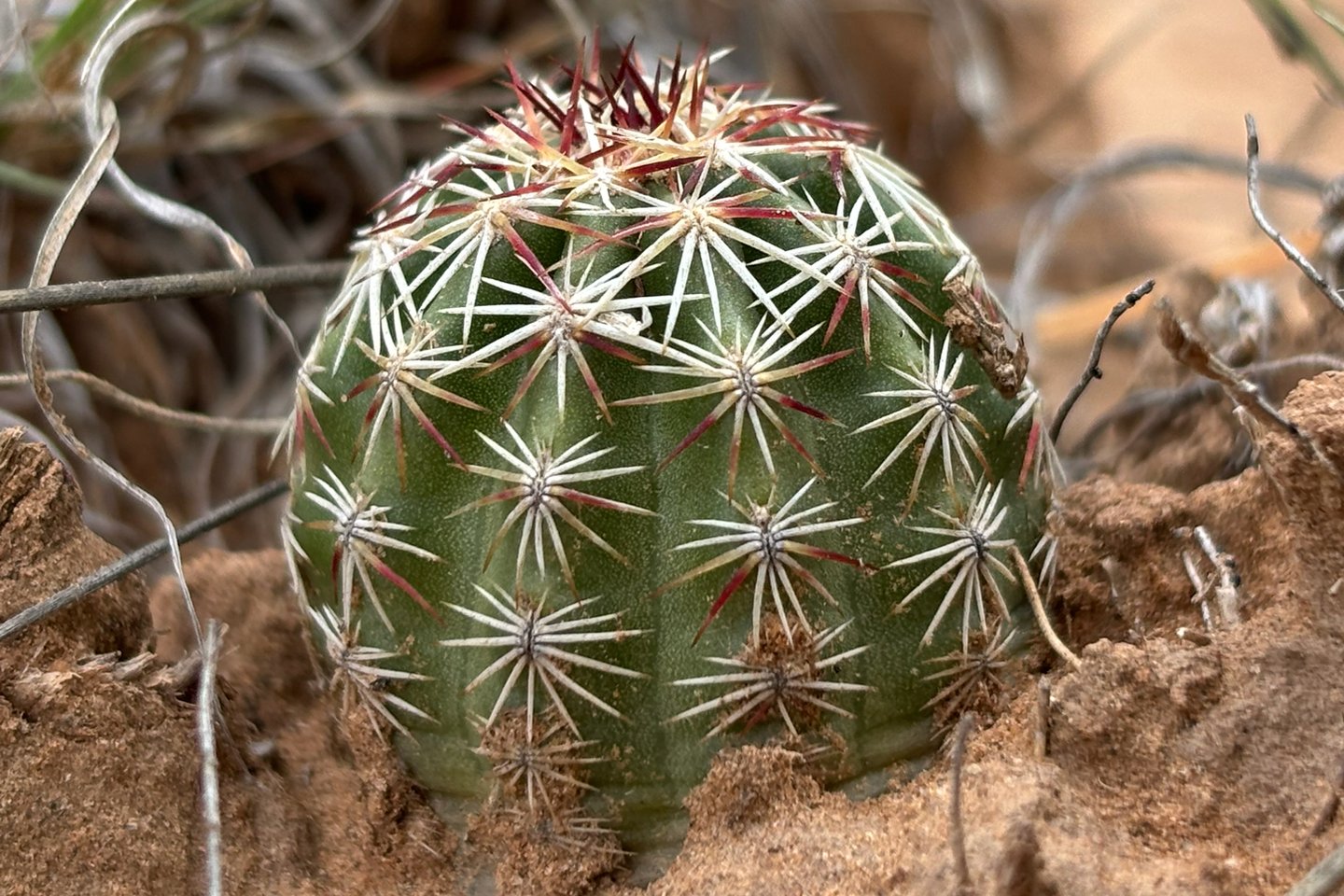
Echinocereus viridiflorus Engelm. is the green-flowered hedgehog cactus of the US Great Plains and intermountain west, described by George Engelmann in 1848 in Wislizenus’s Memoir of a Tour to Northern Mexico, the same publication that established the genus. The Latin epithet viridiflorus means “green-flowered” and refers to the diagnostic small green to yellow-green flower colour, which is unique in a genus otherwise dominated by scarlet, magenta, and pink. The flowers are also lemon-scented in the nominate subspecies, a second character that sets the species apart from every other hedgehog in the launch set.
The species holds the northern range record for the entire genus. Populations extend from the shortgrass prairie of South Dakota and Wyoming south through Colorado, Kansas, Oklahoma, New Mexico, and Texas, and into the northern Mexican states of Coahuila and Chihuahua, at elevations between 700 and 2,700 m. South Dakota populations rank among North America’s northernmost cacti, and the species’s tolerance of dry winter cold to −20°C makes it one of the hardiest cacti available to collectors anywhere in temperate cultivation.
Among the four other Echinocereus covered on this site, E. viridiflorus is the smallest and the most cold-hardy. It sits at the climatic opposite of the Sonoran Echinocereus rigidissimus and the Coahuila highland Echinocereus knippelianus, and shares only the genus’s general body plan with the broadly cylindrical Echinocereus pectinatus of the Mexican limestone country. The Flora of North America places viridiflorus on igneous or novaculite substrates, gravelly or silty alluvium, rarely on limestone.
Taxonomically the species is split into several subspecies and varieties, of which one carries an outsized legal weight. Var. davisii, endemic to a single novaculite outcrop near Marathon in Brewster County, Texas, is listed as Endangered under the US Endangered Species Act by formal determination of the US Fish and Wildlife Service. The species sensu lato is IUCN Least Concern. The Echinocereus triglochidiatus claret cup of the US Southwest is the only other launch sibling with comparable cold-hardiness, but the two are unmistakeable: triglochidiatus is a clumping hummingbird-pollinated scarlet-flowered species, while viridiflorus remains compact, mostly solitary, with small bee-pollinated green flowers.
Echinocereus viridiflorus quick reference
A continental-climate hedgehog of the US Great Plains and intermountain west, the northernmost Echinocereus, growing on igneous, novaculite, and alluvial substrates between 700 and 2,700 m. Values calibrated for seed grown plants in cultivation, drawn from species-specific habitat data and grower consensus across multiple specialist sources for E. viridiflorus rather than genus-level extrapolation.
Taxonomy & nomenclature
The accepted name is Echinocereus viridiflorus Engelm., published in 1848 in F.A. Wislizenus, Memoir of a Tour to Northern Mexico, p. 91. The original collection material was gathered during Wislizenus’s 1846 expedition through what is now New Mexico and northern Mexico, and Engelmann authored the botanical descriptions for the volume in the same publication that established Echinocereus as a genus. Kew POWO accepts the Engelmann name as current (IPNI lsid urn:lsid:ipni.org:names:132479-1). The Latin epithet viridiflorus means “green-flowered” from viridis (green) and florus (flowered), and refers directly to the diagnostic flower colour.
POWO recognises the nominate plus two subspecies. Subsp. correllii (L.D.Benson) W.Blum & Mich.Lange (POWO lsid urn:lsid:ipni.org:names:1001565-1) occurs in southwest Texas in the Davis Mountains and the Marathon area of Brewster County, with smaller stems to about 7.5 cm in diameter and brownish-yellow flowers. Subsp. cylindricus (Engelm.) N.P.Taylor (POWO lsid urn:lsid:ipni.org:names:1001182-1) covers central and southern New Mexico, west Texas, and Coahuila with larger cylindrical stems; some recent molecular work suggests this taxon may warrant species rank, but no published split has been indexed by POWO at the time of writing, so the subspecies treatment remains current.
Var. davisii (Houghton) L.Benson is the legally most consequential infraspecific entity. The US Fish and Wildlife Service uses the variety rank in its species profile and federal Endangered determination for the taxon; some other authorities treat the same plant at subspecies rank. The variety is endemic to a single novaculite (siliceous chert) outcrop near Marathon, Brewster County, Texas, and the page uses var. davisii throughout to align with the operative ESA legal documents.
Principal heterotypic synonyms include Cereus viridiflorus Engelm., the older basionym-form combination still seen in pre-Echinocereus literature; Echinocereus chloranthus (Engelm.) F.Haage, the most important synonym in the collector trade for plants with more numerous central spines and darker brownish-green flowers, treated as a separate species for many years and now subsumed by POWO; and Echinocereus russanthus D.Weniger, the russet-spined Trans-Pecos form. Several additional varieties (canus, neocapillus, rhyolithensis, robustior, russanthus) circulate in collector literature without consistent acceptance across modern authorities.
Historical synonyms (2)
- Echinocereus chloranthus Rümpler, 1885 basionym
- Echinocereus viridiflorus var. davisiae Backeb., homotypic synonym
Sources: POWO (Kew) · IPNI · GBIF · Wikidata
Habitat
Echinocereus viridiflorus sensu lato has the widest latitudinal range of any species in the genus. The northern limit is the shortgrass prairie of South Dakota and adjacent Wyoming; the range continues south through Colorado, Kansas, Nebraska (marginal), Oklahoma, New Mexico, and Texas, and crosses into the northern Mexican states of Chihuahua and Coahuila. POWO summarises the native range as “SW. South Dakota to N. & W. Texas”. Elevation across the species range runs from 700 m on Chihuahuan Desert flats up to 2,700 m in Sierra Madre and Rocky Mountain transition habitats, with most shortgrass prairie populations in South Dakota and Wyoming sitting between 1,200 and 1,800 m.
Habitat types span Chihuahuan Desert scrub at the southern end of the range, semidesert grassland through the central plains, shortgrass prairie at the northern limit, and oak and pinyon-juniper woodland at higher elevations. The Flora of North America records the species on “igneous or novaculite substrates, gravelly or silty alluvium, rarely on limestone”, unlike the limestone country of the Mexican Plateau E. pectinatus. This habitat record does not set the potting mix. The E. viridiflorus mix on this page carries no limestone supplement.
Var. davisii occupies the most restricted microsite in the complex. The variety is endemic to an approximately 29 km exposed novaculite outcrop near Marathon in Brewster County, Trans-Pecos Texas, growing in beds of Selaginella spikemoss on and among the rocky novaculite substrate within Chihuahuan Desert shrubland. Novaculite is a siliceous chert with acidic to near-neutral chemistry; no limestone supplement is appropriate for davisii either. The 1984 USFWS five-year review estimated the wild population at approximately 20,000 plants. The site sits on private ranch land, which adds a trespassing barrier to wild collection on top of the federal ESA prohibition.
Morphology
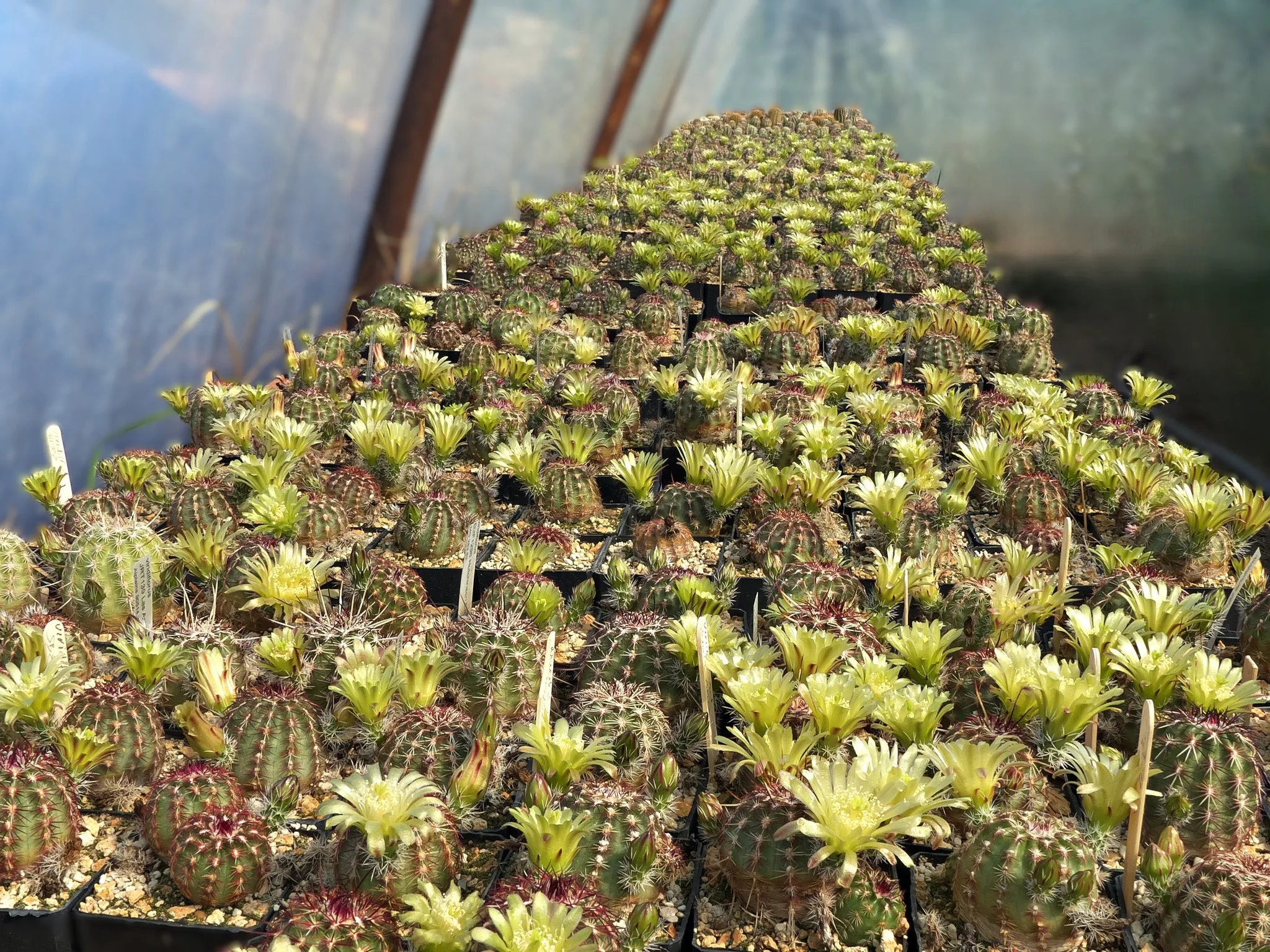
Body small and compact, cylindrical to short-cylindrical, occasionally ovoid in younger plants. Mostly solitary or forming small clusters of a few stems; the species does not build the large mounding colonies typical of E. triglochidiatus. Stem dimensions across the complex run 1.5–30 cm tall and 1–9 cm in diameter, with the nominate subspecies tending toward the smaller end at 3–15 cm tall and 1.5–5 cm wide in most shortgrass prairie populations. Var. davisii is extreme: stems to about 3 cm tall, sometimes withdrawing below the soil surface during drought with only the spine tips visible, which makes it one of the smallest cacti in the world. Subsp. correllii reaches 15–25 cm tall and about 7.5 cm in diameter.
Ribs number 6–18, typically 10–14 in the nominate. Spination is variable across the complex and is the principal morphological character used to segregate the infraspecific taxa. Radial spines run 8–24 per areole, white to cream to red-brown, to about 1.8 cm long, spreading close against the rib. Central spines run 0–4 per areole, with the nominate typically showing 0–1 and the chloranthus group of forms carrying more numerous centrals; central spines reach 2.5 cm long and run reddish-brown to cream. The brown-and-white striped or patterned spine effect that collectors note as a field character arises from the contrast between the darker central, where present, and the lighter radials. The pattern is less dramatic than the banding in E. rigidissimus but is still useful for field identification.
Flowers are the species’s defining feature in the genus. Colour is green to yellowish-green for the nominate, with some populations and infraspecific forms producing brownish-yellow or straw-yellow blooms; the green to yellow-green flower colour is unique in the genus at species level. Size is small relative to most Echinocereus, with the Flora of North America giving 2.5–3 cm long and approximately 2.5–3 cm in diameter. Form is short funnelform, opening widely in sunlight. The flowers are lemon-scented in the nominate subspecies (confirmed across multiple grower and botanical sources) and in var. davisii (llifle records “a pleasant lemony scent” for davisii); FNA notes that floral scent is one of the characters that varies across the complex, and Larson and colleagues treated scent as a chemotaxonomic character in their 1982 American Journal of Botany study of pollination biology. Documentation across subsp. correllii and subsp. cylindricus is less explicit and the page does not claim universal lemon scent for the entire complex. Stigma lobes are green, the genus character; flowers emerge laterally and erumpently through the epidermis adjacent to spine-bearing areoles. Pollinators are halictid sweat bees per Larson et al. 1982; the species is not hummingbird-pollinated, consistent with the small flower size, the green-yellow colour, and the open shortgrass-prairie habitat where hummingbird abundance is lower.
Fruit is small and nearly globular at 5–17 mm long, pale yellowish-green to dull green or dark purple at maturity, covered with small bristly spines that fall away easily as the fruit matures, leaving a glistening wall. The fruit is edible, consistent with the genus-wide spiny-persistent fruit character but at a smaller scale than most siblings.
Locality detail
Echinocereus viridiflorus has no narrowly defined type locality. The species was collected during Wislizenus’s 1846 expedition across what is now New Mexico and northern Mexico, and the 1848 protologue does not record a precise field site. FNA and llifle associate the nominate type with the Santa Fe region of New Mexico, a common Wislizenus collection zone, without lectotypification at finer resolution. The map above marks state-level centroids for the species range plus a sharper pin on the var. davisii locality, which is the only narrowly endemic taxon in the complex.
The state-level centroids reflect a wide-ranging species with abundant subpopulations on multiple substrates across each state. South Dakota and Wyoming carry the most northerly populations on shortgrass prairie. Colorado, Kansas, Nebraska, Oklahoma, and New Mexico cover the heart of the intermountain west and Great Plains range. Texas carries the nominate plus subsp. correllii and var. davisii. Coahuila and Chihuahua extend the distribution south into the northern Mexican states. The var. davisii pin marks a single approximately 29 km exposed novaculite outcrop near Marathon in Brewster County, the entire global range of that taxon, on private ranch land closed to collector access.
Echinocereus viridiflorus care and cultivation
Echinocereus viridiflorus ranks among the easiest Echinocereus to grow in collector cultivation, and it is the single most cold-hardy. The species tolerates the mineral-dominant substrates the genus prefers, flowers reliably when the cold-dry winter rest is respected, and survives outdoor temperatures down to −20°C when the substrate is dry. The single failure mode that accounts for almost all losses in cultivation is wet winter cold; rot at the root crown or stem base when soil holds moisture below 10°C progresses faster in this small-bodied species than in larger-bodied genera, and a single wet winter can kill an established plant.
Substrate
Use the genus baseline mineral mix without limestone supplement: 40% pumice, 20% lava, 15% granite grit, 10% zeolite, 5% coarse silica, and 10% worm castings, for a 90/10 inorganic-to-organic ratio. The Flora of North America records E. viridiflorus on “igneous or novaculite substrates, gravelly or silty alluvium, rarely on limestone”. The shortgrass prairie and Trans-Pecos populations sit on shallow rocky fast-draining sandy-clay loam over rock; var. davisii grows directly on novaculite, a siliceous chert with acidic to near-neutral chemistry. The mix above is shared across the complex rather than a copy of any habitat rock, and aligns with the site’s substrate rules.
All five Echinocereus species on this site share the genus 90/10 mineral-organic baseline. The load-bearing variable is limestone: E. pectinatus and E. knippelianus carry a limestone fraction in the mix as a site figure with no certified carbonate state behind it; E. rigidissimus carries none and is not a calcifuge; E. triglochidiatus and E. viridiflorus run the baseline without pH amendment. Hard tap water already supplies calcium and bicarbonate at every watering, while rainwater and RO water supply neither.
| Species | Pumice | Lava | Zeolite | Granite | Limestone | Silica | Organic |
|---|---|---|---|---|---|---|---|
| E. pectinatus | 40% | 5% | 10% | 15% | 15% | 5% | 10% |
| E. rigidissimus | 40% | 20% | 0% | 25% | 0% | 5% | 10% |
| E. triglochidiatus | 40% | 20% | 10% | 15% | 0% | 5% | 10% |
| E. knippelianus | 40% | 10% | 10% | 15% | 10% | 5% | 10% |
| E. viridiflorus (this page) | 40% | 20% | 10% | 15% | 0% | 5% | 10% |
Watering and light
Cease scheduled watering from November through February. The substrate must be bone dry at the pot base through this period; winter moisture combined with cool temperatures is the universal cause of loss for the species across every grower source. First spring watering should wait for visible bud development, typically March: a single thorough soak followed by complete drying over 10–14 days. From April through June water when the top 3–5 cm is fully dry, generally every 10–14 days at temperate latitudes. The growing season tapers earlier than for the Sonoran monsoon-driven species on this site; reduce frequency from August onward and transition to one or two waterings in October before the dry winter rest. Llifle confirms the schedule: “water sparingly from March till October, and keep perfectly dry in winter, at temperatures from 5 to 15 degrees Celsius”.
Light requirements are full unobstructed sun. The species grows on open shortgrass prairie and gravelly hillsides at 900–2,700 m elevation with no canopy shade, and UV loading at habitat is substantial. In cultivation it tolerates full sun in temperate climates without adverse effects. Reduced light produces etiolation, poor spine development, and weak or no flowering. This is the opposite end of the genus from E. knippelianus, which benefits from afternoon shade in Coahuila highland habitat; viridiflorus does not.
Cold tolerance and repotting
The dry cold floor is −20°C (−4°F), confirmed by independent sources including llifle and the coldhardycactus.com nursery; this places the species in USDA zone 4–5 when dry. Outdoor cultivation without winter protection is viable across most of the continental US and much of northern Europe, provided drainage sheds rain and snow. The critical qualifier is that the cold tolerance is contingent on dry substrate: wet soil at 0°C will kill plants that would survive −20°C when dry. Container growers in high-rainfall winter climates must overwinter under cover. Repot every two to three years or when the plant clearly fills the container; the root system is not aggressive, and under-potting in a smaller container with very porous compost is the consensus grower recommendation. Shallow clay pots suit the compact habit and promote faster drying of the root zone.
Comparison
Among the four other Echinocereus on this site, the closest field comparison for E. viridiflorus in body form is E. pectinatus, which shares the broadly cylindrical compact habit and dense radial spination at collector scale. The two diverge sharply on every other character that matters for identification. Flower colour is the cleanest split: viridiflorus produces small green to yellow-green lemon-scented flowers 2.5–3 cm in diameter; pectinatus produces large pink to magenta funnel flowers 5–12 cm in diameter. Spine arrangement also differs: pectinatus carries flat pectinate radials lying tight against the rib in comb-like rows; viridiflorus radials are more divergent, less rigorously pectinate, and the brown-and-white striped pattern is contributed by the contrast between centrals and radials rather than by the geometry of either set. Range overlaps marginally in west Texas; habitat rock does not, with pectinatus on Mexican Plateau limestone hills and viridiflorus on igneous and novaculite. Cold tolerance is the order-of-magnitude difference: viridiflorus survives to −20°C dry; pectinatus bottoms out near −10°C.
E. rigidissimus is the densest-spined of the launch siblings and shares the trade name “rainbow cactus” with pectinatus in commerce; it is a Sonoran borderlands species at 1,200–2,000 m with rose-pink flowers and a habitat of acidic igneous gravels. The dense pectinate spination of rigidissimus covers the stem in alternating colour bands and is unmistakeable; viridiflorus by contrast carries far more open spination and lacks any banded display. Cold floor for rigidissimus is around −12°C, two-thirds of the viridiflorus tolerance and confined to a much warmer climatic envelope.
E. triglochidiatus is the only other launch sibling with comparable cold-hardiness, surviving to −25°C in the hardiest selected populations. The two are easily distinguished: triglochidiatus is a clumping species with relatively few stout projecting spines, scarlet hummingbird-pollinated flowers that close at night, and a mounding colony habit that can fill a square metre. Viridiflorus remains compact and mostly solitary, carries dense patterned radials, and produces small bee-pollinated green flowers that persist for several days open. E. knippelianus sits at the opposite end of the genus from viridiflorus: small soft-bodied dark green weakly spined shade-tolerant Coahuila highland endemic with magenta apical flowers; nothing about its silhouette or its climate envelope resembles the cold-tolerant US plains viridiflorus.
Frequently asked questions
Is Echinocereus viridiflorus hard to grow?
Beginner. The species is the most cooperative Echinocereus in cultivation among the launch set: its exceptional cold-hardiness to −20°C dry tolerates almost any temperate climate without protected overwintering, the compact body fits a small clay pot indefinitely, and the species flowers reliably as long as the winter rest is dry and cool. The one consistent killer is wet winter cold. Substrate must be bone dry from November through February with temperatures between 5 and 15°C; wet soil at 0°C will kill plants that would survive −20°C when dry. Beyond that single discipline the species is undemanding and forgiving.
Can Echinocereus viridiflorus be grown from seed?
Yes, and seed grown plants are the target for serious collectors. Seed germinates at 21–29°C (70–85°F) substrate temperature with germination typically inside two to four weeks under standard top-sown conditions on a moist well-drained mineral mix; germination is slower and more sporadic below 21°C. Time to first flower from seed is three to four years under good cultivation with a respected cold-dry winter rest, earlier-flowering than most siblings in the genus. The compressed native growing season between snow-melt and first autumn freeze appears to have selected for relatively rapid maturation. Seed-grown plants develop the full compact densely spined habit; grafted stock can produce etiolated or atypically elongated stems and is not the goal here. For var. davisii specifically, any nursery specimen must be seed grown from documented provenance because wild collection is illegal.
Is Echinocereus viridiflorus legal to own?
Yes for the broadly traded nominate, with a sharp legal split for one variety. The species sensu lato is CITES Appendix II by default through the blanket Cactaceae listing; international commercial trade in nursery-propagated material is legal with the appropriate export permits from the country of origin. Domestic trade in nursery-propagated material within a single country does not require CITES permits. Documented seed grown nursery stock is the legally and ethically defensible source for the nominate.
Var. davisii carries a separate and stricter legal regime. The variety is listed as Endangered under the US Endangered Species Act through a formal determination by the US Fish and Wildlife Service, and is also listed as Endangered by the Texas Parks and Wildlife Department. Wild collection from the single Brewster County novaculite site is a federal crime under the ESA; the site additionally sits on private ranch land, so trespassing law adds a second barrier on top of the federal prohibition. The ESA listing is a US federal regime distinct from the IUCN Red List, which assesses the species sensu lato as Least Concern. Nursery-propagated davisii from documented seed sources is legal to own and sell in the US: the ESA does not prohibit possession of legally propagated material. Any plant labelled davisii that lacks a defensible provenance trail should be treated with serious caution.
Where does Echinocereus viridiflorus grow in the wild?
Across the widest latitudinal range of any Echinocereus. The species reaches further north than any other species in the genus, with populations on the shortgrass prairie of southwestern South Dakota and adjacent Wyoming. The range continues south through Colorado, Kansas, Nebraska (marginal records), Oklahoma, New Mexico, and Texas, and into the northern Mexican states of Coahuila and Chihuahua. Elevation runs from 700 m on Chihuahuan Desert flats up to 2,700 m in Sierra Madre and Rocky Mountain transition habitats. Habitat types include shortgrass prairie, semidesert grassland, Chihuahuan Desert scrub, and oak and pinyon-juniper woodland. Substrate is igneous-derived or novaculite, gravelly or silty alluvium, rarely limestone. Var. davisii is the exception: the variety is endemic to a single approximately 29 km novaculite outcrop near Marathon in Brewster County, Trans-Pecos Texas, on private ranch land.
When does Echinocereus viridiflorus flower?
Late March through May for the nominate across most of the range, with higher-elevation and more northern populations extending into June. Flora of North America records the main flowering window as March through May; subsp. correllii blooms March through April per llifle. The flowers are small relative to most Echinocereus at 2.5–3 cm long and approximately 2.5–3 cm in diameter, green to yellowish-green for the nominate, with some forms producing brownish-yellow blooms. The lemon scent is a defining flower character: confirmed for the nominate subspecies and for var. davisii, with documentation across subsp. correllii and subsp. cylindricus less explicit, so the page does not claim universal lemon scent for the entire complex. Flowers open in daylight and persist for several days. Pollinators are halictid sweat bees per the 1982 Larson et al. study in American Journal of Botany; the species is not hummingbird-pollinated, consistent with the small green flower size, the lemon scent, and the open prairie habitat. Cold-dry winter rest is essential for budding the following spring; plants kept warm and moist through winter typically fail to bud.
Sources & further reading
Engelmann, G. (1848). Echinocereus viridiflorus sp. nov. In: Wislizenus, F.A. Memoir of a Tour to Northern Mexico, p. 91 · Kew POWO, Echinocereus viridiflorus Engelm., IPNI lsid urn:lsid:ipni.org:names:132479-1 · Kew POWO, Echinocereus viridiflorus subsp. correllii, IPNI lsid urn:lsid:ipni.org:names:1001565-1 · Kew POWO, Echinocereus viridiflorus subsp. cylindricus, IPNI lsid urn:lsid:ipni.org:names:1001182-1 · Flora of North America Editorial Committee. Echinocereus viridiflorus (Zimmerman & Parfitt). Flora of North America. floranorthamerica.org · IUCN Red List. Echinocereus viridiflorus assessment 2017 (Least Concern, sensu lato). iucnredlist.org · Anderson, E.F. (2001). The Cactus Family. Timber Press. ISBN 0-88192-498-9 · llifle, Encyclopedia of Living Forms, Echinocereus viridiflorus. llifle.com · llifle, Echinocereus viridiflorus subs. davisii. llifle.info · llifle, Echinocereus viridiflorus var. correllii. llifle.com · llifle, Echinocereus viridiflorus subs. chloranthus. llifle.com · US Fish and Wildlife Service. Davis’ Hedgehog Cactus species profile (Echinocereus viridiflorus var. davisii). fws.gov · US Fish and Wildlife Service. ETWP: Determination that Echinocereus viridiflorus var. davisii and Coryphantha minima are Endangered Species. fws.gov · US Fish and Wildlife Service. Five-Year Review: Davis’s Green Pitaya. ecos.fws.gov · Texas Parks and Wildlife Department. Davis’ Green Pitaya. tpwd.texas.gov · Larson, D.A. et al. (1982). Pollination biology and chemotaxonomy of the Echinocereus viridiflorus complex (Cactaceae). American Journal of Botany 69(7): 1109–1118 · NatureServe Explorer. Echinocereus viridiflorus (G4). explorer.natureserve.org · coldhardycactus.com. Echinocereus viridiflorus (EC008) cold hardiness compilation. coldhardycactus.com · windowsillcactus.com. Echinocereus viridiflorus var. montanus seeds. windowsillcactus.com · succulentsnetwork.com. Echinocereus viridiflorus care guide. succulentsnetwork.com · americansouthwest.net. Echinocereus viridiflorus distribution. americansouthwest.net · CITES Appendix II Cactaceae blanket listing; Echinocereus viridiflorus species entry. cites.org · Wikipedia. Echinocereus viridiflorus; Echinocereus (genus). en.wikipedia.org