
Echinocereus triglochidiatus
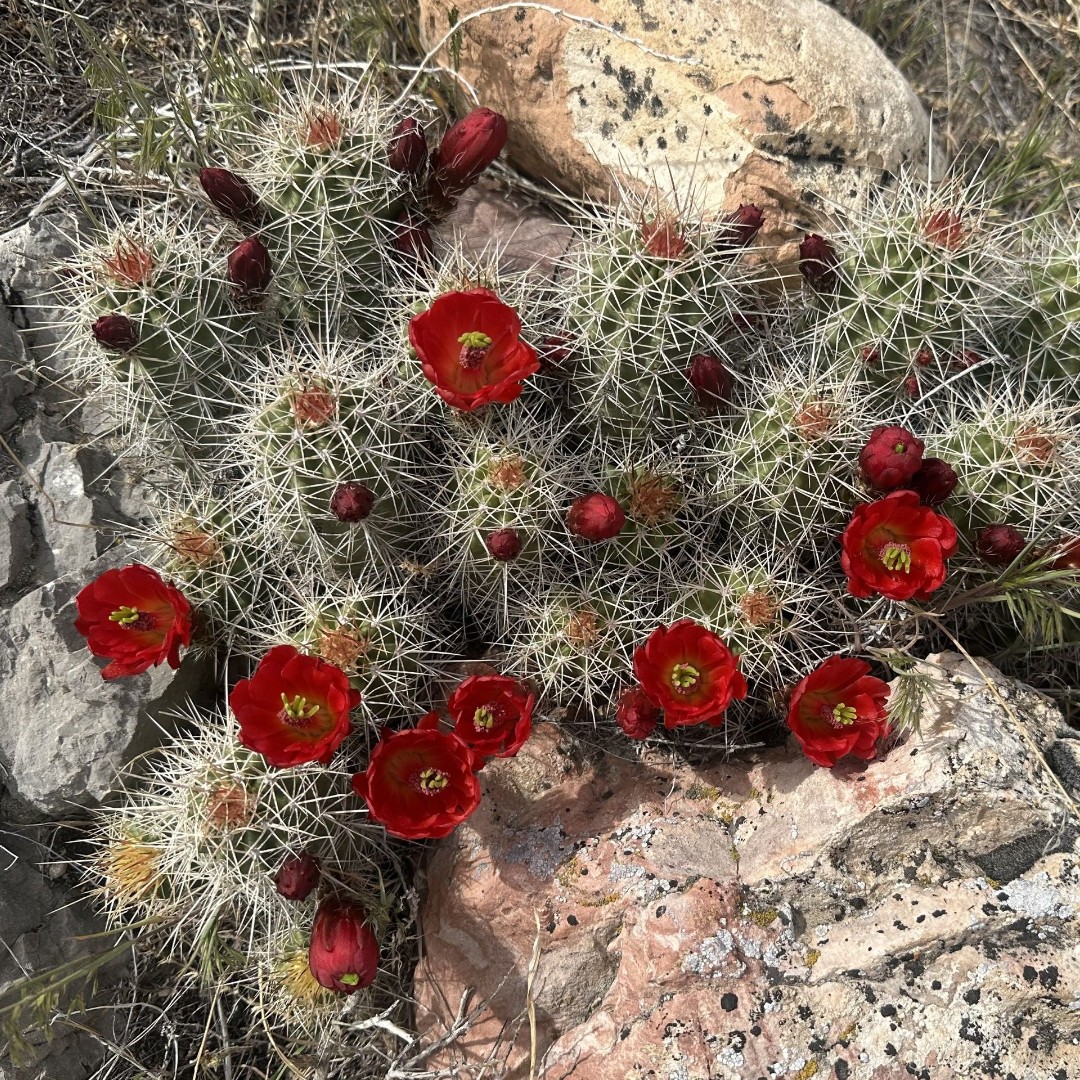
Echinocereus triglochidiatus Engelm. is the claret cup hedgehog of the US Southwest and northern Mexico, the official state cactus of Colorado, and the widest-ranging species in the genus. George Engelmann described it in 1848 in Adolphus Wislizenus’s Memoir of a Tour to Northern Mexico, the same publication that established Echinocereus as a genus. The Latin epithet derives from tri- (three) and glochidium (barbed point) and refers to the angularly ribbed, three-edged cross-section of the central spines in the nominate variety, not to glochids in the Opuntia sense.
The species spans a remarkable elevational and geographic band: 150 metres in the low Mojave Desert of California up to 3,500 metres in conifer-pine ecotone in Colorado and New Mexico, with a US range covering Arizona, California, Colorado, Nevada, New Mexico, Texas, and Utah, and a Mexican range across Sonora, Chihuahua, Coahuila, and Baja California Norte. Across that envelope it occupies the widest substrate range of any species covered on this site, growing on sandstone-derived sands at the Grand Canyon, conglomerate talus at Canyon de Chelly, gypsum-derived alkaline silt at White Sands, and igneous-based loamy sands across the Sierra Madre and Colorado Plateau interior.
Among the five Echinocereus taxa covered on this site, the claret cup is the field opposite of the comb-spined Mexican Plateau species Echinocereus pectinatus: where pectinatus presents flat pink-banded radials in tight comb rows and pink-magenta funnel flowers, triglochidiatus carries few stout projecting spines and produces uniformly scarlet flowers adapted for hummingbird pollination. The Sonoran rainbow cactus Echinocereus rigidissimus also grows on igneous gravels but presents an entirely different silhouette of dense, banded, tightly pectinate spination on a solitary cylindrical stem rather than the many-stemmed clumping mound the claret cup forms in habitat.
Claret cup populations form bulbous piles of erect stems; individual mounds in habitat routinely carry dozens of stems and the largest documented colonies exceed 100 stems within a single metre-wide cluster. This clumping habit is the most distinctive field character at the population level and gives the species its alternate vernacular “Mojave mound cactus.” The soft-bodied Coahuila endemic Echinocereus knippelianus by contrast remains small and clusters only weakly. The US Great Plains Echinocereus viridiflorus shares the cold hardiness but presents an unspectacular bristly cylinder with greenish lemon-scented flowers, removing it from any visual confusion with the scarlet-flowered claret cup.
Echinocereus triglochidiatus quick reference
The most cold-hardy hedgehog in the genus, occupying a remarkable elevational band from 150 to 3,500 metres across the US Southwest and northern Mexico. Values calibrated for seed grown plants of the trade-typical subsp. mojavensis and var. gonacanthus provenance, drawn from species-specific habitat data and grower consensus across multiple specialist sources rather than genus-level extrapolation.
Taxonomy & nomenclature
The accepted name is Echinocereus triglochidiatus Engelm., published in Memoir of a Tour to Northern Mexico (Wislizenus) page 91 in 1848. Engelmann described the species directly under Echinocereus; there is no prior Cereus basionym, which makes E. triglochidiatus concurrent with the formal establishment of the genus itself. Kew POWO accepts the Engelmann combination as the current name (IPNI lsid urn:lsid:ipni.org:names:30030656-2).
Infraspecific taxonomy is actively contested between two treatments. POWO accepts two subspecies: the nominate E. triglochidiatus subsp. triglochidiatus across the eastern part of the range (New Mexico, Colorado, western Texas), and E. triglochidiatus subsp. mojavensis (Engelm. & J.M.Bigelow) W.Blum & Mich.Lange across the Mojave Desert and Great Basin fringe (California, Nevada, Utah, western Colorado, Baja California Norte). The Flora of North America 2020 treatment recognises a third taxon, var. gonacanthus, for plants of intermediate spination, but FNA itself notes that the name has been “carelessly applied to miscellaneous plants” across the species range and is descriptive rather than a geographically coherent population.
The Arizona hedgehog cactus is the sharpest current nomenclatural issue. USFWS lists it as E. triglochidiatus var. arizonicus for the purposes of its 1979 federal Endangered listing, but POWO does not accept this as an infraspecific taxon under E. triglochidiatus sensu stricto; under the POWO framework the diploid arizonicus populations belong to the separate species E. arizonicus, and the USFS Wildflowers profile uses E. coccineus var. arizonicus reflecting the competing tetraploid-elevation treatment. The federal protection remains in force regardless of which taxonomic framework names the listed entity.
Principal synonyms include Cereus gonacanthus Engelm. & J.M.Bigelow (the basionym for var. gonacanthus), Echinocereus paucispinus (Engelm.) Engelm., and E. triglochidiatus var. melanacanthus (Engelm.) L.D.Benson. The spineless form E. triglochidiatus f. inermis (K.Schum.) W.Blum is accepted by POWO at infraspecific rank and is the most widely cultivated non-nominate form in European and US rock-garden trade.
Historical synonym (1)
- Echinocereus triglochidiatus var. triglochidiatus , homotypic synonym
Sources: POWO (Kew) · IPNI · GBIF · Wikidata
Habitat
Echinocereus triglochidiatus spans the widest US geographic and elevational range of any taxon in the genus. The US distribution covers Arizona, California, Colorado, Nevada, New Mexico, Texas, and Utah; the Mexican distribution extends into Sonora, Chihuahua, Coahuila, and Baja California Norte but does not cross south into central Mexico in the manner of E. pectinatus or E. knippelianus. Elevation across the documented range runs from 150 metres in the low Mojave Desert and Sonoran Desert bajadas of California and Nevada up to 3,500 metres in conifer woodland and high pine-oak ecotone in New Mexico and Colorado, per the USFS FEIS database.
Habitat types are unusually diverse. Lower-elevation populations occupy upper Mojave Desert rocky slopes, sandy benches, and canyon walls in California, Nevada, and Utah. Mid-elevation populations sit in xerophyllous scrub and Chihuahuan Desert grassland across Arizona and New Mexico. Upper-elevation populations transition into pinyon-juniper and juniper-oak woodland and reach the margins of ponderosa pine and mixed conifer forest in Colorado and northern New Mexico. Throughout the range plants favour rocky or gravelly hillsides, ledges, and canyon rims rather than deep alluvial flats.
The substrate breadth is the species’s most striking habitat character and a meaningful contrast with the largely limestone habitats of E. pectinatus and the igneous gravels of E. rigidissimus. Grand Canyon populations grow on red Navajo sandstone and Supai-formation soils with pH near neutral to mildly acidic. Canyon de Chelly and Lukachukai populations occupy conglomerate talus on mixed angular grit. White Sands populations grow on gypsum-derived silty alkaline soils with pH 8.0 or higher, a saline substrate where most cacti fail. The most common substrate across the broader range is igneous-derived loamy sand on volcanic basalt, rhyolite, and granite parent materials at pH 6.0 to 7.0. No cultivation source establishes the species as calcicole or calcifuge.
Morphology
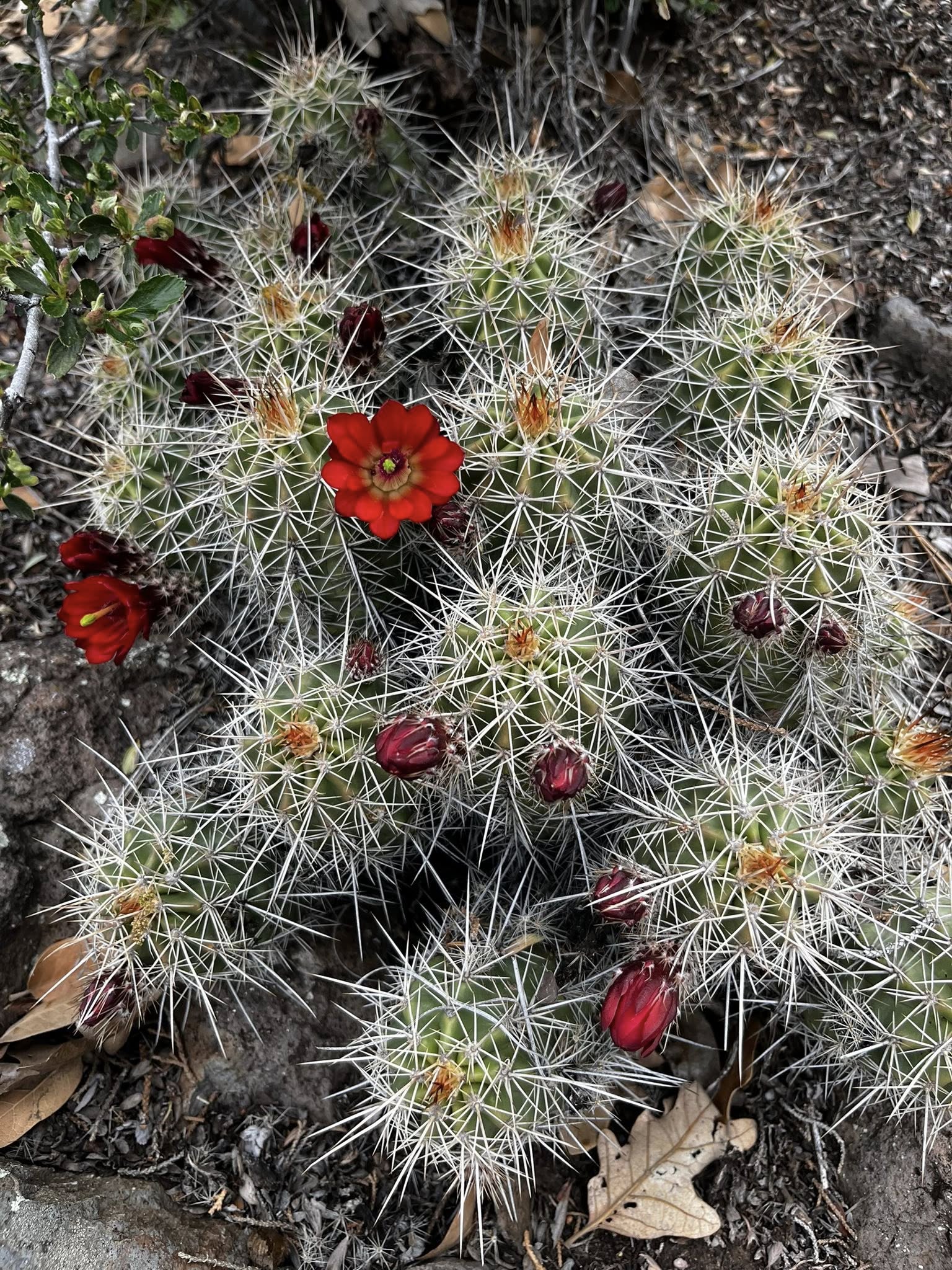
Body clustering, forming bulbous mounds of erect spherical to cylindrical stems. Individual stems run 5–40 cm long and 5–15 cm in diameter, with 5–12 ribs that are blunt and only moderately compressed. Stem epidermis is blue-green to mid-green and largely visible between the spines on most populations, in contrast to the densely spined Mexican-Plateau E. pectinatus. Mature mounds in habitat routinely carry dozens of stems and the largest documented colonies exceed 100 stems within a single cluster a metre or more across. Single-stemmed plants do exist but are far less common than multi-stemmed clumps; the clumping habit is the most reliable field character at the population level.
Spination is the most variable character across the complex and is the reason the varietal taxonomy has been so contested. The nominate subsp. triglochidiatus carries 0–4 central spines per areole, sharply angular and triangular in cross section, 50–120 mm long and stout, with 1–10 radial spines per areole at 15–90 mm, the spines yellowish grey to brownish grey and sometimes darker at the tips. Subsp. mojavensis populations vary by region: California populations often carry stout curling or twisting central spines, while Utah and Colorado populations carry straighter spines. The spineless f. inermis carries no centrals at all (or vestigial spines to 7 mm), giving the plant a uniquely smooth silhouette unusual for a hedgehog cactus, and at the same Great Basin sites fully spined and fully spineless plants can occur side by side.
Flowers are the consistent diagnostic across the entire complex. Colour is uniformly bright scarlet to orange-red across all populations and varieties; no yellow, pink, or purple-flowered form of E. triglochidiatus sensu stricto exists. Funnelform, 4–10 cm long and 3–7 cm wide, with a tube 20–35 mm long. Tepals are rounded, rigid, and waxy, specifically adapted for hummingbird perching: the opening accommodates the bird’s head during nectar access, and the rigid petal structure tolerates the contact pressure. Flowers open in daylight, persist 2–3 consecutive days, and close at night. The multi-day persistence is longer than most other hedgehog cacti and maximises pollination across successive hummingbird foraging rounds. Documented visitors in Arizona populations include broad-tailed (Selasphorus platycercus) and rufous (Selasphorus rufus) hummingbirds; bees may visit but the rigid-petal morphology and the scarlet flower colour favour hummingbirds over insect pollinators across the range.
Fruit is spiny, spherical to obovate, 15–35 mm long, ripening from green to yellow-green or pink, with white pulp and deciduous spines that shed after maturation. Fruit is edible and persists on the plant for two to two and a half months after flowering. The green stigma lobes inside the open flower are diagnostic for the genus.
Locality detail
Echinocereus triglochidiatus has no narrowly defined type locality. Engelmann’s 1848 protologue associates the original material with Wislizenus’s 1846 collecting route through New Mexico territory (present-day New Mexico and southern Colorado), and the USFS FEIS database and Flora of North America treatment associate the type material with the upper Rio Grande drainage. Exact type coordinates are not published in the protologue and pre-date GPS-era documentation, so the type information defers to the upper Rio Grande corridor without sharper designation.
The map above marks centroids rather than precise population coordinates, which suits a wide-ranging species with abundant subpopulations on multiple substrate types across each state. The Colorado centroid covers the official state-cactus range and the high-elevation Colorado Plateau and western Slope populations that supply much of the hardiest seed-line provenance in collector trade. The New Mexico centroid covers the historical type-material region. The central Arizona marker shows the geographically restricted federally-listed var. arizonicus range in the Superstition, Mescal, and Pinal Mountains. The Mojave centroid covers the broader subsp. mojavensis range across California and Nevada, source of most of the spineless f. inermis material in the European and US specialist nursery trade.
Echinocereus triglochidiatus care and cultivation
Echinocereus triglochidiatus is the most beginner-accessible species in the genus and a rewarding cold-hardy cactus for outdoor temperate cultivation. The species tolerates the genus’s preferred mineral-dominant substrates without per-species adjustment, asks only for sharp drainage and full sun through the growing season, and flowers prolifically when winter dormancy is properly cold and dry. The clumping habit means a well-grown plant becomes more visually impressive year on year as the mound expands. The two failure modes that account for almost all losses are winter watering (which produces rapid root collapse at the crown) and insufficient cold dormancy (which produces weak or absent bud set the following spring).
Substrate
The base mix is the genus mineral baseline without modification: 40% pumice (3–6 mm sifted), 20% lava rock (5–10 mm scoria), 15% granite grit (3–5 mm), 10% zeolite (clinoptilolite, 4–6 mm), 5% coarse silica (1–3 mm horticultural grade), and 10% worm castings. The 90/10 inorganic-to-organic ratio is unchanged from the genus framework. The mix carries no limestone, and no lime requirement or lime aversion is established for this species. E. triglochidiatus occupies the widest habitat substrate range in the genus, growing on acidic sandstone-derived soils, neutral igneous loamy sands, and strongly alkaline gypsum-derived soils with equal vigour, but habitat soil is not what sets the pot mix. The White Sands gypsum ecotype and the trade-typical mojavensis or gonacanthus plant from Colorado/Utah igneous-substrate provenance run the same mix.
All five Echinocereus species on this site share the genus 90/10 mineral-organic baseline. The load-bearing variable is limestone: E. pectinatus and E. knippelianus carry limestone in the mix as house convention, not as a species requirement; E. rigidissimus carries none; E. triglochidiatus and E. viridiflorus run the baseline without pH amendment. Hard tap water already supplies calcium and bicarbonate at every watering, while rainwater and RO water supply neither.
| Species | Pumice | Lava | Zeolite | Granite | Limestone | Silica | Organic |
|---|---|---|---|---|---|---|---|
| E. pectinatus | 40% | 5% | 10% | 15% | 15% | 5% | 10% |
| E. rigidissimus | 40% | 20% | 0% | 25% | 0% | 5% | 10% |
| E. triglochidiatus (this page) | 40% | 20% | 10% | 15% | 0% | 5% | 10% |
| E. knippelianus | 40% | 10% | 10% | 15% | 10% | 5% | 10% |
| E. viridiflorus | 40% | 20% | 10% | 15% | 0% | 5% | 10% |
Watering and light
Cease scheduled watering from November through late February. The substrate must be bone dry through this period; winter moisture combined with cool temperatures is the universal cause of catastrophic loss across every grower source consulted. First spring watering should wait until buds are visibly advanced, typically March or early April depending on latitude and exposure: a single thorough soak followed by complete drying over 10–14 days. From April through July, water every 10–14 days when the top 3–5 cm of substrate is fully dry. Reduce frequency from August onward as the growing season tails off, and halt entirely by October. The species is among the more drought-tolerant in the genus at the roots, but the erumpent bud zone at the stem base is sensitive to prolonged wet conditions in cool weather, so water at the pot base rather than over the crown.
Light requirements are full sun, 6–8 hours of direct daily exposure across the growing season. The species grows in open habitat across its entire range and does not benefit from afternoon shade in the manner of E. knippelianus. Reduced light produces etiolation, weakens the colour intensity of the scarlet flowers, and prevents adequate photosynthate accumulation for reliable bud set. Northern European growers should compensate for latitude by maximising reflected light in a south-facing alpine frame or unheated greenhouse rather than reducing the dormancy regime.
Cold tolerance and propagation
The conservative working dry cold floor is −15°C. The trade-typical European and UK plant is overwhelmingly subsp. mojavensis or var. gonacanthus material from high-elevation Colorado and Utah seed lines, not the low-elevation Arizona desert var. arizonicus populations (which tolerate only −6°C) or the absolute hardiest Colorado seed lines (which can survive −25°C). The BCSS forum documents a UK grower’s confirmed survival of an unprotected plant at −17.5°C, and −15°C builds in a 2.5°C safety margin while still reflecting the genuine hardiness of the trade-typical material. Hardier seed-line provenance can take colder still, but wet cold at any temperature kills, so winter dryness is the absolute precondition for every cold-hardiness figure on the page.
Vegetative propagation is unusually practical for this species. The clumping habit generates abundant offsets that separate readily from the mother clump; offsets taken in spring, allowed to callous for 7–10 days and placed on barely moist substrate, root reliably in 3–6 weeks. This makes E. triglochidiatus substantially easier to propagate vegetatively than the single-stemmed E. pectinatus or E. rigidissimus, and a grower who acquires a good clone of f. inermis can expand holdings via offset division without returning to seed. Seed grown plants remain the target for serious collectors: germination at 22–28°C completes in 2–4 weeks, time to first flower from seed is 5–10 years under good cultivation, and seed grown plants develop the natural clumping habit that grafted stock can never fully reproduce.
Comparison
Among the five Echinocereus on this site, E. triglochidiatus presents the lowest field-confusion risk. The combination of the clumping mound habit, the few stout projecting central spines, and the uniformly scarlet hummingbird-pollinated flowers is unique in the genus at the level of any plausible visual lookalike. The pectinate-spined Mexican Plateau E. pectinatus shares neither the spine geometry, the body habit, nor the flower colour, and its largely limestone habitat contrasts with the claret cup’s substrate-indifferent breadth. The Sonoran E. rigidissimus also grows on igneous gravels but presents a solitary cylindrical stem with dense banded pectinate spines and rose-pink flowers, none of which appears in triglochidiatus.
Within the genus the closest field comparison is the Coahuila highland E. knippelianus, which also occasionally clusters but remains small and soft-bodied with weak spination, dark green epidermis, and magenta flowers from the apex; the silhouette and habitat occupancy is at the opposite extreme of the genus from the bristly cylindrical Great Plains E. viridiflorus, which shares the exceptional cold hardiness with triglochidiatus (viridiflorus tolerates −20°C dry) but produces small greenish to yellow-green lemon-scented flowers wholly unlike the large rigid-petalled scarlet flowers of the claret cup. Anyone who has seen a flowering claret cup mound in the field will not confuse it with viridiflorus or knippelianus on any character.
Within the triglochidiatus complex itself the practical distinction at collector scale is geographic and morphological. The nominate subsp. triglochidiatus carries the angularly three-edged central spines that give the species its name. Subsp. mojavensis is the broad Mojave-and-Great-Basin form with variable spination, ranging from twisting central spines (California) through straighter spines (Utah, Colorado) to fully spineless f. inermis. Var. gonacanthus, accepted by Flora of North America but not by POWO, covers plants of intermediate spination between the two POWO-accepted subspecies. The federally-listed var. arizonicus, restricted to central Arizona, carries a much narrower −6°C cold-tolerance floor than the rest of the complex and is not present in collector trade in any case.
Frequently asked questions
Is Echinocereus triglochidiatus hard to grow?
Beginner. The claret cup is among the most beginner-accessible Echinocereus and a good entry point into the genus for collectors moving from common species. It tolerates the genus’s preferred mineral-dominant substrate without per-species adjustment, takes full sun without complaint, and is the most cold-hardy species in the genus when winter dryness is respected. The single hardest discipline is the cold-dry winter rest: the substrate must be bone dry from November through late February and the plant must experience genuine cold (ideally near freezing for an extended window) for reliable bud set the following spring. A plant kept warm and moist through winter typically fails to bud or buds weakly. Beyond that one discipline the species is remarkably forgiving.
Can Echinocereus triglochidiatus be grown from seed?
Yes, and unusually for the genus, vegetative propagation from offsets is also reliably practical. Seed germinates at 22–28°C with germination typically inside two to four weeks under standard top-sown conditions on moist well-drained seed compost. Time to first flower from seed is five to ten years under good cultivation with a respected winter rest. The clumping habit also generates abundant offsets through the growing season; offsets taken in spring, allowed to callous for seven to ten days and placed on barely moist substrate, root reliably in three to six weeks. This makes E. triglochidiatus substantially easier to propagate vegetatively than the single-stemmed E. pectinatus or E. rigidissimus. Seed grown plants remain the target for serious collectors because they develop the natural clumping habit that grafted stock cannot reproduce.
Is Echinocereus triglochidiatus legal to own?
Yes for the trade-typical material, with one taxonomic wrinkle. The species as a whole is IUCN Least Concern (2013) and falls under the CITES Appendix II blanket listing for Cactaceae, which permits international commercial trade with proper documentation: an export permit from the country of origin and an import permit where the receiving country requires one. Domestic trade in nursery-propagated material within a single country does not require CITES permits. The wrinkle is var. arizonicus, the Arizona hedgehog cactus, which has been listed under the US Endangered Species Act since 25 October 1979 with the listed populations confined to central Arizona. That variety is not present in the collector trade. Plants sold in European and US cultivation under the bare name E. triglochidiatus are almost universally subsp. mojavensis or var. gonacanthus material from high-elevation Colorado and Utah provenance, none of which carries any federal listing.
Where does Echinocereus triglochidiatus grow in the wild?
Across the US Southwest and northern Mexico in the widest geographic and elevational range of any species in the genus. The US distribution covers seven states: Arizona, California, Colorado, Nevada, New Mexico, Texas, and Utah, with Colorado holding the species as its official state cactus. The Mexican distribution extends into Sonora, Chihuahua, Coahuila, and Baja California Norte but does not cross into central Mexico. Elevation runs from 150 metres in the low Mojave Desert and Sonoran bajadas of California and Nevada up to 3,500 metres in conifer woodland and pine-oak ecotone in Colorado and New Mexico. Habitat types include upper Mojave Desert rocky slopes, Chihuahuan Desert grassland, pinyon-juniper and juniper-oak woodland, and the margins of ponderosa pine and mixed conifer forest at the upper elevations.
When does Echinocereus triglochidiatus flower?
April through June at lower and mid elevations, with high-elevation populations in Colorado and New Mexico blooming as late as July. Individual flowers are funnel-shaped, four to ten centimetres long and three to seven centimetres wide, and uniformly bright scarlet to orange-red across all populations and varieties; no yellow, pink, or purple-flowered form of the species sensu stricto exists. Flowers open in daylight and persist two to three consecutive days each, closing at night, the multi-day persistence being longer than most other hedgehog cacti. The rounded, rigid, waxy tepals are specifically adapted for hummingbird perching, and the documented pollinators in Arizona populations are the broad-tailed (Selasphorus platycercus) and rufous (Selasphorus rufus) hummingbirds. The flowering season coincides with the northward spring migration of rufous hummingbirds, making the species an important early-season nectar source in southwestern native gardens.
Sources & further reading
Engelmann, G. (1848). Echinocereus triglochidiatus sp. nov. In: Wislizenus, A. Memoir of a Tour to Northern Mexico: 91 · Kew POWO, Echinocereus triglochidiatus Engelm., IPNI lsid urn:lsid:ipni.org:names:30030656-2 · Kew POWO, E. triglochidiatus subsp. mojavensis (Engelm. & J.M.Bigelow) W.Blum & Mich.Lange · Kew POWO, E. triglochidiatus f. inermis (K.Schum.) W.Blum · Flora of North America Editorial Committee. Echinocereus triglochidiatus. Flora of North America vol. 4. floranorthamerica.org · USFS Fire Effects Information System (FEIS). Echinocereus triglochidiatus. fs.usda.gov/database/feis · IUCN Red List. Echinocereus triglochidiatus assessment 2013 (Least Concern); Terry, M., Heil, K. & Corral-Diaz, R. Record e.T152410A633801. iucnredlist.org · US Fish and Wildlife Service. Arizona hedgehog cactus (E. triglochidiatus var. arizonicus) species profile; federal Endangered listing 25 October 1979. fws.gov · USFWS Environmental Conservation Online System (ECOS), Echinocereus arizonicus subsp. arizonicus, TSN 1702. ecos.fws.gov · USGS Open-File Report 2019-1004. Arizona hedgehog cactus systematic data assessment in support of recovery. pubs.usgs.gov · CITES Appendix II Cactaceae blanket listing; E. triglochidiatus taxonomy record. cites.org · Anderson, E.F. (2001). The Cactus Family. Timber Press. ISBN 0-88192-498-9 · llifle, Encyclopedia of Living Forms. Echinocereus triglochidiatus; subsp. mojavensis; var. gonacanthus; var. inermis. llifle.com · British Cactus and Succulent Society. E. triglochidiatus subsp. mojavensis; Cultivation notes on Echinocereus; cold-hardy cacti forum thread (documented −17.5°C UK survival). bcss.org.uk · Gardeners’ Path. Claret Cup Cactus care guide. gardenerspath.com · North American Rock Garden Society. Echinocereus triglochidiatus complex. nargs.org · Native Plant Society of New Mexico. E. triglochidiatus. npsnm.org · Lady Bird Johnson Wildflower Center. E. triglochidiatus. wildflower.org · World Flora Online (WFO) Plant List. E. t. subsp. mojavensis (December 2024). wfoplantlist.org · Cold Hardy Cactus (specialist nursery). EC005 E. t. v. inermis; Zone 3 hardiness claim. coldhardycactus.com · Wikipedia. Echinocereus triglochidiatus; Echinocereus (genus). en.wikipedia.org