
Echinocereus pectinatus
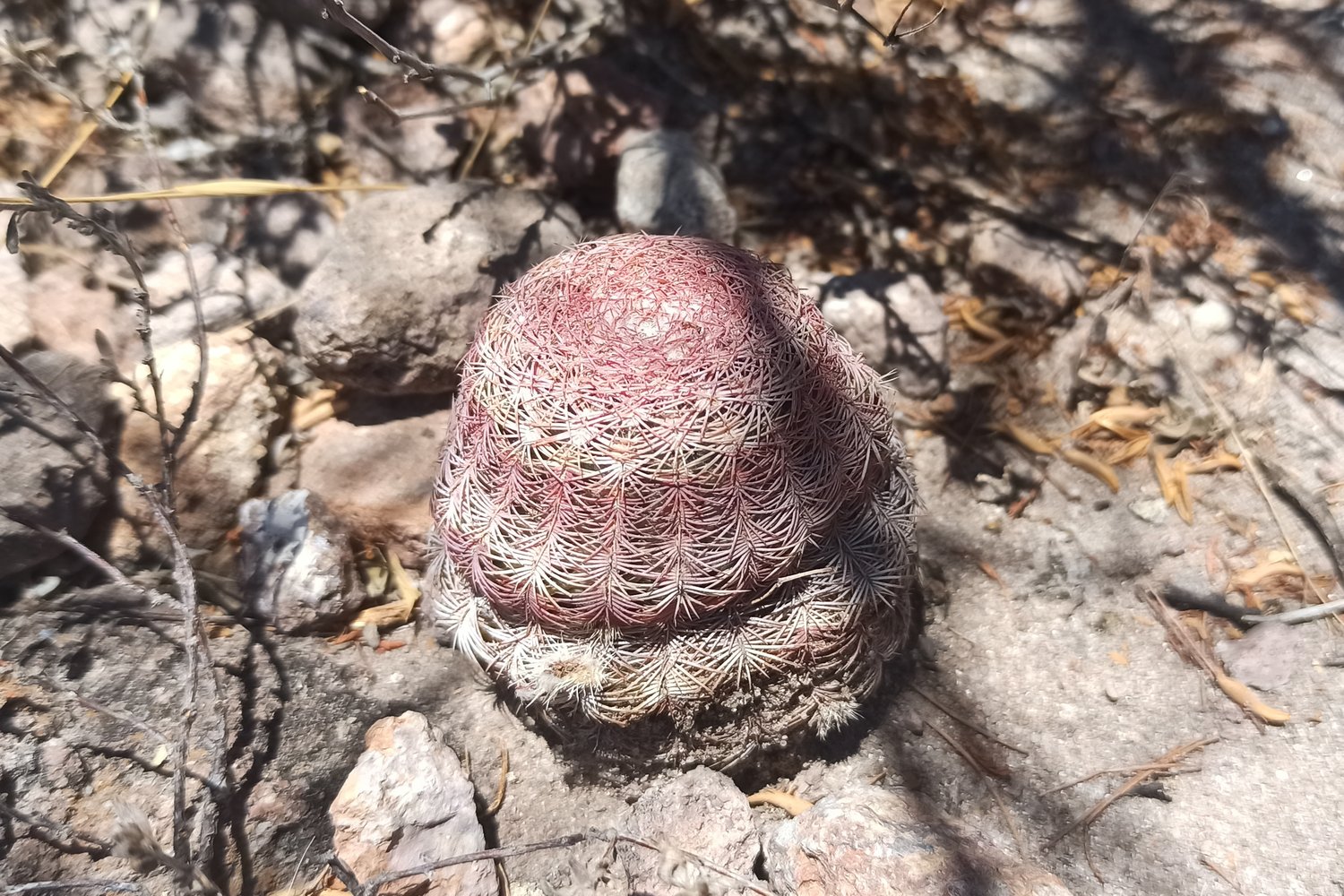
Echinocereus pectinatus (Scheidw.) Engelm. is the comb-spined hedgehog cactus of the central Mexican Plateau, described from cultivated Mexican material by Michael Joseph François Scheidweiler in 1838 as Echinocactus pectinatus and transferred to Echinocereus by George Engelmann ten years later, in the same 1848 publication that established the genus. The Latin epithet pectinatus means “comb-like” and refers directly to the diagnostic spine arrangement: the radials lie flat against the rib surface in tight parallel rows like the teeth of a comb, rather than projecting outward as in most other hedgehog cacti.
Three subspecies are accepted by Kew POWO. The nominate E. pectinatus subsp. pectinatus is the most commonly encountered form in collector cultivation, ranging across nine Mexican states from Sonora and Chihuahua south through San Luis Potosí and Zacatecas. Subsp. rutowiorum is a narrow Chihuahuan endemic with finer spination. Subsp. wenigeri is the only form to reach the United States, occupying the Trans-Pecos limestone country of Brewster, Presidio, and Terrell counties in Texas. Across the species range, populations sit on alkaline limestone-derived soils in xerophyllous scrub between 400 and 1,900 m elevation.
Among the five Echinocereus taxa covered on this site, E. pectinatus sits between the larger Sonoran Echinocereus rigidissimus and the small soft-bodied Echinocereus knippelianus of the Coahuila pine-grasslands. The pectinate spination groups it with rigidissimus; the habitat rock does not. E. rigidissimus grows on acidic igneous gravels. E. pectinatus grows directly on limestone hills.
The trade name “rainbow cactus” is shared between this species and E. rigidissimus, which causes routine mislabelling in commerce. The pink-and-white banding effect is real for both, but the spine geometry differs: pectinatus carries 12–30 pectinate radials per areole with one to five short central spines, while rigidissimus shows denser, shorter radials with essentially no centrals at all. The Echinocereus triglochidiatus claret cup of the US Southwest carries no pectinate spination at all and produces scarlet hummingbird-pollinated flowers, removing it from any field-confusion shortlist with pectinatus.
Echinocereus pectinatus quick reference
A hedgehog cactus of the central Mexican Plateau, growing on alkaline limestone-derived soils between 400 and 1,900 m. Values calibrated for seed grown plants in cultivation, drawn from species-specific habitat data and grower consensus across multiple specialist sources for E. pectinatus rather than genus-level extrapolation.
Taxonomy & nomenclature
The accepted name is Echinocereus pectinatus (Scheidw.) Engelm., with the basionym Echinocactus pectinatus Scheidweiler published in Bulletin de l’Académie Royale des Sciences et Belles-Lettres de Bruxelles 5: 492 (1838). George Engelmann transferred the species to Echinocereus in 1848 in Wislizenus’s Memoir of a Tour to Northern Mexico, the same publication in which he established the genus. Kew POWO accepts the Engelmann combination as the current name (IPNI lsid urn:lsid:ipni.org:names:30000026-2).
POWO recognises three subspecies: the nominate E. pectinatus subsp. pectinatus across northern and central Mexico, E. pectinatus subsp. rutowiorum W.Blum (a Chihuahuan endemic named for the German cactus cultivator Willi Rutow), and E. pectinatus subsp. wenigeri (L.D.Benson) W.Blum & Rutow, the only form reaching the United States. The Texas rainbow cactus formerly treated as E. pectinatus var. dasyacanthus is now accepted by POWO and the Flora of North America at species rank as E. dasyacanthus, removing it from the pectinatus complex entirely.
Principal heterotypic synonyms include the older combinations Cereus pectinatus (Scheidw.) Engelm., still encountered in older US botanical literature and on llifle.com, and Echinocactus pectiniferus Engelm., a 19th-century US-literature form of the name. The trade vernacular “rainbow cactus” is shared with E. rigidissimus in commerce; iNaturalist uses “Spiny Hedgehog Cactus” as the preferred English vernacular, which avoids the collision.
Historical synonyms (6)
- Echinocereus pectinatus var. texensis Rümpler, 1885 homotypic synonym
- Echinocereus pectinatus var. baueri Rother, 1923 homotypic synonym
- Echinocereus pectinatus var. crassispinus Runge, homotypic synonym
- Echinocereus pectinatus var. tamaulipensis Fric, homotypic synonym
- Echinocactus pectiniferus Lem., heterotypic synonym
- Echinocactus pectiniferus var. laevior Lem., heterotypic synonym
Sources: POWO (Kew) · IPNI · GBIF · Wikidata
Habitat
Echinocereus pectinatus ranges across nine Mexican states and into the Trans-Pecos region of southwestern Texas. The Mexican range covers Aguascalientes, Chihuahua, Coahuila, Durango, Guanajuato, Nuevo León, San Luis Potosí, Sonora, Tamaulipas, and Zacatecas. The US range, restricted to subsp. wenigeri, covers Brewster, Presidio, and Terrell counties. Elevation across the species range runs from 400 m on Chihuahuan Desert limestone bajadas up to 1,900 m in the oak-grassland and pine-oak transition of the Sierra Madre.
The primary habitat is rocky slopes and flats on limestone outcrops and limestone-derived soils within Chihuahuan Desert xerophyllous scrub and degraded semi-arid grassland communities. Substrate pH at the population level is alkaline, broadly between 7.0 and 8.0 from limestone parent rock chemistry. A minority of populations occur on sandy or gravelly non-limestone xerophyllous scrub with slightly lower pH, but the IUCN 2017 assessment and the Flora of North America treatment both identify limestone hills as the primary habitat. This is a meaningful contrast with the closely related E. rigidissimus, which grows on acidic igneous Sonoran gravels.
Climate at population level falls into the Chihuahuan Desert monsoon-driven pattern. Summer rainfall arrives July through September and triggers the main growth flush; winters are cold and dry, with lower-elevation populations rarely seeing extended freezes and higher Sierra Madre populations exposed to genuine winter cold. The Trans-Pecos Texas range of subsp. wenigeri is colder than the Mexican nominate range, with Brewster County recording event-level lows around −12°C; Mexican populations at comparable elevations are somewhat sheltered by Sierra Madre topography.
Morphology
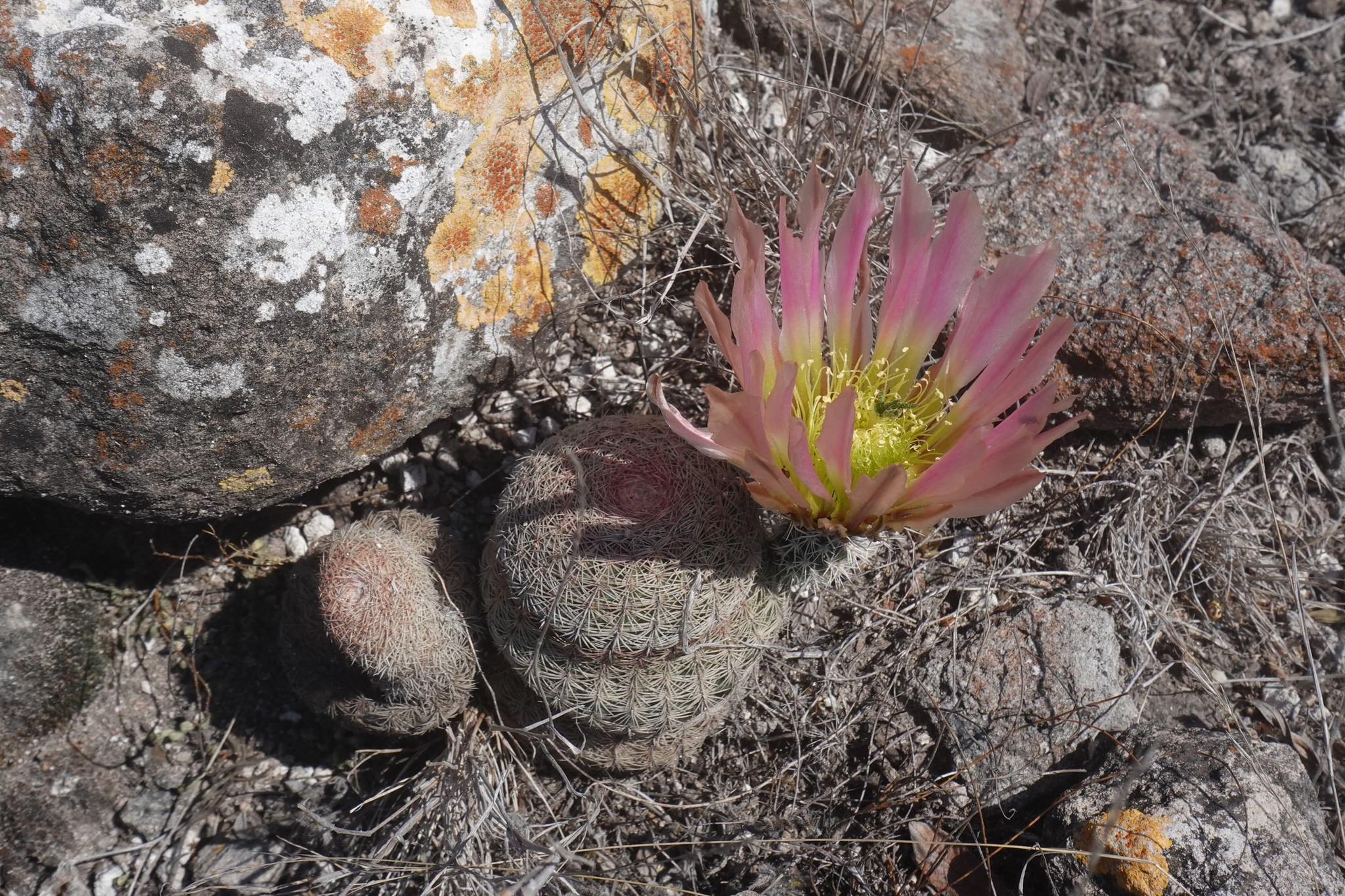
Body upright, spherical to short-cylindrical when young and elongating to narrowly cylindrical with age. Mature plants typically remain solitary; basal offsetting is occasional but the species is not a clustering grower in the manner of E. triglochidiatus. Stem dimensions reach 8–35 cm tall and 3–13 cm in diameter for the nominate subspecies; subsp. wenigeri runs smaller, to 20 cm tall and 10 cm wide per the Flora of North America. Stem epidermis is green to grey-green and largely hidden by the dense spination on healthy plants.
The ribs number 12–23, blunt, compressed, and relatively low. Areoles are white-felted, elliptical, approximately 3 mm long, and closely set along the ribs at intervals tight enough that mature spination produces an almost unbroken white-and-pink surface cover on the upper stem. Radial spines run 12–30 per areole, comb-arranged (pectinate), lying flat against the rib in lateral rows and slightly recurved toward the stem; lengths run 5–15 mm. Fresh radial growth is whitish-pink to pink, fading to whitish or grey-white as the spine ages. The banding effect arises from differential pigment retention between successive growth increments, not from generationally distinct spines as in E. rigidissimus. Central spines run 1–5 per areole, yellowish to pink to brownish, 1–25 mm long; their relative shortness keeps the pectinate silhouette clean.
Flowers are funnel-shaped, 5–12 cm in diameter for the nominate subspecies (occasional reports to 15 cm in the widest-flowered forms), deep pink to magenta with paler whitish-pink throats and the green stigma lobes diagnostic of the genus. Flowers emerge laterally, erumpent through the epidermis adjacent to (rather than from) spine-bearing areoles, the genus-defining mechanism. They open in daylight and persist 3–5 days per flower under typical conditions; a plant in full bloom carries several open flowers simultaneously. Pollination is most probably by medium-sized solitary bees of the Chihuahuan Desert, consistent with the pink-magenta flower colour pattern across the genus, though no peer-reviewed pollinator study specific to E. pectinatus has been located. Fruit is round to elliptical, 2–3 cm in diameter, spiny, green maturing to greenish-purple to deep purple, fleshy and edible, dehiscent along a longitudinal slit; seeds are small and black.
Locality detail
Echinocereus pectinatus has no narrowly defined type locality. Scheidweiler described the basionym in 1838 from cultivated Mexican material, and the protologue does not record a precise field site; isotype and syntype material is held at the National Botanic Garden of Belgium (BR, Brussels) and at Paris (P), without georeferenced collection coordinates. No formal lectotypification has been published in the literature consulted for this page, so the type information defers to country-level Mexico without sharper designation.
The map above marks state-level centroids rather than population coordinates, which suits a wide-ranging species with abundant subpopulations on multiple limestone outcrops across each state. Chihuahua, Coahuila, and San Luis Potosí cover the heart of the Mexican range; Aguascalientes, Durango, Guanajuato, Nuevo León, Sonora, Tamaulipas, and Zacatecas extend the distribution across the broader Plateau. Trans-Pecos Brewster County represents the US distribution of subsp. wenigeri; Presidio and Terrell counties carry additional subsp. wenigeri populations. iNaturalist records 1,949 observations for the nominate subspecies and 241 for subsp. rutowiorum, consistent with the broader distribution of the nominate.
Echinocereus pectinatus care and cultivation
Echinocereus pectinatus ranks among the most reliable Echinocereus in collector cultivation. The species tolerates the mineral-dominant substrates the genus prefers, flowers prolifically when winter dormancy is respected, and is less sensitive to humidity than the high-elevation Coahuila endemics. The two failure modes that account for almost all losses are root rot from winter watering and failure to bud the following spring after a warm winter. Both are operator errors rather than species-level fragility, and both are avoided by respecting the dry-cool November-to-February rest.
Substrate
The base mix is the genus mineral framework with a limestone supplement: 40% pumice, 5% lava, 10% zeolite, 15% granite grit, 15% crushed limestone chips (3–6 mm horticultural limestone or oyster shell chip), 5% coarse silica, and 10% worm castings. The 90/10 inorganic-to-organic ratio is unchanged from the genus baseline; the 15% limestone fraction is house convention rather than a species requirement, and the alkaline limestone-derived soils across the species’ range on the central Mexican Plateau are a habitat fact, not the reason for it. Hard tap water already supplies calcium and bicarbonate at every watering; rainwater and RO water supply neither.
All five Echinocereus species on this site share the genus 90/10 mineral-organic baseline. The load-bearing variable is limestone: E. pectinatus and E. knippelianus carry limestone in the mix as house convention rather than a species requirement; E. rigidissimus carries none, and no source establishes a lime aversion for it; E. triglochidiatus and E. viridiflorus run the baseline with no limestone.
| Species | Pumice | Lava | Zeolite | Granite | Limestone | Silica | Organic |
|---|---|---|---|---|---|---|---|
| E. pectinatus (this page) | 40% | 5% | 10% | 15% | 15% | 5% | 10% |
| E. rigidissimus | 40% | 20% | 0% | 25% | 0% | 5% | 10% |
| E. triglochidiatus | 40% | 20% | 10% | 15% | 0% | 5% | 10% |
| E. knippelianus | 40% | 10% | 10% | 15% | 10% | 5% | 10% |
| E. viridiflorus | 40% | 20% | 10% | 15% | 0% | 5% | 10% |
Watering and light
Cease scheduled watering from November through February. The substrate must be bone dry at the pot base through this period; winter moisture combined with cool temperatures is the single most-cited cause of catastrophic loss for the species across every grower source consulted. First spring watering should wait for visible bud emergence, typically March: a single thorough soak followed by complete drying over 10–14 days. From April through September, water when the top 3–5 cm of substrate is fully dry, generally every 10–14 days at temperate latitudes and slightly more often during a hot dry summer under glass. Water at the base, not from above; the densely spined crown dries slowly and damp spines pressed against areoles can introduce rot pathways.
Light requirements are full sun, 6–8 hours of direct daily exposure for fully developed spine colour and reliable flowering. The pink-banded radial spines that drive the species’s visual appeal require strong UV to express; plants grown indoors at moderate light produce pale washed-out radials, etiolate the stem, and lose the display character that justifies the species in the first place. A south-facing windowsill is the indoor minimum; outdoor summer growing in temperate climates is strongly preferred.
Cold tolerance and repotting
The dry cold floor for the nominate subspecies is −10°C, confirmed by independent sources including llifle and the freakycacti cold-hardiness compilation. The wet-cold tolerance is much narrower: combined moisture and cool temperatures cause rapid root collapse well before the dry-cold limit is approached. Subsp. wenigeri in Trans-Pecos Texas is exposed to harder winters than the Mexican nominate populations and may tolerate slightly lower temperatures, but no specialist source quantifies the difference precisely; the −10°C floor is the conservative figure to plan around. Repot every two years in spring before first watering, when the root system is at its driest and least vulnerable to disturbance. A shallow wide pot suits the relatively flat root architecture; the weak root system rewards minimal handling.
Comparison
Among the five Echinocereus on this site, the closest field comparison for E. pectinatus is E. rigidissimus, which shares the dense pectinate radial spination, the broadly cylindrical body form, and the trade name “rainbow cactus”. The two diverge on habitat rock and spine geometry. E. rigidissimus sits on acidic igneous Sonoran gravels; E. pectinatus grows on Mexican Plateau limestone hills, though neither rock type sets a lime requirement or a lime aversion in cultivation. The radial count overlaps but rigidissimus runs denser (often 30 or more radials per areole in the rubispinus form) and shorter, with essentially no central spines, while pectinatus carries 12 to 30 radials and one to five centrals.
E. triglochidiatus presents no real identification challenge: the claret cup is a clumping species with relatively few stout projecting spines, scarlet hummingbird-pollinated flowers (rather than pectinatus’s pink-magenta funnel-flowers), and a hardiness floor near −25°C that places it in a different cultivation tier altogether. E. knippelianus is at the opposite extreme of the genus: small, soft-bodied, weakly spined, dark green, and shade-tolerant under pine canopy in Coahuila highland; nothing about its silhouette or habitat resembles the comb-spined limestone-loving pectinatus. E. viridiflorus of the US Great Plains has greenish yellow-green lemon-scented flowers, an order of magnitude colder hardiness floor (−20°C dry), and the body silhouette of a small bristly cylinder rather than the clean pectinate rainbow stem of pectinatus.
Within the pectinatus complex, the practical subspecies distinction at collector scale is geographic: the nominate is the dominant Mexican form across most of the range and the most common in the trade; subsp. rutowiorum is the compact Chihuahuan endemic with finer spination and appears occasionally in specialist nursery lists; subsp. wenigeri is the smaller-bodied Trans-Pecos US form with fewer radials per areole and a wider areole spacing. All three share the −10°C dry-cold floor for cultivation purposes.
Frequently asked questions
Is Echinocereus pectinatus hard to grow?
Intermediate. The species is among the most cooperative hedgehogs in collector cultivation: it tolerates the genus’s preferred mineral-dominant substrate, asks only for sharp drainage and full sun, and flowers prolifically when winter dormancy is respected. The single hardest thing is the dry winter rest. Substrate must be bone dry from November through February, with temperatures between 5 and 10°C if possible; winter moisture combined with cool temperatures is the universal cause of catastrophic losses across every grower source. Beyond that one discipline, the species is undemanding.
Can Echinocereus pectinatus be grown from seed?
Yes, and seed grown plants are the target for serious collectors. Seed germinates at around 25°C substrate temperature with germination typically inside two weeks under standard top-sown conditions on a moist well-drained seed compost. Time to first flower from seed is three to five years under good cultivation with a respected winter rest, six to eight years under poor conditions or without dormancy. Grafted plants on Trichocereus or Harrisia rootstocks flower within 18 months but produce a more globose body with a root system that never develops the fibrous drought-tolerant architecture of a seed grown plant. Chiltern Seeds and other specialist suppliers stock mixed-variety E. pectinatus seed; subspecies-specific seed appears in specialist German and Italian seed lists.
Is Echinocereus pectinatus legal to own?
Yes, with documentation. E. pectinatus falls under the CITES Appendix II blanket listing for Cactaceae, which permits international commercial trade with proper permits: an export permit from the country of origin and an import permit where the receiving country requires one. Mexican law additionally lists the species under NOM-059-SEMARNAT-2010 as subject to federal protection. Domestic trade in nursery-propagated material within a single country does not require CITES permits. The legally and ethically defensible source is documented seed grown nursery stock; wild-collected plants from Mexico or Texas are not legally tradeable without CITES documentation, which is not issued for wild-collected material under the standard regime.
Where does Echinocereus pectinatus grow in the wild?
Across the central and northern Mexican Plateau and into the Trans-Pecos region of southwestern Texas. The Mexican range covers nine states: Aguascalientes, Chihuahua, Coahuila, Durango, Guanajuato, Nuevo León, San Luis Potosí, Sonora, Tamaulipas, and Zacatecas. The US range is restricted to subsp. wenigeri in Brewster, Presidio, and Terrell counties. Elevation runs from 400 m on Chihuahuan Desert limestone bajadas up to 1,900 m in the oak-grassland and pine-oak transition of the Sierra Madre. Habitat is rocky slopes and flats on limestone outcrops within xerophyllous scrub or semi-arid grassland, on alkaline soils between pH 7.0 and 8.0.
When does Echinocereus pectinatus flower?
April through July at typical European and US cultivation latitudes for the nominate subspecies, with lower-elevation populations flowering as early as April and higher-elevation or US Trans-Pecos populations peaking in May and June. Individual flowers are 5 to 12 cm in diameter, deep pink to magenta with paler whitish-pink throats and the diagnostic green stigma lobes of the genus. Flowers open in daylight, persist three to five days each, and a well-grown plant carries several open simultaneously through the peak of the season. Pollination is most probably by medium-sized solitary bees of the Chihuahuan Desert, consistent with the pink-magenta colour and funnel form across the genus, though no peer-reviewed pollinator study specific to E. pectinatus has been located.
Sources & further reading
Scheidweiler, M.J.F. (1838). Echinocactus pectinatus sp. nov. Bulletin de l’Académie Royale des Sciences et Belles-Lettres de Bruxelles 5: 492 · Engelmann, G. (1848). Echinocereus pectinatus comb. nov. In: Wislizenus, A. Memoir of a Tour to Northern Mexico · Kew POWO, Echinocereus pectinatus (Scheidw.) Engelm., IPNI lsid urn:lsid:ipni.org:names:30000026-2 · IPNI, urn:lsid:ipni.org:names:30000026-2 · Flora of North America Editorial Committee. Echinocereus pectinatus and var. wenigeri. Flora of North America vol. 4. eFloras.org · IUCN Red List. Echinocereus pectinatus assessment 2017 (Least Concern). iucnredlist.org/species/2947851 · Anderson, E.F. (2001). The Cactus Family. Timber Press. ISBN 0-88192-498-9 · llifle, Encyclopedia of Living Forms, Echinocereus pectinatus (as Cereus pectinatus). llifle.com · cactus-art.biz, Echinocereus pectinatus ssp. pectinatus. cactus-art.biz · World of Succulents. Echinocereus pectinatus (Rainbow Cactus). worldofsucculents.com · GBIF. Echinocereus pectinatus occurrence dataset. gbif.org/species/101338289 · US Fish and Wildlife Service. Echinocereus pectinatus ssp. wenigeri species profile. fws.gov · Lady Bird Johnson Wildflower Center. Echinocereus pectinatus var. wenigeri. wildflower.org · Henry Shaw Cactus and Succulent Society. Echinocereus (Plant of the Month 2018). hscactus.org · CITES Appendix II Cactaceae blanket listing; Echinocereus pectinatus species entry. cites.org · freakycacti. Cactus Cold Hardiness by Minimum Temperature compilation. freakycacti.com · Chiltern Seeds catalogue. Echinocereus pectinatus mixed varieties seed. chilternseeds.co.uk · EarthOne.io. How to Grow Echinocereus pectinatus. earthone.io · Wikipedia. Echinocereus pectinatus; Echinocereus (genus). en.wikipedia.org