
Echinocereus rigidissimus
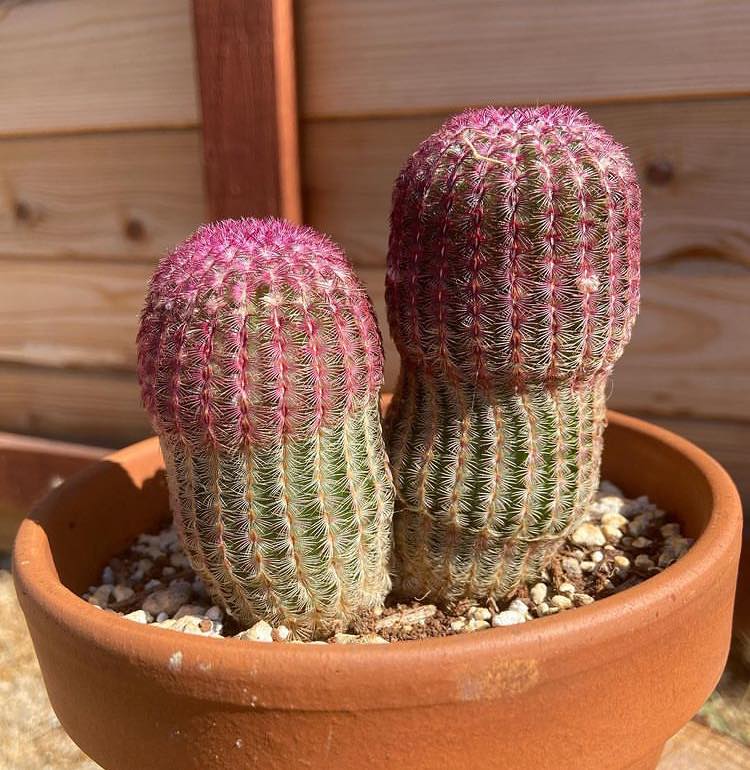
Echinocereus rigidissimus (Engelm.) Hirscht is the rainbow hedgehog cactus of the Sonoran borderlands, described by George Engelmann in 1856 as Cereus pectinatus var. rigidissimus and elevated to species rank under Echinocereus by Karl Hirscht in 1896. The Latin epithet is the superlative of rigidus, “very stiff,” and refers to the notably inflexible pectinate radial spines that lie flat against the ribs in a tight comb pattern. The trade and collector vernacular is more evocative: it is the rainbow cactus, named for the horizontal bands of ruby, pink, and white that encircle the stem as the areole-borne spines fade with age.
Two subspecies are accepted by Kew POWO. The nominate E. rigidissimus subsp. rigidissimus ranges across south-eastern Arizona, extreme south-western New Mexico, northern Sonora, and north-western Chihuahua at 1,200–2,000 m on south-facing igneous gravels and rocky benches. Subsp. rubispinus (Gerhart Frank & A.B.Lau) N.P.Taylor is a narrow micro-endemic restricted by POWO to the Sierra Oscura of western Chihuahua, with denser, shorter, and far more saturated ruby spines than the nominate; it is the form that drives the most intense collector interest and the most rigorous trade in seed grown stock.
Among the five Echinocereus on this site, E. rigidissimus shares its pectinate spine geometry with the closely related Echinocereus pectinatus of the central Mexican Plateau but separates cleanly on habitat geology: pectinatus grows on alkaline limestone hills, while rigidissimus grows on acidic igneous Sonoran gravels. That habitat split does not set the pot mix. The limestone in the pectinatus mix is grower convention and the rigidissimus mix leaves it out, but no source establishes either species as needing lime or being harmed by it.
The horizontal banding effect that gives the species its identity is a function of areole age and light intensity, not pigmentation in mature spines. New spines emerge ruby-red to magenta at the growing apex, fade progressively through pink to pale pink, and settle as near-white on the older lower stem. Because growth is indeterminate and continuous from the crown downward, a healthy plant carries all three bands at once. Light is the trigger: plants kept in reduced light produce uniformly pale spines and lose the display character entirely. The Echinocereus triglochidiatus claret cup of the US Southwest carries no pectinate spination and produces scarlet hummingbird-pollinated flowers, removing it from any field-confusion shortlist with rigidissimus.
Echinocereus rigidissimus quick reference
A hedgehog cactus of the Sonoran borderlands, growing on south-facing igneous gravels at 1,200–2,000 m. Values calibrated for seed grown plants in cultivation, drawn from species-specific habitat data and grower consensus across specialist sources for E. rigidissimus rather than genus-level extrapolation.
Taxonomy & nomenclature
The accepted name is Echinocereus rigidissimus (Engelm.) Hirscht, with the basionym Cereus pectinatus var. rigidissimus Engelm. published in 1856. Kew POWO records the combining author as Hirscht, who published the transfer in Monatsschrift für Kakteenkunde 6: 127 in 1896 (IPNI lsid urn:lsid:ipni.org:names:88002-2). The species is widely cited in collector and nursery literature under the alternative authority (Engelm.) F.Haage, reflecting a competing 1897 claim by the Kakteen-Haage company in Erfurt; both citations refer to the same species, and POWO takes precedence on authorship for this page.
POWO recognises two subspecies. The nominate E. rigidissimus subsp. rigidissimus ranges across south-eastern Arizona, extreme south-western New Mexico, northern Sonora, and north-western Chihuahua. E. rigidissimus subsp. rubispinus (Gerhart Frank & A.B.Lau) N.P.Taylor is a narrow micro-endemic restricted by POWO to the Sierra Oscura of western Chihuahua, with denser, shorter, ruby-purple spines (30–35 per areole, against 16–22 in the nominate) and a narrower stem to about 7 cm in diameter. The subspecies was published by Frank and Lau in Kakteen und andere Sukkulenten 33: 35 (1982) at varietal rank under E. pectinatus using the spelling rubrispinus (two r’s); when N.P.Taylor elevated it to subspecific rank under E. rigidissimus the epithet was corrected to rubispinus (one r), the form now accepted by POWO and IPNI. Trade literature is split, with both spellings still in active commercial use; the page leads with rubispinus as the nomenclaturally accepted form and notes the basionym spelling here so search traffic on either form lands on a useful page.
Principal heterotypic synonyms include Echinocereus pectinatus var. rigidissimus (Engelm.) Rümpler, the historical treatment of rigidissimus as an infraspecific form of E. pectinatus, and Echinocereus dasyacanthus var. rigidissimus (Engelm.) W.T.Marshall. The pectinatus and dasyacanthus infraspecific combinations both predate the modern POWO arrangement, which treats rigidissimus, pectinatus, and dasyacanthus as three distinct species. The trade name “rainbow cactus” is shared with E. pectinatus and E. dasyacanthus, which causes routine mislabelling in commerce; the spine geometry is the cleanest field separator.
Habitat
Echinocereus rigidissimus sensu lato ranges across the Sonoran-Chihuahuan borderlands of the south-western United States and north-western Mexico. The US range covers central-south and south-eastern Arizona and the extreme south-western corner of New Mexico. The Mexican range extends into northern Sonora and north-western Chihuahua. Elevation across the nominate subspecies runs from 1,200 to 2,000 m, with the species favouring south-facing slopes, gravelly hills, rocky benches, and steep canyon sides across that band.
Subsp. rubispinus sits inside this broader picture as a narrow micro-endemic. POWO restricts it to western Chihuahua, specifically the Sierra Oscura, and Alfred Lau’s 1980s field number L088 (later LAU0088) records the type collection from Sierra Obscura at 1,800 m. Trade literature commonly extends the subspecies’ range to northern Sonora, but no herbarium voucher or peer-reviewed publication confirms a Sonoran subsp. rubispinus population in the sources consulted for this page; the broader Sonoran range belongs to the nominate and to the species s.l., not specifically to rubispinus. The Sierra Oscura type collection sits at the upper end of the species elevation band, around 1,800 m, in volcanic or igneous-derived terrain.
Substrate at the population level is acidic, lime-poor, and fast-draining. llifle.com describes the species’ habitat substrate as poor in lime and usually acid; Giromagi independently describes subsp. rubispinus as growing in non-calcareous soils with a recommended cultivation pH between 5 and 7. The geology of the south-eastern Arizona type area is igneous-derived rather than calcareous, and the Sierra Oscura of western Chihuahua is itself a volcanic-igneous zone. No cultivation source establishes the species as a certified calcifuge, though the documented habitat chemistry does not support a calcium-carbonate-heavy substrate either. Climate at population level is the Sonoran summer-rainfall pattern, with the monsoon flush from July through September driving the post-flowering body-growth phase, and a cold-dry winter rest with overnight lows that may reach −5 to −12°C depending on elevation.
Morphology
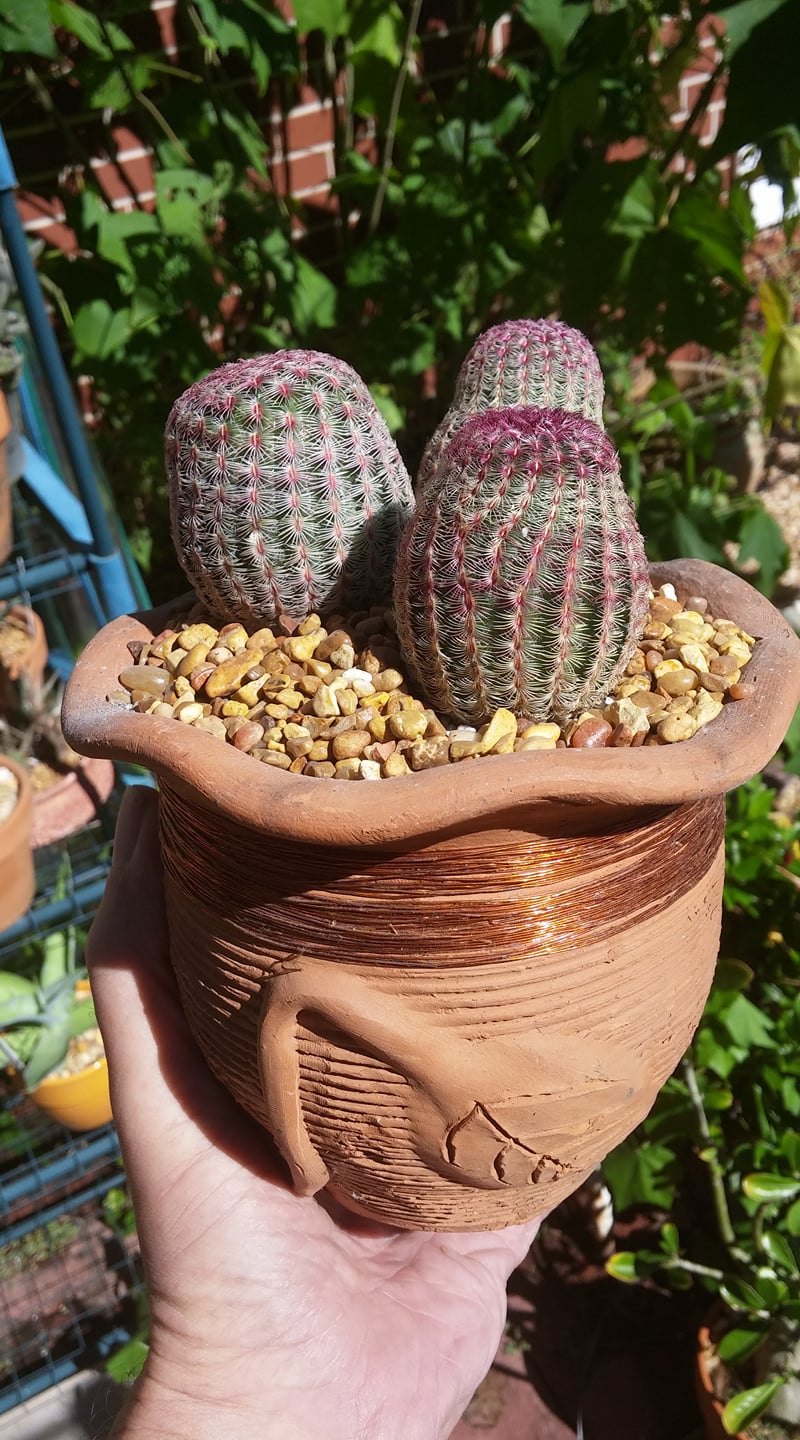
Body solitary and rarely branching, short-cylindrical when young and elongating to broadly cylindrical with age. Mature plants typically reach 6–30 cm tall and 4–11 cm in diameter, with one Santa Catalina Mountains record at 48 cm tall (Wikipedia, E. rigidissimus). The Royal Horticultural Society places the cultivated mature height-spread band at 0.1–0.5 m, reached over 5–10 years. Stem epidermis is dark green and almost entirely hidden by the dense spine cover on healthy plants; the visual identity of the species is the spine layer, not the underlying body. Subsp. rubispinus runs noticeably smaller, with stems narrower (to about 7 cm in diameter) and described in cultivation literature as up to 50 percent more compact than the nominate.
The ribs number 18–23, occasionally to 26, low and slightly tuberculate. Spination is the diagnostic character. There are no central spines; the radials only, arranged in a tight pectinate (comb) pattern that lies flat against the rib face. The nominate subspecies carries 16–22 radials per areole, each spine 5–10 mm long. Subsp. rubispinus carries 30–35 shorter radials (6–10 mm) per areole, producing a denser spine cover and a more saturated ruby base colour. The horizontal banding effect that gives the species its identity is a function of areole age, not generationally distinct spines as in some other rainbow-style cacti. New spines emerge ruby-red to magenta at the growing apex; as the areole matures and moves down the stem with continued apical growth, the spines fade through pink to pale pink and settle as near-white on the lower stem. The intensity of the banding is light-dependent; plants kept at reduced light produce uniformly pale spines and lose the display character entirely.
Flowers are funnel-shaped and large for the body size: 6–7 cm long and 6–9 cm in diameter when fully open, with rose-pink to magenta tepals, a paler whitish throat, yellow anthers, and the green stigma lobes diagnostic of the genus. Flowers emerge laterally, erumpent through the stem epidermis adjacent to spine-bearing areoles, the genus-defining mechanism that produces a small scar at each flowering site. They open in daylight and persist three to five days per flower; multiple buds open in succession across the late-spring flush. Pollination is most likely by medium-sized solitary bees, consistent with the diurnal pink-magenta flower colour and accessible morphology, though no peer-reviewed pollinator study specific to E. rigidissimus has been located. Fruit is globose, around 3 cm in diameter, greenish to dark purplish-brown, spiny, with edible white flesh and dark brown to black seeds; it matures approximately three months after pollination and was used historically as food by Chiricahua and Mescalero Apache peoples.
Locality detail
Echinocereus rigidissimus has no precisely designated type locality in the form of georeferenced coordinates. Engelmann’s 1856 protologue describes the basionym Cereus pectinatus var. rigidissimus from the Arizona / New Mexico borderlands without sharper site data, and no formal lectotypification with coordinate data has been published in the literature consulted for this page. Type information defers to the borderland country-level designation without a sharper field site. The map above marks state-level centroids for the species s.l. range plus a separate, lower-saturation marker for the Sierra Oscura type area of subsp. rubispinus.
The distinction between species-level and subspecies-level ranges is load-bearing here because trade literature commonly carries the broader Sonoran range forward onto subsp. rubispinus labels without the supporting evidence. POWO restricts subsp. rubispinus to western Chihuahua: Sierra Oscura. The Lau collection at LAU0088 from Sierra Oscura at 1,800 m is the type-collection record. Plants sold as subsp. rubispinus with northern Sonora provenance should be treated as nominate E. rigidissimus with denser-than-typical spination unless a herbarium voucher backs the subsp. attribution. Sub-population counts are not separately published for this species; the IUCN Least Concern category reflects the species’ wide US-Mexico range rather than tight population census numbers.
Echinocereus rigidissimus care and cultivation
Echinocereus rigidissimus is more demanding than its limestone-loving sibling E. pectinatus, not because the above-ground husbandry is harder, but because the root system is the fragility point. Loss of roots from overwatering in cool conditions does not reliably reverse on this species; plants that lose their roots usually fail to push new ones, and a specimen that survives the immediate rot event often stalls and never resumes growth. The two failure modes that account for almost all losses are root rot from winter watering and spine-colour collapse from insufficient light. Both are operator errors, and both are avoidable with the dry-cool November-to-February rest and full unobstructed sun in summer.
Substrate
The house mix for E. rigidissimus leaves out limestone, following the genus’s grower convention. The recommended substrate is the genus mineral framework with two adjustments: the zeolite (a slightly alkaline buffer) is dropped, and the granite grit fraction is raised to take its share. The mix is 40% pumice, 20% lava, 25% granite grit, 5% coarse silica, and 10% worm castings (90% inorganic, 10% organic). No limestone supplement, no oyster shell chip, and no zeolite. Habitat substrate at the population level is acidic and lime-poor: llifle records the species’ habitat as “poor in lime and usually acid,” and Giromagi independently recommends a non-calcareous compost with a pH of 5 to 7 for subsp. rubispinus. Both sources are consistent with the south-eastern Arizona and Sierra Oscura geology, both of which are igneous-derived rather than calcareous. Use rainwater or reverse-osmosis water for irrigation where possible; hard tap water with high mineral content acidifies poorly and slowly drifts the substrate pH out of range, with chlorosis the first warning sign.
All five Echinocereus species on this site share the genus 90/10 mineral-organic baseline. The load-bearing variable is limestone: E. pectinatus and E. knippelianus carry limestone in the mix as grower convention, not a proven requirement; E. rigidissimus carries none, and no lime aversion is proven for it; E. triglochidiatus and E. viridiflorus run the baseline without pH amendment.
| Species | Pumice | Lava | Zeolite | Granite | Limestone | Silica | Organic |
|---|---|---|---|---|---|---|---|
| E. pectinatus | 40% | 5% | 10% | 15% | 15% | 5% | 10% |
| E. rigidissimus (this page) | 40% | 20% | 0% | 25% | 0% | 5% | 10% |
| E. triglochidiatus | 40% | 20% | 10% | 15% | 0% | 5% | 10% |
| E. knippelianus | 40% | 10% | 10% | 15% | 10% | 5% | 10% |
| E. viridiflorus | 40% | 20% | 10% | 15% | 0% | 5% | 10% |
Watering and light
Cease scheduled watering from November through February. The substrate must be bone dry through this period; the species is among the most rot-prone in the genus, and combined moisture and cool temperatures cause rapid root collapse well before any cold limit is approached. First spring watering should wait for visible bud emergence in March or April: a single thorough soak followed by complete drying over 10–14 days. From April through September, water when the top 3–5 cm of substrate is fully dry, generally every 10–14 days at temperate latitudes and slightly more often during the hottest weeks. Water at the base, not from above; the densely spined crown dries slowly and damp spines pressed against areoles can introduce rot pathways.
Light requirements are the second non-negotiable for this species: full unobstructed sun, 6–8 hours of direct daily exposure, the more the better short of epidermis bleaching above approximately 40°C. The ruby-to-white spine banding that drives the species’s ornamental value is light-dependent, not just decorative. Plants kept at moderate or reduced light produce uniformly pale spines and the banding effect collapses entirely; the result is a plant that no longer resembles the species it was sold as. A south-facing windowsill is the indoor minimum; outdoor summer growing under unfiltered sun is strongly preferred. The Royal Horticultural Society places the cultivation light requirement at full sun, south or west-facing, and Trex Plants confirms the same threshold for spine-colour expression.
Cold tolerance and repotting
The dry cold floor for the nominate subspecies is −12°C, cross-verified by Wikipedia and llifle and consistent with the higher-elevation Sierra Madre populations. Subsp. rubispinus, from the Sierra Oscura at around 1,800 m, may tolerate similar or slightly lower temperatures; Giromagi cites −10°C for the subspecies. The wet-cold tolerance is much narrower: combined moisture and cool temperatures cause rapid root collapse well before the dry-cold limit is approached, and root loss on this species is rarely reversible. Repot every two to three years in late spring when the plant is actively growing, into a pot only two inches wider than the existing root spread; the species is rootbound-tolerant and resents large pots that hold excess moisture. Wrap the stem in folded newspaper or foam for handling; the dense pectinate spines snap if forced sideways against their comb orientation.
Comparison
Among the five Echinocereus on this site the closest field comparison for E. rigidissimus is E. pectinatus, which shares the dense pectinate radial spination, the broadly cylindrical body form, and the shared trade name “rainbow cactus”. The two diverge cleanly on substrate chemistry and spine geometry. E. pectinatus sits on alkaline limestone hills of the central Mexican Plateau; E. rigidissimus sits on acidic igneous Sonoran borderland gravels. The radial counts differ in shape rather than absolute number: pectinatus carries 12–30 longer radials per areole with one to five short central spines, while rigidissimus carries 16–22 shorter radials per areole in the nominate (and 30–35 in subsp. rubispinus) with no central spines at all. The absence of centrals is the cleanest field separator from pectinatus.
E. triglochidiatus presents no real identification difficulty: the claret cup is a clumping species with relatively few stout outward-projecting spines, scarlet hummingbird-pollinated flowers (rather than rigidissimus’s rose-pink to magenta funnel-flowers), and a hardiness floor near −25°C that places it in a different cultivation tier altogether. Echinocereus knippelianus is at the opposite extreme of the genus: small, soft-bodied, weakly spined, dark green, and shade-tolerant under pine canopy in the Coahuila highlands; nothing about its silhouette or habitat resembles the densely spined Sonoran rainbow cactus. Echinocereus viridiflorus of the US Great Plains has greenish lemon-scented flowers, an order of magnitude colder hardiness floor (−20°C dry), and a small bristly cylindrical body that does not resemble the broad pectinate stem of rigidissimus.
Within E. rigidissimus, the practical distinction at collector scale is between the nominate subspecies and subsp. rubispinus. The nominate is the wider-distributed Sonoran-borderland form with 16–22 longer radials per areole and a softer pink-and-white banding; subsp. rubispinus is the W. Chihuahua micro-endemic with 30–35 shorter, deeper-ruby radials and a more compact stem to about 7 cm in diameter. Both share the −12°C dry-cold floor for cultivation purposes. Trade material with documented W. Chihuahua provenance and the Lau collection number LAU0088 (or its descendants) is the closest most growers will get to verified subsp. rubispinus stock; plants sold as rubispinus with northern Sonora provenance should be treated as densely spined nominate rigidissimus until a voucher proves otherwise.
Frequently asked questions
Is Echinocereus rigidissimus hard to grow?
Intermediate. The species is not technically demanding on substrate composition, and it flowers reliably in cultivation provided the winter rest is dry and cool. The single hardest thing is that the root system is fragile and does not recover well from damage. Loss of roots from overwatering in cool conditions is rarely reversible on this species; a plant that loses its roots usually fails to push new ones, and a specimen that survives the immediate rot event often stalls. The discipline that prevents almost all losses is bone-dry substrate from November through February with temperatures between 5 and 10°C if possible, plus full unobstructed sun in summer to hold the spine-colour banding.
Can Echinocereus rigidissimus be grown from seed?
Yes, and seed is the only practical method for collectors aiming at seed grown plants. E. rigidissimus rarely offsets, so vegetative propagation from cuttings is not a realistic option. Seed germinates at 25–30°C substrate temperature with light aiding germination, typically inside one to two weeks under standard top-sown conditions on a fine mineral surface. Time to first flower from seed in temperate cultivation is four to seven years for most growers under good conditions with a respected winter rest, longer without dormancy. Grafted plants on Trichocereus or Hylocereus rootstocks reach full ornamental size inside 18 to 24 months but may show a different body shape and reduced spine density compared to a seed grown plant raised at its natural pace. For collectors targeting the diagnostic ruby spine banding of subsp. rubispinus, the slower route preserves the habit that grafted plants partially lose.
Is Echinocereus rigidissimus legal to own?
Yes, with documentation. E. rigidissimus falls under the CITES Appendix II blanket listing for Cactaceae, which permits international commercial trade of nursery-propagated material with proper permits: an export permit from the country of origin and an import permit where the receiving country requires one. Domestic trade in nursery-propagated plants within a single country does not require CITES permits. The two subspecies sit differently in practice. The nominate is widely traded and broadly distributed; documented nursery-propagated stock is easy to source. Subsp. rubispinus, as a narrow Chihuahuan micro-endemic restricted to the Sierra Oscura, is more vulnerable to wild-collection pressure, and Mexican law under the Ley General de Vida Silvestre prohibits collection of wild cactus without federal permits. The legally and ethically defensible source for either subspecies is documented nursery-propagated stock, ideally with field number provenance for rubispinus.
Where does Echinocereus rigidissimus grow in the wild?
Across the Sonoran-Chihuahuan borderlands of the south-western United States and north-western Mexico. The US range covers central-south and south-eastern Arizona and the extreme south-western corner of New Mexico. The Mexican range extends into northern Sonora and north-western Chihuahua. Elevation runs from 1,200 to 2,000 m, and the species favours south-facing slopes, gravelly hills, rocky benches, and steep canyon sides on igneous-derived gravels rather than limestone. Subsp. rubispinus is restricted by POWO to a single narrow area: the Sierra Oscura of western Chihuahua, with the type collection from around 1,800 m on volcanic terrain. Trade literature commonly extends the subspecies range to northern Sonora; this is not supported by any herbarium voucher located in the sources consulted, and the broader Sonoran range belongs to the species s.l., not specifically to rubispinus.
When does Echinocereus rigidissimus flower?
Late April through June in cultivation at typical European and US latitudes, with some sources extending the window to early July at higher elevations. Individual flowers are funnel-shaped, 6 to 7 cm long and 6 to 9 cm in diameter when fully open, with rose-pink to magenta tepals, a paler whitish throat, yellow anthers, and the diagnostic green stigma lobes of the genus. Flowers open in daylight and persist three to five days each, and a well-grown plant carries multiple buds opening in succession across the late-spring flush. Pollination is most likely by medium-sized solitary bees, consistent with the diurnal pink-magenta flower colour and accessible morphology, though no peer-reviewed pollinator study specific to E. rigidissimus has been located. First flower from seedlings in temperate cultivation arrives at four to seven years for most growers, considerably longer without a respected dry winter rest.
Sources & further reading
Engelmann, G. (1856). Cereus pectinatus var. rigidissimus. In: Synopsis of the Cactaceae of the Territory of the United States and Adjacent Regions · Hirscht, K. (1896). Echinocereus rigidissimus comb. nov. Monatsschrift für Kakteenkunde 6: 127 · Frank, G. and Lau, A.B. (1982). Echinocereus pectinatus var. rubrispinus sp. nov. Kakteen und andere Sukkulenten 33: 35 (basionym of subsp. rubispinus) · Kew POWO, Echinocereus rigidissimus (Engelm.) Hirscht, IPNI lsid urn:lsid:ipni.org:names:88002-2 · Kew POWO, Echinocereus rigidissimus subsp. rubispinus (Gerhart Frank & A.B.Lau) N.P.Taylor, IPNI lsid urn:lsid:ipni.org:names:923228-1 · IPNI, urn:lsid:ipni.org:names:88002-2 and 923228-1 · IUCN Red List. Echinocereus rigidissimus assessment 2017 (Least Concern, Terry & Heil). iucnredlist.org/species/152497/85682419 · Anderson, E.F. (2001). The Cactus Family. Timber Press. ISBN 0-88192-498-9 · de Vos, J.M. et al. (2025). Phylogenomics and classification of Cactaceae based on hundreds of nuclear genes. Plant Systematics and Evolution · Reyes-Olivas et al. (2015). How and why does the areole meristem move in Echinocereus (Cactaceae)? Annals of Botany 115(1): 19–33. PMC4284107 · llifle, Encyclopedia of Living Forms, Echinocereus rigidissimus. llifle.com/Encyclopedia/CACTI/Family/Cactaceae/8509 · Southwest Desert Flora. Echinocereus rigidissimus, Rainbow Hedgehog Cactus. southwestdesertflora.com · Giromagi Cactus and Succulents. Echinocereus rigidissimus subsp. rubispinus. giromagicactusandsucculents.com · Royal Horticultural Society Plant Finder. Echinocereus rigidissimus. rhs.org.uk/plants/115504 · Trex Plants. Echinocereus genus cultivation notes. trexplants.com/cacti/echinocereus · echinocereus.biz seed listing, E. rigidissimus rubispinus LAU0088 (Sierra Oscura, W. Chihuahua, 1800 m) · British Cactus and Succulent Society. Cultivation notes on Echinocereus. bcss.org.uk · CITES Appendix II Cactaceae blanket listing. cites.org · cactusnames.org. Echinocereus rigidissimus etymology (Latin rigidus, very stiff) · Wikipedia. Echinocereus rigidissimus; Echinocereus (genus). en.wikipedia.org