Mammillaria bertholdii
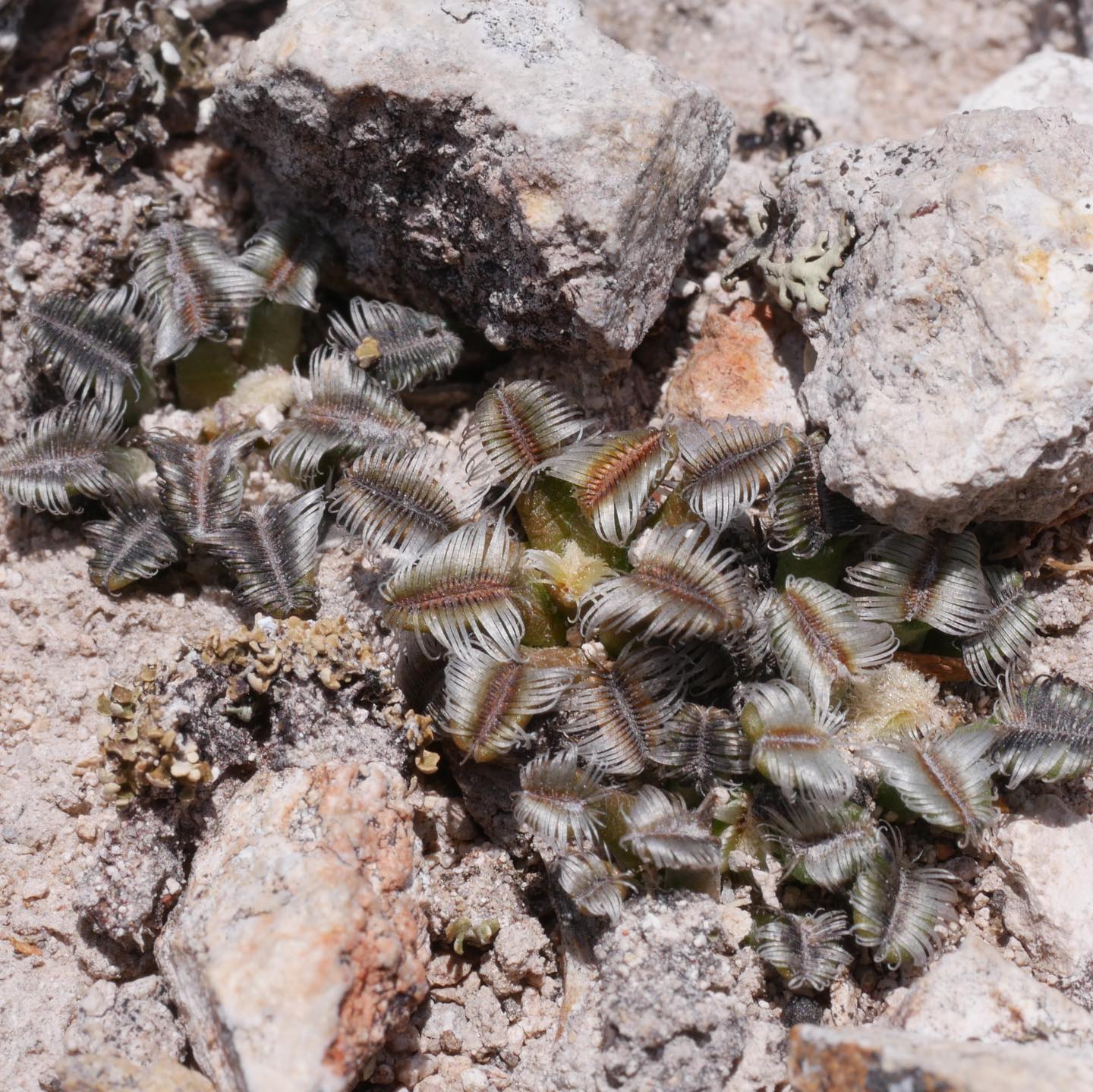
Mammillaria bertholdii was described in 2014 from a small hill population near Miahuatlán de Porfirio Díaz, Oaxaca. Thomas Linzen published the species in Mitteilungsblatt AfM 38(2) after the field collector Andreas Berthold surfaced the plants during a March 2013 tour of the Sierra Sur. On the rock, the plant reads like an illusion: a disc of elongated pectinate areoles sitting almost flush with the shale, with a tuberous root heavier than the visible stem hidden below.
What makes M. bertholdii anomalous is its taxonomic placement. Linzen assigned it to Series Longiflorae within the Mammillaria saboae group, a cluster of miniature geophytes whose other members live in Chihuahua, Sonora, and Durango. The Oaxaca plant is the only saboae-group species south of the Trans-Mexican Volcanic Belt, an outlier that implies either a much older ancestral range or a long-distance dispersal nobody has yet resolved.
The body rarely exceeds 3 cm across, and flowering plants often carry a pink, crocus-like flower wider than the plant itself. Seeds are cryptocarpic, ripening inside the stem over years and emerging only when the tissue fractures. Fresh seed carries germination inhibitors, which is why most offered plants are grafted onto fast rootstocks.
The species shares Oaxaca with Mammillaria huitzilopochtli on nearby Sierra slopes and sits at the southern edge of the same genus-cluster that carries Mammillaria napina through the Tehuacán-Cuicatlán valley a short drive north. What follows gathers the published habitat data, the cultivation consensus from specialist growers who have kept plants of documented provenance, and the diagnostic characters that separate M. bertholdii from its most-confused lookalike.
Mammillaria bertholdii quick reference
An Oaxaca shale-hill geophyte with a tuberous taproot, pectinate eyelash spines, and a pink crocus-like flower wider than the body itself. Values calibrated for seed grown plants in cultivation, drawn from the Linzen protologue, llifle habitat notes, and specialist grower reports.
Taxonomy & Nomenclature
Linzen (2014) established Mammillaria bertholdii in Mitteilungsblatt AfM 38(2):124–128 on material collected by Andreas Berthold in March 2013 near Miahuatlán de Porfirio Díaz. The epithet honours the field discoverer. POWO accepts the name with no synonyms; IPNI indexes the same place of publication under authority Linzen.
Series placement is the part of the protologue that has aged best. Linzen keyed the plant into Series Longiflorae of the Mammillaria saboae group on the basis of flower structure: pink, crocus-like, funnelform, with a floral tube longer than the visible body. The elongated pectinate areoles read closer to Pelecyphora aselliformis than to a typical mammillaria, a discrepancy Linzen acknowledged without trying to resolve. No molecular placement has been published since, so the species sits in Longiflorae on morphological grounds and waits on a gene tree to confirm or rearrange it.
Habitat
Published populations sit on the tops and steep slopes of low shale hills in the Sierra Sur de Oaxaca, both near Miahuatlán de Porfirio Díaz and in the area of San José de Lachuguiri (Uhlig field number MZ 1745). Substrate is rocky shale with shallow soils effectively devoid of organic matter; plants grow in small flat rock wells rather than under pine canopy even where pines scatter the broader landscape.
The known range covers about 10 km² across a handful of hill populations. Climate is summer-rain southern Oaxaca with a dry winter; grower reports place the hills at roughly 1,500 to 1,800 m elevation, though the protologue does not fix an exact altitude band. The populations sit at the southern extreme of a broader Puebla-Oaxaca rare-cactus corridor that also carries Mammillaria crucigera on the state line to the north.
Morphology
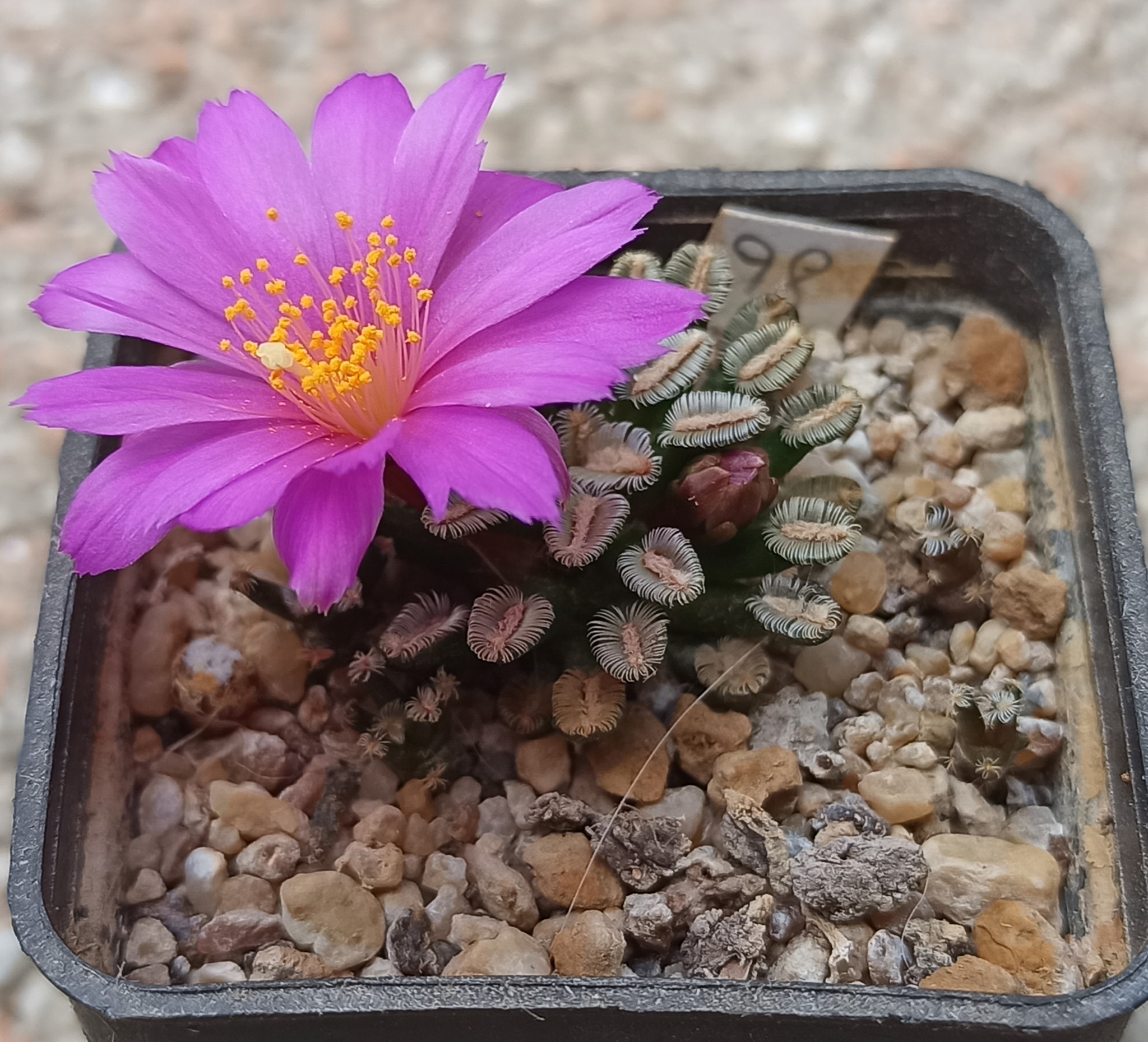
Stems are solitary or in small clusters of a few heads, spherical with a flattened apex, and rarely more than 3 cm across in habitat. Cultivated plants on a fast rootstock bulk up quickly; seed grown plants hold well below 2 cm for years before approaching wild size. The visible body is a disc of slender tubercles with strongly elongated areoles carrying pectinate spines at the tips; there are no central spines, and the overall look is of a pectinate mat flush with the substrate.
Beneath the disc, a tuberous taproot often exceeds the visible stem in mass. The flower rises on an unusually long floral tube from an axil near the apex: pink, crocus-like, funnelform, often wider than the plant itself. The overall flower-to-body proportion is the visual signature that separates M. bertholdii from every mammillaria outside the Saboae group.
Fruit is cryptocarpic, retained inside the stem where seeds ripen over years; they emerge only when the tissue splits. Areoles in this species read closer to those of Mammillaria pectinifera than to a typical mammillaria, which is a large part of why the two species keep getting confused in the hobby.
Locality detail
The two published localities sit in southern Oaxaca on the southern flank of the Sierra Sur. Because the species is restricted to small hill populations and has already drawn poaching interest, the coordinates below are published regional centroids rather than precise GPS fixes.
Cultivation
Almost every offered plant arrives grafted on a fast rootstock. The notes below cover both grafted and ungrafted culture, because the cultivation problems the two groups face are different: grafted plants collapse over winter when the rootstock dehydrates indoors; ungrafted plants collapse the moment the tuberous taproot sees standing water.
Substrate
Match the shale rock-well habitat with a mineral-heavy mix. Pumice as the dominant aggregate, granite grit for structure and slow mineral release, and a small fraction of low-nutrient cactus mix for trace organic input. Limestone chip is not required because the native substrate is shale, not limestone, and adding it shifts pH away from the natural setting for no benefit. Avoid organic-heavy mixes outright. The tuberous taproot rots quickly in any substrate that holds moisture against it, so the finished mix should dry top-down within a day or two of watering even in a shaded spot.
Watering and light
Water lightly through the summer growing season and stop entirely once autumn cools. The winter rest is dry and bright; a minimum of 8 to 10°C is the grower consensus, with dry cold tolerated far better than any wet cold. Light wants to be strong but not full blistering sun at altitude: four hours of direct light a day suits the species, as does a bright east-facing position. The pectinate spines shade the apex naturally, so all-day summer sun buys little benefit and adds scorch risk.
Grafted stock grows fast but often dries up on the rootstock over winter if the host is water-stressed indoors; seed grown plants grow much more slowly but settle into natural body proportions the grafted versions rarely reach. Growers who want a plant to keep over decades usually run both: a grafted backup for insurance, and a seed grown specimen in the primary collection.
Comparison
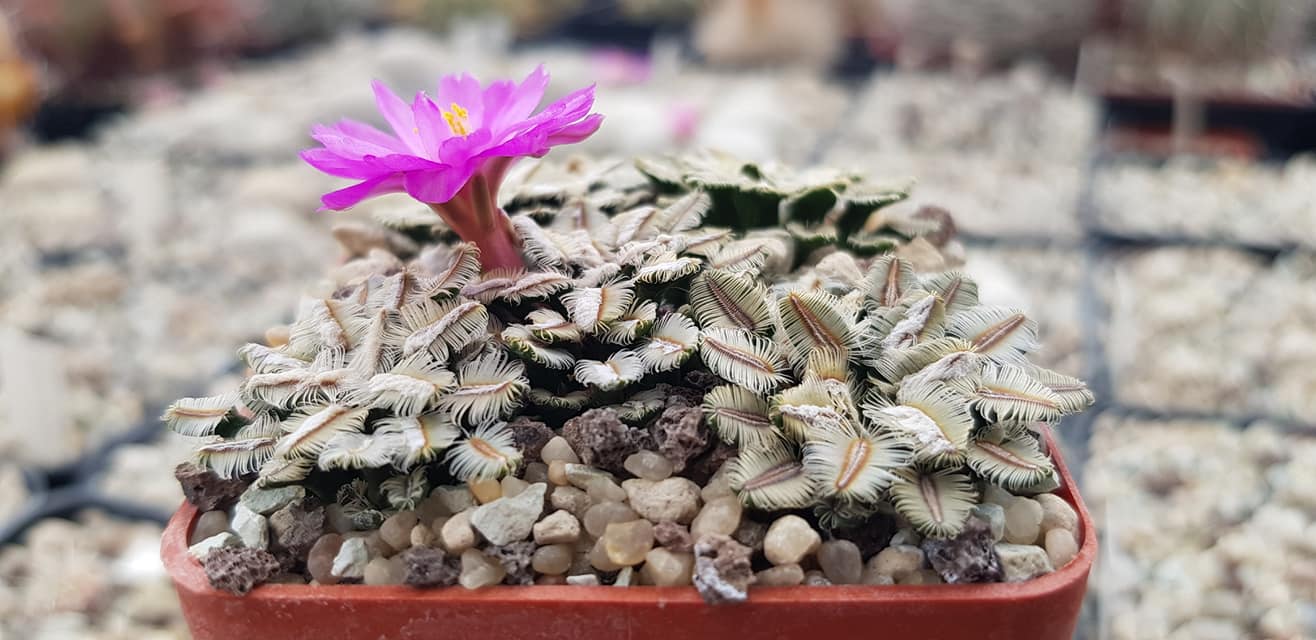
Among mammillarias, M. bertholdii is most likely to be mistaken for Mammillaria pectinifera. Both carry pectinate spines on elongated areoles, both are miniature Mexican endemics, and both fit a hand easily. Pectinifera is a Tehuacán-Valley plant on limestone, with a flat-topped habit that sits slightly proud of the substrate and a small rose-pink flower rising just above the apex. Bertholdii is an Oaxaca-shale plant with a deeper geophytic habit, a tuberous taproot heavier than the stem, and a crocus-like funnelform flower that typically overreaches the entire visible plant. Pectinifera’s fruit emerges red; bertholdii’s is cryptocarpic and never shows outside the stem.
A second confusion is with members of the saboae group further north. Those share the flower structure but live in Sonora, Chihuahua, and Durango, and their populations are not adjacent to the Oaxaca range. A third is with Pelecyphora aselliformis, which matches the elongated pectinate areole but sits in a different tribe and produces a very different flower. The two questions collectors actually raise are the pectinifera comparison and whether the plant at hand is grafted or ungrafted; the FAQ below takes each in turn.
Frequently asked questions
How do you tell Mammillaria bertholdii apart from Mammillaria pectinifera in the field?
Both carry pectinate spines on elongated areoles, both are Mexican miniatures, and both have been confused in the hobby since bertholdii was described. Drag the divider below to see the two plants side-by-side, then scan the character rows.
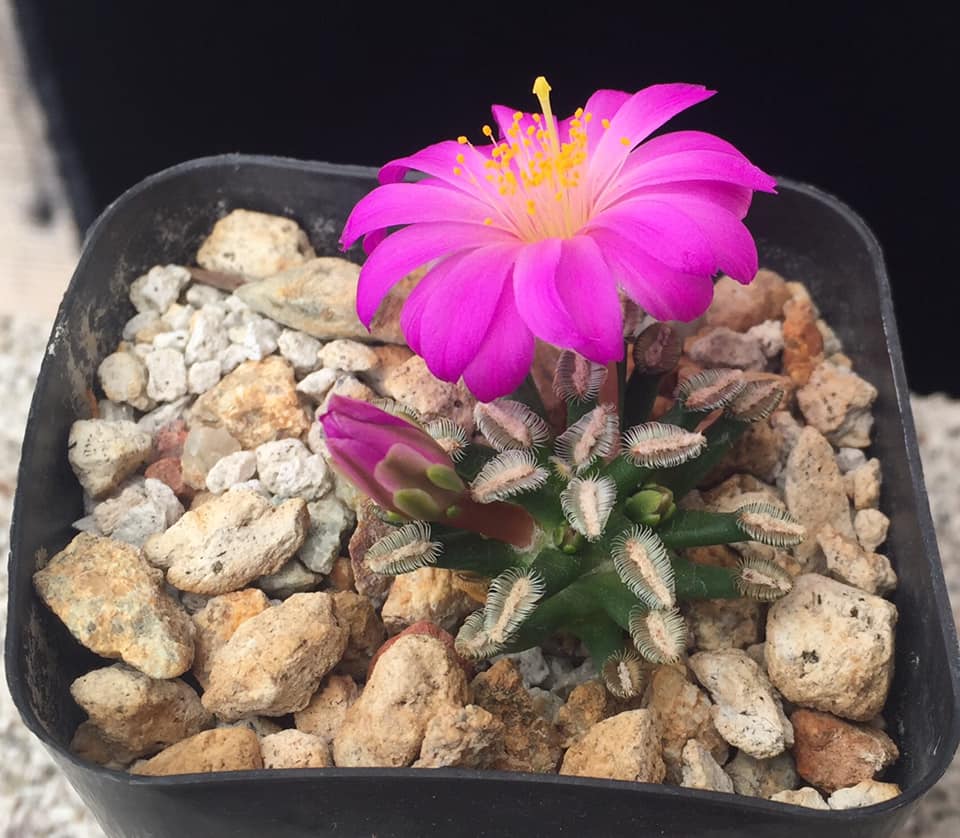
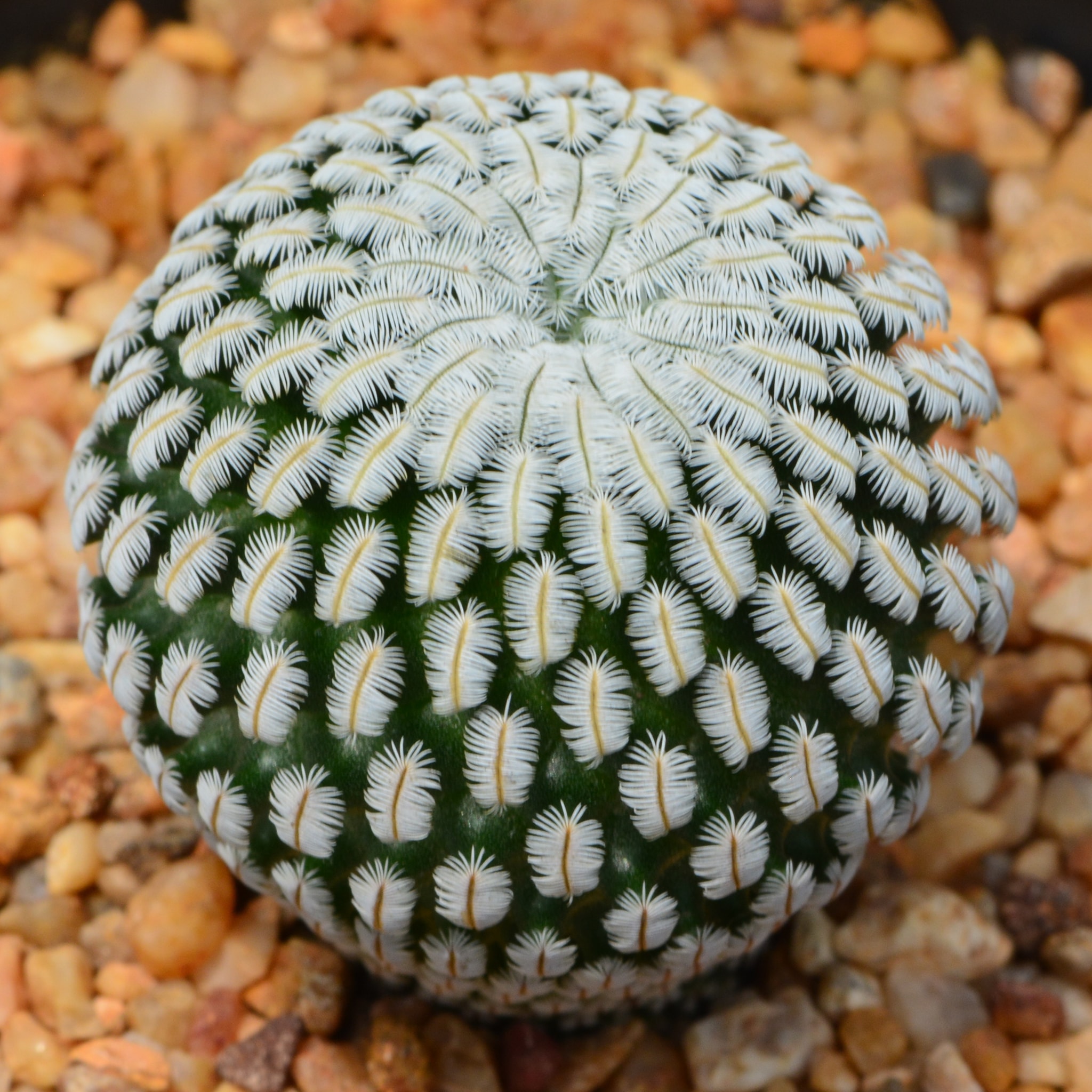
The flower-to-body ratio and the cryptocarpic fruit are the two most diagnostic characters. If the flower is wider than the body and the fruit never emerges, the plant is bertholdii; if the flower sits small on the apex and a red fruit is visible at ripening, it is pectinifera.
How do you grow Mammillaria bertholdii in cultivation?
Shallow mineral substrate dominated by pumice with granite grit, sparse watering through summer, dry winter rest at 8 to 10°C minimum, bright light but not blistering full sun. The tuberous taproot rots quickly in any mix that holds water, so underpot to the smallest container that fits the root and let the substrate dry top-down between waterings. Almost every offered plant arrives grafted; seed grown stock is slower but settles into better body proportions over a decade.
When was Mammillaria bertholdii discovered?
Andreas Berthold found the plants in the field in March 2013 during a tour of the Sierra Sur de Oaxaca. Thomas Linzen published the formal species description the following year in Mitteilungsblatt AfM 38(2):124–128 (2014), placing the plant in Series Longiflorae within the Mammillaria saboae group. The epithet honours the field discoverer.
Is Mammillaria bertholdii legal to own?
Yes, with paperwork. All Cactaceae sit on CITES Appendix II, so international movement requires CITES export documents from the country of origin and matching import documents where applicable. Buy only from nurseries that can document nursery-propagated provenance, and avoid any plant offered as wild-collected; Oaxaca hill populations are small and poaching pressure is already on the radar of Mexican collectors.
Why is Mammillaria bertholdii almost always sold grafted?
Seeds are cryptocarpic and carry germination inhibitors that keep fresh seed from sprouting well. Older seed that has sat for five to eight years germinates more reliably, but that lag does not fit a commercial grow-out schedule. Grafting onto a fast rootstock bypasses the seed bottleneck and lets nurseries produce flowering-size plants inside eighteen months; seed grown stock takes a decade or more to approach wild size.
Does Mammillaria bertholdii flower as a young plant?
Grafted stock can flower within the first two years on the rootstock, often at a body diameter under 1 cm. Ungrafted plants flower much later, typically past the five-year mark and at a larger body diameter. The flowers are pink, crocus-like, and funnelform, often wider than the plant itself; the overreaching flower-to-body ratio is part of the species’ visual signature.
Sources & further reading
Linzen, T. (2014). Eine sensationelle Entdeckung aus Oaxaca. Mammillaria bertholdii spec. nov., ein neues Mitglied der Reihe Longiflorae. Mitteilungsblatt AfM 38(2): 124–128 · Kew POWO, Mammillaria bertholdii Linzen taxon record (urn:lsid:ipni.org:names:60466132-2) · IPNI, place of publication for Mammillaria bertholdii Linzen, 2014 · llifle.com Encyclopedia of Living Forms, Mammillaria bertholdii habitat and morphology notes · Henry Shaw Cactus and Succulent Society, Plant of the Month: Mammillaria bertholdii, 2019 · CONABIO Enciclovida, Biznaguita de Oaxaca (Mammillaria bertholdii) record · CITES Checklist of Cactaceae, current edition, Appendix II listing of all Cactaceae · Uhlig Kakteen catalogue, field locality MZ 1745 (Lachuguiri, Oaxaca) · Anderson, E. F. (2001). The Cactus Family. Timber Press · Hunt, D., Taylor, N. & Charles, G. (2013). The New Cactus Lexicon. dh books