Mammillaria huitzilopochtli
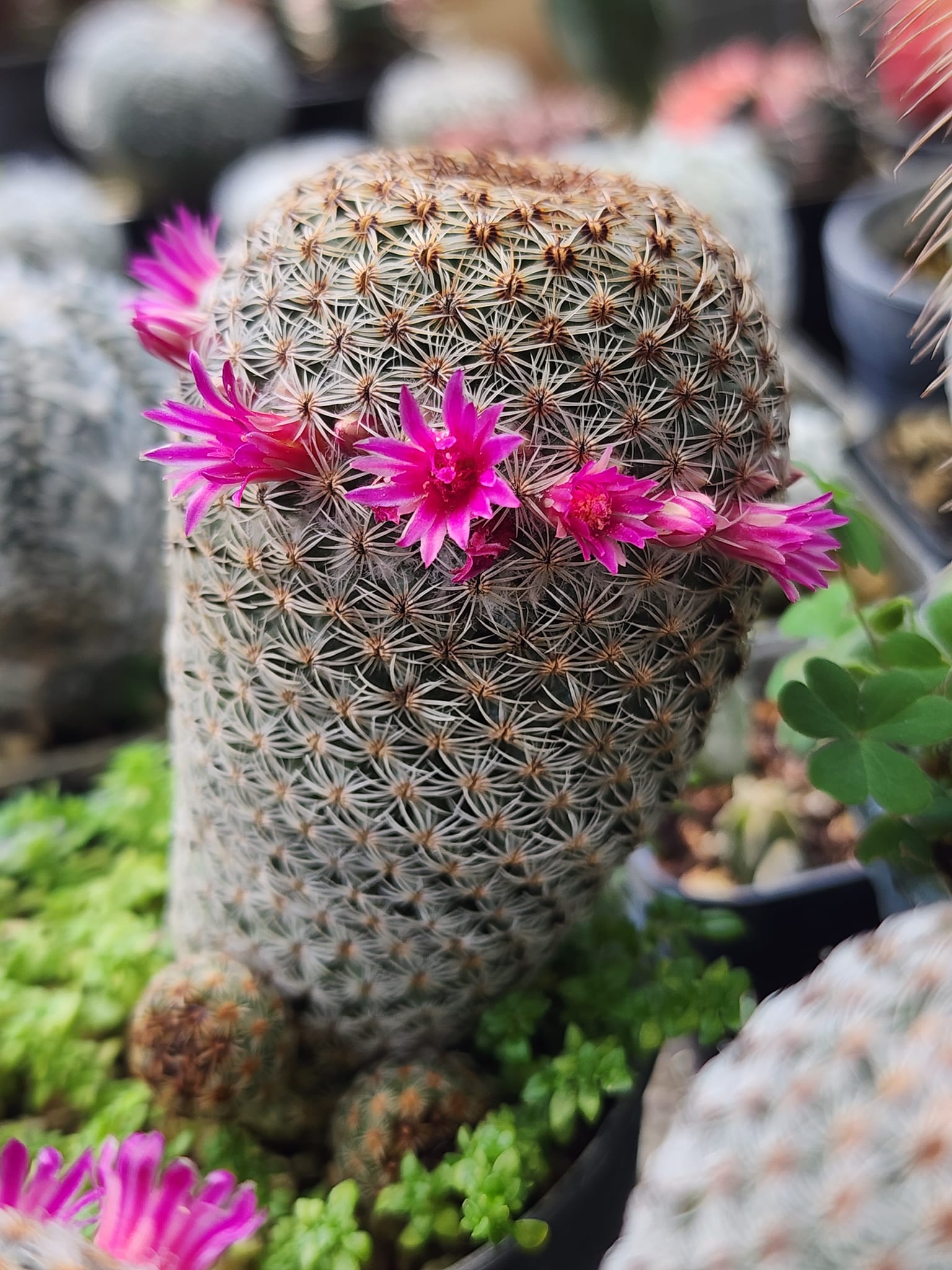
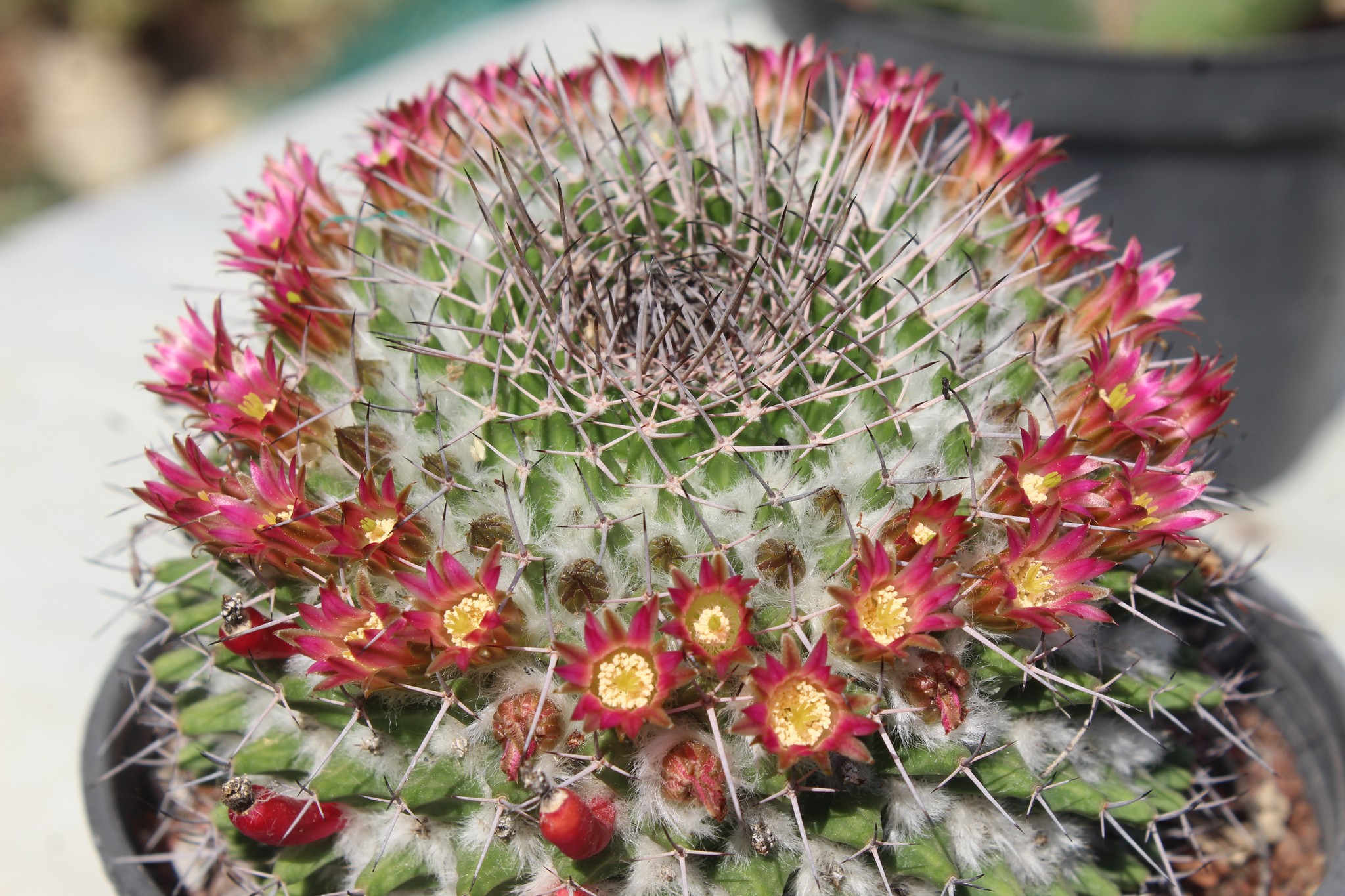
Mammillaria huitzilopochtli D.R. Hunt (1979) is a small globose-to-club-shaped cactus from the limestone cliffs of the Tehuacán-Cuicatlán valley, on the Oaxaca side of the Oaxaca-Puebla border. Hunt named it for Huitzilopochtli, the Aztec sun-and-war deity whose cult centred on the same high plateau country the species inhabits. The epithet suits a plant wrapped in fifteen to thirty glassy-white pectinate radials, its carmine flowers ringing the apex in September through December like a solar crown.
The species belongs to Hunt’s series Supertextae, a group of cliff-dwelling central Mexican Mammillaria confirmed as a natural clade by Cervantes et al. (2021) on the strength of a 46-bp rpl16 inversion. Its nearest molecular relatives in that analysis are the cross-shaped-areole taxa in the M. crucigera alliance, which share the same Oaxaca-Puebla canyon system and the same obligate-saxicole habit. Within huitzilopochtli itself Pilbeam (1999) recognises two subspecies: the nominate, which typically lacks central spines altogether, and subsp. niduliformis (A.B. Lau) Pilbeam, which adds two to four curved brown centrals up to two centimetres long.
Seven known subpopulations sit along a roughly fifty-kilometre stretch of the Cuicatlán arm of the valley, a landscape of vertical limestone walls, tropical deciduous forest, and summer-rain seasonality averaging around four hundred millimetres a year. Companion cacti on the same cliff faces include Mammillaria carnea, M. sphacelata, Ferocactus recurvus, and the columnar Pachycereus weberi, with Echeveria laui endemic to the same ledges. Demography work by Valverde and Zavala-Hurtado (2010) shows that seedling recruitment is almost entirely confined to shaded cliff crevices; exposed plateau surfaces cook the juveniles inside a season.
The cliff-obligate habit is the backbone of the cultivation profile. Solorzano et al. (2014) documented low seed set in the wild, a high inbreeding coefficient, and active illegal collection from several of the seven subpopulations, pressures that shape the declining population trend flagged in the most recent Red List review. On the bench, the species rewards a lean mineral substrate, summer water that mirrors the Tehuacán wet season, and a dry winter rest. Grafted stock flowers quickly and clusters aggressively; seed grown plants hold the tight solitary body longer and develop denser pectinate spine cover.
Mammillaria huitzilopochtli quick reference
A saxicolous Oaxacan Mammillaria from vertical limestone cliffs of the Tehuacán-Cuicatlán valley, summer-rainfall climate around 400 mm, moderate elevation 400 to 1,000 m. Values calibrated for seed grown plants in cultivation, drawn from Pilbeam’s monograph, Hunt’s protologue, and grower consensus reported in llifle and cactus-art.
Taxonomy & nomenclature
David Hunt published the species in the Cactus and Succulent Journal of Great Britain 41: 106 in 1979, placing it in his series Supertextae, a cluster of cliff-dwelling central Mexican Mammillaria defined by small compressed tubercles, pectinate radials, and nectar-secreting axils. Molecular work by Cervantes et al. (2021) in PhytoKeys 177 recovers the series as monophyletic on the strength of a 46-base-pair inversion in the plastid rpl16 intron; in that analysis huitzilopochtli sits in a sister clade to the crucigera complex, while the superficially similar M. dixanthocentron falls in a separate clade altogether.
Alfred Lau described a more heavily spined form from Tomellín Canyon in the Journal of the Mammillaria Society 34: 46 as M. huitzilopochtli var. niduliformis in 1994. John Pilbeam raised the taxon to subspecific rank in his 1999 Cactus File Handbook 6: 143, the current treatment on Kew POWO. The two subspecies share habitat but differ in spine architecture: the nominate carries zero to one central, while subsp. niduliformis consistently adds two to four curved brown centrals up to twenty millimetres long. No heterotypic synonyms exist at species rank.
The epithet commemorates Huitzilopochtli, the Mexica patron god of war and the sun, whose cult once centred on the plateau country these plants still inhabit. Collector field numbers from the type region include Lau 66, Lau 1495, and Lau 1500, traceable through the Mammillaria Society archive. The Oaxacan endemic M. bertholdii, described more than three decades later by Wolfgang Lauer, sits far enough outside the Supertextae clade that the resemblance is entirely convergent; its hooked single central and wet-soil preference make the two easy to separate in person.
Habitat
Every confirmed population sits on vertical or near-vertical limestone in the Cuicatlán arm of the Tehuacán-Cuicatlán valley, between roughly 400 and 1,000 m elevation, with the densest occurrences at 450 to 700 m. The canyon system is one of the driest zones in southern Mexico, receiving only 350 to 450 mm of rain a year and concentrating almost all of it between June and September. Adult plants root in cliff crevices where limestone weathers into a shallow rubble of calcite grit and a trace of humus; seedlings establish only in shaded fissures, a constraint that Valverde and Zavala-Hurtado (2010) identified as the bottleneck for recruitment on disturbed cliff faces.
Martorell and Patiño’s 2006 cliff-microclimate study, on congeners in the same region, measured midday surface temperatures nearly ten degrees cooler on vertical walls than on adjacent plateau soils. The oblique sun angle, thermal mass of the limestone, and cliff updraughts combine to buffer the plants through the six-month dry season. That thermal refuge is the reason huitzilopochtli shares cliff ledges with Echeveria laui rather than the adjacent plateau cacti, and why it cannot simply be translocated onto level ground.
The valley’s limestone substrate is the same parent rock that supports M. pectinifera on the Puebla side of the reserve and that M. napina colonises as a Tehuacán-Cuicatlán geophyte. The three species never meet in the same microhabitat. Pectinifera keeps to flat limestone pavement, napina buries its body in gravel, and huitzilopochtli hangs off the cliff face. All three share the calcareous substrate, the summer-rain regime, and the CITES Appendix II listing that protects the valley’s cactus flora as a whole.
Morphology
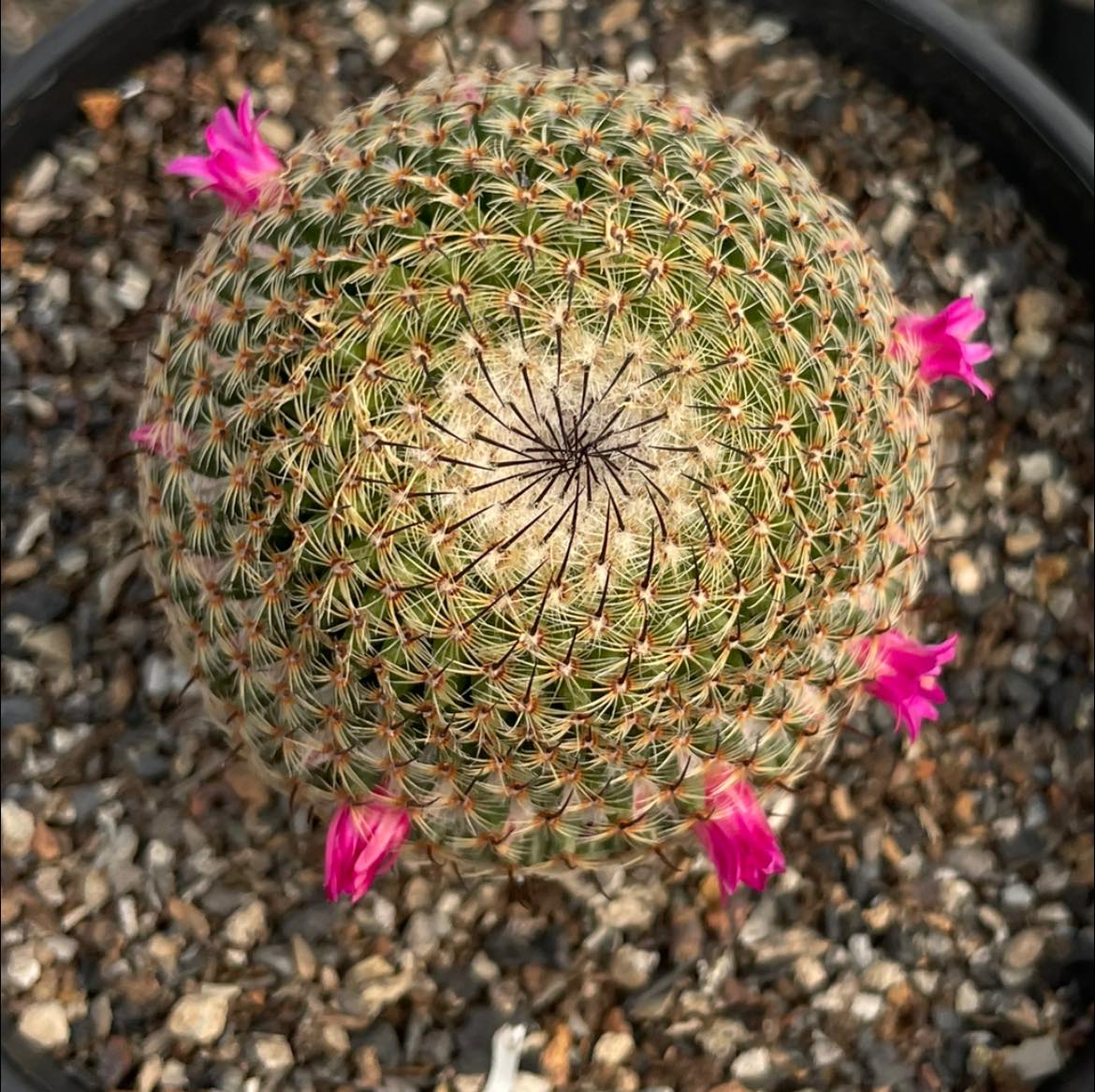
Adults are solitary or slowly clustering, 8 to 15 cm tall and 6 to 8 cm wide, dark green with a slight apical depression. The tubercles are laterally compressed cylinders; the axils in the flowering zone pack with dense white wool that helps insulate the apex through the dry winter. Elliptic areoles sit on the tubercle tip and carry fifteen to thirty pectinate radials, each 1.5 to 3.5 mm long, glassy white with a brown base. The radials lay flat along the body, producing the characteristic soft-mat texture that reads as cream on the cliff face at distance.
Central spines are the diagnostic split between the two subspecies. The nominate typically carries zero centrals, occasionally one erect grey-to-black spine 4 to 20 mm long. Subsp. niduliformis consistently adds two to four curved brown-to-black centrals up to twenty millimetres long, radiating from the areole like a bird’s nest (hence the epithet). Neither subspecies carries truly hooked centrals in the strict recurved-tip sense; field photographs and type-locality material show curvature along the length rather than a terminal hook.
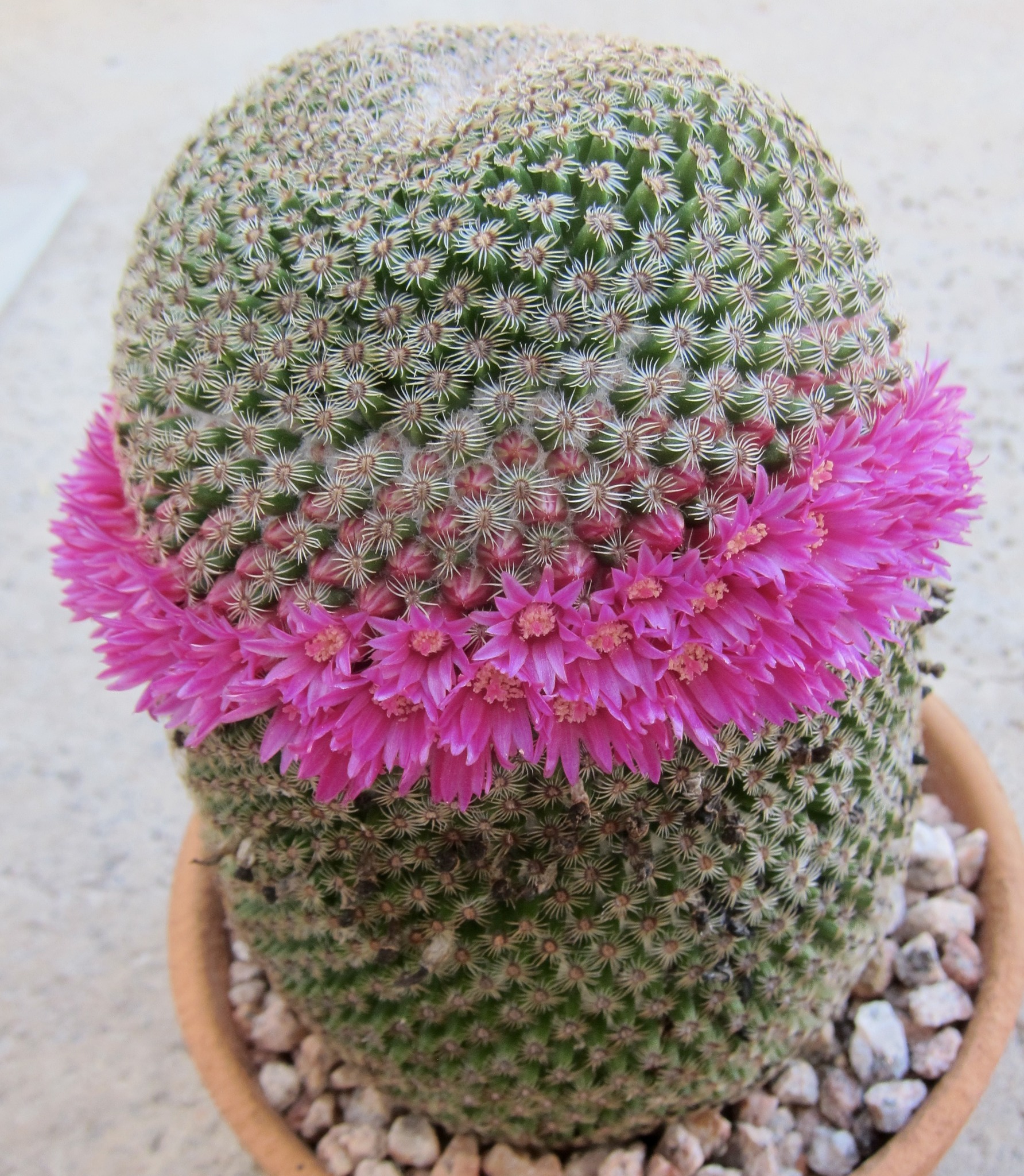
Flowers open at the crown in a carmine-pink ring from September through December, following Flores-Martínez et al. (2013). Each corolla is modest: 12 to 15 mm long, 7 to 10 mm across, with carmine stigmas and low nectar volume. The species is xenogamous, bee-pollinated, and sets seed in only about thirty-five per cent of ovules in the wild. Fruits ripen as 15 mm cylindrical red berries; seed output in cultivation is frequently nil unless a second genetically distinct plant sits nearby.
Locality detail
The map below plots approximate regional centroids for the four best-documented locality clusters in the Tehuacán-Cuicatlán valley. Precise coordinates are deliberately withheld: Solorzano et al. (2014) flagged active illegal collection across five of the seven known subpopulations, and the 2013 IUCN assessors named harvesting as the primary declining-trend driver. Published studies give the cluster names and valley geography, which is all a collector needs to orient the species.
Cultivation
Cultivation reflects the limestone-cliff origin point. The body tolerates sun, the root neck does not tolerate sustained moisture, and the seasonal rhythm of the Tehuacán summer monsoon maps directly onto the watering calendar. Treat the plant as a rupicolous specialist and it rewards a long-lived collector bench; treat it as a generic summer-growing Mammillaria and it stalls.
Substrate
A mineral-dominant mix of sixty per cent pumice, thirty per cent crushed granite or decomposed granite, and ten per cent low-nutrient cactus soil matches the native drainage character. A small fraction of calcite grit or crushed limestone chip nods to the calcareous parent rock without raising pH into the alkaline zone that triggers iron lockout. Zeolite at around five per cent helps buffer summer watering on the bench. Reseat the top-dressing with a coarser grit layer to keep the root neck dry after irrigation.
Watering and light
Water fully from June through September, letting the mix run dry between each soak; this tracks the native 350 to 450 mm summer rain window. Taper through October, then hold the plant bone dry from November into April. A cold, wet winter kills faster than a dry frost: the species takes −5°C without damage when dry, but rots at 5°C if watered. Bright direct sun suits it most of the year, with dappling through the hottest midsummer weeks to echo the oblique cliff-face light. Growth accelerates under a graft but the body elongates and the pectinate spine pattern loosens; seed grown plants keep the tight habit that makes the species a collector target.
Comparison
The cliff-obligate habit plus the pectinate white radial mat place M. huitzilopochtli close to a small group of Tehuacán-Cuicatlán Mammillaria that share one or both characters. The most frequent confusion in trade is with M. carnea, which grows on the same cliff ledges but carries four stiff pink-brown centrals, bleeds milky sap from damaged tubercles, and opens pale flesh-pink flowers rather than the carmine ring of huitzilopochtli. The FAQ distinguishing table below summarises the diagnostic split.
Further afield, the cross-shaped-areole taxa of the crucigera complex share the Oaxaca-Puebla canyon range and the series-Supertextae habit, but read as obviously different once the characteristic cruciform central-spine pattern forms on a mature areole. Recent Oaxacan discoveries such as the 2016 M. bertholdii look superficially related at seedling size; the hooked single central and nearly buried body of bertholdii separate it once the plant is three centimetres across.
Among Tehuacán endemics with pectinate radials, the Puebla miniature M. pectinifera looks closest at thumbnail size. Pectinifera keeps a single flattened button body, lives on open limestone pavement, and never climbs cliff faces; huitzilopochtli grows taller, clusters with age, and depends on cliff verticality for thermal buffering. The cultivated cost of mistaking one for the other is real: pectinifera wants a wider flat pan and a drier regime; huitzilopochtli wants depth, summer water, and no winter wet.
Frequently asked questions
How do you tell Mammillaria huitzilopochtli apart from Mammillaria carnea?
M. huitzilopochtli and M. carnea share the Tehuacán-Cuicatlán cliff ledges and appear together in Oaxacan trade, which drives most of the identification confusion. Six characters split them cleanly.
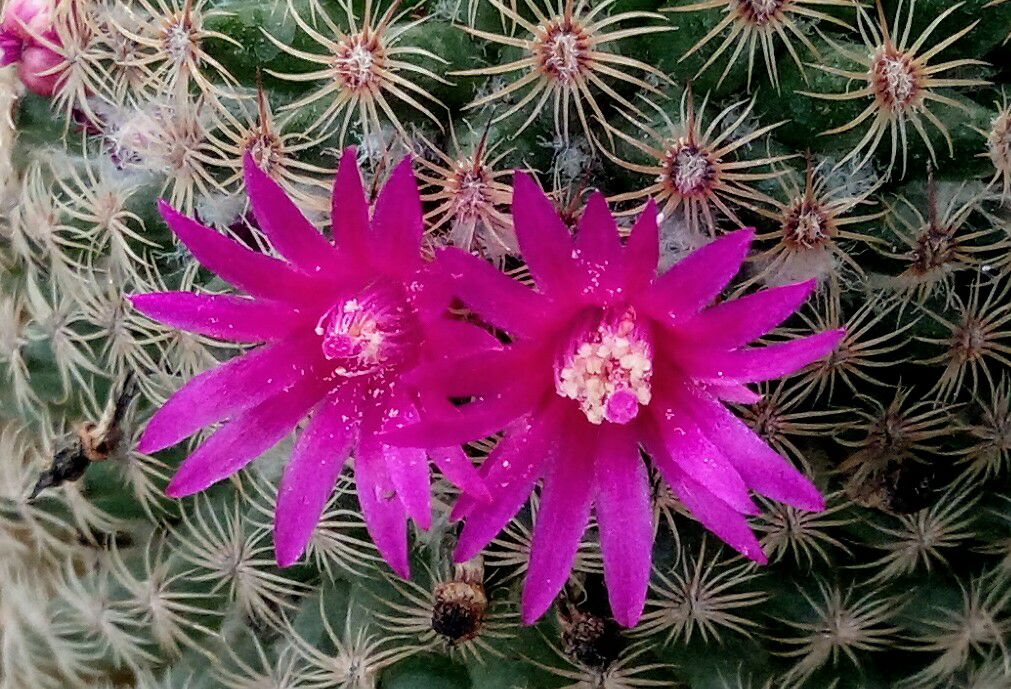
The single most diagnostic character is the milky sap: nick a tubercle gently with a clean blade and carnea beads white latex inside a minute, while huitzilopochtli stays clear. Central-spine count is the next most reliable split when the plant is not in flower.
How difficult is Mammillaria huitzilopochtli to grow?
Intermediate for a committed cactus grower and unforgiving for a beginner. The species tolerates heat and bright sun, but the root neck rots within days if the plant is cold and wet at the same time. Match the native Tehuacán rhythm: summer water from June through September, bone dry from November to April, and a sharp mineral mix under a coarse grit top dressing. Plants on a graft are easier to establish; seed grown stock rewards steady discipline.
Can Mammillaria huitzilopochtli be grown from seed?
Yes. Sow on a sieved mineral mix at 21 to 27°C with overhead shade; Valverde and Zavala-Hurtado (2010) showed wild seedlings recruit only in shaded crevices, and the same rule applies on the bench. Germination runs at a few weeks. The growth-rate contrast is the reason collectors pay the patience premium: a seed grown plant reaches flowering size at three to five centimetres in six to eight years and keeps the tight pectinate habit, while the same seed on a Pereskiopsis graft flowers in eighteen months and loosens that spine pattern.
Is Mammillaria huitzilopochtli legal to buy and sell?
Yes, under CITES Appendix II documentation. The species is listed under the family-wide Cactaceae appendix, so cross-border sales require a CITES export permit from the country of origin and often a corresponding import permit. Plants of documented nursery origin are traded legally throughout the EU, the UK, and the United States. Wild-collected material violates both CITES and Mexican federal law under NOM-059-SEMARNAT; illegal harvesting is one of the threats named in the 2013 IUCN assessment.
Where does Mammillaria huitzilopochtli grow in the wild?
Endemic to the Cuicatlán arm of the Tehuacán-Cuicatlán valley in Oaxaca, with a narrow extension across the Puebla state line that shows up in the peer-reviewed genetics work. All seven known subpopulations sit on vertical limestone cliffs between roughly 400 and 1,000 m elevation, in tropical deciduous forest receiving 350 to 450 mm of summer-concentrated rain. The type region lies around Tomellín Canyon and Cuicatlán.
When does Mammillaria huitzilopochtli flower?
September through December, following Flores-Martínez et al.’s 2013 floral-biology study. Flowers form a carmine-pink ring around the apex; each bloom stays open for roughly six days, and anthesis is diurnal. Plants flower reliably once they reach three to five centimetres across, which on seed grown stock takes six to eight years. Fruit set in cultivation is frequently nil without a second genetically distinct plant, because the species is facultatively outcrossing.
Sources & further reading
Hunt, D.R. (1979). Cactus and Succulent Journal of Great Britain 41: 106. · Lau, A.B. (1994). M. huitzilopochtli var. niduliformis. Journal of the Mammillaria Society 34: 46. · Pilbeam, J. (1999). Cactus File Handbook 6: 143. · Anderson, E.F. (2001). The Cactus Family. Timber Press. · Martorell, C. & Patiño, P. (2006). Globose cacti on cliffs avoid high temperatures in southern Mexico. Journal of Arid Environments 67(4): 541–552. · Valverde, T. & Zavala-Hurtado, J.A. (2010). Demography of an endangered endemic rupicolous cactus. Plant Ecology 210: 105–118. · Arias, S., Valverde, T. & Zavala-Hurtado, A. (2013). Mammillaria huitzilopochtli. IUCN Red List of Threatened Species e.T152488A593042. · Flores-Martínez, A., Manzanero, G.I., Golubov, J. & Mandujano, M.C. (2013). Floral biology of Mammillaria huitzilopochtli. Botanical Sciences 91(3): 349–356. · Solorzano, S., Cuevas-Alducin, P.D., García-Gómez, V. & Dávila, P. (2014). Genetic diversity and conservation of Mammillaria huitzilopochtli and M. supertexta. Revista Mexicana de Biodiversidad 85(2). · Hernández, H.M. & Gómez-Hinostrosa, C. (2015). Mapping the Cacti of Mexico, Part II: Mammillaria. DH Books. · Cervantes, C.R., Hinojosa-Alvarez, S., Wegier, A., Rosas, U. & Arias, S. (2021). Evaluating the monophyly of Mammillaria series Supertextae. PhytoKeys 177: 25–42. · POWO (2026). Kew Science, Plants of the World Online.