Mammillaria schwarzii
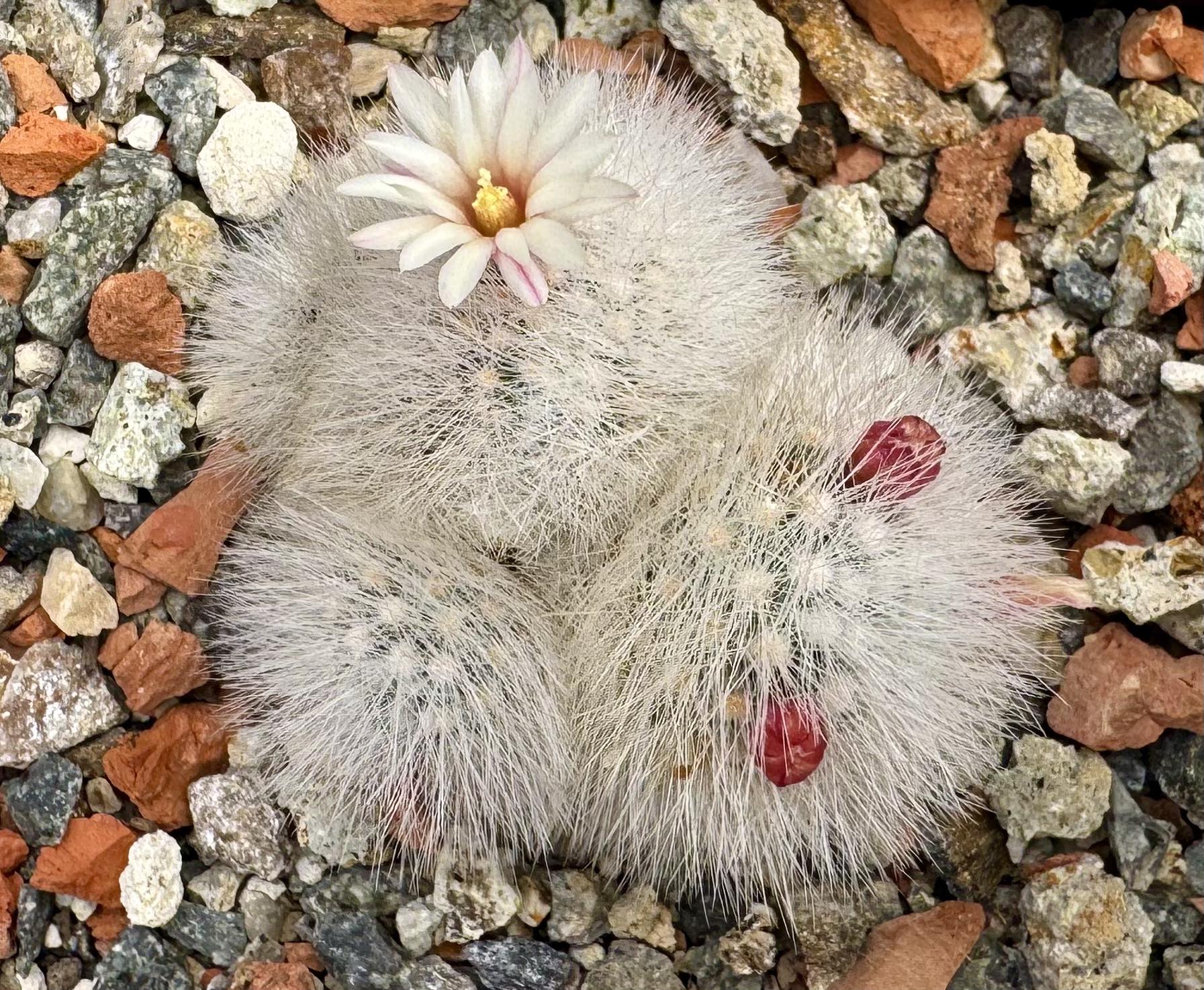
Mammillaria schwarzii is a densely caespitose cliff cactus known from a single site on volcanic rock in northern Guanajuato. Each head stays under 3.5 cm in diameter, but the colony spreads into a low mound of many small stems that reads as one pale patch against the dark cliff face. The spine mat is glassy white and almost entirely hairlike, so the green body is never visible at a distance.
Ernest Shurly described the species in the Cactus and Succulent Journal of Great Britain in 1949, working from material that Fritz Schwarz had sent out of Mexico. The plant then vanished from cultivation for nearly four decades, treated as possibly extinct until W. A. and Betty Fitz Maurice relocated the original population in 1987 using locality notes they had drawn directly from Schwarz himself.
The rediscovered population sits on a volcanic cliff approximately four kilometres long and one hundred metres wide, split between exposed faces and shaded crevices. The same rediscovery paper documented the site as a standard stop for European cactus-tour groups, which is how most specialist collectors learned the locality before its IUCN assessment was written. The collecting pressure that followed is the dominant conservation story for the species, and it aligns the schwarzii build closely with our coverage of Mammillaria herrerae, another Mexican single-site endemic whose wild population collapsed once its location was published.
Mammillaria schwarzii quick reference
A cliff-dwelling miniature Mammillaria from volcanic rock at 2,000 to 2,400 m in northern Guanajuato, densely clustering from a young age and wrapped in glassy white hairlike spination. Values calibrated for seed grown plants in cultivation, drawn from the Fitz Maurice field accounts, ISI 2016 notes, and specialist grower consensus.
Taxonomy & nomenclature
The accepted name on Kew POWO is Mammillaria schwarzii Shurly, first published in the Cactus and Succulent Journal of Great Britain volume 11, page 17, in 1949. Shurly worked with material associated with the German collector Fritz Schwarz, whom the specific epithet honours. The only current nomenclatural synonym is Krainzia schwarzii (Shurly) Doweld, published in Sukkulenty in 2000; POWO does not accept the Krainzia combination.
A separate homonym, Mammillaria schwarzii (Fric) Backeb., exists in older literature and is sometimes cited against this species by mistake. The Backeberg name is illegitimate and now treated as a synonym of Mammillaria coahuilensis, which is a Coahuilan plant unrelated to the Guanajuato cliff endemic. Where retailers or secondary sources attribute the species to “F. Schwarz ex Backeb.” they are conflating the two names.
Infrageneric placement follows Hunt’s New Cactus Lexicon: subgenus Mammillaria, section Cylindricothelae, series Stylothelae. That placement puts schwarzii alongside Mammillaria crinita, Mammillaria bocasana, and our own encyclopedia entry for Mammillaria duwei, the other Guanajuato Stylothelae endemic on this site. Butterworth and colleagues confirmed Stylothelae as a clade in their 2007 Bradleya paper using a localised rpl16 intron loss, so the series is a natural group rather than a morphological grouping of convenience.
One taxonomic discrepancy is worth recording. IPNI records the type-specimen provenance as San Luis Potosí, while every field account from the Fitz Maurices onward places the population in northern Guanajuato. The Guanajuato locality is the one confirmed by repeat field visits and is the basis for the IUCN assessment, so we treat it as the working type locality while flagging the IPNI record for readers tracing the original literature.
Habitat
The habitat is volcanic, not limestone. Northern Guanajuato sits on the Mesa Central volcanic highlands rather than the limestone karst of the Sierra Gorda biosphere reserve to the east, and every field account of M. schwarzii places it on basaltic to andesitic cliff faces at 2,000 to 2,400 metres. Soil accumulates in crevices and on ledge pockets, giving the roots a thin mineral substrate with excellent drainage and constant air movement.
The region receives 400 to 600 mm of rainfall each year, concentrated between June and September; winters are dry and cool. Vegetation at the site is an ecotone between semi-desert matorral and oak woodland, and the species occupies both exposed cliff faces and shaded crevices sheltered by overhangs. That dual aspect matters for cultivation: plants do not evolve under constant full sun, yet the high-elevation light they receive when the sun does reach them is very intense by the standards of a pot in a collection greenhouse.
The single-cliff distribution is the load-bearing conservation fact. Fitz Maurice’s 1994 assessment described a cliff system roughly one hundred metres wide by four kilometres long, which gives the species an extent of occurrence below 100 km² regardless of how the perimeter is drawn. A comparable single-site pattern governs Mammillaria pectinifera in the Tehuacán Valley, although that species is at least distributed across eighteen fragmented populations rather than pinned to one escarpment.
Morphology
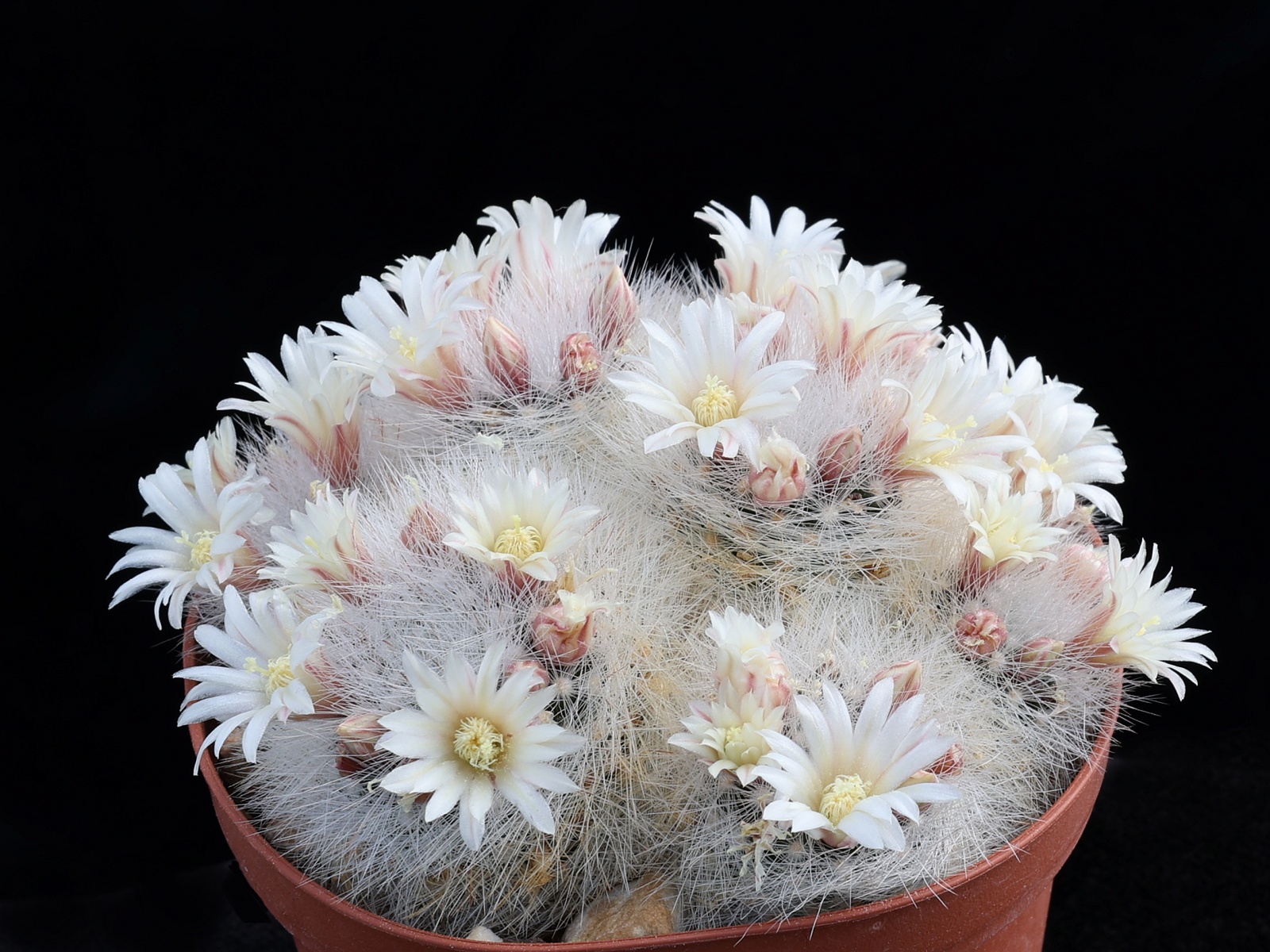
Individual stems stay 3 cm tall by 3.5 cm wide at maturity, globose to short-cylindrical, and arranged in 8 and 13 tubercle spirals. The tubercles themselves are soft and roughly 7 mm long, each topped by a small round areole with persistent white wool. Axils carry up to a dozen thin white bristles about 5 mm long, but the real visual character comes from the spines.
Each areole carries 35 to 40 hairlike radials roughly 8 mm long, shiny white and weak enough to break under the lightest touch, plus 8 to 9 centrals at 5 to 6 mm. The centrals sit one erect and the rest porrect, and they read as barely distinguishable from the radials except under magnification, where they resolve as slightly stiffer and tipped in light red-brown. Cultivated forms with fully glassy-white centrals are common; chestnut-tipped plants turn up often enough to count as natural variation rather than a separate form.
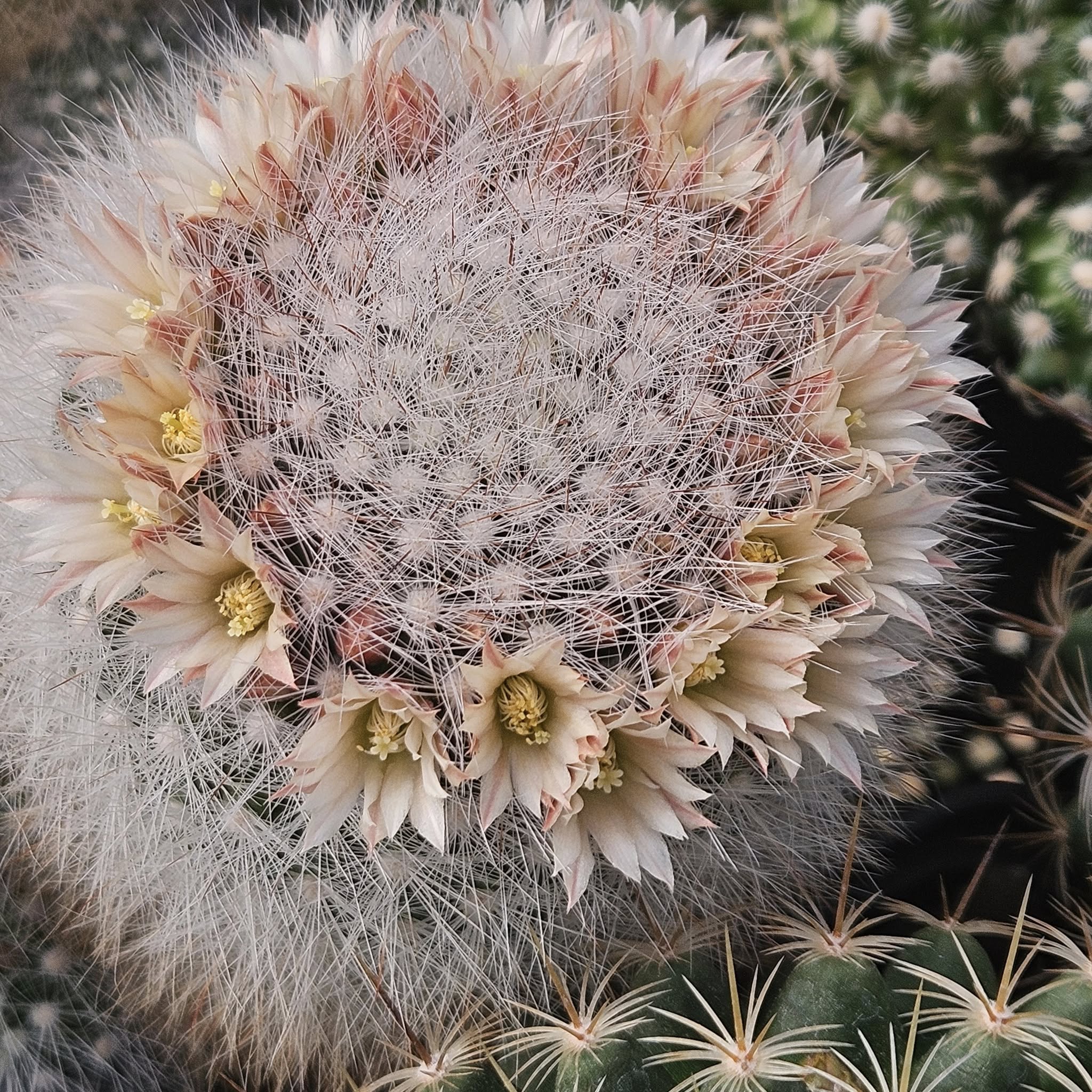
Flowers open in a ring just below the apex in May, cream-white with narrow red midstripes on the outer tepals and greenish-white inner tepals. Each bloom measures about 15 mm long by 12 mm across, short-tubed and campanulate. Fruits that follow are bright red and produced in masses, which is the one time in the calendar the white spine mat has a colour contrast working against it. Seeds are black. Reports of a pink-flowered “f. roseiflora” in cultivation almost certainly describe hybrid seedlings from mixed collections rather than a natural variant, and no authority recognises the form.
Locality detail
The map below marks the approximate regional centroid rather than the sharp coordinates of the known cliff population, following the IUCN assessment’s own redaction practice for the most at-risk Mexican Cactaceae. The point shown is accurate to within tens of kilometres, which is enough for orientation and too coarse to guide anyone to the plants.
Cultivation
Mammillaria schwarzii is an advanced-level plant whose failure mode is crown rot rather than etiolation, and the whole cultivation strategy follows from that one fact. The cliff habitat pairs excellent drainage with constant air movement, and the spine mat is dense enough to hold water against the apex for days after a careless watering.
Substrate
Target a fully mineral mix: 60 per cent pumice in a small grain, 20 per cent crushed lava rock, and 20 per cent decomposed granite, with a thin calcined-clay top dressing to keep the spines off anything that retains moisture. Limestone chip has no advantage here because the native substrate is volcanic, not karst. Add no organic content; the roots never encounter humus in the wild and do not benefit from it in pots. Repot every two to three years in summer with bone-dry medium, and callus any root damage for at least five days before returning the plant to water.
Watering and light
Water only when the mix is fully dry, and water from the edge of the pot rather than overhead. A clustered colony traps water at the base of every head, and overhead watering in anything short of full ventilation will start a crown rot that travels across the whole mound before it becomes visible. Taper off through September and keep the plant completely dry from October through March. Winter minimum is about 1°C dry; the species does not tolerate wet cold.
Light is the counter-intuitive part. The habitat sits on cliff faces that only receive direct sun for a short window each day, but the altitude delivers high-UV diffuse light for the rest of it. Cultivated plants want very bright filtered light all day, with shade cloth cutting the hottest hours through summer. Plants grown in dim conditions open their spine mat, lose the tight mounding habit, and colour green instead of reading as a pale patch. Seed grown specimens reach 10 cm-wide mature mounds in roughly a decade under consistent conditions; grafted plants reach that size faster but run to taller loose heads that carry a different silhouette and lose value for serious collectors.
Comparison
Within its own series, M. schwarzii sits closer to Mammillaria duwei than to most other Stylothelae members, but the two species are not easily confused in person. Duwei is a Guanajuato endemic on volcanic rock to the east of the schwarzii cliff, with a larger solitary body, plumose feathery radials on a visible dark-green skin, and cream-yellow flowers. Schwarzii is the denser and smaller of the two, mounding from the start and never showing its body through the spine mat.
At a genus-wide level the likeliest confusion is with Mammillaria parkinsonii, the Querétaro owl-eye pincushion. Parkinsonii reaches 15 cm heads, clusters by dichotomous split rather than by forming a diffuse mound, and its central spines are visibly stiffer and fewer than its radials. The character-by-character split lives in the FAQ Q1 table below.
Farther afield, the conservation profile of schwarzii parallels Mammillaria napina, another single-region Mexican endemic whose population is pinned to a small area and driven primarily by collection. Napina hides its body underground rather than under spines, which is the opposite structural strategy for the same problem, and the two species share the same conservation profile at the IUCN for substantially similar reasons.
Frequently asked questions
How do you tell Mammillaria schwarzii apart from Mammillaria parkinsonii?
Collectors who see only spine-mat photographs regularly conflate M. schwarzii with Mammillaria parkinsonii. Both are white-spined Mexican pincushions that cluster with age, but on close inspection every diagnostic character separates them.
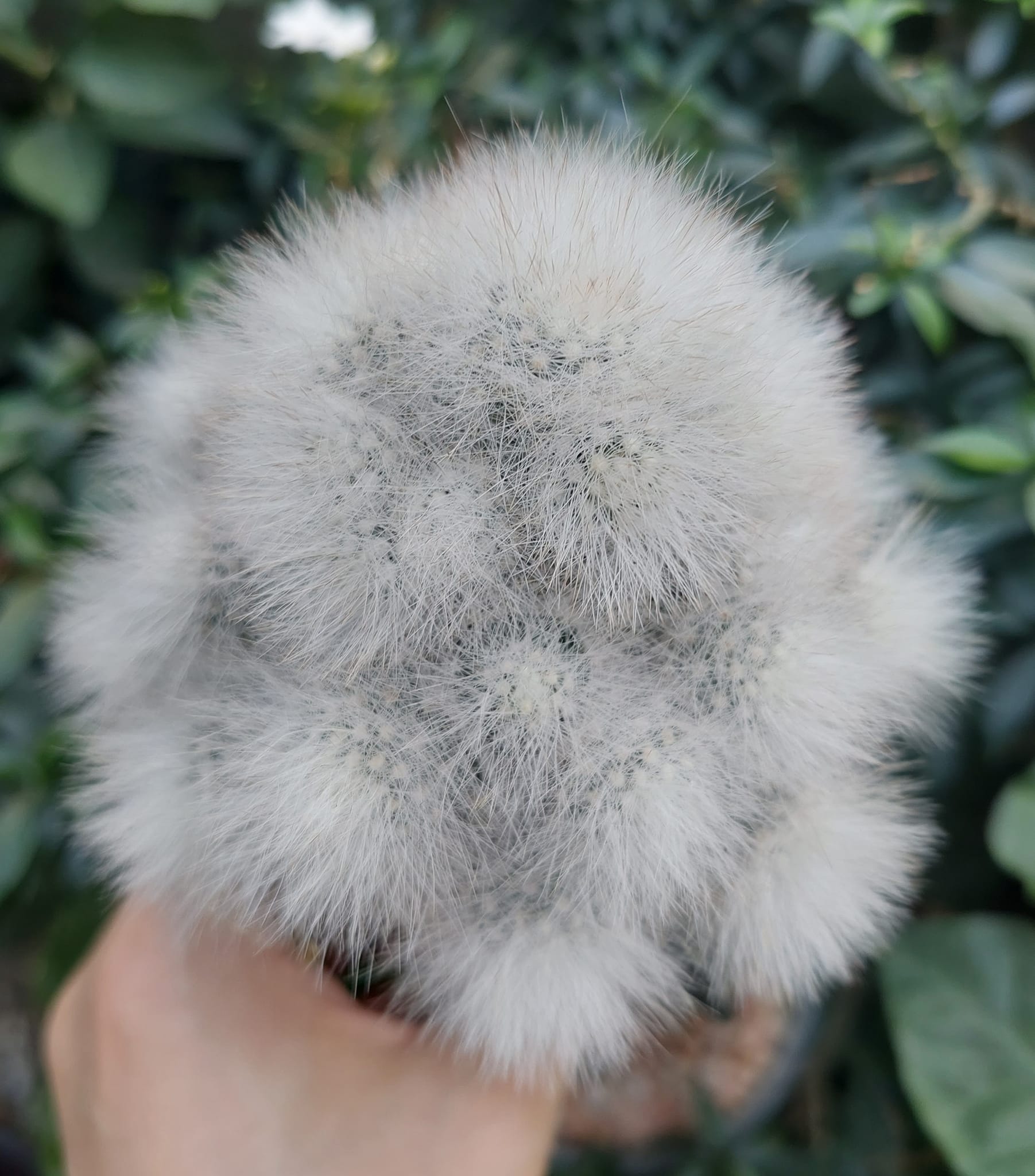
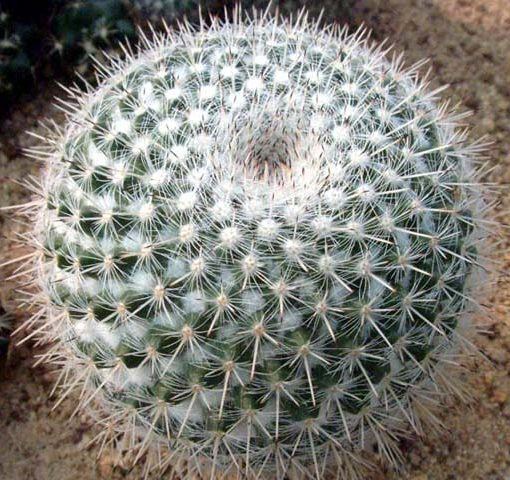
The central-spine count and texture is the most reliable diagnostic. Schwarzii’s entire spine cover reads as one uniform layer; parkinsonii projects its two to five stiff centrals outward from the radial pectination, producing the unmistakable owl-eye silhouette on every head.
Is Mammillaria schwarzii difficult to grow?
Yes. The species is advanced-level as an ungrafted plant because its densely packed heads trap water against the stem crowns for days after a careless watering, and the cliff-native root system is modest enough that recovery from a rot episode is slow. Fitz Maurice’s own grower notes and the Huntington ISI 2016 accession description both flag crown rot from overhead watering as the dominant failure mode. Growers who keep the plant alive long-term water only when the mix is bone dry, water from the pot edge rather than overhead, and leave it completely dry from October through March.
Is Mammillaria schwarzii endangered, and is it legal to buy?
The species carries the highest-risk IUCN Red List assessment and appears on CITES Appendix II under the blanket Cactaceae listing, which regulates international trade. Legal ownership requires nursery-propagated stock with paperwork demonstrating artificial propagation (CITES source code D for artificially propagated plants, source code A for seed grown). Mexico’s NOM-059-SEMARNAT-2010 also protects the species domestically as sujeta a protección especial. Wild-collected plants should never be purchased, and any seller who cannot document propagation provenance should be avoided.
When does Mammillaria schwarzii flower, and at what age?
Flowering is a spring event in cultivation, peaking in May, with cream-white blooms roughly 12 mm across opening in a ring just below the apex of each head. Seed grown plants start to bloom at around three to five years from germination, well before the mound reads as a mature colony. Bright red fruit follows later in the season and sits on the plant for months, which is the one time the glassy white spine mat has a visible contrast working against it.
Where does Mammillaria schwarzii grow in the wild?
On a single volcanic cliff in northern Guanajuato, at 2,000 to 2,400 metres, near San Felipe on the Mesa Central highlands. The cliff runs roughly four kilometres long and one hundred metres wide, and the population splits between exposed faces and shaded crevices. Older sources sometimes attribute the species to Jalpan de Serra in the Sierra Gorda limestone belt, but every verified field account from 1987 onward places it on volcanic rock in Guanajuato, not on the Querétaro karst.
How large does a mature Mammillaria schwarzii colony get?
Individual heads stay small, about 3 cm tall by 3.5 cm across, and a mature colony forms a low irregular mound rather than a tall cluster. Long-established cultivated plants reach fifty or more heads and spread ten to fifteen centimetres across while remaining under five centimetres tall overall. The slow low-growing habit is the species signature and is expressed most completely on seed grown plants; grafted stock runs to taller loose heads that never settle into the right silhouette.
Sources & further reading
Shurly, E. W. (1949). Mammillaria schwarzii spec. nova. Cactus and Succulent Journal of Great Britain 11: 17. · Fitz Maurice, W. A. & Fitz Maurice, B. (1988). The rediscovery of Mammillaria schwarzii. Cactus and Succulent Journal (USA) 60(2): 72–75. · Fitz Maurice, W. A. & Fitz Maurice, B. (1994). Conservation notes on Mammillaria schwarzii. Cactus and Succulent Journal (USA) 66(3): 107–109. · Sánchez, E., Fitz Maurice, W. A., Fitz Maurice, B. & Bárcenas Luna, R. (2013). Mammillaria schwarzii. The IUCN Red List of Threatened Species 2013: e.T40851A2936962. · Hunt, D. R. (2006). The New Cactus Lexicon. dh books, Milborne Port. · Anderson, E. F. (2001). The Cactus Family. Timber Press, Portland. · Butterworth, C. A. et al. (2007). A localised loss of the chloroplast rpl16 intron in Mammillaria series Stylothelae. Bradleya 25: 139–152. · Hernández, H. M. & Gómez-Hinostrosa, C. (2015). Mapping the Cacti of Mexico. Part II: Mammillaria. Succulent Plant Research 9. · Huntington Botanical Gardens (2016). ISI 2016-4 Mammillaria schwarzii. International Succulent Introductions. · CITES (2019). CITES Cactaceae Checklist (3rd edition). Royal Botanic Gardens, Kew. · Kew POWO record Mammillaria schwarzii Shurly (IPNI 151666-2). Plants of the World Online.