Mammillaria herrerae f. albiflora
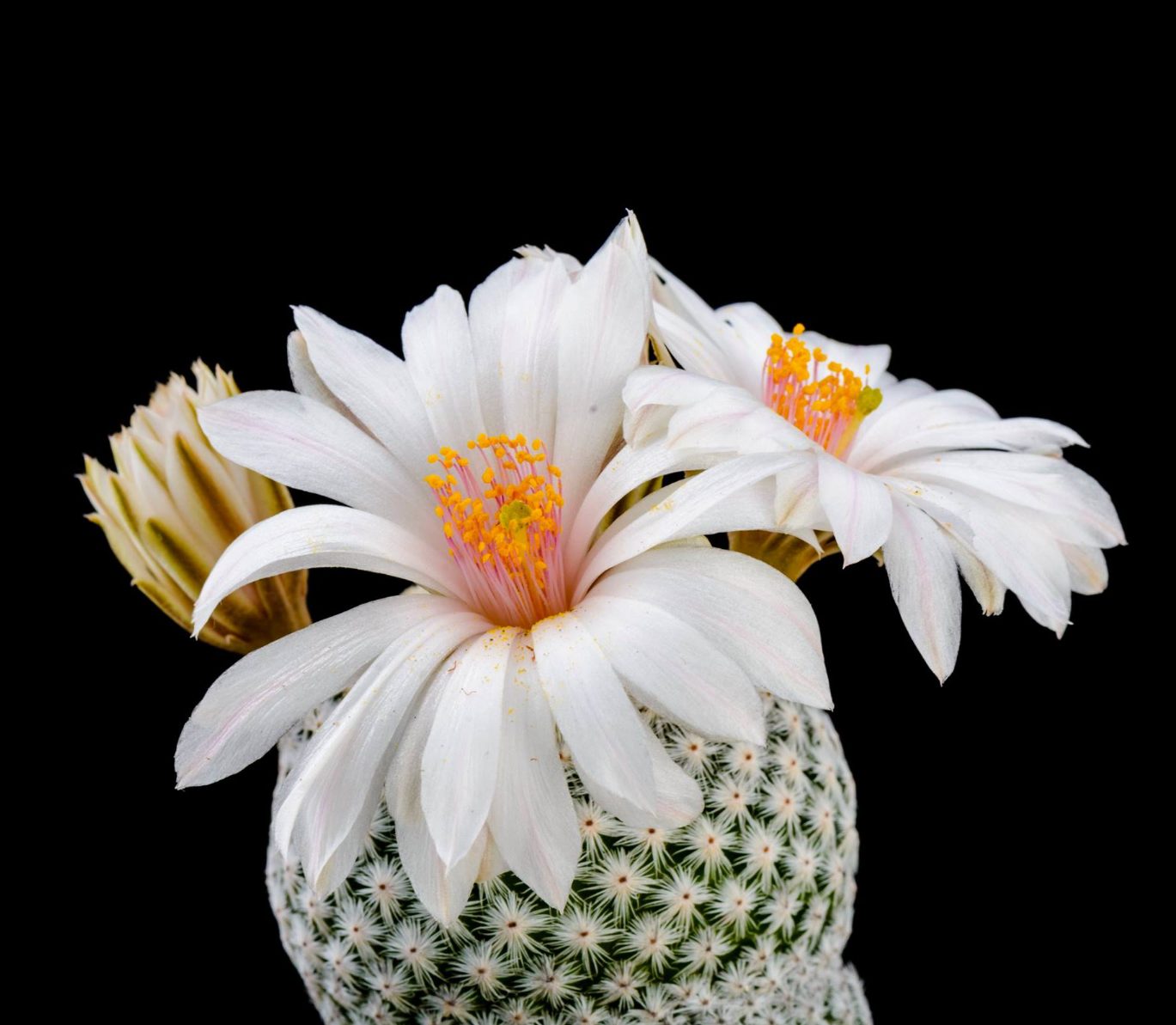
Mammillaria herrerae f. albiflora is the white-flowered form of a species most collectors already count among the hardest Mexican miniatures to hold. Where the regular form species carries pink apical flowers over a dense white spine mat in a narrow Querétaro valley, the albiflora form carries near-pure white flowers over a slenderer body, and its only known range sits about 50 km north in Guanajuato on calcareous slopes south of San José de los Pozos.
Erich Werdermann published the taxon as M. herrerae var. albiflora in 1931, in the same Berlin-Dahlem bulletin issue that carries the description of M. herrerae itself. Curt Backeberg raised it to species rank as M. albiflora in 1937, and that is the name Kew POWO accepts today. Grower literature and Mexican atlases still split on the rank. Hunt at one point treated it as a phase of M. herrerae; Hernández and Gómez-Hinostrosa (2015) follow the species treatment. On this page the form is covered under its cultivated-collector name; the species-rank history sits in the Taxonomy section below.
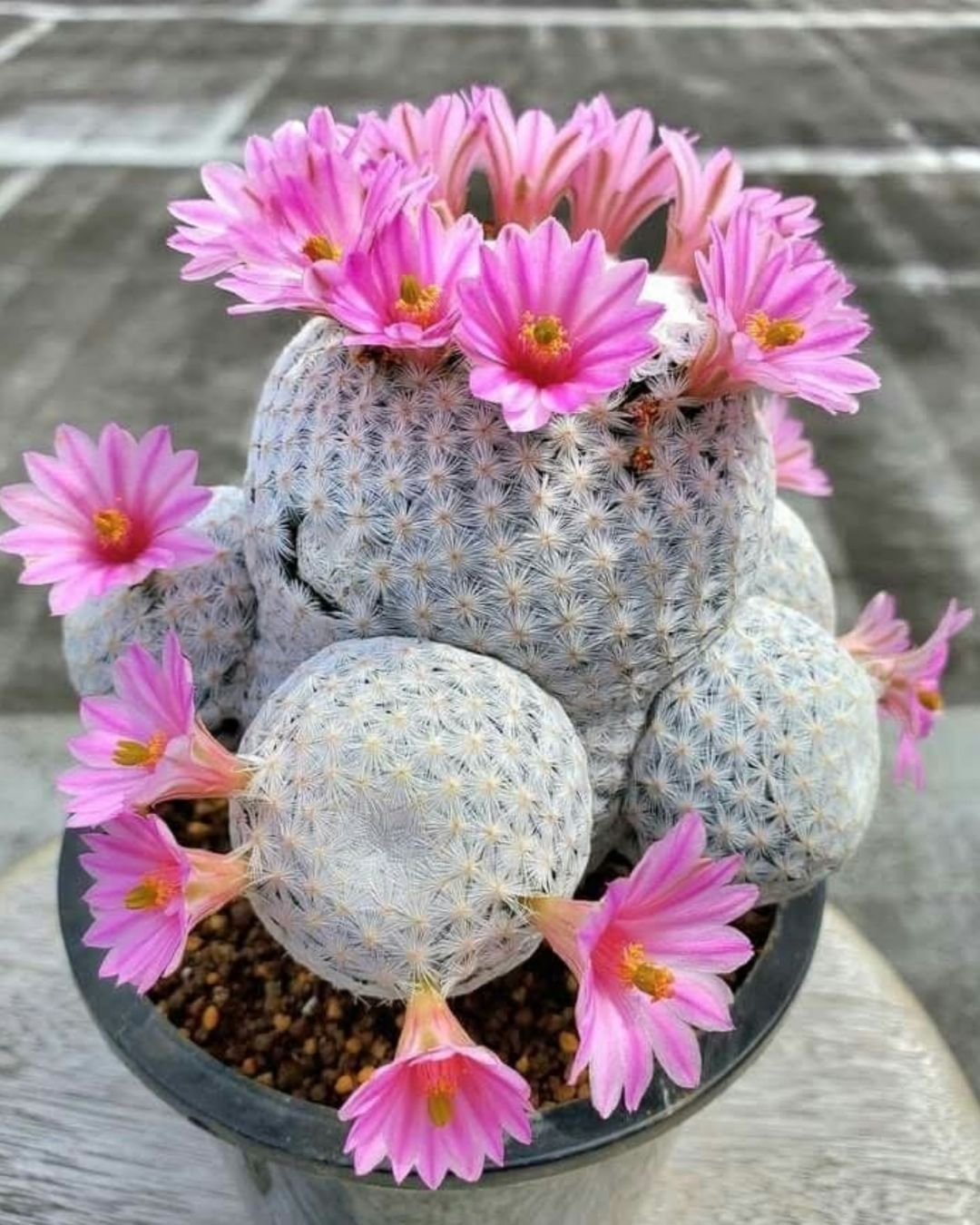
Bodies stay solitary and narrow at about 2 cm across and 5 to 7 cm tall, obscured by 60 to 80 fine interlacing white radial spines and no central spines at all. The flowers are the diagnostic character: 3.5 cm across, white, occasionally carrying a faint rose flush at the throat under strong light. For a plant this small, that flower size reads as disproportionate in person and is the reason the form is chased despite its legal and cultivation difficulty.
Mammillaria herrerae f. albiflora quick reference
A white-flowered form of M. herrerae from calcareous slopes in Guanajuato, 2,150 to 2,200 m, wrapped in 60 to 80 fine interlacing white radials and carrying disproportionately large 3.5 cm white flowers. Values calibrated for seed grown plants in cultivation, drawn from IUCN habitat data and specialist grower practice.
Taxonomy & nomenclature
Werdermann described the taxon in Notizblatt des Botanischen Gartens und Museums zu Berlin-Dahlem 11: 277 (1931) as M. herrerae var. albiflora. The type material came from Guanajuato, not from the Cadereyta valley that holds the nominate form. Backeberg elevated the variety to species rank as M. albiflora in 1937, citing the consistent differences in spine count, flower colour, and disjunct range.
Kew POWO and the IUCN Red List both accept M. albiflora at species rank, with M. herrerae var. albiflora reduced to synonymy alongside Escobariopsis albiflora (Werderm.) Doweld and Neomammillaria herrerae var. albiflora (Werderm.) Y.Itô. David Hunt at one point suggested the taxon was a phase of M. herrerae rather than a distinct entity; Charlie Glass and others argued the consistent morphology and the 50 km range gap warranted species rank, and that position carried. Hernández and Gómez-Hinostrosa (2015) follow POWO.
Within the genus the form sits in a small group of spinose Mexican miniatures that collectors routinely confuse on catalogue images. M. duwei analogues notwithstanding, the two closest visual matches are M. herrerae itself and M. pectinifera; the Distinguishing table in the FAQ below covers the herrerae comparison row by row.
Habitat
The form is known from a handful of calcareous slopes south of San José de los Pozos in northeastern Guanajuato, between roughly 2,150 and 2,200 m. Recorded sites include La Calera and a stretch of the Pozos to San José Iturbide road. Parent rock is limestone, with a thin mineral crust between outcrops and xerophytic scrub dominated by Opuntia, Jatropha, and low matorral. Plants grow wedged into rock fissures or pressed flat against gravel pans, where the narrow body and white spine mat read as part of the substrate to anything bigger than a passing insect.
The climate is semi-desert with a summer rain peak, typically 400 to 500 mm annually, falling mostly between June and September. Winters are dry and cold, with frosts on clear nights but the substrate drying quickly once the sun lifts. That dry-cold regime is the reason specialist growers can hold the form outdoors in Mediterranean climates; wet-cold winter conditions collapse plants within days. Regional cactus flora it shares slope with includes M. schwarzii on volcanic cliffs further north, though the two do not co-occur at any known site.
Morphology
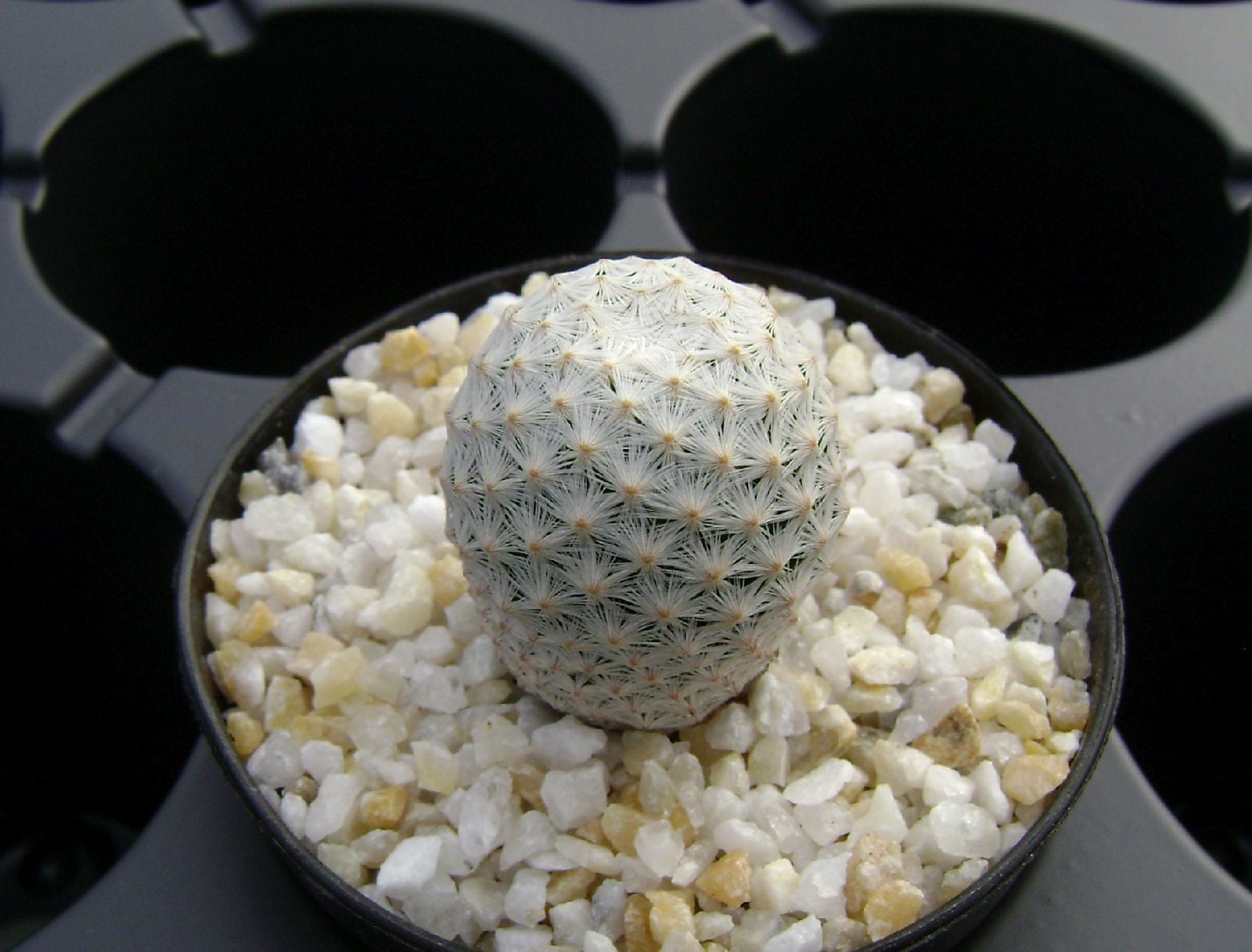
Stems stay solitary across the plant’s known range and in almost all cultivated material, offsetting only rarely even on long-held specimens. The body is cylindrical to narrowly club-shaped, about 2 cm in diameter at maturity and reaching 5 to 7 cm in height. Tubercles are short, conical, and completely obscured by spination; the plant reads as a white bristle cone rather than as a recognisable Mammillaria in the field.
Radial spines number 60 to 80 per areole, arranged in fine interlacing layers that enclose the body almost entirely. Each spine is short (roughly 3 to 5 mm), white, and soft to the touch; the overall effect is a matted cotton-wool sheath rather than the stiff needle cover of most Mammillaria. Central spines are absent. This is the single most reliable vegetative separator from M. herrerae, which routinely carries more than 100 radials per areole in denser, overlapping rosettes.
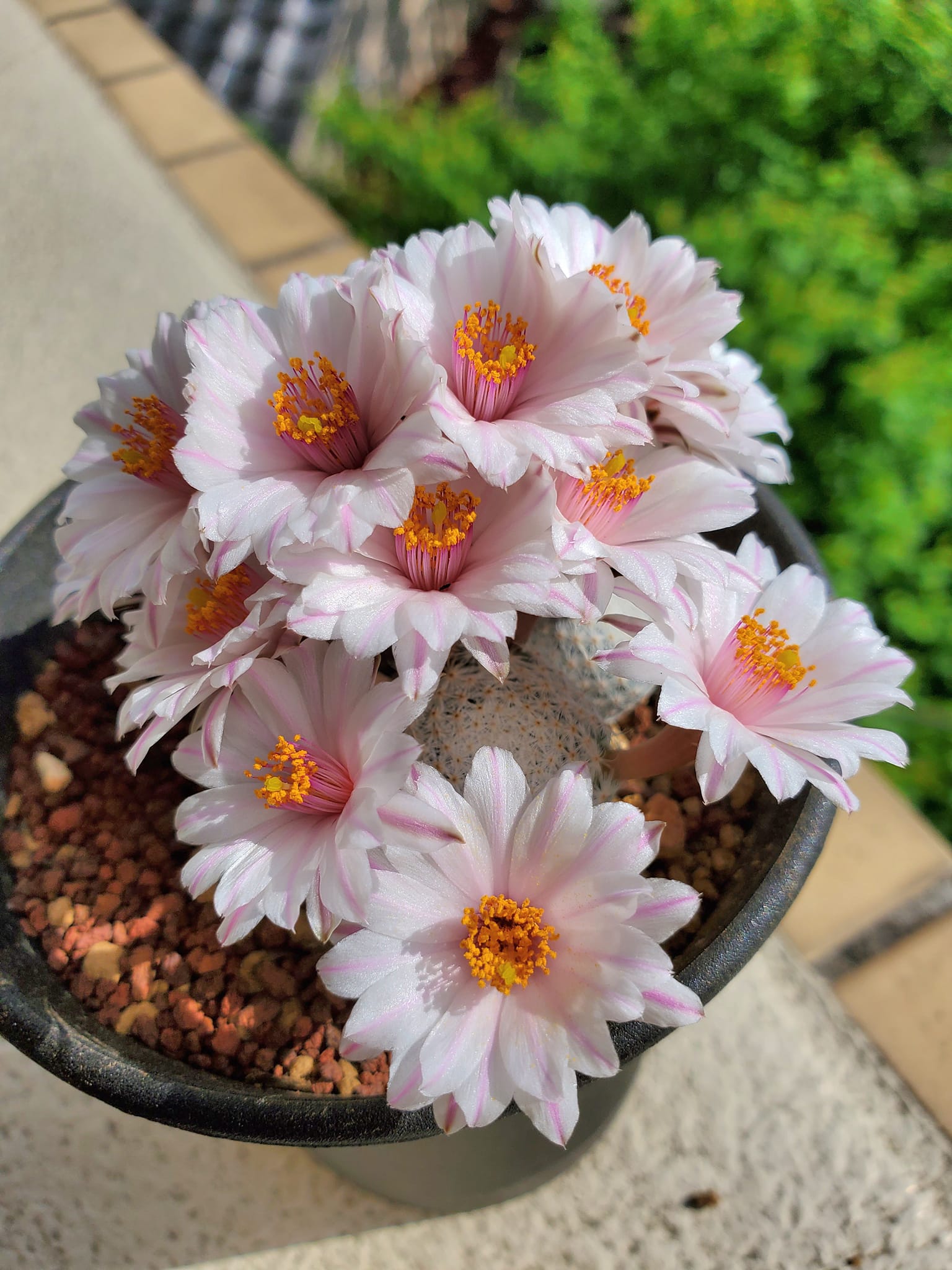
Flowers are the diagnostic character and the reason for the epithet. Each flower opens to 3.5 cm across, sits near the crown in a ring at the apex, and carries broad white tepals with a pale yellow throat; under strong light, a faint pink midstripe may develop, but the overall impression stays unambiguously white. In European cultivation flowering runs April through May, triggered by the first warm week after a dry winter rest. Fruit is cryptocarpic, staying lodged in the spine mat for months; seeds are black and about 1 mm across, viable without scarification.
Locality detail
All confirmed sites lie within a few kilometres of each other south of San José de los Pozos, in the municipality of San Luis de la Paz, Guanajuato. The IUCN 2013 assessment gives an area of occupancy below 5 km² and treats the whole range as a single threat-based location. The map below uses approximate regional centroids rather than sharp GPS points; precise coordinates for the remaining subpopulations are withheld from public assessment documents because illegal collection is the primary driver of decline and continues to be recorded at the known sites.
Cultivation
Substrate
The wild substrate is easy to replicate in cultivation: a low-organic mineral mix with a clear limestone component. A workable blend is roughly 45 per cent pumice, 25 per cent granite grit, 20 per cent crushed limestone chip, and 10 per cent calcined diatomaceous earth, with no bark, no organic peat content, and no garden soil. The limestone fraction is the piece most growers skip on first attempts; without it, plants hold shape for a season or two and then stall, and flowering drops off before decline becomes visible at the crown. Pumice and decomposed granite handle drainage, limestone handles pH and slow mineral feed.
Watering and light
Watering stays tight year-round. Through the growing season (April through September in the northern hemisphere) water lightly once every two to three weeks, letting the mix dry completely between applications and dropping to zero during any heatwave above about 32°C. From October through March hold dry; a single mist in late winter is acceptable if the plant has shrunk by more than about a quarter of its summer height, but nothing heavier. The dry winter rest is what triggers flowering, and growers who keep winter water flowing report reliably poor flower set.
Light requirements are high. The form evolved on open calcareous slopes at 2,150 m and tolerates full sun in cultivation once acclimated; under less than about 70 per cent of full summer sun the body elongates, spine cover loosens, and the plant reads as a different species within two seasons. Morning sun with unfiltered midday exposure is the sweet spot in most temperate glasshouses. Cold tolerance is respectable for the genus: dry, plants shrug off short drops to about -5°C, but any wet-cold event collapses the root neck within days and the damage is usually terminal. Overwintering dry in a frost-free but unheated space is the standard European practice.
Propagation is almost always from seed. Plants rarely offset, and when they do the offset is slow to root on its own. Seed germinates readily on a sterile pumice and limestone chip mix under bottom heat; cotyledons appear within ten days and the first true spines within six weeks. Grafted stock exists and reaches flowering inside eighteen months on Myrtillocactus or Pereskiopsis, but the grafted body loses the natural narrow habit within a season and the spine mat loosens; seed grown plants held from germination are the target for collector-grade specimens.
Comparison with related taxa
The most common confusion is with M. herrerae, which shares the bristly-white spine mat and the disproportionate apical flower habit. Spine count is the fastest in-person tell: the albiflora form rarely exceeds 80 radials per areole, while a mature Cadereyta M. herrerae runs 100 and frequently more. Body shape is the second: herrerae sits as a squat globe, albiflora as a narrow column. Flower colour settles any remaining doubt, though neither taxon reliably flowers in the first four years from seed.
M. duwei, another Guanajuato endemic covered on the site, carries plumose feathery radials rather than the interlacing needle-fine white spines of the albiflora form; the two taxa sit roughly 100 km apart and do not co-occur. M. pectinifera, the Tehuacán Valley miniature, shares the pectinate-adjacent spine aesthetic and the miniature body but carries a clearer comb-arranged radial set and a pink flower. Newer grower-level confusion runs to M. luethyi, but luethyi has pectinate radials and violet flowers and does not resemble albiflora in person once both are seen at scale.
For the non-expert buyer the practical diagnostic is the flower: if the plant is offered as M. herrerae and blooms true white, verify the origin before paying a herrerae price. Verified Guanajuato-provenance plants run higher than nominate-form herrerae in serious collections, and sellers with mixed seed batches have been known to relabel either direction as the season demands.
Frequently asked questions
How do you tell M. herrerae f. albiflora apart from M. herrerae?
Both taxa were published by Werdermann in 1931, and catalogue photos rarely resolve the diagnostic spine count. Pull the slider above to compare a flowering M. herrerae f. albiflora against the nominate M. herrerae; the white-versus-pink flower is the fastest tell, the radial spine count is the most reliable.
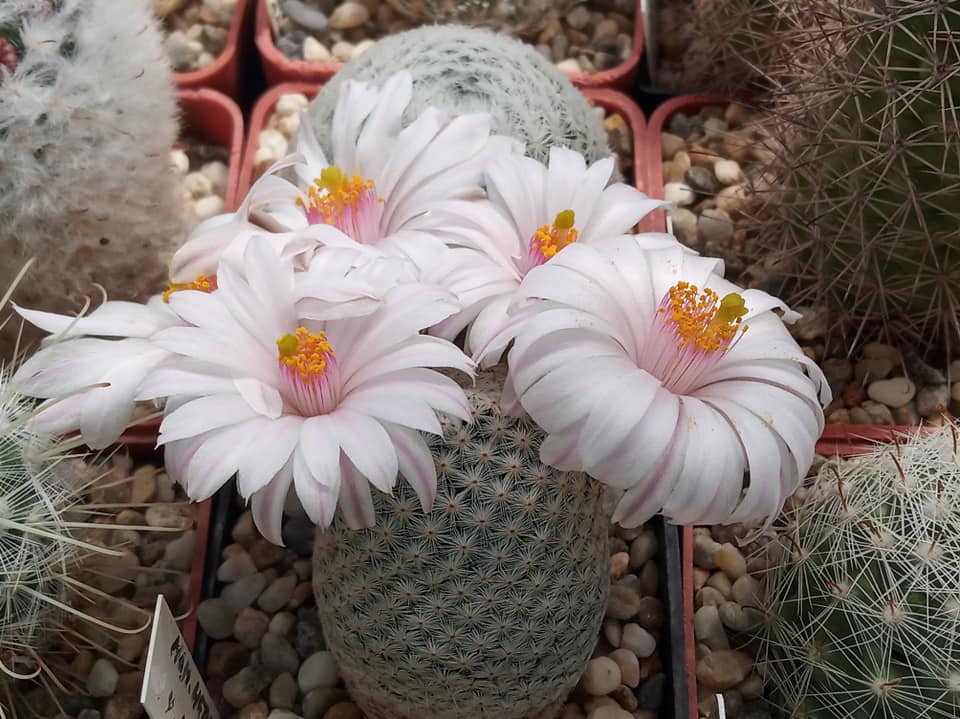
Radial spine count settles ambiguous cases when the plant is not in flower. Count radials on three mature areoles at mid-body; if the average sits under 90, the plant is the albiflora form regardless of label.
Is M. herrerae f. albiflora hard to grow?
Advanced. The root neck rots within days under wet-cold winter conditions, flowering requires a dry winter rest with visible shrinkage, and the plant drops character fast under insufficient light. Specialist growers hold it reliably in a limestone-heavy mineral mix with tight watering; beginners lose plants inside a year. Budget this taxon alongside the hardest Mexican miniatures in cultivation, not the general-purpose Mammillaria shelf.
Can M. herrerae f. albiflora be grown from seed?
Yes, and seed is the standard route because offsets are rare. Fresh black seed germinates on sterile pumice and limestone chip within about ten days under bottom heat. Seed grown plants develop natural body proportions and a full radial spine mat, while grafted stock loses those characters within a season. Expect four to six years to first flower on a properly-grown seedling.
Is M. herrerae f. albiflora legal to own?
Cactaceae sit on CITES Appendix II, so international movement of this taxon requires CITES export and import paperwork regardless of whether the plant is sold under M. herrerae, M. albiflora, or the form name. In Mexico the species is additionally protected under NOM-059-SEMARNAT-2010. Buy only from nurseries that supply the CITES permit number on the invoice; seed grown nursery stock of documented origin is the only legal route for collectors outside Mexico.
Where does M. herrerae f. albiflora grow in the wild?
The known range is a handful of calcareous slopes south of San José de los Pozos in northeastern Guanajuato, Mexico, between about 2,150 and 2,200 m. Recorded sites include La Calera and a stretch of the Pozos to San José Iturbide road. The IUCN 2013 assessment gives an area of occupancy below 5 km² and treats the whole range as a single threat-based location. Precise coordinates are withheld from public documents because illegal collection continues at the known sites.
When does M. herrerae f. albiflora flower?
April through May in European and North American cultivation, triggered by the first warm week after a dry winter rest. Flowers open around mid-morning and close by late afternoon, repeating for three to four days per flush. Plants that held a dry winter and shrank by roughly a quarter set a denser flower ring than those that were kept watered through the cool months. First flowering on seed grown stock runs four to six years from sowing.
Sources & further reading
Werdermann, E. (1931). Notizblatt des Botanischen Gartens und Museums zu Berlin-Dahlem 11: 277. · Backeberg, C. (1937). Blätter für Kakteenforschung; elevation of var. albiflora to species rank. · Kew POWO, Plants of the World Online. Mammillaria albiflora (Werderm.) Backeb. · Fitz Maurice, B., Fitz Maurice, W.A., Sotomayor, M. & Sánchez, E. (2013). Mammillaria albiflora. The IUCN Red List of Threatened Species 2013. · Hernández, H.M. & Gómez-Hinostrosa, C. (2015). Mapping the cacti of Mexico Part II: Mammillaria. Succulent Plant Research 9: 1-189. · Anderson, E.F. (2001). The Cactus Family. Timber Press. · Hunt, D. (2013). The New Cactus Lexicon. dh Books. · Pilbeam, J. (1999). Mammillaria. The Cactus File Handbook 6. · llifle.com, Encyclopedia of Living Forms, Mammillaria albiflora entry. · NOM-059-SEMARNAT-2010, Mexican federal protected species list.