Mammillaria herrerae
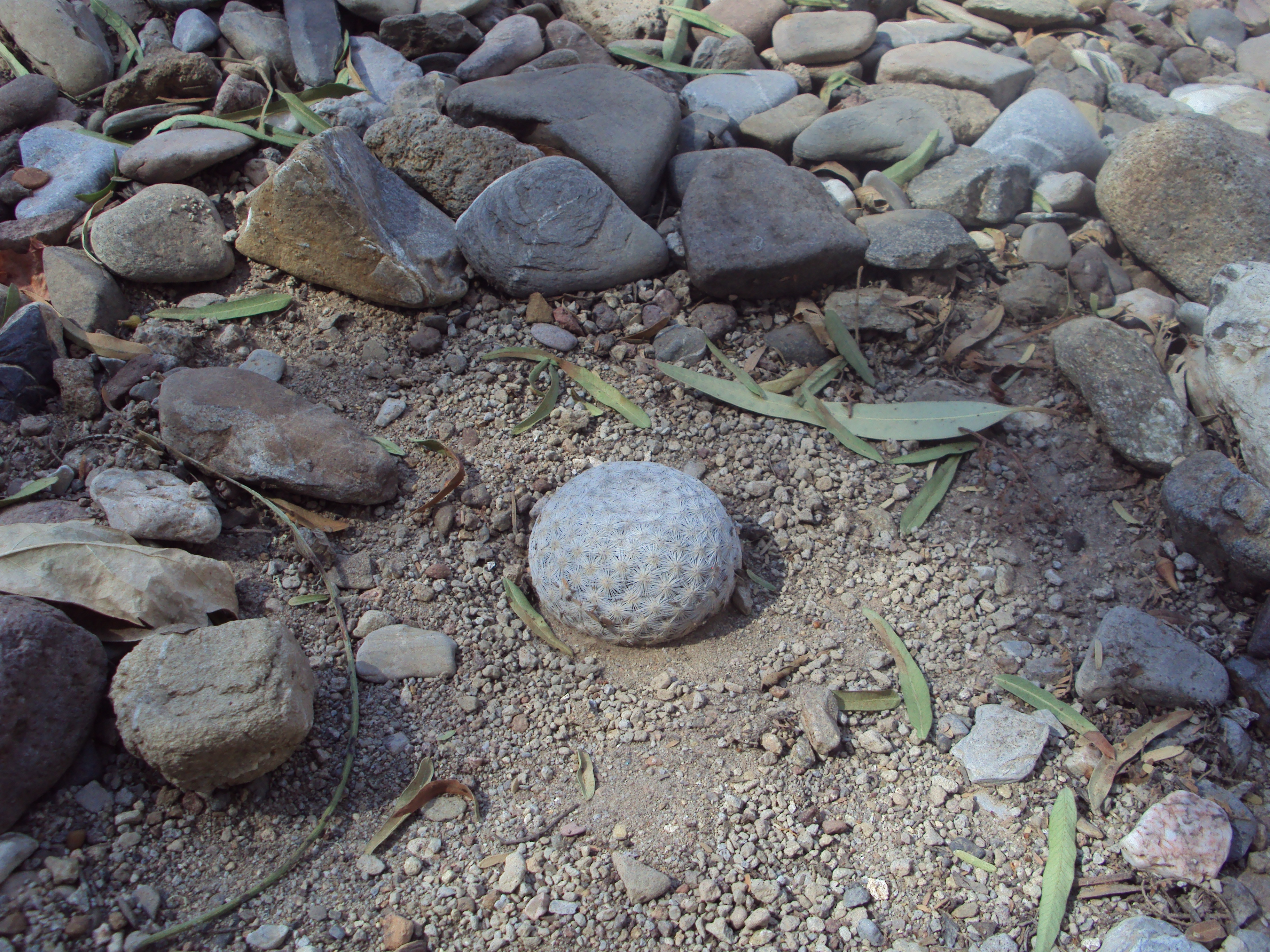
Mammillaria herrerae is a single-location Chihuahuan Desert endemic confined to a short stretch of calcareous slope east of Cadereyta de Montes in Querétaro, Mexico. Werdermann described it in 1931 from material he had received from the type locality around Vista Hermosa; the species spent decades as a collector rarity before 1980s field work established how narrow its range really is. Kew POWO keeps the name accepted in its original combination; Chilita herrerae, Escobariopsis herrerae, and Neomammillaria herrerae are the segregate-genus synonyms you still see in older literature and seed catalogues.
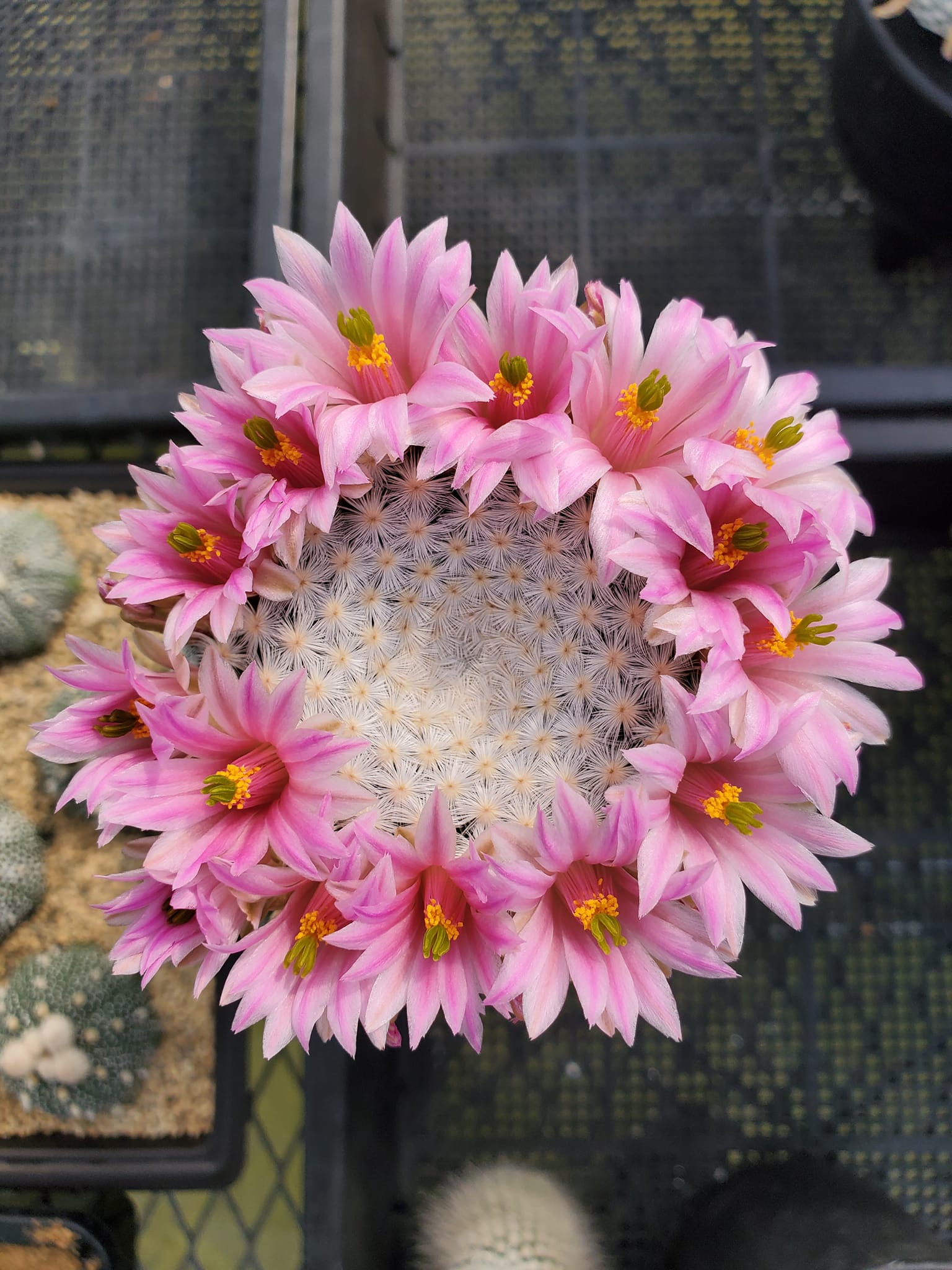
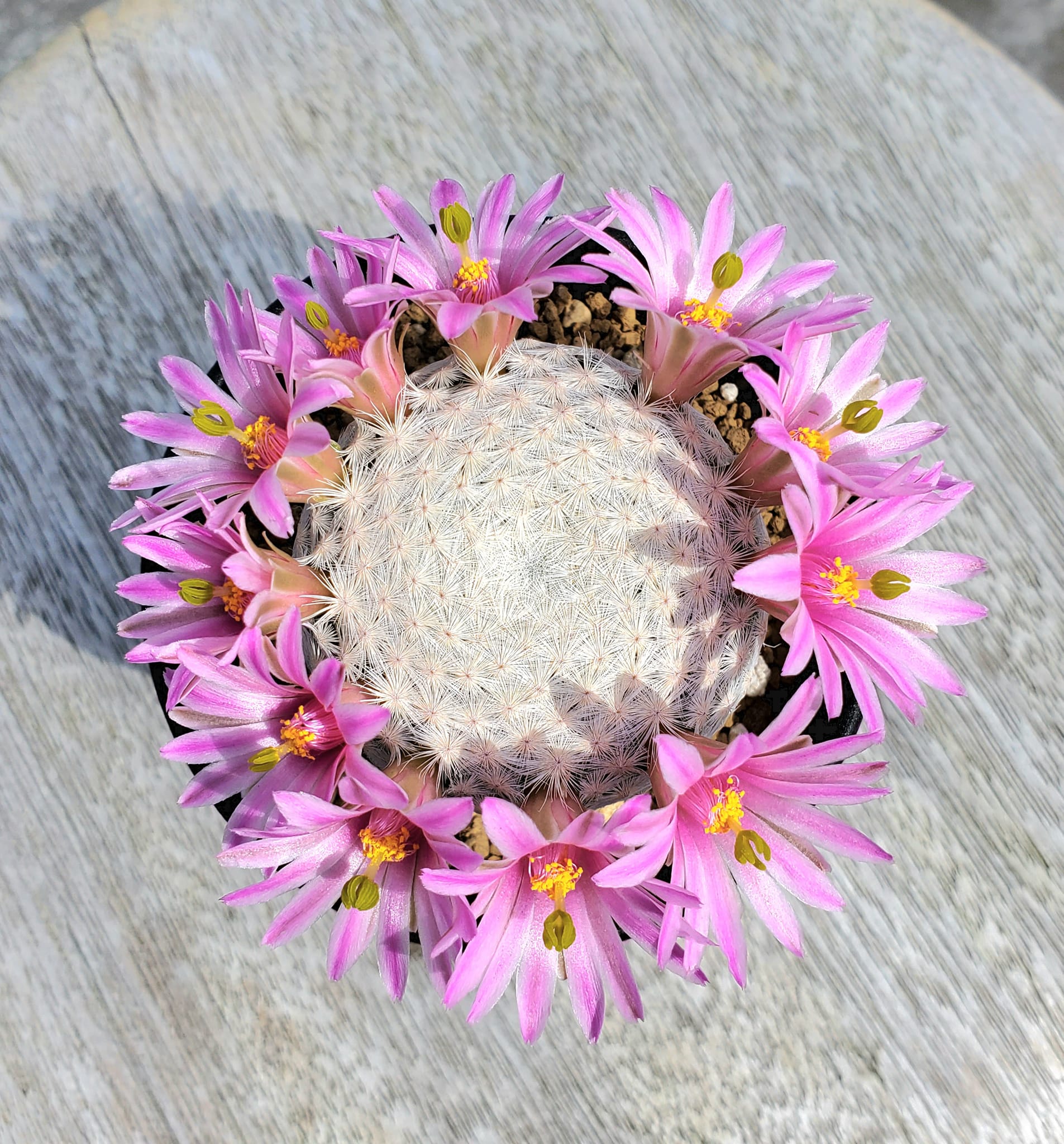
The body is a white globe of 2 to 3.5 cm in habitat, wrapped in a hundred or more bristly white to grey radial spines that interlace tightly enough to hide the epidermis. There are no central spines. In April and May the crown produces one to several funnelform flowers of 20 to 25 mm, pale pink to red-violet, disproportionately large for the stem they sit on. The effect reads instantly as a miniature version of the much more variable Mammillaria napina floral display, and that is part of why serious collectors care about it.
The combination of a tiny extent of occurrence, a specific calcareous Regosol substrate, and flowers that practically advertise the plant from a metre away has been catastrophic. The 2013 IUCN assessment by Gómez-Hinostrosa, Guadalupe Martínez, and Sánchez recorded a population decline exceeding ninety-five per cent over the preceding twenty years, driven almost entirely by illegal collection for the international cactus market. What is left in habitat is estimated at roughly 430 mature individuals within an area of occupancy of 0.87 square kilometres. The same single-population profile shows up in Mammillaria schwarzii further north near Jalpan de Serra, and this pattern is what makes miniature Mexican endemics so vulnerable to collector off-take in the first place.
Everything on this page is keyed to that reality. Cultivation information is written for seed grown plants of documented nursery origin; field-collected material is illegal to trade internationally under CITES Appendix II and federally protected in Mexico under NOM-059.
Mammillaria herrerae quick reference
A Querétaro single-location endemic with a solitary globose body, dense white bristle spination, and flowers almost as wide as the stem. Values calibrated for seed grown plants in cultivation, drawn from habitat data in the 2013 IUCN assessment and specialist grower consensus.
Taxonomy & nomenclature
Werdermann published Mammillaria herrerae in 1931 in Notizblatt des Botanischen Gartens und Museums zu Berlin-Dahlem, volume 11, page 276. The epithet honours Alfonso Herrera, the nineteenth-century Mexican naturalist whose collections underpinned early work on the Mexican cactus flora. Kew POWO accepts the original combination; the segregate-genus combinations Chilita herrerae (Buxbaum), Escobariopsis herrerae (Doweld), and Neomammillaria herrerae (Itô) are all treated as synonyms and persist mostly in seed-list catalogues and older European literature.
Within Mammillaria, the species sits in the Lasiacanthae section alongside Mammillaria albiflora, M. humboldtii, and M. candida. These are united by dense, bristly white radial spination, absence or near-absence of central spines, and a strong preference for calcareous substrates on exposed slopes. The field number L 711 (Alfred Lau, 1974, Vista Hermosa, 1,300–1,800 m) is the reference provenance marker cited across European and North American seed suppliers.
Habitat
Endemic to a single location in the eastern part of the Cadereyta de Montes municipality in Querétaro, central Mexico. The known sites cluster on the lower slopes of the Sierra del Doctor, the Mesa de León subquadrant around Vista Hermosa, and the El Arbolito ejido, all on moderate slopes of calcareous Regosols weathered from Early Cretaceous limestone. Altitude runs from about 1,800 to 2,050 m at the core sites, with outliers recorded from 1,300 up to 2,500 m.
Vegetation is semi-desert submontane microphyll-rosetophyll scrub. The species grows between tussock grasses and wedged against limestone cobble and bedrock, sharing ground with Echinocactus grusonii, Ferocactus hystrix, and Thelocactus leucanthus. The calcareous slope orientation keeps drainage sharp during the summer rains and limits standing moisture during the cool dry winter. This is the habitat fingerprint that cultivation needs to reproduce.
Morphology
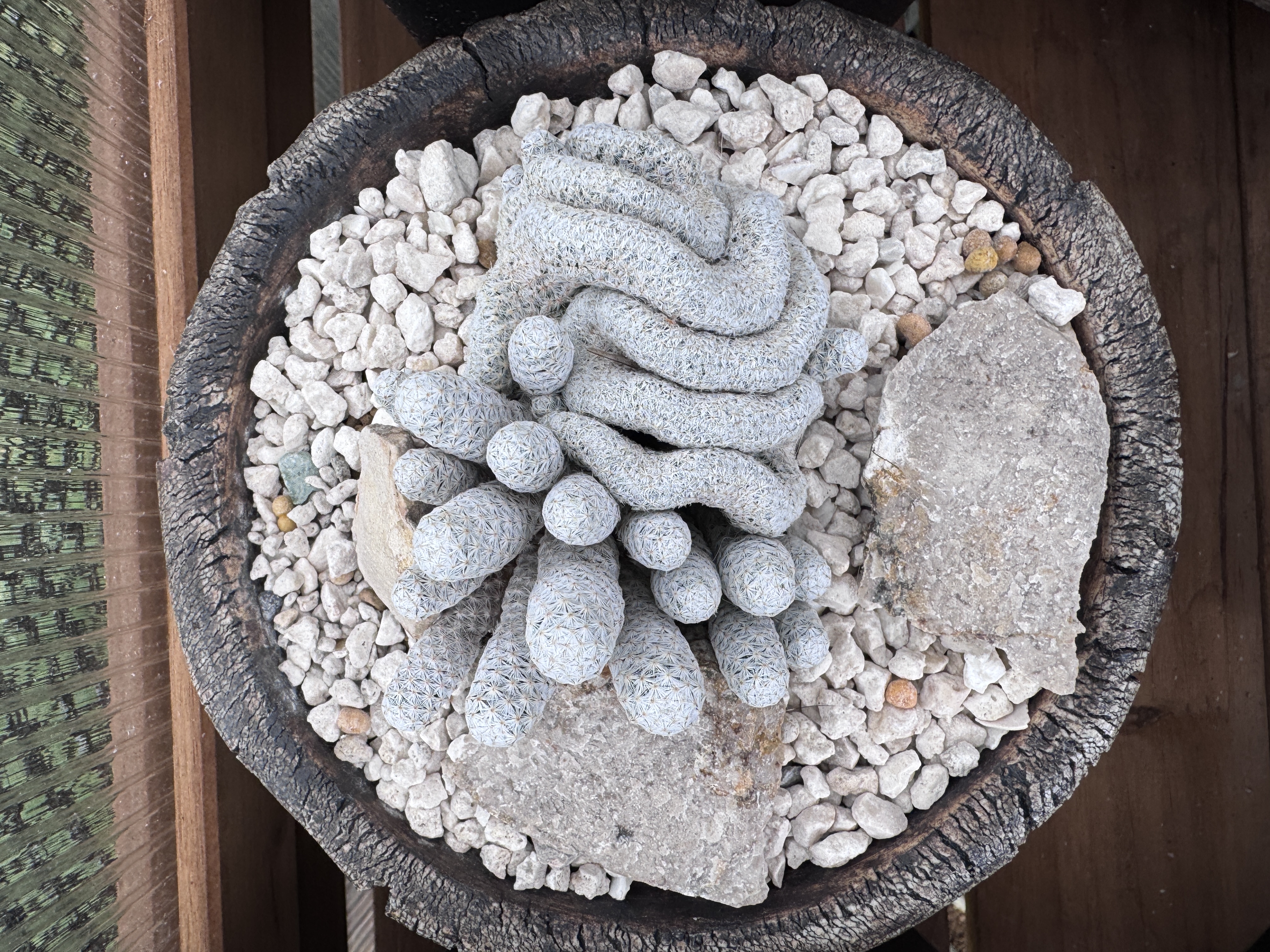
Stems are solitary, globose at first and shortly elongating with age, 2 to 3.5 cm in diameter and the same again in height at habitat-grown proportions. Seed grown cultivation specimens reach 5 to 8 cm tall. The plant body carries no latex. Tubercles are cylindrical, closely set, truncate at the tip, with naked axils, which is part of what distinguishes the species from the otherwise similar Mammillaria candida.
Spination is the diagnostic character. A hundred or more bristly, unequal, interlacing radials cover the stem, 1 to 5 mm long, white to pale grey. There are no central spines. The density is such that the green epidermis is completely hidden on an adult, and the overall impression is of a ball of wound thread rather than a spiny cactus.
Flowers open on the crown from April through May and are pale pink to red-violet, funnelform, 20 to 25 mm long. The relative scale is striking: a fully open flower can equal the diameter of the stem carrying it. Fruits are small whitish globose berries with blackish-brown seeds. Seed set is reliable on seed grown plants that are at least five to seven years old and have reached roughly 3 cm in diameter.
Locality detail
The map below shows the Cadereyta de Montes locality cluster. Exact coordinates for Mammillaria herrerae sub-sites are withheld from public records because of the documented poaching history; the markers use regional centroids keyed to the published Ejido Vista Hermosa coordinates (20° 40′ 28″ N, 99° 32′ 23″ W) and to nearby named settlements referenced in the 2013 IUCN assessment.
Cultivation
Seed grown Mammillaria herrerae rewards growers who can enforce a dry winter. The species dies under routine greenhouse conditions because the narrow transition between root and stem is the rot-prone organ, and a single wet-cold episode will sever it. The cultivation programme below is keyed to the 2013 IUCN habitat description and to the grower consensus published in the British Cactus and Succulent Journal and European specialist literature.
Substrate
Mineral-dominant mix that matches the calcareous Regosol the species evolved on. A workable ratio is 40 per cent pumice, 30 per cent granite grit or decomposed granite, 15 per cent lava rock, 10 to 15 per cent limestone chip, and at most 5 per cent low-nutrient cactus compost. Skip peat, standard potting soil, and any ingredient that holds water at the root neck. Some European growers report better spine colour on a slightly acidic mix with no limestone addition; that is a minority position and the majority keep limestone in to track habitat chemistry.
Watering and light
Water sparingly from March through September, allowing the substrate to dry fully between applications. Stop completely from mid-October through February, with the single exception of a brief overhead misting in mid-winter if humidity drops far enough to threaten spider-mite colonisation. Full sun with strong ventilation, acclimated from spring through summer; juvenile plants are noticeably reddish and need the same exposure adult plants do to build mature spine density.
Seed grown versus grafted
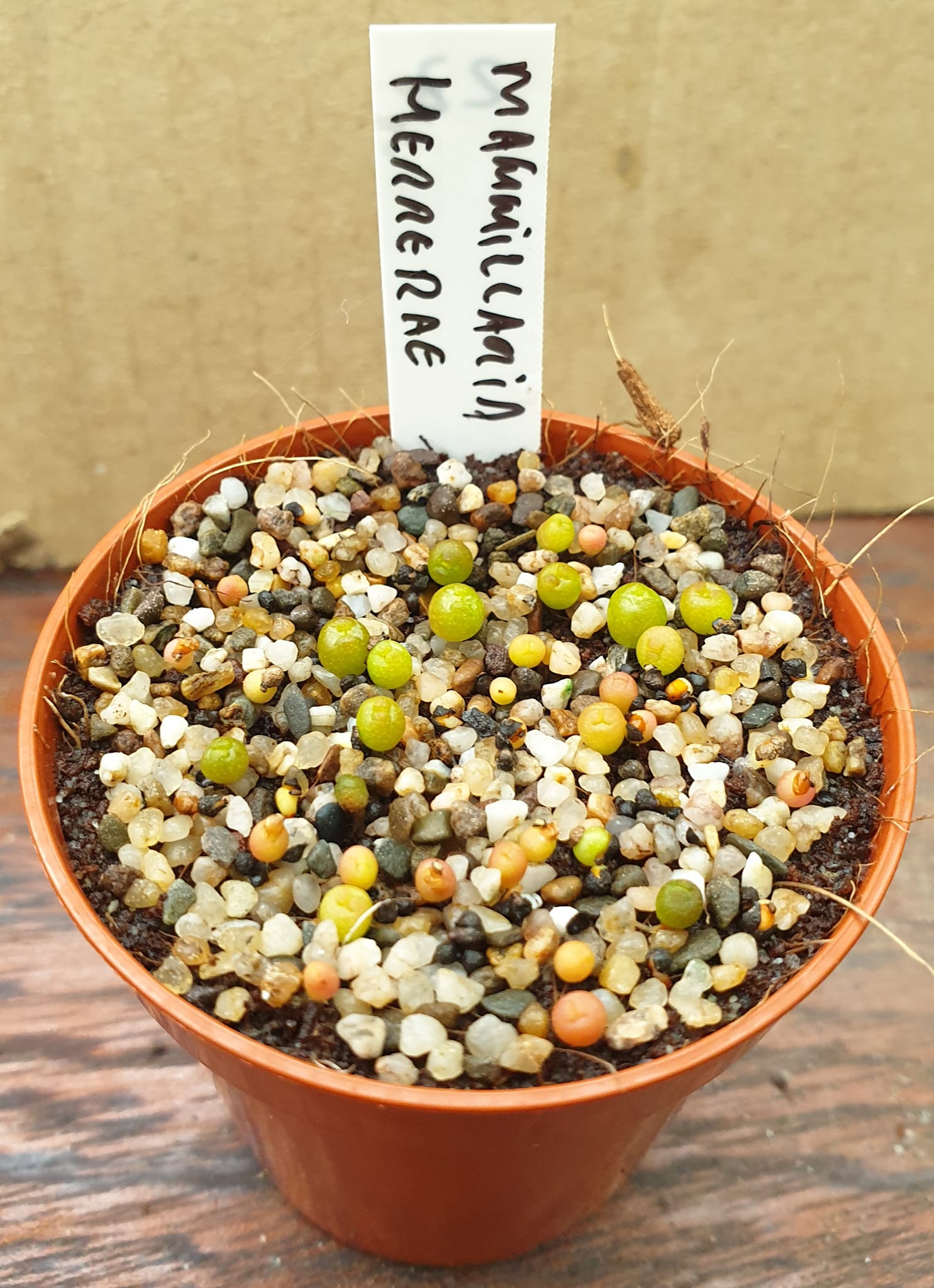
Seed grown plants are the only acceptable long-term specimen for a serious collection. Seeds germinate in 7 to 14 days at 21 to 27 °C under standard sterile mineral sowing; the seedlings spend their first two years in a community tray before potting on. Expect five to seven years from sowing to the first flowering crown at around 3 cm diameter, and a total of ten to fifteen years to a mature show-scale body.
Grafting onto Pereskiopsis or Hylocereus is used by conservation propagation programmes to bulk up seed-bank genetics quickly, and there is no objection to grafted material being used that way. Grafted retail stock is a different matter. The forced growth rate produces stretched, oversized bodies that never settle into the 3-cm habitat proportion; degrafting partially corrects the habit but the early body record is already fixed. Seed grown is the target.
Comparison
The closest visual analogue in the genus is Mammillaria candida. Both species carry a hundred or more white radial spines that fully cover the body, both hold large pink flowers for the stem size, and both come up together in grower conversation about dense white Mammillaria. The separation is body scale and axil character: M. candida clusters to 15 cm or more, offsets, and carries axillary wool and bristles, while M. herrerae stays solitary at 2 to 3.5 cm and has naked axils.
Mammillaria albiflora is the second comparison that comes up. Both share the Lasiacanthae section and the dense bristle spination, but M. albiflora carries pure white flowers and lives on different substrate in Guanajuato. For a different kind of cross-reference, Mammillaria napina is the Tehuacán-Cuicatlán geophyte whose root morphology solves the opposite problem: it disappears into the substrate during dormancy rather than relying on dense spine cover for protection. Both species throw disproportionate pink flowers at the collector as a reward.
Two other Mexican limestone endemics sit in the same cross-reference space. Mammillaria pectinifera carries a flat pectinate white-spined body that reads similar to herrerae from above, though the spine arrangement is comb-like rather than interlacing and the plant sits almost flush with the soil. Mammillaria crucigera, from the Tehuacán-Cuicatlán border region, shares the preference for calcareous substrate and the compact ball-like body but carries a distinctive cross-shaped areole spine pattern instead of the herrerae bristle covering.
Frequently asked questions
How do you tell Mammillaria herrerae apart from Mammillaria candida?
Both species are small white-spined Mammillaria with pink flowers, and newer collectors regularly mislabel seedlings. Four characters separate them cleanly; the single most diagnostic is axil wool.
Pull a tubercle away from the stem to check. Naked axil means herrerae. Dense wool and bristles in the axil means candida. Body scale confirms: a 15 cm clustering mound of white spines is candida every time.
Is Mammillaria herrerae hard to grow?
It is intermediate to advanced. The plant itself is not fussy about light or substrate if the mix is mineral-dominant, but the narrow neck between root and stem rots within days under wet-cold conditions. Growers who can enforce a completely dry winter from October through February do well with it; those who cannot should graft a backup plant for insurance.
How old does a Mammillaria herrerae need to be to flower?
Five to seven years when seed grown, at which point the stem is around 3 cm in diameter. Flowering is reliable once the plant crosses that threshold. Grafted specimens flower inside two years but the forced body proportions stay visible; collectors who value natural habit wait for seed grown plants.
Is Mammillaria herrerae legal to own?
Yes, from seed grown or artificially propagated nursery stock. The genus is on CITES Appendix II and the species is federally protected in Mexico under NOM-059-SEMARNAT-2010, so wild-collected material is illegal to trade internationally. Specialist European and US nurseries offer documented seed grown specimens, and those are the only defensible route into a collection.
Where does Mammillaria herrerae grow in the wild?
On calcareous slopes in the eastern part of Cadereyta de Montes municipality in Querétaro, Mexico, at roughly 1,800 to 2,050 m. The known sites cluster around Vista Hermosa, El Arbolito, and the base of the Sierra del Doctor. The full global extent of occurrence is 3.4 km² and the area of occupancy is 0.87 km², making it one of the most restricted Mammillaria in the genus.
Why is Mammillaria herrerae so rare?
Because of collection, not ecology. The species has an extremely small native range, but it is the thirty-plus years of illegal off-take for the international cactus market that produced the ninety-five per cent population decline recorded in the 2013 IUCN assessment by Gómez-Hinostrosa, Guadalupe Martínez, and Sánchez. Roughly 430 mature individuals remain in habitat.
Sources & further reading
Werdermann, Notizbl. Bot. Gart. Berlin-Dahlem 11: 276 (1931) · Kew POWO, Mammillaria herrerae Werderm. (accessed 2026) · Gómez-Hinostrosa, Guadalupe Martínez & Sánchez, IUCN Red List 2013 · Hernández & Gómez-Hinostrosa, Mapping the Cacti of Mexico (2015) · Anderson, The Cactus Family (2001) · llifle.com, Mammillaria herrerae entry · Cadereyta Regional Botanical Garden ex-situ records · British Cactus and Succulent Journal grower notes