Mammillaria duwei
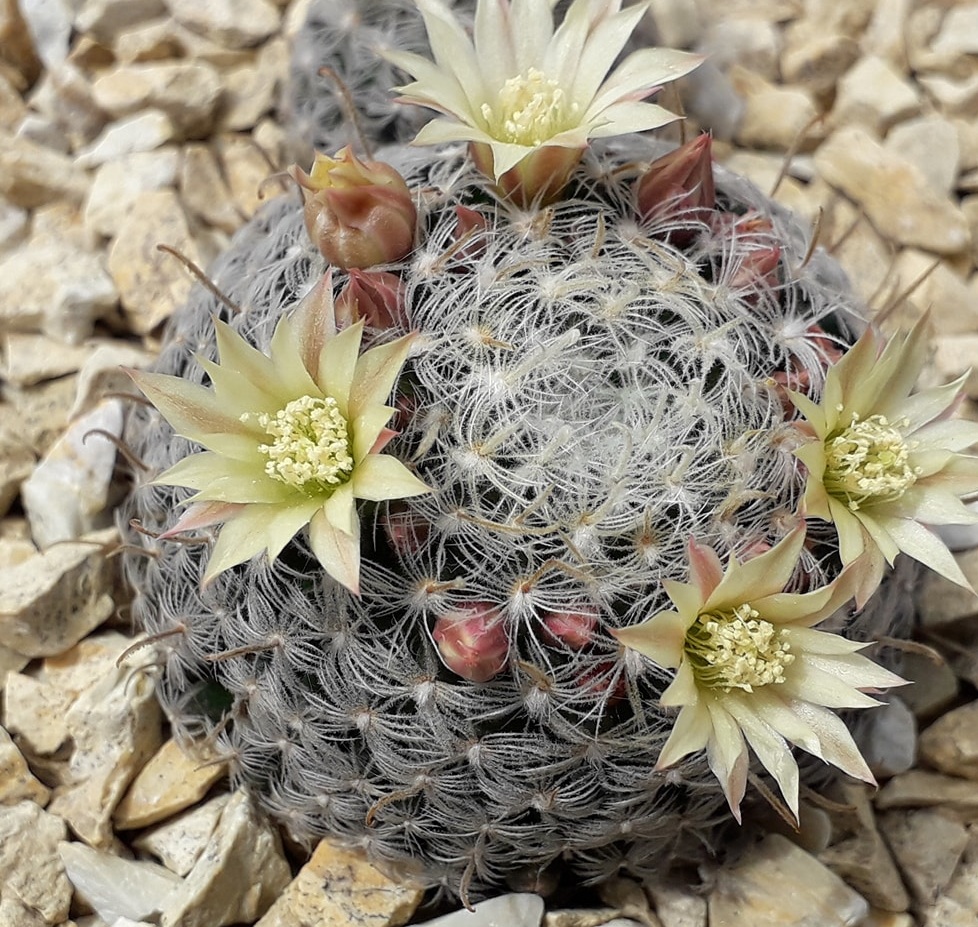
Mammillaria duwei is a small solitary cactus with a flattened-globose dark-green body, plumose feathery radial spines, and funnel-shaped cream to pale-yellow flowers that read wider than the stem they sit on. Mature plants stay between 3.5 and 6 cm across and 2 to 4 cm tall, anchored by a tuberous taproot into volcanic rock pockets at 1,800 to 2,000 m.
The species was described in 1985 by Helmut Rogozinski and Pierre Josef Braun in Kakteen und andere Sukkulenten, from material collected by Rogozinski and Walter Duwe in Guanajuato. The specific epithet honours Duwe, long-serving chairman of the Cologne chapter of the German Cactus Society and co-collector of the type. In English-language literature the species is sometimes filed as a subspecies of Mammillaria crinita or Mammillaria nana; Kew POWO retains it at species rank and we follow POWO throughout.
Collectors routinely confuse duwei with Mammillaria herrerae, the other tiny Mexican white-fluffy pincushion on this encyclopedia, and the two have nothing in common at close range. Duwei shows a visible green body through an open layer of feathery radials and blooms in cream-yellow; herrerae hides its body entirely under a hundred-plus bristly white radials and blooms in pink-violet. The FAQ Q1 below breaks the difference down character by character.
Mammillaria duwei quick reference
A Stylothelae-series Mammillaria from volcanic scrub at 1,800 to 2,000 m northeast of the city of Guanajuato, solitary with a tuberous taproot, dark-green body, plumose feathery radials, and cream-yellow funnelform flowers. Values calibrated for seed grown plants in cultivation, drawn from the 2013 IUCN assessment, llifle cultivation notes, and specialist grower experience.
Taxonomy & nomenclature
The accepted name on Kew POWO is Mammillaria duwei Rogoz. & P.J.Braun, first published in Kakteen und andere Sukkulenten volume 36, issue 8, page 164, in 1985. The specific epithet honours Walter Duwe, co-collector of the type and long-serving chairman of the DKG’s Cologne chapter; the holotype (Rogozinski & Duwe 1) is lodged at KOELN.
Infrageneric placement is subgenus Mammillaria, section Cylindricothelae, series Stylothelae, the same series that holds Mammillaria schwarzii and the broader crinita, bocasana, and marcosii group. Butterworth and colleagues established Stylothelae as a monophyletic clade in their 2007 Bradleya paper via a localised chloroplast rpl16 intron loss, which places duwei close to schwarzii at the molecular level and not only on morphological grounds.
Treatments vary between authorities. Anderson’s The Cactus Family (2001) synonymised duwei under Mammillaria crinita, and Fitz Maurice followed in 2002. Pilbeam (1999) placed it as Mammillaria nana subsp. duwei, and Mottram (2000) as Mammillaria trichacantha subsp. duwei. Kew POWO retains the species at full rank; the 2013 IUCN assessment was written under the POWO name, and the conservation record is cleaner if the taxon carries its own name rather than being folded into a wide species concept. We follow POWO.
POWO’s native-range entry also includes San Luis Potosí alongside Guanajuato, but the IUCN assessors document only a single Guanajuato location, and no field source consulted during this build places the species in SLP. The SLP citation in POWO probably reflects aggregated herbarium data; we use Guanajuato as the working range and flag the discrepancy here for anyone tracing the literature.
Habitat
The habitat is volcanic rock in xerophyllous scrub (matorral xerófilo), not the limestone karst that serves some other rare Mexican Mammillaria. Plants sit in crevices and ledge pockets at 1,800 to 2,000 m, northeast of the city of Guanajuato on the edge of the Mesa Central. The nearby 2023-described Mammillaria monochrysacantha grows on comparable volcanic outcrops in the same district, which supports a broader Guanajuato Stylothelae association with this substrate rather than with limestone.
Annual rainfall in the region is 400 to 600 mm, concentrated between June and September. Winters are cool and dry, which is the full calendar the cultivation regime has to match. Associated vegetation is a typical central Mexican matorral of shrubs and scattered succulents, and M. duwei grows under or between these shrubs rather than in fully open sites. The partial shade explains why unacclimatised cultivated plants sunburn so quickly under direct midsummer sun even when the habitat elevation suggests they should not.
Range is extraordinarily compressed. The IUCN assessment gives extent of occurrence and area of occupancy as the same 35 km² figure, reflecting a single location split across two subpopulations. Rarity at this scale puts duwei in the same conservation cohort as Mammillaria napina, whose Tehuacán population occupies a similarly small area and faces the same pair of threats: illegal collection and slow habitat conversion for grazing or agriculture.
Morphology
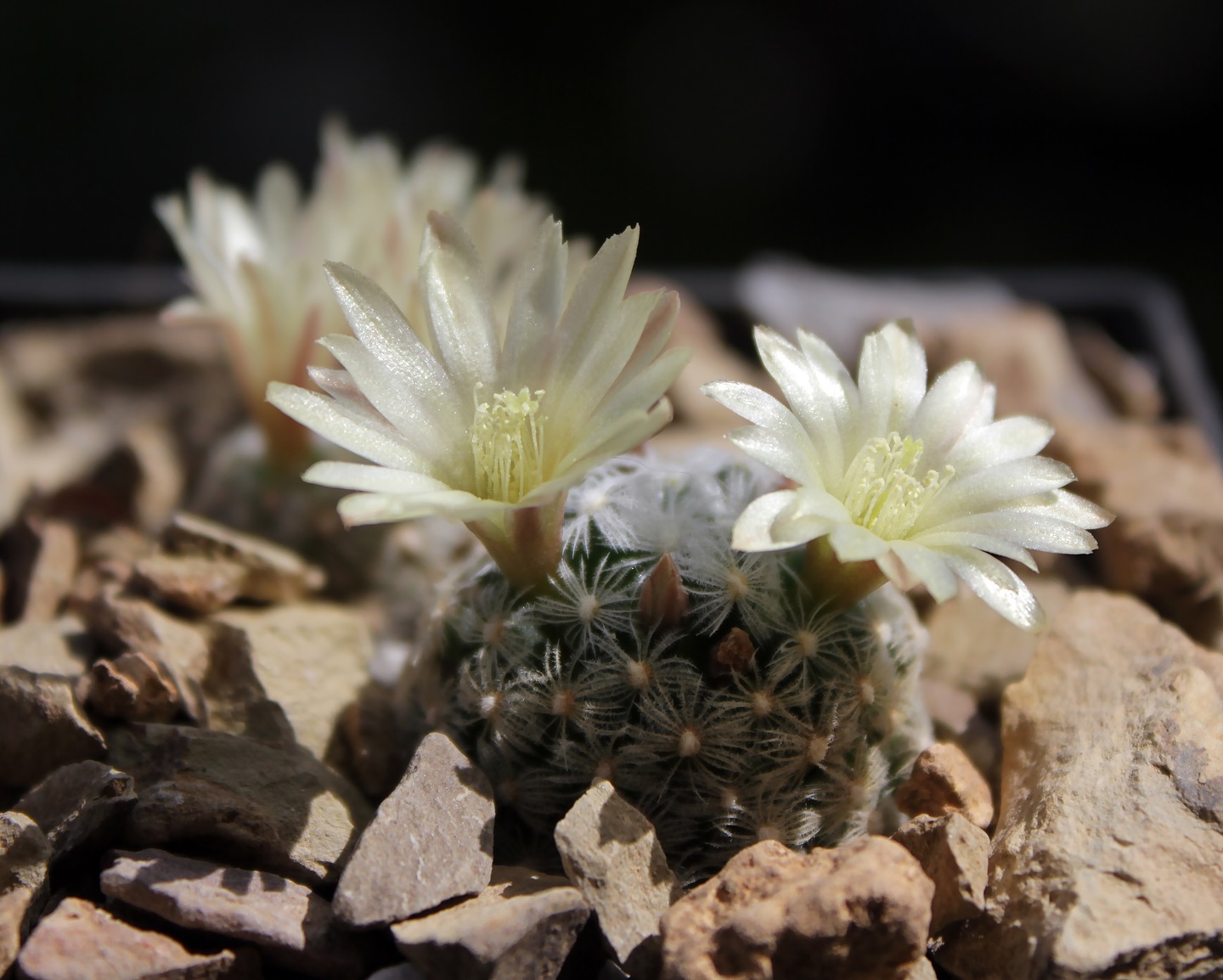
Mature stems are solitary, rarely offsetting, and measure 3.5 to 6 cm wide by 2 to 4 cm tall. Body shape is flattened-globose to short-cylindric, and the epidermis is a dark matte green that bronzes slightly in high light. A tuberous taproot anchors the plant into rock pockets and demands a deep pot in cultivation, even though the aerial body stays small. Tubercles are club-shaped, roughly 4 to 5 mm long, with a little wool in the axils but none of the heavy bristle tufts seen in other Stylothelae species.
The radial spines are the diagnostic feature. Each areole carries 28 to 36 acicular radials 3.5 to 4 mm long, whitish with brownish bases, and under magnification visibly plumose with a silky-hair texture that distinguishes them from the stiff bristle-radials of similar white-fluffy Mammillaria. Centrals vary between clones: zero to two is typical, occasionally up to four, yellowish, hooked, and reaching 8 mm. Light levels in cultivation strongly affect central spine development, with low-light plants often running entirely radial and higher-light plants throwing the hooked centrals reliably.
Flowers open funnel-shaped rather than tubular, cream to pale yellow, roughly 20 mm long by 20 mm across, with lanceolate acuminate inner segments that spread wide to the point the bloom looks wider than the stem it sits on. No reddish midstripe appears in any authoritative source; flower colour reads simply as a clean cream-yellow. Fruit is red, elongated and club-shaped, 1.5 to 2.1 cm long and 2 to 4 mm wide. Seeds are blackish-brown. A spineless horticultural form (f. inermis) circulates in European collections but is a cultivated selection without taxonomic standing.
Locality detail
The map below marks the regional centroid rather than the sharp coordinates of the single documented population, consistent with the IUCN assessors’ own practice for the most at-risk Mexican Cactaceae. The point is accurate to within tens of kilometres, which orients the reader to the northeastern Guanajuato volcanic belt without guiding anyone to the plants themselves.
Cultivation
Mammillaria duwei is an intermediate-to-advanced plant that grows and flowers reliably without a graft when the watering and substrate discipline matches the habitat calendar. A graft insurance copy is a reasonable second step in humid collections; the species is rot-prone enough to justify the precaution without being one of those Stylothelae members that cannot be maintained as an ungrafted plant at all.
Substrate
Target a predominantly mineral mix: 50 per cent pumice, 20 per cent decomposed granite, 15 per cent crushed lava rock, and 15 per cent low-nutrient cactus base. The small organic component supports the tuberous taproot better than the fully mineral mixes that suit cliff-dwelling Mammillaria; this species does root into shallow humus pockets in the wild. Use a deep pot rather than a shallow bowl. Calcined diatomaceous earth in the top centimetre adds drainage insurance without blocking breathability. Do not substitute any of the banned ingredients; the role is drainage, not water-retention.
Watering and light
Water from April through September only when the mix is dry, and prefer pot-edge or bottom watering to overhead. Taper off through autumn and keep the plant completely dry from November through March. The winter dormancy is a non-negotiable item on the calendar; a moist pot at 10°C triggers root rot reliably.
Light should be bright all day but filtered through the hottest summer hours. The habitat plants grow under matorral shrubs that cut direct sun, and cultivated stock sunburns on exposed summer sills without acclimation. Plants kept in dim conditions lose central spine expression and grow elongated; plants exposed to strong light without transition bronze and scar. Winter minimum is about -5°C when the substrate is bone dry. Keep the plant above 5°C if any residual moisture remains, because wet cold is the single most common cause of losses on this species.
Comparison
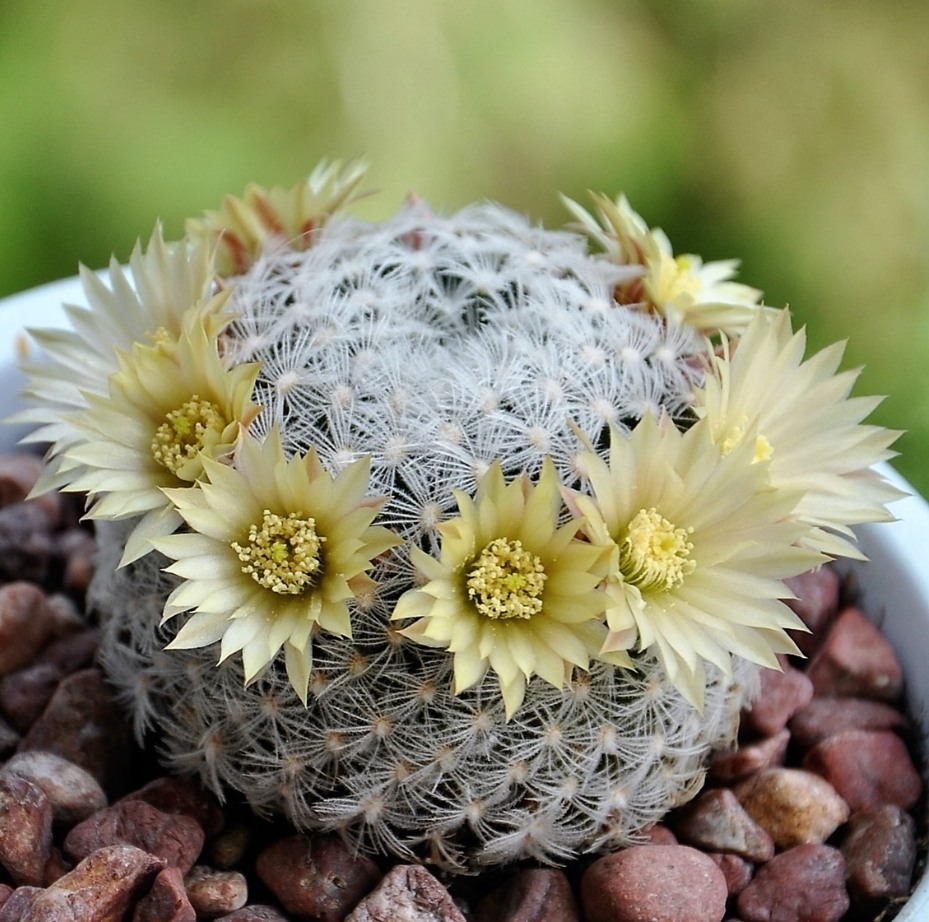
Within Stylothelae, M. duwei sits closest to Mammillaria schwarzii at the molecular level, but the two plants are easy to tell apart in person. Schwarzii clusters densely into a low mound of many small 3 cm heads wrapped in glassy hairlike spines and cream-white flowers with red midstripes; duwei stays solitary, keeps a visibly green flattened body under feathery radials, and blooms cream-yellow. The two species grow on different parts of the same Guanajuato volcanic belt, roughly fifty kilometres apart as the crow flies.
The frequent collector confusion is with Mammillaria herrerae, the other tiny Mexican white-fluffy pincushion many nurseries sell as interchangeable stock. The character-by-character split lives in the FAQ Q1 table below. The short version: spine texture is plumose-feathery in duwei and bristly in herrerae, radial count is 28 to 36 in duwei versus 100 or more in herrerae, and flower colour is cream-yellow versus pink-violet. Any one of those characters settles the identification.
Farther afield, duwei shares a conservation profile with Mammillaria pectinifera. Both are small, range-restricted Mexican endemics pushed toward extinction by commercial collection, both enjoy the CITES Appendix II umbrella without much practical enforcement at habitat level, and both are best preserved as seed grown stock in serious collections rather than as field-sourced plants.
Frequently asked questions
How do you tell Mammillaria duwei apart from Mammillaria herrerae?
Retailers often sell M. duwei and Mammillaria herrerae as interchangeable white-fluffy miniatures. Every diagnostic character separates them.
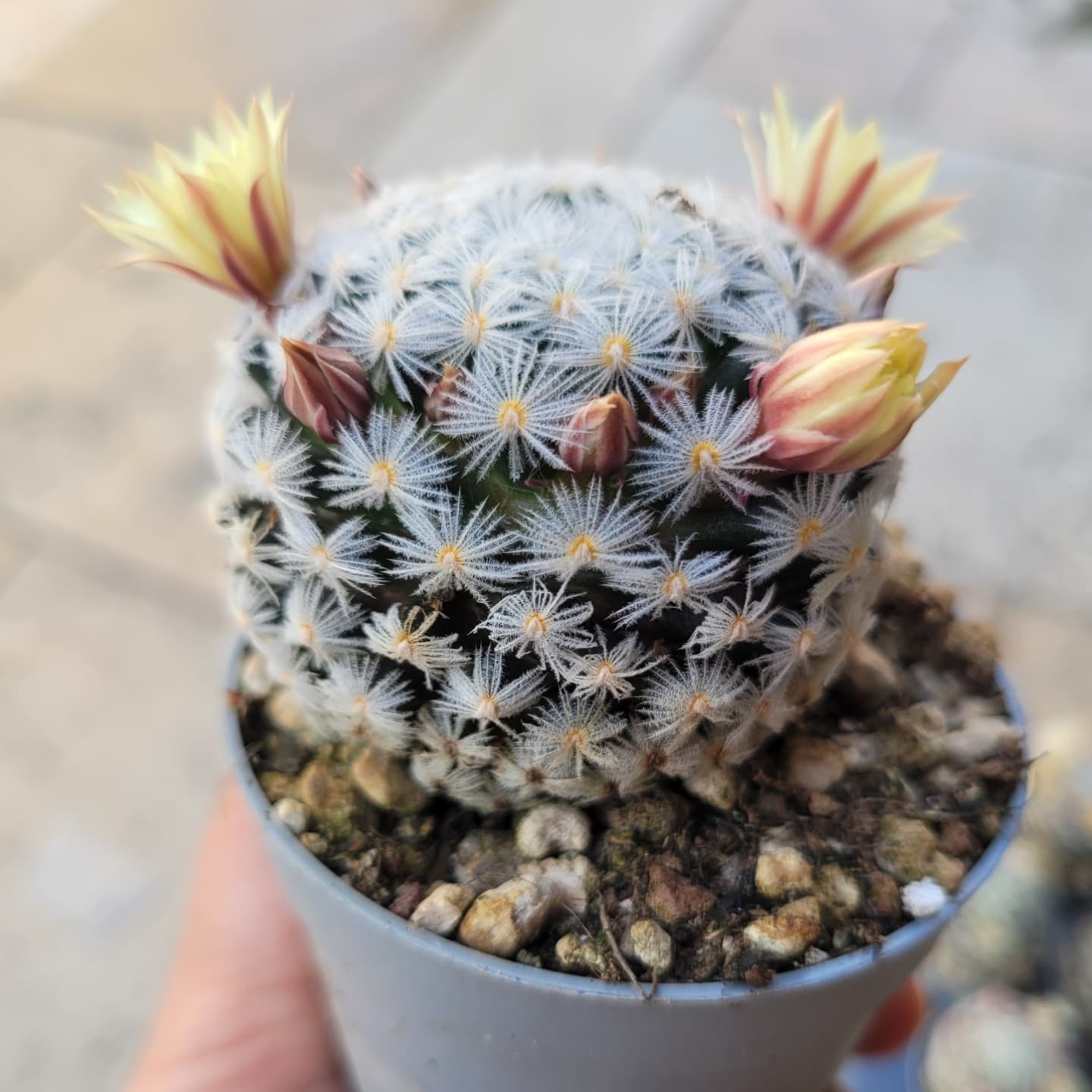
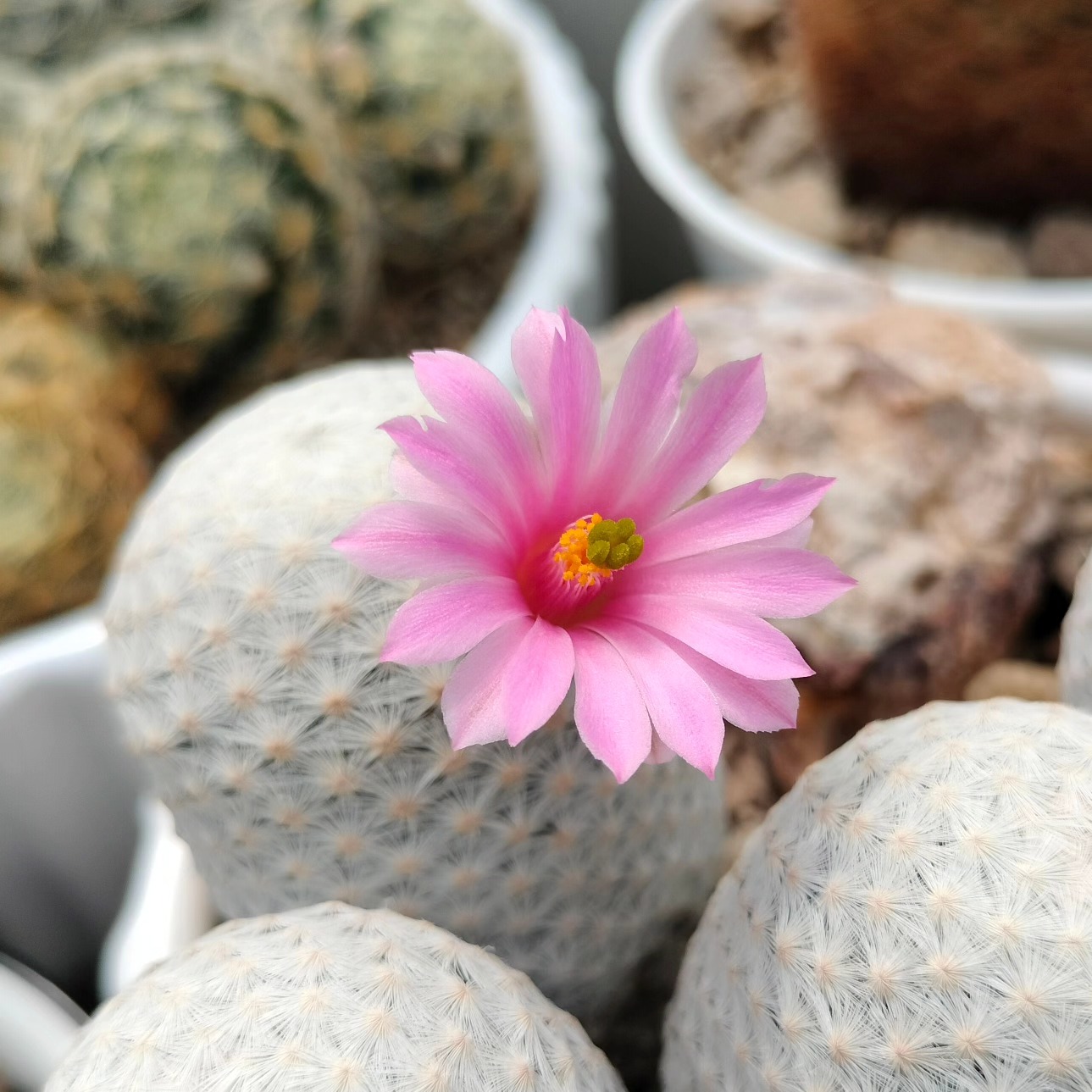
Flower colour is the quickest separator in flower; spine count and texture are the reliable separators out of flower. Herrerae reads as a single white bristly ball at arm’s length; duwei reads as a green body with a feathery white skirt.
Is Mammillaria duwei difficult to grow?
It is rot-prone but not ungrowable. Seed grown plants reach adult body width in five to seven years when the substrate stays mostly mineral and the pot dries between waterings. The reliable failure modes are wet winter substrate and direct summer sun on unacclimatised stock, both of which are avoidable. Growers in humid climates keep an insurance graft as a hedge; growers with dry winter glasshouses can skip the graft and run the species ungrafted.
Can Mammillaria duwei be grown from seed?
Yes. Fresh seed germinates in 7 to 14 days at 21 to 27°C under high humidity and gives 40 to 50 per cent success, which is typical for Mammillaria. Seedlings stay in their community tray for the first twelve months, then move to individual 5 cm pots in the mineral-heavy mix used for adults. Central spine development is variable between seedlings and is stronger under higher light; plants kept too dim will run entirely radial and never throw the hooked centrals. First flowers arrive at three to four years from germination.
Is Mammillaria duwei legal to buy?
Yes, if the plant is nursery-propagated and the seller can document artificial propagation. The species sits on CITES Appendix II under the blanket Cactaceae listing, which regulates international commercial trade and requires export permits; artificially propagated plants travel under CITES source code D and seed grown plants under code A. Mexico also protects the species domestically under NOM-059-SEMARNAT-2010 as sujeta a protección especial. Never buy wild-collected material or plants without provenance paperwork; both contribute directly to the decline the IUCN assessment records.
Where does Mammillaria duwei grow in the wild?
The only documented wild location is a single site northeast of the city of Guanajuato, in the San Luis de la Paz district, split across two subpopulations at 1,800 to 2,000 m. The substrate is volcanic rock in xerophyllous scrub, and plants grow in crevices and under matorral shrubs rather than in open ground. Kew POWO also lists San Luis Potosí in the range, but the 2013 IUCN assessment and every peer-reviewed field source place the species in Guanajuato only.
When does Mammillaria duwei flower, and at what age?
Flowering runs from spring through early summer, with cream to pale yellow funnelform blooms roughly 20 mm across opening over several weeks. Seed grown plants begin to bloom at three to four years from germination, before the body reaches adult size. The flowers are noticeably wider than the stem on which they sit, which is the field mark that makes a mature flowering specimen unmistakable among similar-sized small Mammillaria.
Sources & further reading
Rogozinski, H. & Braun, P.J. (1985). Mammillaria duwei – eine neue Art aus Guanajuato, Mexiko. Kakteen und andere Sukkulenten 36(8): 164. · Fitz Maurice, B. & Fitz Maurice, W. A. (2013). Mammillaria duwei. The IUCN Red List of Threatened Species 2013: e.T40832A2935278. · Hunt, D. R. (2006). The New Cactus Lexicon. dh books, Milborne Port. · Anderson, E. F. (2001). The Cactus Family. Timber Press, Portland. · Pilbeam, J. (1999). Mammillaria. Cirio Publishing Services, Southampton. · Butterworth, C. A. et al. (2007). A localised loss of the chloroplast rpl16 intron in Mammillaria series Stylothelae. Bradleya 25: 139–152. · González-Zamora, P., Aquino, D., Rodríguez, A. & Sánchez, D. (2023). Mammillaria monochrysacantha (Cactaceae), a new endemic species from Guanajuato, Mexico. Phytotaxa 618(3). · Hernández, H. M. & Gómez-Hinostrosa, C. (2015). Mapping the Cacti of Mexico. Part II: Mammillaria. Succulent Plant Research 9. · CITES (2019). CITES Cactaceae Checklist (3rd edition). Royal Botanic Gardens, Kew. · Kew POWO record Mammillaria duwei Rogoz. & P.J.Braun (IPNI 280340-2). Plants of the World Online. · CONABIO / Enciclovida species record for Mammillaria duwei; NaturaLista Mexico taxon 207245.