
Welwitschia mirabilis
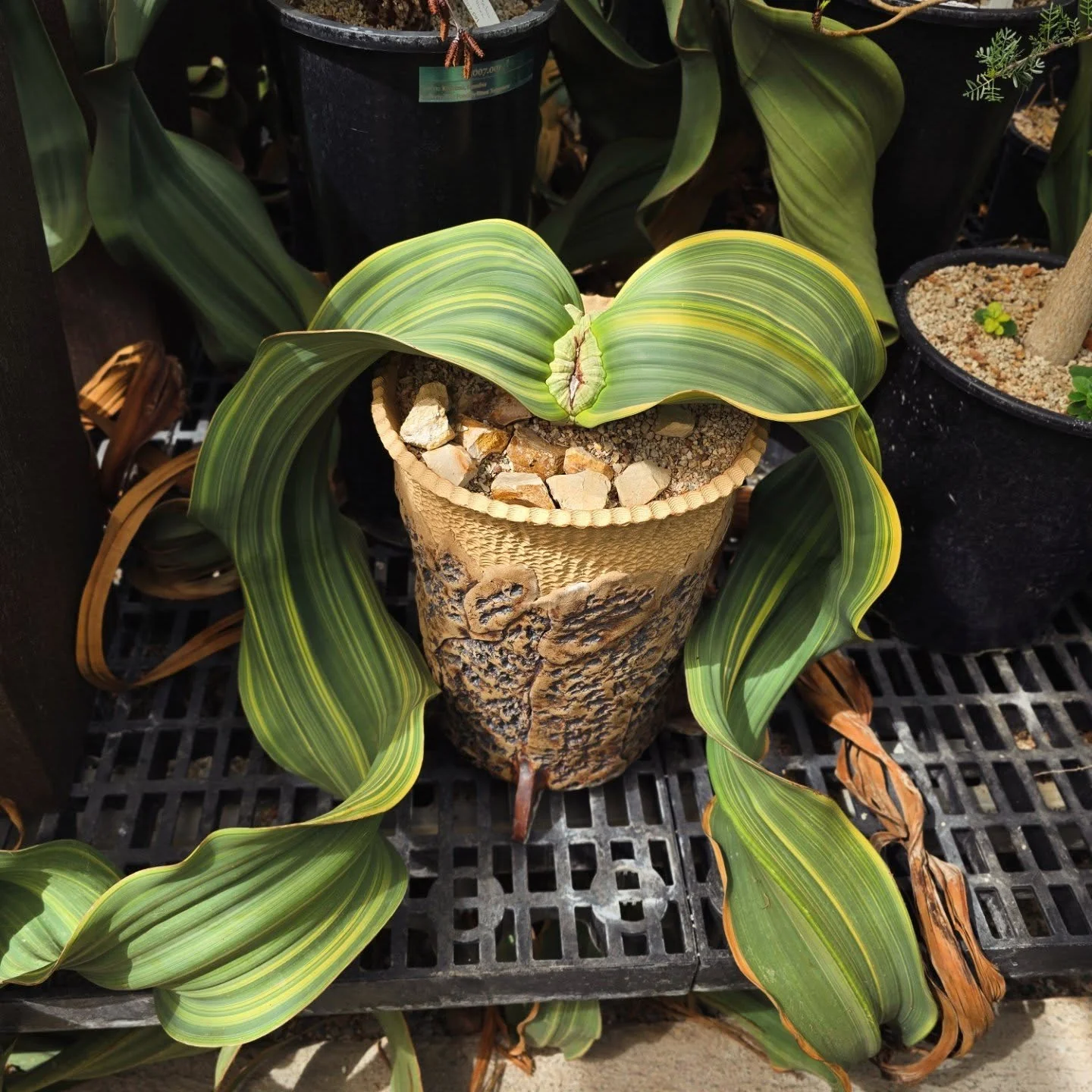
Welwitschia mirabilis is the two-leaved living fossil of the Namib, a plant that looks less grown than assembled from wreckage. A low, woody crown sits nearly flush with the gravel, and from its rim spread just two leathery leaves that never stop growing and never fall. Over a lifetime measured in centuries those leaves split lengthwise and fray into a heap of ribbon-like straps, so an old plant reads at a distance like a pile of storm-torn tarpaulin caught on the desert floor.
It is not a cactus, and not a flowering plant at all. Welwitschia is a gymnosperm, the sole species of its family, and one of only three surviving lineages of the ancient gnetophytes alongside Gnetum and Ephedra. It reproduces from cones rather than flowers, on separate male and female plants, and its closest relatives are long extinct. Collectors keep it not for bloom or spine but for exactly this: it is a branch of the plant kingdom almost entirely to itself.
The entire plant is those two leaves, carried for its whole long life. They grow from a band of tissue at the leaf base, pushing out new length at the bottom while the tips shred and die back, so the plant never adds a third leaf and never resets. Individuals commonly pass four hundred years, the oldest are dated well beyond a thousand, and a deep taproot anchors the crown against the wind and the shifting gravel.
Everything about growing it follows from one habitat fact. This is a plant of the fog coast, rooted deep in sharp, near-sterile ground, kept alive by moisture it can reach at the root rather than rain it can catch on top. That is why the cultivation regime below looks nothing like a cactus regime, and why a deep pot of pure pumice, watered every day, is the method that works.
Welwitschia mirabilis quick reference
A fog-desert gymnosperm from the coastal Namib, grown on the specialist and botanic-garden method rather than any cactus routine: a deep pot of pure pumice kept evenly moist at the root. Values calibrated for seed grown plants in cultivation, drawn from habitat and specialist grower experience.
Taxonomy & nomenclature
The accepted name is Welwitschia mirabilis Hook.f. The genus honours Friedrich Welwitsch, the Austrian botanist who documented the plant in Angola in 1859; Joseph Dalton Hooker described it for the Linnean Society in 1863. Welwitsch had proposed the genus name Tumboa, after a local name for the plant, and that name survives in the synonyms Tumboa bainesii and Tumboa strobilifera, with Welwitschia bainesii a later combination. Kew POWO keeps all of these in synonymy under W. mirabilis.
The species is the only member of its genus and its family, Welwitschiaceae. That family sits in the division Gnetophyta, the gnetophytes, one of the four living gymnosperm lineages and the group that also holds Gnetum and Ephedra. Placing Welwitschia among the seed plants has occupied botanists since Hooker, because its combination of vessel-bearing wood, cone-borne seed and insect visitation cuts across the usual gymnosperm pattern; modern molecular work groups the three gnetophyte genera together but leaves their tie to the conifers and to the flowering plants a live question.
Two subspecies are recognised, following Leuenberger in 2001: the typical W. mirabilis subsp. mirabilis of Angola and northern Namibia, and subsp. namibiana of Namibia, separated on cone and seed detail and on range. Both are the same unmistakable plant. Because the genus is monotypic there are no sibling species to confuse it with, which is unusual on this site and part of what makes it a collector’s curiosity.
Historical synonyms (4)
- Tumboa bainesii Hook.f., 1861 basionym
- Welwitschia mirabilis subsp. namibiana Leuenb., 2001 homotypic synonym
- Welwitschia bainesii (Hook.f.) Carrière, 1867 heterotypic synonym
- Welwitschia namibiana (Leuenb.) Christenh. & Byng, 2018 heterotypic synonym
Sources: POWO (Kew) · IPNI · GBIF · Wikidata
Habitat
Welwitschia mirabilis lives in one of the driest inhabited places on Earth: the coastal belt of the Namib Desert, in a narrow strip running about a thousand kilometres from the Kuiseb River in central Namibia north into Namibe province in southern Angola. It is seldom found more than a hundred to a hundred and fifty kilometres inland. Rainfall across much of that range is negligible and unreliable; what the plant lives on instead is fog, the thick advective bank that rolls off the cold Benguela current most mornings and beads on every surface it meets.
Plants grow scattered on open gravel plains and along the shallow ephemeral watercourses that carry rare runoff, their long taproots reaching for moisture held deep in the coarse ground. The spacing is wide, the soil is sharp and near-sterile, and the light and wind are relentless. This is the whole design brief for the plant: reach water at depth, shed heat and wind through tough leaves, and last. The two subspecies split this range between them, subsp. mirabilis to the north and subsp. namibiana through the Namibian Namib, including the well-known stands on the gravel flats east of Swakopmund.
The long leathery leaves are the plant’s exchange surface with that fog. Trailed flat across warm gravel they present a large area to catch and shed moisture and to radiate heat, and their coarse, split condition is the ordinary state of a leaf that has been growing without pause for decades or centuries. What looks like damage is simply age.
Morphology
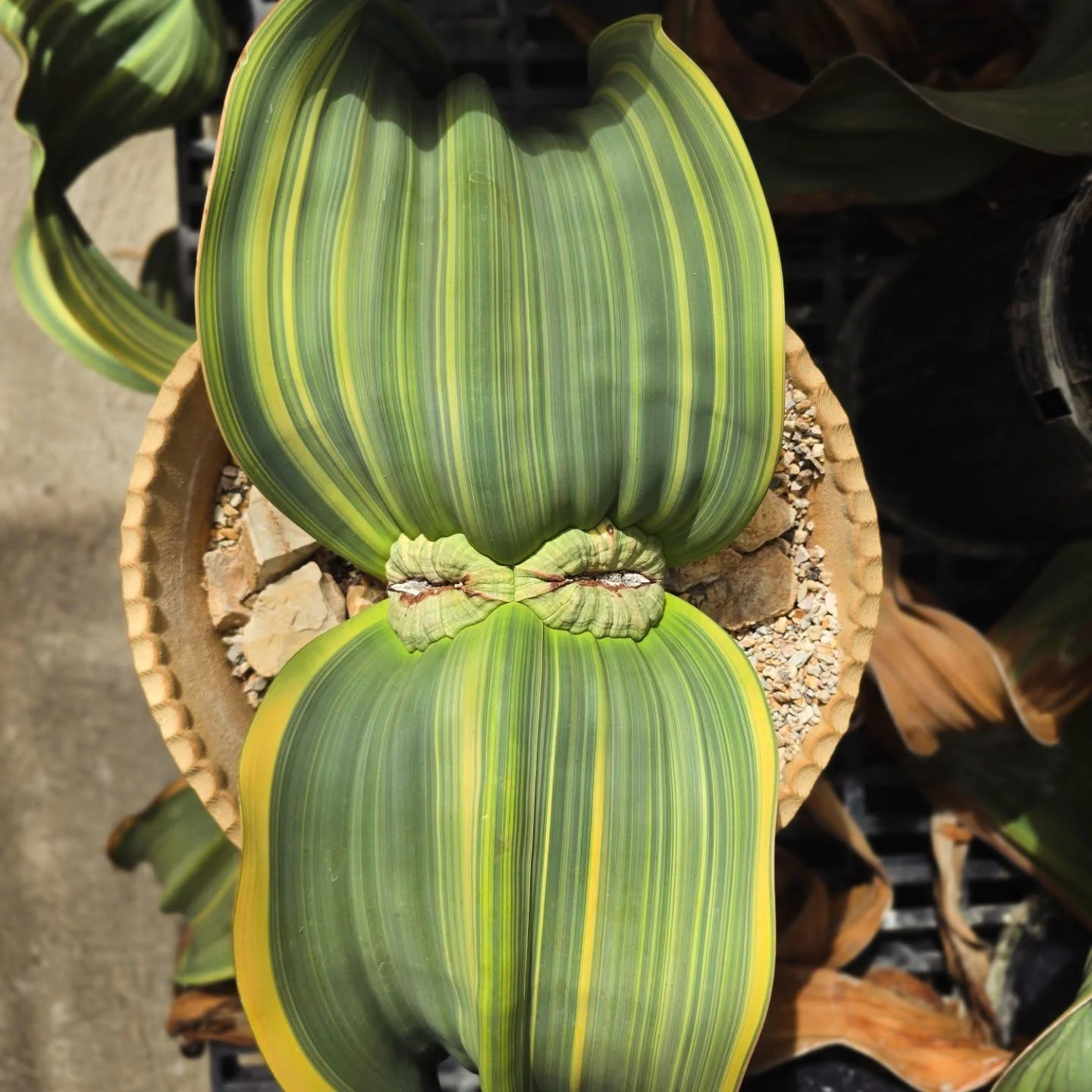
The body of the plant is a short, squat, woody crown, obconic and mostly buried, reaching up to about a metre across in the largest individuals and sitting only a little proud of the ground. From the crown a single deep taproot descends, and the top of the crown is concave, splitting into two lobes with age. There is no trunk and no branching. Almost the entire visible plant is leaf.
The two leaves are the defining feature. A plant produces exactly two true leaves in its life, opposite each other, and keeps them forever. They grow continuously from a basal meristem, a band of dividing tissue at the leaf base, adding length at the bottom while the ends weather, dry and tear. Left to grow the leaves would run several metres; erosion at the tips holds them to roughly two to four metres, and lengthwise splitting divides each original leaf into many strap-like segments, which is why a plant appears to have far more than two. It never grows a replacement.
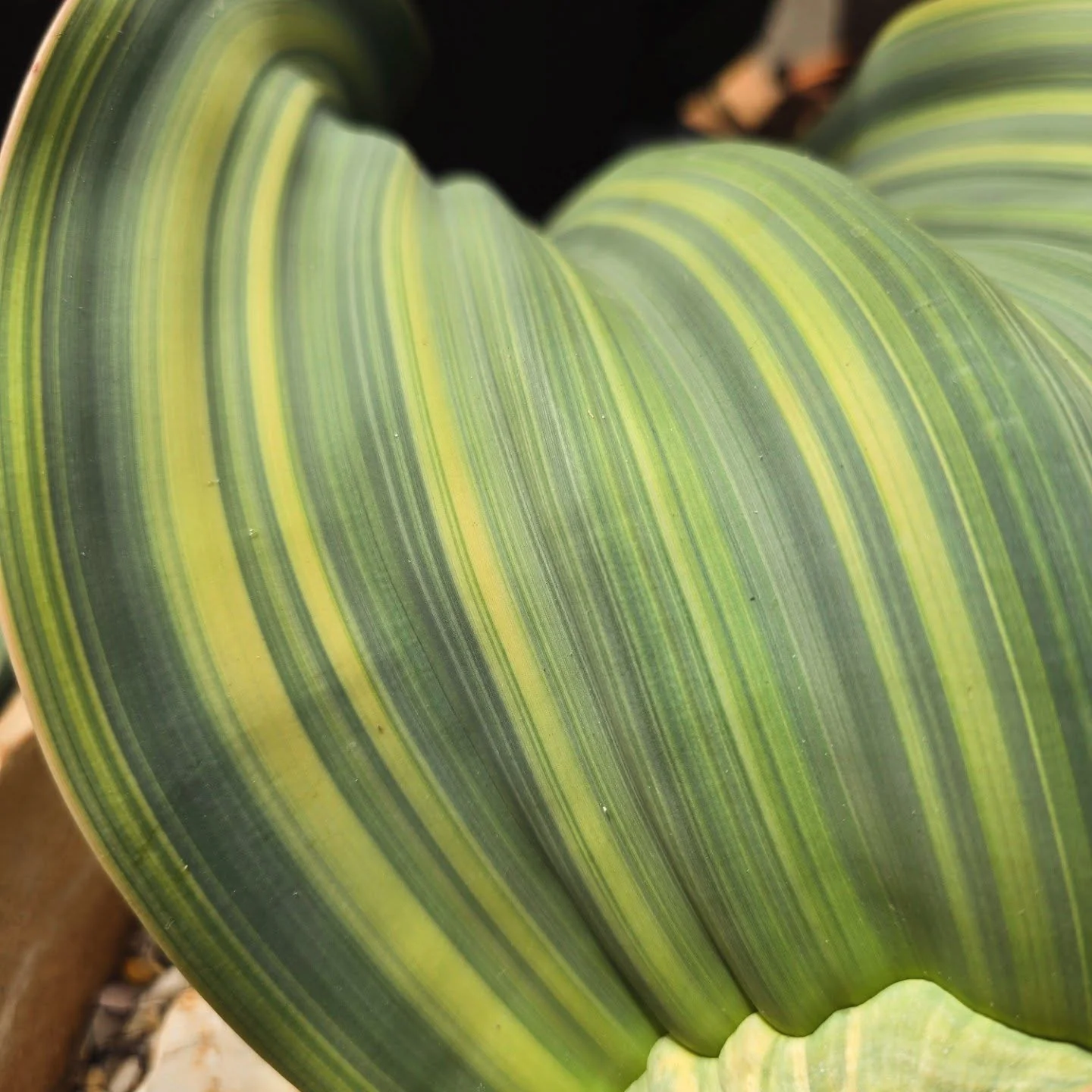
Leaf colour is normally a matte grey-green, but cultivated plants often develop bold longitudinal bands of yellow and green, a variegation many collectors seek out and the plants shown on this page carry strongly.
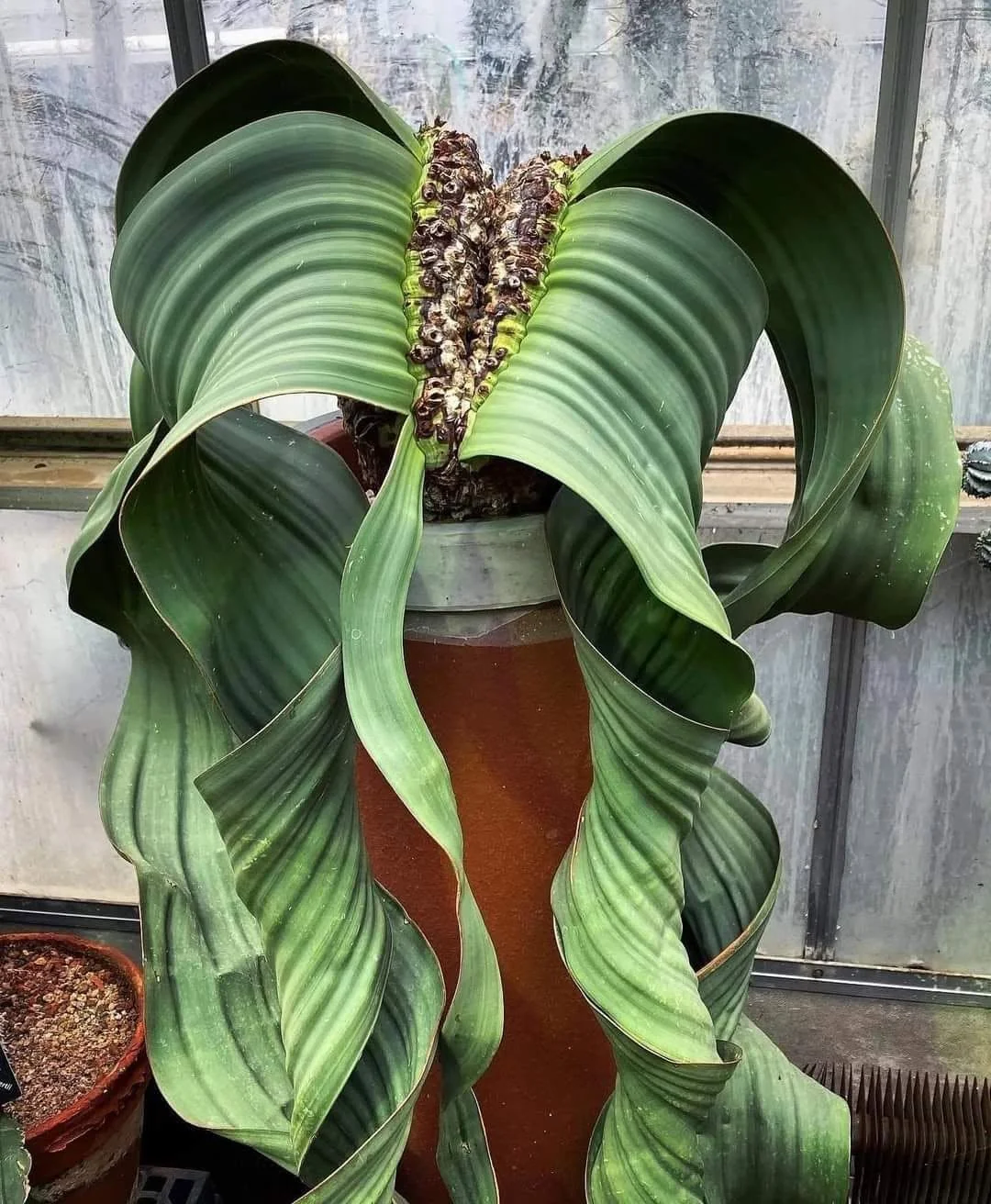
Reproduction is by cones, not flowers, and the plant is dioecious, meaning male and female cones are borne on separate individuals. Small branched cone-stalks rise from the crown rim: male plants carry slender salmon to brick-red pollen cones, female plants larger bluish-green seed cones that brown as they ripen and shed winged seed. Insects visit the cones, drawn to sugary droplets, and both wind and insects move the pollen. There is no true flower and no fruit in the botanical sense; the reproductive parts are the gymnosperm cones, however flower-like they can look at a glance.
Locality detail
The range is a coastal ribbon of the Namib Desert shared between Namibia and southern Angola. The map below marks three anchors along it: the accessible Welwitschia Plains east of Swakopmund, the higher-risk northern Namibian populations, and the Angolan end around Namibe where the plant was first documented. Markers are regional centroids, not precise stands.
Wild plants are effectively impossible to move and slow past belief to replace, and the species is listed on CITES Appendix II, so any plant or seed offered for sale should carry clear evidence of cultivated, seed grown origin. The plants worth owning are raised from seed under glass, never lifted from the desert.
Cultivation
Two facts frame the whole method. The plant sends a deep taproot into sharp, near-sterile ground and wants moisture reliably at that root, and its seedling stage is fragile and quick to rot. Solve those two and Welwitschia is a long-lived, undemanding plant; get the root zone wrong, disturb the taproot, or let a seedling damp off, and it fails fast. The regime here follows the specialist and botanic-garden practice used for the species, and it deliberately looks nothing like cactus care.
Substrate
Grow it in 100 per cent horticultural pumice at the small 3/16 inch grade, with no organic component, no cactus soil and no sand. The fine pumice packs closely between the roots while still draining the instant water passes through, which is exactly the balance the plant needs: constant access to moisture with no standing water at the crown. Because pumice holds almost no nutrients, feeding is built into watering rather than into the mix. A pot around pH 5.8, slightly acidic, suits it well.
Unlike the mineral blends used for the cacti on this site, Welwitschia is grown in a single ingredient: pure horticultural pumice at the small 3/16 inch grade. The table keeps the site’s standard columns for comparison, so every share but pumice reads zero.
| Species | Pumice | Lava | Zeolite | Granite | Limestone | Silica | Organic |
|---|---|---|---|---|---|---|---|
| W. mirabilis (this page) | 100% | 0% | 0% | 0% | 0% | 0% | 0% |
Watering, feeding and light
Water every day, and do not let the root dry out. This reverses the soak-and-dry rule that governs cacti, and it works only because the medium is pure pumice: water runs straight through, so daily irrigation keeps the taproot evenly moist without ever leaving the plant wet. Feed with a balanced water-soluble fertiliser, around a 10-10-10 ratio, applied dilute with the watering through the growing season, since the inert pumice supplies nothing itself. Give the plant full sun and warmth; it is frost-tender, so hold it above about 5°C and never let cold and wet coincide at the root. At rarecactus.com we raise our Welwitschia from seed in deep columns of pure pumice, watered and fed every day so the taproot never checks.
The plant is grown from seed and only from seed; there is no reliable vegetative propagation and it is never grafted, so every cultivated plant is a seed grown plant. Sow fresh seed warm into a deep container, treat against fungus, and keep humidity up until the seedling roots, because damping-off is the usual killer at this stage. Above all, sow into the pot the plant will stay in: the taproot goes down early and resents disturbance, and transplanting an established Welwitschia is the most common way growers lose one. A deep pot from the start is not optional.
Comparison
Welwitschia mirabilis can be confused with nothing else on Earth. It is the only species in its genus and its family, and its two-leaves-for-life habit is shared by no other plant on Earth, so identification to species is never in question. The comparisons that matter to a grower are internal: telling male plants from female, and knowing which subspecies is in the pot.
Sex shows only at the cones, and only on a mature plant. Male plants throw many small, slender cones that flush salmon to brick-red as they shed pollen; female plants bear fewer, larger, bluish-green seed cones that brown and open to release winged seed. A non-coning plant cannot be sexed by leaf or crown alone. Seed set needs both a male and a female, so a collection aiming to raise its own seed needs plants of each.
The two subspecies are harder to call and rarely labelled in trade. Subspecies mirabilis is the Angolan and far-northern plant, subsp. namibiana the Namibian one, and they are separated on cone and seed detail rather than on anything obvious in a young potted plant. For all practical purposes the collector is growing one remarkable species; the subspecies label is a provenance note, not a different plant.
Frequently asked questions
Is Welwitschia mirabilis a cactus?
No. It only shares a desert address with cacti. Welwitschia is a gymnosperm, in the division Gnetophyta, which makes it a distant cousin of conifers and of Ephedra and Gnetum, not a cactus and not a flowering plant. It reproduces from cones rather than flowers, and it is the only species in its whole family. That is exactly why collectors want it: almost nothing else alive is closely related to it.
How long does Welwitschia mirabilis live?
Centuries, routinely. Ordinary plants pass four hundred years, and the largest individuals have been radiocarbon-dated well beyond a thousand, with some estimates near two thousand. It grows slowly and never stops: the same two leaves keep extending from the base for the plant’s entire life, which is what lets a single plant persist on the same patch of gravel for so long.
How many leaves does Welwitschia have?
Two, for life. A plant produces exactly two true leaves as a seedling and keeps them forever, growing them continuously from a band of tissue at the base while the tips wear away. Those two leaves split lengthwise into many straps over time, so an old plant looks like it has a dozen, but it is always just the original pair, torn and enlarged.
How do you grow Welwitschia mirabilis from seed?
Sow fresh seed warm into a deep pot of pure pumice, because the taproot goes down fast and hates being moved later. Keep it humid until germination and treat against fungus, since damping-off is the main seedling killer. Once up, give full sun, water daily so the root never dries, and feed dilute balanced fertiliser with the water. The one rule that matters most is to sow into the final container and not transplant.
Where does Welwitschia mirabilis grow in the wild?
Only in the coastal Namib Desert, along a narrow strip about a thousand kilometres long from the Kuiseb River in Namibia north into southern Angola, rarely more than a hundred and fifty kilometres from the sea. It survives on fog off the cold Benguela current rather than on rain, growing scattered across open gravel plains and dry watercourses with its taproot reaching moisture held deep in the ground.
Sources & further reading
Hooker, J.D. 1863. On Welwitschia, a new genus of Gnetaceae. Transactions of the Linnean Society of London 24: 1–48 · Kew POWO, Welwitschia mirabilis Hook.f., powo.science.kew.org/taxon/urn:lsid:ipni.org:names:383591-1 · IPNI, International Plant Names Index, urn:lsid:ipni.org:names:383591-1 · GBIF Secretariat, GBIF Backbone Taxonomy, Welwitschia mirabilis Hook.f. · Leuenberger, B.E. 2001. The subspecies of Welwitschia mirabilis (Welwitschiaceae). Willdenowia 31: 261–267 · The Gymnosperm Database, Welwitschiaceae and Welwitschia mirabilis, conifers.org · SANBI PlantZAfrica, Welwitschia mirabilis (habitat, cones, common names) · Wan, T. et al. 2021. The Welwitschia genome reveals a unique biology underpinning extreme longevity in deserts. Nature Communications 12: 4247 · CITES, Welwitschia mirabilis (Appendix II), cites.org · UC Davis Botanical Conservatory, Welwitschia mirabilis notable-plant collection and propagation, conservatory.ucdavis.edu · University of Connecticut EEB greenhouse, Welwitschia mirabilis cultivation notes (pumice medium, daily watering and feeding, deep pots)