
Ariocarpus retusus subsp. furfuraceus
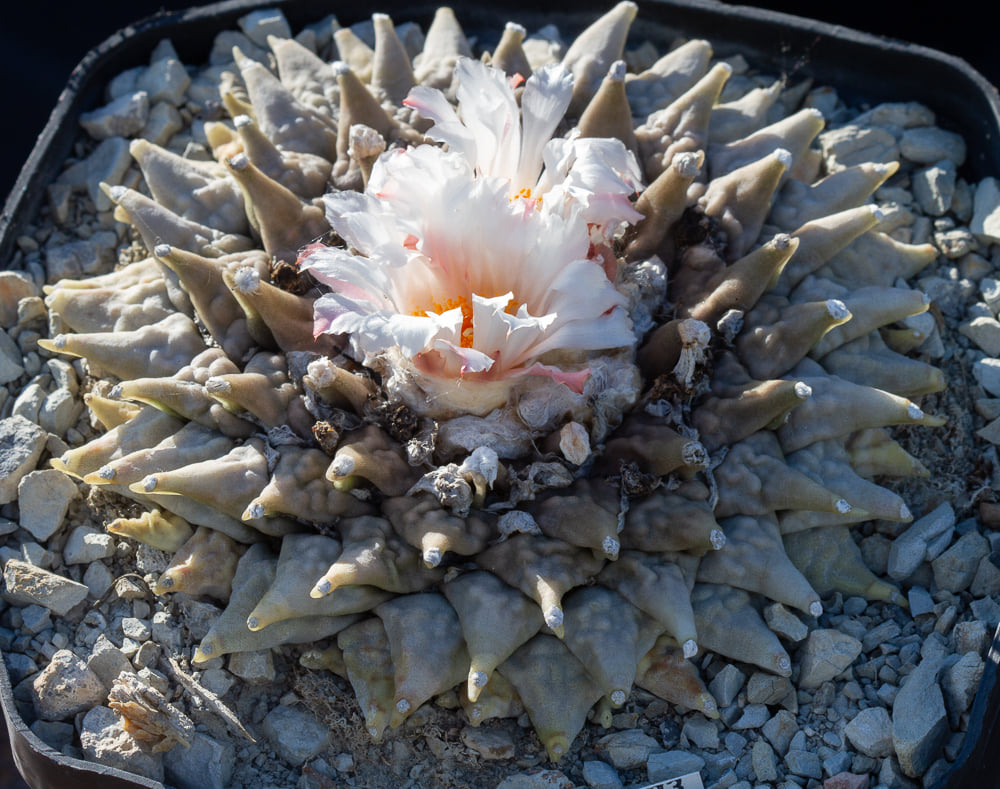
Ariocarpus retusus subsp. furfuraceus is the northern Mexican form of the most widely distributed Ariocarpus, distinguished by equilaterally triangular tubercles whose adaxial face carries a distinctive whitish, mealy coating. The Latin epithet furfuraceus means ‘bran-like’ or ‘scurfy’, and the texture is the single most reliable field character separating this form from A. retusus as commonly encountered in southern populations. The basionym, Mammillaria furfuracea, was published by Sereno Watson in 1890 from material collected in the limestone scrub south of Saltillo, Coahuila, in the Carneros Pass area.
The taxonomy of this name is actively contested and the page is honest about that. Kew POWO treats every furfuraceus combination as a synonym of A. retusus. Anderson and Fitz Maurice’s 1997 monograph Ariocarpus revisited, the most authoritative specialist treatment of the genus, recognises only two subspecies within A. retusus: the nominate subsp. retusus and subsp. trigonus. Neither authority elevates furfuraceus to a formal infraspecific rank. BCSS field-number records and most specialist growers nonetheless use ‘subsp. furfuraceus’ or ‘var. furfuraceus’ consistently to denote the recognisable Coahuila and Nuevo León population cluster with the diagnostic mealy epidermis. The slug, the page title, and the related-taxa grid here all retain the epithet because it is how the plant circulates in collector usage and in field data. The Taxonomy section explains the disagreement in full.
Distribution centres on the Chihuahuan Desert piedmont north and south of Saltillo, Coahuila, with documented furfuraceus-labelled collections extending into northern Nuevo León (Doctor Arroyo, the Galeana-Rayones road) and into San Luis Potosí along Route 80 toward Huizache. Plants grow on calcareous limestone slopes, rocky calcareous flats, and gravelly limestone-clay soils within Chihuahuan Desert scrub at 1,300–2,000 m, with the furfuraceus-labelled field collections clustering between 1,400 and 1,700 m. The plants are geophytic, sitting flush with the soil surface and storing water in a substantial fleshy tap root.
CITES Appendix I has covered the entire genus Ariocarpus since the eighth Conference of the Parties in 1992. Commercial international trade in wild-collected plants is prohibited; artificially propagated material moves only with full permit documentation from the country of origin. Mature, seed grown specimens are the collector standard and develop the natural geophytic habit, the substantial tap root, and the proper tubercle proportions. Grafted plants accelerate juvenile growth at the cost of body character.
Ariocarpus retusus subsp. furfuraceus quick reference
A Chihuahuan Desert geophyte from calcareous slopes north of Saltillo with a summer-active growing season, autumn flowers, and a long dry winter rest. Values calibrated for seed grown plants in cultivation, drawn from habitat data and specialist grower experience.
Taxonomy & nomenclature
The basionym is Mammillaria furfuracea S. Watson, published in Proceedings of the American Academy of Arts and Sciences 25: 150 (1890), from Mexican material attributed to the limestone scrub south of Saltillo, Coahuila. H.S. Thompson recombined the name as Ariocarpus furfuraceus in Reports of the Missouri Botanical Garden 9: 130 (1898). The variety combination A. retusus var. furfuraceus (S. Watson) G. Frank appeared in Kakteen 63: CVIIIb (1975). A further form rank, A. retusus f. furfuraceus, was emitted by Batov in 2015. An older form name, Ariocarpus furfuraceus f. cristata Frič (1925), refers to the cristate horticultural mutation; that growth form is covered on a separate page at A. retusus f. cristata.
Three positions on rank coexist in current literature, and a curator-grade encyclopedia has to acknowledge all three. Position A, the lumper position, is held by Kew POWO, citing Govaerts’s 1995 World Checklist of Seed Plants: every furfuraceus combination is a synonym of A. retusus Scheidw., and the species is treated as a single, extremely variable taxon across its range. Position B is the specialist-monograph position. Anderson and Fitz Maurice’s 1997 Ariocarpus revisited (Haseltonia 5: 1–20) recognises only two subspecies within A. retusus: the nominate subsp. retusus and subsp. trigonus. The 1997 revision lists furfuraceus among ‘names encountered in cultivation’ rather than among accepted infraspecific taxa. Position C is the operational collector position: BCSS field-number records, llifle, and most specialist growers use ‘v. furfuraceus’ or ‘subsp. furfuraceus’ consistently to denote a recognisable population cluster characterised by equilateral, mealy-surfaced tubercles. No formally published ‘subsp. furfuraceus’ combination exists in the ICN sense; the rank is horticultural.
This page follows POWO as the baseline taxonomy of record and notes that no current authority accepts furfuraceus as a formal subspecies. The epithet is retained in the page title, the slug, and the related-taxa grid because that is how the plant circulates in field records, in specialist nursery catalogues, and in collector vocabulary, and because a reader looking for it will type the word into a search box. The lumper argument has merit: Watson noted that the diagnostic tubercle character was inconstant, and intermediate plants exist wherever the putative furfuraceus and typical retusus populations meet across Nuevo León and Zacatecas. The splitter argument also has merit: the northern Coahuila population has a recognisably different look in hand and in photographs, and the BCSS field collectors record it consistently.
A separate problematic name in the retusus complex is Ariocarpus confusus Halda & Horáček (Cactaceae Bratislava 7: 1, 1997), later recombined by Lüthy in 1999 as A. retusus subsp. confusus. This name covers the populations around Aramberri, Nuevo León, and is sometimes conflated with furfuraceus in trade. The Aramberri populations are geographically and morphologically distinct from typical furfuraceus and are not covered on this page.
Historical synonyms (12)
- Anhalonium prismaticum Lem., 1839 basionym
- Anhalonium retusum (Scheidw.) Salm-Dyck, 1845 homotypic synonym
- Ariocarpus retusus var. furfuraceus (S.Watson) G.Frank, 1975 homotypic synonym
- Ariocarpus retusus subsp. scapharostroides Halda & Horácek, 1997 homotypic synonym
- Ariocarpus retusus subsp. horacekii Halda & Panar., 1998 homotypic synonym
- Ariocarpus retusus subsp. jarmilae Halda, Horácek & Panar., 1998 homotypic synonym
- Ariocarpus retusus subsp. panarottoi Halda & Horácek, 1998 homotypic synonym
- Ariocarpus retusus subsp. confusus (Halda & Horácek) Lüthy, 1999 homotypic synonym
- Ariocarpus retusus subsp. sladkovskyi Halda & Kupcák, 2000 homotypic synonym
- Ariocarpus retusus subsp. pectinatus Weisbarth, 2003 homotypic synonym
- Anhalonium pulvilligerum Lem., 1843 heterotypic synonym
- Anhalonium elongatum Salm-Dyck, 1845 heterotypic synonym
Sources: GBIF
Habitat
A. retusus subsp. furfuraceus grows on calcareous substrates in Chihuahuan Desert scrub: gravelly limestone slopes, rocky calcareous flats, and mixed limestone-clay soils. The Carneros Pass area south of Saltillo, the principal furfuraceus locality, sits on Cretaceous limestone outcrops at approximately 1,500–1,700 m. Gypseous outcrops occur in parts of the wider A. retusus range, but the furfuraceus form is not specifically a gypsophile.
Associated vegetation at the core Coahuila localities includes Larrea tridentata (creosote bush), several Agave species, Mimosa monancistra, multiple Opuntia species, and a varied Chihuahuan Desert scrub matrix with Yucca, Hechtia, Dasylirion, Fouquieria, and Nolina. The plants integrate into this matrix at ground level; the tubercle rosette sits flush with the limestone gravel and is largely invisible until the autumn flowers emerge from the crown wool.
Climate is semi-arid to arid with marked seasonality. Most rainfall falls between July and September; autumn through spring is dry. Summer maxima exceed 35°C on exposed limestone, while winter minima can drop below -5°C on the higher Coahuila ridges, always with the plants dormant and dry. The seasonality is the engine of the cultivation regime: a generous summer wet, a dry autumn into bloom, and a dry winter rest at low temperatures.
Furfuraceus-labelled populations occupy the northern and western portion of the wider A. retusus range. Typical A. retusus sensu stricto is broadly distributed from north of Saltillo southward through San Luis Potosí, into Zacatecas, and into Tamaulipas. There is substantial geographic overlap and morphological intergradation across the Nuevo León and Zacatecas portions of the range, which is one factual basis for the lumper position and which the page does not paper over.
Morphology
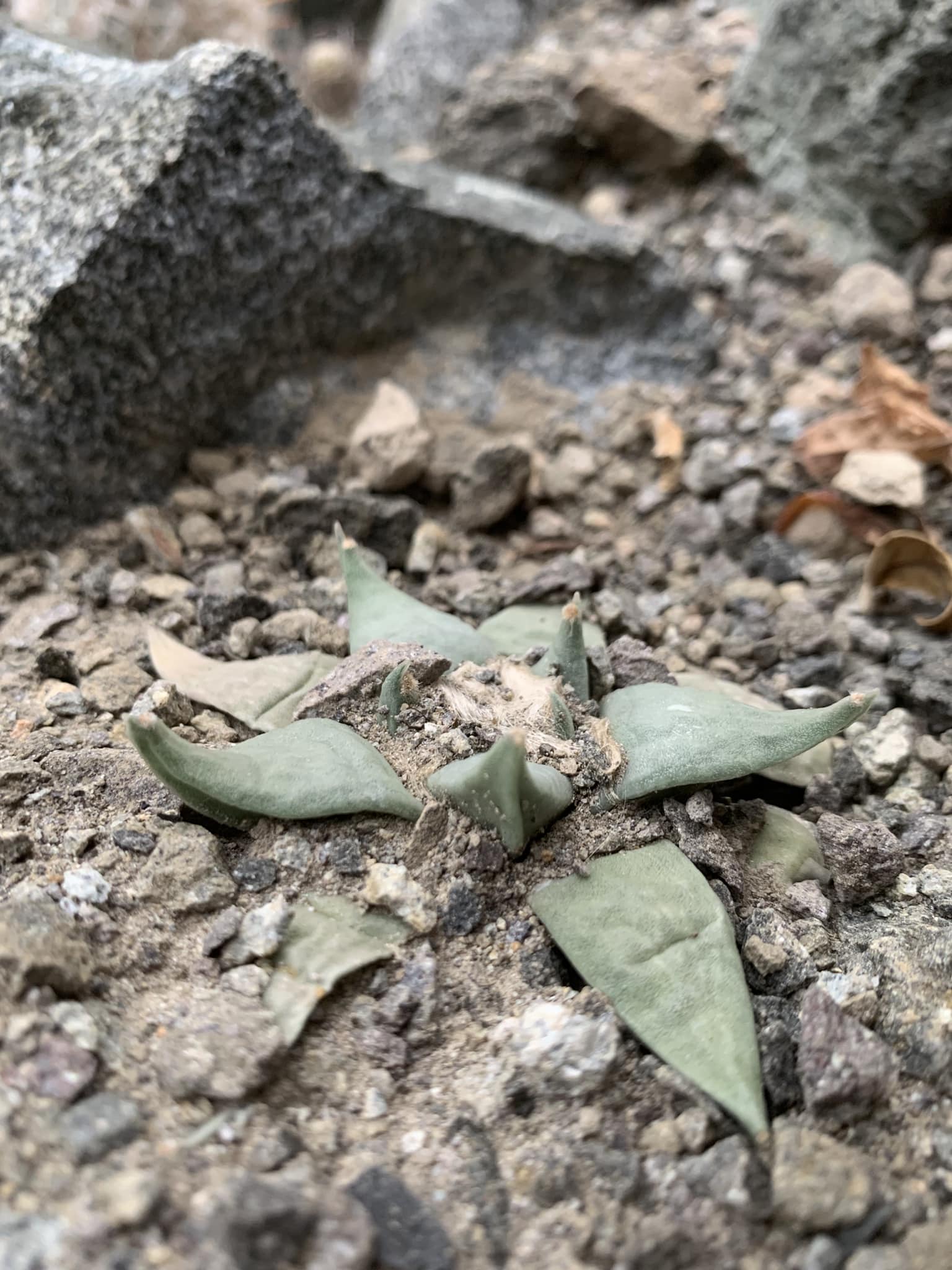
The body is a solitary, slow-growing geophyte. The stem is flattened-globose, rounded at the apex, grey-green to dark grey-brown-green, sitting flush with the soil surface or only slightly above it. Body dimensions run 3–12 cm tall and 10–25 cm in diameter on mature plants; the visible rosette is always wider than it is tall. Below the body, a substantial fleshy tap root anchors the plant and stores water through the long winter dormancy. Loss of the tap root, whether from rot or from clumsy transplanting, almost always kills the plant.
Tubercles are the diagnostic character. In the furfuraceus form they are equilaterally triangular in plan view: nearly as wide as long, 1.5–4 cm long, 1–3.5 cm wide. In the typical A. retusus from southern populations, tubercles are elongated, longer than wide, and taper to a less blunt tip. The adaxial face of a furfuraceus tubercle carries a whitish to greyish mealy coating, almost chalky or frosted in appearance, that results from microscopic surface roughness and waxy cuticular deposits on the epidermis. Watson named the taxon for this character. In typical A. retusus the adaxial face is smooth or only slightly roughened with no powdery deposit. Tubercle colour in furfuraceus leans dark grey-green and brownish; typical A. retusus from southern populations leans more blue-green and lighter.
Areoles sit as small woolly pads at the tubercle tips. Seedlings carry small feather-like spines on the areoles; adult plants are essentially spineless, with persistent areolar wool but no functional spine. This is consistent across the entire A. retusus complex and sets Ariocarpus apart from genera that retain adult spines.
Dense white to creamy wool fills the crown throughout the year and is the visual signature of the genus from above. Flowers emerge from this crown wool in autumn, primarily September and October with occasional bloom into November. Individual flowers are diurnal, 4–5 cm in diameter and 2–4.2 cm long, white to pale pink and occasionally with reddish midveins on the petals. Flower colour separates this form cleanly from A. trigonus, which produces yellow to creamy-white flowers. Fruit is white, green, or rarely pinkish, 10–25 mm long, ripening slowly through the dry autumn and winter; seeds are hidden in the crown wool until released by mechanical disturbance or rain.
Locality detail
Furfuraceus-labelled collections cluster in the limestone belt running from south of Saltillo through northern Nuevo León and into the highlands of San Luis Potosí. The type area, where Watson’s 1890 basionym originates, is in the vicinity of Carneros Pass, Coahuila. The map below carries regional centroids for documented BCSS field-number records: Doctor Arroyo (CZ 127, 1987), the Galeana-Rayones road at 1,470 m (CS 84.5, 2007), and Route 80 toward Huizache (CSD 76, 1997).
Sharp GPS coordinates are not published on this page. CITES Appendix I status, the historical record of illegal collection across the genus, and the slow regenerative biology of the plants together argue for centroid-only reporting. The BCSS Field Number Finder carries the fine-grained data behind authentication; the locality names above are the public-domain portion.
Ariocarpus retusus subsp. furfuraceus care and cultivation
Three habitat facts structure every cultivation decision for A. retusus subsp. furfuraceus. The substrate is a calcareous, mineral-dominated limestone scrub soil with very low organic content. The seasonal climate is a summer-active wet, an autumn-flowering taper, and a strict dry winter rest. The body is a geophyte with a substantial tap root that does not tolerate stagnant moisture or cold-and-wet conditions. Cultivation that respects all three of these is forgiving for an Ariocarpus; cultivation that violates any one tends to kill the plant slowly through root rot.
Substrate
The canonical cultivation ratio for A. retusus subsp. furfuraceus is 43 per cent pumice, 15 per cent lava rock, 5 per cent zeolite, 20 per cent granite grit, 12 per cent limestone chip, and 5 per cent worm castings. A calcium-bearing component is standard genus-wide practice, not a furfuraceus-specific finding: growers on hard tap water should reduce or omit the limestone chip, since the water itself already supplies calcium, while growers on RO or rainwater should keep it at the stated share. The zeolite handles cation exchange and pH buffering through the summer watering window. Avoid moisture-retentive organic amendments: they trap water at the root collar and add nothing that the pumice and granite grit do not already provide.
All eleven Ariocarpus pages on this site share one uniform mineral formulation; no cultivation source anywhere in the genus supports a different mineral share for any taxon, gypsum-hill locality included. The limestone chip sits at 12 per cent, a house convention drawn from published grower recipes (one of which runs as high as 20 per cent) rather than a per-species measurement, and growers on hard tap water should reduce or omit it since the water itself already supplies calcium.
| Species | Pumice | Lava | Zeolite | Granite | Limestone | Silica | Organic |
|---|---|---|---|---|---|---|---|
| A. fissuratus | 43% | 15% | 5% | 20% | 12% | 0% | 5% |
| A. fissuratus subsp. lloydii | 43% | 15% | 5% | 20% | 12% | 0% | 5% |
| A. retusus | 43% | 15% | 5% | 20% | 12% | 0% | 5% |
| A. retusus subsp. furfuraceus (this page) | 43% | 15% | 5% | 20% | 12% | 0% | 5% |
| A. retusus f. cristata | 43% | 15% | 5% | 20% | 12% | 0% | 5% |
| A. kotschoubeyanus | 43% | 15% | 5% | 20% | 12% | 0% | 5% |
| A. scaphirostris | 43% | 15% | 5% | 20% | 12% | 0% | 5% |
| A. agavoides | 43% | 15% | 5% | 20% | 12% | 0% | 5% |
| A. bravoanus | 43% | 15% | 5% | 20% | 12% | 0% | 5% |
| A. bravoanus subsp. hintonii | 43% | 15% | 5% | 20% | 12% | 0% | 5% |
| A. trigonus | 43% | 15% | 5% | 20% | 12% | 0% | 5% |
Watering and light
Water sparingly through the April-to-October growing season once the substrate has dried completely. Bottom-watering, where the pot is set in a tray of water and the substrate wicks up the moisture from below, preserves the crown wool and the tubercle epidermis and is the preferred routine for many specialist growers. Overhead watering during peak heat can stain the wool and abrade the mealy tubercle surface that defines the form.
From November through March, withhold water entirely. The plant is dormant; the tap root is full of stored water; the danger is rot from cold-and-wet, not desiccation. Even prolonged drought is tolerated when the plant is fully dormant. Begin watering again cautiously in late March or April once nighttime temperatures consistently exceed 10°C and the plant shows the first signs of plumping in the tubercles.
Light should be high. Mature plants tolerate full sun once acclimatised; juveniles and recently repotted plants benefit from 30–40% shade during the hottest summer hours to prevent bronzing of the tubercle epidermis. Insufficient light combined with any moisture promotes rot and produces softer, less compact growth that does not match the natural body proportions.
Cold tolerance and dormancy
The species tolerates dry cold to roughly -5°C for short exposures; brief exposures to -10°C are documented in the cultivation literature. The reliable operational floor is 5°C if dry, with a target winter rest at 5–10°C for two to four months. This cool, dry, bright winter rest is essential for flower bud initiation; plants kept warm and dry through winter still survive but bloom unreliably the following autumn. A cold floor with any substrate moisture is fatal.
Propagation
Seed is the legitimate and preferred propagation route. A. retusus is described as the easiest Ariocarpus to raise from seed, with relatively high germination rates in warm spring conditions and forgiving early-seedling growth. Seed grown plants reach flowering size in approximately 6–15 years depending on conditions, with optimal warm glasshouse cultivation pulling that toward the lower end. The resulting plants develop the natural geophytic habit, the substantial tap root, and the proper tubercle proportions that are the hallmarks of a specimen-grade Ariocarpus.
Grafted plants reach flowering size faster, typically in 2–4 years on Pereskiopsis or Echinopsis rootstock. The trade-off is body character: graft-accelerated growth distorts the geometry of the rosette, produces taller and more inflated juvenile bodies, and frequently yields tubercles that do not match the natural proportions of the form. For collectors targeting habitat-representative specimens, seed grown is the goal; grafted material serves as a faster path to bloom or as backup insurance for a high-value wild-source clone in the collection.
Comparison
The most useful comparison for this page is the type A. retusus, since the entire taxonomic debate around furfuraceus is whether it is distinguishable from the type at all. Side-by-side, the equilateral tubercle proportions and the mealy adaxial epidermis of furfuraceus are recognisable to any experienced grower. Watson named the form for these characters. The lumper argument that the characters are inconstant is also true; intermediate plants exist across the Nuevo León and Zacatecas overlap, and individual southern A. retusus can occasionally show more equilateral tubercles than the geographic average. Identification rests on the surface texture: powdery and chalky in furfuraceus, smooth in typical A. retusus.
A. trigonus is the secondary comparator and a much more obvious separation. Its tubercles are elongated and sharply triangular, twice as long as wide, often curved toward the tip. Its flowers are yellow to creamy white, never the white-to-pink range of the retusus complex, and it grows primarily in thorn-forest below 1,000 m rather than in the high-elevation limestone scrub of the retusus complex. The Anderson and Fitz Maurice 1997 monograph treats trigonus as a full subspecies of retusus on molecular and ecological grounds, but the field separation is unambiguous in any case.
A. fissuratus and A. fissuratus subsp. lloydii share the broader Chihuahuan Desert range but differ in the tubercles entirely: deeply fissured, callused tubercles versus the smooth-faced (or, in this form, mealy-faced) entire tubercles of the retusus complex. The fissures in fissuratus are structural surface furrows that read clearly even in low-resolution photographs; no analogous structure exists in the retusus complex.
Frequently asked questions
How do you tell Ariocarpus retusus subsp. furfuraceus apart from typical Ariocarpus retusus?
The page’s primary identification question. Drag the slider to compare the two side by side, then check the character table for the diagnostic features.


Tubercle surface texture is the single most diagnostic character. The mealy, scurfy upper face of furfuraceus tubercles is visible in photographs and reads cleanly in hand. Tubercle proportions (equilateral versus elongate) confirm the identification but require side-by-side comparison or measurement, since both forms are variable.
Is Ariocarpus retusus subsp. furfuraceus hard to grow?
For an Ariocarpus, furfuraceus is forgiving once a calcareous mineral substrate and a strict dry winter rest are in place. The species is described as the easiest Ariocarpus to raise from seed, with relatively high germination rates and forgiving early seedling growth. The two persistent risks are root rot from winter watering or from a substrate that retains moisture (organic-heavy or fine-particle mixes) and damage to the mealy tubercle epidermis from overhead watering during peak heat. Both are operational habits rather than species-level difficulty: with a limestone-bearing pumice and granite grit mix, bottom-watering during summer, and a cool dry winter rest, established plants are stable for decades.
How long does Ariocarpus retusus subsp. furfuraceus take to flower from seed?
Seed grown plants reach flowering size in approximately 6–15 years, with optimal warm-glasshouse cultivation pulling the timeline toward the lower end of the range. The expected window for the species is 6–10 years, with 8 years a frequent first-flower point under good conditions. Grafted plants on Pereskiopsis or Echinopsis rootstock reach flowering size in 2–4 years, but the resulting body proportions and tubercle character do not match the natural form.
Is Ariocarpus legal to own? What does CITES Appendix I mean?
The entire genus Ariocarpus has been on CITES Appendix I since the eighth Conference of the Parties in 1992. Appendix I is the most restrictive CITES category. Commercial international trade in wild-collected specimens is prohibited. International trade in artificially propagated material is allowed only with full CITES export permits from the country of origin (typically Mexico, via SEMARNAT) and import permits from the destination country. Domestic acquisition of nursery-propagated plants within a single country is permitted in most jurisdictions and does not require CITES paperwork; consult applicable national legislation. In Mexico, NOM-059-SEMARNAT-2010 lists the species as Sujeta a protección especial, and unauthorised collection, transport, or commercialisation is prohibited under the General Wildlife Law.
Where does Ariocarpus retusus subsp. furfuraceus grow in the wild?
Furfuraceus-labelled populations occupy the northern part of the wider A. retusus range, centred on Coahuila and northern Nuevo León. The principal locality is Carneros Pass, south of Saltillo, Coahuila, where the basionym was collected. BCSS field records also place furfuraceus populations at Doctor Arroyo (Nuevo León, CZ 127, 1987), the Galeana-Rayones road (Nuevo León, CS 84.5, 2007, at 1,470 m), and Route 80 toward Huizache (San Luis Potosí, CSD 76, 1997). Plants grow on calcareous limestone slopes and rocky calcareous flats within Chihuahuan Desert scrub at 1,300–2,000 m, with the furfuraceus-labelled records clustering between 1,400 and 1,700 m. Sharp GPS coordinates are not published given CITES Appendix I status and documented illegal collection pressure across the genus.
When does Ariocarpus retusus subsp. furfuraceus flower?
Primary flowering season is autumn, September through October, with occasional bloom into November in warmer collections. Flowers emerge from the dense crown wool, are diurnal, and run 4–5 cm in diameter, white to very pale pink, occasionally with reddish midveins on the petals. Flower colour is essentially identical to the typical A. retusus from southern populations and contrasts cleanly with the yellow flowers of subsp. trigonus. A cool, dry, bright winter rest at 5–10°C for two to four months is required for reliable flower bud initiation the following autumn.
Sources & further reading
Watson, S. 1890. Mammillaria furfuracea S.Watson (basionym). Proceedings of the American Academy of Arts and Sciences 25: 150 · Thompson, H.S. 1898. Ariocarpus furfuraceus (S.Watson) H.S.Thomps., comb. nov. Reports of the Missouri Botanical Garden 9: 130 · Anderson, E.F. & Fitz Maurice, W.A. 1997. Ariocarpus revisited. Haseltonia 5: 1–20 · Anderson, E.F. 2001. The Cactus Family. Timber Press, Portland · Hunt, D. & Taylor, N. (eds.) 2006. The New Cactus Lexicon. DH Books, Milborne Port · Halda, J.J. & Horáček, J. 1997. Ariocarpus confusus Halda & Horáček. Cactaceae (Bratislava) 7: 1; Lüthy, J. 1999. A. retusus subsp. confusus. Kakteen And. Sukk. 50: 278 · Hernández, H.M. & Gómez-Hinostrosa, C. 2015. Mapping the Cacti of Mexico. Part II. Succulent Plant Research 9, DH Books, Milborne Port · Govaerts, R. 1995. World Checklist of Seed Plants. Treatment cited by Kew POWO for synonymy of furfuraceus combinations · Kew POWO, Ariocarpus retusus Scheidw. and synonyms · IPNI, Ariocarpus retusus Scheidw. (lectotype designation Hunt & Taylor 2006) · IUCN Red List, Ariocarpus retusus: Least Concern; assessors B. Fitz Maurice & W.A. Fitz Maurice · CITES, genus Ariocarpus Appendix I (since COP8, 1992); A. retusus taxon page · DOF / SEMARNAT, NOM-059-SEMARNAT-2010, Ariocarpus retusus: Sujeta a protección especial (published 30 December 2010; updated 14 November 2019) · BCSS Field Number Finder, A. retusus furfuraceus collection records (CZ 127 Doctor Arroyo NL 1987; CS 84.5 Galeana-Rayones NL 2007 at 1,470 m; CSD 76 Route 80 SLP 1997) · BCSS, Cultivation notes on Ariocarpus (substrate, watering regime, cold tolerance) · Henry Shaw Cactus and Succulent Society, 2019. Plant of the Month: Ariocarpus retusus · llifle Encyclopedia of Living Forms, Ariocarpus retusus var. furfuraceus