
Pelecyphora aselliformis
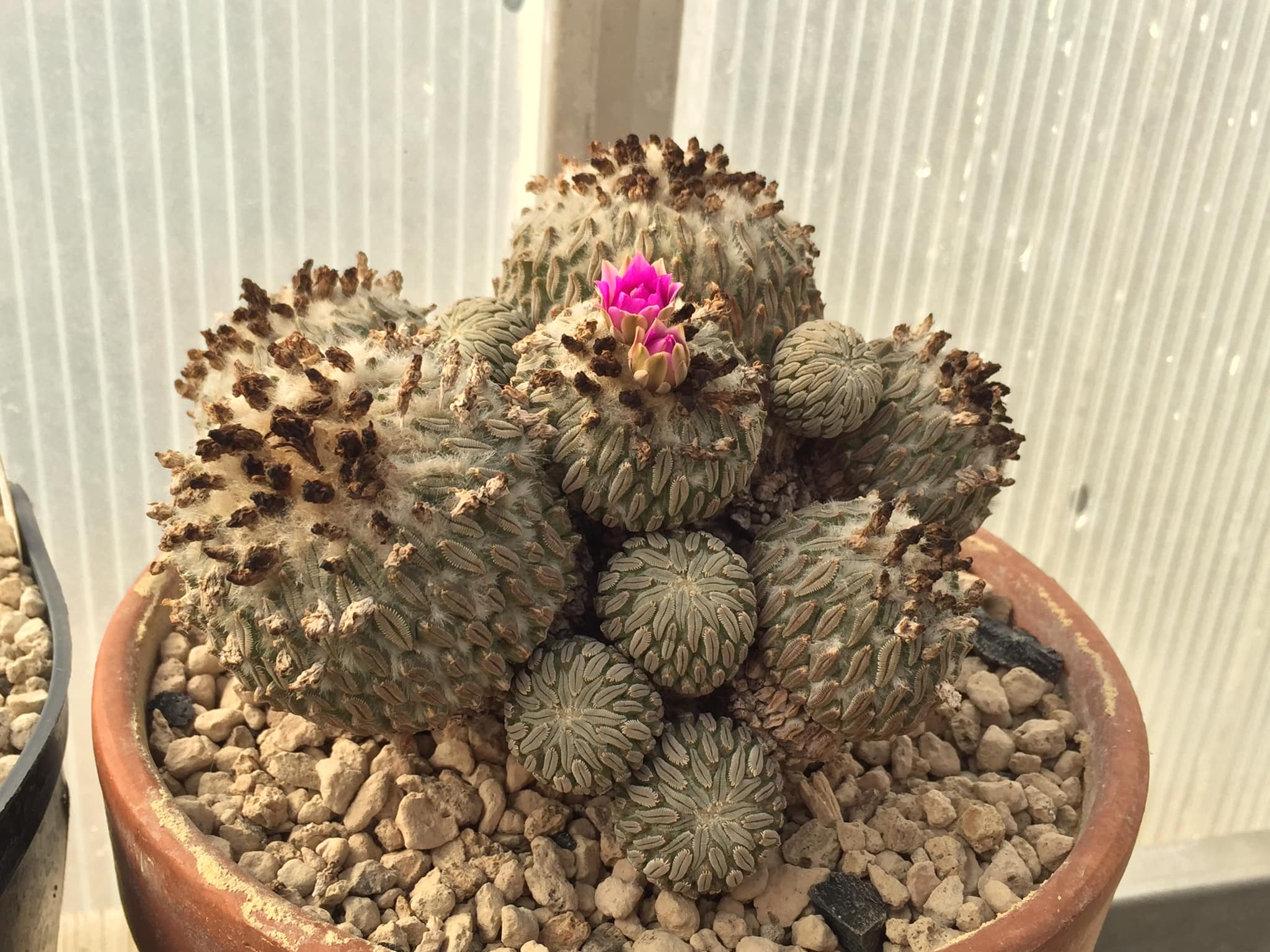
Pelecyphora aselliformis C.Ehrenb. is the woodlouse cactus of central San Luis Potosí, described by Carl August Ehrenberg in Botanische Zeitung in 1843 and named for the genus that combines Greek pelekys (axe or hatchet) with phoreus (bearing), a reference to the laterally compressed, hatchet-blade shape of each tubercle. The species epithet aselliformis means woodlouse-shaped: the forty to sixty white pectinate spines on each flattened tubercle are arranged in two opposed comb ranks, and the overall body reads as a curled isopod from any distance.
The genus Pelecyphora was effectively monotypic for most of its history. Encephalocarpus strobiliformis A.Berger sat as a separate monotypic genus from 1929 until molecular work in the 2010s recovered it nested within Pelecyphora; the formal recombination as Pelecyphora strobiliformis is now accepted by POWO. The two species share the genus and the limestone obligation but cannot be confused at a glance: P. strobiliformis carries imbricate triangular pinecone-scale tubercles with no pectinate spines, a pale pink flower, and a Coahuila/Nuevo León distribution that does not overlap with the San Luis Potosí range of aselliformis.
The broader 2022 Sanchez et al. recircumscription of Pelecyphora transferred most of Escobaria and several Coryphantha species into the genus, expanding it to roughly two dozen species. Under that treatment, aselliformis remains untouched as the type species of the genus, its morphological corner unique: the combination of paired pectinate spine ranks on flattened axe-blade tubercles is unmatched anywhere else in Pelecyphora or in adjacent genera Mammillaria and Coryphantha.
In habitat the species grows on Cretaceous and Tertiary limestone substrates in the southern Chihuahuan Desert at 1,800 to 2,400 m, within an area the IUCN estimates at roughly 500 km² entirely inside the state of San Luis Potosí. It is locally abundant within that range and does not cross onto non-limestone substrates within its known extent. Wild collection pressure and road construction have been the principal documented threats, but the population trend is currently stable.
Pelecyphora aselliformis quick reference
A miniature of central San Luis Potosí, growing on Cretaceous limestone substrates at 1,800 to 2,400 m in the southern Chihuahuan Desert. Values calibrated for seed grown plants in cultivation, drawn from species-specific habitat data and grower sources.
Taxonomy & nomenclature
The accepted name is Pelecyphora aselliformis C.Ehrenb., published in Botanische Zeitung (Berlin) 1: 737 (1843). POWO accepts the species in this combination and lists three homotypic synonyms reflecting 19th-century attempts to place the plant in other genera: Anhalonium aselliforme (Ehrenb.) F.A.C.Weber (1898), Ariocarpus aselliformis (Ehrenb.) F.A.C.Weber (1898), and Mammillaria aselliformis (Ehrenb.) H.P.Kelsey & Dayton (1942). None of these alternative placements is currently accepted. The holotype illustration in the protologue serves as the de facto iconotype; the type specimen itself is now considered lost.
One heterotypic synonym exists: Pelecyphora aselliformis var. concolor Hook.f., described in Curtis’s Botanical Magazine 99: t. 6061 (1873) from cultivated material with paler spines. POWO treats this as a synonym of the species; the varietal name has no standing. The horticultural designation P. aselliformis f. monstruosa that circulates on llifle is a cultivar label, not a botanical name.
The genus name combines Greek pelekys (axe or hatchet) with phoreus (bearing), referring to the laterally compressed, axe-blade shape of the tubercles. The epithet aselliformis means woodlouse-shaped, from Latin asellus (a small donkey or, in medieval and Renaissance natural history, a wood-louse/isopod), referring to the segmented appearance the paired pectinate spine rows create on each flattened tubercle.
The 2022 Sanchez et al. PhytoKeys paper recircumscribed Pelecyphora by absorbing most of Escobaria and several Coryphantha species, producing twenty-five new combinations. Under that expanded delimitation the genus holds roughly two dozen species; POWO presently accepts the broader circumscription. Aselliformis remains the type species of the genus in all treatments and its morphology is unaffected by the recircumscription.
Historical synonyms (4)
- Anhalonium aselliforme (Ehrenb.) F.A.C.Weber, 1898 basionym
- Pelecyphora aselliformis var. concolor Hook.fil., 1873 homotypic synonym
- Ariocarpus aselliformis (Ehrenb.) F.A.C.Weber, 1898 homotypic synonym
- Mammillaria aselliformis (Ehrenb.) H.P.Kelsey & Dayton, 1942 homotypic synonym
Sources: POWO (Kew) · IPNI · GBIF · Wikidata
Habitat
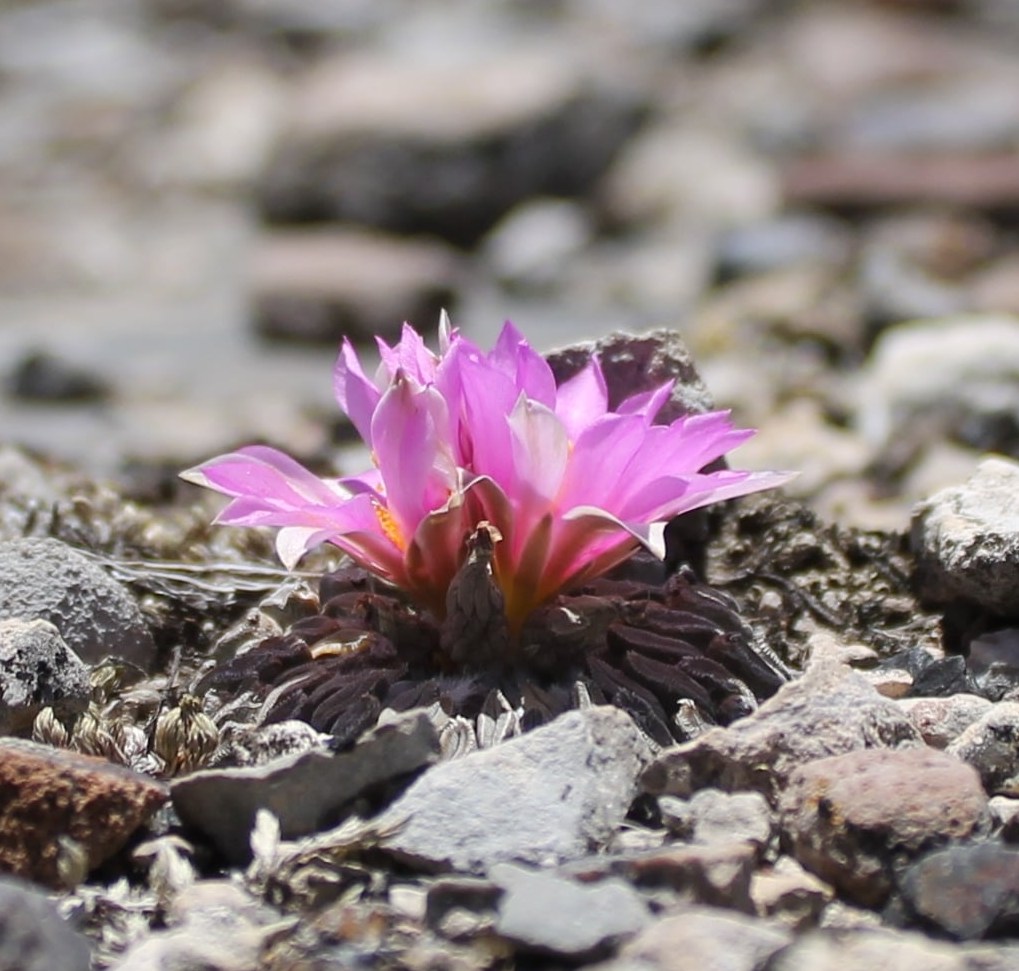
Pelecyphora aselliformis is a San Luis Potosí endemic. The entire wild range is estimated by the IUCN at approximately 500 km², all within central San Luis Potosí, on Cretaceous and Tertiary limestone substrates of the southern Chihuahuan Desert. Known population clusters run through the limestone hills around Villa de Reyes and the El Huizache plain north of the state capital. Elevation: 1,800 to 2,400 m.
The species is found on limestone across its known range. Wild substrate is broken Cretaceous limestone with thin dark mineral-rich pockets between rocks, at pH 7.4 to 8.0 throughout the profile. Plants grow in the shade of bushes and do not receive direct midday sun. Plant community is open desert scrub with Larrea, Agave, and thorny shrub species typical of the southern Chihuahuan Desert at mid-elevation.
Annual rainfall at the type-locality corridor is roughly 380 mm, concentrated in late-summer monsoon storms, with a dry winter lasting from November through March. This pronounced wet-dry seasonality drives the cultivation watering regime: an active growing season matching the monsoon window and a strict dry rest through winter. Habitat winter minima on still clear nights can reach light frost at 2,400 m, but the substrate buffers the root zone; the plants tolerate brief -4°C dry better than any cool-wet condition.
The species is locally abundant within its limited range. More than ten subpopulations are known and the population trend is stable. Mapping work by Hernandez & Gomez-Hinostrosa does not record any populations outside San Luis Potosí; the POWO inclusion of Jalisco reflects a database artefact rather than primary occurrence data.
Morphology
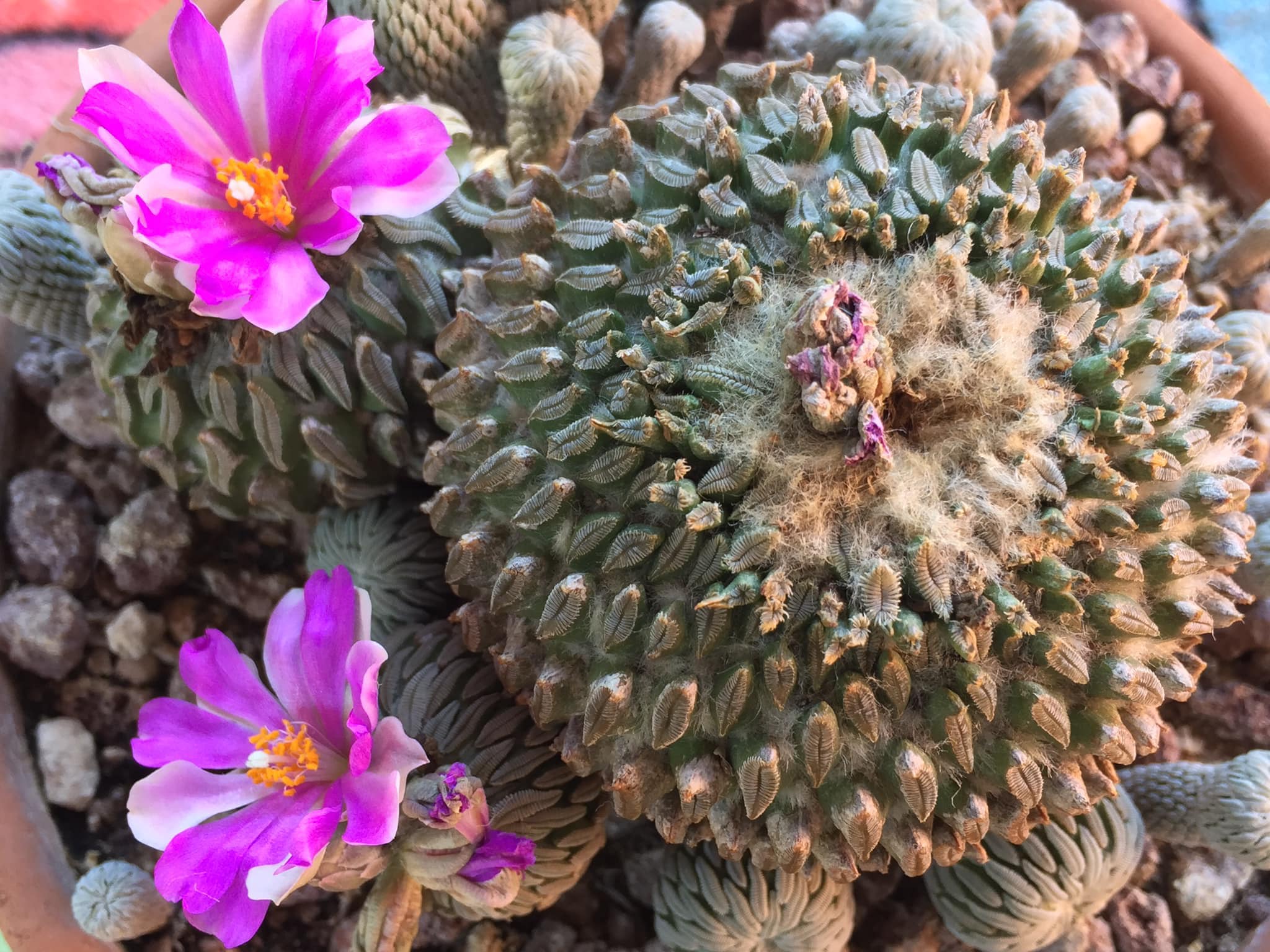
Body solitary or weakly clustering, globose to short-cylindrical, 2 to 5 cm in diameter and 5 to 10 cm tall in mature plants. Young plants pass through a clavate phase before assuming the adult globose silhouette. Stem colour is grey-green to dull olive; the surface reads as uniformly silvery from a metre away because of the dense pectinate spination covering it.
The diagnostic feature is the tubercle geometry. Each tubercle is laterally compressed into a flattened axe-blade or hatchet shape, 5 to 9 mm long, 2 to 4 mm tall, and only 1 to 2.5 mm thick. Tubercles are arranged in low spirals around the body. Viewed from the side, each tubercle reads as a single segment of a woodlouse, and the whole body reads as a curled isopod. The etymological chain runs from Ehrenberg’s aselliformis through the observation that these axe-carrying (pelecyphora) segments look exactly like the overlapping scutes of a terrestrial isopod.
Areoles are elongated, narrow, and oval to almost linear, running along the apex of each hatchet blade. White-woolly when young, weathering grey on older areoles. Spines: 40 to 60 per areole, all radial, no central differentiated, all 0.7 to 4 mm long, white to pale grey, soft to the touch. They are arranged in two opposed pectinate ranks along the length of the elongated areole, each rank combing toward the other across the areole’s central axis. This paired-comb arrangement is not replicated in any other species in the family.
Flowers magenta to violet-pink, with paler outer tepals, 2 to 3 cm in diameter, opening at the apex from the woolly crown. Flowering in habitat runs February through May, concentrated in April and May in northern-hemisphere cultivation. Flowers open during the day and last several days. Fruit small, dry, dehiscing within the apical wool; seeds dark brown to blackish, glossy, approximately 1 mm.
Locality detail
The type locality is given in the 1843 protologue as the vicinity of San Luis Potosí city. That is the full extent of the original geographic information; the precise collection site is not recorded and subsequent neotypification relied on the protologue illustration and living material from the same corridor rather than a located historical specimen.
The map plots two state-level centroids rather than point-level population coordinates. For an Appendix I-listed species with known collector-pressure history, publishing precise GPS data would facilitate collection rather than conservation. Regional centroids convey the range without exposing individual colonies. The entire wild range falls within central San Luis Potosí; the species does not extend into neighbouring states on the basis of any primary occurrence data available in the current literature.
Pelecyphora aselliformis care and cultivation
Pelecyphora aselliformis is an advanced cultivation subject. The three requirements that account for the advanced rating are the limestone substrate, the sensitivity to cool-wet conditions, and the very slow ungrafted growth rate. All three are manageable with the right setup; none is forgiving of shortcuts.
Substrate
No cultivation source establishes this species as calcicole or calcifuge; habitat is documented as alkaline Cretaceous limestone at pH 7.4 to 8.0, a plain habitat fact. Target composition: 30% pumice (3 to 6 mm), 20% crushed lava rock (scoria), 10% zeolite (clinoptilolite, 4 to 6 mm), 5% decomposed granite grit, 20% crushed limestone or oolitic gravel (3 to 8 mm), 5% quartz silica grit (1 to 3 mm), 10% worm castings. The limestone fraction at 20% is raised above the site baseline as a house convention rather than documented evidence; habitat data from llifle, the 2001 Anderson monograph, and the IUCN assessment describe Cretaceous limestone as the exclusive wild habitat. Pure pumice mixes without calcium carbonate underperform, and growers report slower growth and loosened spination on neutral-pH mixes. Use no organic amendments beyond worm castings; mineral aggregate only.
Both Pelecyphora species on this site share a 90/10 inorganic-to-organic baseline; the limestone percentage is the key variable, and it is set by house convention for the genus.
| Species | Pumice | Lava | Zeolite | Granite | Limestone | Silica | Organic |
|---|---|---|---|---|---|---|---|
| P. aselliformis (this page) | 30% | 20% | 10% | 5% | 20% | 5% | 10% |
| P. strobiliformis | 35% | 15% | 10% | 10% | 18% | 5% | 7% |
Watering and light
Keep the substrate dry from December through February, with no watering at all. In October and November, one light watering per month at most. First spring watering waits for visible warmth in March: one thorough soak, then complete drying over 14 to 21 days before the next. From April through September, water when the substrate is dry to the pot base; typical interval 14 to 21 days at moderate temperatures, shortening to 10 to 14 days during peak summer heat. The winter dry rest is non-negotiable: a single overwatering in cool conditions is sufficient to collapse the centre within two weeks. Habitat receives about 380 mm of rainfall concentrated in late summer monsoon storms; the cultivation regime mirrors that pattern.
Light requirements differ from most Chihuahuan Desert cacti. In habitat, plants grow in the shade of bushes and avoid direct midday sun. Under glass, an east or south-east aspect with light shading from June to August is appropriate. Full unfiltered south-facing summer sun scorches the apex and browns the spination. The body should remain silvery-grey, not flushed pink-bronze.
Propagation
From seed, six to eight years from germination to flowering size is typical. Sow on a sterile mineral-heavy mix at 20 to 25°C, surface-sown, germination in 10 to 20 days. First true tubercles appear in the second year. Most commercially available plants are grafted onto Pereskiopsis for fast initial growth, then either re-grafted to a more durable rootstock or degrafted onto mineral substrate. The Badalamenti et al. 2016 micrografting protocol uses Opuntia ficus-indica with 81 to 97% success and 85% post-transfer survival. Seed grown specimens command the collector premium; grafted plants are faster but the distorted growth pushes tubercles away from the diagnostic flattened form.
Comparison
The single most useful diagnostic for P. aselliformis is the paired-comb pectinate spination on flattened hatchet-blade tubercles. No other species in cultivation matches that combination. The five species most likely to be confused with aselliformis are addressed below.
Pelecyphora strobiliformis is the sister species in the genus. Tubercles are imbricate triangular pinecone-scale shapes rather than flattened hatchet blades; spines are not pectinate; flowers are pale pink rather than magenta. Habitat is Coahuila and Nuevo León, not San Luis Potosí. The two share the limestone obligation and the miniature stature but cannot be confused at a glance.
Turbinicarpus pseudopectinatus, formerly placed in Pelecyphora itself as P. pseudopectinata Backeb., is the closest morphological echo outside the genus. Body smaller (3 to 4 cm), tubercles less laterally compressed, pectinate spines arranged in a single rank per areole rather than the paired-comb arrangement of aselliformis. Flower magenta-violet but smaller (1.5 to 2 cm). Distribution Tamaulipas and Nuevo León, not San Luis Potosí. The combination of body size, tubercle compression degree, and single versus paired comb separates the two in any side-by-side comparison.
Lophophora williamsii shares the common name peyotillo in San Luis Potosí markets and is routinely confused with aselliformis by non-specialists. The two are not confusable on close inspection: Lophophora is entirely unspined with woolly areoles only, while aselliformis is densely spined. The alkaloid overlap adds to the confusion: aselliformis produces trace mescaline (Neal et al. 1972), but at concentrations far below any practical equivalence with L. williamsii.
Frequently asked questions
Is Pelecyphora aselliformis hard to grow?
Advanced. The limestone fraction in the mix is the first adjustment growers get wrong: a crushed limestone fraction landing the mix near pH 7.4 to 8.0 is house convention for the genus’s limestone share, not a proven requirement of this species. Hard tap water already supplies calcium and bicarbonate at every watering; rainwater and RO water supply neither, and that is the real variable in whether the limestone share makes sense. The dry winter rest is the second hurdle: a single overwatering at temperatures below 10°C is enough to rot the plant from the centre within two weeks. The very slow ungrafted growth rate is the third challenge; six to eight years to flowering size is typical for ungrafted plants, and growers accustomed to faster-growing cacti find the pace discouraging. Clay pots, a strictly dry winter, east-aspect filtered light, and a fast-draining mineral substrate are the four non-negotiables.
Can Pelecyphora aselliformis be grown from seed?
Yes, and seed grown plants are the collector target. Germination at 20 to 25°C on a sterile mineral-heavy surface mix is reliable; first true tubercles develop in the second year. The challenge is time: six to eight years from germination to first flower for ungrafted plants. Most trade plants are grafted onto Pereskiopsis for fast early growth, accelerating to flowering size in roughly two to three years, then either degrafted or kept on a durable rootstock. Grafted plants flower faster but the forced growth distorts the flattened tubercle geometry that makes the species distinctive.
Is Pelecyphora aselliformis legal to own?
Pelecyphora aselliformis is listed on CITES Appendix I, the strictest trade category. Appendix I does not make the plant illegal to own; it means that any international commercial trade in wild-collected material is prohibited, and that even nursery-propagated plants moving across borders require both an export permit from the country of origin and an import permit in the destination country. Personal possession of documented nursery-propagated stock with appropriate paperwork is legal in most jurisdictions. Under NOM-059-SEMARNAT-2010, the species is listed as Sujeta a protección especial in Mexico. The defensible collector source is documented nursery stock with CITES permits.
Where does Pelecyphora aselliformis grow in the wild?
Central San Luis Potosí, Mexico, on Cretaceous and Tertiary limestone substrates in the southern Chihuahuan Desert at 1,800 to 2,400 m elevation. The IUCN estimates the total wild range at approximately 500 km², all within one Mexican state. More than ten subpopulations are known; the population trend is stable. Plants grow in the shade of desert shrubs on broken limestone outcrops with thin dark mineral-rich soil between rocks, at soil pH 7.4 to 8.0. The species does not occur outside San Luis Potosí on any primary occurrence data: POWO’s Jalisco record is a database artefact, not a documented wild population.
When does Pelecyphora aselliformis flower?
February through May in habitat, concentrated in April and May under northern-hemisphere cultivation schedules. Flowers are magenta to violet-pink, 2 to 3 cm in diameter, with paler outer tepals, opening at the apex from the woolly crown. Individual flowers open during the day and last several days. The flower colour against the silvery pectinate body is part of the species’s visual signature; plants in good cultivation condition produce multiple simultaneous apical flowers from mid-spring onward.
Sources & further reading
Ehrenberg, C.A. (1843). Pelecyphora aselliformis C.Ehrenb. Botanische Zeitung (Berlin) 1: 737. · Plants of the World Online (Kew POWO). Pelecyphora aselliformis C.Ehrenb. powo.science.kew.org · IUCN Red List of Threatened Species. Pelecyphora aselliformis C.Ehrenb., assessment ID 152618, assessed by Fitz Maurice, B. & Goettsch, B.K. (2009), reassessed 2013, category Least Concern, criteria v3.1. iucnredlist.org · CITES Appendices. Pelecyphora aselliformis: Appendix I listing since original Cactaceae annex. cites.org · NOM-059-SEMARNAT-2010. Pelecyphora aselliformis listed as Sujeta a protección especial (Pr). Diario Oficial de la Federación. · Anderson, E.F. (2001). The Cactus Family. Timber Press, Portland. · Neal, J.M., Sato, P.T., Howald, W.N. & McLaughlin, J.L. (1972). Cactus Alkaloids: Identification in the Mexican Peyote Pelecyphora aselliformis Ehrenberg. Science 176(4039): 1131–1133. · Sánchez, D., Vázquez-Benítez, B., Vázquez-Sánchez, M., Aquino, D. & Arias, S. (2022). Phylogenetic relationships in Coryphantha and implications on Pelecyphora and Escobaria (Cacteae, Cactoideae, Cactaceae). PhytoKeys 188: 115–165. · Badalamenti, O., Carra, A., Oddo, E., Carimi, F. & Sajeva, M. (2016). Is in vitro micrografting a possible valid alternative to traditional micropropagation in Cactaceae? Pelecyphora aselliformis as a case study. SpringerPlus 5: 201. · Hernández, H.M. & Gómez-Hinostrosa, C. (2015). Mapping the cacti of Mexico. Part II. Succulent Plant Research vol. 9. · llifle.com Encyclopedia of Living Forms. Pelecyphora aselliformis. llifle.com