
Avonia mallei
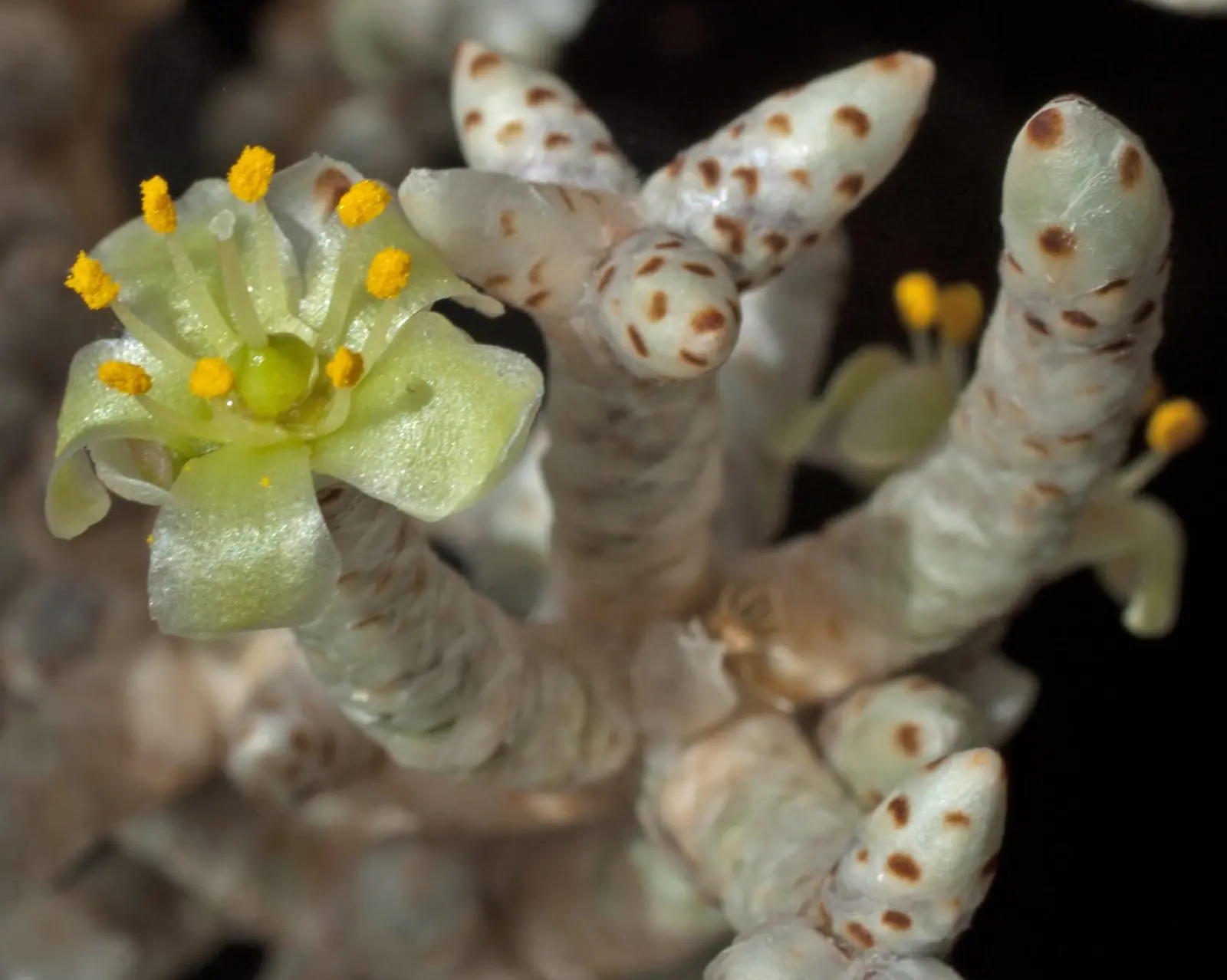
Avonia mallei is known to science from three herbarium sheets. One botanist collected all of them, in the space of two months in 1994, on hillsides in the Northern Cape of South Africa where the plants sat in reddish soil between pegmatite and quartz pebbles. No botanic garden anywhere holds the species. No nursery sells it, and no one sells its seed.
That is an unusual position for a plant to occupy, and it limits what can be known about it. George Williamson described the species in 1995 and the description has never been digitised, so the detailed account of what this plant looks like sits in a print journal and nowhere a reader can reach. The photographs here are the only accessible record of the living plant.
The name inverts the pattern the rest of the genus follows. For Avonia quinaria and most of its relatives the Anacampseros name came first and Rowley moved it across in 1994. Here Williamson published straight into Avonia, so the Avonia name is the original and the Anacampseros combination is the later transfer. Kew POWO accepts that transfer and does not recognise Avonia as a genus at all; the GBIF backbone accepts every Avonia name, including this one. This site follows GBIF, publishing under Avonia while giving the POWO name alongside.
The other thing worth knowing before the detail: scarce in cultivation and threatened in habitat are separate claims, and only the first is true here.
Avonia mallei quick reference
A pegmatite hillside plant from the Namaqualand coastal belt of the Northern Cape, on a cool pole-facing slope in a winter-rainfall desert of roughly 72 mm a year plus coastal fog. Values calibrated for seed grown plants in cultivation. No source publishes cultivation data for this species; every value here is derived from its habitat.
Taxonomy & nomenclature
Avonia mallei G.Will. was published in Cact. Succ. J. (Los Angeles) 67(2): 104 (1995), IPNI LSID urn:lsid:ipni.org:names:982400-1. IPNI records the citation type as tax. nov., an original description rather than a transfer, which is what sets the name apart. The author abbreviation stands alone with no parenthetical author in front of it. Writing it as (G.Will.) G.Will. is the error to guard against, and it is an easy one to make, because six of the seven Avonia species really do carry a parenthetical author.
Kew POWO accepts Anacampseros mallei (G.Will.) G.Will., Aloe 34(1–2): 45 (1997), and treats the Avonia name as a synonym. Williamson made that combination himself two years after his own description, which is why the author repeats. POWO goes further and recognises no Avonia at all, sinking the whole segregate back into Anacampseros. The GBIF backbone takes the opposite view and accepts every Avonia name, this one included. Two major authorities disagree; this site follows GBIF, publishes under Avonia, and gives the POWO name so a reader can follow either.
A second Anacampseros mallei combination exists, attributed to Dreher in 2013. IPNI carries it and flags it as an isonym: the same combination on the same basionym, published a second time independently. Under the nomenclature code an isonym has no standing and only the earliest publication counts, so the 1997 name is the one that matters. A reader who finds the 2013 combination should not read it as a more recent accepted name.
There is no variety or subspecies of this species. A targeted IPNI search on the epithet returns four records and not one of them is infraspecific. This matters because the trade sells the plant as ‘Avonia ustulata v. mallei’, a name that has never been published at any rank, and llifle’s Avonia ustulata treatment does not mention mallei either. The label is a trade convenience. It is also the route by which the wrong growing calendar reached this species.
The genus itself is Rowley’s 1994 segregate, the papery-scaled half of Anacampseros: leaves tiny and hidden under overlapping stipular scales, against the larger naked leaves of Anacampseros in the strict sense. Rowley circumscribed nine species; Williamson added this one the following year, and later authors brought the total to around fourteen. The family is Anacampserotaceae, erected in 2010 when Portulacaceae was broken up. IPNI still files these names under Portulacaceae, which is index vintage rather than a dispute.
Historical synonym (1)
- Anacampseros mallei (G.Will.) G.Will., 1997 basionym
Sources: GBIF
Habitat
Avonia mallei grows on sloping hillsides in the Northern Cape of South Africa, rooted in well-drained reddish soil between pegmatite and quartz pebbles, under Succulent Karoo vegetation on a cool, pole-facing slope. The botanist who described the species wrote his field notes straight onto the herbarium sheets, so the habitat stands recorded in his own words. Williamson’s label on the February 1994 collection reads: in well-drained, rocky, red soil, pegmatite and quartz, Karoo vegetation, full sun exposure, southwest aspect, undisturbed. A second sheet from the following month records a hill slope and plants growing on a south quartz-pegmatite slope. SANBI renders the same habitat as sloping hillsides, in reddish soil between pegmatite and quartz pebbles, within the Succulent Karoo.
Read the rock carefully, because it drives everything downstream. Pegmatite is a very coarse-grained igneous rock of feldspar, quartz and mica. It is not quartzite, and this is not a quartz field. The feldspar weathers to clay and potassium, giving a fines fraction a pure quartz field never has; the quartz weathers to inert grit, which is what the pebbles are; the mica releases potassium, magnesium and iron. The reddish colour is iron oxide, and red soil on a slope means well-oxidised, freely drained weathering. No carbonate occurs in any of it, and no source records lime, calcrete or dolomite. The plants root in the soil between the stones, which is SANBI’s exact wording.
The aspect is the finding most likely to be read backwards. Both labels give a southerly slope, and in the southern hemisphere south is the pole-facing side: cooler, lower insolation, the shaded half of the year’s light budget. Full sun exposure on a southwest aspect therefore means unshaded by plants or rock, but sitting on the cool side of the hill. Northern-hemisphere instinct inverts this and produces a baking-exposure plant that does not exist.
The three collections sit in the Namaqualand coastal belt, inland and east of Port Nolloth. That coast is a cool maritime desert: the nearest station with published figures takes roughly 72 mm of rain a year with a winter peak, averages a daily maximum near 19°C, clears 30°C on around fifteen days a year, and receives heavy advection fog off the Benguela Current. The specimens lie about 52 km inland of that station and higher, so they will run hotter by day, colder by night and drier of fog. Those numbers are a direction, not this plant’s climate record, and no station sits on the population. The season is the part that carries: the rain here falls in winter.
One caveat on the range. SANBI gives the distribution as Richtersveld, but the coordinates on the three sheets sit roughly 95 to 100 km south of the biogeographic Richtersveld and two of the labels carry the Springbok herbarium division. Port Nolloth is the seat of the Richtersveld municipality, so SANBI may mean the municipal sense rather than the mountain desert. That reconciliation is a hypothesis and it is not confirmed, so the range is best given as the Namaqualand and Richtersveld region of the Succulent Karoo and nothing sharper. Avonia herreana is the sibling that is a central Richtersveld endemic in the strict sense.
Morphology
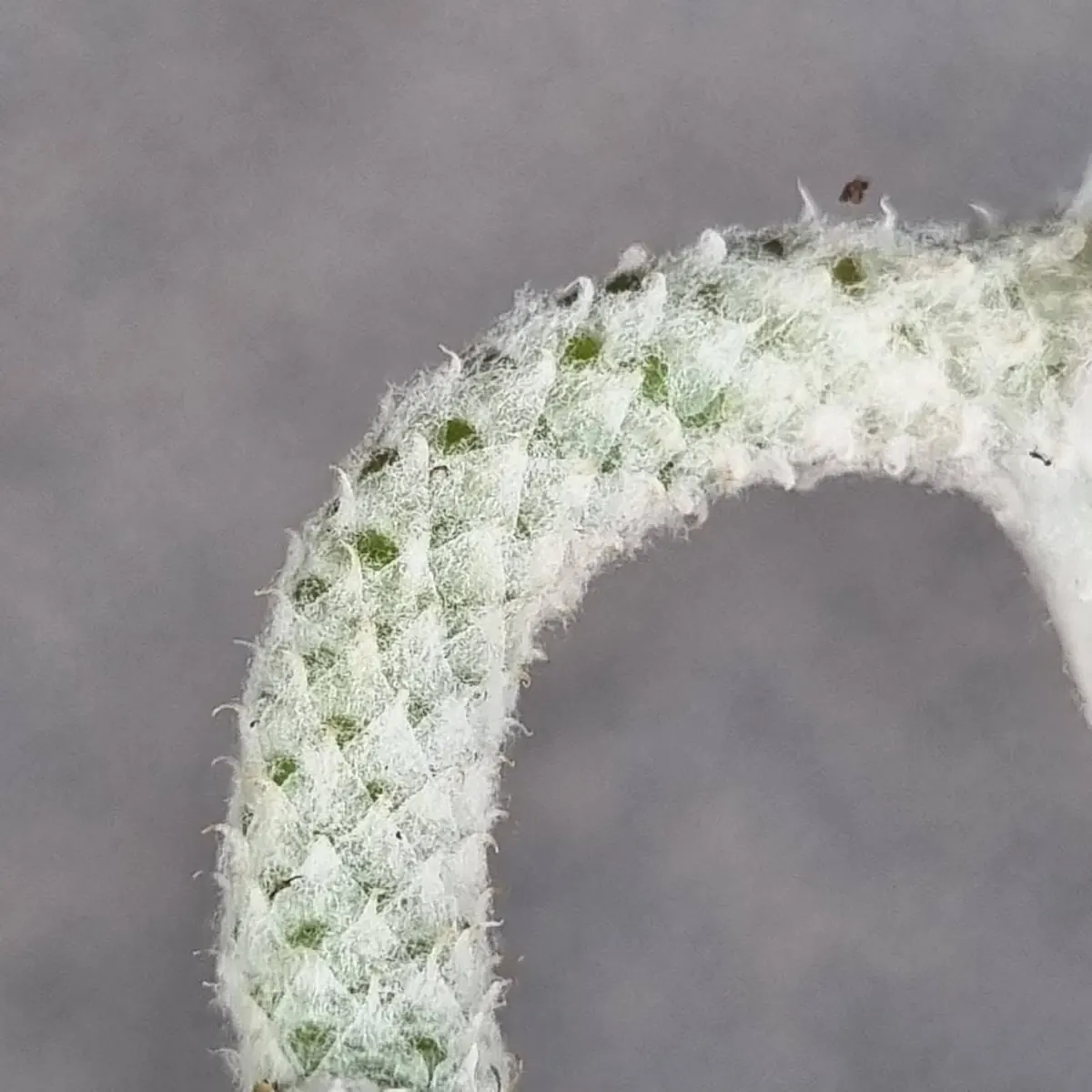
Avonia mallei carries slender arching branches sheathed along their whole length in white woolly scales, with the tiny leaves of the genus hidden beneath overlapping stipular scales. That is the sum of it, because no accessible source describes this plant. Williamson’s original description, in volume 67 of the Cactus and Succulent Journal for 1995, is the only certain account of the caudex, the branches, the stipules, the flower and the seed, and it has never been digitised. No secondary source reproduces it, and llifle, which covers six species of this genus, has no page for this species at all.
What can be said comes from the photographs and from the genus. The branch shown here is slender and arching, sheathed along its whole length in white woolly scales set close enough that only slips of green show between them. The plant at the top of the page carries a single pale yellow-green flower with yellow stamens, and its white scaled branches are marked with rusty brown dots. Those are observations of two specific plants in two specific frames, not a species description, and they should not be read as one.
At genus level one character holds by definition. Avonia was erected for the species whose leaves are tiny and hidden beneath imbricate stipular scales, against the larger naked leaves of Anacampseros proper, so that much applies here by virtue of the genus the species was described into. Beyond it, nothing. There is a description of this plant circulating that belongs to ‘Avonia ustulata v. mallei’, a name with no standing, and its subject could be this species, or A. ustulata, or unverified trade material.
Locality detail
Every occurrence record for Avonia mallei in the world comes from three preserved specimens at the Compton Herbarium, all gathered in the Northern Cape inland and east of Port Nolloth, within a few kilometres of each other. G.F. Williamson collected them in February and March 1994 under his numbers 5202, 5284 and 5302. The collector is the man who described the species a year later, so one of the three is very probably the type, but no source says which and none of the sheets carries a type status. Every occurrence record is filed under the Avonia name; none sits under the POWO-accepted Anacampseros combination.
The map shows a coarsened regional centroid. The herbarium sheets are georeferenced to six decimal places, a real locality for a plant with an extent of occurrence under 100 km² and three known collections in thirty years. The labels also name a hill that appears in no accessible gazetteer. Elevation is not recorded on any of the three sheets, and no figure has been published for the species.
Cultivation
Grow Avonia mallei in a sharply drained mineral mix, in bright but cool light, watered lightly through the northern winter and rested through the northern summer. Nobody has published cultivation notes for this species. The watering calendar below follows the habitat evidence for its coastal winter-rainfall locality; the substrate mineral fractions do not, because a pot is a different physical system from a hillside and the rock at any locality is not evidence about what grows best in a container. At rarecactus.com we grow our plants from seed and say plainly where a recommendation rests on habitat inference and where it rests on nothing published at all.
Substrate
Grow it in 30 per cent pumice, 20 per cent lava, 12 per cent zeolite, 20 per cent granite grit, 13 per cent silica grit and 5 per cent low-nutrient organic base, with no limestone at all. That is 95 per cent mineral to 5 per cent organic, the rot-class figure this genus runs on for an arid caudiciform succulent with no published recipe of its own. Limestone sits at zero, and that zero is an honest gap rather than a calcifuge finding: no source recommends lime for this species or its genus, but no source reports harm from lime either, so the plant does not meet this site’s test for calling anything a calcifuge. Zero is simply what no evidence looks like.
Granite, silica, lava and zeolite are house-formulation figures: none of them carries a species-specific cultivation finding, because no published source addresses this plant’s mineral needs at all. This page runs granite and silica as the coarse structural grit, zeolite for cation exchange without added water-holding mass, and lava for weight at the base of the pot. The proportions are a working convention for this genus’s rot class, not a reading of the rock the species happens to grow on.
Organic and limestone are the two components with cultivation evidence behind them, and both are held to the same values across all seven Avonia: organic at 5 per cent, set by the rot-class evidence for arid caudiciform succulents, and limestone at 0 per cent, because no cultivation source in the literature recommends lime for any Avonia. The remaining columns (pumice, lava, zeolite, granite, silica) are house-formulation figures that set drainage and particle size in the pot; they vary from page to page as a growing convention, not because any source ties a percentage to a species’ own rock.
| Species | Pumice | Lava | Zeolite | Granite | Limestone | Silica | Organic |
|---|---|---|---|---|---|---|---|
| A. quinaria | 41% | 8% | 10% | 8% | 0% | 28% | 5% |
| A. papyracea | 37% | 18% | 10% | 10% | 0% | 20% | 5% |
| A. albissima | 30% | 15% | 8% | 15% | 0% | 27% | 5% |
| A. herreana | 28% | 15% | 8% | 12% | 0% | 32% | 5% |
| A. ustulata | 50% | 15% | 15% | 10% | 0% | 5% | 5% |
| A. dinteri | 35% | 20% | 10% | 20% | 0% | 10% | 5% |
| A. mallei (this page) | 30% | 20% | 12% | 20% | 0% | 13% | 5% |
One published recommendation for this genus is worth setting aside. A widely-copied care sheet builds its draining mix on a lightweight white expanded aggregate, and Google’s own summary now repeats that to every searcher as 50 per cent or more of mineral grit. The intent is right and the material is not: that aggregate floats to the surface and washes out of the pot, and it is not used on this site. The mix above is 83 per cent coarse mineral before the zeolite is counted, so the intent is met and beaten.
Watering and light
The three known collections sit in the Namaqualand coastal belt, and that belt takes its rain in winter. A plant from a winter-rainfall desert grows in the southern winter, which in the northern hemisphere means growth from roughly October through April and a dry rest across the northern summer, near enough June to August. Water lightly and infrequently even in growth: the habitat gets around 72 mm a year and supplements it with fog, so ambient humidity over a dry root zone is closer to home than a heavy soak.
The incumbent advice says the opposite, and it is worth understanding why. The March-to-October growing season quoted for this species traces back to llifle’s page for A. ustulata, which is a Great Karoo plant from a summer-rainfall region. That advice is roughly right for A. ustulata. It reached this species through the trade name that welds the two together, and it inverts here. The same is not true across the genus: Avonia papyracea and several others really are summer growers, and the calendar has to be settled species by species rather than declared for Avonia as a whole.
Hold that inference at the strength it deserves. The locality is solid and the rainfall regime of that coast is solid, but no source states the calendar for this species, so it is a derivation and not a fact. It is also the inference that matters most: if it is right, then following the top search result waters the plant through its dormancy and starves it through its growth, and a caudex plant that is watered while dormant rots at the neck.
Light should be bright and unshaded but cool. The field label says full sun, and it says southwest aspect, and in that hemisphere those two together mean an open position on the cooler side of the slope at a site whose daily maximum averages around 19°C. Full sun in a cool maritime desert is not full sun under northern glass. Keep the plant above roughly 5°C and dry at the root; no source gives a frost figure for this species and the maritime habitat does not support the genus-level frost claims, so treat them as unverified. Note also that the winter-growth inference makes the usual cold, dry winter rest actively wrong here, because this is when the plant should be growing.
Seed is the only realistic route to this plant and there is no seed to be had. The one propagation figure published for the genus puts germination at ten to fifteen days between 15 and 21°C, which is cooler than the usual cactus window and sits comfortably with the cool winter-rainfall habitat derived above. Sow at the start of the growing season, which on this calendar means northern autumn rather than spring. Whether that transfers to this species is untested; the figure comes from a commercial catalogue covering Avonia generally, and no species-specific figure has been published.
Comparison
Avonia mallei parts from Avonia ustulata on range, rock, rainfall and conservation status, and on no published morphological character at all. That is the comparison that matters, and not because the two look alike. Nobody can say whether they look alike, because there is no accessible description of A. mallei to compare. They matter to each other because the market has already merged them: material circulates as ‘Avonia ustulata v. mallei’, and that name has never been published at any rank.
Everything that can be checked separates them cleanly. This is a Northern Cape endemic with an extent of occurrence under 100 km² and three collections on record; A. ustulata ranges across the Eastern Cape, the Free State and the Western Cape. SANBI holds this one at Rare and A. ustulata at Least Concern. This one grows on pegmatite and quartz in red, iron-stained soil; A. ustulata grows on grey and yellowish Karoo shales, which it mimics. This one takes winter rain; A. ustulata takes summer rain. The nomenclature runs opposite ways too, since the Avonia name is the original here and the transfer there.
Note what that list does not contain: a single morphological character. Six differences of range, rock, rainfall, status and nomenclature, and not one of them helps you with an unlabelled plant in a pot. Without provenance data these two cannot reliably be told apart, and anyone buying or selling under the trade name is working with the same gap.
Against the rest of the genus the contrast is about outcomes rather than looks. Avonia albissima is the widest-ranging of these species and sits at Least Concern; this one is held at Rare on range restriction alone, with a stable population and no recorded threats. Both of those are ordinary conservation outcomes. The scarcity here is a market fact and not a conservation one: zero botanic gardens hold it, zero nurseries list it, zero vendors sell its seed, and the entire scientific record is three sheets in one herbarium. Those are the numbers, and they are the whole of the claim.
Frequently asked questions
How do you grow Avonia mallei?
In a sharply drained mineral mix, in bright but cool light, watered lightly through the northern winter rather than the summer. The mix is 30 per cent pumice, 20 per cent lava, 12 per cent zeolite, 20 per cent granite grit, 13 per cent silica grit and 5 per cent organic, with no limestone. Every one of those figures is derived from the plant’s habitat, because no source publishes cultivation notes for this species.
When is Avonia mallei dormant?
Through the northern summer, with growth running roughly October to April. That inverts the March-to-October calendar quoted almost everywhere. The reasoning is that all three known collections sit in the Namaqualand coastal belt, which is a winter-rainfall desert, and a winter-rainfall plant grows in the southern winter. No source states this for the species, so it is a derivation rather than a fact, and it does not generalise to the rest of the genus.
How do you propagate Avonia mallei?
From seed, in theory. In practice there is no seed to buy: vendors who stock A. quinaria, A. albissima and A. papyracea seed carry nothing for this species, and no nursery lists the plant. The only germination figures published for the genus are ten to fifteen days at 15 to 21°C, which is cooler than the usual cactus window. Sow at the start of the growing season, which on this species’s calendar means northern autumn.
How often should you water Avonia mallei?
Lightly and rarely, even when it is growing. The habitat takes roughly 72 mm of rain a year and tops it up with coastal fog, so ambient humidity over a dry root zone is nearer to home than a heavy soak. The plant carries a caudex and the neck is where a caudex rots, so drainage at the surface matters more than volume. Water on the wrong half of the year and the caudex is what you lose.
Where can you buy Avonia mallei?
Nowhere, as far as the record shows. No botanic garden in the world reports holding it, no nursery lists the plant, no vendor sells the seed, and the whole scientific record is three herbarium sheets collected by one botanist in 1994. The species is CITES Appendix II through the genus listing, so nursery-propagated material would be legal to own and trade with the right paperwork. There simply is not any. Anything offered as ‘ustulata v. mallei’ is trading under a name that was never published, and its identity is unverified.
Sources & further reading
Williamson, G. 1995. Avonia mallei. Cactus and Succulent Journal (Los Angeles) 67(2): 104–107 (protologue) · Williamson, G. 1997. Anacampseros mallei (G.Will.) G.Will. Aloe 34(1–2): 45 · Rowley, G.D. 1994. Avonia G.D.Rowley. Bradleya 12(prepr.): 111–112 · IPNI, International Plant Names Index, urn:lsid:ipni.org:names:982400-1 (Avonia mallei, tax. nov.) and 997083-1 (Anacampseros mallei, comb. nov.) · Kew POWO, Anacampseros mallei (G.Will.) G.Will., powo.science.kew.org · GBIF Secretariat, GBIF Backbone Taxonomy, Avonia mallei key 5646652 (accepted) and Occurrence API, taxonKey 5646652 (3 preserved specimens, Compton Herbarium NBG, Williamson 5202 / 5284 / 5302, 1994) · SANBI, Red List of South African Plants, Anacampseros mallei, species 3974-4008 (Rare; Williamson & Potter, 2005; EOO under 100 km²; population stable) · BGCI PlantSearch, Anacampseros mallei (zero ex-situ holdings worldwide) · ITIS, Integrated Taxonomic Information System, TSN 847633 (Avonia mallei accepted; CITES Appendix II) · CITES Appendices, Anacampseros spp. (Appendix II, in force 01/07/1975; annotation includes Avonia spp.; annotation #4 from CoP15, 23/06/2010) · Nyffeler, R. & Eggli, U. 2010. Disintegrating Portulacaceae. Taxon 59(1) (Anacampserotaceae) · Henry Shaw Cactus & Succulent Society, Avonia (2009) (genus-level cultivation) · llifle, Encyclopedia of Living Forms, Avonia ustulata