
Mammillaria pectinifera
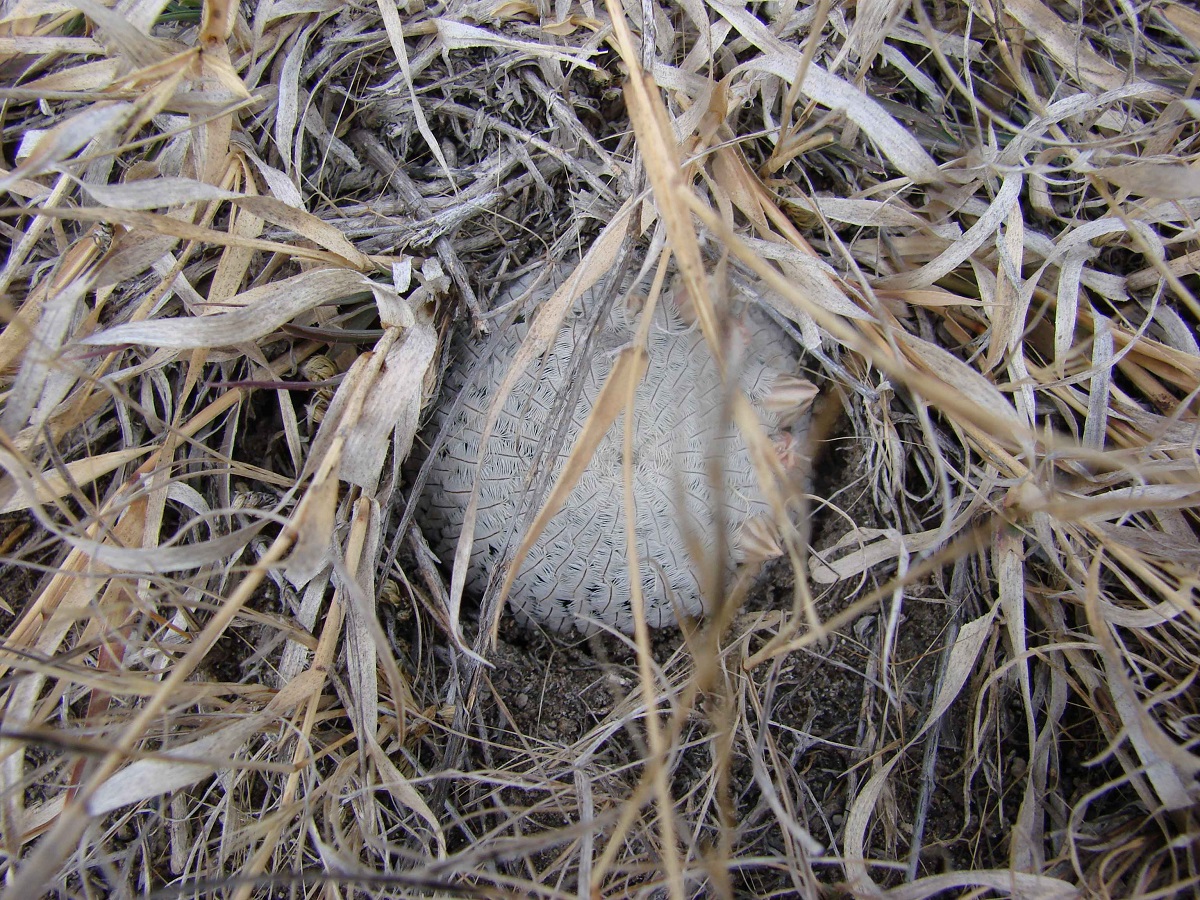
Mammillaria pectinifera is a Tehuacán-Cuicatlán Valley endemic from central Mexico, confined to roughly eighteen fragmented subpopulations on calcareous slopes in Puebla with a handful of outlying Oaxaca records. The body is a flat-globose miniature of 2 to 3 cm that sits almost flush with the substrate. Twenty to forty pectinate white radial spines, 1.5 to 2 mm long, lie flat against the short rounded tubercles in a comb-like pattern, with no central spines at any age. This is the only Mexican Mammillaria with strictly pectinate spination, and collectors have tracked that single character for more than a century.
The taxonomic history runs through a different genus first. Stein described the plant as Pelecyphora pectinata in Gartenflora 34: 25 (1885); F.A.C. Weber transferred it to Mammillaria in Bois, Dictionnaire d’Horticulture 2: 804 (1898). Britton and Rose later segregated it again into monotypic Solisia pectinata (1923), and that name still circulates in older seed catalogues and European nursery lists. Kew POWO keeps the Weber combination as the accepted name; Solisia pectinata, Neomammillaria pectinata, and Pelecyphora pectinata are the synonyms.
The species shares its valley with Mammillaria napina, and the two overlap on substrate and climate without competing on growth form. M. napina retreats underground on a tuberous taproot during dormancy, while M. pectinifera relies on a flat-to-the-soil body and its dense comb of spines for the same protection. The 2013 IUCN assessment recorded continuing decline across the eighteen known subpopulations, driven chiefly by habitat fragmentation from land-use change, livestock grazing, limestone extraction for construction, and persistent illegal collection for the specialist cactus trade. Landscape genetics work by Contreras-Negrete and colleagues documents the inbreeding signature and genetic bottlenecks that follow from a breeding population split across eighteen fragments with a mean population growth rate of 0.743.
Mammillaria pectinifera sits on CITES Appendix I, one of roughly thirty cactus taxa on the stricter appendix, so wild-collected material cannot legally cross an international border under any commercial or hobbyist permit. Artificially propagated nursery stock is the only defensible route into a serious collection.
Mammillaria pectinifera quick reference
A Tehuacán-Cuicatlán Valley miniature with a flat-globose body pressed almost flush to the substrate, twenty to forty pectinate white radial spines, and short-lived diurnal pink-to-white flowers with darker midstripes. Values calibrated for seed grown plants in cultivation, drawn from the 2013 IUCN habitat description and specialist grower consensus.
Taxonomy & nomenclature
Stein described this plant as Pelecyphora pectinata in Gartenflora 34: 25 (1885), referring to the flat comb-like spine rows that run along each tubercle. F.A.C. Weber transferred the species to Mammillaria in Bois’s Dictionnaire d’Horticulture 2: 804 (1898); that Weber combination is the one Kew POWO accepts today. Britton and Rose (1923) pulled it out again into monotypic Solisia pectinata, a segregate genus still cited on European seed lists despite being sunk back into Mammillaria by Hunt and by Anderson. Fosberg’s Neomammillaria pectinata (1931) is the third synonym still in circulation.
Within Mammillaria the species sits near the Lasiacanthae section, grouped with other white-spined miniatures such as Mammillaria albilanata and M. solisioides, the latter now treated by Hunt as M. pectinifera subsp. solisioides in some modern references. The historical confusion with Pelecyphora aselliformis runs through every nineteenth-century European collection note, and the two species are still mislabelled in amateur collections; the distinguishing characters sit in the habit and tubercle shape rather than in the spination. Seed-list provenance markers for wild-origin material are now limited to old collections predating CITES Appendix I enforcement; current nursery stock descends from ex-situ programmes and the long-established European seed banks.
Historical synonyms (5)
- Solisia pectinata (Stein) Britton & Rose, 1923 basionym
- Lactomamillaria aselliformoides Frič, 1924 heterotypic synonym
- Neomammillaria pectinata (Stein) Fosberg, 1931 heterotypic synonym
- Pelecyphora aselliformis var. pectinata Hort, heterotypic synonym
- Pelecyphora pectinata K.Schum., heterotypic synonym
Sources: GBIF
Habitat
Endemic to the Tehuacán-Cuicatlán Valley in central Mexico, a semi-arid intermontane basin straddling the Puebla-Oaxaca border. Core subpopulations cluster around Petlalzingo, Salitrillo, and Texcala in Puebla, with a handful of outlying records on the Oaxaca side near Huajuapan de León. Published elevation figures span 1,300 to 2,300 m across the fragmented range; the older Petlalzingo cluster sits at roughly 1,300 to 1,400 m, while Valiente-Banuet field work on later-found sites records the full spread up to 2,300 m.
Vegetation is xerophytic scrub on Cretaceous limestone and calcareous Regosols, dominated by Cephalocereus columna-trajani, Neobuxbaumia tetetzo, and Beaucarnea gracilis, with Mammillaria pectinifera pressed almost flush to the soil surface between grass clumps and limestone cobble. The same valley shelters M. napina on the equivalent calcareous substrate, and the two species turn up in the same field inventories despite occupying different vertical niches: M. napina disappearing below ground during dormancy, M. pectinifera staying at the surface and relying on spine cover for protection. Climate is summer-rain-dominated with a pronounced cool dry winter, and the calcareous slope drainage is what keeps the species out of prolonged standing moisture.
Morphology
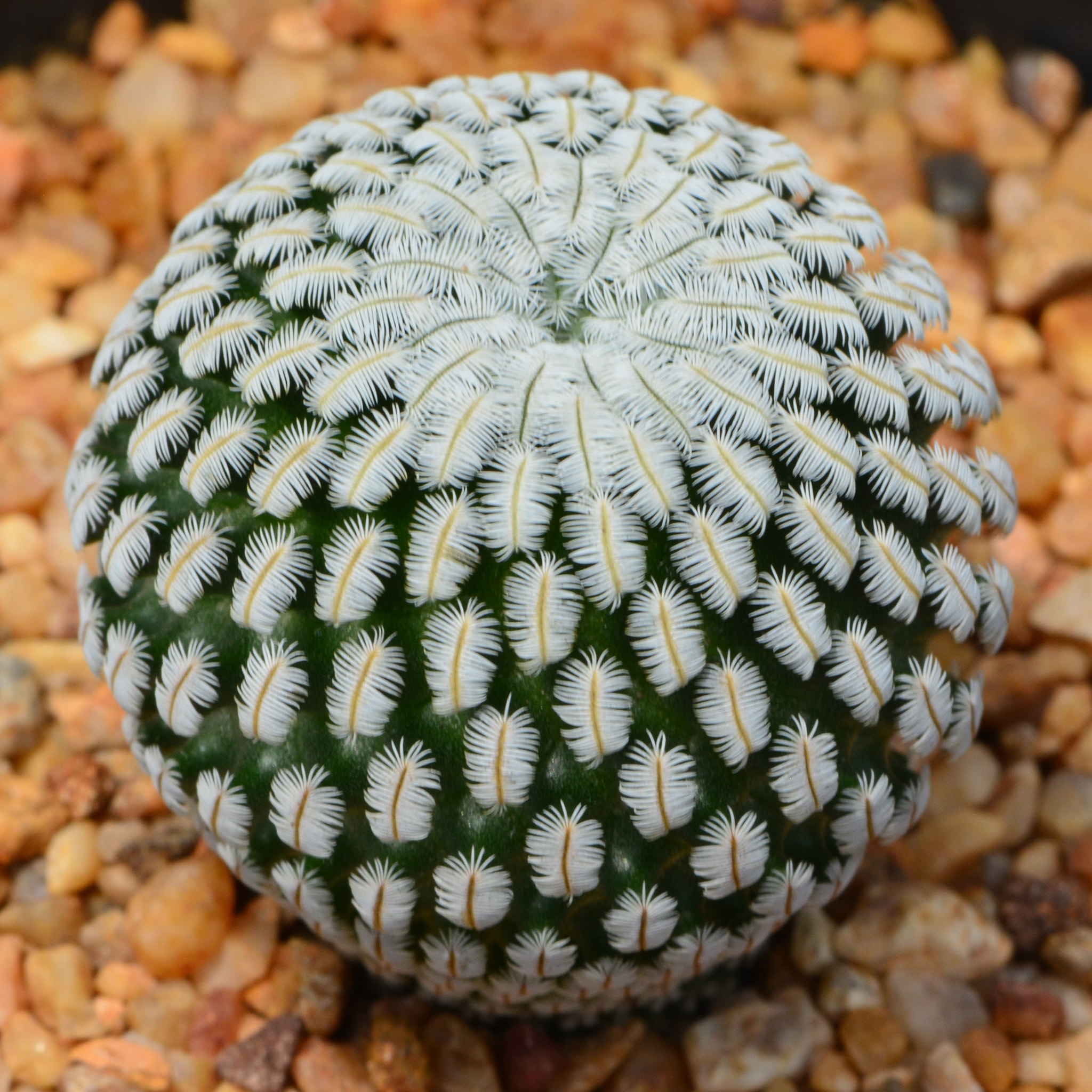
Stems are solitary, flat-globose to shortly depressed-globose, 2 to 3 cm in diameter and 2 to 4 cm tall, with the apex sitting barely above the soil line in habitat. Tubercles are short, rounded, and densely packed, with the axils naked or nearly so. No latex. Cultivation specimens stretch slightly taller than habitat plants but keep the solitary flat-globose habit.
Spination is diagnostic. Twenty to forty pectinate radial spines, bristle-fine, white, 1.5 to 2 mm long, lie flat against each tubercle in a comb-like pattern that is unique in the Mexican Mammillaria flora. No central spines develop at any life stage, and that character alone separates the species from the otherwise similar Mammillaria herrerae, whose 100-plus interlacing bristles cover the body in a three-dimensional cage rather than pressing flat to the tubercle.
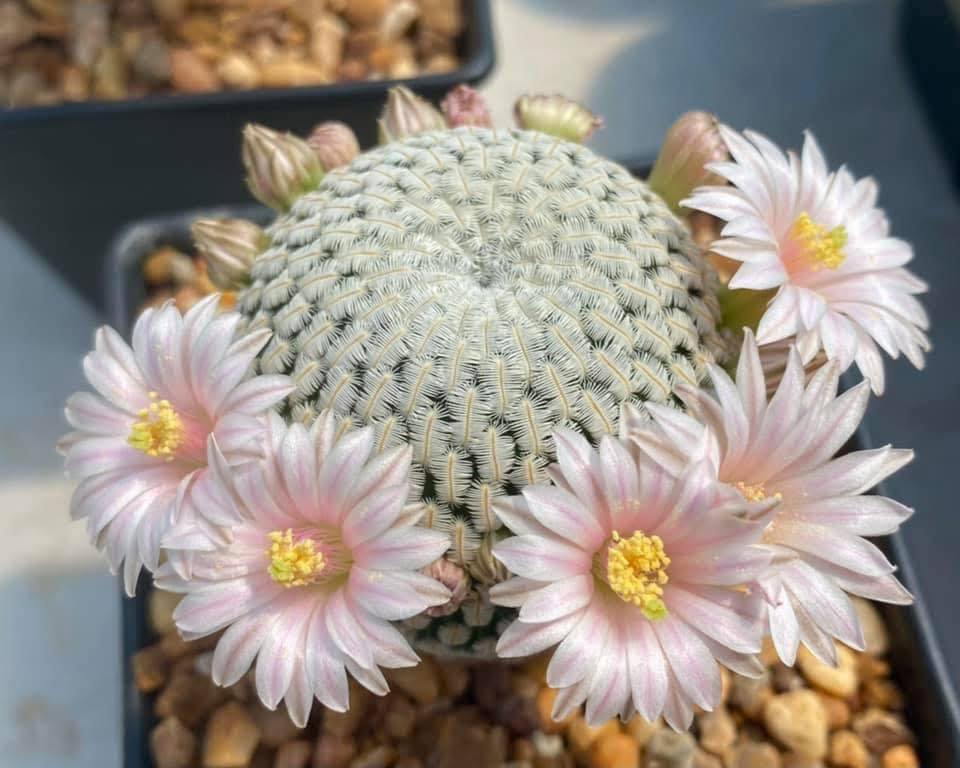
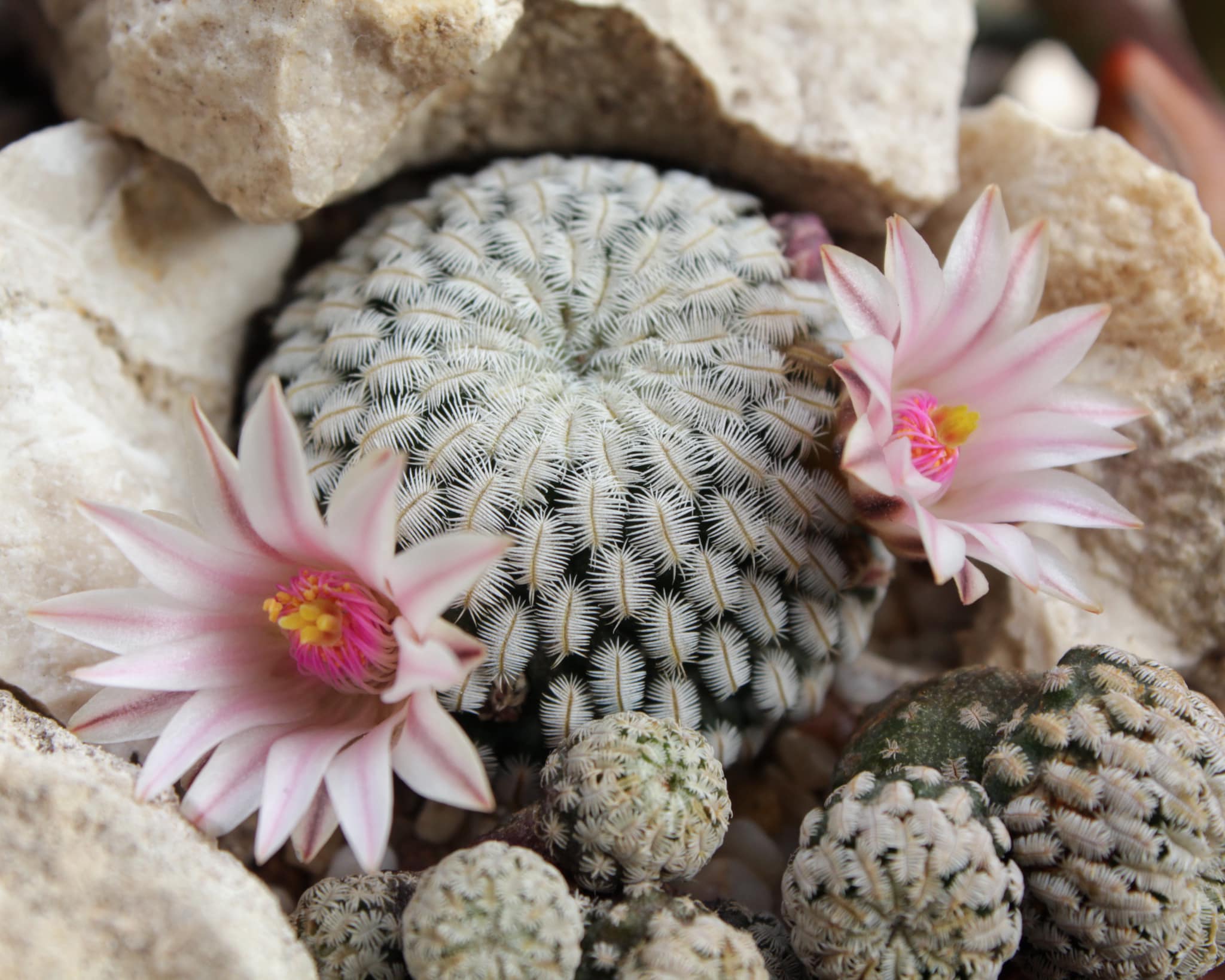
Flowers open on the crown in April and May, pale pink to near white, 20 to 30 mm long and wide, each outer tepal carrying a darker red-pink midstripe. Anthesis is diurnal and lasts about four hours per day; each flower opens for a single day, and the floral structure is herkogamous with the stigma held distinctly above the anthers. Ceratina bees are the dominant pollinators in published field observations. Fruits are small club-shaped greenish-pink berries carrying blackish-brown seeds; published germination rates sit at roughly 23 per cent on fresh seed under sterile mineral sowing.
Locality detail
The map below shows the Tehuacán-Cuicatlán Valley subpopulation clusters. Exact coordinates for individual Mammillaria pectinifera sites are not published to the pin: the CITES Appendix I listing and documented poaching history make precise location data a conservation liability. The markers below use published regional centroids keyed to named municipios and to the type-locality neighbourhood around Petlalzingo.
Mammillaria pectinifera care and cultivation
Mammillaria pectinifera is the hardest cultivation problem in the genus alongside M. herrerae, and it kills more beginner collectors than any other species on this encyclopedia. The difficulty is not light or heat; it is the disproportionately large tap root feeding a flat-globose body that sits almost flush with the substrate. Any water held at the root neck under cool conditions rots the transition in a matter of days. The cultivation programme below is keyed to the 2013 IUCN habitat description and to grower consensus published in the British Cactus and Succulent Journal and in European specialist literature.
Substrate
Mineral-dominant and sharply draining. The canonical ratio is 40 per cent pumice, 15 per cent lava rock, 5 per cent zeolite, 25 per cent granite grit, 10 per cent limestone chip, and 5 per cent low-nutrient cactus compost. The limestone chip follows a named grower’s cultivation recommendation, not a reading of the Tehuacán-Cuicatlán limestone the species shares with its neighbours; skipping it does no harm in cultivation but removes one source of trace alkalinity that specialist European growers report correlates with better spine density. The zeolite buffers pH and paces nutrients through summer watering. Use a deep container relative to its diameter so the tap root has somewhere to go; shallow pans stall the plant within two seasons.
All ten Mammillaria species on this site share the same declared house-formulation blend for pumice, lava, zeolite and granite; no published source gives species-specific figures for those four. Organic sits at a flat 5 per cent across the genus, the floor of the rot-risk band and not a per-species finding. Limestone is the one component with any cultivation basis, and only a few species carry it, on a named grower’s practice rather than on habitat rock.
| Species | Pumice | Lava | Zeolite | Granite | Limestone | Silica | Organic |
|---|---|---|---|---|---|---|---|
| M. herrerae | 40% | 15% | 5% | 25% | 10% | 0% | 5% |
| M. napina | 35% | 15% | 5% | 30% | 10% | 0% | 5% |
| M. pectinifera (this page) | 40% | 15% | 5% | 25% | 10% | 0% | 5% |
| M. duwei | 40% | 15% | 5% | 20% | 5% | 0% | 15% |
| M. schwarzii | 45% | 20% | 10% | 15% | 0% | 0% | 10% |
| M. bertholdii | 40% | 15% | 5% | 30% | 0% | 0% | 10% |
| M. luethyi | 45% | 15% | 5% | 25% | 0% | 0% | 10% |
| M. huitzilopochtli | 45% | 15% | 5% | 20% | 5% | 0% | 10% |
| M. crucigera | 30% | 20% | 10% | 25% | 10% | 0% | 5% |
| M. herrerae f. albiflora | 40% | 10% | 5% | 20% | 15% | 5% | 5% |
Watering and light
Water lightly from March through September, allowing the substrate to dry out completely between applications. Bottom watering is safer than overhead on a plant that sits this close to the soil surface; overhead misting in summer is fine if the plant can dry fully before night temperatures drop. From mid-October through February the plant stays bone dry, with at most a light overhead mist in the coldest weeks to discourage spider mite. Full sun with strong ventilation, acclimated from spring through summer; juveniles colour slightly reddish under adequate sun and need that exposure to build mature spine density.
Propagation in serious collections is from seed. Fresh seed germinates at roughly 23 per cent under sterile mineral sowing at 21 to 27 °C, and seedlings spend their first two to three years in a community tray before potting on. Expect eight to twelve years from sowing to first flowering at roughly 2 cm body diameter, and upward of fifteen years to a mature show-scale body. Grafting onto Pereskiopsis or Hylocereus is standard for conservation propagation programmes that need to bulk up seed-bank genetics quickly, and there is no objection to grafted material used that way. For a serious collection, seed grown is the target; grafted retail stock never settles into the flat-globose habit that defines the species.
Comparison
The classic confusion is with Pelecyphora aselliformis, which shares the pectinate comb-like spine arrangement that gave Mammillaria pectinifera its Stein basionym (Pelecyphora pectinata). The two species are not closely related in modern phylogeny, and the separation reads from the habit: P. aselliformis clusters into mounds of short-cylindrical stems with elongated, laterally flattened tubercles, while M. pectinifera stays solitary, flat-globose, and flush to the soil. Tubercle shape confirms: laterally flattened hatchet-like in P. aselliformis, short and rounded in M. pectinifera.
Within the genus, the nearest visual analogue is Mammillaria crucigera, another small calcareous endemic of the Puebla-Oaxaca border that sits at similar elevation on similar limestone. M. crucigera carries a distinctive cross-shaped areole spine arrangement rather than pectinate radials, so side-by-side the two separate immediately on spine pattern. M. herrerae is the other structural comparison: both species stay solitary and small, both are white-spined, but herrerae wraps its body in interlacing bristle spines that cage the stem in three dimensions while pectinifera keeps its radials strictly flat.
Conservation profile is the last comparison, and it is the one that matters for a collector deciding where their time goes. M. pectinifera is on CITES Appendix I, with a fragmented eighteen-subpopulation structure and an active landscape-genetics paper trail showing inbreeding signatures. Mammillaria schwarzii, at the opposite end of the same Mexican single-location endemic axis, sits on a single Querétaro population and on CITES Appendix II, and the lower appendix reflects how the species slipped through early listings rather than any lower extinction risk. Collection politics around a species change the moment it moves between appendices.
Frequently asked questions
How do you tell Mammillaria pectinifera apart from Pelecyphora aselliformis?
Both species carry the pectinate comb-like spines that gave Mammillaria pectinifera its Stein basionym, and nineteenth-century collections mixed them up routinely. Modern phylogeny places them in different genera; six characters separate them cleanly, and habit alone is the fastest tell.


Habit is the fastest field character. A clump of short-cylindrical stems on elongated flattened tubercles is P. aselliformis. A solitary flat-globose miniature with short rounded tubercles, pressed almost flush to the soil, is M. pectinifera.
Is Mammillaria pectinifera hard to grow?
Advanced. The plant is not fussy about light, heat, or substrate recipe as long as the mix is mineral-dominant, but the oversized tap root feeding a body pressed flush to the soil makes it exceptionally rot-prone at the root neck. Growers who can enforce a completely dry October-through-February dormancy and who use a deep porous container usually succeed. Growers who cannot should graft a backup onto Pereskiopsis for insurance and keep the seed grown specimen separate.
Can Mammillaria pectinifera be grown from seed?
Yes, and seed is the target for serious collections. Fresh seed germinates at roughly 23 per cent under sterile mineral sowing at 21 to 27 °C, which is lower than most Mammillaria, so sow densely. Seedlings spend their first two to three years in a community tray before potting on, and the first flowering crown appears at roughly 2 cm diameter after eight to twelve years. That timeline is the reason commercial stock is so often grafted.
Is Mammillaria pectinifera legal to own?
Yes, from artificially propagated nursery stock. The species is on CITES Appendix I, one of roughly thirty cactus taxa on the stricter appendix, which makes wild-collected material illegal to trade internationally under any commercial or hobbyist permit. Artificially propagated plants on CITES certificates move across borders the same way other cacti do. Buy only from nurseries that can produce the paperwork.
Where does Mammillaria pectinifera grow in the wild?
On calcareous limestone slopes in the Tehuacán-Cuicatlán Valley of central Mexico, chiefly in Puebla with a small number of outlying Oaxaca records. Core subpopulations sit around Petlalzingo, Salitrillo, and Texcala. Published elevation data span 1,300 to 2,300 m across the fragmented range, with the long-known Petlalzingo cluster at the lower end and more recent field records at the upper end. The 2013 IUCN assessment recognises eighteen subpopulations.
When does Mammillaria pectinifera flower?
April and May. Flowers are pale pink to near white with a darker red-pink midstripe on each outer tepal, 20 to 30 mm long and wide, with a diurnal anthesis of roughly four hours per day; each flower opens for a single day. Published pollination work has Ceratina bees as the dominant flower visitors and records a herkogamous floral structure with the stigma held distinctly above the anthers.
Sources & further reading
Stein, Gartenflora 34: 25 (1885), basionym Pelecyphora pectinata · F.A.C. Weber in Bois, Dict. Hort. 2: 804 (1898) · Kew POWO, Mammillaria pectinifera F.A.C.Weber (accessed 2026) · IUCN Red List 2013 assessment for Mammillaria pectinifera · Valiente-Banuet et al., ecological status of M. pectinifera, Tehuacán-Cuicatlán (2009) · Contreras-Negrete et al., landscape genetics of M. pectinifera, Perspectives in Plant Ecology (2018) · Solano, Flores-Olvera et al., floral morphometry and pollination of M. pectinifera · Hernández & Gómez-Hinostrosa, Mapping the Cacti of Mexico (2015) · Anderson, The Cactus Family (2001) · Hunt, The New Cactus Lexicon (2013) · CITES Appendix I listing, Checklist of Cactaceae · llifle.com and cactus-art.biz grower notes