
Mammillaria luethyi
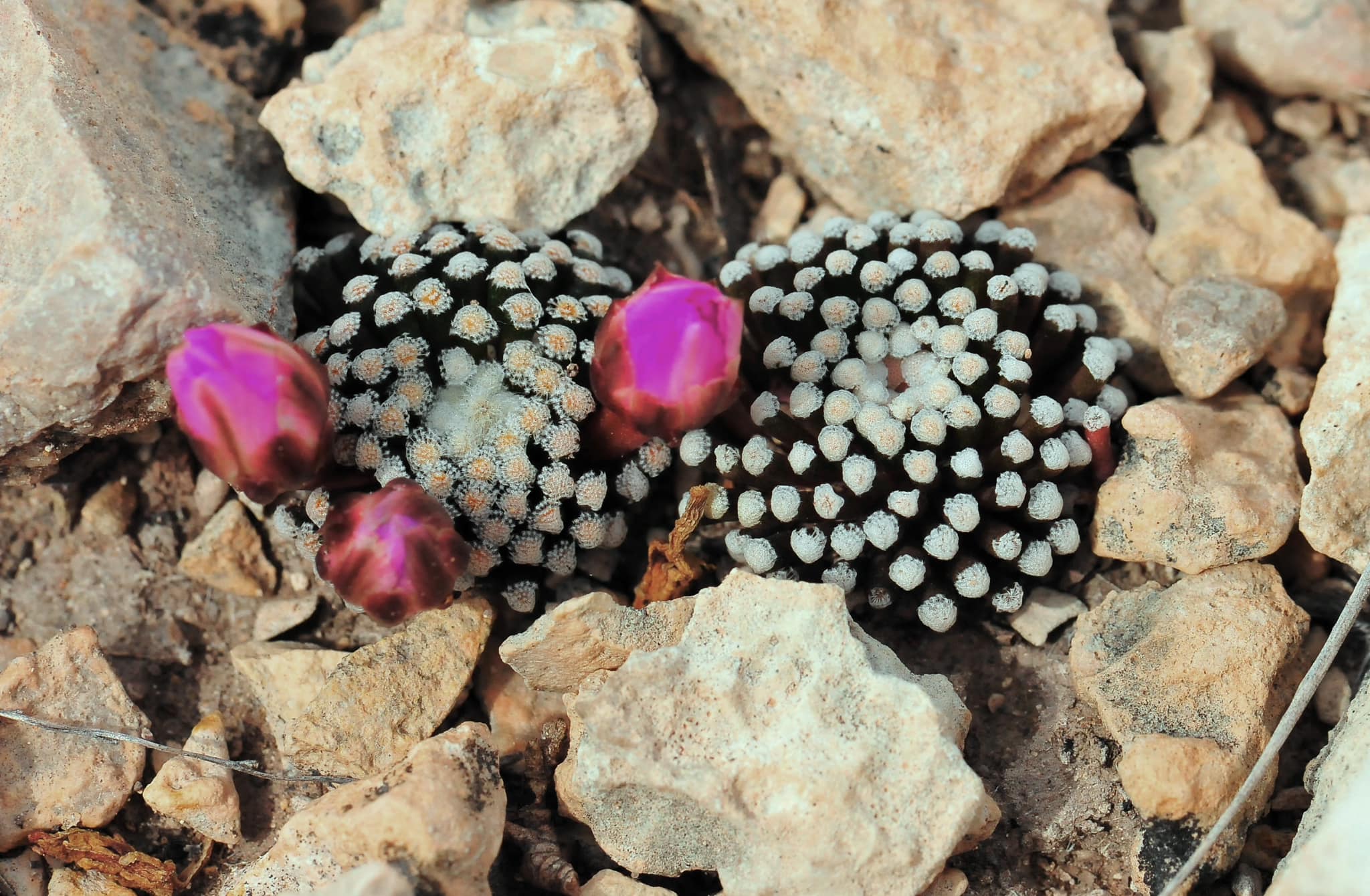
A Coahuila miniature that sat unnamed in the literature for forty-four years between its first photograph and its formal description. The plant sits almost entirely below the surface of horizontal limestone slabs in the northern Chihuahuan Desert, pushing only a shallow crown of stark white spines through a thin skin of sandy clay. Each areole carries up to eighty of those spines, and the diagnostic character waits at the tip. Every spine branches repeatedly into a minute parasol, a morphology not recorded in any other member of Cactaceae.
Norman Boke photographed blooming plants in a coffee tin at the Crosby Hotel in Ciudad Acuña in 1952. Ladislaus Cutak documented the specimens at Missouri Botanical Garden, the plants died without setting identifiable seed, and the species vanished from the literature while Backeberg tried to place the photographs in Neogomesia and Buxbaum shifted them to Normanbokea. Jonas M. Lüthy pinpointed the probable locality on a topographic map in late 1995. George S. Hinton followed the coordinates the following spring and described the plant that autumn in Phytologia 80, placing it in series Herrerae alongside the single-population Querétaro endemic Mammillaria herrerae.
Two further populations have come to light since 1996, one of them numbering several thousand individuals, which softened the initial fewer-than-200 reading into the assessment summarised below. The rediscovery narrative sits alongside similar recent-description stories in the genus, most clearly Mammillaria bertholdii, described in 2016 from a single Oaxaca locality on comparably restricted limestone ground.
Mammillaria luethyi quick reference
A Coahuilan miniature from horizontal limestone slabs, with umbrella-branched spine tips and magenta flowers larger than the stem itself. Values calibrated for seed grown plants in cultivation, drawn from habitat data and specialist grower experience.
Taxonomy & nomenclature
The protologue sits in Phytologia 80 from 1996, where George S. Hinton described the species from material collected in northern Coahuila earlier that year. The specific epithet honours Jonas M. Lüthy, the Swiss botanist who pinpointed the probable locality on a topographic map in late 1995 after four decades of the plant being absent from the literature. Photographs circulated from the 1952 Ciudad Acuña encounter had misled Curt Backeberg into a tentative Neogomesia placement and Franz Buxbaum into Normanbokea before Glass and Foster correctly argued Mammillaria affinity in 1978 on vegetative grounds.
Modern treatment places the species in series Herrerae, the small-bodied white-spined Mexican clade that also contains Mammillaria sanchez-mejoradae, Mammillaria albiflora and Mammillaria humboldtii. Guiggi proposed a monotypic genus Cryptocarpocactus in 2024 built on the cryptocarpic fruit character, but Kew POWO has not adopted that combination and the Hinton name remains accepted.
Habitat
The known populations sit on horizontal limestone slabs in the Sierra de la Paila of northern Coahuila at roughly 800 metres. The plant occupies a shallow layer of sandy clay and fine gravel, one and a half to two centimetres deep, that has accumulated in natural depressions on the exposed bedrock. Most of the stem and the entire fleshy taproot sit below that surface. In the driest part of the year the plant contracts further and can vanish underground, leaving only the spine crown flush with the substrate.
Associated microhabitat species include Selaginella wrightii, Neolloydia conoidea, Bouteloua gracilis and scattered lichens on the rock surface. The surrounding Chihuahuan flora is typical for the latitude and elevation: Agave lechuguilla, Dasylirion species, Fouquieria splendens, Yucca elata, and the hooked-spined Glandulicactus uncinatus. Annual rainfall falls in the 200 to 350 millimetre band with a clear summer-monsoon peak; winters are cool and essentially dry. Documented plant density on the slab ranges from one to three individuals per square metre where the species occurs at all.
Morphology
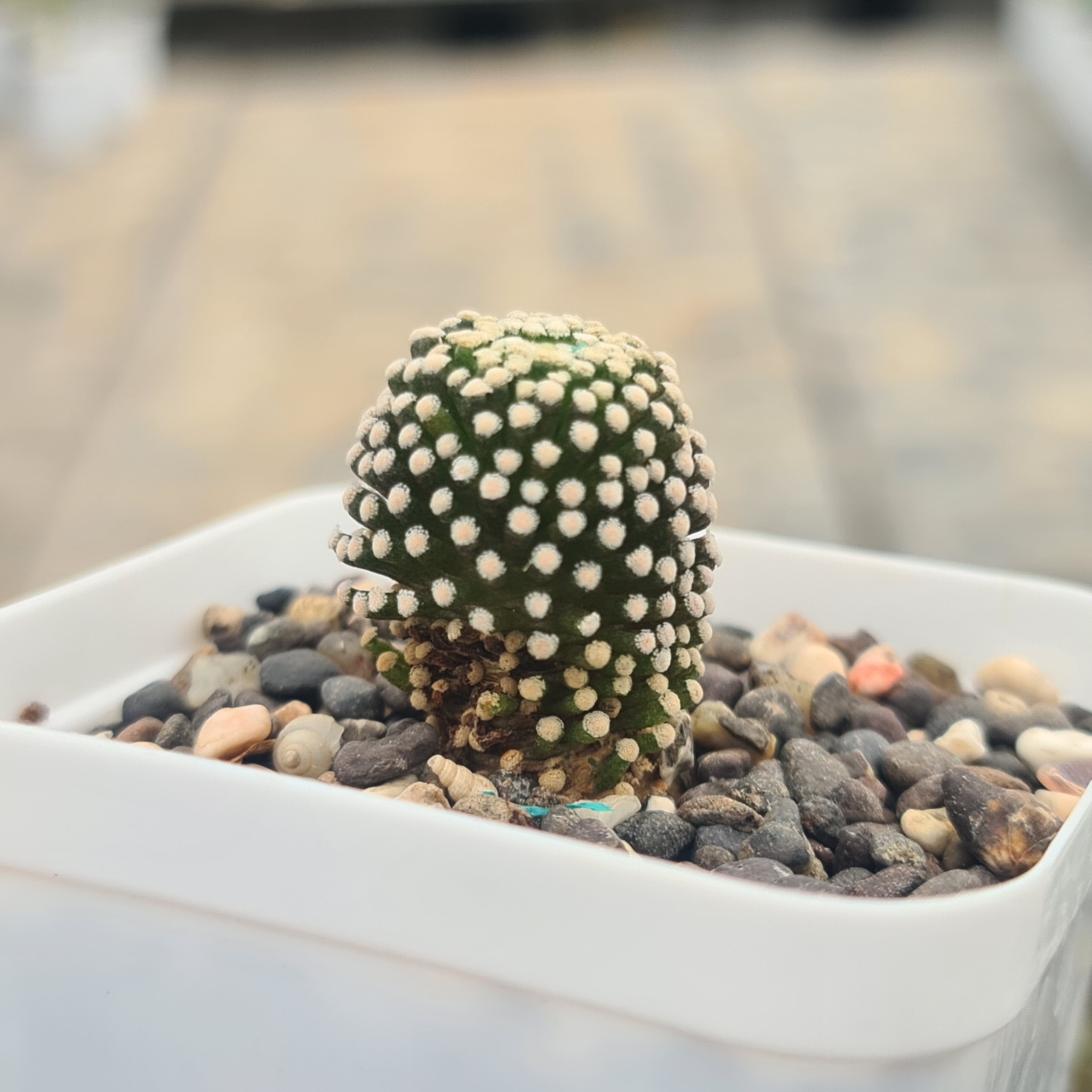
In habitat the body is a flattened sub-globose head about one and a half centimetres across, solitary to clustering into small groups of up to seven heads. The epidermis is very dark green and can read almost black under strong light. Tubercles are slender and cylindrical, up to five and a half millimetres long, with lightly bristly axils and a reddish or whitish tubercle base.
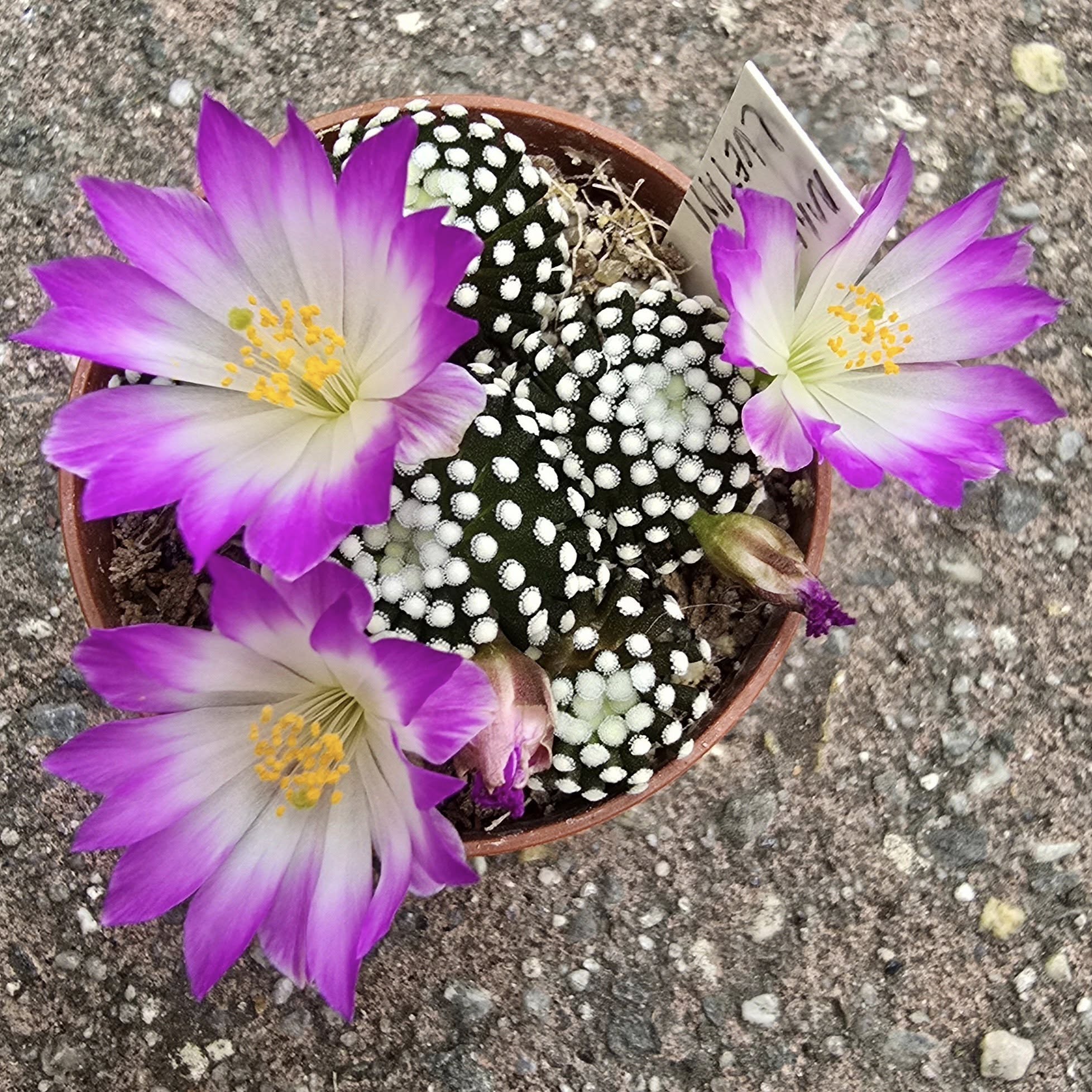
Each areole carries up to eighty radial spines and no central spines. The spines themselves are short (0.4 to 0.6 millimetres), soft, and white, arranged in dense flattened clusters under two millimetres across. Every spine tip branches repeatedly to form a minute umbrella or parasol that covers the plant apex in a woolly white layer when viewed from above, a character unique in the family. Flowers emerge laterally from older tubercles rather than from the apex. The corolla opens to a full three centimetres across, rich magenta with a white throat, yellow to orange anthers, and a greenish stigma, and individual flushes continue through the summer.
Fruit biology sits at the other end of the reproductive strategy spectrum from most of the genus. The small, green to reddish fruits are cryptocarpic: they ripen and stay inside the stem body rather than exserting. Seeds are black and about a millimetre across; they contain strong germination inhibitors and can remain viable inside the living plant for five to eight years, released only when a stem senesces or is damaged.
Locality detail
Three populations are currently recognised within a small area of the Sierra de la Paila in northern Coahuila at around 800 metres. Exact coordinates are withheld from the published literature because the species would be stripped from known slabs by collectors within months of disclosure. The map point below shows the range centroid rather than any specific slab and is accurate only to within a few kilometres.
Mammillaria luethyi care and cultivation
The species behaves in cultivation the way its habitat predicts: mineral-lean substrate, fast drainage, plenty of light, and a bone-dry winter. Crown and root-neck rot under cold wet conditions are the main failure modes reported across growers. Most plants in collections are grafted; seed grown material is scarce because the cryptocarpic fruit only gives up its seed when the mother stem is damaged, and the seed itself carries strong inhibitors that delay germination by years.
Substrate
Mix a pumice-dominant mineral substrate: 50 per cent pumice, 15 per cent lava rock, 5 per cent zeolite, 25 per cent granite grit, no limestone chip, and 5 per cent worm castings. The zeolite carries cation exchange and slow nutrient pacing between waterings. The lava fraction is the drainage aggregate that keeps the mix open through successive wet-dry cycles. No cultivation-tier source gives a limestone or organic figure for this species specifically, so both sit at the genus default: limestone omitted, organic held to a lean 5 per cent.
All ten Mammillaria species on this site share the same declared house-formulation blend for pumice, lava, zeolite and granite; no published source gives species-specific figures for those four. Organic sits at a flat 5 per cent across the genus, the floor of the rot-risk band and not a per-species finding. Limestone is the one component with any cultivation basis, and only a few species carry it, on a named grower’s practice rather than on habitat rock.
| Species | Pumice | Lava | Zeolite | Granite | Limestone | Silica | Organic |
|---|---|---|---|---|---|---|---|
| M. herrerae | 40% | 15% | 5% | 25% | 10% | 0% | 5% |
| M. napina | 35% | 15% | 5% | 30% | 10% | 0% | 5% |
| M. pectinifera | 40% | 15% | 5% | 25% | 10% | 0% | 5% |
| M. duwei | 40% | 15% | 5% | 20% | 5% | 0% | 15% |
| M. schwarzii | 45% | 20% | 10% | 15% | 0% | 0% | 10% |
| M. bertholdii | 40% | 15% | 5% | 30% | 0% | 0% | 10% |
| M. luethyi (this page) | 50% | 15% | 5% | 25% | 0% | 0% | 5% |
| M. huitzilopochtli | 45% | 15% | 5% | 20% | 5% | 0% | 10% |
| M. crucigera | 30% | 20% | 10% | 25% | 10% | 0% | 5% |
| M. herrerae f. albiflora | 40% | 10% | 5% | 20% | 15% | 5% | 5% |
Watering and light
Water well in the active season (late spring through early autumn) once the substrate is dry through the root zone. Frequency depends on climate and container choice; most growers land between weekly and fortnightly at the peak of summer for plants in shallow ceramic. Taper from October and stop entirely from November through February. Plants in dry winter rest tolerate brief dips to -4°C without damage; any moisture below 5°C carries a high crown-rot risk, so a winter minimum above 8°C is the safe margin. Full sun suits the species in cultivation; insufficient light etiolates the crown and dulls the spine cluster.
Propagation follows the same grafted-dominant pattern seen in most of series Herrerae. Grafted plants on a vigorous rootstock clump readily and flower within two growing seasons, and offsets taken from grafted mothers root without much difficulty once callused. Seed grown plants are the long-term collector goal, but fresh seed is hard to source and germination is slow and uneven; starting from seed is a multi-year project rather than a season’s work.
Comparison
The closest collector confusion is with Mammillaria pectinifera, the other white-spined Mexican limestone miniature that shows up in the same cultivation bench. The two plants look superficially alike at a glance, particularly on unflowered offsets under nursery conditions, but the diagnostic characters sit a long way apart once you look closely. M. pectinifera carries true pectinate spine rows flattened along the tubercle flanks; M. luethyi carries a dense crown of radial spines whose tips branch repeatedly into parasols. The Tehuacán-Cuicatlán limestone endemic grows at 1,800 to 2,200 metres and flowers white to pale pink; the Coahuilan endemic grows at 800 metres on horizontal slabs and flowers rich magenta with a white throat.
Two other comparisons come up regularly. Mammillaria albiflora sits in the same series and carries sixty to eighty slender intertwined radial spines, which can read like M. luethyi in a seedling photograph, but the Guanajuato plant is taller-cylindrical, flowers white with faint pink, and carries no trace of the branched spine tip. Mammillaria theresae from Durango is the other pink-flowered Mexican miniature worth knowing; the habit is cylindrical rather than flat, the spines are pinnate (feathery) rather than umbrella-branched, and the flowers are substantially larger and crocus-shaped.
A cross-verification against Mammillaria crucigera is worth running if you encounter unlabelled offsets on a limestone-endemic tray. M. crucigera shows cross-shaped areole spines and a clustering columnar habit; there is no overlap in spine shape with either M. luethyi or M. pectinifera, and the identification falls out immediately once the areole is examined under a loupe.
Frequently asked questions
How do you tell Mammillaria luethyi apart from Mammillaria pectinifera?
Most collector confusion on a nursery bench is between Mammillaria luethyi and Mammillaria pectinifera. Both are small white-spined Mexican limestone miniatures photographed from above. Looked at closely the two plants sit in different series, different habitats, and carry completely different spine architectures. Drag the slider to compare the two crowns directly, then scan the table below for the full set of diagnostic characters.


The branched spine tip is the single most diagnostic character. No other cactus produces it, so a loupe view of a single areole settles the identification even before flowers open. Mammillaria luethyi also flowers a true magenta that you will not see in any form of Mammillaria pectinifera.
Is Mammillaria luethyi hard to grow?
Intermediate rather than beginner. The plant tolerates normal cactus-bench discipline (mineral substrate, occasional summer soaking, a bone-dry winter) but punishes cold wet conditions with rapid crown rot, and the cryptocarpic fruit habit means that a lost specimen is hard to replace from seed. Most collectors buy grafted stock and either keep the plant grafted or let it self-degraft over time.
Can you grow Mammillaria luethyi from seed?
Yes, but fresh seed is hard to source and germination is slow. Fruits are cryptocarpic and sit inside the stem, and the seed itself carries strong germination inhibitors that can delay sprouting by several years. Specialist seed lists occasionally carry fresh batches; expect patchy germination and a multi-year wait to flowering size. Grafting onto a vigorous rootstock is the standard route for faster results and is how most nursery plants enter the trade.
Is Mammillaria luethyi legal to own?
Yes, with paperwork. All Cactaceae sit on CITES Appendix II, which regulates international trade rather than private ownership. Nursery-propagated plants moved across borders need the appropriate CITES documentation from the exporting nursery. Within most jurisdictions there is no restriction on holding nursery stock of known origin; wild-collected plants are a separate matter, and the species has no public locality data specifically because collector pressure on known sites would be immediate.
Where does Mammillaria luethyi grow in the wild?
Three populations are currently recognised in the Sierra de la Paila of northern Coahuila, Mexico, at around 800 metres. The plants occupy a shallow layer of sandy clay over horizontal limestone slabs in Chihuahuan semi-desert, with Agave lechuguilla, Dasylirion and Fouquieria splendens in the surrounding flora. Exact coordinates are withheld from the published literature.
When does Mammillaria luethyi flower?
Summer, with individual flushes through the warm months rather than a single event. Flowers open laterally from older tubercles, each corolla reaching up to three centimetres across, which is larger than the stem head itself. Plants reach flowering size at roughly three to four centimetres diameter; grafted stock gets there in two growing seasons, while seed grown plants take considerably longer.
Sources & further reading
Hinton, G.S. (1996). Mammillaria luethyi (Cactaceae), a new species from Coahuila, Mexico. Phytologia 80(1): 58–61. · Fitz Maurice, W.A. & Fitz Maurice, B. (1998). Fieldnotes: Mammillaria luethyi. Cactus and Succulent Journal (US) 70(1): 23–26. · Brunt, C. (2003). Cacti in flower: Mammillaria luethyi. viridis.net. · Glass, C. & Foster, R. (1978). The genus Mammillaria: subgeneric treatment. Cactus and Succulent Journal (US). · Lüthy, J.M. (2017). From the mysterious plant to the most common Mammillaria: the story of Mammillaria luethyi. Journal of the Mammillaria Society 61(2). · IUCN Red List (2017, carried through 2022.2). Mammillaria luethyi, assessors Fitz Maurice, Fitz Maurice & Hernández. Category: Vulnerable. · Hunt, D. (2013). The New Cactus Lexicon. dh Books. · Anderson, E.F. (2001). The Cactus Family. Timber Press. · Guiggi, A. (2024). Cryptocarpocactus luethyi (G.S.Hinton) Guiggi, comb. nov. Cactology 5(Suppl. 15): 10. Not accepted by Kew POWO. · Kew POWO. Mammillaria luethyi G.S.Hinton. Plants of the World Online, accessed 2026. · llifle. Mammillaria luethyi. Encyclopedia of Living Forms, accessed 2026.