
Lithops burchellii
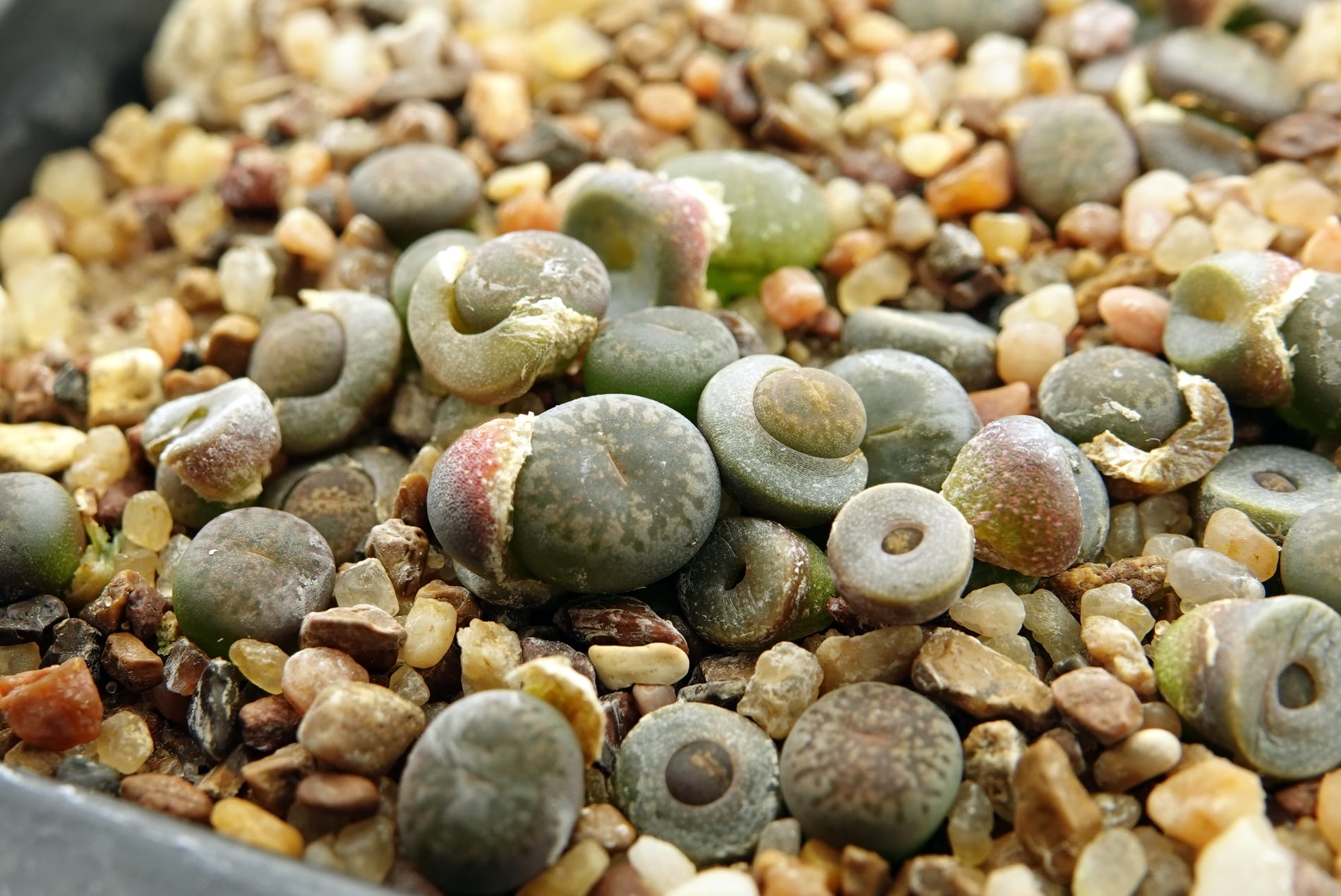
Lithops burchellii (D.T.Cole) Jainta is the Northern Cape calcrete-habitat species that occupies a small range northeast of the town of Douglas, on the south bank of the Vaal River near its confluence with the Orange River. Doreen Cole described the taxon in 1988 as L. lesliei subsp. burchellii in her monograph Lithops Flowering Stones, distinguishing it from the nominate lesliei by face character, body size, and substrate. Jainta elevated it to full species rank in 2019 in Avonia 37(1): 6, alongside bella, euniceae, and glaudinae; Kew POWO accepts the elevation, and the on-site treatment follows POWO.
The specific epithet honours William John Burchell (1781–1863), the English naturalist, botanist, artist, and explorer who collected the first scientifically described Lithops specimen during his 1810–1815 South African interior expedition. Burchell encountered the plant on the veld and initially took it for a curiously shaped pebble; the specimen was later described as Mesembryanthemum turbiniforme and is the type collection that anchors the genus. Cole’s choice of the epithet was deliberate: naming the Northern Cape Lithops after the man who made the first recorded encounter with a living Lithops in the field is a fitting act of taxonomic attribution. Burchell is further commemorated by Burchell’s zebra, Burchell’s coucal, and the plant genus Burchellia R.Br.
Among the taxa covered on this site, L. burchellii is the closest comparison to Lithops lesliei, its former parent. The two share the summer-rainfall calendar and the inverted Lithops growth schedule (active in autumn and winter, dormant in summer), but differ in substrate (calcrete with jaspilite for burchellii, ferruginous quartzite and ironstone for lesliei), face character (pale whitish-grey with dark slate-grey windows for burchellii, brown-coffee to green-grey ground with darker brown windows for lesliei), body size (smaller in burchellii), and range (a tight Douglas-area cluster for burchellii, the broad Free State and Gauteng-to-Botswana arc for lesliei). The anthocyanin-free L. lesliei ‘Albinica’ and yellow-flowering L. lesliei ‘Storm’s Albinigold’ selections are both lesliei-derived, not burchellii-derived; no comparable albinistic selection of burchellii is established in the trade.
L. burchellii is held by SANBI under Near Threatened regulation, one category less severe than the parent lesliei Vulnerable assessment, probably because the small Douglas range sits away from the dense traditional-medicine harvesting networks that depress the Free State and Gauteng lesliei populations. The species is not listed on any CITES appendix, is grown exclusively from seed (no grafting tradition exists in the genus), and is widely available through specialist Lithops seed lists in both the C302 type-locality form and the secondary C308 form. For genus context compare against the white-flowered Lithops karasmontana of the Namibian Karas Mountains and the smaller-bodied Lithops julii of Namibia and the Northern Cape, both winter-rainfall species with white rather than yellow flowers.
Lithops burchellii quick reference
A summer-rainfall Northern Cape mesemb that grows actively in the cool months and rests dry through summer; the calendar is inverted relative to every cactus on this site and matches the wider Lithops framework. Values calibrated for seed grown plants in cultivation, with the substrate adjusted for the calcrete-with-jaspilite type-locality habitat rather than the genus-default quartzite mix.
Taxonomy & nomenclature
The accepted name is Lithops burchellii (D.T.Cole) Jainta, published in Avonia 37(1): 6 (2019). The elevation paper, Ein neuer taxonomischer Ansatz für die Gattung Lithops N.E.Br., raised burchellii alongside bella, euniceae, and glaudinae from subspecific rank to full species rank. Kew POWO accepts the 2019 elevation; the basionym record (L. lesliei subsp. burchellii D.T.Cole, IPNI 950519-1) is retained for synonymy. GBIF cross-references both records under species ID 5554199.
The basionym is Lithops lesliei subsp. burchellii D.T.Cole, published by Doreen Cole in Lithops Flowering Stones (Acorn Books, Johannesburg, 1988), page 217. Cole established the subspecies in her monographic treatment of the genus to cover the geographically separated Northern Cape outlier population that her own collection numbers C302 (the type accession, 20 km north-northeast of Douglas) and C308 (10 km north-northeast of Douglas) had documented. The Cole distinguishing characters were colour and markings versus the nominate lesliei, and finer meshlike face markings with clavate marginal lines versus the L. lesliei var. venteri form. Jainta’s 2019 elevation rests on the same character set plus the substrate disjunction (calcrete with jaspilite for burchellii, ferruginous quartzite and ironstone for lesliei) and the range discontinuity between the Douglas cluster and the broader lesliei Free State/Gauteng arc.
The relationship to the former parent is direct: every page of older trade literature, every llifle accession entry, and every pre-2019 specialist Lithops monograph carries the taxon as L. lesliei subsp. burchellii. The name persists in collector circles and on seed lists, and the on-site treatment here notes the subspecies basionym in the sidebar synonyms row to carry that history forward. The taxonomic act of elevation does not change the plant, the habitat, or the cultivation requirements; it changes only the rank at which the taxon is recognised. POWO treatment is the on-site authority, and POWO has accepted the Jainta combination.
Historical synonym (1)
- Lithops lesliei subsp. burchellii D.T.Cole, 1988 heterotypic synonym
Sources: GBIF
Habitat
Lithops burchellii occupies a small range northeast of the town of Douglas in the Northern Cape Province of South Africa, on the south bank of the Vaal River near its confluence with the Orange River. Two populations are formally documented: the type locality at Cole accession C302, 20 km north-northeast of Douglas, and a secondary stand at C308, 10 km north-northeast of Douglas. A probable third occurrence in a military zone further northeast along the Vaal River corridor is mentioned in Cole’s monograph but has no confirmed peer-reviewed records. Douglas itself sits roughly 80 km southeast of Kimberley at the junction of the Vaal and Riet Rivers, in the Nama Karoo and Savanna biome transition at approximately 800–900 m elevation.
The climate at the type locality is BWk on the Köppen classification: mid-latitude desert, summer-dominant rainfall between November and March, hot summers, cool dry winters. Annual rainfall runs 200–350 mm. This places burchellii in the same summer-rainfall envelope as the former parent lesliei, even though the species is a Northern Cape taxon and the Northern Cape includes both summer- and winter-rainfall sub-regions; the Douglas area is firmly on the summer-rainfall side. The cultivation calendar therefore matches the parent: active growth and flowering in autumn, tapered watering through winter, full dormancy through summer. No calendar adjustment relative to lesliei is needed.
The substrate is the load-bearing distinction from lesliei. Plants grow flush with or slightly below the surface in calcrete with some jaspilite: a calcium-carbonate hardpan parent material with a banded iron formation contributing the red, brown, and black colour components. The soil colour is grey-white with red, brown, and black flecks, and the pale grey burchellii body matches it closely; the dark slate-grey windows of the species mimic the dark jaspilite staining on the calcrete chips. This is a tighter substrate-colour match than the rust-brown lesliei body over rust-brown ironstone. The calcrete drains reasonably but not as freely as pure quartzite gravel; surface drainage is rapid, sub-surface drainage moderate. Associated vegetation is grassy: the species sits in gravel pockets among Northern Cape grasses rather than on bare quartz fields like its western Namibian congeners.
Morphology
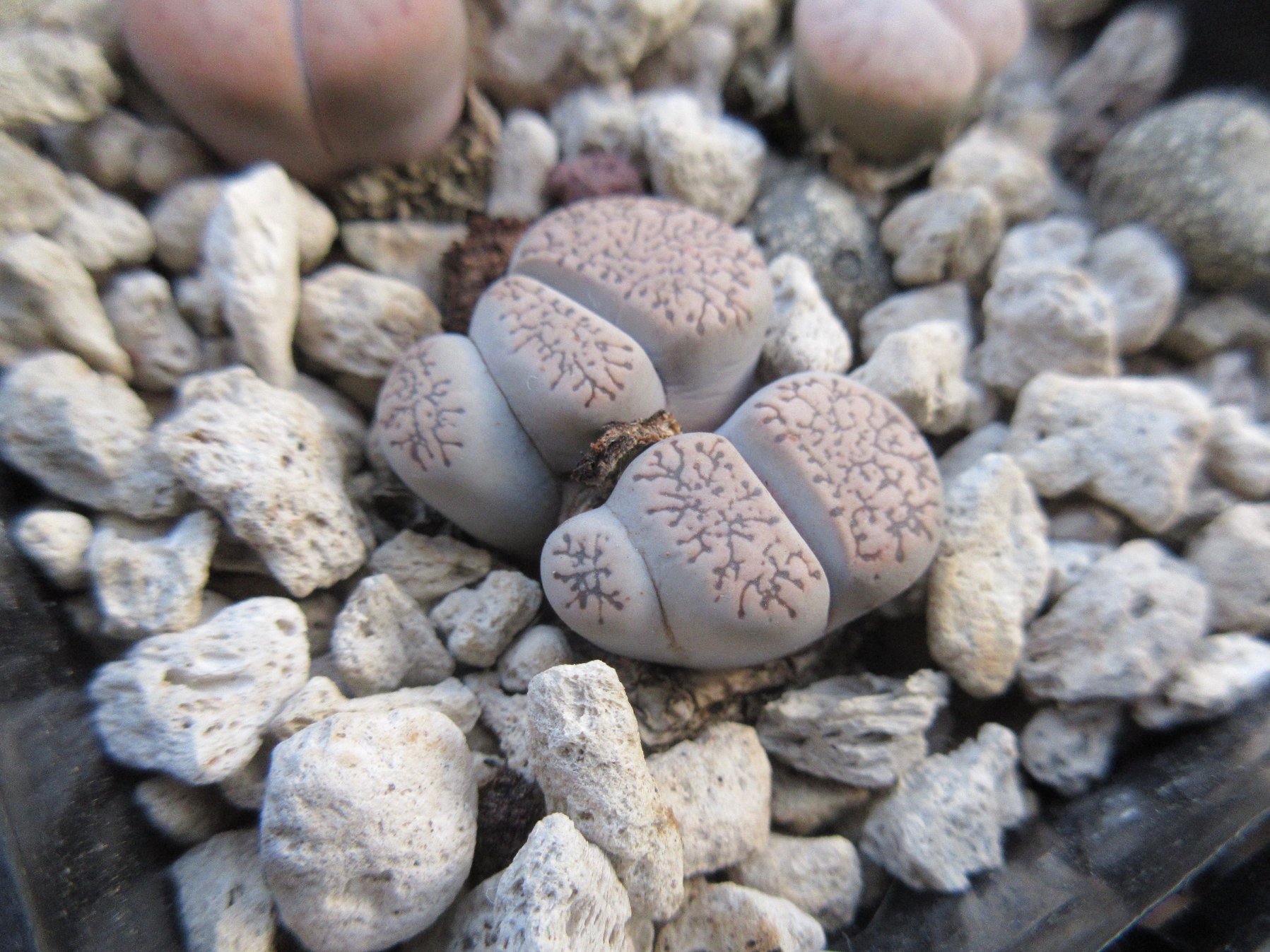
Body form is the standard Lithops architecture: a single pair of fused leaves forming an inverted cone that sits flush with or slightly below the soil surface, with only the truncated dorsal face exposed and the lobes elliptic in profile. The plant is essentially stemless. L. burchellii bodies are medium to small, smaller than those of the parent lesliei (which runs 25–35 mm across); the smaller body size is one of the principal characters Cole used to separate the taxon in 1988. Plants are solitary or form small clumps of two or more heads; the species does not build the larger multi-headed clumps that some other Lithops achieve.
Face colour and pattern are the diagnostic feature. The ground colour runs whitish grey to greyish white, often with pinkish undertones in some individuals (the basis for the “pinker face” descriptor in older trade material). This is categorically paler than the brown-coffee to green-grey face of the nominate lesliei. Across the face lies a network of very dark slate-grey to near-black windows and channels in a fine meshlike pattern, with clavate marginal lines (lines that are club-shaped or thickened at their tips) along the edge of each leaf. The C302 type-locality form carries highly branched lines; the C308 form is a similarly fine-patterned but visually distinctive expression. The high-contrast pale face with dark windows is the visual signature of the species and the character that distinguishes burchellii from L. lesliei var. venteri (which has continuous rather than meshlike face panels) as well as from the nominate lesliei.
Flowers are yellow, daisy-form, single per body, emerging from the central fissure in autumn. The flowers are often quite small for the genus and noticeably smaller on average than those of the nominate L. lesliei, which run up to 5 cm in diameter; no published measurement for burchellii flowers specifically was located in the source set, so a precise diameter is not stated here. The flower colour is consistent with the parent yellow rather than the white of the western Namibian Lithops such as L. karasmontana and L. julii. No white-flowered form of burchellii has been documented; the anthocyanin-free albinistic selections in the lesliei complex (‘Albinica’ and ‘Storm’s Albinigold’) are both lesliei-derived and have no burchellii-derived equivalent in the trade. The species is an obligate outcrosser; seed production in cultivation requires hand pollination between two genetically distinct plants.
Locality detail
The type locality of Lithops burchellii is Cole accession C302, 20 km north-northeast of Douglas in the Northern Cape Province of South Africa. Doreen Cole documented the population in her 1988 monograph Lithops Flowering Stones as subsp. burchellii of L. lesliei; Jainta carried the same C302 type accession into the 2019 species elevation. The secondary documented stand is C308, 10 km north-northeast of Douglas on the same calcrete-jaspilite substrate. Both localities sit south of the Vaal River, in the Nama Karoo and Savanna biome transition at roughly 800–900 m elevation. A probable third occurrence in a military zone further northeast along the Vaal River corridor is mentioned in Cole’s monograph but has no confirmed peer-reviewed records.
The map above marks the C302 type locality, the C308 secondary population, and the town of Douglas as a geographic reference. Marker positions for the C-numbers are approximate within the documented bearing-and-distance from Douglas; specific GPS coordinates for sensitive species are deliberately not published to standard collector-grade precision. The total documented range is small: a tight cluster within roughly 30 km of Douglas, in marked contrast to the broad multi-province L. lesliei range that spans the Free State, Gauteng, eastern Northern Cape, North West, and southern Botswana. The narrow range is the principal driver of the SANBI Near Threatened assessment: any ground-disturbance event in the calcrete-jaspilite habitat near Douglas would carry the species toward Threatened categories quickly.
Lithops burchellii care and cultivation
Lithops burchellii shares the easier lesliei-complex temperament but holds less stored moisture through summer dormancy on account of its smaller body, so the margin for watering error is narrower than on the parent species. The cultivation framework is the genus framework: 95% mineral substrate, the inverted seasonal calendar, full sun, and dry winter cold. The substrate adjustment for the calcrete type-locality habitat is the only species-specific deviation from the genus default. Learn the Lithops calendar on L. lesliei first; burchellii is the next step rather than the starting point.
Substrate
The house mesemb formulation for burchellii is 33% pumice (3–5 mm), 12% lava rock (5–10 mm, structural drainage aggregate), 10% zeolite (clinoptilolite, 4–6 mm), 20% granite grit (3–5 mm), 0% limestone, 20% coarse silica grit (1–3 mm angular crystalline quartz), and 5% worm castings as the sole organic component. The 95/5 inorganic-to-organic ratio is the Lithops genus baseline, higher than the cactus-default 90/10 used elsewhere on this site; organic holds at that class-prior figure because the named-grower sources on file for the genus disagree by more than the site’s ten-point resolution threshold. Limestone is omitted: no source reports a lime preference for burchellii or for the genus in either direction. Silica sits at 20 per cent as a house continuity figure, not an evidenced one. The lava fraction aerates the lower pot volume and supports fast drainage during the active autumn-winter season. Pot in unglazed terracotta or clay composite, 10–12 cm deep, never glazed ceramic; the porosity of unglazed clay accelerates drying and moderates temperature swings around the buried body.
All 16 Lithops on this site use one flat mineral formulation: the 95/5 mesemb baseline (95% inorganic, 5% organic), higher than the 90/10 cactus default used elsewhere on this site. No cultivation source at any tier distinguishes substrate practice between Lithops species, so every row below carries the same house formulation rather than sixteen separate findings. Silica sits at 20% and limestone at 0% as continuity conventions, not evidenced per-species figures.
| Species | Pumice | Lava | Zeolite | Granite | Limestone | Silica | Organic |
|---|---|---|---|---|---|---|---|
| L. lesliei | 33% | 12% | 10% | 20% | 0% | 20% | 5% |
| L. karasmontana | 33% | 12% | 10% | 20% | 0% | 20% | 5% |
| L. karasmontana subsp. bella | 33% | 12% | 10% | 20% | 0% | 20% | 5% |
| L. karasmontana subsp. amicorum | 33% | 12% | 10% | 20% | 0% | 20% | 5% |
| L. karasmontana ‘Top Red’ | 33% | 12% | 10% | 20% | 0% | 20% | 5% |
| L. burchellii (this page) | 33% | 12% | 10% | 20% | 0% | 20% | 5% |
| L. lesliei ‘Albinica’ | 33% | 12% | 10% | 20% | 0% | 20% | 5% |
| L. lesliei ‘Storm’s Albinigold’ | 33% | 12% | 10% | 20% | 0% | 20% | 5% |
| L. pseudotruncatella | 33% | 12% | 10% | 20% | 0% | 20% | 5% |
| L. dendritica | 33% | 12% | 10% | 20% | 0% | 20% | 5% |
| L. optica | 33% | 12% | 10% | 20% | 0% | 20% | 5% |
| L. optica ‘Rubra’ | 33% | 12% | 10% | 20% | 0% | 20% | 5% |
| L. aucampiae | 33% | 12% | 10% | 20% | 0% | 20% | 5% |
| L. aucampiae subsp. koelemanii | 33% | 12% | 10% | 20% | 0% | 20% | 5% |
| L. julii | 33% | 12% | 10% | 20% | 0% | 20% | 5% |
| L. julii subsp. fulleri | 33% | 12% | 10% | 20% | 0% | 20% | 5% |
Watering and light
The watering calendar is inverted relative to every cactus on this site, and it matches the parent L. lesliei. L. burchellii grows actively in the cool months and rests dry through summer. In Northern Hemisphere cultivation: full dormancy May through July (no water at all, wrinkled bodies are normal and not a watering signal), watch and wait through August (first light water at the end of the month if temperatures are clearly trending down), active watering September through November (water thoroughly to runoff, then let the mix dry completely over 10–14 days; this is the flowering window), tapered watering December through February (every 3–4 weeks maximum, never while the old leaf pair is mid-transfer to the new pair), final water March or April, then stop. The smaller burchellii body holds less stored moisture than the larger lesliei, so the summer dormancy window is the same length but the plant has narrower margins for any out-of-cycle watering error.
Light requirements are the genus default: bright direct sun, minimum 5–6 hours daily for compact body shape and the high-contrast pale face with dark slate windows that gives the species its visual signature. Northern Cape interior insolation is the habitat baseline. A south-facing windowsill in the Northern Hemisphere is the indoor minimum; outdoor summer growing under unglazed glass or shade cloth is preferred where climate allows. Plants under chronically low light etiolate, stretch their fissures, lose face contrast (the slate windows fade toward grey as anthocyanin and tannin pigmentation drops back), and split their skins on the next watering. The summer dormancy requirement is light-independent: bright sun through summer is fine provided the substrate is bone dry.
Cold tolerance and the leaf-pair cycle
The dry cold floor for cultivation is −2°C; the Northern Cape interior delivers genuine frost in winter, which the plant survives only because it is bone dry across the cold months. A wet plant at any temperature near freezing is a dead plant. The danger is moisture, not cold. Keep the substrate dry from late autumn through the end of winter and the species rides out conditions far harder than anything a typical European or North American grower has on offer. The species defining biological event is the annual leaf-pair replacement, shared with every other Lithops: the new pair grows inside the old one over winter, draws moisture and nutrient from it, and emerges in spring as the old pair desiccates to paper. Do not water while the old pair is mid-transfer. Watering during the January-February transfer window refills the old leaves, starves the new pair, and kills the plant from inside.
Comparison
The closest comparison is the former parent L. lesliei, which Cole originally treated as carrying burchellii as a subspecies and which Jainta separated in 2019. The two species share the summer-rainfall calendar and the inverted Lithops growth schedule, but split on four characters: substrate (calcrete with jaspilite for burchellii, ferruginous quartzite and ironstone for lesliei), face colour (whitish grey for burchellii, brown-coffee to green-grey for lesliei), face pattern (fine meshlike with clavate marginal lines for burchellii, broader continuous panels and more variable pattern for lesliei), and range (a tight Douglas-area cluster for burchellii, the broad Free State and Gauteng-to-Botswana arc for lesliei). Body size is also reduced in burchellii relative to the larger lesliei.
Across the broader genus, the white-flowered L. karasmontana of the Namibian Karas Mountains and the lip-smear-faced L. julii of Namibia and the Northern Cape are the next most-encountered species in the trade. Both flower white rather than yellow, both sit in the winter-rainfall western half of the genus range, and both are marginally less forgiving in cultivation than the eastern summer-rainfall burchellii. The Sperrgebiet endemic Lithops optica is the opposite cultivation extreme: coastal fog-belt habitat, frost-free in habitat, flowers after the winter solstice rather than in autumn, and IUCN Critically Endangered. Of the two summer-rainfall species in the genus, Lithops aucampiae of the Postmasburg ironstone belt is the closest cultivation analogue to the lesliei/burchellii pair, though the chocolate-brown aucampiae body is categorically darker than either.
Within the trade, L. burchellii is sold both under its current accepted name and under the legacy L. lesliei subsp. burchellii combination that Cole established in 1988. Specialist seed lists carry C302 type-locality stock and C308 secondary-population stock as separate accessions; both are the same species and require identical cultivation, with the C302 form generally regarded as the more visually striking on account of its highly branched marginal lines. No anthocyanin-free albinistic selection of burchellii is established in the trade; the ‘Albinica’ and ‘Storm’s Albinigold’ cream-bodied selections in the wider lesliei complex are both L. lesliei-derived rather than L. burchellii-derived.
Frequently asked questions
Is Lithops burchellii hard to grow?
Intermediate. L. burchellii shares the easier lesliei-complex temperament that makes the former parent species the standard beginner Lithops, but the smaller burchellii body holds less stored moisture through summer dormancy than the nominate, so the margin for watering error is narrower. The single hardest thing is the inverted seasonal calendar shared across the genus: Lithops grow in autumn and winter and rest dry through summer, the opposite of every cactus on this site. Growers carrying their cactus watering instincts across to a Lithops pot kill plants in the first June. Learn the calendar on L. lesliei first, then move to burchellii.
Can Lithops burchellii be grown from seed?
Yes, and seed is the only standard propagation route for the species. Specialist Lithops seed lists carry both the C302 type-locality stock and the C308 secondary-population stock as separate accessions; both are the same species and germinate identically. Seeds germinate in 1–3 weeks at 20–25°C day with cooler nights around 10–15°C, surface-sown without cover on a moist mineral-dominant seedling mix. Time to first flower is 4–5 years under good cultivation with respected dormancy, slightly slower than the parent L. lesliei on account of the smaller body. Grafting is not standard practice for Lithops in the way it is for rare cacti; the genus is grown almost exclusively from seed in the global trade, and grafted Lithops are essentially unknown in collector circles.
Is Lithops burchellii legal to own?
Yes, with no CITES paperwork. L. burchellii is not listed on any CITES appendix because the family Aizoaceae is not covered by the Cactaceae blanket Appendix II listing; the no-CITES status is the load-bearing legal distinction between Lithops and most of the other rare succulents on this site. Wild collection inside South Africa requires a TOPS permit under the National Environmental Management: Biodiversity Act (NEMBA, Act 10 of 2004), plus conformance with provincial ordinances; the SANBI Red List carries the species at Near Threatened, one category less severe than the parent lesliei Vulnerable assessment, probably because the small Douglas range sits away from the dense traditional-medicine harvesting networks that depress the Free State and Gauteng lesliei populations. Nursery-propagated material with documented seed-grown provenance is the legally and ethically defensible source for collector specimens worldwide; international trade in nursery stock is unrestricted by CITES.
Where does Lithops burchellii grow in the wild?
In a tight cluster northeast of the town of Douglas in the Northern Cape Province of South Africa, on the south bank of the Vaal River near its confluence with the Orange River. Two populations are formally documented: the type locality at Cole accession C302, 20 km north-northeast of Douglas, and a secondary stand at C308, 10 km north-northeast of Douglas. Elevation runs approximately 800–900 m. Climate is summer-rainfall BWk (mid-latitude desert) with 200–350 mm of annual precipitation falling between November and March. The substrate is calcrete with jaspilite: a calcium-carbonate hardpan with banded iron formation contributing the red, brown, and black flecks of the surface gravel. Plants sit flush with or slightly below the soil surface in gravel pockets among Northern Cape grasses, the pale whitish-grey body matching the calcrete chips and the dark slate-grey windows mimicking the jaspilite staining.
When does Lithops burchellii flower?
Autumn. In Northern Hemisphere cultivation the flowering window runs October to November, corresponding to Southern Hemisphere April in habitat. Flowers are yellow, daisy-form, single per body, emerging from the central fissure between the two fused leaves. The flowers are often quite small for the genus and noticeably smaller on average than those of the former parent L. lesliei, which run up to 5 cm in diameter; no published measurement specific to burchellii flowers was located in the source set. The flower colour is consistent with the parent yellow rather than the white of the western Namibian Lithops. No white-flowered form of burchellii has been documented. Individual flowers open in the early afternoon and close in the late afternoon, following the consistent daily cycle the genus shares. The species is an obligate outcrosser; flowers do not self-pollinate, so seed production in cultivation needs hand pollination between two genetically distinct plants.
Sources & further reading
Cole, D.T. (1988). Lithops Flowering Stones, p. 217. Acorn Books, Johannesburg (basionym: L. lesliei subsp. burchellii) · Jainta, M. (2019). Ein neuer taxonomischer Ansatz für die Gattung Lithops N.E.Br. Avonia 37(1): 6–17 (species elevation) · Kew POWO. Lithops burchellii (D.T.Cole) Jainta, taxon 77197154-1. powo.science.kew.org · Kew POWO. Lithops lesliei subsp. burchellii D.T.Cole, IPNI lsid urn:lsid:ipni.org:names:950519-1 (basionym record). powo.science.kew.org · IPNI. Lithops lesliei subsp. burchellii, 950519-1. ipni.org · Cole, D.T. and Cole, N.A. (2005). Lithops: Flowering Stones (2nd ed.). Cactus & Co · SANBI Red List of South African Plants. Lithops lesliei subsp. burchellii, Near Threatened. redlist.sanbi.org/species.php?species=85-117 · Raimondo, D., von Staden, L., Foden, W., Victor, J.E., Helme, N.A., Turner, R.C., Kamundi, D.A. and Manyama, P.A. (2009). Red List of South African Plants. Strelitzia 25. SANBI, Pretoria · llifle, Encyclopedia of Living Forms. Lithops lesliei subs. burchellii + C302 + C308 locality entries. llifle.com · GBIF. Lithops lesliei subsp. burchellii D.T.Cole occurrence dataset, species ID 5554199. gbif.org/species/5554199 · Wikipedia. William John Burchell (etymology). en.wikipedia.org · Wikipedia. Lithops lesliei (parent context, conservation table). en.wikipedia.org · WeatherAndClimate.com. Douglas, Northern Cape (BWk climate, summer-rainfall). weatherandclimate.com