
Lithops lesliei ‘Albinica’
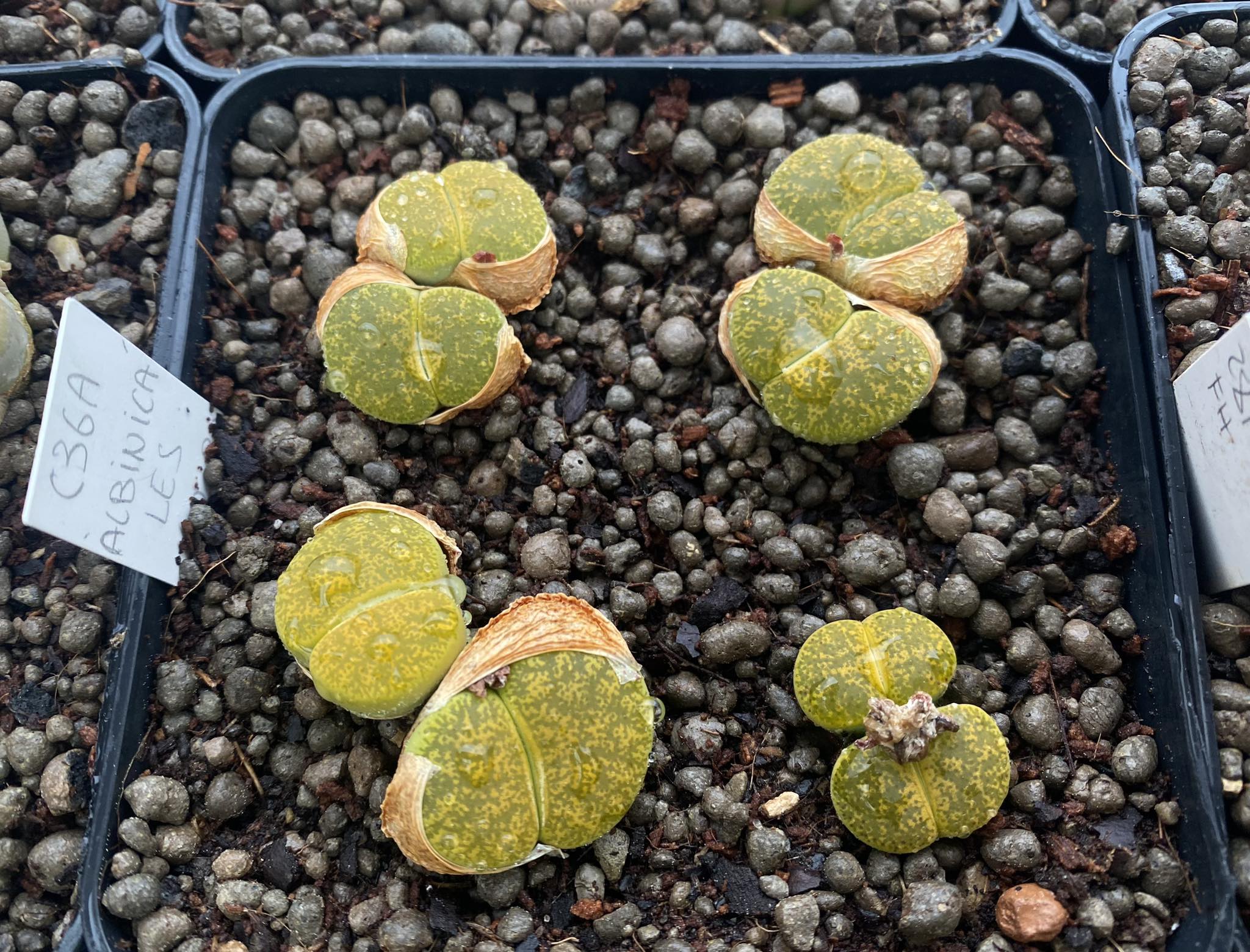
Lithops lesliei ‘Albinica’ is the cream-bodied anthocyanin-free selection of Lithops lesliei from D.T. Cole’s collection C036A near Warrenton in the Northern Cape. Cole assigned the forma epithet L. lesliei f. albinica in 1968 in the Cactus and Succulent Journal; the formal cultivar publication followed in Aloe 22(3): 58-62 in 1985, with a photograph on page 163 of Lithops: Flowering Stones in 1988. The ICRA cultivar register names A.V. Dabner and Peter H. Wilkins as the originators who brought stabilised C036A stock into circulation; the precise division of labour between their nursery selection and Cole’s field description is not on the public record.
The cultivar is governed by the International Code of Nomenclature for Cultivated Plants, not the botanical code: POWO carries no f. albinica or var. albinica under L. lesliei, treating the colour mutation as a horticultural selection only. The Latin forma name from 1968 was retained as the cultivar epithet because it had become widely known and accepted in the trade. Shared ecology, the parent species’ full habitat and conservation profile, and the genus-wide cultivation calendar are covered on the parent Lithops lesliei page; this page covers what makes ‘Albinica’ distinct.
‘Albinica’ runs alongside its companion C036B selection L. lesliei ‘Storm’s Albinigold’, which is vegetatively indistinguishable but produces yellow rather than white flowers. Both came out of the same Warrenton population and can only be told apart in bloom; a non-flowering plant labelled as either cultivar carries an unresolved identity until its first flower opens. The colour-loss mutation is shared with the anthocyanin-free pattern in other Lithops, including the cream selections sometimes offered alongside Lithops aucampiae, but the parent stock and ICRA registration tie ‘Albinica’ specifically to the Warrenton C036A lineage.
Lithops lesliei ‘Albinica’ quick reference
Care follows the parent L. lesliei calendar with one departure: the cream anthocyanin-free body has no built-in UV photoprotection and benefits from light summer shade under glass. Values calibrated for seed grown plants in cultivation, drawn from C036A stock notes and the parent species’ Highveld habitat data.
Taxonomy & nomenclature
The cultivar epithet ‘Albinica’ was formally published by Cole in Aloe 22(3): 58-62 (1985), with the photographic record on page 163 of Lithops: Flowering Stones in 1988. The cultivar name retained the Latin epithet from Cole’s 1968 forma designation L. lesliei f. albinica (Cactus and Succulent Journal, Los Angeles), where Cole had drawn the type material from his collection number C036A near Warrenton in the Northern Cape. The ICRA cultivar register describes ‘Albinica’ as a stabilised green-bodied white-flowering aberration and credits A.V. Dabner and Peter H. Wilkins as originators of the stabilised stock.
POWO does not list f. albinica, var. albinica, or any related infraspecific taxon under L. lesliei. The colour mutation is treated as a horticultural selection under the International Code of Nomenclature for Cultivated Plants, which is the standard modern handling for a stabilised colour break with no geographic isolation from the parent population. The etymology comes from Latin albus (white), referring to the white flowers; the cream body colour comes from the absence of anthocyanin pigments rather than from the same root.
‘Storm’s Albinigold’ (C036B, Cole 1985, Ed Storms) is the parallel ICRA-registered selection from the same Warrenton population, vegetatively identical to ‘Albinica’ but flowering yellow rather than white. Both cultivars sit under L. lesliei; the older taxa.json attribution of ‘Storm’s Albinigold’ to L. aucampiae was corrected in the 2026-05-05 review and both selections now sit on the lesliei page tree on this site.
Habitat
The C036A type locality sits near Warrenton in the Northern Cape, on the Highveld substrate of conglomeritic sandstone, brown siltstone, ferruginous quartzite, and white calcite that characterises the broader C036 Warrenton Form site. Plants grow in gravel pockets among Highveld grasses, in the same summer-rainfall climate envelope that governs the rest of the L. lesliei range. Whether anthocyanin-free plants occur spontaneously elsewhere in the species range is not confirmed in any source accessed; the historical Vince Formosa note that ‘Vivid Green’ from the now-defunct Parkways Lithops seed list (collection C5) was identical to C036A ‘Albinica’ stock raises the possibility but is not formally established.
Full ecology, the wider South African and Botswanan range of L. lesliei, the Highveld elevation band, and the summer-rainfall climate context are covered on the parent species page. The cultivar departure from the parent is biological rather than ecological: the same locality, the same substrate, the same climate, with the colour-loss mutation overlaid.
Morphology
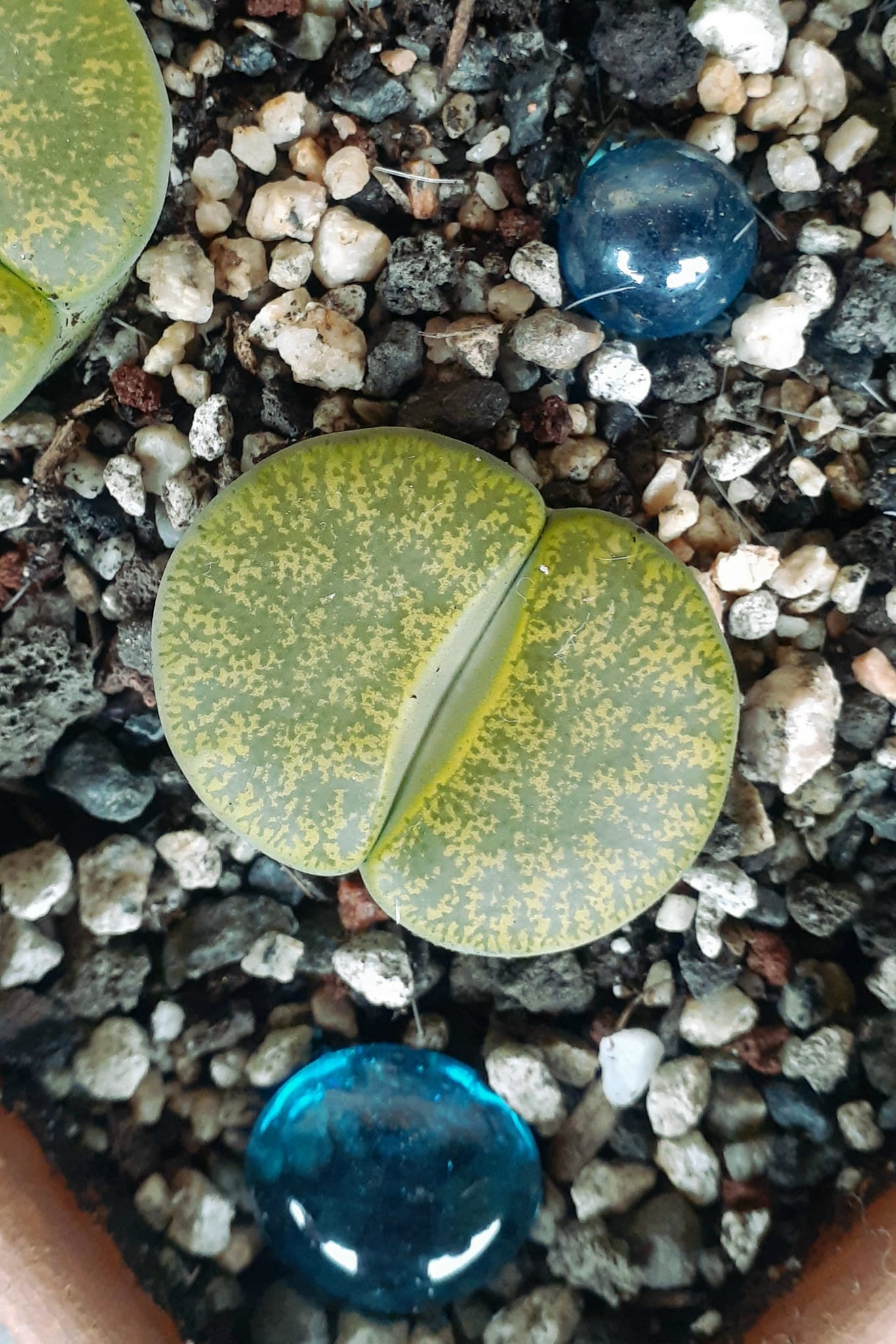
Body architecture is identical to the parent species: a single pair of fused leaves forming an inverted truncated cone that sits flush with the soil, with only the flat dorsal face exposed. Mature pairs reach roughly 5 cm long and 3 cm wide, in the same size band as the standard L. lesliei. No data suggests the cultivar differs in body size or fissure depth. The single structural departure is pigmentation.
The standard L. lesliei face is brown-coffee to grey-green with a complex rust-brown to red-brown lacework of channelled lines, the warm tones driven by anthocyanin pigments that intensify under UV and cool temperatures. ‘Albinica’ is anthocyanin-free: the face is distinctly translucent, grass-green to pale yellowish, with fine yellow lines and patches in place of the rusty-orange channelled network of the type. The skin has a slight waxy sheen that collectors describe as lime-green under good light. Window areas appear as pale green or translucent zones rather than as the warm-toned dark lines of the typical form, and the patterning reads washed-out by comparison while remaining functional as a photosynthetic lens.
Flowers are white to cream, daisy-form, emerging from the central fissure between the leaves on bright autumn afternoons. The standard species flower is yellow, rarely white in wild populations; ‘Albinica’ consistently produces white to cream flowers, and the flower colour is the single character that allowed Cole to assign C036A as a distinct collection from the adjacent yellow-flowered C036 Warrenton Form and from C036B ‘Storm’s Albinigold’. The two cultivars are vegetatively indistinguishable; flower colour is the only reliable diagnostic, and a non-flowering plant of either cannot be assigned with certainty to one or the other.
Locality detail
The C036A type collection sits near Warrenton in the Northern Cape, on the same Highveld substrate as the standard C036 Warrenton Form: conglomeritic sandstone, brown shaly siltstone, quartzite, ferruginous quartzite, and white calcite, with plants in gravel pockets among Highveld grasses. The C036 series groups the Warrenton populations: C036 is the standard yellow-flowered Warrenton Form, C036A is ‘Albinica’ (white-flowered, anthocyanin-free), and C036B is ‘Storm’s Albinigold’ (yellow-flowered, anthocyanin-free). All three sit in the same population on the northern fringe of the Kimberley range, and the colour-loss selections were drawn from this single locality.
The full distribution and locality set for L. lesliei, with map and centroid markers across the Free State, Gauteng, Northern Cape, North West, Botswana, and the Limpopo outlier, is covered on the parent species page. The cultivar locality narrative collapses to a single C-number on this page because ‘Albinica’ is provenance-tracked rather than geographically distributed.
Lithops lesliei ‘Albinica’ care and cultivation
‘Albinica’ runs on the parent L. lesliei calendar in every respect except light management. The cultivar inherits the species reputation as the most forgiving Lithops in cultivation. Substrate, watering calendar, container choice, and cold floor are unchanged from the parent species and are documented in full there; the rest of this section covers the cultivar departure in light handling and the seed-fixity considerations that matter when sourcing or growing the plant.
Substrate and watering
The house mesemb formulation applies unchanged from the parent: 33% pumice (3–5 mm), 12% lava rock (5–10 mm, structural drainage aggregate), 10% zeolite (clinoptilolite, 4–6 mm), 20% granite grit (3–5 mm), 0% limestone, 20% coarse silica grit (1–3 mm angular crystalline quartz), and 5% worm castings. No per-cultivar departure is evidenced for ‘Albinica’, so limestone stays omitted and organic and silica stay at the genus continuity figures; the zeolite buffers the mix toward neutral pH. The lava fraction is the structural drainage aggregate for the active autumn-winter growing season. The watering calendar is the inverted Lithops schedule: dormant May through July, active September through November, tapered to a final water in March or April. Never water while the old leaf-pair is mid-transfer to the new.
All 16 Lithops on this site use one flat mineral formulation: the 95/5 mesemb baseline (95% inorganic, 5% organic), higher than the 90/10 cactus default used elsewhere on this site. No cultivation source at any tier distinguishes substrate practice between Lithops species, so every row below carries the same house formulation rather than sixteen separate findings. Silica sits at 20% and limestone at 0% as continuity conventions, not evidenced per-species figures.
| Species | Pumice | Lava | Zeolite | Granite | Limestone | Silica | Organic |
|---|---|---|---|---|---|---|---|
| L. lesliei | 33% | 12% | 10% | 20% | 0% | 20% | 5% |
| L. karasmontana | 33% | 12% | 10% | 20% | 0% | 20% | 5% |
| L. karasmontana subsp. bella | 33% | 12% | 10% | 20% | 0% | 20% | 5% |
| L. karasmontana subsp. amicorum | 33% | 12% | 10% | 20% | 0% | 20% | 5% |
| L. karasmontana ‘Top Red’ | 33% | 12% | 10% | 20% | 0% | 20% | 5% |
| L. burchellii | 33% | 12% | 10% | 20% | 0% | 20% | 5% |
| L. lesliei ‘Albinica’ (this page) | 33% | 12% | 10% | 20% | 0% | 20% | 5% |
| L. lesliei ‘Storm’s Albinigold’ | 33% | 12% | 10% | 20% | 0% | 20% | 5% |
| L. pseudotruncatella | 33% | 12% | 10% | 20% | 0% | 20% | 5% |
| L. dendritica | 33% | 12% | 10% | 20% | 0% | 20% | 5% |
| L. optica | 33% | 12% | 10% | 20% | 0% | 20% | 5% |
| L. optica ‘Rubra’ | 33% | 12% | 10% | 20% | 0% | 20% | 5% |
| L. aucampiae | 33% | 12% | 10% | 20% | 0% | 20% | 5% |
| L. aucampiae subsp. koelemanii | 33% | 12% | 10% | 20% | 0% | 20% | 5% |
| L. julii | 33% | 12% | 10% | 20% | 0% | 20% | 5% |
| L. julii subsp. fulleri | 33% | 12% | 10% | 20% | 0% | 20% | 5% |
Light, the cultivar departure
The cream anthocyanin-free body has no built-in UV photoprotection. In the standard L. lesliei, anthocyanin pigments absorb excess light energy as the warm-red and rust-brown tones intensify under strong sun and cool temperatures; ‘Albinica’ cannot mount that response and therefore lacks the colour-based UV screen that pigmented siblings carry by default. Under low light the cultivar etiolates and produces soft, rot-prone bodies, the same failure mode as the standard form. Under extreme UV, particularly midsummer glasshouse sun behind glass that traps heat, ‘Albinica’ risks bleaching or surface scalding that the rust-faced standard would tolerate without visible damage.
The practical handling rule: treat ‘Albinica’ as a full-sun plant, but provide 20–30% summer shade cloth during the hottest weeks if growing under glass. A south-facing windowsill with five or more hours of direct sun is suitable in the Northern Hemisphere and avoids the extreme heat accumulation of a closed glasshouse. Outdoor cultivation in temperate climates where the plant takes a softened light through high cloud during summer needs no special intervention. The cultivar is not a fragile shade plant; it is a full-sun plant with a narrower tolerance for the high end of the UV envelope than its rust-faced sibling.
Seed fixity from C036A stock
‘Albinica’ is described in the ICRA register as a stabilised green-bodied white-flowering aberration. The word stabilised here means the phenotype reproduces consistently when self-pollinated or crossed with plants of the same C036A provenance, not that every seedling in an open-pollinated batch will show the colour break. Cole collection number tracking exists for exactly this purpose: seeds labelled C036A or Ex CO36A indicate controlled pollination between plants of the same collection, maximising the probability that offspring express the ‘Albinica’ phenotype. Seeds from a cross with standard yellow-flowered L. lesliei will produce a mix of green-bodied white-flowered seedlings, yellow-flowered cream-bodied seedlings (similar to ‘Storm’s Albinigold’), and seedlings reverting toward the rust-brown type, depending on the dominance relationships of the colour alleles. Source seed labelled with the C036A provenance from established specialists (Mesa Garden, Mesemb Study Group affiliated suppliers) for reliable cultivar expression.
Comparison
The closest comparison is the sibling C036B selection ‘Storm’s Albinigold’. Both cultivars came from the same Warrenton population, both are anthocyanin-free with cream to grass-green bodies and pale yellow line patterning, and both run on identical care calendars. The single reliable diagnostic is flower colour: ‘Albinica’ produces white to cream flowers, ‘Storm’s Albinigold’ produces rich yellow flowers. Out of bloom, the two are indistinguishable. This creates a low-level authentication headache at shows and in seed batches; collectors carrying labelled stock should record provenance carefully and treat any unlabelled cream-bodied L. lesliei as identifiable only in flower.
Against the standard L. lesliei, the comparison reduces to the colour break: rust-brown lacework on grey-green ground in the type, fine yellow lines on cream to grass-green ground in ‘Albinica’, yellow flowers in the type, white-cream flowers in the cultivar. Body shape and size are unchanged. The Warrenton C036 yellow-flowered form is the immediate sibling on the same locality and is the appropriate comparator if checking a labelled C036 line for consistency.
Across the broader genus, the anthocyanin-free pattern recurs in other Lithops cultivars and selections, including the cream selections sometimes offered alongside Lithops julii and other Northern Cape species. None of those carry the Warrenton C036A provenance that ties ‘Albinica’ to a specific Cole-curated lineage; the cultivar value rests as much on the documented C036A origin as on the visible phenotype. Collectors tracking cultivar lineages buy C036A-labelled seed; collectors buying for the colour-loss aesthetic alone may also look at the visually similar cream selections in other species without the same provenance discipline.
Frequently asked questions
Is Lithops lesliei ‘Albinica’ hard to grow?
Beginner with one cultivar caveat. ‘Albinica’ inherits the parent L. lesliei reputation as the most forgiving Lithops in cultivation and is a defensible first plant for anyone learning the inverted Lithops calendar. The single cultivar departure is light: the cream anthocyanin-free body has no built-in UV photoprotection and benefits from 20–30% summer shade cloth under glass to prevent bleaching or surface scalding through the hottest weeks. Outdoor cultivation in temperate climates and a south-facing windowsill with five or more hours of direct sun both work without intervention. The hard rule is the same as for any Lithops: no water from May through July and no water while the old leaf pair is mid-transfer to the new pair in late winter.
Can Lithops lesliei ‘Albinica’ be grown from seed?
Yes, and seed labelled with the C036A provenance is the standard route to the cultivar. The ICRA register describes ‘Albinica’ as a stabilised green-bodied white-flowering aberration, meaning the phenotype reproduces consistently when self-pollinated or crossed within C036A stock; open-pollinated seed from unlabelled cream-bodied parents carries an unknown proportion of standard L. lesliei phenotypes in the offspring. Mesa Garden and Mesemb Study Group affiliated suppliers carry labelled C036A seed. Germination is prompt under standard Lithops conditions (surface-sown on mineral mix at 20–25°C, one to two weeks), with three to five years to first flowering. Grafting is not used for Lithops; seed is the only standard propagation route.
Is Lithops lesliei ‘Albinica’ legal to own?
Yes, with no CITES paperwork. The family Aizoaceae is not covered by the Cactaceae blanket Appendix II listing, so neither the parent species nor the cultivar carries CITES restrictions. ‘Albinica’ is propagated entirely from controlled crosses within C036A stock by specialist seed suppliers and nurseries; the SANBI Near Threatened assessment for the parent species, driven by illegal medicinal harvesting, applies to wild L. lesliei and not to the nursery-propagated cultivar trade. Plants and seed from documented cultivated lineages are legal to purchase and own in virtually any jurisdiction.
Where does the ‘Albinica’ population come from in the wild?
The original ‘Albinica’ plants (Cole collection C036A) were collected near Warrenton in the Northern Cape, South Africa, growing in gravel pockets among Highveld summer-rainfall grassland on a substrate of conglomeritic sandstone, brown shaly siltstone, ferruginous quartzite, and white calcite. The C036 series groups the Warrenton populations: C036 is the standard yellow-flowered Warrenton Form, C036A is ‘Albinica’, and C036B is the yellow-flowered ‘Storm’s Albinigold’. The broader parent species ranges across the Vaal River basin from Kimberley through Gauteng to Polokwane and east to Bethlehem in the Free State, and into southeast Botswana, but the documented ‘Albinica’ colour mutation comes from this one locality.
When does Lithops lesliei ‘Albinica’ flower?
Autumn. In Northern Hemisphere cultivation the flowering window runs September through November, opening in the early afternoon on bright autumn days and closing in the late afternoon. Flowers are white to cream, daisy-form, emerging from the central fissure between the two fused leaves. The white-cream flower is the defining diagnostic of the cultivar: the standard L. lesliei produces yellow flowers, the sibling ‘Storm’s Albinigold’ from C036B produces yellow flowers, and ‘Albinica’ is the white-flowered C036A selection. One plant typically produces one flower per growing season, though older multi-headed specimens may produce several across a 2–4 week bloom period as successive heads come into flower.
Sources & further reading
Cole, D.T. (1968). Lithops lesliei f. albinica. Cactus and Succulent Journal (Los Angeles) · Cole, D.T. (1985). Some Lithops Cultivars. Aloe 22(3): 58-62 · Cole, D.T. (1988). Lithops: Flowering Stones, p. 163. Acorn Books · Cole, D.T. and Cole, N.A. (2005). Lithops: Flowering Stones (2nd ed.). Cactus & Co · Kew POWO. Lithops lesliei (N.E.Br.) N.E.Br. (no f. albinica in synonymy; cultivar treated under ICNCP). powo.science.kew.org · International Cultivar Registration Authority for the genus Lithops N.E.Br., via Scrapbooklithops register. ‘Albinica’ originators: A.V. Dabner and Peter H. Wilkins. docslib.org · llifle, Encyclopedia of Living Forms. Lithops lesliei f. albinica; L. lesliei C036A cv. albinica; L. lesliei C036B cv. Storms Albinigold; L. lesliei C036 Warrenton Form. llifle.com · SANBI Red List of South African Plants. Lithops lesliei subsp. lesliei Near Threatened, assessed 2008. redlist.sanbi.org