
Lithops dendritica
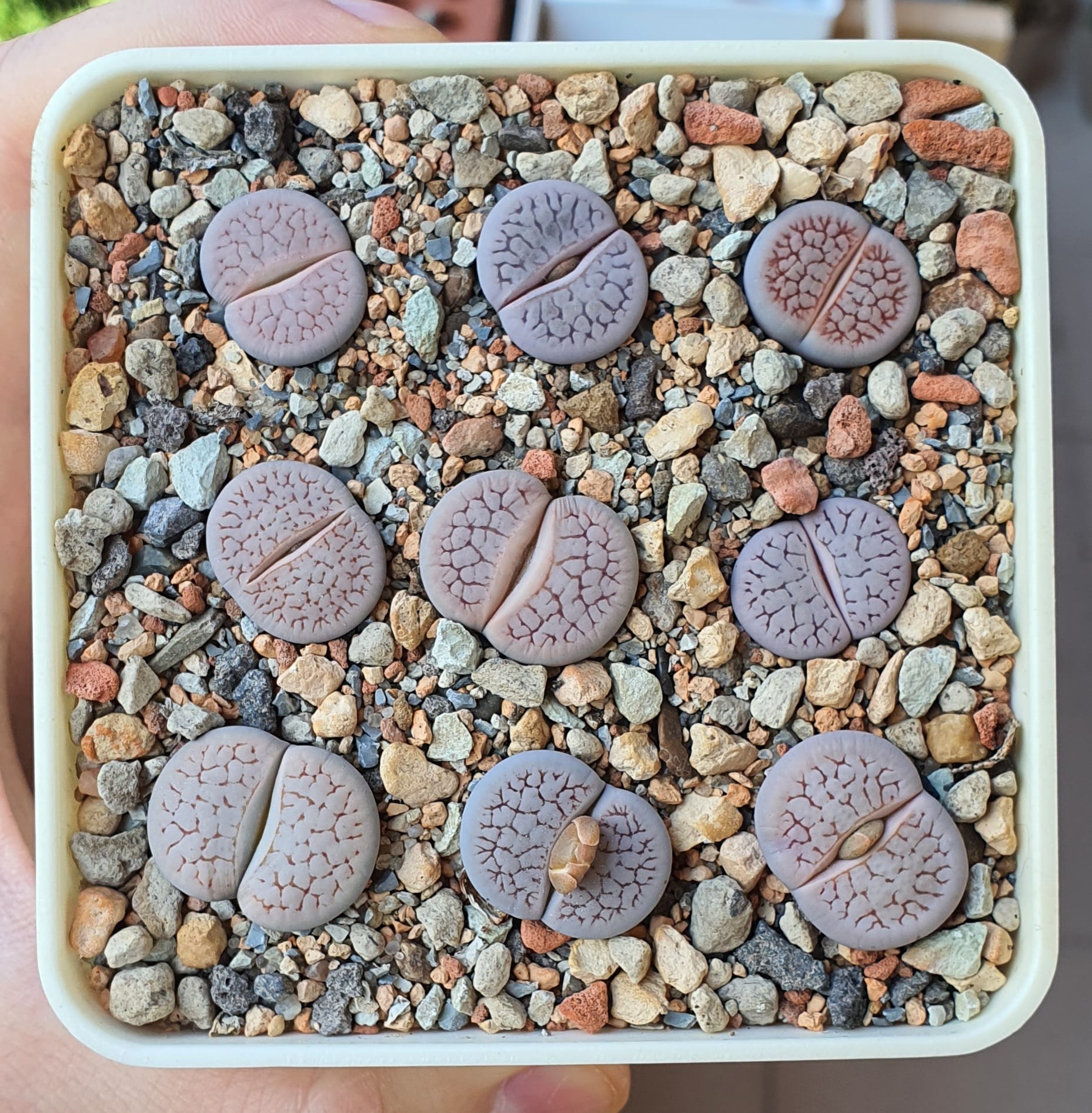
Lithops dendritica Nel is the Namibian living stone named for the organised, self-similar branching network of rust-brown rubrications that runs across its dorsal face. C.G. Nel published the original species description in 1947, the epithet drawn from the Greek dendron via the Neo-Latin dendriticus, naming the tree-like, almost honeycomb pattern of the windowed face. D.T. Cole sank the species under L. pseudotruncatella as a subspecies in his 1988 monograph, and the trade carried it under that name for three decades. R.A. Earlé and A.J. Young reinstated it at full species rank in Bradleya 38 (2020) on the basis of seed morphology and face character; Kew POWO carries the elevation, and the species page on this site reflects the current accepted treatment.
The range is compact and Namibian. Documented populations sit between roughly 6 km and 95 km of Rehoboth in the Hardap Region of central Namibia, on the rust-brown grit and pale chip ground of the central plateau at around 1,500 m elevation. Substrate is siliceous quartzite and mica schist; the pale farinosa-form population at Cole C245 grows specifically among quartzite and mica schist chips where its washed-out body colour matches the ground so closely that the plants are invisible in the field until they flower. This is summer-rainfall country, with most moisture arriving between November and March in the wild, consistent with the broader interior Namibian Lithops belt.
Among the species this site covers, L. dendritica sits next to its former parent Lithops pseudotruncatella, which retains the type locality near Windhoek and a less regular face pattern. The two were lumped under pseudotruncatella in the trade for decades and remain tangled in seed-dealer catalogues and older grower references. Cole field numbers are the cleanest provenance currency in circulation: C071 marks the type locality 50 km WNW of Rehoboth, C072 and C073 the colourful western populations, C245 the pale farinosa form, C357 a southwestern locality, and C384 the closest population to Rehoboth town. Compare against the white-flowered Lithops karasmontana of the southern Karas Mountains and the lip-smear-faced Lithops julii to place the dendritic face network in genus context.
The cultivation profile is genus-standard: the inverted Lithops calendar (active in autumn and winter, dormant in summer), 95% mineral substrate, full sun, and dry winter cold. Yellow daisy-form flowers up to 50 mm in diameter emerge from the central fissure between the leaf pair in autumn, often as wide as or wider than the body itself. Bodies reach 45 x 37 mm at maturity, larger than many species in the genus, and form clumps of multiple heads with age. Seed grown plants reach first flower at three to four years under good conditions. L. dendritica is intermediate in cultivation: less forgiving than the summer-rainfall Lithops lesliei, but well within reach for any grower who has learned the genus calendar.
Lithops dendritica quick reference
A central-plateau Namibian mesemb that grows actively in the cool months and rests dry through summer; the calendar is inverted relative to every cactus on this site. Values calibrated for seed grown plants in cultivation, drawn from L. dendritica habitat data and grower consensus across Cole-numbered specialist sources rather than genus-level extrapolation.
Taxonomy & nomenclature
The accepted name is Lithops dendritica Nel, originally published in C.G. Nel’s monograph Lithops (Stellenbosch, 1947) at species rank. The epithet dendritica derives from the Ancient Greek dendron (tree) via the Neo-Latin dendriticus, naming the diagnostic face pattern: a dense network of blood-red to reddish-brown rubrications that branch and rebranch in a tree-like, self-similar arrangement, often approaching a honeycomb appearance across the dorsal window. The character is the source of the name and is the single reliable field separator from the nominate L. pseudotruncatella.
The taxonomic history runs Nel 1947 (species rank) → de Boer & Boom (variety-rank combination L. pseudotruncatella var. dendritica) → D.T. Cole, Lithops: Flowering Stones, 218 (1988), demoting the taxon to subspecies rank under L. pseudotruncatella. Cole’s subspecies treatment became the dominant horticultural reference and remained the trade-standard name for three decades. R.A. Earlé and A.J. Young revisited the complex in Bradleya 38 (2020) on the basis of seed morphology, face character, and substrate, and reinstated L. dendritica Nel at full species rank with four accepted subspecies: nominate dendritica, archerae (de Boer) Earlé & Young, groendrayensis (H. Jacobsen) Earlé & Young, and schoemanii (Earlé & Uijs) Earlé & Young (described 2019). Kew POWO carries the elevation; the POWO entry for L. pseudotruncatella no longer lists dendritica among its synonyms, and the POWO entry for L. dendritica subsp. schoemanii carries L. pseudotruncatella subsp. schoemanii as a homotypic synonym. The Lithops Research and Conservation Foundation taxa list reflects the same arrangement.
Heterotypic synonyms folded into the species during the Cole-era treatment include L. farinosa Dinter (the pale-bodied farinosa form, Cole C245 at 55 km SSW of Rehoboth) and L. pseudotruncatella subsp. pulmonuncula (the type-locality form, Cole C071, 50 km WNW of Rehoboth). Both names continue to circulate among specialist collectors as form designators within the species. C.G. Nel (1894–1958) was a South African botanist and pharmacist whose 1947 monograph formalised many of the Lithops names that modern treatments still carry; D.T. Cole (1923–2018) spent decades revising the genus and produced the standard horticultural reference Lithops: Flowering Stones (1988, revised 2005 with N.A. Cole). The current POWO treatment effectively returns Nel’s species to the rank he first published.
Habitat
Lithops dendritica is endemic to central Namibia and occupies a compact range west and southwest of the town of Rehoboth in the Hardap Region. Documented Cole field localities span from 6 km south of Rehoboth (C384) to 95 km WSW of Rehoboth (C073), with the type locality 50 km WNW at C071. All known populations fall within roughly 100 km of Rehoboth town on the central Namibian plateau, distinct from the more northern L. pseudotruncatella stronghold on the Khomas Plateau around Windhoek.
Substrate is siliceous quartzite and mica schist. The plants sit buried flush with the soil surface among quartz and schist chips that match the body colour so closely that wild populations are effectively invisible to casual observation until the autumn flowering window. The pale-bodied farinosa form at Cole C245, 55 km SSW of Rehoboth, grows specifically among pale quartzite and mica schist gravel where its washed-out grey-brown body is cryptic against the ground; the C072 and C073 populations 65–95 km WSW of Rehoboth show more colourful branching face networks on a richer orange-grey base. Organic matter at the microsite is negligible.
Climate is summer-rainfall semi-arid plateau. The Rehoboth area receives most precipitation between November and March, with annual totals typically in the 150–300 mm range and a long dry winter from May through August. Elevation is approximately 1,500 m, putting the populations on the central Namibian plateau with high diurnal temperature swings, hot summers, and cool dry winters. The seasonal calendar in habitat aligns with the broader Lithops summer-dormancy pattern: bodies firm and shrink through the summer dry period, the new leaf pair initiates inside the old as autumn temperatures break, and flowering follows the first autumn moisture.
Morphology
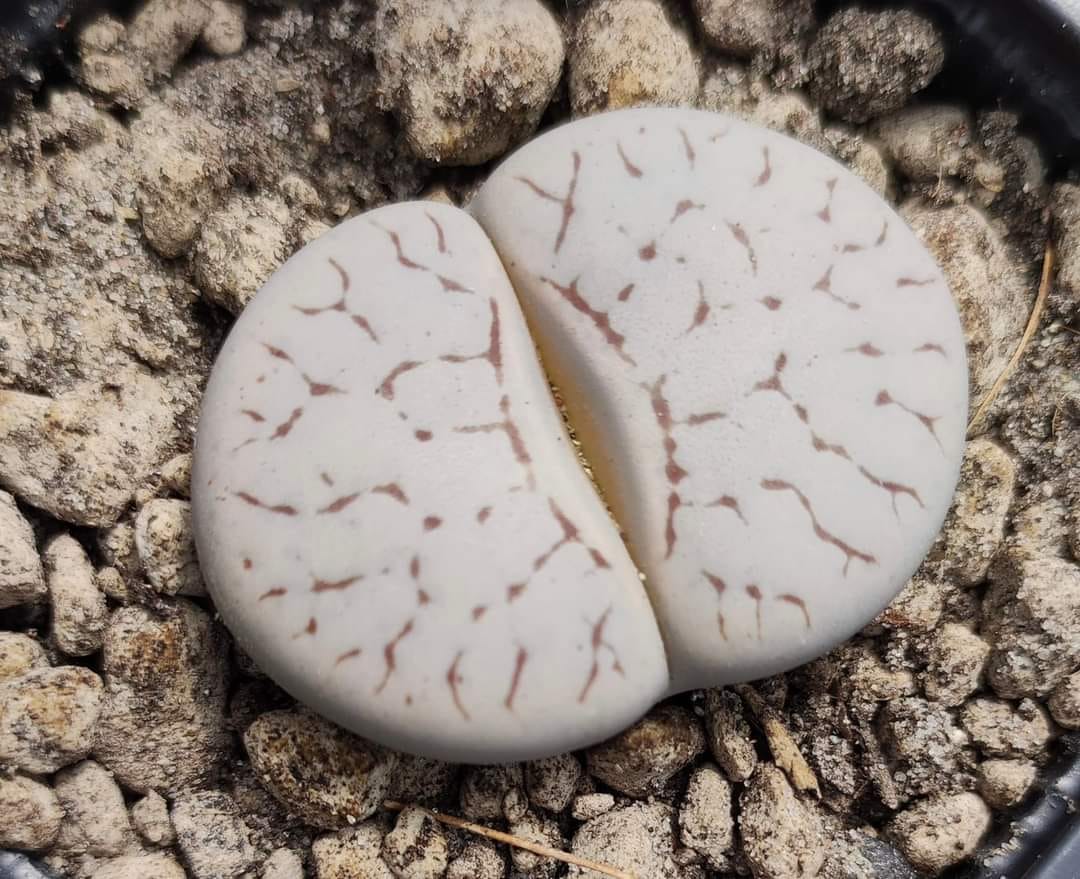
Body form is the standard Lithops architecture: a single pair of fused leaves forming an inverted cone that sits flush with or slightly below the soil surface, with only the flat to slightly convex dorsal face exposed. The plant is essentially stemless. L. dendritica bodies are large for the genus, reaching up to 45 x 37 mm at maturity with a typical size around 35 x 28 mm. Bodies are solitary in young plants but cluster with age; mature specimens form tight groups of four or more heads, with the clumping habit increasing each year as new leaf pairs emerge from established bodies.
Face colour and pattern are the diagnostic feature. The base ground colour ranges from grey to pale grey-brown across most populations, with a pinkish or reddish tinge in some clones, and runs to a notably pale blue-grey in the farinosa form at C245. Across this ground lies an organised, self-similar network of branched rubrications in blood-red to rust-brown, the lines repeatedly bifurcating to produce a tree-like, almost honeycomb pattern across the translucent dorsal window. The bifurcation regularity is the key character: in the nominate L. pseudotruncatella the rubrications are present but less systematically arranged and produce a diffuse, mottled face read; in dendritica the pattern reads as stamped or printed rather than random. The C072 and C073 western populations show the most colourful branching lines on a richer orange-grey base. The window lacework is the photosynthetic lens that admits filtered light to the chlorophyll-packed tissue inside the buried body, the convergent adaptation that defines the genus.
Flowers are yellow, daisy-form, multi-petalled, and large relative to the body, reaching 50 mm in diameter and often matching or exceeding the body width. They emerge from the central fissure between the two fused leaves in autumn, typically September through November in Northern Hemisphere cultivation and corresponding to the autumn rains in Southern Hemisphere habitat. Flowers open in early to mid-afternoon, stay open for two to three hours per day, close before dusk, and reopen daily for four to seven days per bloom. Seed capsules are six-chambered. The species is an obligate outcrosser; flowers do not self-pollinate, and seed production in cultivation requires hand pollination between two genetically distinct plants. No floral character reliably separates dendritica from the nominate pseudotruncatella; the morphological distinction rests entirely on the face pattern.
Locality detail
The type locality of Lithops dendritica is 50 km west-north-west of Rehoboth in the Hardap Region of central Namibia, marked in the trade by Cole field number C071. The C071 stock is also the source of the pulmonuncula synonym form, with pink-tinged veins on a grey-brown ground. Rehoboth sits on the central Namibian plateau roughly 90 km south of Windhoek; the species’ range is compact relative to the broader Lithops genus, with all six well-documented Cole localities falling within 100 km of the town.
The map above marks the type locality at C071, the colourful western populations at C072 and C073, the pale farinosa form at C245, the southwestern locality at C357, and the closest documented population to Rehoboth town at C384. Cole field numbers are the primary provenance currency in serious collector circles and remain the cleanest way to source specific population genetics through specialist seed dealers. Coordinates shown are regional centroids drawn from the Cole 1988 distance-and-bearing notations rather than sharp GPS points; the species is not under acute poaching pressure, but precise wild localities for any Lithops are kept deliberately approximate as a matter of curator practice.
Lithops dendritica care and cultivation
Lithops dendritica follows the genus calendar without deviation. Active growth runs through the cool months and summer is bone dry; the schedule is inverted relative to every cactus on the rest of this site. The species is intermediate in difficulty, less forgiving than the summer-rainfall L. lesliei but well within reach for any grower who has learned the genus pattern. The headline cultivation fact is the annual leaf-pair replacement: each year the new pair grows inside the old one, drawing moisture and nutrient from it, and emerges as the old pair desiccates to paper. Watering during the transfer window (January through February in Northern Hemisphere cultivation) refills the old leaves, starves the new pair, and kills the plant from inside. This is not a sun or substrate problem; it is a calendar discipline problem, and it is the single biggest cause of cultivation loss in the genus.
Substrate
The house mesemb formulation for dendritica is 33% pumice (3–5 mm), 12% lava rock (5–10 mm, structural drainage aggregate), 10% zeolite (clinoptilolite, 4–6 mm), 20% granite grit (3–5 mm), 0% limestone, 20% coarse silica grit (1–3 mm angular crystalline quartz), and 5% worm castings as the sole organic component. The 95/5 inorganic-to-organic ratio is the Lithops genus baseline, higher than the cactus-default 90/10 used elsewhere on this site; the figure is a class-prior default, not a per-species finding, because the grower sources on file for the genus disagree with each other by more than the site’s resolution threshold. Limestone is omitted and silica sits at 20 per cent as house continuity figures; no cultivation source, for this species or any other Lithops, distinguishes either number by taxon. The lava fraction is the structural drainage aggregate. Pot in unglazed terracotta or clay composite, 10–12 cm deep, never glazed ceramic; the porosity of unglazed clay accelerates drying and moderates temperature swings around the buried body.
All 16 Lithops on this site use one flat mineral formulation: the 95/5 mesemb baseline (95% inorganic, 5% organic), higher than the 90/10 cactus default used elsewhere on this site. No cultivation source at any tier distinguishes substrate practice between Lithops species, so every row below carries the same house formulation rather than sixteen separate findings. Silica sits at 20% and limestone at 0% as continuity conventions, not evidenced per-species figures.
| Species | Pumice | Lava | Zeolite | Granite | Limestone | Silica | Organic |
|---|---|---|---|---|---|---|---|
| L. lesliei | 33% | 12% | 10% | 20% | 0% | 20% | 5% |
| L. karasmontana | 33% | 12% | 10% | 20% | 0% | 20% | 5% |
| L. karasmontana subsp. bella | 33% | 12% | 10% | 20% | 0% | 20% | 5% |
| L. karasmontana subsp. amicorum | 33% | 12% | 10% | 20% | 0% | 20% | 5% |
| L. karasmontana ‘Top Red’ | 33% | 12% | 10% | 20% | 0% | 20% | 5% |
| L. burchellii | 33% | 12% | 10% | 20% | 0% | 20% | 5% |
| L. lesliei ‘Albinica’ | 33% | 12% | 10% | 20% | 0% | 20% | 5% |
| L. lesliei ‘Storm’s Albinigold’ | 33% | 12% | 10% | 20% | 0% | 20% | 5% |
| L. pseudotruncatella | 33% | 12% | 10% | 20% | 0% | 20% | 5% |
| L. dendritica (this page) | 33% | 12% | 10% | 20% | 0% | 20% | 5% |
| L. optica | 33% | 12% | 10% | 20% | 0% | 20% | 5% |
| L. optica ‘Rubra’ | 33% | 12% | 10% | 20% | 0% | 20% | 5% |
| L. aucampiae | 33% | 12% | 10% | 20% | 0% | 20% | 5% |
| L. aucampiae subsp. koelemanii | 33% | 12% | 10% | 20% | 0% | 20% | 5% |
| L. julii | 33% | 12% | 10% | 20% | 0% | 20% | 5% |
| L. julii subsp. fulleri | 33% | 12% | 10% | 20% | 0% | 20% | 5% |
Watering and light
The watering calendar in Northern Hemisphere cultivation: full dormancy May through July (no water at all, wrinkled summer bodies are normal and not a watering signal), watch and wait through August (first light water at the end of the month if temperatures are clearly trending down), active watering September through November (water thoroughly to runoff, then let the mix dry completely over 10–14 days; this is the flowering window), tapered watering December through February (every 3–4 weeks maximum, and never while the old leaf pair is mid-transfer to the new pair), final water March or April, then stop. Three to four months of total dormancy is normal and survivable for healthy plants in a deep pot.
Light requirements are the genus default: bright direct sun, minimum 6 hours daily for compact body shape and the strong rust-brown face contrast that distinguishes dendritica from washed-out understory plants. Namibian central plateau insolation is the habitat baseline, and plants under chronically low light etiolate, lose face pattern definition, and split their skins on the next watering. A south-facing windowsill in the Northern Hemisphere is the indoor minimum; outdoor summer growing under unglazed glass or 30–40% shade cloth is preferred where climate allows. The summer dormancy requirement is light-independent: bright sun through summer is fine provided the substrate is bone dry.
Cold tolerance and the leaf-pair cycle
The dry cold floor for cultivation is 2°C; the central Namibian plateau delivers cool dry winters in habitat that the plant survives only because it is bone dry across the cold months. A wet plant at any temperature near freezing is a dead plant. The danger is moisture, not cold. Keep the substrate dry from late autumn through the end of winter and the species rides out conditions far harder than anything a typical European or North American grower has on offer. Repot only at the end of the dry dormancy period (July or early August) when the new leaf pair is just beginning to push; mid-cycle repotting damages the taproot and the new pair emerges malformed. Multi-headed clumps should not be divided until the heads are clearly separated and producing individual fissures, since early division wrecks the shared root mass.
Comparison
The closest comparison is the nominate L. pseudotruncatella, the species under which dendritica sat as a subspecies for three decades after Cole’s 1988 monograph. Both share the buried habit, large body size, yellow daisy-form autumn flowers, and Namibian distribution. The single reliable separator is face pattern: dendritica carries an organised, self-similar network of branched rust-brown rubrications that read as stamped or printed across the dorsal face, while nominate pseudotruncatella shows less regular rubrications that produce a diffuse, mottled face read. A grower familiar with one can separate them in hand. Range adds a secondary signal: pseudotruncatella occupies the Khomas Plateau around Windhoek, while dendritica sits roughly 90 km south on the Rehoboth plateau.
Across the broader genus, L. dendritica is one of several yellow-flowered Namibian species. The white-flowered L. karasmontana of the southern Karas Mountains separates cleanly on flower colour and on its deeper red-brown channelled face grooves rather than the dendritic network. L. julii has white flowers and a distinctive dark lip-smear along the fissure edge, with smaller bodies than dendritica. The summer-rainfall L. lesliei shares the yellow flower but has a rust-brown lacework face on a much wider range across South Africa and southern Botswana, and is the most beginner-friendly species in the genus. The Sperrgebiet endemic L. optica sits at the opposite cultivation extreme: coastal fog-belt habitat, frost-free in habitat, flowers after the winter solstice rather than in autumn, and IUCN Critically Endangered.
Cole field numbers are the cleanest way to separate populations within dendritica. The C071 type-locality stock shows pink-tinged veins on a grey-brown ground; C072 and C073 from the western reaches of the range carry the most colourful branching lines on a richer orange-grey base; the C245 farinosa form is distinctively pale blue-grey, with the body colour matched to the pale quartzite and mica schist chip ground at its locality 55 km SSW of Rehoboth. Plants in trade without a Cole number cannot be attributed to a specific population and may represent any of the above; serious collectors source under Cole numbers from specialist seed dealers.
Frequently asked questions
Is Lithops dendritica hard to grow?
Intermediate. The face-pattern character that makes dendritica visually distinctive does not change the plant’s requirements, which are the genus standard: strict summer dormancy with no water, autumn watering timed to the first growth signs, full direct sun, and a 95% mineral substrate. The single hardest thing is respecting the May through August dry dormancy and resisting the impulse to water shrunken-looking summer bodies. Growers who learn that discipline find the species reliable and long-lived. Less forgiving than the summer-rainfall L. lesliei, more forgiving than the coastal L. optica; a sound mid-genus benchmark.
Can Lithops dendritica be grown from seed?
Yes, and it is the standard acquisition path for serious collectors. Seeds germinate in 7–30 days at 20–25°C surface-sown without cover on a moist mineral-dominant seedling mix. Time to first flower is 3–4 years under good cultivation with respected dormancy. Multiple specialist seed suppliers list dendritica seed under Cole field numbers (C071, C072, C073, C245, C357, C384), allowing growers to source specific population genetics. Grafting is not standard practice for Lithops and is essentially unknown in collector circles; the genus is grown almost exclusively from seed in the global trade.
Is Lithops dendritica legal to own?
Yes, with no CITES paperwork. L. dendritica is not listed on any CITES appendix because the family Aizoaceae is not covered by the Cactaceae blanket Appendix-II listing; the no-CITES status is the load-bearing legal distinction between Lithops and most of the other rare succulents on this site. International trade in nursery-propagated material is unrestricted by CITES. Wild collection inside Namibia is regulated under the Nature Conservation Ordinance 4 of 1975 and requires permits issued by the Ministry of Environment and Tourism. Nursery-propagated material with documented seed grown provenance, sold under Cole numbers by specialist seed dealers in Europe, North America, and Asia, is the legally and ethically defensible source for collector specimens worldwide.
Where does Lithops dendritica grow in the wild?
In central Namibia, in the Hardap Region west and southwest of the town of Rehoboth. The documented range spans roughly 100 km of country between Cole C384 (6 km S of Rehoboth) and Cole C073 (95 km WSW of Rehoboth), with the type locality 50 km WNW at Cole C071. Plants grow buried flush with the soil surface among quartzite and mica schist chips at approximately 1,500 m elevation on the central Namibian plateau. The pale farinosa-form population at Cole C245, 55 km SSW of Rehoboth, grows specifically among pale chip ground where the washed-out grey body is cryptic against the substrate. Climate is summer-rainfall semi-arid plateau with annual rainfall of 150–300 mm and a long dry winter from May through August.
When does Lithops dendritica flower?
Autumn. In Northern Hemisphere cultivation the flowering window typically runs September through November. Flowers are yellow, daisy-form, multi-petalled, and large relative to the body, reaching up to 50 mm in diameter and often matching or exceeding the body width. They emerge from the central fissure between the two fused leaves, open in the early to mid-afternoon, stay open for two to three hours per day, close before dusk, and reopen daily for four to seven days per bloom. The species is an obligate outcrosser; flowers do not self-pollinate, and seed production in cultivation requires hand pollination between two genetically distinct plants. Plants grown from seed typically flower for the first time in their third or fourth year.
Sources & further reading
Nel, C.G. (1947). Lithops. Stellenbosch (basionym; L. dendritica Nel, p. 68) · Cole, D.T. (1988). Lithops: Flowering Stones. Acorn Books, Johannesburg (subsp. dendritica combination, p. 218) · Cole, D.T. and Cole, N.A. (2005). Lithops: Flowering Stones (2nd ed.). Cactus & Co · Earlé, R.A. and Young, A.J. (2020). The form, structure and size of Lithops N.E.Br. seeds and the taxonomic implications. Bradleya 38: 195–224 (L. dendritica reinstated at species rank) · Kew POWO. Lithops N.E.Br. genus page, powo.science.kew.org/taxon/urn:lsid:ipni.org:names:16237-1 · Kew POWO. Lithops pseudotruncatella (A.Berger) N.E.Br., urn:lsid:ipni.org:names:362478-1 (confirms dendritica not retained as synonym) · Kew POWO. Lithops dendritica subsp. schoemanii (R.A.Earle & Uijs) R.A.Earle & A.J.Young, urn:lsid:ipni.org:names:77211355-1 · Lithops Research and Conservation Foundation. Taxa list. lithopsfoundation.com/lithops-taxa · llifle, Encyclopedia of Living Forms. Lithops pseudotruncatella subsp. dendritica C071 (TL), C072, C073, C245 entries. llifle.com · Loots, S. (2005). Red Data Book of Namibian Plants. SABONET Report Series 38 (LC for L. pseudotruncatella complex at Namibian national level) · Cactus and Succulent Society of America (2026). Update on L. pseudotruncatella f. alpina habitat preservation in Namibia. cactusandsucculentsociety.org · Mesa Garden seed catalogue (2026). Lithops dendritica Cole-numbered seed listings. mesagarden.com