
Lithops pseudotruncatella
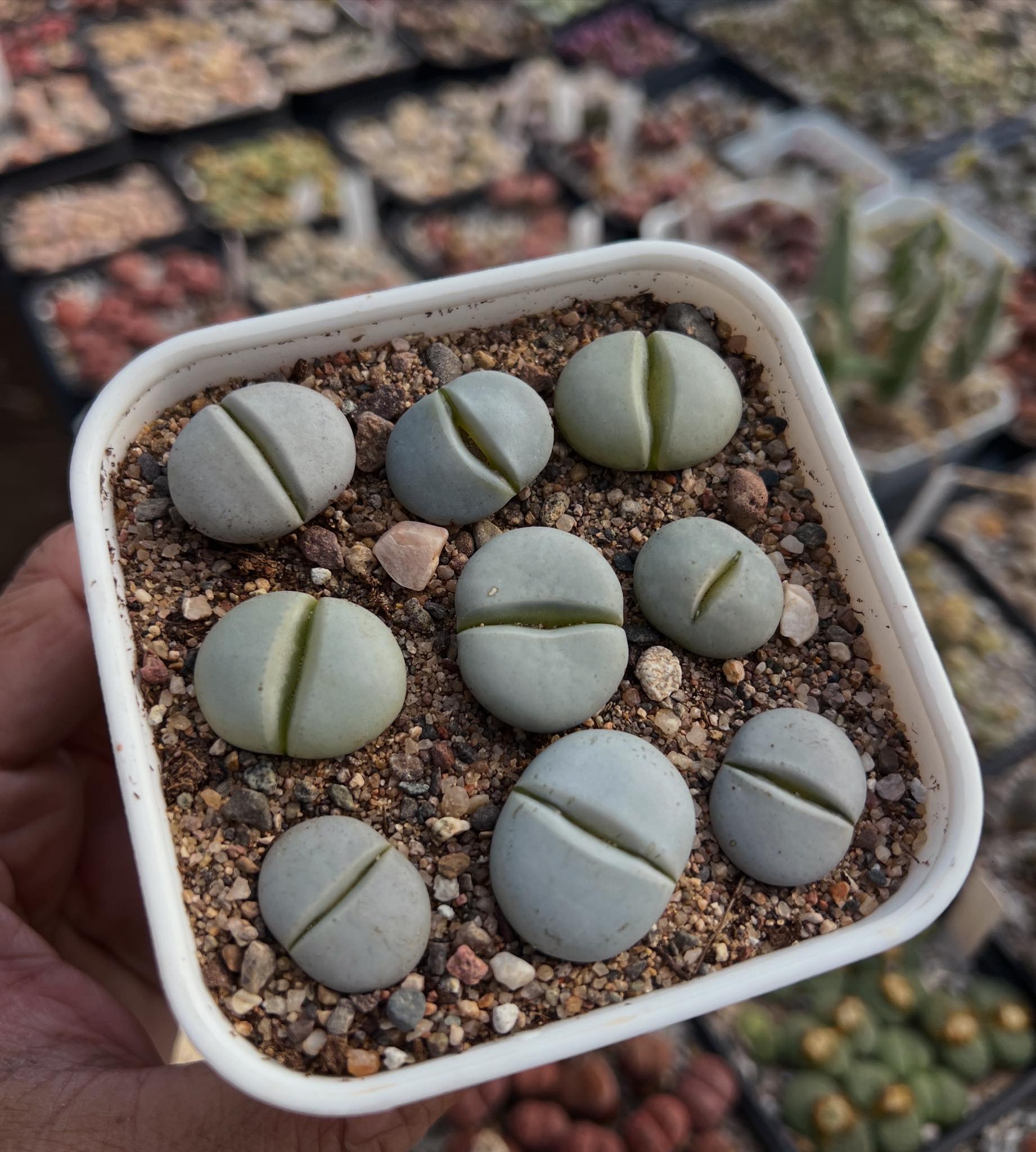
Lithops pseudotruncatella (A.Berger) N.E.Br. is the Khomas Plateau living stone that Alwin Berger first described in 1908 as Mesembryanthemum pseudotruncatellum, working from specimens Kurt Dinter had collected near Windhoek in what was then German South West Africa. Nicholas Edward Brown transferred the species to his newly established genus Lithops in 1922, in the same Gardeners’ Chronicle publication that founded the genus. The specific epithet means ‘false little truncated one,’ a deliberate nod by Berger to the superficially similar Mesembryanthemum truncatellum Haw. that the new species could be confused with.
The species is a strict Namibian endemic, restricted to the higher plains of the Khomas Hochland centred on Windhoek. It occupies a roughly 40 km radius around the city with a long extension reaching some 120 km northeast beyond Steinhausen, covering the summer-rainfall Khomas Plateau between roughly 1,400 and 1,700 m elevation. Plants sit buried flush with the soil surface among quartzite and mica schist pebbles whose colours so closely match the dorsal face that locating individuals in habitat has historically required dedicated collector field trips. The body wears a distinctive dense branching network of fine rust-brown lines etched into a grey to pale-brown ground, with yellow flowers up to 50 mm across appearing earlier in the season than most of the genus.
Although early monographs and trade lists treated the dendritic Namibian populations as a subspecies under L. pseudotruncatella, the Earle and Young revision (Bradleya 38: 195-224, 2020) reinstated those plants as the full species Lithops dendritica, leaving L. pseudotruncatella with three accepted infraspecific taxa per Kew POWO: subsp. volkii, var. elisabethiae, and var. riehmerae. The species is not the type of the genus Lithops; that distinction belongs to Lithops lesliei, which Brown chose as the genus type when he published the 1922 combination. The historical primacy of L. pseudotruncatella sits in its 1908 basionym, the earliest formal description in the modern genus concept.
L. pseudotruncatella earned the Royal Horticultural Society Award of Garden Merit and is widely available as seed-grown nursery stock through specialist European and North American suppliers. The robust body size, forgiving cultivation tolerance, and reliable flowering make it a dependable starting point for collectors learning the genus. Compare the white-flowered Lithops karasmontana of the Karas Mountains and the smaller-bodied Lithops julii with their shared Namibian range to place this species in genus context; against the eastern summer-rainfall Highveld species L. lesliei, pseudotruncatella is the western-Namibian counterpart with a finer face network and an earlier flowering window.
Lithops pseudotruncatella quick reference
A summer-rainfall Khomas Plateau mesemb that grows actively in the cool months and rests dry through summer; the calendar is inverted relative to every cactus on this site. Values calibrated for seed grown plants in cultivation, drawn from L. pseudotruncatella-specific habitat data on the Windhoek highlands and grower consensus across multiple specialist Lithops sources rather than genus-level extrapolation.
Taxonomy & nomenclature
The accepted name is Lithops pseudotruncatella (A.Berger) N.E.Br., with the basionym Mesembryanthemum pseudotruncatellum A.Berger published in Mesembrianthemen und Portulacaceen: 289 (1908). Berger worked from specimens Kurt Dinter had collected near Windhoek in what was then German South West Africa, and his epithet (‘false little truncated one,’ from Greek pseudo-) deliberately referenced the superficially similar Mesembryanthemum truncatellum Haw. with which the new species could be confused. N.E. Brown transferred the species to his newly established genus Lithops in Gardeners’ Chronicle Series III, 71: 65 (1922), in the same publication that established the genus. Kew POWO carries the 1922 combination as the current name (IPNI lsid urn:lsid:ipni.org:names:362478-1).
L. pseudotruncatella is not the type species of the genus Lithops. That distinction belongs to L. lesliei, which Brown designated as the genus type when he published the 1922 combinations. The historical significance of pseudotruncatella sits elsewhere: it carries the earliest formal Berger description in the modern genus concept (1908, before Brown had separated Lithops from Mesembryanthemum) and was one of the founding species in Brown’s 1922 genus account. The taxonomic literature occasionally conflates ‘first described in the modern sense’ with ‘type species,’ which is why the misconception circulates; the two are separate concepts and the type designation belongs to lesliei.
Kew POWO accepts three infraspecific taxa under the species: L. pseudotruncatella subsp. volkii (Schwantes ex de Boer & Boom) D.T.Cole from 45 km south of Windhoek; var. elisabethiae (Dinter) de Boer & Boom from 55 km east-southeast of Otjiwarongo (the northernmost occurrence); and var. riehmerae D.T.Cole from 50 km southeast of Windhoek (Cole C097, syn. edithiae). Principal heterotypic synonyms include the basionym, L. alpina Dinter, L. elisabethiae Dinter, and L. mundtii Tischer. The Earle and Young revision in Bradleya 38: 195-224 (2020), based on seed morphology, reinstated four former L. pseudotruncatella subspecies as Lithops dendritica: subsp. archerae, subsp. dendritica, subsp. groendrayensis, and subsp. schoemanii. Those taxa are no longer treated under pseudotruncatella; the resulting Lithops dendritica has its own page on this site.
Historical synonyms (8)
- Lithops pseudotruncatella subsp. pulmonuncula (Dinter ex Jacobsen) Dinter, homotypic synonym
- Lithops pseudotruncatella var. archeri (DeBoer) D.T.Cole, homotypic synonym
- Lithops archerae DeBoer, heterotypic synonym
- Lithops edithae Jacobsen, heterotypic synonym
- Lithops mundtii Tischer, heterotypic synonym
- Lithops vallis-mariae var. groendraaiensis (Jacobsen) DeBoer, heterotypic synonym
- Lithops volkii Schwantes, heterotypic synonym
- Mesembryanthemum evexum N.E.Br., heterotypic synonym
Sources: POWO (Kew) · IPNI · GBIF · Wikidata
Habitat
Lithops pseudotruncatella is a strict Namibian endemic, with no records from South Africa or the surrounding countries. The core range covers the higher plains of the Khomas Hochland (Khomas Plateau) centred on Windhoek, with a radius of approximately 40 km from the city and a long extension projecting some 120 km northeast beyond Steinhausen. Documented localities in the literature include Windhoek surrounds, Lichtenstein, Ondekaremba, Friedenau, Witvlei, and the Eros Mountains. Elevation across the range runs roughly 1,400 to 1,700 m, with a high outlier at Rusch Peak documented at 2,420 m. The Khomas Plateau ranks among the higher-elevation Lithops habitats in Namibia.
The climate is summer-rainfall, with the wet season running November through March and the peak in January-March. Annual rainfall totals 200–300 mm. This places L. pseudotruncatella alongside the eastern Highveld L. lesliei as a summer-rainfall Lithops, distinct from the winter-rainfall western coastal species such as Lithops optica of the Sperrgebiet. Drought stress through the dry austral winter from May to August is the natural rest season the cultivation calendar mirrors. Summer daytime temperatures can exceed 35°C; winter nights can drop close to 0°C at the higher elevations, with light frost possible but not a regular feature of the core Windhoek-area habitat.
The substrate is quartzite and mica schist; plants grow buried in quartz-rich grit and pebble fields whose colours range across white, yellow-brown, grey, dark brown, and red-stained tones. The match between pebble palette and dorsal face colour is so close that field surveys have traditionally needed trained eyes to find individuals. The Khomas Hochland supports mixed thornbush-grassland vegetation dominated by Acacia species and grasses; Lithops occupy open, sparsely vegetated areas where pebble cover is high and grass cover is low. A 2015 field study found plant density was positively associated with high gravel and pebble cover (not sand) and with flat to gently rising topography. No calcareous or laterite substrate is associated with the species, which is why the cultivation mix on this page omits limestone and stays on the siliceous-default 95/5.
Morphology
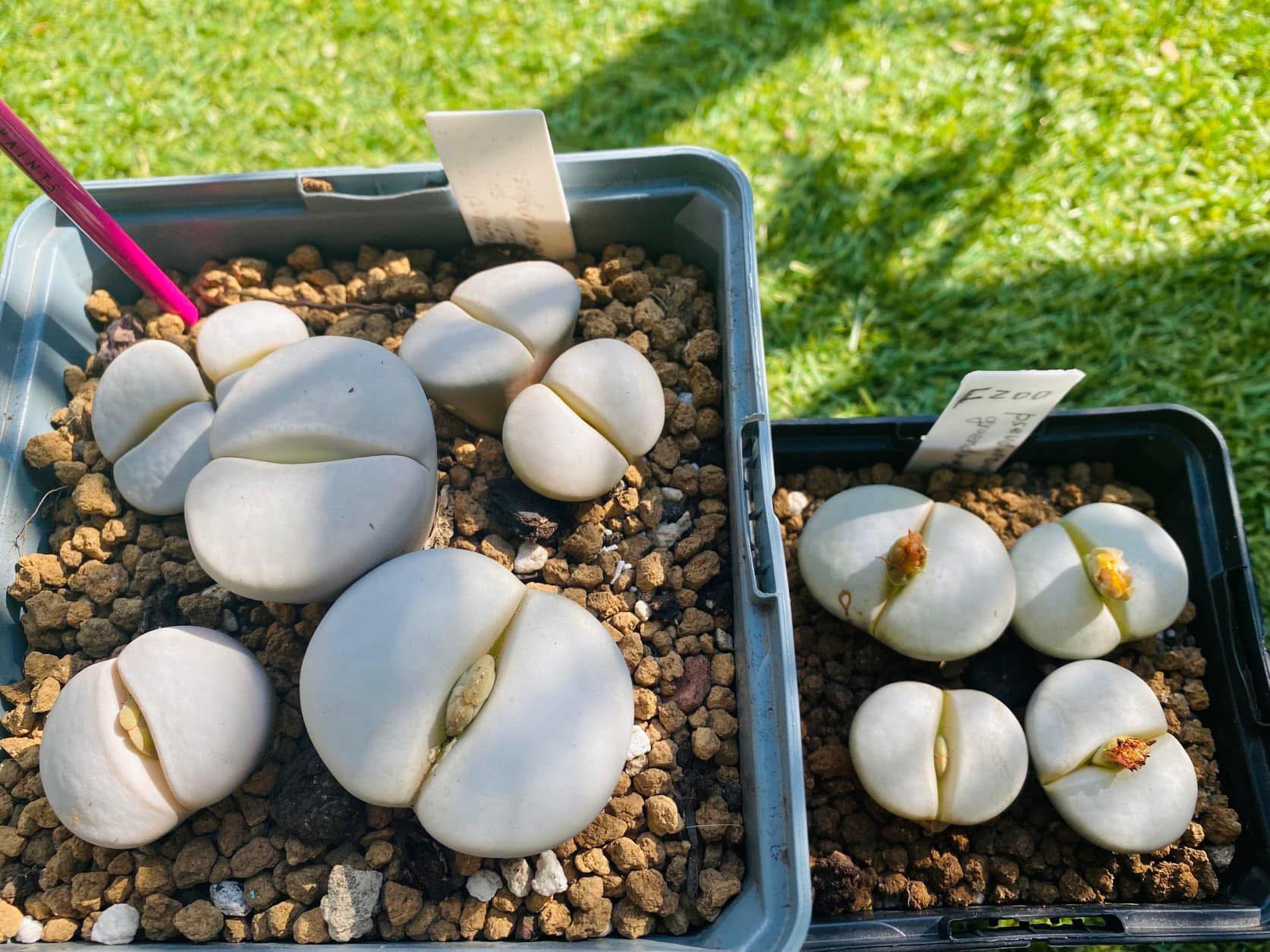
Body form is the standard Lithops architecture: a single pair of fused leaves forming an inverted cone that sits flush with or slightly below the soil surface, with only the flat to slightly convex dorsal face exposed. The plant is essentially stemless. L. pseudotruncatella sits at the larger end of the genus body-size range: facial diameter 25–50 mm by 20–35 mm (width by depth of face), with plant height up to roughly 40–50 mm above the soil. The C067 Windhoek-area stock is widely cited as among the more robust and easier Lithops in cultivation, in part because the larger body size makes the species less prone to rot than the smaller-bodied western siblings. Plants are typically solitary or branch slowly to form small clumps in age.
Body colour runs from grey to pale brown, with some populations carrying a bluish-grey cast; the C067 form is described in habitat as ‘pale blue-grey to brownish grey.’ The dorsal face wears the species’s diagnostic feature: a dense branching network of fine rust-brown to brownish-red channels etched into the surface, forming a dendritic or tree-like pattern. Cole described the lines as ‘branching lines or dendritic markings, which are more or less confluent, forming grooves.’ Numerous dusky dot-form windows scatter through the channelled network in some populations; the lacework varies from fine and intricate (C067) to broader and more open (C070), with no two clones identical. The translucent windows act as the photosynthetic lens that admits filtered light to the chlorophyll-packed tissue inside the buried body, the convergent adaptation that defines the genus.
Flowers are yellow, occasionally white, daisy-form, up to 50 mm in diameter (large relative to the body), single per body, emerging from the central fissure between the leaf pair. The flowering window is the species’s second distinctive trait: L. pseudotruncatella flowers earlier than most Lithops, typically between July and October in the Northern Hemisphere, with some populations and climates pushing into early summer. Most species in the genus flower September through November NH; the species’s position as one of the earliest-flowering Lithops is an established outlier behaviour in the literature. Each flower opens in early to mid-afternoon, stays open 2–3 hours per day, closes before dusk, and lasts 4–7 days, reopening each afternoon. The species is not self-fertile; cross-pollination between separate genetically distinct bodies is required for seed set. Pollinators in habitat and cultivation include bees, flies, wasps, gnats, and other insects.
Locality detail
The type locality of Lithops pseudotruncatella is the Khomas Plateau near Windhoek, based on collections Kurt Dinter made in then-German South West Africa and forwarded to Berger for the 1908 description. Precise GPS coordinates for the type point are not published; Windhoek city centre stands in as the regional anchor on the map. The species was the first Lithops Berger formally described and one of the founding species in Brown’s 1922 genus circumscription, so the Khomas Plateau is in a real sense the type ground for the modern Lithops concept even though the genus type species designation went to lesliei.
The map above marks the regional Windhoek anchor, the C067 reference locality 20 km east-northeast of Windhoek that supplies most cultivated stock, the southern subsp. volkii ground 45 km south of Windhoek, the southeastern var. riehmerae locality at C097, the northern var. elisabethiae outlier near Otjiwarongo, and the eastward range extension toward Steinhausen. Cole field numbers documented in Lithops Flowering Stones (2005) for the nominate include C067 (20 km ENE of Windhoek), C068 (35 km SSE of Windhoek, syn. alpina), C070 (30 km S of Windhoek), C100 (135 km NE of Windhoek, syn. mundtii), C263 (20 km W of Windhoek), C315 (20 km ENE of Windhoek), and C381 (30 km S of Windhoek, syn. alpina). Cole numbers remain the standard collector provenance reference for wild-origin stock in cultivation.
Lithops pseudotruncatella care and cultivation
Lithops pseudotruncatella is among the more forgiving Lithops in cultivation and a sound species for a collector moving into the genus from a cactus background. The robust body size makes it less prone to rot than smaller western species, the C067 stock that dominates the trade is widely cited as easy-growing, and flowering is reliable from year three or four onwards under good light. The cultivation framework remains the genus framework: 95% mineral substrate, the inverted seasonal calendar, full sun, and dry winter cold. The species’s tolerance is in degree, not in kind.
Substrate
The house mesemb formulation for pseudotruncatella is 33% pumice (3–5 mm), 12% lava rock (5–10 mm, structural drainage aggregate), 10% zeolite (clinoptilolite, 4–6 mm), 20% granite grit (3–5 mm), 0% limestone, 20% coarse silica grit (1–3 mm angular crystalline quartz), and 5% worm castings as the sole organic component. The 95/5 inorganic-to-organic ratio is the Lithops genus baseline, higher than the cactus-default 90/10 used elsewhere on this site; it is a class-prior figure rather than a per-population finding, since the named-grower sources on file for the genus disagree by more than the site’s resolution threshold. Silica sits at 20 per cent and limestone at 0 per cent as house continuity figures: no published source names a grit material, a proportion, or a lime preference specific to this species. The zeolite buffers around neutral pH; the lava fraction keeps the lower pot volume aerated during the active autumn-winter season. Pot in unglazed terracotta or clay composite, 10–12 cm deep, never glazed ceramic; the porosity of unglazed clay accelerates drying and moderates temperature swings around the buried body.
All 16 Lithops on this site use one flat mineral formulation: the 95/5 mesemb baseline (95% inorganic, 5% organic), higher than the 90/10 cactus default used elsewhere on this site. No cultivation source at any tier distinguishes substrate practice between Lithops species, so every row below carries the same house formulation rather than sixteen separate findings. Silica sits at 20% and limestone at 0% as continuity conventions, not evidenced per-species figures.
| Species | Pumice | Lava | Zeolite | Granite | Limestone | Silica | Organic |
|---|---|---|---|---|---|---|---|
| L. lesliei | 33% | 12% | 10% | 20% | 0% | 20% | 5% |
| L. karasmontana | 33% | 12% | 10% | 20% | 0% | 20% | 5% |
| L. karasmontana subsp. bella | 33% | 12% | 10% | 20% | 0% | 20% | 5% |
| L. karasmontana subsp. amicorum | 33% | 12% | 10% | 20% | 0% | 20% | 5% |
| L. karasmontana ‘Top Red’ | 33% | 12% | 10% | 20% | 0% | 20% | 5% |
| L. burchellii | 33% | 12% | 10% | 20% | 0% | 20% | 5% |
| L. lesliei ‘Albinica’ | 33% | 12% | 10% | 20% | 0% | 20% | 5% |
| L. lesliei ‘Storm’s Albinigold’ | 33% | 12% | 10% | 20% | 0% | 20% | 5% |
| L. pseudotruncatella (this page) | 33% | 12% | 10% | 20% | 0% | 20% | 5% |
| L. dendritica | 33% | 12% | 10% | 20% | 0% | 20% | 5% |
| L. optica | 33% | 12% | 10% | 20% | 0% | 20% | 5% |
| L. optica ‘Rubra’ | 33% | 12% | 10% | 20% | 0% | 20% | 5% |
| L. aucampiae | 33% | 12% | 10% | 20% | 0% | 20% | 5% |
| L. aucampiae subsp. koelemanii | 33% | 12% | 10% | 20% | 0% | 20% | 5% |
| L. julii | 33% | 12% | 10% | 20% | 0% | 20% | 5% |
| L. julii subsp. fulleri | 33% | 12% | 10% | 20% | 0% | 20% | 5% |
Watering and light
The watering calendar is inverted relative to every cactus on this site. L. pseudotruncatella grows actively in the cool months and rests dry through summer. In Northern Hemisphere cultivation: full dormancy May through July (no water at all, wrinkled bodies are normal and not a watering signal), watch and wait through August (first light water at the end of the month if temperatures are clearly trending down), active watering September through November (water thoroughly to runoff, then let the mix dry completely over 10–14 days; the species’s flowering window opens earlier than the genus norm and may run from July through October), tapered watering December through February (every 3–4 weeks maximum, and never while the old leaf pair is mid-transfer to the new pair), final water March or April, then stop.
Light requirements are at the brighter end of the genus: minimum 6 hours of direct sun daily for tight body shape and the diagnostic rust-brown face network. Khomas Plateau insolation at 1,400–1,700 m is the habitat baseline, and grower notes consistently describe L. pseudotruncatella as among the most sun-tolerant species in cultivation. A south-facing windowsill in the Northern Hemisphere is the indoor minimum; outdoor summer growing under unglazed glass or 30–40% shade cloth in the hottest weather is preferred where climate allows. Plants under chronically low light etiolate, stretch their fissures, lose face contrast, and split their skins on the next watering. The summer dormancy requirement is light-independent: bright sun through summer is fine provided the substrate is bone dry.
Cold tolerance and the leaf-pair cycle
The dry cold floor for cultivation is roughly 2°C; Khomas Plateau winter nights at 1,400–1,700 m can approach freezing in habitat, which the plant survives because it is bone dry across the cold months. Llifle gives 5°C as a safe cultivation minimum with light frost tolerance to about −7°C for short periods on completely dry plants; the conservative 2°C floor for the care widget lands between those two figures. A wet plant at any temperature near freezing is a dead plant, regardless of species or provenance. Keep the substrate dry from late autumn through the end of winter and the species rides out conditions far harder than anything a typical European or North American grower has on offer. The defining biological event of the year remains the annual leaf-pair replacement: the new pair grows inside the old one over winter, draws moisture and nutrient from it, and emerges in spring as the old pair desiccates to paper. Do not water while the old pair is mid-transfer.
Comparison
The closest visual sibling among the Namibian Lithops is L. karasmontana of the Karas Mountains in southern Namibia. Both species share Namibian habitat and a grey-brown body, but the differences are quickly diagnostic: L. pseudotruncatella flowers yellow and wears a fine dendritic rust-brown line network; L. karasmontana flowers white and wears deeper, bolder red-brown grooves and channels on a brownish-grey to tan body. The yellow-versus-white flower colour is the cleanest single character to separate them. Range disjunction also helps: pseudotruncatella sits on the Khomas Plateau around Windhoek; karasmontana sits 500 km south in the Karas Mountains.
L. julii is the second comparator collectors raise. It also flowers white, is smaller-bodied than pseudotruncatella, and carries dark lip markings along the groove edges rather than a dendritic line network across the face. Distribution overlaps in southern Namibia and the Northern Cape but does not reach the Khomas Plateau. The body-size and flower-colour differences make the two species easy to keep separate in cultivation.
The taxonomic comparator that warrants explicit treatment is Lithops dendritica. Until the 2020 Earle and Young revision, the dendritic-faced Namibian populations now under L. dendritica were treated as subspecies under L. pseudotruncatella, including former subsp. archerae, subsp. dendritica, subsp. groendrayensis, and subsp. schoemanii. The Bradleya 38 paper reinstated dendritica as a full species on the basis of seed morphology, and POWO carries the elevation. Older trade lists and pre-2020 specialist literature still circulate the subspecies treatment, so plants sold under names like ‘L. pseudotruncatella subsp. dendritica’ are typically true L. dendritica under current taxonomy. The L. dendritica page on this site carries the full treatment of those reinstated taxa; under pseudotruncatella proper, the accepted infraspecific taxa are limited to subsp. volkii, var. elisabethiae, and var. riehmerae.
Frequently asked questions
Is Lithops pseudotruncatella hard to grow?
Intermediate, leaning beginner. L. pseudotruncatella is a forgiving Lithops in cultivation; the C067 Windhoek-area stock that dominates the international trade is widely cited as a robust, easy-growing plant in the genus. The larger body size makes it less prone to rot than smaller-bodied western species, and flowering is reliable from year three or four onwards under good light. The single hardest thing remains the inverted Lithops calendar: the genus grows in autumn and winter and rests dry through summer, the opposite of every cactus. Growers carrying their cactus watering instincts across to a Lithops pot kill plants in the first June. Learn the calendar on a robust species like this one before moving to fussier western siblings such as L. optica.
Can Lithops pseudotruncatella be grown from seed?
Yes, and seed is the only standard propagation route for the species. Surface-sow on a fine mineral substrate (swimming-pool filter sand or fine silica grit with a small fraction of worm castings) without burying the seeds; light is needed for germination. Maintain humidity through a closed container or tent for the first 2–4 weeks, with daytime temperatures of 20–28°C and cooler nights around 10–15°C. Germination begins within 4–7 days at 24°C and continues in staggered waves for several weeks. Time to first flower is 3–4 years under good cultivation, sometimes earlier; L. pseudotruncatella is sometimes cited as among the faster-flowering Lithops from seed. Grafting is not standard practice for the genus; the annual leaf-pair cycle is body-specific and cannot be accelerated by grafting in the way cactus growth can. Seed grown is the only path for a genuine specimen.
Is Lithops pseudotruncatella legal to own?
Yes, with no CITES paperwork. The species is not listed on any CITES appendix because the family Aizoaceae is not covered by the Cactaceae blanket Appendix-II listing; the no-CITES status is the load-bearing legal distinction between Lithops and most of the other rare succulents on this site. International trade in nursery-propagated material is unrestricted in the EU, UK, US, and Australia, and the species is among the most widely available Lithops through specialist seed and plant suppliers. Wild collection inside Namibia falls under the Nature Conservation Ordinance 4 of 1975 and requires permits from the Ministry of Environment, Forestry and Tourism; field study itself needs a research permit. NEMBA (the South African National Environmental Management: Biodiversity Act) does not apply because the species is Namibian rather than South African. Nursery stock with documented seed-grown provenance is the legally and ethically defensible source for collector specimens worldwide.
Where does Lithops pseudotruncatella grow in the wild?
Strictly across the Khomas Plateau (Khomas Hochland) of central Namibia, centred on Windhoek. The core range covers a roughly 40 km radius around the city with a long extension projecting some 120 km northeast beyond Steinhausen. Documented localities include Windhoek surrounds, Lichtenstein, Ondekaremba, Friedenau, Witvlei, and the Eros Mountains, with var. elisabethiae as the northernmost outlier 55 km east-southeast of Otjiwarongo. Elevation runs 1,400–1,700 m across the Khomas Plateau, with a high outlier at Rusch Peak documented at 2,420 m. The substrate is quartzite and mica schist; plants grow buried flush among quartz pebbles and grit so closely matched in colour to the dorsal face that locating individuals in habitat has historically required dedicated collector field trips. The climate is summer-rainfall, with 200–300 mm of annual precipitation arriving mostly between November and March.
When does Lithops pseudotruncatella flower?
Earlier than most of the genus. In Northern Hemisphere cultivation the flowering window typically runs July through October, with the peak in late summer to early autumn; some populations and climates flower as early as July. Most other Lithops bloom September through November NH, so L. pseudotruncatella stands out as one of the earliest-flowering species in the genus. Flowers are yellow (occasionally white), daisy-form, up to 50 mm in diameter (large relative to the body), single per body, emerging from the central fissure between the two fused leaves. Each flower opens in the early to mid-afternoon, stays open 2–3 hours per day, closes before dusk, and lasts 4–7 days, reopening each afternoon. The species is not self-fertile; cross-pollination between two genetically distinct bodies is required for seed set. Pollinators in habitat and cultivation include bees, flies, wasps, gnats, and other insects.
Sources & further reading
Berger, A. (1908). Mesembrianthemen und Portulacaceen: 289 (basionym Mesembryanthemum pseudotruncatellum) · Brown, N.E. (1922). Lithops pseudotruncatella (A.Berger) N.E.Br. Gardeners’ Chronicle Series III, 71: 65 · Kew POWO. Lithops pseudotruncatella (A.Berger) N.E.Br., IPNI lsid urn:lsid:ipni.org:names:362478-1. powo.science.kew.org · Kew POWO. Lithops N.E.Br. genus page (38 accepted species). powo.science.kew.org · Kew POWO. Lithops dendritica subsp. schoemanii (R.A.Earle & Uijs) R.A.Earle & A.J.Young. powo.science.kew.org · Earle, R.A. and Young, A.J. (2020). The form, structure and size of Lithops N.E.Br. seeds and the taxonomic implications. Bradleya 38: 195-224 · Cole, D.T. and Cole, N.A. (2005). Lithops: Flowering Stones (2nd ed.). Cactus & Co · Lithops Research and Conservation Foundation. Taxa list. lithopsfoundation.com/lithops-taxa · llifle, Encyclopedia of Living Forms. Lithops pseudotruncatella and C067 locality entry. llifle.com · Travaldo’s Blog (2019). Lithops pseudotruncatella care and culture. travaldo.blogspot.com · Cactus and Succulent Society of America (February 2026). Update: Preserving Habitat of Lithops pseudotruncatella f. alpina in Namibia. cactusandsucculentsociety.org · Royal Horticultural Society. Lithops pseudotruncatella Award of Garden Merit. rhs.org.uk · Wikipedia. Lithops; Lithops pseudotruncatella. en.wikipedia.org