
Lithops lesliei ‘Storm’s Albinigold’
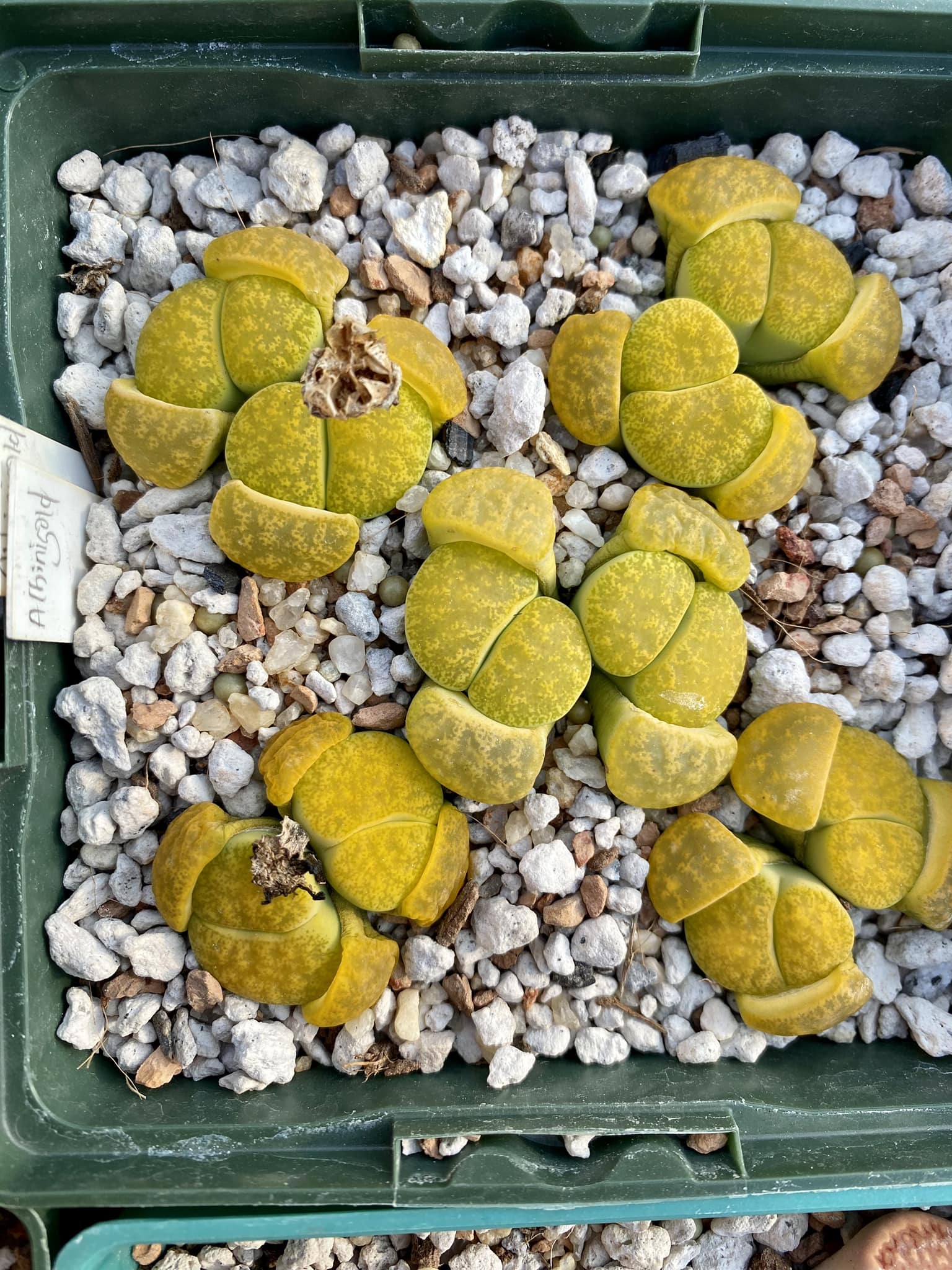
Lithops lesliei ‘Storm’s Albinigold’ is the anthocyanin-free yellow-flowering cultivar of Lithops lesliei, formally published by D.T. Cole in Aloe 22(3): 59–61 (1985) from a spontaneous seedling aberration that appeared in Cole reference number C036B Near Warrenton stock raised by the American nurseryman Ed Storms at Azle, Texas. The ‘Albinigold’ compound combines albini- (the anthocyanin-free phenotype) with -gold (the cream-yellow body and golden flower that result when anthocyanin pigments are absent).
The cultivar is the yellow-flowered companion to L. lesliei ‘Albinica’, the C036A white-flowered cultivar Cole described in 1968 from the same Warrenton population. Vegetatively the two are indistinguishable: both are anthocyanin-free, both show the same cream-gold body and pale translucent window, both lack the rust-brown lacework of the standard L. lesliei face. Flower colour is the only reliable visual diagnostic; ‘Albinica’ flowers white to pale-cream, ‘Storm’s Albinigold’ flowers the standard golden yellow. A non-flowering plant of either cultivar cannot be assigned with certainty to one or the other.
Ed Storms operated a private mail-order Lithops collection at Azle, Texas from at least the 1970s; his collection was acquired by what became Living Stones Nursery in Tucson, Arizona in 1987, which is the documented chain of custody for the cultivar in the global trade. Storms also selected the unrelated L. aucampiae ‘Storm’s Snowcap’ (Cole reference number C392), a white-flowered chocolate-bodied aucampiae cultivar; the two Storms cultivars are different plants from different parent species, and the shared selector surname produces persistent crossed-up attributions in trade lists. This page covers the lesliei cultivar only.
Lithops lesliei ‘Storm’s Albinigold’ quick reference
Care matches the wild-type Lithops lesliei calendar in every load-bearing respect: summer-rainfall Highveld grassland mesemb that grows actively in the cool months and rests bone dry through summer. The calendar is inverted relative to every cactus on this site. The single cultivar-specific care note is the midsummer light caution: anthocyanin-free Lithops lack the photoprotective UV screen that pigmented forms carry, so a 20-30% shade cloth at the height of summer in a glass-covered greenhouse is prudent.
Taxonomy & cultivar history
‘Storm’s Albinigold’ is a horticultural selection of Lithops lesliei (N.E.Br.) N.E.Br. governed under the International Code of Nomenclature for Cultivated Plants (ICNCP), not the botanical code that covers the parent species. Cole formally published the epithet in Aloe 22(3): 59–61 (1985) under the C036B Cole reference number, with a photographic plate in Cole’s monograph Lithops: Flowering Stones (Acorn Books 1988, revised Cactus & Co. 2005). POWO does not list L. lesliei infraspecific taxa in cultivar form, consistent with the modern treatment that places selection-grade names under the ICNCP rather than the botanical code.
Ed Storms (American nurseryman, Azle, Texas) is the documented selector. The selection arose as a spontaneous anthocyanin-free aberration in seedlings raised by Storms from Cole reference number C036B Near Warrenton stock; Cole credits Storms with the original line and assigns C036B to fix the cultivar to its parent population. The anthocyanin-free phenotype is a single-locus recessive trait analogous to albino mutations in other plant genera; selfing or sibling-crossing two confirmed C036B mutants produces 100% Albinigold offspring, which is why the cultivar is described as stabilised on the ICRA register. Selective breeding to fix the phenotype more reliably commenced at the Gunsen-en Nursery (House of Shimada) in Japan in 2009; that is the most active modern breeding line for the cultivar.
Habitat & provenance
The cultivar is a horticultural selection from a single documented locality and does not have a separate wild range. C036B parent stock comes from the C036 Warrenton population in the Northern Cape of South Africa, on a substrate of alkaline pans, conglomeritic and feldspathic sandstone, brown shaly siltstone, quartzite, ferruginous quartzite, amygdaloidal lava, and white calcite. Plants grow in gravel pockets between Highveld grasses in summer-rainfall grassland at roughly 1,100–1,200 m elevation, the same ecological context as the standard L. lesliei nominate. The full distribution and habitat context for the parent species (Vaal River basin range from Kimberley to Polokwane and into southern Botswana, ironstone substrate diversity, conservation narrative) lives on the parent page and is not duplicated here. Whether anthocyanin-free plants occur spontaneously elsewhere in the L. lesliei range is not documented; no source confirms a second wild provenance for the Albinigold trait.
Morphology & cultivar character
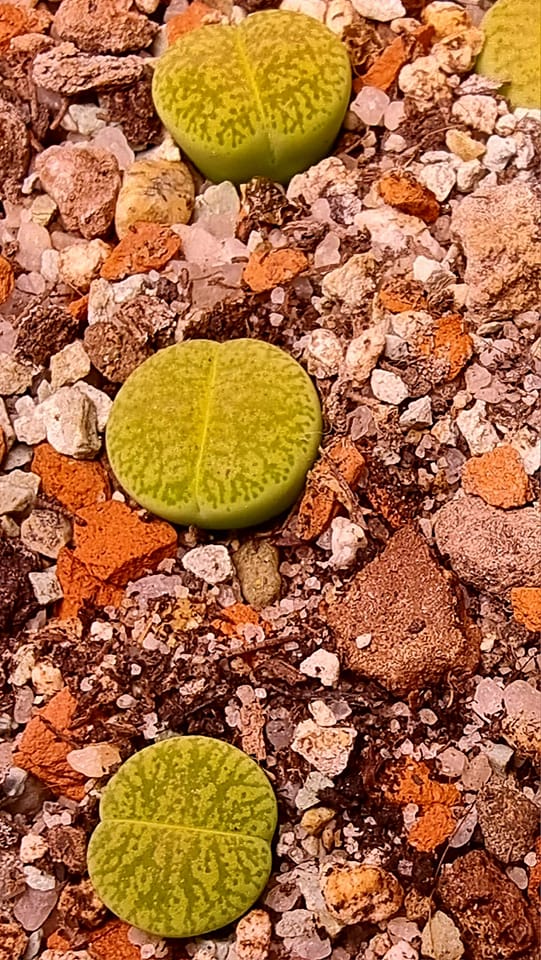
The defining cultivar character is anthocyanin loss. In the standard L. lesliei body, anthocyanins drive the rust-brown and warm-orange tones of the face ground colour and the dark lacework lines that score the translucent windows; the pigments deepen under bright light and cool temperatures, producing the sun-stress colouration collectors prize. ‘Storm’s Albinigold’ has none of this. Without anthocyanin, the body face shows a cream to pale yellow-gold ground with a slightly translucent greenish or yellowish window and muted yellow lines in place of the rich red-brown tracery of the wild-type. Body dimensions are unchanged from the parent species: mature pairs reach roughly 25–35 mm across with the fissure approximately 5 mm deep.
The most useful comparator is the sibling cultivar L. lesliei ‘Albinica’ (C036A), the white-flowered selection Cole described from the same Warrenton locality in 1968. Vegetatively the two cultivars are indistinguishable; Cole’s 1985 description states the point directly. Flower colour is the only reliable visual diagnostic, and reflects a biological asymmetry: ‘Albinica’ loses both vegetative and floral anthocyanin and produces a white-cream flower, while ‘Storm’s Albinigold’ loses only the vegetative pathway and retains the standard yellow L. lesliei flower.
Flowers are golden yellow with the standard pink shading on the underside of the petals, daisy-form, around 3 cm in diameter, single per body, emerging from the central fissure in autumn. Like the parent species the cultivar is an obligate outcrosser; flowers do not self-pollinate, and seed production requires hand pollination between two genetically distinct C036B plants to maintain the stabilised phenotype across the next generation.
Locality & trade context
The cultivar has no separate wild locality of its own. Parent C036B stock came from the C036 Warrenton population, 25–30 km north and west of Kimberley in the Northern Cape of South Africa; the anthocyanin-free aberration appeared spontaneously in seedlings raised by Ed Storms from this stock at his Azle, Texas collection. The cultivar exists only in cultivation; no second wild source has been documented.
‘Storm’s Albinigold’ sits in the upper tier of the collector market for Lithops cultivars, carried by specialist mesemb nurseries and collector seed exchanges. Seed labelled with the C036B Cole reference number and provenance back to the Storms or post-1987 Living Stones Nursery line is the marker collectors look for. The Albinigold name appears informally elsewhere in the trade (occasionally applied to L. aucampiae selections or to other anthocyanin-free Lithops phenotypes), but every primary horticultural source places the cultivar under L. lesliei from C036B Warrenton stock.
Lithops lesliei ‘Storm’s Albinigold’ care and cultivation
Care matches the wild-type L. lesliei framework in every load-bearing respect: 95% mineral substrate, the inverted Lithops seasonal calendar (active in autumn and winter, dormant in summer), full sun exposure, and dry winter cold. The single cultivar-specific addition is the midsummer light caution outlined below.
Substrate
The mix is the house mesemb formulation, identical to the parent: 33% pumice (3–5 mm), 12% lava rock (5–10 mm, structural drainage aggregate), 10% zeolite (clinoptilolite, 4–6 mm), 20% granite grit (3–5 mm), 0% limestone, 20% coarse silica grit (1–3 mm angular crystalline quartz), and 5% worm castings. Limestone is omitted and organic and silica stay at the genus continuity figures; no source distinguishes cultivation practice for this cultivar from the wild-type. The zeolite buffers the mix toward neutral pH and the lava fraction aerates the lower pot volume through the active autumn-winter growing window. Pot in unglazed terracotta or clay composite, 10–12 cm deep, never glazed ceramic.
All 16 Lithops on this site use one flat mineral formulation: the 95/5 mesemb baseline (95% inorganic, 5% organic), higher than the 90/10 cactus default used elsewhere on this site. No cultivation source at any tier distinguishes substrate practice between Lithops species, so every row below carries the same house formulation rather than sixteen separate findings. Silica sits at 20% and limestone at 0% as continuity conventions, not evidenced per-species figures.
| Species | Pumice | Lava | Zeolite | Granite | Limestone | Silica | Organic |
|---|---|---|---|---|---|---|---|
| L. lesliei | 33% | 12% | 10% | 20% | 0% | 20% | 5% |
| L. karasmontana | 33% | 12% | 10% | 20% | 0% | 20% | 5% |
| L. karasmontana subsp. bella | 33% | 12% | 10% | 20% | 0% | 20% | 5% |
| L. karasmontana subsp. amicorum | 33% | 12% | 10% | 20% | 0% | 20% | 5% |
| L. karasmontana ‘Top Red’ | 33% | 12% | 10% | 20% | 0% | 20% | 5% |
| L. burchellii | 33% | 12% | 10% | 20% | 0% | 20% | 5% |
| L. lesliei ‘Albinica’ | 33% | 12% | 10% | 20% | 0% | 20% | 5% |
| L. lesliei ‘Storm’s Albinigold’ (this page) | 33% | 12% | 10% | 20% | 0% | 20% | 5% |
| L. pseudotruncatella | 33% | 12% | 10% | 20% | 0% | 20% | 5% |
| L. dendritica | 33% | 12% | 10% | 20% | 0% | 20% | 5% |
| L. optica | 33% | 12% | 10% | 20% | 0% | 20% | 5% |
| L. optica ‘Rubra’ | 33% | 12% | 10% | 20% | 0% | 20% | 5% |
| L. aucampiae | 33% | 12% | 10% | 20% | 0% | 20% | 5% |
| L. aucampiae subsp. koelemanii | 33% | 12% | 10% | 20% | 0% | 20% | 5% |
| L. julii | 33% | 12% | 10% | 20% | 0% | 20% | 5% |
| L. julii subsp. fulleri | 33% | 12% | 10% | 20% | 0% | 20% | 5% |
Watering and light
The watering calendar is identical to the parent species. Full dormancy May through July (no water; wrinkled bodies are normal), watch and wait through August (first light water at the end of the month if temperatures are clearly trending down), active watering September through November (water thoroughly to runoff, then let the mix dry completely over 10–14 days; this is the autumn flowering window), tapered watering December through February (every 3–4 weeks maximum, and never while the old leaf pair is mid-transfer to the new pair), final water March or April, then stop.
Light is the only departure from the wild-type calibration. Full sun, 5–6+ hours direct daily, is still the target for compact body shape and rot-resistant skin. The departure is at the high end: the standard species uses anthocyanin pigments as a passive UV screen, and the cultivar has no anthocyanins. Under extreme midsummer glass-house conditions the cultivar risks bleaching or surface scalding that the pigmented form would shrug off. A 20–30% shade cloth across the height of summer in glass is prudent; the cultivar does not need significantly less light, just slightly less of the worst of it.
Cold tolerance and propagation
The dry cold floor matches the parent species at −2°C; wet cold near freezing kills the plant from the collar at any temperature. Propagation is by seed only. Seed labelled with C036B provenance and produced by selfing or sibling-crossing two confirmed Albinigold parents produces 100% Albinigold offspring; seed from a cross with standard L. lesliei produces a heterozygous F1 that looks standard, with the recessive Albinigold phenotype reappearing in roughly a quarter of the F2 selfed offspring. Time to first flower is 3–5 years from seed under good cultivation.
Comparison
The single most useful comparator is sibling cultivar L. lesliei ‘Albinica’. The two cultivars are vegetatively indistinguishable: same cream-gold body, same pale translucent window, same body dimensions. Flower colour is the only reliable visual diagnostic; ‘Albinica’ produces a white-cream flower (anthocyanin loss extends to the floral pigment pathway), ‘Storm’s Albinigold’ produces the standard golden yellow flower (the floral pathway is intact). The pair sits at the C036 Warrenton locality in Cole’s reference system: C036A is ‘Albinica’, C036B is ‘Storm’s Albinigold’, and the standard rust-bodied yellow-flowered nominate sits at C036.
Against the wild-type the cultivar is immediately separable: the standard plant carries a rust-brown body face etched with darker translucent windows in a fine lacework, and the warm tones intensify under bright light and cool temperatures into the deep rust-orange sun-stress colouration collectors prize. ‘Storm’s Albinigold’ never develops this; the body stays cream-gold regardless of light intensity. The cultivar is grown for the colour-loss novelty and the C036B provenance, not for the face character. Across the wider complex, Lithops burchellii (Jainta 2019, formerly L. lesliei subsp. burchellii) is the next neighbour and sits on calcrete rather than ironstone with no anthocyanin-free cultivar documented. The aucampiae cultivar ‘Storm’s Snowcap’ (C392) by the same selector is a different plant: standard chocolate-brown aucampiae body with white flowers, no anthocyanin loss in the body itself.
Frequently asked questions
Is Lithops lesliei ‘Storm’s Albinigold’ hard to grow?
Beginner-friendly. The cultivar inherits the most forgiving care calendar in the genus from the parent species and is one of the easiest anthocyanin-free Lithops to keep alive. The single hard rule is the inverted Lithops seasonal calendar: active in autumn and winter, dormant in summer, the opposite of every cactus. The cultivar-specific addition is a midsummer light note: because the anthocyanin-free body lacks the photoprotective UV screen of the standard species, a 20–30% shade cloth across the height of summer in glass is prudent.
Can Lithops lesliei ‘Storm’s Albinigold’ be grown from seed?
Yes, and seed is the only standard propagation route. Seeds germinate in 1–3 weeks at 20–25°C day with cooler nights around 10–15°C, surface-sown without cover. The anthocyanin-free phenotype is recessive: seed labelled with C036B provenance and produced by selfing or sibling-crossing two confirmed Albinigold parents produces 100% Albinigold offspring; cross-pollinated lots without C036B provenance carry an unknown proportion of standard-phenotype offspring. Time to first flower is 3–5 years from seed under good cultivation.
Is Lithops lesliei ‘Storm’s Albinigold’ legal to own?
Yes, with no CITES paperwork. Lithops are not listed on any CITES appendix because the family Aizoaceae is not covered by the Cactaceae blanket Appendix II listing. The cultivar is by definition nursery-propagated stock with chain of custody back to Ed Storms’ original C036B selection and does not draw from wild populations. Wild collection of the parent species inside South Africa requires a TOPS permit under NEMBA (Act 10 of 2004) because L. lesliei is SANBI-assessed Near Threatened (2008), but cultivar-grade material is outside that scope. International trade in specialist nursery stock and seed is unrestricted.
What does Lithops lesliei ‘Storm’s Albinigold’ look like?
A cream to pale yellow-gold body with a slightly translucent greenish or yellowish window and muted pale lines in place of the rust-brown lacework of the standard L. lesliei. Without anthocyanin the body stays pale regardless of light intensity and never develops the deep sun-stress colouration of the wild-type. Body dimensions are unchanged: roughly 25–35 mm across, fissure about 5 mm deep. Flowers are the standard golden yellow L. lesliei flower, around 3 cm in diameter, daisy-form, opening from the central fissure in autumn. The yellow flower is the only reliable diagnostic separating the cultivar from sibling ‘Albinica’ (C036A), which is vegetatively indistinguishable but produces white-cream flowers.
When does Lithops lesliei ‘Storm’s Albinigold’ flower?
Autumn. In Northern Hemisphere cultivation the flowering window runs October to November. Flowers are golden yellow with pink shading on the underside of the petals, daisy-form, around 3 cm in diameter, single per body, emerging from the central fissure between the two fused leaves. Individual flowers open in the early afternoon and close in the late afternoon across a 2–4 week bloom period as successive heads in a clump come into flower. Like the parent species the cultivar is an obligate outcrosser; seed production needs hand pollination between two genetically distinct C036B plants to maintain the stabilised phenotype.
Sources & further reading
Cole, D.T. (1985). Lithops lesliei ‘Storms Albinigold’ (Cole reference number C036B). Aloe 22(3): 59–61 · Cole, D.T. (1988). Lithops: Flowering Stones. Acorn Books, with photographic plate of ‘Storms Albinigold’ on p. 163 · Cole, D.T. and Cole, N.A. (2005). Lithops: Flowering Stones (revised ed.). Cactus & Co · Kew POWO. Lithops lesliei (N.E.Br.) N.E.Br. (parent species record). powo.science.kew.org · llifle. Lithops lesliei C036B Near Warrenton, South Africa cv. Storms Albinigold. llifle.com (Encyclopedia of Living Forms entry 12983) · llifle. Lithops lesliei f. albinica / C036A cv. albinica (sibling cultivar reference). llifle.com (entries 12972 and 12973) · llifle. Lithops lesliei C036 Warrenton Form (parent population reference). llifle.com (entry 13083) · llifle. Lithops aucampiae C392 cv. Storms’s Snowcap (separate Storms cultivar; not the same plant). llifle.com (entry 14204) · Scrapbooklithops cultivar register. Lithops lesliei subsp. lesliei ‘Storm’s Albinigold’: stabilised green-bodied yellow-flowering aberration; Gunsen-en Nursery selective breeding from 2009. scrapbooklithops.com · lithops-passion.com Cultivars Gallery. ‘Storm’s Albinigold’ under L. lesliei; ‘Storm’s Snowcap’ under L. aucampiae. lithops-passion.com · cactus-art.biz. Lithops lesliei C036B ‘Storms Albinigold’. cactus-art.biz · Living Stones Nursery (Tucson, Arizona). About page: “In 1987 we acquired the Storms’ lithops collection.” lithops.com/about · Storms, E. (1986). The New Growing the Mesembs. Ed Storms Inc., P.O. Box 775, Azle, TX 76020 (58 pp) · SANBI Red List of South African Plants. Lithops lesliei subsp. lesliei: Near Threatened, assessed 2008 by Williams, V.L., Raimondo, D., Crouch, N.R., Cunningham, A.B., Scott-Shaw, C.R., Lötter, M., Ngwenya, A.M. and Mills, L. redlist.sanbi.org · International Cultivar Registration Authority (ICRA) Lithops register. via Scrapbooklithops cultivar pages and DocsLib mirror