
Pseudolithos mccoyi
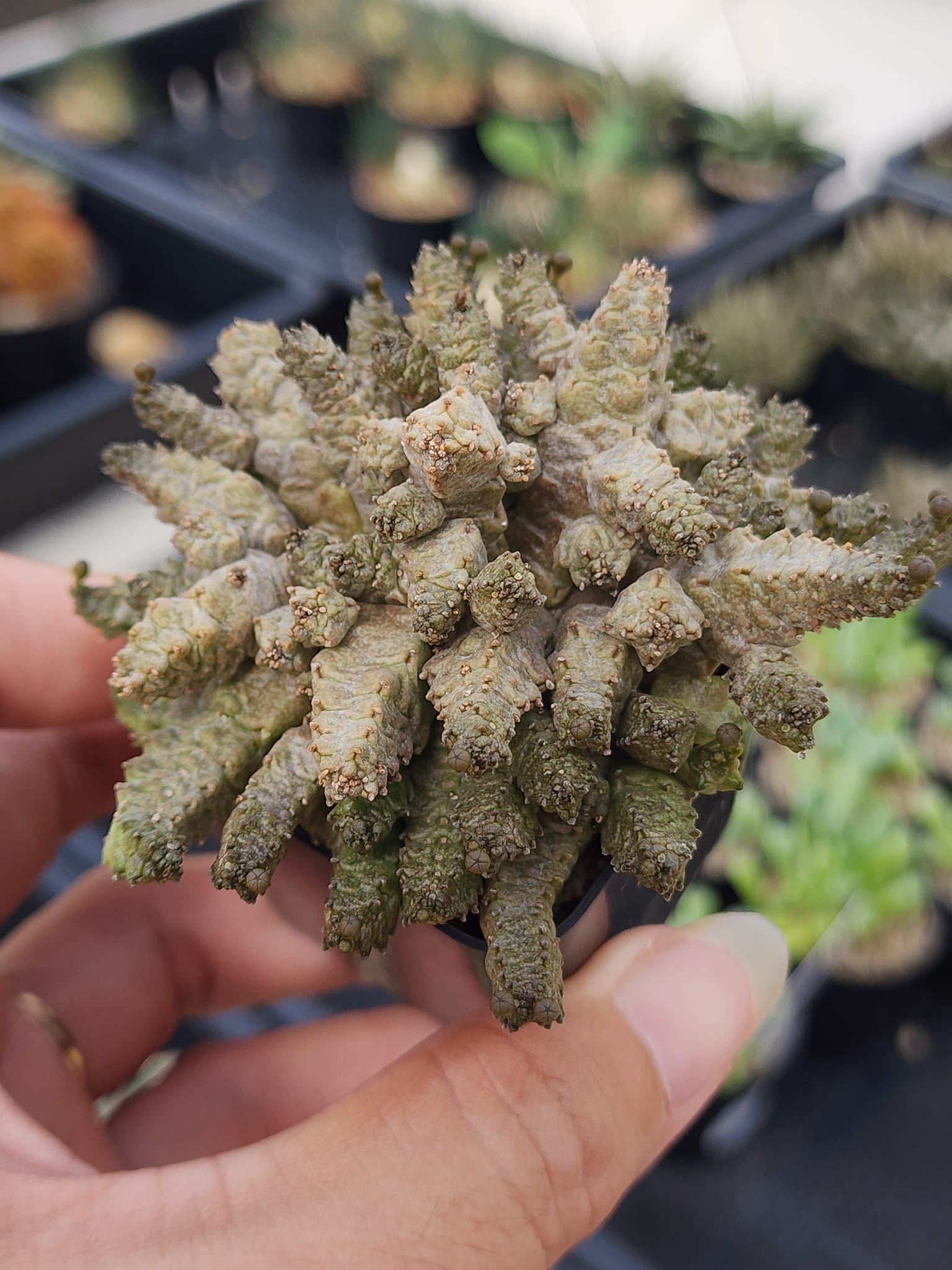
Pseudolithos mccoyi Lavranos & Mies was described in 2001 in Asklepios 82: 29, making it the most recently published species in the genus. The epithet honours Tom A. McCoy, an American collector and researcher of Arabian succulent flora based in Riyadh, Kingdom of Saudi Arabia, who collected the type material on the Dhofar coast of Oman. Although Pseudolithos mccoyi belongs to the milkweed family rather than Cactaceae, its stone-mimicking habit and extreme drought adaptation place it squarely in the rare-succulent collector world.
The type locality lies near Mirbat, a small coastal town on the Dhofar coast of Oman, roughly 70 km east of Salalah, at approximately 80 m elevation. Kew POWO lists the native range as Oman and Yemen, extending P. mccoyi across the Gulf of Aden, separating it from the rest of the genus. This Arabian Peninsula disjunction is the most biogeographically notable feature of the species. The Yemeni component of the range has not been geographically characterised in any source retrieved; no locality, elevation, or habitat data for Yemeni populations is published.
The most distinctive character is the freely-branching growth habit. P. mccoyi begins branching at roughly six months of age, producing small clumps of slender quadrangular stems with a bulbose base. The stems are four-angled with prominent triangular podaria at the stem edges, giving them a finger-like or arm-like profile entirely unlike the squat spherical bodies of Pseudolithos cubiformis or the rounded pebble form of Pseudolithos migiurtinus. Surface texture is dark powdery brown and finely wrinkled, more subtly textured than the bold geometric tessellation of P. cubiformis.
The genus Pseudolithos P.R.O.Bally was first published in Candollea 20: 41 (1965), placing it among the stapelioid Ceropegieae within Asclepiadoideae. All species are carrion-scented fly-pollinated stapeliad succulents adapted to semi-arid rocky terrain in the Horn of Africa and the southern Arabian Peninsula. Molecular phylogenetic work placed the genus most closely to Caralluma R.Br. in the stapelioid alliance.
Pseudolithos mccoyi quick reference
A coastal-limestone stapeliad from hot, seasonally dry terrain on the Dhofar coast of Oman, where thin mineral soils over Tertiary limestone provide fast drainage and no organic horizon. Values calibrated for seed grown plants in cultivation, drawn from habitat data and specialist grower experience with the genus.
Taxonomy & nomenclature
The accepted name is Pseudolithos mccoyi Lavranos & Mies, published in Asklepios 82: 29 (2001). Asklepios is the journal of the International Asclepiad Society; volume 82 dates to 2001. Kew POWO currently accepts Pseudolithos mccoyi as the valid name, with two synonyms representing subsequent generic transfers based on molecular phylogenetic revisions.
A 2002 molecular phylogenetic study combined P. mccoyi into the reinstated genus Anomalluma Plowes as Anomalluma mccoyi (Lavranos & Mies) Meve & Liede, based on ITS and chloroplast spacer phylogenies of the stapelioid Ceropegieae. The name Anomalluma mccoyi remains in use in some collector labels and older literature. A 2017 phylogenetic revision combined all 31 stapeliad genera into a broadly circumscribed Ceropegia, creating Ceropegia mccoyi (Lavranos & Mies) Bruyns. This broad-Ceropegia concept has not been followed by POWO or WFO and is treated here as contested. The page follows POWO.
Tom A. McCoy, born 1959, is an American collector and researcher of Arabian succulent flora based in Riyadh, Kingdom of Saudi Arabia. His field presence in the Dhofar region is documented by multiple independent botanical records: a Yemen trip in January 2000 produced the material for Huernia mccoyi; his Mirbat fieldwork also yielded Sulcolluma mirbatensis McCoy, a new species from the same locality as the P. mccoyi type. The describer team, Lavranos and Mies, were specialists in Arabian and northeast African succulents; John J. Lavranos (1926–2016) described numerous new species from across the Horn of Africa and the Arabian Peninsula.
The family placement is Apocynaceae, subfamily Asclepiadoideae, tribe Ceropegieae, subtribe Stapeliinae. Earlier literature uses Asclepiadaceae, which is now treated as a synonym of Apocynaceae under APG IV. The genus Pseudolithos P.R.O.Bally is most closely related to Caralluma R.Br. in molecular analyses, with more distant affinities to Echidnopsis and Rhytidocaulon.
Historical synonym (1)
- Anomalluma mccoyi (Lavranos & Mies) Meve & Liede, 2002 basionym
Sources: GBIF
Habitat
The type locality is on Tertiary limestone coastal terrain near Mirbat, Dhofar Governorate, Oman, at approximately 80 m elevation. The Dhofar coastal plain east of Salalah consists of folded Tertiary limestone with karst features; soils at the microsite are thin, mineral, fast-draining, and essentially organic-free, formed in shallow pockets between bedrock outcrops on rocky slopes and rubble. The vegetation community at the type locality can be inferred as low scrub on limestone rubble, consistent with general Dhofar coastal flora including Euphorbia dhofarensis, low Acacia scrub, and Caralluma allies. No source documents the specific plant associates at the P. mccoyi microsite.
The climate context is important. The Dhofar region is famous for the khareef, a monsoon fog system that affects the Dhofar jebel escarpment from mid-June to mid-September. However, Mirbat at 80 m on the eastern Dhofar coast sits below and largely east of the main fog belt, which is concentrated on the south-facing jebel above 400 m. The type locality is in a hotter, drier coastal zone than the fog-forest escarpment; some episodic fog input is possible in the khareef period but the microclimate is not a fog-oasis regime. Annual precipitation on the eastern Dhofar coast is approximately 50–100 mm; temperatures range from approximately 20 to 38°C through the year, rarely falling below 18°C.
The Arabian Peninsula range of P. mccoyi extends the genus across the Gulf of Aden. The other three species in the genus occur in the Horn of Africa, separated from P. mccoyi by the Gulf of Aden. The biogeographic separation implies a colonisation event or vicariant split across the Gulf. The Yemeni part of the range has not been geographically characterised; field access to Yemen is severely restricted due to ongoing conflict.
Morphology
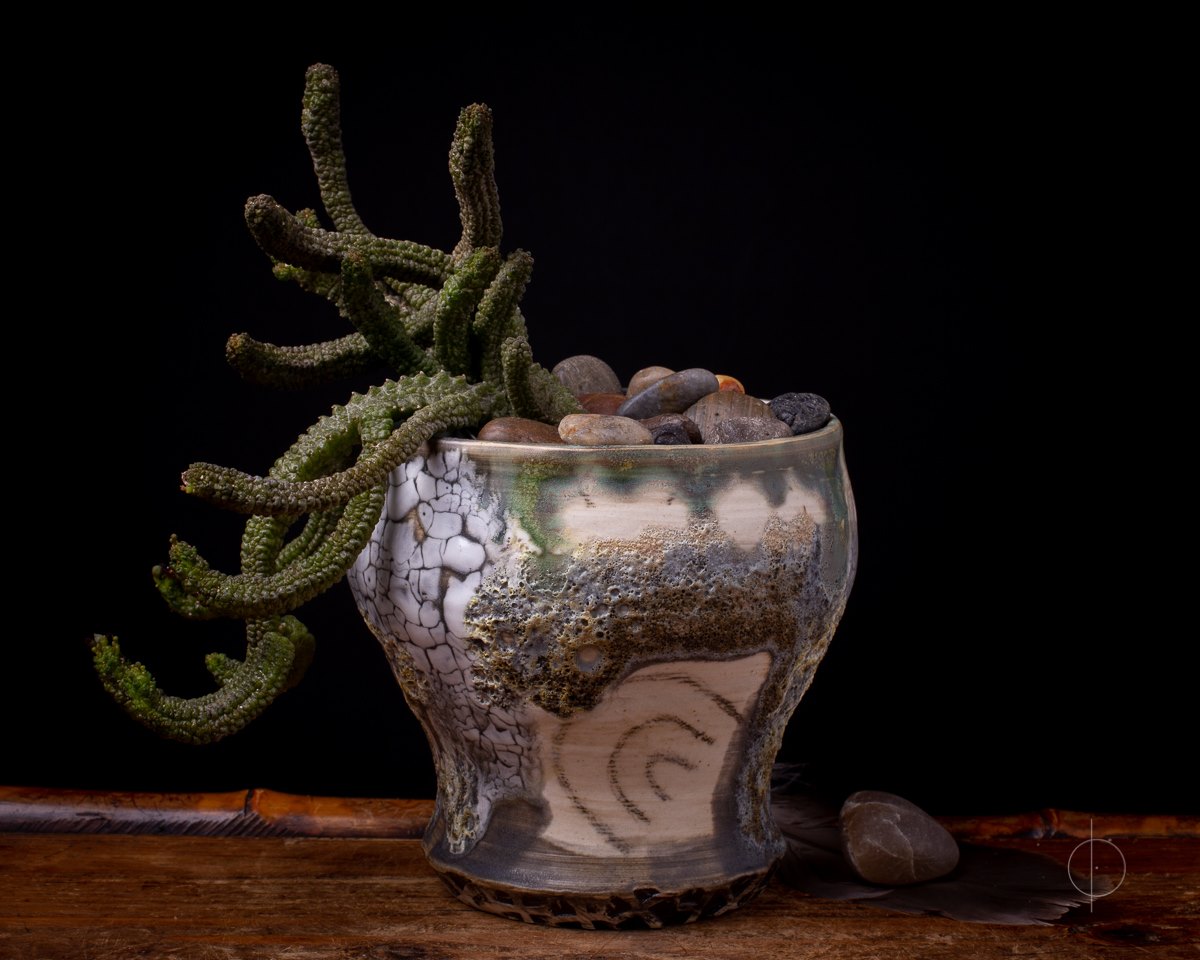
Pseudolithos mccoyi is a freely-branching succulent perennial that begins producing new stems at roughly six months of age, eventually forming small clumps. The stems are distinctly quadrangular in cross-section, slender and elongated with a bulbose shared base, and carry prominent triangular podaria (angular ridges) at the stem corners. This gives individual stems a finger-like or arm-like profile. Overall plant height is described as approximately 7 cm when ungrafted; grafted plants grow larger. No precise stem diameter in mm has been located in published sources.
Surface texture is dark powdery brown and finely wrinkled, with angular ridges at the stem corners that are visible and diagnostic. Body colour is variable: grey to grey-green in well-grown plants, dark powdery brown in others. There are no spines; stapeliad succulents do not produce spines. The surface texture and angular geometry are the primary visual identity characters.
Flowers are small even by Pseudolithos standards, approximately 5 mm in diameter, sessile or subsessile on the stem surface. Flower colour ranges from olive-green to dark maroon with dark spots, variable between individual plants. The carrion scent typical of the entire subfamily Asclepiadoideae serves as the pollination signal for fly visitors; the motile club-shaped corolla hairs characteristic of the genus are present and wave with the slightest air movement. Fruit consists of small paired follicles containing 10–20 comose (pappus-bearing) seeds per pod; seed is described as rarely available in the horticultural trade.
Locality detail
The type locality is near Mirbat, a small coastal town on the Dhofar coast of Oman approximately 70 km east of Salalah. The published coordinates are approximately 17°00’N, 54°45’E, at roughly 80 m elevation, on Tertiary limestone terrain. Mirbat is a publicly known town and the coordinates are at the level of the settled coastal area; the collector and describer chose to publish this resolution. The regional-centroid map marker above represents the published Mirbat locality.
Kew POWO gives the range as Oman and Yemen. No secondary source characterises the Yemeni component with a specific locality, elevation, or habitat description. The Yemen portion of the range sits in an area where field access has been effectively impossible since 2015 due to ongoing conflict; any Yemeni population data in the literature predates the current situation. This page treats Dhofar as the documented range and notes Yemen as a POWO-listed extension without specific locality data.
Pseudolithos mccoyi care and cultivation
The specialist consensus on Pseudolithos mccoyi is consistent across multiple sources: this is among the most demanding species in an already difficult genus. The species is reported as difficult to grow, and that difficulty is not modest. The core challenge is rot management; the stem base is highly susceptible, and either excessive or insufficient watering can trigger rapid collapse.
Substrate
Pseudolithos mccoyi is reported as one of the more rot-prone species in the genus, so the substrate has to dry within a day of watering. The recipe is 45 per cent pumice for aeration, 8 per cent lava rock for structural drainage, 10 per cent zeolite for cation exchange, 20 per cent granite grit, 10 per cent coarse silica, and 7 per cent worm castings. No source publishes an organic figure naming P. mccoyi alone; the 7 per cent comes from grower-practice evidence at the arid stapeliad and caudiciform group level. Limestone is absent: no source recommends limestone, dolomite, or oyster grit for this genus. The horizontal stem-placement rule from the original cultivation notes still stands: do not bury the base in substrate, as the rot-prone collar must remain at or above the surface.
All four Pseudolithos species on this site share one substrate vector. No published source distinguishes one Pseudolithos species from another on substrate composition, so the same recipe applies across the genus rather than a figure invented per species. Limestone stays at 0 percent because no source at any tier recommends limestone, dolomite, or oyster grit for this genus. The organic share is set from grower-practice evidence at the arid stapeliad and caudiciform group level, not from any single Pseudolithos-only source.
| Species | Pumice | Lava | Zeolite | Granite | Limestone | Silica | Organic |
|---|---|---|---|---|---|---|---|
| P. cubiformis | 45% | 8% | 10% | 20% | 0% | 10% | 7% |
| P. migiurtinus | 45% | 8% | 10% | 20% | 0% | 10% | 7% |
| P. caput-viperae | 45% | 8% | 10% | 20% | 0% | 10% | 7% |
| P. mccoyi (this page) | 45% | 8% | 10% | 20% | 0% | 10% | 7% |
Watering and light
The growth season follows the Dhofar summer pattern. From late spring through summer, water when the substrate has dried fully throughout, roughly every 10 to 14 days under warm conditions. The Dhofar coast receives limited annual rainfall (50–100 mm at Mirbat), concentrated largely in the khareef period (June–September); watering in cultivation mirrors this summer-active rhythm. In autumn, reduce frequency progressively. In winter, keep the substrate nearly dry; if greenhouse temperatures stay above 15°C, a minimal water may be given monthly, but at cooler temperatures the plant should remain completely dry.
Strong but indirect light works best; full sun should be avoided. This matches the coastal rocky-scrub habitat at Mirbat, where plants likely grow in positions that receive diffuse or filtered light rather than intense overhead sun. In cultivation, bright indirect or lightly filtered light is the target.
Cold tolerance
The cold floor is 10°C in practical cultivation. Brief dips to approximately 5°C may be tolerated when the plant is completely dry, but specialist consensus places the comfortable minimum around 8–10°C. The origin on a hot maritime coast at 80 m in Oman means this species has no natural cold hardening. Freeze exposure would be lethal. Cold and wet together kill rapidly; keep the substrate dry whenever temperatures approach the minimum.
Grafting
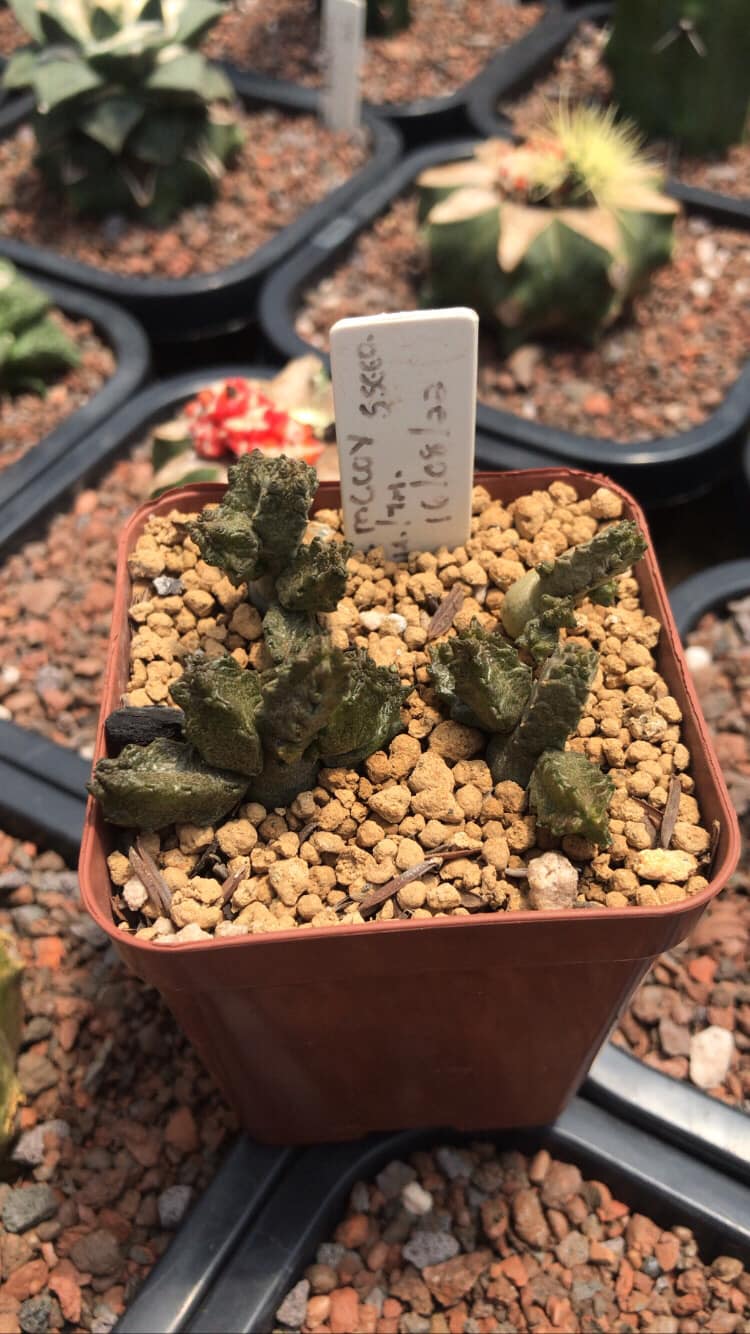
Pseudolithos mccoyi is predominantly encountered in trade as grafted plants. Unlike Cactaceae where grafting uses woody rootstocks (Pereskiopsis, Trichocereus), stapeliads graft onto compatible Asclepiadoideae: Ceropegia linearis is the most recommended rootstock for Pseudolithos species. Caralluma and Echidnopsis are also used. Graft bonding in stapeliads is rapid, typically three to five days, because the succulent flesh of both scion and stock acts as a natural adhesive. Grafting extends the viable life of plants that begin rotting by allowing small unblemished stem segments to be rescued before collapse. Seed grown plants are slower and more demanding but produce more compact bodies with the natural freely-branching character of the species.
Seed is described as rarely available in trade; only P. migiurtinus and P. cubiformis have reliably sourceable seed. When fresh seed of P. mccoyi is obtained, germination is not particularly difficult. The challenge is maintaining seedlings through the early stages before the plants develop their characteristic freely-branching habit; juvenile plants are more vulnerable to rot than established clumps.
Comparison
Within a genus of four species, the identification matrix is small. The most practically important comparison is P. mccoyi versus Pseudolithos caput-viperae, the only other freely-branching small-clumping species in the genus. Both species produce multi-stem clumps of modest size, which is the immediate shared character that causes confusion in collections and at sales. The FAQ below provides the full identification table; the key characters are stem shape and geography.
P. mccoyi produces clearly four-angled slender finger-like stems with prominent triangular podaria at the corners and a finely wrinkled dark powdery-brown surface. P. caput-viperae produces conjoined stone-like bodies with a tessellated, raised-tubercle surface and a rounded snake-head profile (the name means “viper’s head”). In hand, the stem geometry is unambiguous: the angular, finger-like stems of mccoyi versus the rounded, conjoined bodies of caput-viperae are distinct at any viewing angle. Geography provides a second clean separator: P. mccoyi is from Oman and Yemen; P. caput-viperae occurs in the Horn of Africa. Any purchase documentation showing Arabian Peninsula provenance points to mccoyi unambiguously.
The comparison with the two larger solitary species is less practically urgent. Pseudolithos cubiformis produces squat, angular cube-like grey-green bodies that are predominantly solitary and grow substantially larger than either freely-branching species. P. migiurtinus, the type species, is a rounded pebble mimic with a smooth surface that lacks the angular geometry of either branching species. Both solitary species are recognisable on habit alone once the freely-branching character of P. mccoyi and caput-viperae is established as the first filter.
Frequently asked questions
How do you tell Pseudolithos mccoyi apart from Pseudolithos caput-viperae?
Both Pseudolithos mccoyi and Pseudolithos caput-viperae are the only freely-branching small-clumping species in the genus; a collector holding small-clump photographs will confuse them far more readily than either with the larger solitary species. Drag the slider to compare both plants, then check the character table.


The fastest field check is stem form: clearly four-angled finger-like stems with triangular ridges at the corners are P. mccoyi; conjoined rounded bodies resembling snake heads are caput-viperae. Geography confirms the identification unambiguously: any purchase label showing Arabian Peninsula origin points to mccoyi; Horn of Africa provenance points to caput-viperae.
Is Pseudolithos mccoyi hard to grow?
Yes, and the difficulty is not modest. Multiple independent cultivation sources describe it as among the most challenging species in a genus already regarded as difficult. The core problem is rot management: the stem base is highly susceptible, and both overwatering and underwatering can trigger rapid collapse. The 100% mineral substrate, the unusual horizontal stem-placement instruction, and the 10°C minimum temperature all require active management. Grafted plants on Ceropegia linearis are substantially more forgiving than ungrafted plants, which is why grafted specimens dominate the trade supply.
Is Pseudolithos a cactus?
No. Pseudolithos belongs to the family Apocynaceae (subfamily Asclepiadoideae, the stapeliads), not Cactaceae. The stone-mimicking body form, extreme drought adaptation, and collector appeal are convergent with rare cacti, not phylogenetically related. Stapeliads are milkweed relatives; they produce latex, carrion-scented fly-pollinated flowers, and paired follicle fruits with wind-dispersed comose seeds. None of those characters are found in Cactaceae. The practical cultivation overlap is real: mineral-only substrate, summer-active watering, high minimum temperatures, and a strong preference for a dry winter rest all apply to both groups.
Where does Pseudolithos mccoyi grow in the wild?
On Tertiary limestone coastal terrain near Mirbat, Dhofar Governorate, Oman, at approximately 80 m elevation, and in adjacent southern Yemen according to POWO (with no published locality data for the Yemeni part of the range). The Mirbat type locality is on the eastern Dhofar coast, a hot, dry maritime zone that sits below and east of the main khareef fog belt affecting the Dhofar jebel escarpment. Soils at the type locality are thin, mineral, and fast-draining, formed over Tertiary limestone karst with no organic horizon. This is the only Arabian Peninsula species in the genus; the other three species occur in the Horn of Africa, separated by the Gulf of Aden.
Can Pseudolithos mccoyi be propagated from seed?
Seed is available only rarely. Only P. migiurtinus and P. cubiformis have reliably sourceable seed in the trade; P. mccoyi seed is essentially absent from commerce. When fresh seed is obtained, germination itself is not particularly difficult; the challenge is maintaining seedlings through the early stages before the freely-branching habit is established. Grafting onto Ceropegia linearis or compatible Caralluma rootstocks is the practical propagation path for most collectors; it rescues rotting plants, accelerates growth, and produces the bulk of trade stock.
What distinguishes Pseudolithos mccoyi from the rest of the genus?
Two features set it apart from all other Pseudolithos species. First, geography: it is the only species in the genus from the Arabian Peninsula, separated from its congeners by the Gulf of Aden. Second, it shares the freely-branching quadrangular finger-like stem form only with P. caput-viperae, but even that comparison is resolved by stem texture and flower size (see the identification table above). Within the genus, the closest known relatives to P. mccoyi on a morphological basis are the freely-branching congeners; molecular work has not yet placed all Pseudolithos species into a resolved phylogeny. The 2001 description date makes P. mccoyi the most recently described species in the genus.
Sources & further reading
Lavranos, J.J. & Mies, B. (2001). Pseudolithos mccoyi sp. nov. Asklepios 82: 29 · IPNI. Pseudolithos mccoyi Lavranos & Mies. urn:lsid:ipni.org:names:1020802-1 · Kew POWO. Pseudolithos mccoyi Lavranos & Mies. powo.science.kew.org · Meve, U. & Liede, S. (2002). A molecular phylogeny and generic rearrangement of the stapelioid Ceropegieae. Plant Systematics and Evolution 234: 171–209 · Bruyns, P.V., Klak, C. & Hanacek, P. (2017). A revised, phylogenetically-based concept of Ceropegia. South African Journal of Botany 112: 399–436 · llifle.com Encyclopedia of Living Forms, Pseudolithos mccoyi entry ID 12771 · Bihrmann, S. (c. 2010–2020). Caudiciform plant database: Anomalluma mccoyi · Asclepiad Exhibition (asclepiad-exhibition.org). Notes: Pseudolithos and Quaqua · Henry Shaw Cactus and Succulent Society (2009). Pseudolithos: Plant of the Month · Spikes and Spines (blog, 2015). Asklepios 120 and growing Pseudolithos · McCoy, T.A. (2012). Sulcolluma mirbatensis, an unique new species from Oman. Cactus and Succulent Journal (US) 84(2): 100–103 · World of Succulents. Huernia mccoyi (Tom McCoy biography) · MBG Ecological Restoration (2015). Dhofar: Oman’s vertical fog oasis on the edge of the unknown · Quaternary Research / Cambridge Core. Vegetation dynamics in Dhofar, Oman. doi:10.1017/qua.2019.79