
Lithops optica ‘Rubra’
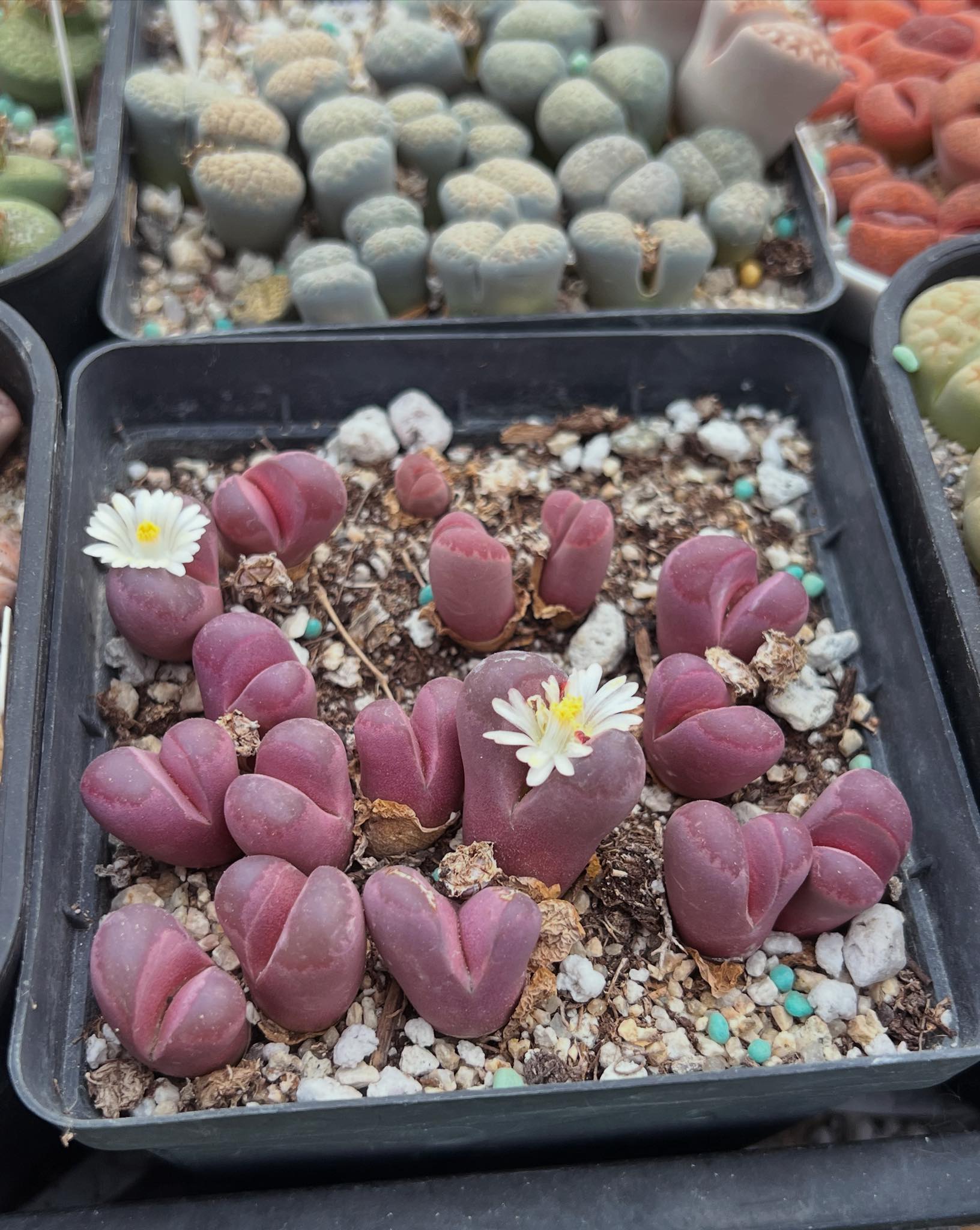
Lithops optica ‘Rubra’ is the iconic ruby to wine-purple cultivar of the Sperrgebiet living-stones species, and the most photographed selection in the entire Lithops trade. The cultivar has been in continuous nursery cultivation since at least 1925, when Georg Tischer published Mesembryanthemum opticum var. rubrum in Zeitschrift für Sukkulentenkunde from specimens collected on the coastal strip west of Lüderitz. N.E. Brown elevated the form to species rank as Lithops rubra in Gardeners’ Chronicle in 1926; Jacobsen demoted it to forma in 1933; modern horticultural practice under the International Code of Nomenclature for Cultivated Plants treats the form as the cultivar ‘Rubra’, in single quotes and not italicised, superseding the earlier botanical-rank names. The Lithops International Cultivar Registration Authority was established in August 2013 under Keith Green with International Society for Horticultural Science sanction; ‘Rubra’ is the earliest-known and commercially dominant colour form in the genus.
Plants of ‘Rubra’ in the global trade are overwhelmingly nursery-propagated. The cultivar predates modern Namibian wildlife protection by more than half a century, and every reputable specialist nursery sells it as seed-grown stock with documented provenance running back through F2 and F3 rubra-to-rubra crosses. Buying a nursery ‘Rubra’ is fully legal worldwide, requires no CITES paperwork because the family Aizoaceae sits outside the Cactaceae Appendix-II listing, and actively contributes to ex-situ conservation by sustaining commercial demand on cultivated stock rather than creating an economic signal that rewards illegal wild collection. The parent Lithops optica carries an IUCN Critically Endangered (2024) assessment, with the entire wild population confined to the diamond-restricted Sperrgebiet (Tsau //Khaeb National Park) near Lüderitz; the full Sperrgebiet legal framework, the 2024 IUCN reclassification, and the Namibian Nature Conservation Ordinance and Forest Act provisions are covered on the parent species page.
Visually, ‘Rubra’ is the same plant as the nominate L. optica in every dimension except colour. Body geometry is the standard optica oblong obconical (inverted cone), up to 20 mm tall and roughly 15 by 12 mm at the dorsal face. Window geometry is identical: the near-complete translucent window that covers most of the dorsal surface and gives the species its name (Latin opticus, of the eye) is the largest proportionate window in the genus. What ‘Rubra’ does that the nominate does not is load that window with anthocyanin pigment. The body sides shift from grey-green to milky pink and reddish-purple; the window itself runs from light ruby-red to deep dark ruby depending on light intensity and the season. The deepest pigmentation appears in autumn and early winter when light hours are dropping and night temperatures are falling, exactly when the plant is in its active growth and flowering phase.
Within the genus, ‘Rubra’ sits alongside the anthocyanin-free albinic selections at the opposite end of the pigment spectrum: L. lesliei ‘Albinica’ and L. lesliei ‘Storm’s Albinigold’ are the cream-bodied photographic foils to the ruby-purple ‘Rubra’. The cultivation calendar for ‘Rubra’ is the standard inverted Lithops schedule (active autumn through early spring, dormant summer) with one specific deviation: L. optica is a late-flowering outlier that blooms after the winter solstice (December–January in cultivation), several weeks to two months later than the autumn-flowering majority of the genus exemplified by Lithops lesliei. This shifts the autumn watering restart later for ‘Rubra’ growers; calibrate to the actual flower timing, not to the genus-standard October–November bud.
Lithops optica ‘Rubra’ quick reference
A coastal mist-belt cultivar of the Sperrgebiet living-stones species; care matches the parent L. optica in every dimension except light, where bright exposure is essential to express the cultivar’s ruby anthocyanin pigmentation, and in the watering calendar, where the late-flowering window (December–January, after the winter solstice) shifts the autumn watering restart later than for autumn-flowering Lithops. Values calibrated for seed grown plants in cultivation, drawn from L. optica-specific habitat data and grower consensus across multiple Lithops cultivation sources rather than genus-level extrapolation.
Taxonomy & nomenclature
The current accepted designation is Lithops optica (Marloth) N.E.Br. cv. ‘Rubra’, with the cultivar name in single quotes and not italicised per the International Code of Nomenclature for Cultivated Plants. The form was first described by Georg Tischer as Mesembryanthemum opticum var. rubrum Tischer in Zeitschrift für Sukkulentenkunde 2: 65 (1925). N.E. Brown elevated it to species rank as Lithops rubra (Tischer) N.E.Br. in Gardeners’ Chronicle series 3, 79: 116 (1926); Tischer published the parallel combination L. optica var. rubra in Möller’s Deutsche Gärtnerei-Zeitung 41: 330 (1926); Hermann Jacobsen demoted it to forma rank as L. optica f. rubra in Sukkulentenkunde 148 (1933). All four botanical-rank names refer to the same plant and are treated by Kew POWO as synonyms of the parent species L. optica; the cultivar designation is the modern horticultural standard.
The Lithops International Cultivar Registration Authority was established in August 2013 under Keith Green of Scrapbooklithops, sanctioned by the International Society for Horticultural Science. ‘Rubra’ is the earliest-known and commercially dominant colour form in the genus and carries a continuous nursery cultivation lineage from the 1925 founding collection through unbroken twentieth-century European, Japanese, and American succulent commerce. Some specialist vendors still list the plant under the older botanical names (var. rubra, f. rubra, or occasionally just L. optica rubra without quotes); all refer to the same cultivar. Cole’s 2005 monograph Lithops: Flowering Stones is the primary monographic authority for the cultivar boundary and confirms the synonymy trail above.
The parent species L. optica (Marloth) N.E.Br. was established by N.E. Brown in The Gardeners’ Chronicle series 3, 71: 80 (18 February 1922), transferring Marloth’s 1909 Mesembryanthemum opticum into the new genus Lithops. POWO recognises no infraspecific taxa under L. optica; the ‘Rubra’ cultivar is a horticultural selection rather than a formal botanical rank.
Habitat
Habitat is shared with the parent L. optica and is covered in detail on the parent species page; the summary here is enough to place ‘Rubra’ growers’ cultivation choices in context. The cultivar was collected from the same coastal strip as the nominate, on the Lüderitz coast inside the Sperrgebiet (Tsau //Khaeb National Park), Namibia. LLIFLE catalogues two specific rubra-form locality records: Cole 081A at 10 km west of Lüderitz, and Cole 311 at 45 km southeast of Lüderitz. Both sites are coastal, near sea level, on Precambrian basement-rock sandy gravel, within roughly 100 km of Lüderitz and entirely within Sperrgebiet territory.
The climate is the most distinctive of any Lithops on this site: coastal mist-belt, predominantly winter rainfall, 20–50 mm annually, supplemented by 180+ Atlantic fog days per year. The cold Benguela Current upwelling moderates temperature year-round; coastal Lüderitz typically runs 9–20°C with no recorded hard frost. This sets the cultivation baseline: 5°C dry as the cold floor (warmer than the genus-default 2°C), and watering protocol that respects a fog-supplemented coastal-desert origin rather than the inland summer-rainfall regime of L. lesliei. The colour difference between ‘Rubra’ and the nominate is also habitat-relevant: the rubra anthocyanin pigmentation is documented as a natural colour variant in habitat, not a horticultural selection arising in cultivation, and was the form Tischer collected for the 1925 description.
Morphology
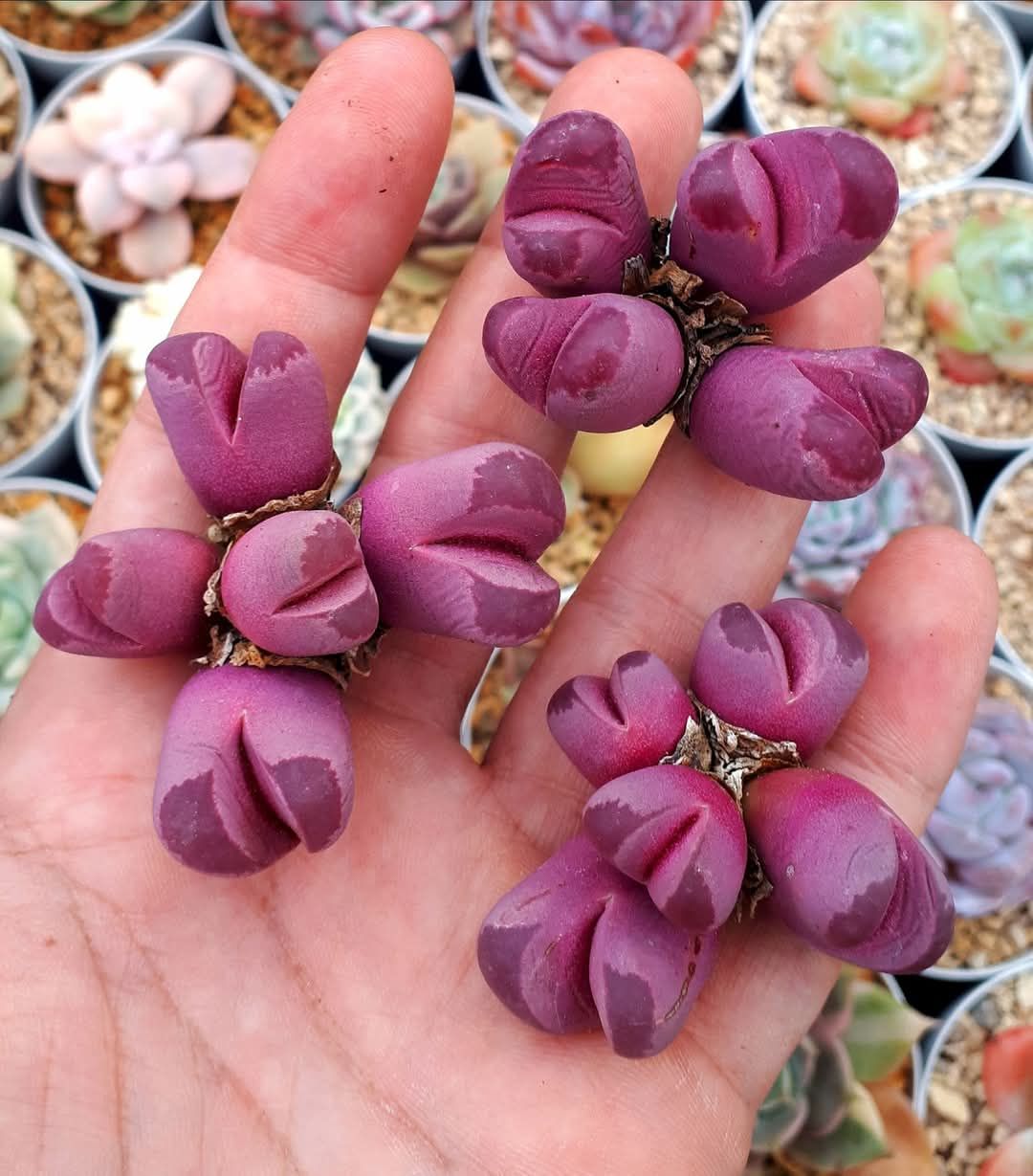
Body architecture is identical to the nominate L. optica in every measurable dimension. A single pair of fused leaves forms an oblong obconical (inverted cone-shaped) body, often with unequal leaf-pair halves, up to 20 mm tall and roughly 15 by 12 mm at the dorsal face. The body sits flush with the soil surface, almost stemless, with only the dorsal face exposed. Plants form clumps of multiple heads in cultivation over time. What ‘Rubra’ does that the nominate does not is replace the cool grey-green pigment palette with warm anthocyanin-driven ruby and wine-purple. The body sides (the flanks of the leaf pair, visible above the soil line) are milky pink to reddish-purple. The dorsal window surface, which in the nominate is whitish-grey to nearly clear, in ‘Rubra’ ranges from light ruby-red to deep dark ruby depending on light intensity and the season.
The window itself is the species’s defining character and the cultivar inherits it unchanged in geometry. L. optica has the largest proportionate window in the Lithops genus, covering nearly the entire dorsal face with minimal internal patterning. In the nominate the window is so transparent that the green photosynthetic interior is visible through it in well-grown specimens; in ‘Rubra’ the same near-clear window is loaded with anthocyanin pigment, producing the cultivar’s characteristic deep ruby effect. This contrasts sharply with the dense red-brown channelled lines of Lithops karasmontana or the lip-smear face markings of Lithops julii; ‘Rubra’ reads as a single ruby plate rather than as a patterned face.
Flowers are white, sometimes with pink-flushed petal tips, daisy-like, 12–25 mm in diameter, opening in the late afternoon and closing at dusk. The species is self-sterile; cross-pollination between two genetically distinct plants is required for seed set. Flower colour does not differ between ‘Rubra’ and the nominate; the ruby pigment is a vegetative character only. The flowering window is the cultivar’s second cultivation distinction (the first being light requirements): L. optica as a species flowers after the winter solstice, December–January in cultivation, which is several weeks to two months later than the October–November flush of most Lithops. The deepest ruby pigmentation in ‘Rubra’ appears in autumn and early winter as light hours drop and night temperatures fall, exactly when the plant is in its active growth and flowering phase. Summer dormancy often lightens the body even on well-lit plants.
Genetics are the cultivar’s single most-asked-about feature among growers planning to raise plants from seed. The rubra pigmentation is recessive relative to the grey-green nominate colouration. Seed labelled as ‘Rubra’ by ‘Rubra’ (both parents rubra-coloured) will produce a phenotypically mixed batch: a fraction of seedlings will express rubra pigmentation, but many will germinate as grey-green nominate-type plants. This is honest seed and honest labelling; reputable specialist vendors specify F2 or F3 rubra-to-rubra crossing history on their packets, which increases the rubra-coloured proportion above the basic Mendelian ratio without ever fixing it at 100%. Vegetative division of multi-headed clusters is the only propagation method that guarantees rubra colouration in offspring; seedlings that do not show pink colouration in their first true leaf pair will not colour up later under better light.
Locality detail
Two specific Cole-numbered field localities are documented for the rubra form, both inside the Sperrgebiet coastal strip near Lüderitz: C081A at 10 km west of Lüderitz, and C311 at 45 km southeast of Lüderitz. Both are coastal sites near sea level on Precambrian basement-rock sandy gravel, the same substrate matrix as the nominate L. optica populations across the wider species range. Plants at these sites are camouflaged into the gravel by the ruby-purple body colour, which closely matches the iron-stained quartz pebbles in the local mineral mix; collectors in the era before the Sperrgebiet access restriction tightened in the late twentieth century reported the plants as easier to spot than the grey-green nominate against the same background, an artefact of the warm pigment standing out against the cool gravel rather than blending into it.
The Sperrgebiet (Tsau //Khaeb National Park) has been a restricted area since 1908, when the colonial administration declared it off-limits to unauthorised persons under the diamond-mining exclusion. It was redesignated as a national park in June 2004 and is governed under Namibia’s Nature Conservation Ordinance 4 of 1975. Entry without a Ministry of Environment, Forestry and Tourism permit is illegal, and collection of any plant from inside the park is specifically prohibited. The full legal framework, the 2024 IUCN Critically Endangered reclassification, and the recent Namibian succulent-poaching enforcement record are covered on the parent L. optica species page; the locality framing here exists to place ‘Rubra’ geographically rather than to repeat the parent’s legal treatment.
Lithops optica ‘Rubra’ care and cultivation
‘Rubra’ cultivation matches the parent L. optica in every dimension except light. The genus-default 95/5 mineral substrate, the inverted seasonal calendar (active autumn through early spring, dormant summer), the 5°C dry cold floor reflecting the frost-free coastal habitat, and the unglazed terracotta container preference are all identical to the nominate species. What ‘Rubra’ growers must add is a strict light discipline: the cultivar’s defining ruby anthocyanin pigmentation is light-dependent and temperature-sensitive, and pallid plants in shade are the single most common ‘Rubra’ cultivation failure that delivers a live plant rather than a dead one. Watering also runs on a calendar shifted later than autumn-flowering Lithops, tracking the December–January post-solstice flower characteristic of the species.
Substrate
‘Rubra’ is grown on the same house mesemb formulation as the parent species: 33% pumice (3–5 mm), 12% lava rock (5–10 mm, structural drainage aggregate), 10% zeolite (clinoptilolite, 4–6 mm), 20% granite grit (3–5 mm), 0% limestone, 20% coarse silica grit (1–3 mm angular crystalline quartz), and 5% worm castings as the sole organic component. No cultivation source distinguishes this cultivar, or optica generally, from any other Lithops on silica share, granite share, or lime preference; the zeolite already buffers the mix toward neutral pH. The lava fraction aerates the lower pot volume through the active autumn-winter season. Pot in unglazed terracotta or clay composite, 10–12 cm deep; never glazed ceramic. The porosity of unglazed clay accelerates drying around the rot-prone collar zone.
All 16 Lithops on this site use one flat mineral formulation: the 95/5 mesemb baseline (95% inorganic, 5% organic), higher than the 90/10 cactus default used elsewhere on this site. No cultivation source at any tier distinguishes substrate practice between Lithops species, so every row below carries the same house formulation rather than sixteen separate findings. Silica sits at 20% and limestone at 0% as continuity conventions, not evidenced per-species figures.
| Species | Pumice | Lava | Zeolite | Granite | Limestone | Silica | Organic |
|---|---|---|---|---|---|---|---|
| L. lesliei | 33% | 12% | 10% | 20% | 0% | 20% | 5% |
| L. karasmontana | 33% | 12% | 10% | 20% | 0% | 20% | 5% |
| L. karasmontana subsp. bella | 33% | 12% | 10% | 20% | 0% | 20% | 5% |
| L. karasmontana subsp. amicorum | 33% | 12% | 10% | 20% | 0% | 20% | 5% |
| L. karasmontana ‘Top Red’ | 33% | 12% | 10% | 20% | 0% | 20% | 5% |
| L. burchellii | 33% | 12% | 10% | 20% | 0% | 20% | 5% |
| L. lesliei ‘Albinica’ | 33% | 12% | 10% | 20% | 0% | 20% | 5% |
| L. lesliei ‘Storm’s Albinigold’ | 33% | 12% | 10% | 20% | 0% | 20% | 5% |
| L. pseudotruncatella | 33% | 12% | 10% | 20% | 0% | 20% | 5% |
| L. dendritica | 33% | 12% | 10% | 20% | 0% | 20% | 5% |
| L. optica | 33% | 12% | 10% | 20% | 0% | 20% | 5% |
| L. optica ‘Rubra’ (this page) | 33% | 12% | 10% | 20% | 0% | 20% | 5% |
| L. aucampiae | 33% | 12% | 10% | 20% | 0% | 20% | 5% |
| L. aucampiae subsp. koelemanii | 33% | 12% | 10% | 20% | 0% | 20% | 5% |
| L. julii | 33% | 12% | 10% | 20% | 0% | 20% | 5% |
| L. julii subsp. fulleri | 33% | 12% | 10% | 20% | 0% | 20% | 5% |
Light and pigment expression
This is the load-bearing cultivar-specific cultivation note. The ruby anthocyanin pigmentation is UV-responsive and temperature-sensitive: it intensifies under bright light and cool nights, and fades in shade or warmth. Plants grown in insufficient light do not turn red. They remain green or pale and lose the entire visual character that defines the cultivar. A windowsill-grown ‘Rubra’ receiving three to four hours of weak autumn sun will stay pallid indefinitely; a greenhouse-grown specimen with strong light and cool autumn nights deepens to near-black purple as temperatures drop. Practical rule: ‘Rubra’ needs the same bright direct sun as the nominate, with five to six hours daily as the floor, and is less forgiving of shortfall because the colour consequence is visible and immediate. The deepest ruby pigmentation appears in autumn and early winter when both light hours are declining and night temperatures are dropping, exactly when the plant is in its active growth and flowering phase.
Watering and the late flower
The watering calendar is inverted relative to every cactus on this site, and shifted later than most Lithops because of the species’s post-solstice flowering. In Northern Hemisphere cultivation: full dormancy May through August (no water at all; wrinkled bodies in summer are normal and not a watering signal), watch and wait through September, first light water in early November once the new leaf pair is visibly pushing at the fissure, active watering November through January (water thoroughly to runoff, then let the mix dry completely over 10–14 days; this is the December–January flowering window), tapered watering February and March (every 3–4 weeks maximum, and never while the old leaf pair is mid-transfer to the new pair), final water March or April, then stop. Growers experienced with autumn-flowering Lithops sometimes start the autumn restart too early on the genus-standard October calendar and find ‘Rubra’ plants burst their skins or rot. Calibrate to the actual emergence of the new leaf pair and the actual flower timing, not to the genus-standard October bud.
Cold tolerance and propagation
The dry cold floor is 5°C; the Lüderitz coastal habitat is frost-free year-round under Benguela Current moderation, and the species has no frost experience to draw on. This is warmer than the 2°C genus-default and noticeably warmer than the −2°C floor appropriate for the Highveld-grassland L. lesliei. Wet cold at any temperature near freezing is fatal. Propagation runs on two paths. Seed germinates readily in 2–3 weeks at 20–25°C day with cooler nights, surface-sown on a moist mineral seedling mix; first flower follows at 3–5 years under good cultivation, but seed-grown batches from rubra-by-rubra crosses are phenotypically mixed because the rubra trait is recessive. Vegetative division of multi-headed clusters is the only method that guarantees rubra colouration in offspring; carefully separate divisions in spring once the old leaf pair is fully retired, with each division containing at least one head plus a root fraction. Most growers leave clumps undivided, since plants prefer to grow as clusters.
Comparison
The closest comparison is the parent L. optica itself: same body geometry, same window architecture, same habitat, same flower; only the pigment differs. Plants of the nominate carry the cool whitish-grey to grey-green palette, with the dorsal window so transparent that the green photosynthetic interior shows through. ‘Rubra’ loads the same window with anthocyanin and produces the warm ruby plate that defines the cultivar. The parent species page covers the IUCN Critically Endangered assessment, the Sperrgebiet legal framework, and the wider L. optica ecology; the cultivar page concentrates on the colour and the cultivation deviations that follow from it.
Across the broader genus, ‘Rubra’ sits at one extreme of the Lithops pigment spectrum. The opposite extreme is anthocyanin loss: the cream-bodied L. lesliei ‘Albinica’ and the parallel C036B yellow-flowering selection ‘Storm’s Albinigold’ are the photographic foils to ‘Rubra’, both selecting against the pigment that ‘Rubra’ selects for. Among patterned-face Lithops, the dense red-brown channelled lines of L. karasmontana, the brick-red lacework of L. karasmontana ‘Top Red’, and the intricate lip-smear markings of L. julii are the warm-toned counterpoints to ‘Rubra’’s single ruby plate; all three rely on patterned face character for visual interest where ‘Rubra’ relies on single-colour intensity.
Cultivation difficulty places ‘Rubra’ in the intermediate to advanced bracket, harder than the beginner-friendly L. lesliei at the easy end of the genus and easier than the most demanding western winter-rainfall species. The two failure modes are calendar and light. Growers who carry the genus-standard October watering restart across to a ‘Rubra’ plant find the new pair has not yet emerged; growers who give it three or four hours of weak windowsill light end up with a healthy green plant that has lost the entire reason anyone bought a ‘Rubra’ in the first place.
Frequently asked questions
Is Lithops optica ‘Rubra’ hard to grow?
Intermediate to advanced. The two failure modes are calendar and light. L. optica flowers later than most Lithops (December–January in cultivation, two months after the October–November genus norm), so growers who carry the standard autumn watering restart across find ‘Rubra’ plants burst their skins or rot before the new leaf pair has emerged. Light is the second challenge: the cultivar’s defining ruby anthocyanin pigment is light-dependent and temperature-sensitive, and plants in shade lose the entire visual character that defines the cultivar. A windowsill ‘Rubra’ with three or four hours of weak sun stays pallid green indefinitely. Bright direct sun, the late-flowering calendar, and the absolute summer-dormancy requirement are the three things to get right.
Can Lithops optica ‘Rubra’ be grown from seed?
Yes, but with a recessive-genetics caveat. Seeds are widely available from specialist Lithops nurseries; they germinate readily in 2–3 weeks at 20–25°C day temperature with cooler nights, surface-sown on a moist mineral seedling mix, and reach first flower at 3–5 years under good cultivation. The catch is that the rubra pigmentation is recessive relative to the nominate grey-green colouration. A seed packet labelled ‘Rubra’ by ‘Rubra’ (both parents rubra-coloured) yields a phenotypically mixed batch: a fraction of seedlings express the cultivar pigment, but many germinate as grey-green nominate-type plants. F2 and F3 rubra-to-rubra crosses from established lines (rareplant.me, Cape Succulent Seeds, others) increase the rubra-coloured proportion but never fix it at 100%. Vegetative division of multi-headed clusters is the only propagation method that guarantees rubra colouration in offspring.
Is Lithops optica ‘Rubra’ legal to own?
Yes. Nursery-propagated ‘Rubra’ is fully legal to buy, own, and import or export anywhere in the world without CITES paperwork. The family Aizoaceae is not listed under CITES (the Cactaceae blanket Appendix-II listing does not extend to mesembs), so international trade in nursery stock is unrestricted by treaty. The cultivar has been in continuous nursery cultivation since at least 1925, predating modern Namibian wildlife protection by more than half a century, and every reputable specialist nursery sells it as seed-grown stock. The legal prohibition that applies to L. optica covers wild collection from the Sperrgebiet (Tsau //Khaeb National Park) in Namibia, which is illegal under Namibian Nature Conservation Ordinance 4 of 1975 and Forest Act 12 of 2001 with active enforcement by the Ministry of Environment, Forestry and Tourism. Nursery purchase from a documented-provenance specialist is the legally and ethically defensible route, and actively supports ex-situ conservation by removing commercial demand from the Critically Endangered wild population. Full Sperrgebiet legal framework is covered on the parent L. optica species page.
Where does Lithops optica grow in the wild?
Endemic to the Lüderitz coastal zone in southwestern Namibia, inside the Sperrgebiet (Tsau //Khaeb National Park). All known wild populations sit within roughly 100 km of Lüderitz, on coastal sandy-gravel Precambrian basement rock at near sea level, sustained by Atlantic fog (180+ fog days per year) and sparse winter rainfall (20–50 mm annually) under the moderating influence of the cold Benguela Current. The specific rubra-form locality records are Cole 081A at 10 km west of Lüderitz and Cole 311 at 45 km southeast of Lüderitz, both in the same Sperrgebiet coastal strip. The Sperrgebiet has been a restricted diamond-mining zone since 1908 and a national park since 2004; the access restriction provides de facto protection of the wild population on top of the legal prohibition. Full habitat and ecology are covered on the parent L. optica species page.
When does Lithops optica ‘Rubra’ flower?
December to January in Northern Hemisphere cultivation, later than most other Lithops which flower October to November. This late-flowering character is inherited from the parent L. optica and is the species’s defining seasonal outlier within the genus: L. optica blooms after the winter solstice in its Southern Hemisphere habitat, and the calendar timing tracks the Northern Hemisphere winter rather than inverting in cultivation. Flowers are white, sometimes with pink-flushed petal tips, daisy-like, 12–25 mm in diameter, opening in the late afternoon and closing at dusk. Flower colour does not differ between ‘Rubra’ and the nominate; the ruby pigment is a vegetative character only. The species is self-sterile, so seed production in cultivation requires hand pollination between two genetically distinct plants. The late-flowering window has practical consequences for the watering calendar, which runs roughly two months later than for autumn-flowering Lithops such as L. lesliei.
Sources & further reading
Tischer, G. (1925). Mesembryanthemum opticum var. rubrum. Zeitschrift für Sukkulentenkunde 2: 65 · Brown, N.E. (1926). Lithops rubra (Tischer) N.E.Br. Gardeners’ Chronicle series 3, 79: 116 · Jacobsen, H. (1933). Lithops optica f. rubra. Sukkulentenkunde 148 · Cole, D.T. and Cole, N.A. (2005). Lithops: Flowering Stones (2nd ed.). Cactus & Co · LLIFLE, Encyclopedia of Living Forms. Lithops optica cv. rubra. llifle.com/Encyclopedia/SUCCULENTS/Family/Aizoaceae/13181/Lithops_optica_cv._rubra · LLIFLE. Lithops optica f. rubra. llifle.com/Encyclopedia/SUCCULENTS/Family/Aizoaceae/13185/Lithops_optica_f._rubra · LLIFLE. Lithops optica C081A and C311 locality entries (rubra form). llifle.com · PlantZAfrica / SANBI. Lithops optica (parent species habitat and ex-situ conservation framing). pza.sanbi.org/lithops-optica · Wikipedia. Lithops optica. en.wikipedia.org (IUCN Critically Endangered 2024 reference; assessors Loots, Van Wyk, Mannheimer, Burke, and Rugheimer) · Scrapbooklithops. Lithops International Cultivar Registration Authority (ICRA), established August 2013 under Keith Green. scrapbooklithops.com/cultivars.html · BCSS Forum. Lithops optica ‘rubra’ cultivation thread (light-dependent pigmentation). forum.bcss.org.uk/viewtopic.php?t=144191 · Conservation Namibia (2024). Plant poaching in Namibia (Forest Act 12 of 2001, Protected Plants Task Team enforcement statistics). conservationnamibia.com/articles/plant-poaching-2024.php · B.Willow (2025). The Danger of Illegal Poaching of Lithops and Why Cultivation Matters. bwillow.com · rareplant.me. Lithops optica cv Rubra F3 seed listing (rubra-to-rubra multi-generation crossing evidence). rareplant.me · Namibia Nature Conservation Ordinance 4 of 1975. faolex.fao.org