
Acanthocereus
Known Species
What is Acanthocereus and what makes it different from other cacti?
Acanthocereus is a small genus of night-flowering, columnar to sprawling cacti, with about seven to ten accepted species depending on the authority, since Kew POWO recognises up to roughly nineteen published names and botanists have split and merged them for over a century. The name joins the Greek akantha, a thorn, to the Latin cereus, a wax candle, so it reads as ‘spiny column’. Two characters set it apart: stems that are sharply three to five angled, almost winged, and lined with stout marginal spines, and large white funnel-shaped flowers that open only at night for moth pollinators. The best known member is A. tetragonus, the barbed-wire cactus behind the mass-market fairy castle houseplant.
Where does Acanthocereus grow in the wild?
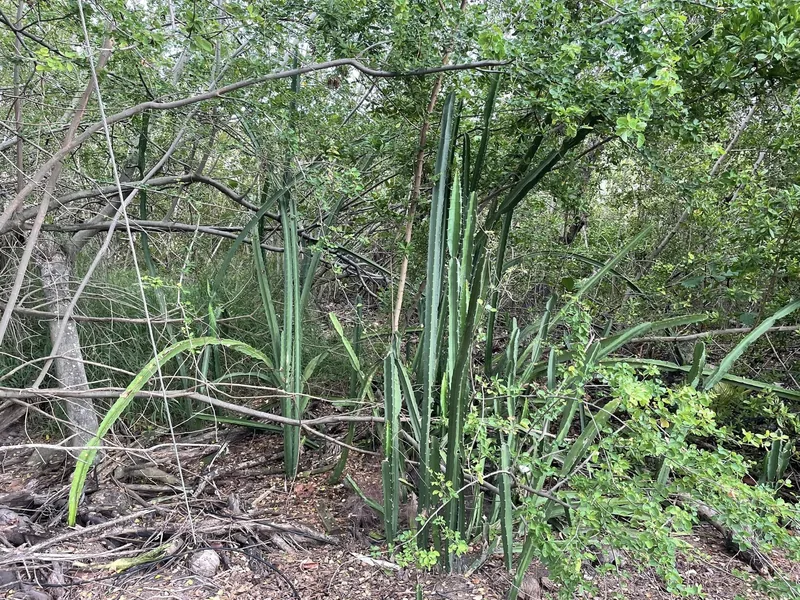
The genus is native across the warm Americas. Its range runs from southern Florida, the Keys and the lower Rio Grande Valley of Texas, through Mexico and Central America, across the Caribbean islands and on to northern South America in Colombia and Venezuela. These are plants of warm lowlands rather than high deserts: coastal hammocks, sandy thickets and hot dry scrub, often near the sea and tolerant of salt-influenced ground. The sprawling spiny stems clamber over other vegetation into dense thorny tangles, which people have long planted as living fences.
How big does Acanthocereus get?
In the wild these are large plants. A. tetragonus, the biggest and most widespread species, builds sprawling, clambering, almost tree-like stems that reach two to seven metres as they lean on other growth, each stem about six to eight centimetres across. Most species in the genus are similarly vigorous lowland growers. The famous exception is the fairy castle, a slow monstrose cultivar of A. tetragonus that stays around a foot tall in a pot and grows only an inch or two a year, a different scale entirely from the wild column it mutated from.
What do Acanthocereus flowers look like?
Large, white and nocturnal. The funnel-shaped blooms open after dark, often around midnight, are fragrant, and can be twelve to twenty-five centimetres long at the genus level, pollinated by hawk moths. They are followed by shiny red, egg-shaped fruit a few centimetres long that is sweet and edible. This night-blooming biology is worth remembering when shopping: a potted fairy castle seldom flowers, so the bright pink, red or yellow blooms seen on shelf plants are almost always fake straw-flowers glued or pinned on, not the real white night flower of the species.
How cold-hardy is Acanthocereus?
Treat the genus as tender and keep plants above about 10°C / 50°F for unstressed growth. As warm-lowland and coastal plants they have no real frost tolerance; the most widespread species sits around USDA zone 10, taking brief, bone-dry dips to near freezing at most, about −1°C / 30°F. Any hard or extended frost damages the soft tissue, and the monstrose fairy castle scars especially easily, so it must come indoors before temperatures approach freezing.
What substrate does Acanthocereus need in cultivation?
A gritty, sharply draining mineral mix, roughly half pumice with decomposed granite and a little lava and silica grit, plus only a small organic fraction. As a vigorous lowland and coastal grower rather than a rot-prone cliff miniature, the genus tolerates a touch more organic matter than a slow high-altitude species would, but fast drainage still matters far more than richness, and the soft monstrose tissue of the fairy castle makes free drainage matter more, not less. Skip limestone, and never let water stand at the base, since wet feet and rot are the main killers.
Is Acanthocereus legal to own?
Yes, Acanthocereus is legal to own, and nursery-grown plants are bought and sold freely. Like every cactus the genus sits on CITES Appendix II, the family-wide Cactaceae listing in force since 1975, rather than the stricter Appendix I, so nursery-grown plants are freely bought, sold and kept and only need export paperwork to cross borders. A. tetragonus is assessed as Least Concern and is common, even weedy where it has naturalised outside its range, so there is no conservation barrier to owning a cultivated plant, including the fairy castle.
Is the fairy castle cactus a real Acanthocereus species, and can you grow it from seed?
The fairy castle is not a species. It is the ‘Fairy Castle’ monstrose cultivar of Acanthocereus tetragonus, a slow, many-turreted mutant clone of the wild barbed-wire cactus, so it should never be written as a species or as A. tetragonus f. anything. And no, you cannot grow it true from seed: the castle habit is a somatic mutation, so a sown seed simply gives back an ordinary triangle cactus, and the cultivar is kept going only by rooting stem cuttings of castle tissue. At rarecactus.com we grow our cacti from seed in our own greenhouse, and the fairy castle is the exception we are upfront about, a vegetative monstrose cultivar propagated from cuttings rather than a seed grown plant, because cuttings are the only way to keep the castle form true. See the fairy castle Acanthocereus tetragonus page for the full story.
Further reading: trace any wild-collected specimen back to its origin in our Acanthocereus field numbers database.