
Avonia ustulata
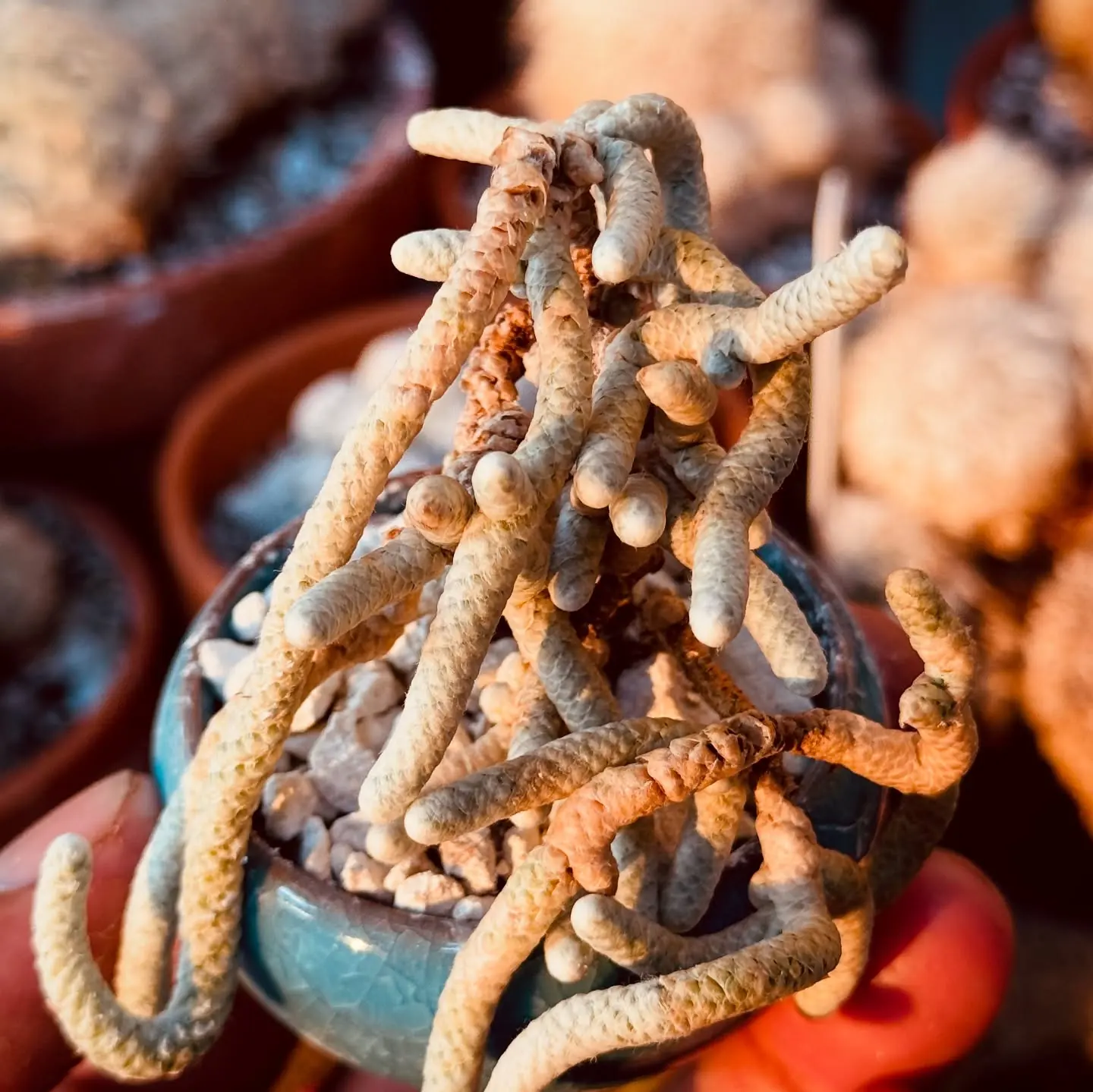
Avonia ustulata is the odd one out among the papery-scaled Avonia. Where its relatives sit on white quartz and match it, this one grows on the grey and yellowish shales of the Karoo and matches those instead, a dull silvery-grey tangle of worm-thin branches that reads at a glance as a bird dropping on the stone.
The camouflage is the whole plant in one observation. Avonia papyracea is comparatively much more white because it is matching quartz gravel; A. ustulata is dull because it is matching shale. Every cultivation decision for it follows from that one difference in rock, and it is why the substrate inverts the genus pattern rather than repeating it.
The plant itself is small and undemonstrative. Branches reach about 2.5 cm long and barely 2 mm thick, dividing dichotomously and sheathed in closely overlapping papery scales that hide the minuscule leaves underneath. Below them sits a caudex of 6 to 8 mm, partly underground, which enlarges over many slow years. Set beside the turnip caudex of Avonia quinaria or the 5 to 10 cm base of Avonia dinteri, this is no caudex showpiece, and it should not be sold as one.
What it has instead is a history. Its Afrikaans names, Kirriemoer and Moerbossie, both mean leaven: the root was dried, powdered and used to start the fermentation of karrie, a Cape honey beer whose name descends from Khoikhoi. Very few succulents on this site carry a documented job in someone’s kitchen.
Avonia ustulata quick reference
A shale plant of the interior Karoo and Free State, from a range that runs from summer rainfall to non-seasonal and never reaches a winter rainfall regime. It grows through the warm months and rests bone-dry. Values calibrated for seed grown plants in cultivation, drawn from habitat and specialist grower experience.
Taxonomy & nomenclature
The accepted name is Avonia ustulata (E.Mey. ex Fenzl) G.D.Rowley, the combination Gordon Rowley made in Bradleya 12 in 1994 when he segregated Avonia from Anacampseros on the strength of its tiny leaves hidden under papery stipular scales. Two major authorities disagree about whether that genus should exist. Kew’s Plants of the World Online recognises no Avonia at all and sinks every species back into Anacampseros, so under POWO this plant is Anacampseros ustulata. The GBIF backbone accepts Avonia ustulata as current and files the Anacampseros name as its synonym. Both names are correct under their own authority, and neither is a misspelling of the other.
This site follows GBIF and publishes under Avonia, which is also the name the trade and the collector literature use. A reader who arrives from Kew under Anacampseros ustulata is looking at the same plant under a different treatment. The family is Anacampserotaceae in either case. This is not a cactus, and none of the cactus conventions used elsewhere on this site apply to it.
The basionym carries a conflict that Kew has with itself. POWO and Rowley attribute the name to E.Mey. ex Fenzl, and SANBI follows them; IPNI, also published by Kew, attributes it instead to E.Mey. ex Sond. in Flora Capensis. Two different dates sit behind those two attributions, so no basionym year is settled: to publish one would be to pick a single author over the other. The authorities differ, and neither the basionym author nor its date is established. No subspecies or varieties are accepted, and the ‘Avonia ustulata v. mallei’ label that circulates in the trade is not a published name at any rank: the plant it refers to is the full species Avonia mallei.
In international trade the plant is covered by the CITES Appendix II listing of Anacampseros species, in force since 1975, which reaches Avonia through an annotation that expressly includes it; there is no separate Avonia listing to find. A later annotation exempts seed of artificially propagated plants, which is why seed moves without a permit. One member of the genus, A. quinaria, was moved up to Appendix I in 2026 and now sits under stricter rules; that transfer applies to that species alone and does not touch this one.
Historical synonym (1)
- Anacampseros ustulata E.Mey., homotypic synonym
Sources: GBIF
Habitat
Avonia ustulata is a South African endemic recorded from three provinces: the Eastern Cape, the Free State and the Western Cape. Herbarium collections put it from roughly 28 to 33 degrees south and 21 to 27 degrees east, a box some six hundred kilometres across in each direction, taking in Winburg, Bloemfontein, Fauresmith and Bethulie in the Free State, Colesberg, Queenstown and Graaff-Reinet in the Eastern Cape, and Prince Albert, Laingsburg and the Nieuweveld in the Western Cape. Nothing places it in Namaqualand, the Richtersveld, Bushmanland or Namibia, which is where most of the genus lives.
It grows on the grey or yellowish shales of the Karoo, the mudstones of the Beaufort Group, on ridges, low rocky rises and open flats rather than in valley bottoms. The vegetation around it is Nama Karoo dwarf shrubland for most of the range, grading into Succulent Karoo at the Prince Albert end and into Highveld grassland fringe in the Free State. No associated species has been recorded in the literature.
The colour of the plant is a direct read on the colour of the rock. It is dull where Avonia albissima and its quartz-field relatives are chalk-white, and the reference literature reads it as a bird-dropping mimic: something small, grey-brown and uninteresting on a stone, which is an effective way to not be eaten. This reading is not a settled fact.
Rainfall is where this species parts company with the genus, and it matters more than anything else to keeping it alive. The Free State localities take strong summer rain. The Eastern Cape Karoo core takes late-summer rain. The southwestern end around Prince Albert and Laingsburg is non-seasonal, with a little winter drift off the Swartberg. The range never reaches a winter-rainfall regime at all: that zone begins west of this plant’s western limit. Avonia herreana on its Richtersveld ridges is a winter-rainfall plant and wants the opposite calendar. These two are not interchangeable, and treating the genus as one growing season is how collections get killed.
Those Free State and eastern Karoo sites also take hard, regular winter frost, at a time of year when the plant is dormant and dry. That fact does real work in cultivation.
Morphology
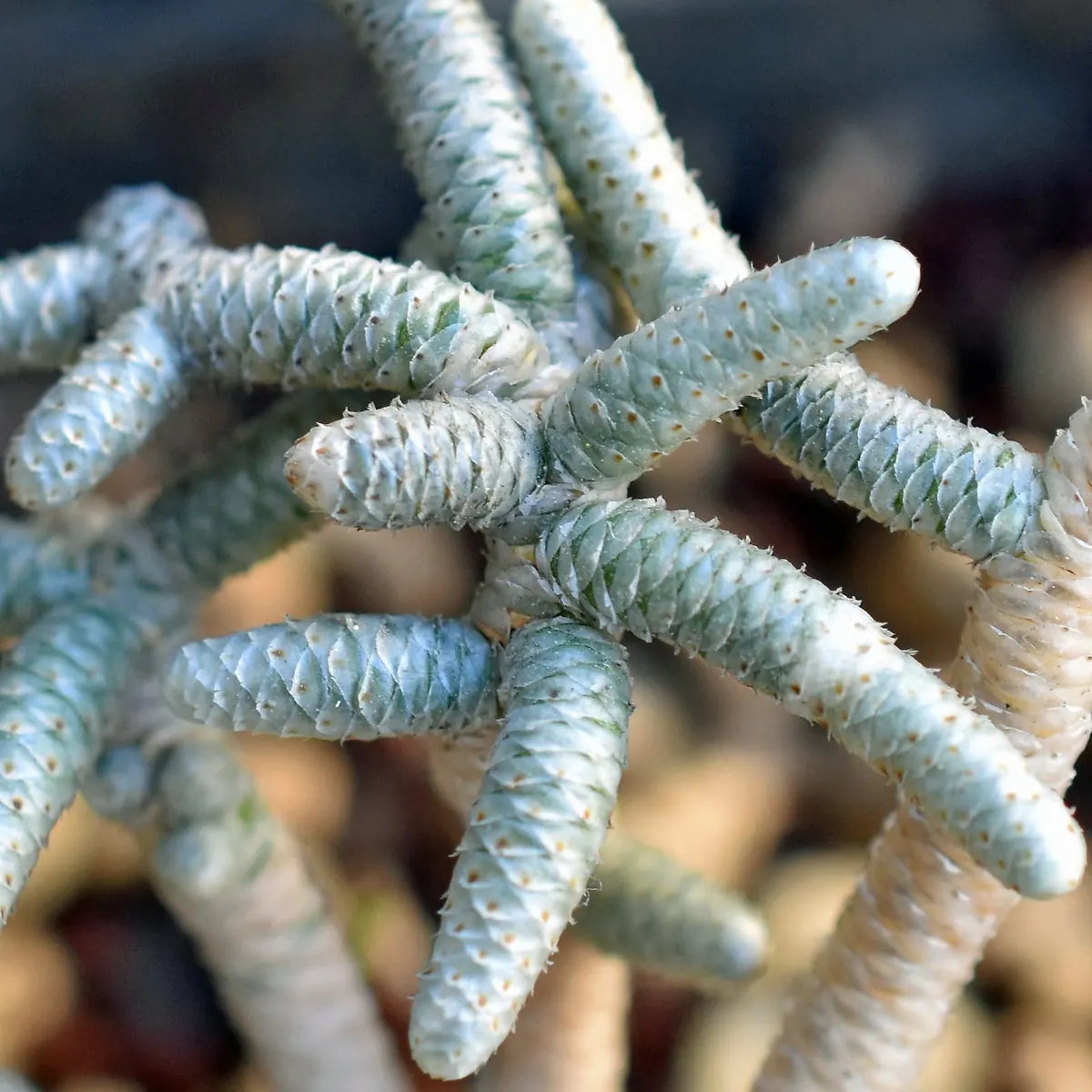
Avonia ustulata is a tiny tufted shrub whose silvery-grey, worm-like branches rise from a partly underground caudex, much branched from the base. That caudex runs 6 to 8 mm across and is more or less developed depending on age. The primary branches are about 2.5 cm long and barely 2 mm in diameter, straight or tortuose, dividing dichotomously and densely covered in closely imbricated papery scales. The leaves are minuscule and hidden beneath those scales, which is the character the whole genus is built on.
The stipules themselves are very minute, silvery-grey, broadly ovate-triangular, acute and closely adpressed. On the fertile stems, and only on the fertile stems, their apex stands out from the branch and is a rusty brown with a white margin. That is the scorched look the epithet records, ustulatus being Latin for singed.
It is worth being precise about the limits of that character, because it is the fastest way to identify the plant and also the easiest way to be wrong. It belongs to fertile stems. A sterile plant, a juvenile, or a mature plant out of its fertile phase shows silvery-grey adpressed stipules and nothing rusty at all, and will not key out this way. A fertile plant is flushed rusty brown at the scale tips; a sterile one stays silvery-grey with nothing rusty at all. The two look like different species and they are the same one.
Flowers are small, terminal and pale cream, equalling the involucre, which is about 2 mm long. The capsule is 3-valved and more than twice the length of the involucre. No flower diameter has been published, and the seed has not been described. Reports of large golden-yellow flowers on this species do circulate and are not supported by anything traceable; a plant whose branches are 2.5 cm long and whose involucre is 2 mm does not carry a centimetre-and-a-half bloom.
Locality detail
Avonia ustulata is recorded from three district clusters: the Free State around Bloemfontein, the Eastern Cape Karoo around Colesberg, and the Western Cape Karoo around Prince Albert. The three markers below are district centroids for those provinces, each anchored on real herbarium collections held at the National Herbarium in Pretoria and the Compton Herbarium, with one Polish museum sheet from 1937 among them. They are not point localities. The collectors behind them read as a roll-call of twentieth-century Karoo botany: Muller, Henrici, Briers, Retief, Bayer, Bruyns, Leistner, Shearing.
One record sits in the Northern Cape, on the Leeu-Gamka to Fraserburg road, in a spot that straddles the provincial line. The national Red List does not recognise a Northern Cape occurrence, and a single sheet is not a province: it may be a georeferencing slip or a misdetermination, and it is best treated as unconfirmed. No elevation has been published for any of these localities; they are all interior plateau country, and that is as far as the evidence goes.
Cultivation
Avonia ustulata is grown in a sharply drained, almost entirely mineral mix, watered through the northern summer and kept bone-dry through winter. The watering calendar follows the habitat rainfall regime; the substrate does not carry any lime, because no cultivation source recommends it for this species or its genus, and this page does not repeat the parent-rock reasoning that used to justify it. Its range runs from summer to non-seasonal rainfall, so there is no calendar inversion to remember.
Substrate
Use roughly 50 per cent pumice, 15 per cent lava rock, 15 per cent zeolite, 10 per cent granite grit, 5 per cent silica grit, 5 per cent worm castings and no limestone. That is 95 per cent mineral to 5 per cent organic, the rot-class figure this genus runs on. The organic fraction is the one component here with any cultivation support at all, and it points toward a gritty free-draining compost rather than a pure mineral bed, which is the direction this recipe already runs.
Limestone sits at zero rather than tracking the shale this species grows on. No source anywhere in the literature for this genus recommends lime for any Avonia, this species included, and the farm-name evidence and regional soil chemistry that used to support a limestone fraction here never rose above a reading of the rock; a pot is not a hillside, and what the parent material does at a locality is not evidence about what the plant wants in cultivation. Silica and granite are house-formulation grit, sized the same way they are on every other page in this genus rather than inverted to match a sibling’s quartz.
The zeolite at 15 per cent is a house-formulation figure, not a reading of the clay content in this species’ native soil profile. It supplies cation exchange without added water-holding mass, and 15 per cent is a house judgment call for this page rather than a species-specific finding; nothing published ties a zeolite percentage to this or any Avonia. Note what is absent. The recipe most widely repeated online, including in Google’s own summary, is only half mineral and leans on a lightweight white aggregate that floats to the surface and washes out of the pot on watering. This site does not use it. The job it is being asked to do is drainage and aeration; pumice and lava do that job and stay where they are put.
Organic and limestone are the two components with cultivation evidence behind them, and both are held to the same values across all seven Avonia: organic at 5 per cent, set by the rot-class evidence for arid caudiciform succulents, and limestone at 0 per cent, because no cultivation source in the literature recommends lime for any Avonia. The remaining columns (pumice, lava, zeolite, granite, silica) are house-formulation figures that set drainage and particle size in the pot; they vary from page to page as a growing convention, not because any source ties a percentage to a species’ own rock.
| Species | Pumice | Lava | Zeolite | Granite | Limestone | Silica | Organic |
|---|---|---|---|---|---|---|---|
| A. quinaria | 41% | 8% | 10% | 8% | 0% | 28% | 5% |
| A. papyracea | 37% | 18% | 10% | 10% | 0% | 20% | 5% |
| A. albissima | 30% | 15% | 8% | 15% | 0% | 27% | 5% |
| A. herreana | 28% | 15% | 8% | 12% | 0% | 32% | 5% |
| A. ustulata (this page) | 50% | 15% | 15% | 10% | 0% | 5% | 5% |
| A. dinteri | 35% | 20% | 10% | 20% | 0% | 10% | 5% |
| A. mallei | 30% | 20% | 12% | 20% | 0% | 13% | 5% |
Watering and light
Water normally through the growing season, roughly March to October, then keep the plant almost completely dry through winter. That calendar holds for this species: a southern hemisphere summer-rainfall plant grown in the northern hemisphere grows in the northern summer, and the timing lands in the right place. The winter-rainfall members of the genus are a different problem, and their calendars should never be copied onto this one.
Provenance introduces one wrinkle. The range spans summer rainfall in the Free State to non-seasonal rainfall at the Prince Albert end, and trade material rarely carries locality data, so the default should be the summer-rainfall calendar that fits the majority of the range and almost all of the specimen record. Plants of known southwestern origin may take light out-of-season water. Give it full sun to light shade; the habitat is open ridge and flat with no canopy, and bright light keeps growth compact.
On cold, the sources disagree and the disagreement is worth seeing. The horticultural literature splits between a floor near -5°C and a much milder figure around -1°C. Habitat breaks the tie: Bloemfontein, Winburg, Fauresmith and Bethulie take hard, regular winter frost, and a plant that is dormant and bone-dry through that is not living at a -1°C limit. Treat -5°C dry as the working floor, and never let cold and wet arrive together.
Propagation
Seed is the route. No propagation by cuttings, offsets or division has been described for this species. Germinate cool, at 15 to 21°C, which is well below what a cactus grower would reach for by reflex, and expect movement within a week or two. At rarecactus.com we grow every Avonia from seed rather than buying in collected plants, and with this species that discipline starts at the packet, because viability falls away quickly after harvest and old seed is simply dead seed. CITES exempts seed of artificially propagated plants, so it crosses borders without a permit.
The seedlings are where people lose them, and the window is narrow in both directions: too much water kills them immediately, and so does none at all. There is no grafting economy around this plant and none is needed. Grown from seed in a deep enough pot to bury the caudex the way habitat does, rather than the shallow pan usually recommended for the genus, it is a steady plant that asks very little beyond a dry winter.
Comparison
Avonia ustulata is confused with A. papyracea more often than with anything else, and the two separate reliably on colour, branch thickness and branch length. The confusion is old enough that the reference literature pre-empts it in the middle of describing the habitat. Both are worm-like branched plants sheathed in imbricate papery stipules over a caudex, unlike the turnip-caudex A. quinaria, and their ranges overlap in the Great Karoo and the Eastern Cape.
Three characters separate them and all three hold at any age. Colour: A. ustulata is dull silvery-grey, A. papyracea is comparatively much more white. Branch thickness: barely 2 mm against 5 to 6 mm. Branch length: about 2.5 cm against 5 to 10 cm. A 2 mm dull grey worm is A. ustulata; a 5 to 6 mm chalk-white snake is A. papyracea. The rusty stipule apex confirms it fastest of all, but only on a fertile plant, so it is a bonus rather than the key. Habitat is the weakest discriminator of the set, because the ranges overlap, and it should never be used alone.
A. albissima is equally white but never meets this species in the field, ranging from southern Angola through Namibia to Griqualand West, so it is a photograph problem rather than a field problem. The one to watch in the trade is A. mallei, which is still sold under an unpublished label that files it as a variety of this species. They are separate species with opposite rainfall regimes, and that label is how a winter-rainfall plant ends up on a summer-rainfall watering schedule.
Frequently asked questions
How do you grow Avonia ustulata?
Give it a sharply draining mineral mix of about 30 per cent pumice, 15 per cent lava, 15 per cent zeolite, 10 per cent granite grit, 15 per cent crushed limestone, 5 per cent silica grit and 10 per cent worm castings, in a pot deep enough to bury the caudex. Water it through the growing season from roughly March to October and keep it almost completely dry in winter. Full sun to light shade suits it. Most online recipes lean on a lightweight white aggregate that floats to the top and washes out; pumice and lava do the same job and stay put.
What is the common name for Avonia ustulata?
Kirriemoer and Moerbossie, both Afrikaans, and both recorded by South Africa’s national Red List. They mean leaven. The root was dried and powdered to start the fermentation of karrie, a honey beer whose name comes from Khoikhoi, and moer is Afrikaans for leaven or dregs, so Moerbossie is the little leaven bush. A 1913 record of Cape usage names this species directly as the moer wortel. The names are shared with a few other succulents used the same way, so they are not exclusive to this plant.
How do you propagate Avonia ustulata?
From seed, sown fresh. Viability drops away quickly after harvest, so old seed is a waste of a season. Germinate cool, at 15 to 21°C, and expect movement within a week or two. The seedling stage is the hard part and the water window is narrow in both directions: too much kills them immediately, and none kills them too. No propagation by cuttings, offsets or division has been described for this species, so seed is the only route. Grafting plays no part here.
When is Avonia ustulata dormant, and how should it be watered?
It is dormant in winter and grows through the warm months, roughly March to October. This one is a summer-rainfall plant from the interior Karoo and the Free State, so there is no calendar to invert: it grows in the northern summer. Water normally in growth, then keep it almost completely dry until spring. The dry rest is not optional, since water on a dormant, partly buried caudex is what kills these plants. Be careful reading genus-wide advice, because the Richtersveld species are winter growers and want the opposite.
When does Avonia ustulata flower, and why are the flowers never open?
It flowers in summer, and the flowers are small, terminal and pale cream. The reason you keep missing them is that they open only in hot weather, briefly, and in the afternoon. A grower who checks the plants in the morning will conclude it never flowers at all. Give it heat and strong light and look late in the day. Claims of large golden-yellow blooms on this species are not supported by any traceable source.
Sources & further reading
Rowley, G.D. 1994. Avonia. Bradleya 12(prepr.): 111–112 (genus segregation; the ustulata combination at p. 112) · IPNI, International Plant Names Index, Anacampseros ustulata E.Mey. ex Sond., Flora Capensis 2: 383 (1862) · Wikispecies, Anacampseros ustulata E.Mey. ex Fenzl, Annalen des Wiener Museums der Naturgeschichte 2: 295 (1840) · Kew POWO, Anacampseros ustulata E.Mey. ex Fenzl (accepted; Avonia not recognised) · GBIF Secretariat, GBIF Backbone Taxonomy, Avonia ustulata (E.Mey. ex Fenzl) G.D.Rowley (accepted; Anacampseros ustulata in synonymy) · GBIF occurrence records, herbaria PRE, NBG and AMU (34 records, 24 georeferenced, 1930–2001; Eastern Cape, Free State, Western Cape) · SANBI, Red List of South African Plants, Anacampseros ustulata ‘Kirriemoer’ (Least Concern; assessed 2005 by G. Williamson and L. Potter) · llifle, Encyclopedia of Succulents, Avonia ustulata, entry 25182 (habitat, morphology, stipule diagnostic, cultivation) · World of Succulents, Avonia ustulata (sterile and fertile stem dimensions; hardiness zone) · Pettman, C. 1913. Africanderisms (Anacampseros ustulata as the moer wortel of karrie), via the Dictionary of South African English · Smith, C.A. 1966. Common Names of South African Plants, via the Dictionary of South African English · Dictionary of South African English, entries ‘karrie’ and ‘moer’ (Khoikhoi ‖kare / Nama !kari-b etymology) · CITES Appendices, Anacampseros spp., Appendix II (annotation including Avonia spp.; seed of artificially propagated plants exempt)