
Lithops karasmontana subsp. bella
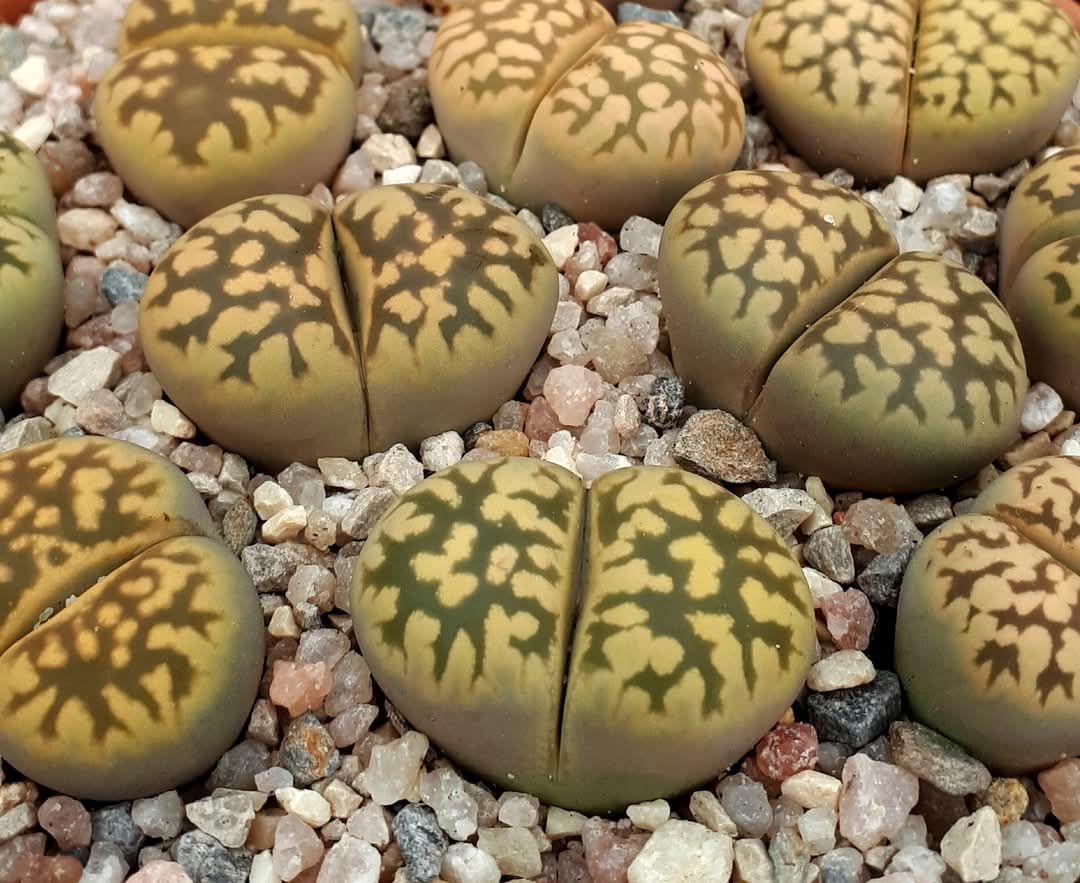
Lithops karasmontana subsp. bella (N.E.Br.) D.T.Cole is the cream-faced, pellucid-windowed subspecies of the parent species Lithops karasmontana from the granite mountains around the town of Aus in southern Namibia. Nicholas Edward Brown described the plant first as the full species Lithops bella in Gardeners’ Chronicle in 1922, choosing the Latin epithet bella (beautiful) for the appearance of the face; D.T. Cole later reduced it to subspecific rank under L. karasmontana in his 1988 monograph and that combination is the name used across the specialist mesemb trade. Both names refer to the same plant.
The taxonomic position is contested. POWO synonymises subsp. bella back under the nominate L. karasmontana, treating the cream face character and the granite mountain geography as intra-subspecific variation rather than a subspecies-rank break. Field documentation of wild populations points the other way. In Wild Lithops (2017) Harald Jainta photographed the whole karasmontana complex across its Namibian range and recorded a breadth of habitat variation that blurs the boundaries modern taxonomy draws between its members, and his 2019 Avonia paper argues for a broader reassessment of the genus rather than for POWO’s lumping. The trade has not followed either of these moves: Mesa Garden, Cape Succulent Seeds, Trex Plants, and the rest of the specialist mesemb seed network all carry the plant under Cole’s 1988 subspecies name with C-numbers and the SB2181 collector accession in active circulation. This page uses the Cole subspecies designation because that is the name collectors search for and the name on every seed packet.
The subspecies is best known for two characters that differentiate it from its siblings in the karasmontana complex. The face is cream to grey-buff with a large irregular green window that is fully transparent, allowing light to reach the chlorophyll-packed tissue inside the buried body in a way the nominate’s red-channelled and dense face does not; this pellucid window is the single most diagnostic feature. Mature specimens also clump aggressively, building heads year on year until well-grown plants can carry up to sixty heads in a single mound, the most pronounced clumping habit in the karasmontana complex. The C143A locality form from 60 km north-northeast of Aus is the high-contrast zebraic selection that drives the modern collector market.
Within this site the closest comparisons are the parent L. karasmontana (red-channelled face), the L. karasmontana ‘Top Red’ cultivar (the brick-red trade-defining selection from the nominate end of the colour spectrum), the recently POWO-accepted L. karasmontana subsp. amicorum (rare in cultivation), and the broader genus context provided by the most-cultivated species Lithops lesliei. All Lithops on this site share the inverted Aizoaceae growth calendar described in the care widget below: active in autumn and winter, dry through summer.
Lithops karasmontana subsp. bella quick reference
A winter-rainfall southern Namibian mesemb that grows actively in the cool months and rests dry through summer; the calendar is inverted relative to every cactus on this site. The values below are the genus framework as it applies to the karasmontana complex; no published source identifies a cultivation difference between subsp. bella and the nominate karasmontana. For the full seasonal calendar, dormancy timing, and substrate detail see the parent L. karasmontana page.
Taxonomy & nomenclature
POWO synonymises subsp. bella under the nominate L. karasmontana; the trade universally retains Cole’s 1988 subspecies designation. The accepted name as used here is Lithops karasmontana subsp. bella (N.E.Br.) D.T.Cole, with the basionym Lithops bella N.E.Br. published in Gardeners’ Chronicle series 3, 71: 80 (1922). Brown described the plant as a full species in the same year he established the genus Lithops and chose the Latin epithet bella, meaning beautiful, for the face character. The type was collected by E.C. Phillips from the granite country near Aus-Gubub in what was then South West Africa and is now southern Namibia.
D.T. Cole reduced L. bella to subspecific rank under L. karasmontana in his 1988 monograph and the 2005 second edition of Lithops: Flowering Stones. Under the Cole circumscription the parent L. karasmontana carries three additional subspecies on this site: the nominate, subsp. eberlanzii (not currently a separate page), and the recently POWO-accepted subsp. amicorum elevated from the species rank L. amicorum by Loots and Ritz. Of these, subsp. bella is the only one whose POWO treatment is currently in active dispute.
Two further taxonomic notes are worth flagging. First, Harald Jainta’s field work on wild Lithops, the 2017 monograph Wild Lithops and the 2019 Avonia 37: 6–17 paper setting out a new taxonomic approach to the genus, documents the breadth of habitat variation across the karasmontana complex that complicates where its subspecies boundaries fall; POWO retains the synonymy used here, and Cole’s 1988 subspecies name remains the one in trade circulation. Second, the basionym Lithops bella N.E.Br. is itself listed by POWO as a synonym of subsp. bella, so seed packets and nursery labels marked simply “Lithops bella” without the subspecies qualifier refer to the same plant. Buyers should expect Cole 1988 material under either name.
Historical synonyms (3)
- Mesembryanthemum bellum Dinter, 1923 basionym
- Lithops edithae N.E.Br., 1934 heterotypic synonym
- Lithops erniana Loesch & Tischer, heterotypic synonym
Sources: GBIF
Habitat
Subsp. bella occupies a narrow boomerang-shaped range in the Karas Region of southern Namibia, running roughly from Witputs in the south to Helmeringhausen in the north, arcing to the north and west of the town of Aus. The range sits at the boundary between the Namib fog-desert and the semi-arid interior plateau, in country that is geographically distinct from the higher Karas Mountains proper to the east where the nominate karasmontana sits, and from the Sperrgebiet fringe further south where subsp. eberlanzii reaches the Atlantic-influenced coastal zone.
The substrate is the load-bearing habitat distinction. Subsp. bella grows on barren mineral slopes in granite mountains rather than on the white quartzite quartz-field flats that characterise many other Lithops habitats. The granite is siliceous like the quartzite of the wider genus range but is coarser-grained, darker in colour, and has greater thermal mass into the night. Plants nestle in gravel pockets below granite overhangs and among lichen-crusted rocks on south-facing slopes with the body buried flush with the surface in the standard Lithops fashion. The surrounding matrix is coarse granite grit rather than the fine quartzite flour of the classic quartz-field populations.
Annual rainfall in the Aus area runs roughly 50–150 mm, concentrated as summer thunderstorms with some additional winter fog moisture reaching the inland edge of the Namib. Elevation is moderate by the standards of the karasmontana complex, lower than the 1,600 m peaks of the Karas Mountains proper to the east, with frost possible but not consistent in the cooler months. Among documented Cole collection numbers, C108 (5 km south of Aus) is the type locality with jagged milky windows; C143A (60 km north-northeast of Aus) is the high-contrast zebraic form that dominates the modern collector market; C285 sits near Aus with intermediate patterning; and C295 lies 115 km south-south-east of Aus with wide irregular windows. The intra-subspecies variation across these four populations is part of what makes the subspecies attractive to specialist collectors.
Morphology
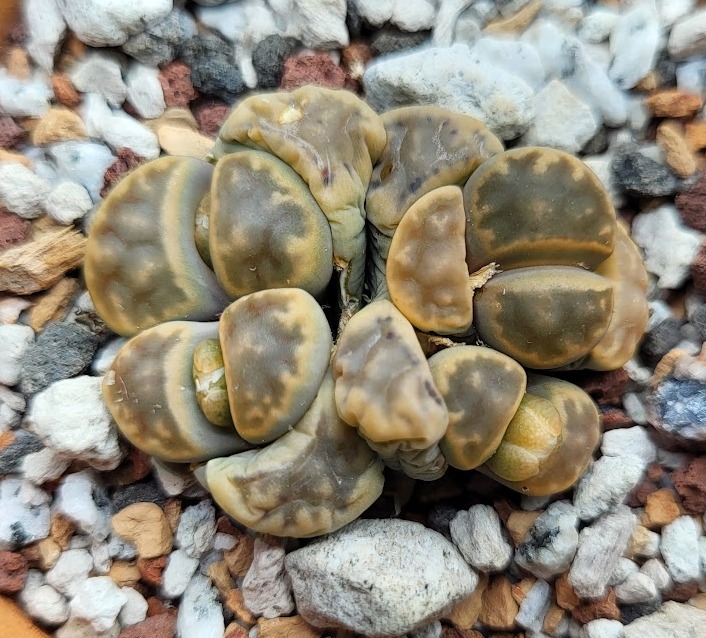
Body form is the standard Lithops architecture: a single pair of fused leaves forming a turbiniform inverted cone that sits flush with or slightly below the soil surface, with only the flat to slightly convex dorsal face exposed. Plants are essentially stemless. Each body reaches roughly 2.5–3 cm across and up to about 3 cm tall above the substrate, with a fissure of 4–10 mm between the two lobes and pale grey fissure walls. Subsp. bella is a smaller-bodied taxon than the nominate karasmontana but produces dense clumps over time, with mature multi-head specimens documented at up to sixty heads in a single mound; this is the most pronounced clumping habit in the karasmontana complex and is one reason the subspecies sells well in the specialist mesemb trade.
The face is the diagnostic feature and is the load-bearing character separating subsp. bella from its siblings. The background colour of the face tissue is buff, light grey, light brown, or grey-brown, never the brick-red or red-brown of the nominate. The window is large and irregular in outline, dark green to light green, and is fully transparent: light passes through to the photosynthetic tissue inside the buried body, hence the term pellucid. The ridges and islands standing above the window surface are buff, light yellow, pinkish-yellow, or light brownish-yellow, and stand cleanly proud of the window field rather than merging with it. The high-contrast result is described in the literature as zebraic and is most pronounced in the C143A locality form. Compared against the nominate, subsp. bella has cream where the nominate has red channels; compared against subsp. eberlanzii, subsp. bella has a pellucid window and clean buff ridges where eberlanzii has an opaque dark green window and greenish-white ridges that merge with the window in a wavy, less distinct boundary.
Flowers are white, satiny, narrow-rayed, and 25–45 mm in diameter (most commonly 25–35 mm), emerging from the central fissure between the leaf pair in late summer to autumn, which translates to September through November in Northern Hemisphere cultivation. The white flower is shared with the nominate karasmontana and with subsp. eberlanzii; the entire karasmontana complex produces white flowers, in contrast to the yellow-flowered majority of the genus represented on this site by Lithops lesliei. Like all Lithops the species is an obligate outcrosser; flowers do not self-pollinate, and seed production in cultivation requires hand pollination between two genetically distinct plants.
Locality detail
The type locality of Lithops karasmontana subsp. bella is the population 5 km south of the town of Aus in the Karas Region of southern Namibia, designated by Cole as collection number C108. The C108 population displays jagged milky windows and is the morphological anchor for the subspecies description in Cole’s 1988 monograph.
The map above marks the C108 type locality south of Aus, the C143A zebraic form to the north-north-east, the C285 and C295 satellite populations, and the Witputs and Helmeringhausen range edges that define the boomerang-shaped subspecies distribution. Documented field-number provenance for the subspecies is unusually rich: C108, C143A, C285, and C295 in the Cole numbering system are all in active circulation in the specialist trade, and the SB2181 accession from Steven Brack’s Mesa Garden in New Mexico is the most commonly encountered single accession on collector seed lists. The intra-subspecies variation across these populations, ranging from milky to high-contrast zebraic, is one of the reasons subsp. bella attracts collector interest beyond the broader karasmontana complex.
Lithops karasmontana subsp. bella care and cultivation
No published source identifies a cultivation difference between subsp. bella and the nominate karasmontana. Both occupy southern Namibian granite country at broadly similar rainfall regimes and respond to the same seasonal calendar in cultivation. The full treatment of substrate, watering calendar, dormancy management, light, and cold-floor guidance is on the parent L. karasmontana page; the care widget above carries the headline values. This section covers only what is specific to subsp. bella.
Substrate
The mix for subsp. bella is the same house mesemb formulation used across the genus: 33% pumice (3–5 mm), 12% lava rock (5–10 mm, structural drainage aggregate), 10% zeolite (clinoptilolite, 4–6 mm), 20% granite grit (3–5 mm), 0% limestone, 20% coarse silica grit (1–3 mm angular crystalline quartz), and 5% worm castings. No source distinguishes cultivation practice for subsp. bella from the rest of the karasmontana complex, so granite, pumice, lava and zeolite stay at the declared house shares and organic, limestone and silica stay at the genus continuity figures. The zeolite buffers the mix toward neutral pH. The lava fraction is the structural drainage aggregate that keeps the lower pot volume open through successive wet-dry cycles. Pot in unglazed terracotta, 10–12 cm deep; the strong clumping habit makes a wider pot worth planning for from the start.
All 16 Lithops on this site use one flat mineral formulation: the 95/5 mesemb baseline (95% inorganic, 5% organic), higher than the 90/10 cactus default used elsewhere on this site. No cultivation source at any tier distinguishes substrate practice between Lithops species, so every row below carries the same house formulation rather than sixteen separate findings. Silica sits at 20% and limestone at 0% as continuity conventions, not evidenced per-species figures.
| Species | Pumice | Lava | Zeolite | Granite | Limestone | Silica | Organic |
|---|---|---|---|---|---|---|---|
| L. lesliei | 33% | 12% | 10% | 20% | 0% | 20% | 5% |
| L. karasmontana | 33% | 12% | 10% | 20% | 0% | 20% | 5% |
| L. karasmontana subsp. bella (this page) | 33% | 12% | 10% | 20% | 0% | 20% | 5% |
| L. karasmontana subsp. amicorum | 33% | 12% | 10% | 20% | 0% | 20% | 5% |
| L. karasmontana ‘Top Red’ | 33% | 12% | 10% | 20% | 0% | 20% | 5% |
| L. burchellii | 33% | 12% | 10% | 20% | 0% | 20% | 5% |
| L. lesliei ‘Albinica’ | 33% | 12% | 10% | 20% | 0% | 20% | 5% |
| L. lesliei ‘Storm’s Albinigold’ | 33% | 12% | 10% | 20% | 0% | 20% | 5% |
| L. pseudotruncatella | 33% | 12% | 10% | 20% | 0% | 20% | 5% |
| L. dendritica | 33% | 12% | 10% | 20% | 0% | 20% | 5% |
| L. optica | 33% | 12% | 10% | 20% | 0% | 20% | 5% |
| L. optica ‘Rubra’ | 33% | 12% | 10% | 20% | 0% | 20% | 5% |
| L. aucampiae | 33% | 12% | 10% | 20% | 0% | 20% | 5% |
| L. aucampiae subsp. koelemanii | 33% | 12% | 10% | 20% | 0% | 20% | 5% |
| L. julii | 33% | 12% | 10% | 20% | 0% | 20% | 5% |
| L. julii subsp. fulleri | 33% | 12% | 10% | 20% | 0% | 20% | 5% |
Propagation and the clumping habit
Seed grown is the standard propagation route, as it is across the genus, and the subspecies is widely available on specialist mesemb seed lists from Mesa Garden, Cape Succulent Seeds, Trex Plants, and others under the Cole 1988 subspecies name with C-number or SB2181 provenance. Germination follows the standard Lithops profile and seedlings reach the adult face pattern over two to three years. Because subsp. bella clumps to many heads where most other Lithops form smaller groups, division of mature multi-head specimens is a viable alternate route on this taxon in a way that it is not for single-headed Lithops. Divide carefully after the new leaf pair has fully emerged in spring and before the next dormancy. Grafting is not practised for Lithops in the way it is for rare cacti and there is no established rootstock-scion technique in the Aizoaceae.
Comparison
Within the karasmontana complex the diagnostic axis is face colour and window character. Subsp. bella sits at the cream-and-pellucid end of the spectrum: cream to grey-buff ground, large irregular transparent green window, buff to yellow-buff raised ridges. The nominate L. karasmontana sits at the opposite end of the same spectrum: brick-red to red-brown ground, dense network of red-brown channels, partly rather than fully pellucid window, warmer and darker overall tone. Subsp. eberlanzii (no separate page on this site) is the third character form: opaque dark green window rather than pellucid, greenish-white ridges that merge into a wavy, less distinct boundary with the window field, and an overall grey-green muted tone.
The L. karasmontana ‘Top Red’ cultivar is the trade-defining selection from the nominate end of the spectrum and is the obvious aesthetic counterpoint to subsp. bella: brick-red channels and warm tones in ‘Top Red’ against cream ridges and zebraic contrast in subsp. bella. The two are commonly grown side by side as a complementary pair within the karasmontana complex. The fourth subspecies on this site, subsp. amicorum, is rare in cultivation; it was previously treated as the full species L. amicorum D.T.Cole and was elevated to subspecific rank under karasmontana by Loots and Ritz, and remains an outlier rather than a frequent comparison.
Across the wider genus the closest comparable taxa are the white-flowered L. julii, with its red-brown lip-smear face markings, and the broader genus context provided by Lithops lesliei, the most widely cultivated species and the standard plant on which growers learn the inverted Lithops calendar. None of these comparisons displaces the primary diagnostic for subsp. bella, which is the combination of cream-to-buff ridges, a pellucid green window, and the pronounced clumping habit reaching up to sixty heads on mature specimens. That triple is enough to identify the subspecies across the trade regardless of which of the four documented C-number forms a given plant traces back to.
Frequently asked questions
Is Lithops karasmontana subsp. bella hard to grow?
Intermediate. The subspecies is no fussier than the nominate karasmontana and behaves predictably on the standard inverted Lithops calendar: active in autumn and winter, completely dry through summer. The single hardest thing is resisting the urge to water during the May to August dormancy, when summer heat tempts a cactus-trained grower to reach for the can; any summer water will rot the plant from the inside before any external symptom appears. Growers comfortable with the wider Lithops calendar handle subsp. bella without trouble. The clumping habit makes established plants particularly forgiving of minor imprecision because there are multiple heads to absorb any single rot event.
Can Lithops karasmontana subsp. bella be grown from seed?
Yes, and seed is the standard propagation route. The subspecies is widely available on specialist mesemb seed lists from Mesa Garden, Cape Succulent Seeds, Trex Plants, and similar sources under the Cole 1988 subspecies name, often with C-number provenance (C108 type locality, C143A zebraic form, C285, C295) or the Steven Brack accession SB2181. Seeds germinate reliably from fresh material sown in summer on a mineral-dominant surface kept warm and lightly misted; seedlings show the adult face pattern over two to three years. Because subsp. bella clumps to many heads more aggressively than most other Lithops, division of mature multi-head specimens is also a viable alternate propagation route on this taxon, performed after the new leaf pair has fully emerged. Grafting is not practised for Lithops.
Is Lithops karasmontana subsp. bella legal to own?
Yes, with no CITES paperwork. The subspecies is not listed on any CITES appendix because the family Aizoaceae is not covered by the Cactaceae blanket Appendix-II listing; the no-CITES status is the load-bearing legal distinction between Lithops and most of the other rare succulents on this site. Wild collection inside Namibia is regulated under the Nature Conservation Ordinance 4 of 1975, which protects indigenous succulents from collection and export without a permit from the Ministry of Environment, Forestry and Tourism; section 75 of the Ordinance provides the licensed-nursery exemption that underpins the international seed trade. Nursery-propagated material with documented C-number or SB-number provenance is the legally and ethically defensible source for collector specimens worldwide.
Where does Lithops karasmontana subsp. bella grow in the wild?
In a narrow boomerang-shaped range in the Karas Region of southern Namibia, running roughly from Witputs in the south to Helmeringhausen in the north and arcing to the north and west of the town of Aus. Habitat is granite mountain slopes with mineral substrate of coarse granite grit, rather than the white quartzite quartz-field flats that characterise many other Lithops. Plants nestle in gravel pockets below granite overhangs and among lichen-crusted rocks with the body buried flush with the surface. Annual rainfall is roughly 50–150 mm, concentrated as summer thunderstorms with some additional winter fog reaching the inland edge of the Namib. Documented Cole collection localities include C108 (5 km south of Aus, the type locality), C143A (60 km north-north-east of Aus, the zebraic form), C285 near Aus, and C295 at 115 km south-south-east of Aus.
When does Lithops karasmontana subsp. bella flower?
Late summer to autumn. In Northern Hemisphere cultivation the flowering window runs September through November, corresponding to the autumn season in the southern Namibian habitat. Flowers are white, satiny, narrow-rayed, and 25–45 mm in diameter (most commonly 25–35 mm), single per body, emerging from the central fissure between the two fused leaves. White is the default flower colour across the entire L. karasmontana complex and is one of the characters that distinguishes the group from the yellow-flowered majority of the genus, which is represented on this site by Lithops lesliei. The species is an obligate outcrosser; flowers do not self-pollinate, so seed production in cultivation requires hand pollination between two genetically distinct plants. Plants reach first flower from seed at three to four years.
Sources & further reading
Brown, N.E. (1922). Lithops bella N.E.Br. Gardeners’ Chronicle series 3, 71: 80 · Cole, D.T. (1988). Lithops karasmontana subsp. bella (N.E.Br.) D.T.Cole, in Lithops: Flowering Stones. Acorn Books · Cole, D.T. and Cole, N.A. (2005). Lithops: Flowering Stones (2nd ed.). Cactus & Co · Kew POWO. Lithops karasmontana subsp. bella (N.E.Br.) D.T.Cole, IPNI lsid urn:lsid:ipni.org:names:954647-1. powo.science.kew.org · Kew POWO. Lithops bella N.E.Br. (basionym, synonymised). powo.science.kew.org/taxon/urn:lsid:ipni.org:names:362413-1 · Kew POWO. Lithops karasmontana (Dinter & Schwantes) N.E.Br. (parent species). powo.science.kew.org/taxon/urn:lsid:ipni.org:names:362452-1 · llifle, Encyclopedia of Living Forms. Lithops karasmontana subs. bella. llifle.com · llifle, Encyclopedia of Living Forms. Lithops karasmontana subs. bella C108 TL: 5 km S of Aus, Namibia. llifle.net · llifle, Encyclopedia of Living Forms. Lithops karasmontana subs. bella C143A, 60 km NNE of Aus, Namibia. llifle.com · llifle, Encyclopedia of Living Forms. Lithops karasmontana subs. eberlanzii (used for comparative window character). llifle.com · Wikipedia. Lithops karasmontana. en.wikipedia.org · World of Succulents. Lithops karasmontana subsp. bella. worldofsucculents.com · Mesa Garden. ssp. bella product category, multiple C-number and SB2181 accessions. mesagarden.com · Cape Succulent Seeds. Lithops karasmontana ssp. bella C-295. capesucculentseeds.com · Trex Plants. Lithops karasmontana ssp. Bella SB 2181. trexplants.com · Jainta, H. (2017). Wild Lithops. Klaus Hess Publishers, Göttingen & Windhoek. ISBN 978-3-933117-93-9 · Jainta, H. (2019). Ein neuer taxonomischer Ansatz für die Gattung Lithops N.E.Br. Avonia 37: 6–17 (new taxonomic approach to the genus; POWO retains the existing synonymy) · Namibia Nature Conservation Ordinance 4 of 1975 (general plant protection; section 75 licensed-nursery exemption). faolex.fao.org