
Lithops aucampiae
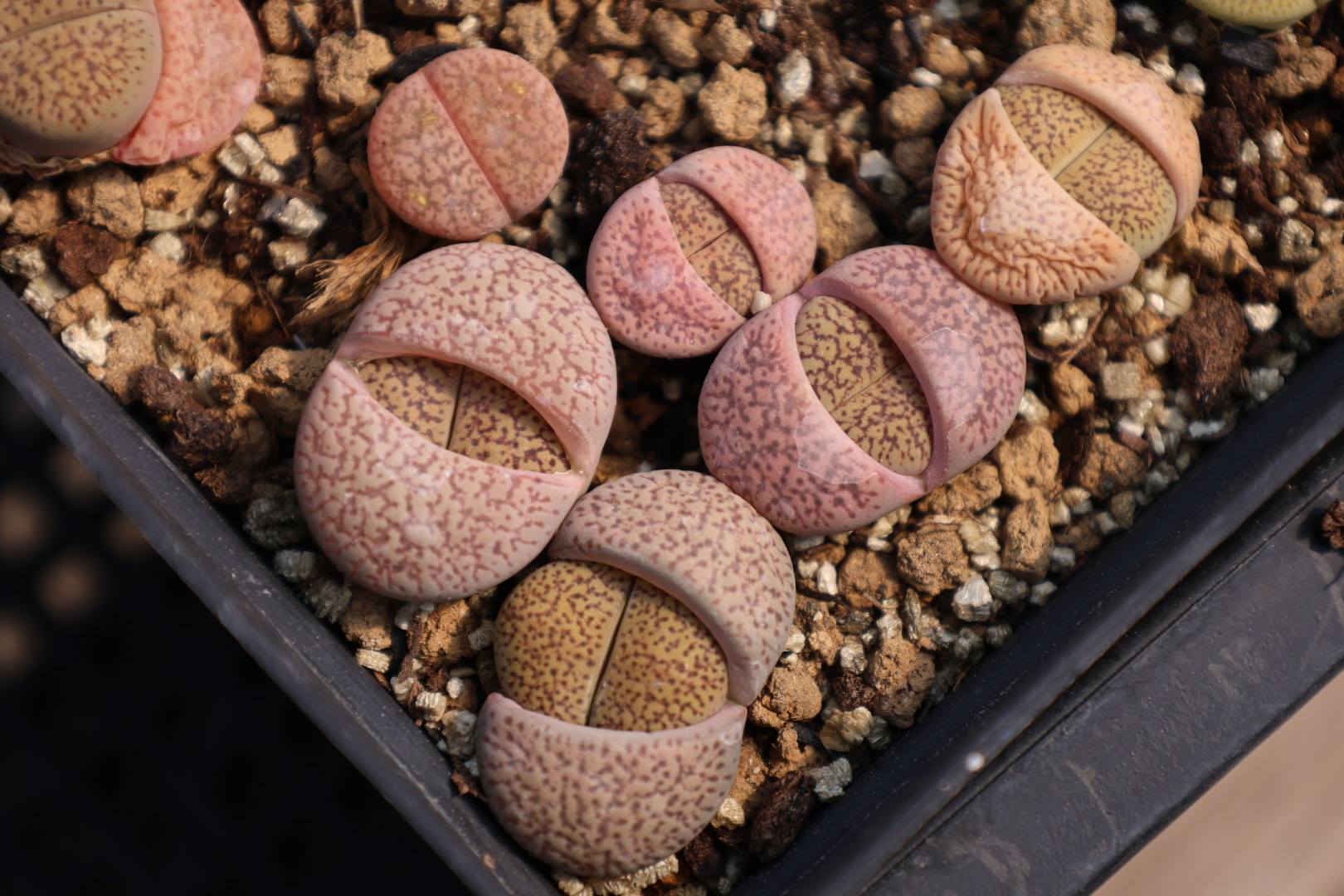
Lithops aucampiae L.Bolus is the chocolate-brown ironstone-belt living stone of the South African Northern Cape, and one of the easiest species in the genus to grow. Louisa Bolus described the species in South African Gardening and Country Life 22: 276 in November 1932 from material collected three years earlier on a farm near Postmasburg by Juanita Aucamp; the specific epithet is the genitive form of Aucamp, commemorating the discoverer. Kew POWO accepts the species as L. aucampiae with no accepted infraspecific taxa, treating Cole’s subsp. euniceae and koelemanii as synonyms of the nominate.
The species sits in the summer-rainfall arm of the genus, occupying the Postmasburg-Kuruman-Sishen arc of Precambrian banded ironstone formation across roughly 100 km of the Northern Cape interior. This puts it on the eastern, summer-rainfall side of the genus alongside Lithops lesliei rather than in the winter-rainfall zones of the western Namibian and Sperrgebiet species. The summer-rainfall origin shifts the wild growth calendar a few weeks but the inverted Lithops cultivation rhythm still applies in cultivation: active in autumn and winter, fully dormant in summer. The calendar runs the opposite direction from every cactus on the rest of this site, and it is the most common cause of catastrophic loss for growers carrying their cactus watering instincts into a Lithops pot.
The body is a chocolate-brown obconical leaf pair with a deep red-brown translucent window panel traversed by fine irregularly branched darker lines; the Kuruman form (C173) is described by llifle as a striking bitter chocolate. Bodies are large for the genus at 25-55 mm across the upper face, which contributes to the beginner reputation: the fissure is easy to read and the plant tolerates handling better than its smaller western siblings. Among the taxa covered on this site, the Cole/SANBI subspecies L. aucampiae subsp. koelemanii (POWO synonymises) is treated separately for collectors who search for the name; it has paler face colour with a reduced window and dot patterning rather than the nominate’s continuous brown windows.
L. aucampiae earned the Royal Horticultural Society Award of Garden Merit in 2002 and is one of the standard starter species for anyone learning the genus. Flowers are bright yellow, daisy-form, up to 52 mm across at maximum, single per body, and emerge from the central fissure in autumn. Compare against the white-flowered Lithops karasmontana of the Namibian Karas Mountains, which carries similar body size and reddish-brown patterning but flowers white rather than yellow, and the lip-smear-faced Lithops julii for the genus context. Two recent peer-reviewed studies (Field et al. 2013; Oddo et al. 2021) have used L. aucampiae as the model species for the genus in confirming Crassulacean Acid Metabolism and the dual high-light / shade-tolerance adaptation of the buried body.
Lithops aucampiae quick reference
A summer-rainfall Northern Cape ironstone-belt mesemb that grows actively in the cool months and rests dry through summer; the calendar is inverted relative to every cactus on this site. Values calibrated for seed grown plants in cultivation, drawn from L. aucampiae-specific habitat data and the ironstone-belt substrate adjustment that distinguishes this species from quartz-field Lithops further west.
Taxonomy & nomenclature
The accepted name is Lithops aucampiae L.Bolus, published in South African Gardening and Country Life 22: 276 (November 1932). The author abbreviation L.Bolus refers to Harriet Margaret Louisa Bolus, the South African botanist at the Bolus Herbarium, University of Cape Town. The specific epithet honours Juanita Aucamp, who collected the original specimen in 1929 from a farm near Postmasburg and presented material to Bolus for formal description. Kew POWO carries the name with the IPNI lsid urn:lsid:ipni.org:names:362411-1; GBIF mirrors the POWO treatment.
POWO accepts no infraspecific taxa under L. aucampiae, treating four names as synonyms of the nominate including L. koelemanii de Boer (1960, Succulenta 1960: 28) and the combination L. aucampiae var. koelemanii (de Boer) D.T.Cole published in Excelsa 3: 55 (1973). D.T. Cole’s monograph Lithops: Flowering Stones (1988, revised 2005) recognised additional infraspecific taxa, including subsp. euniceae (de Boer) D.T.Cole from the Hopetown area and var. koelemanii from the desolate reddish quartzite areas northwest of Postmasburg. The South African National Biodiversity Institute (SANBI) Red List of South African Plants tracks subsp. aucampiae and subsp. euniceae as separate assessment units, the former Least Concern (2019) and the latter Vulnerable D2 (2005). POWO and SANBI therefore disagree at the rank of the infraspecific names; the on-page treatment here defers to POWO synonymy while flagging the trade and conservation treatments where collectors will encounter them.
On this site the Cole-treatment subspecies L. aucampiae subsp. koelemanii is carried as a separate page because the name is universally used in the trade and on specialist locality-form sites such as llifle, even though POWO synonymises it. The Cole-treatment subsp. euniceae is not separately covered: its narrow Hopetown range, restricted-population conservation status, and POWO synonymy together place it outside the current launch set, but readers should be aware that the global IUCN Vulnerable assessment for the species is driven by the euniceae populations and not by the widespread nominate.
Historical synonyms (8)
- Mesembryanthemum turbiniforme Haw., 1821 basionym
- Lithops aucampiae var. koelemanii (de Boer) D.T.Cole, 1973 homotypic synonym
- Lithops aucampiae var. eunicii DeBoer, homotypic synonym
- Lithops aucampiae var. fluminalis (DeBoer) Cole, homotypic synonym
- Lithops turbiniformis (Haw.) N.E.Br., 1922 heterotypic synonym
- Lithops koelemanii DeBoer, heterotypic synonym
- Lithops loganiae L.Bolus, heterotypic synonym
- Lithops loganii L.Bolus, heterotypic synonym
Sources: POWO (Kew) · IPNI · GBIF · Wikidata
Habitat
Lithops aucampiae is endemic to the Northern Cape Province of South Africa, with the core distribution following the Postmasburg-Kuruman-Sishen-Griquatown arc, a belt of Precambrian banded ironstone formation that runs roughly 100 km northwest from Postmasburg toward Olifantshoek. Additional populations are recorded 70 km west of Vryburg, near Danielskuil, near Severn, and west of Sishen; an outlying population of the Cole-treatment subsp. euniceae sits considerably to the south near Hopetown on different geology. POWO records the distribution as North-West Province to Northern Cape; the older Wikipedia framing as Transvaal reflects pre-1994 provincial boundaries and should be read as Northern Cape today, with a small portion in the western North West Province along the old Transvaal border.
The climate is summer-rainfall: the Postmasburg area receives roughly 250–400 mm of annual rainfall, predominantly between November and March, with cold dry winters from April through September. This is the inverse of the winter-rainfall zones where most of the western and Namibian Lithops grow, and it puts L. aucampiae on the same wild seasonal calendar as Lithops lesliei further east. Elevation across the Postmasburg plateau runs approximately 1,100–1,300 m above sea level; the summer-rainfall zone at this altitude delivers occasional ground frost in the field winter, which the species survives only because it is bone dry across the cold months.
The substrate is ironstone, predominantly banded ironstone formation (BIF) with sandstone, chert, and quartzite fragments mixed in. The parent rock is ferruginous and gives the surface soil a characteristic deep red colour; plants grow almost completely buried in this reddish substrate with only the dorsal face exposed, extraordinarily well-camouflaged against the iron-oxide fragments. Var. koelemanii populations grow specifically on desert-desolate areas of reddish quartzite with body texture and colouration described as resembling an old brick. Associated vegetation is dry shrubland and Kimberley Thornveld in the Northern Cape, transitioning to Northern Upper Karoo in the Hopetown subpopulation. Growth is in small colonies scattered across the hard substrate, individual plants effectively invisible to the field surveyor outside the autumn flowering window.
Morphology
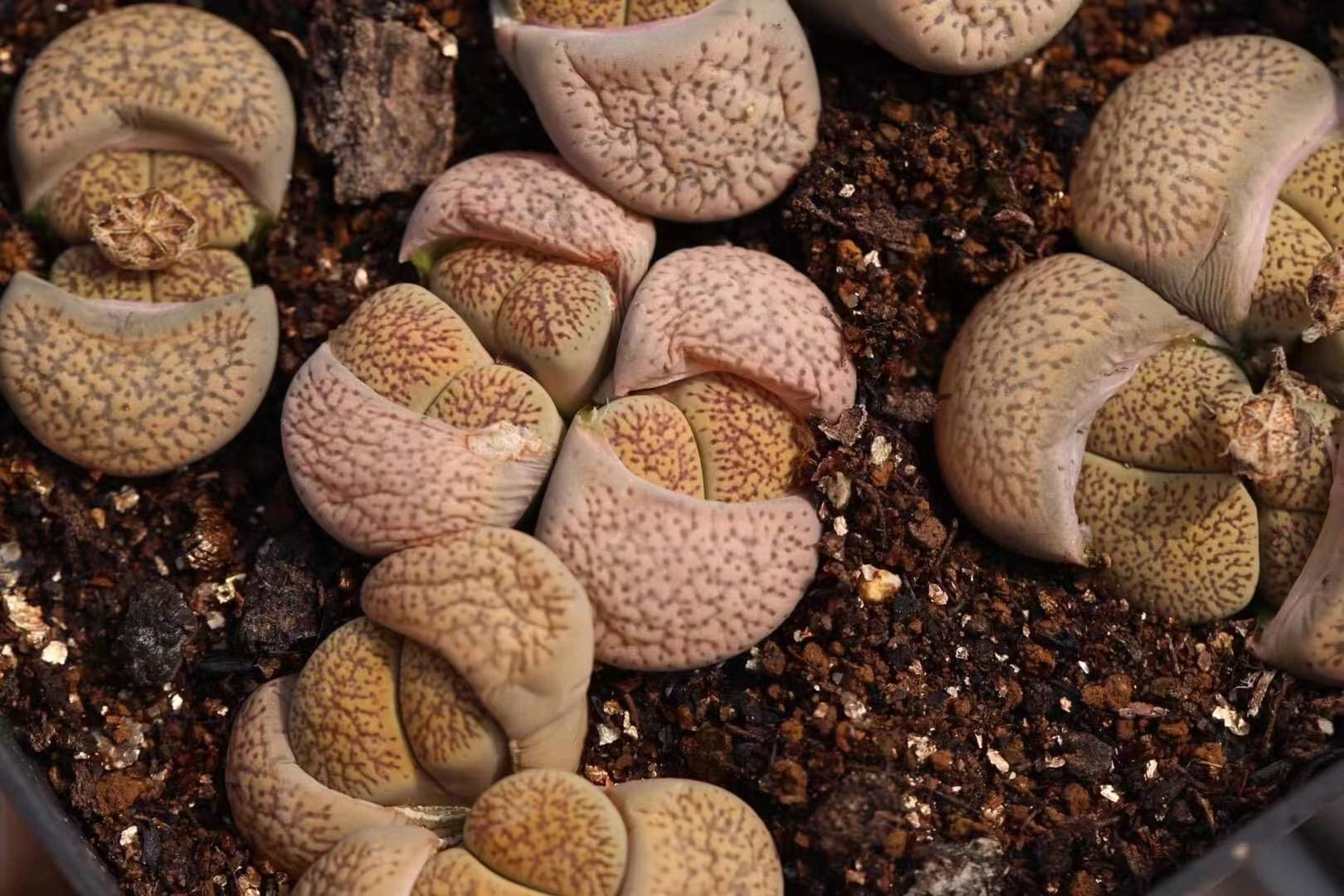
Body form is the standard Lithops architecture: a single pair of fused leaves forming an obconical (inverted-cone) shape that sits flush with or slightly below the soil surface, with only the truncated dorsal face exposed. The plant is essentially stemless. L. aucampiae bodies are medium to very large for the genus at 25–55 mm across the upper face and 20–40 mm front to back, making this one of the largest species in cultivation. With age, clumps of 2–5 bodies are common; large established plants can reach 12 or more heads over a decade. The size and clumping habit are both contributors to the beginner reputation: the fissure is easy to read, the plant tolerates handling better than its smaller western siblings, and the visual mass of an established clump is rewarding well before flowering.
Face colour and pattern are the diagnostic feature. The ground colour is variable brown-red, with the Kuruman form (C173) described by llifle as a striking bitter chocolate and the RHS describing thick paired reddish-ochre leaves with darker tip markings. The face-pattern zone carries yellowish to reddish-brown margins, often more intensely coloured than the islands within. The window is a continuous panel of obscurely translucent dark red-brown occupying a large portion of the dorsal face, traversed by fine irregularly branched lines; in var. koelemanii the window is reduced and the groove between the leaf pair is also reduced, giving a more uniform matte surface. The window functions as a diffusing lens that admits filtered light to the chlorophyll-packed tissue inside the buried body, the convergent adaptation that defines the genus.
Crassulacean Acid Metabolism is confirmed for the species by two recent peer-reviewed studies. Field et al. (2013, PLoS ONE 8(10): e75671) demonstrated significantly higher pre-dawn than pre-dusk malate concentrations consistent with nocturnal CO2 fixation, and showed that the translucent windows do not simply enhance photosynthesis: above-ground tissue is adapted for high light, below-ground tissue for shade, with UV-blocking flavonoids in the window epidermis protecting the buried photosynthetic layer. Oddo et al. (2021, Plant Physiology and Biochemistry 165: 196–199) corroborated the CAM finding through carbon isotope analysis, recording δ¹³C values from −16.4 to −13.1 per mille in a six-month drought-stress experiment. Flowers are bright yellow, daisy-form, up to 52 mm across at maximum (typical 25–40 mm), single per body, emerging from the central fissure in autumn; capsules are mostly 6-chambered with seeds light brown to brown. The named cultivar Storm’s Snowcap (C392), selected by Ed Storms from Kuruman-form stock, produces white flowers from a chocolate-brown body of the standard nominate type.
Locality detail
The type locality of Lithops aucampiae is a farm near Postmasburg, Northern Cape, South Africa, where Juanita Aucamp collected the original specimen in 1929 and transmitted material to Louisa Bolus for description in 1932. The Postmasburg-Kuruman-Sishen ironstone arc that anchors the species range is part of the Precambrian banded ironstone formation belt of the Northern Cape; the same geology underpins the Sishen iron mining district, with L. aucampiae occupying the rocky outcrops between and around the mining footprint.
The map above marks the type locality at Postmasburg, the var. koelemanii type 35 km northwest of Postmasburg, range centroids at Kuruman and Sishen and Danielskuil, and the disjunct subsp. euniceae population near Hopetown. C-number localities documented by Cole and curated on llifle include C003 (10 km SE of Postmasburg, the type), C016 (var. koelemanii type, 35 km NW of Postmasburg), C173 (Kuruman bitter chocolate form), C172 (west of Sishen), C002 (Danielskuil), C298 (near Severn), and C392 (Kuruman-area parent of cv. Storm’s Snowcap). Population stability is good across the nominate range: subpopulations are large, no decline is recorded, and SANBI assesses subsp. aucampiae as Least Concern (2019). The Hopetown subsp. euniceae is the conservation outlier, restricted to two known locations and threatened by habitat degradation through dumping; SANBI assesses it Vulnerable D2 (2005) and it is the population that drives the species-level IUCN global Vulnerable category.
Lithops aucampiae care and cultivation
Lithops aucampiae is widely acknowledged as one of the easiest species in the genus and one of the standard starter Lithops in the global trade. The species tolerates imprecise watering better than its winter-rainfall western siblings, recovers from mild overwatering events that would kill a coastal Lithops, and produces autumn flowers reliably from year four onward under good light. The cultivation framework is still the genus framework: 95% mineral substrate, the inverted seasonal calendar, full sun, and dry winter cold. The tolerance is in degree, not in kind.
Substrate
The house mesemb formulation is 33% pumice (3–5 mm), 12% lava rock (5–10 mm, structural drainage aggregate), 10% zeolite (clinoptilolite, 4–6 mm), 20% granite grit (3–5 mm), 0% limestone, 20% coarse silica grit (1–3 mm angular crystalline quartz), and 5% worm castings as the sole organic component. Pumice is the balancer and primary aggregate, lava sets pot depth for the eventual root run, zeolite supplies cation exchange without adding water-holding mass, and granite is the hard-grit share opposite pumice for a genus with very little tolerance for a slow-drying collar. All four are declared house choices, not species-specific findings. Organic holds at the class-prior 5 per cent: named-grower sources for the genus disagree by more than the site’s ten-point resolution threshold, so the figure stays put pending stronger evidence. Limestone is omitted; no source, for aucampiae or for the genus generally, reports a lime preference in either direction. Silica sits at 20 per cent as a house continuity figure rather than an evidenced one; no published source names a top-dressing grit material or proportion specific to this species. Pot in unglazed terracotta or clay composite, 10–12 cm deep; the porosity of unglazed clay accelerates drying and moderates temperature swings around the buried body.
All 16 Lithops on this site use one flat mineral formulation: the 95/5 mesemb baseline (95% inorganic, 5% organic), higher than the 90/10 cactus default used elsewhere on this site. No cultivation source at any tier distinguishes substrate practice between Lithops species, so every row below carries the same house formulation rather than sixteen separate findings. Silica sits at 20% and limestone at 0% as continuity conventions, not evidenced per-species figures.
| Species | Pumice | Lava | Zeolite | Granite | Limestone | Silica | Organic |
|---|---|---|---|---|---|---|---|
| L. lesliei | 33% | 12% | 10% | 20% | 0% | 20% | 5% |
| L. karasmontana | 33% | 12% | 10% | 20% | 0% | 20% | 5% |
| L. karasmontana subsp. bella | 33% | 12% | 10% | 20% | 0% | 20% | 5% |
| L. karasmontana subsp. amicorum | 33% | 12% | 10% | 20% | 0% | 20% | 5% |
| L. karasmontana ‘Top Red’ | 33% | 12% | 10% | 20% | 0% | 20% | 5% |
| L. burchellii | 33% | 12% | 10% | 20% | 0% | 20% | 5% |
| L. lesliei ‘Albinica’ | 33% | 12% | 10% | 20% | 0% | 20% | 5% |
| L. lesliei ‘Storm’s Albinigold’ | 33% | 12% | 10% | 20% | 0% | 20% | 5% |
| L. pseudotruncatella | 33% | 12% | 10% | 20% | 0% | 20% | 5% |
| L. dendritica | 33% | 12% | 10% | 20% | 0% | 20% | 5% |
| L. optica | 33% | 12% | 10% | 20% | 0% | 20% | 5% |
| L. optica ‘Rubra’ | 33% | 12% | 10% | 20% | 0% | 20% | 5% |
| L. aucampiae (this page) | 33% | 12% | 10% | 20% | 0% | 20% | 5% |
| L. aucampiae subsp. koelemanii | 33% | 12% | 10% | 20% | 0% | 20% | 5% |
| L. julii | 33% | 12% | 10% | 20% | 0% | 20% | 5% |
| L. julii subsp. fulleri | 33% | 12% | 10% | 20% | 0% | 20% | 5% |
Watering and light
The watering calendar is inverted relative to every cactus on this site. L. aucampiae grows actively in the cool months and rests dry through summer. In Northern Hemisphere cultivation: full dormancy May through July (no water at all; wrinkled bodies are normal and not a watering signal), watch and wait through August (first light water at the end of the month if temperatures are clearly trending down), active watering September through November (water thoroughly to runoff, then let the mix dry completely over 10–14 days; this is the flowering window), tapered watering December through February (every 3–4 weeks maximum, and never while the old leaf pair is mid-transfer to the new pair), final water March or April, then stop. The summer-rainfall origin of the species might suggest tolerance for more summer moisture than winter-rainfall siblings; do not adjust on this basis. In cultivation the leaf-pair replacement cycle governs watering timing regardless of the wild seasonal calendar, and growers who water summer-rainfall Lithops in Northern Hemisphere summer still lose plants to rot.
Light requirements are the genus default: bright direct sun, minimum 5–6 hours daily for compact body shape and the deep chocolate-brown face colour that defines the species. Postmasburg ironstone-belt insolation is the habitat baseline. A south-facing windowsill in the Northern Hemisphere is the indoor minimum; outdoor summer growing under unglazed glass or shade cloth is preferred where climate allows. Plants under chronically low light etiolate, stretch their fissures, lose face contrast, and split their skins on the next watering. The summer dormancy requirement is light-independent: bright sun through summer is fine provided the substrate is bone dry.
Cold tolerance and the leaf-pair cycle
The dry cold floor for cultivation is −2°C. Llifle gives a standard minimum of 5C and a short-term hardiness to −7°C in bone-dry soil; the Northern Cape interior at 1,100–1,300 m delivers occasional ground frost in habitat and the species survives it because it is bone dry across the cold months. A wet plant at any temperature near freezing is a dead plant. The danger is moisture, not cold. Keep the substrate dry from late autumn through the end of winter and the species rides out conditions far harder than anything a typical European or North American grower has on offer. The species’s defining biological event is the annual leaf-pair replacement: the new pair grows inside the old one over winter, draws moisture and nutrient from it, and emerges in spring as the old pair desiccates to paper. Do not water while the old pair is mid-transfer. Watering during the January-February transfer window refills the old leaves, starves the new pair, and kills the plant from inside.
Comparison
Within the eastern summer-rainfall arm of the genus, the closest comparison is L. lesliei, which shares the summer-rainfall calendar, yellow flowers, and brown face patterning with L. aucampiae and is the species most likely to be confused with it by a buyer or beginner. L. aucampiae bodies are noticeably larger (25–55 mm across the upper face vs 15–30 mm for typical lesliei), the window is a continuous solid-looking dark red-brown panel with fine branching lines rather than the lobed lacework of lesliei, and the overall colouration tends toward rich chocolate and brick-red rather than the variable grey-brown to olive-brown of lesliei. L. aucampiae clumps faster, sits on ironstone in the Postmasburg-Kuruman arc rather than on the broader Highveld mix of substrates that lesliei tolerates, and both species hold the RHS Award of Garden Merit.
Across the broader genus, L. karasmontana is the next most-encountered visual comparator: similar body size in some forms, similar reddish-brown patterning, but with white rather than yellow flowers, more channelled and carved face lines rather than the softer branching network of aucampiae, and a winter-rainfall higher-elevation Karas Mountains habitat in Namibia rather than the summer-rainfall ironstone of the Northern Cape. The lip-smear-faced Lithops julii and the Sperrgebiet endemic Lithops optica represent the opposite ends of the genus by face character and habitat respectively; aucampiae sits comfortably in the easy beginner zone, with optica as the demanding coastal-fog opposite and the smaller western species in between.
Among named cultivars and infraspecific entities of aucampiae, the Cole-treatment subsp. koelemanii (POWO synonymises) is the most-grown form after the nominate, distinguished by a paler face with reduced window and dot patterning rather than the nominate’s continuous brown windows, growing on desolate reddish quartzite 35 km northwest of Postmasburg with body texture often described as resembling an old brick. The named cultivar Storm’s Snowcap (C392), selected by Ed Storms in Texas from Kuruman-form parent stock, is the white-flowered aucampiae: a chocolate-brown body of the standard nominate type but with white flowers instead of the yellow that characterises the rest of the species. The earlier cultivar attribution of the name ‘Storm’s Albinigold’ to aucampiae in some trade sources is a taxonomic error; that cultivar is in fact L. lesliei ‘Storm’s Albinigold’ from C036B stock and is treated on this site under the parent species there.
Frequently asked questions
Is Lithops aucampiae hard to grow?
Beginner. L. aucampiae is widely acknowledged as one of the easiest species in the genus and one of the standard plants for anyone learning Lithops cultivation. The species holds the Royal Horticultural Society Award of Garden Merit (2002), tolerates the genus-baseline 95% mineral mix even when the ironstone-belt adjustment is not available, recovers from mild overwatering events that would kill a winter-rainfall coastal Lithops, and flowers reliably from year four onward under good light. The single hardest rule is the inverted seasonal calendar: Lithops grow in autumn and winter and rest dry from May through August, the opposite of every cactus. Growers carrying their cactus watering instincts across to a Lithops pot kill plants in the first June. Learn the calendar on aucampiae, then move to fussier western species.
Can Lithops aucampiae be grown from seed?
Yes, and seed is the standard propagation route for the species. Seeds germinate in 4–10 days at 20–25°C day with cooler nights around 10–15°C; the temperature differential between day and night is important and constant warm conditions slow or inhibit germination. Seeds are surface-sown on a fine mineral-dominant seedling mix without cover, kept moist with a fine mister for the first weeks, and shielded from direct sun in the first year. First body replacement occurs at 3–4 months from germination and is the first critical vulnerability period: drastically reduce watering as the new pair starts. Time to first flower is 3–4 years under good cultivation. Grafting is not practised for the genus; division of clumps is technically possible but carries collar-damage risk and is rarely necessary.
Is Lithops aucampiae legal to own?
Yes, with no CITES paperwork. L. aucampiae is not listed on any CITES appendix because the family Aizoaceae is not covered by the Cactaceae blanket Appendix II listing; the no-CITES status is the load-bearing legal distinction between Lithops and most of the rare cacti on the rest of this site. Wild collection inside South Africa is subject to the National Environmental Management: Biodiversity Act (NEMBA, Act 10 of 2004) and provincial ordinances under the Northern Cape Nature Conservation framework; trespass and landowner-permission rules apply on private farmland regardless. The widespread nominate subsp. aucampiae is SANBI Least Concern (2019) with stable populations across the Postmasburg-Kuruman arc; the restricted Hopetown subsp. euniceae is SANBI Vulnerable D2 (2005). Nursery-propagated material with documented seed-grown provenance is the legally and ethically defensible source for collector specimens worldwide; international trade in nursery stock is unrestricted by CITES.
Where does Lithops aucampiae grow in the wild?
On banded ironstone formation in the Northern Cape Province of South Africa. The core distribution follows the Postmasburg-Kuruman-Sishen-Griquatown arc, approximately 100 km of Precambrian ironstone outcrop extending northwest from Postmasburg toward Olifantshoek, with additional populations near Vryburg, Danielskuil, Severn, and west of Sishen. An outlying population of the Cole-treatment subsp. euniceae sits to the south near Hopetown on different geology. Elevation runs approximately 1,100–1,300 m above sea level on the Postmasburg plateau. The climate is summer-rainfall (roughly 250–400 mm annually, predominantly November to March) with cold dry winters that include occasional ground frost. Substrate is ferruginous ironstone with sandstone, chert, and quartzite fragments mixed in; the parent rock gives the surface soil a characteristic deep red colour and the plants grow almost completely buried with only the dorsal face exposed.
When does Lithops aucampiae flower?
Autumn. In Northern Hemisphere cultivation the flowering window runs October to November, corresponding to Southern Hemisphere March-May in habitat. Flowers are bright yellow, daisy-form, up to 52 mm across at maximum (typical 25–40 mm), single per body, emerging from the central fissure between the two fused leaves. The flower is large relative to the body and visually striking against the dark chocolate-brown body surface. Yellow is the default colour and is the primary character separating L. aucampiae from white-flowered Lithops such as L. karasmontana. Individual flowers open during the warmer part of the day and close in the evening, following a consistent daily cycle across the bloom period. The named cultivar Storm’s Snowcap (C392) is the white-flowered exception to the yellow-flower rule for the species. Pollinators in habitat are likely native bees and other Hymenoptera attracted to the bright yellow disc; no pollinator study specific to L. aucampiae has been published.
Sources & further reading
Bolus, L. (1932). Lithops aucampiae L.Bolus. South African Gardening and Country Life 22: 276 · Kew POWO. Lithops aucampiae L.Bolus, IPNI lsid urn:lsid:ipni.org:names:362411-1. powo.science.kew.org · Cole, D.T. and Cole, N.A. (2005). Lithops: Flowering Stones (2nd ed.). Cactus & Co · SANBI Red List of South African Plants. Lithops aucampiae subsp. aucampiae Least Concern, assessed 2019. redlist.sanbi.org/species.php?species=85-1 · SANBI Red List of South African Plants. Lithops aucampiae subsp. euniceae Vulnerable D2, assessed 2005 by Victor, J.E. and Hammer, S.A. redlist.sanbi.org/species.php?species=85-101 · Field, K.J., George, R., Fearn, B., Quick, W.P. and Davey, M.P. (2013). Best of both worlds: simultaneous high-light and shade-tolerance adaptations within individual leaves of the living stone Lithops aucampiae. PLoS ONE 8(10): e75671 · Oddo, E., D’Asaro, G., Monti, E., Signa, G., Vizzini, S. and Sajeva, M. (2021). Carbon and nitrogen isotopic values in Lithops aucampiae during leaf development. Plant Physiology and Biochemistry 165: 196–199 · Royal Horticultural Society. Lithops aucampiae Award of Garden Merit (2002). rhs.org.uk/plants/10357 · llifle, Encyclopedia of Living Forms. Lithops aucampiae and locality entries C002 (Danielskuil), C003 (Postmasburg type), C016 (var. koelemanii type), C172 (Sishen), C173 (Kuruman), C298 (Severn), C392 (cv. Storm’s Snowcap). llifle.com · GBIF. Lithops aucampiae L.Bolus occurrence dataset. gbif.org/species/165695028 · Beci Lithops. How to grow Lithops from seed. lithops.me · Wikipedia. Lithops aucampiae; Lithops. en.wikipedia.org