
Lithops aucampiae subsp. koelemanii
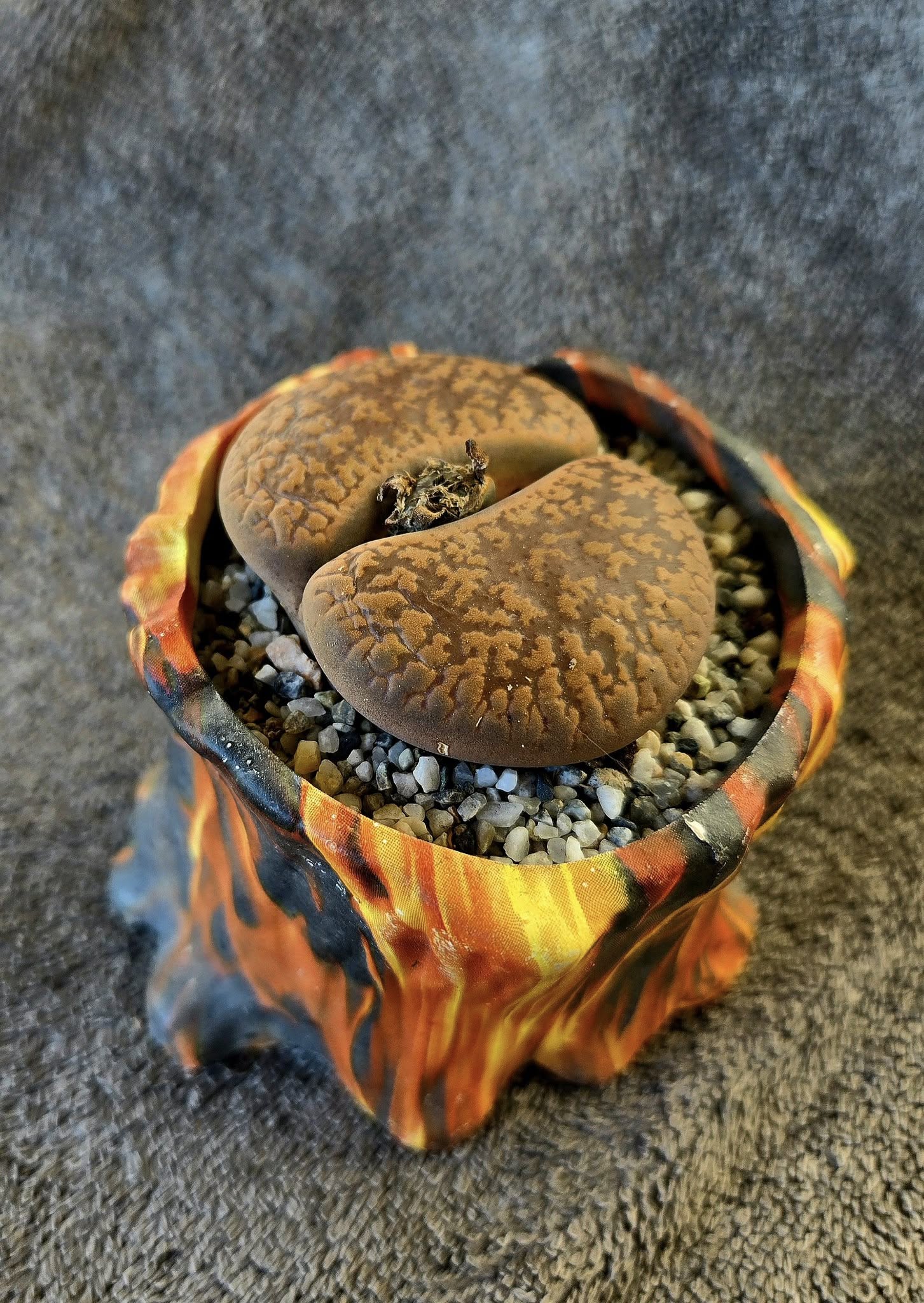
Lithops aucampiae subsp. koelemanii (de Boer) D.T.Cole is the windowless brick-faced subspecies of L. aucampiae, restricted to two Cole-numbered populations on the ironstone belt around Postmasburg in the Northern Cape. The taxon owes its diagnostic identity to a single character: the fenestral window that defines most Lithops, and which makes the nominate Lithops aucampiae instantly recognisable as a continuous dark red-brown panel, is absent or greatly reduced across the dorsal face of koelemanii. The result is a uniform dull matte surface that several specialist sources have described as carrying the texture and pitting of an old brick.
Taxonomic status sits in active disagreement between authorities. Hermanus de Boer described the plant as a new species Lithops koelemanii in Succulenta 39(3): 28 (1960), working from material that Art Koeleman of Pretoria had collected at the type locality 35 km northwest of Postmasburg. D.T. Cole reduced it to variety rank in Excelsa 3: 55 (1973), then elevated it again to subspecies rank in his 1988 monograph Lithops Flowering Stones. POWO synonymises the subspecies entirely and carries only the variety combination L. aucampiae var. koelemanii as a synonym of the nominate. The subspecies rank is the convention used in the specialist Lithops literature post-1988 and is the name under which seed and plants circulate in the trade, so the on-page treatment here follows the Cole 1988 designation while flagging the POWO synonymy explicitly.
Two Cole field numbers anchor provenance for the trade. C016 is the type locality collection 35 km northwest of Postmasburg; C256 is a second documented population 35 km west-southwest of the same town. Both sit within the Postmasburg ironstone belt and circulate as separately labelled seed offerings from specialist suppliers, allowing provenance-conscious collectors to work with geographically distinct populations under one subspecies name. The collector appeal of koelemanii in the Lithops world rests on its inversion of the genus aesthetic: most Lithops are prized for the visual complexity of their windows, and koelemanii instead presents an almost featureless brick-coloured face that reads as an oddity even within an already strange genus. Compare against the Sperrgebiet Lithops optica, which sits at the opposite extreme with windows that nearly fill the entire dorsal face and admit visible light to the buried green tissue inside.
Cultivation defers in nearly every detail to the parent L. aucampiae page. The subspecies shares the parent’s summer-rainfall Postmasburg climate, the same ironstone-adjusted substrate (40% pumice, 25% granite grit, 15% silica grit, 10% zeolite, 5% worm castings, with an optional 5% limestone substitution), the same inverted Lithops watering calendar, the same dry cold floor near −2°C, and the same yellow autumn flowers that emerge from the central fissure regardless of how reduced the surrounding window happens to be. The subspecies is rated equally beginner-friendly to the nominate and offers a forgiving entry point to the genus alongside Lithops lesliei, which shares the summer-rainfall South African origin and tolerates a similar margin of imprecise watering.
Lithops aucampiae subsp. koelemanii quick reference
Cultivation values are inherited from the parent L. aucampiae page; the subspecies shares the same summer-rainfall Postmasburg climate, the same ironstone-adjusted substrate, and the same inverted Lithops calendar. The values below are the operational summary; full ironstone-substrate reasoning sits on the parent page.
Taxonomy & nomenclature
POWO synonymises subsp. koelemanii under the nominate L. aucampiae and accepts no infraspecific taxa for the species. The taxon is sold across the global Lithops trade under D.T. Cole’s 1988 subspecies designation, and the specialist literature post-1988 universally uses subsp. koelemanii; this site follows the Cole treatment while flagging the POWO synonymy explicitly. The basionym Lithops koelemanii de Boer was published in Succulenta (Netherlands) 39(3): 28 (1960), based on material that Art Koeleman of Pretoria collected at a population 35 km northwest of Postmasburg. The original description noted brick-red colouration, a reduced or absent window, fruit with six locules, and a small two-bodied clump habit.
Cole reduced the rank to variety in Excelsa 3: 55 (1973) as Lithops aucampiae var. koelemanii (de Boer) D.T.Cole, judging the plants too similar to L. aucampiae at species level. He elevated the rank again to subspecies in the 1988 first edition of Lithops Flowering Stones (Acorn Books), and the 2005 revised edition (Cactus & Co) retains the subspecies treatment. The authority chain (de Boer) D.T.Cole holds at either rank because de Boer wrote the original 1960 species description; Cole’s name carries only the rank-change combination, not the basionym.
Cole’s 1988 monograph also established the subsp. euniceae (de Boer) D.T.Cole treatment for the geographically distinct Hopetown populations, which sit south of the koelemanii range and which SANBI tracks as a separately Vulnerable assessment unit. The two Cole subspecies (koelemanii and euniceae) are not adjacent in the field and represent independent geographic sub-populations of the broader L. aucampiae species range across the Postmasburg-Kuruman ironstone belt and the Northern Cape. The epithet koelemanii follows the standard Latinised possessive convention for personal names ending in a consonant; the common name “Koeleman’s pebble plant” or “Koeleman’s living stone” appears on some trade catalogues but is not standardised.
Habitat
Lithops aucampiae subsp. koelemanii is known from two documented populations on the Postmasburg ironstone belt of the Northern Cape: the type locality 35 km northwest of the town of Postmasburg (Cole C016) and a second locality 35 km west-southwest of the same town (Cole C256). Both sit within the broader L. aucampiae range, which extends across the Postmasburg-Kuruman belt and into adjacent parts of the Northern Cape. The koelemanii populations are geographically distinct from the bulk of the nominate range, which sits to the north, east, and south of the town. The geographic separation is partial, not complete; koelemanii is a recognisable sub-population within the species rather than a fully isolated taxon.
Substrate and climate are inherited from the parent species. The Postmasburg ironstone belt is reddish ferruginous laterite and quartzite, with a sandy surface layer scattered across hard ironstone fragments. Plants grow in small scattered colonies amid the rocks and gravel, with the brick-red colouration of the koelemanii bodies providing camouflage against the ironstone-coloured substrate that gives the wider belt its name. The climate is summer-rainfall, with most of the annual 200–350 mm of precipitation arriving between October and April; the dry season runs May through September. This summer-rainfall pattern places koelemanii alongside Lithops lesliei in the eastern summer-rainfall arm of the genus, distinct from the western winter-rainfall populations of Lithops karasmontana and the Sperrgebiet species. The Postmasburg plateau sits at approximately 1,100–1,300 m elevation, inferred from regional geography rather than a species-specific citation.
See the parent L. aucampiae page for the full Postmasburg ironstone belt ecology, the species-level range across the broader Northern Cape, and the historical context for the 1929 Aucamp discovery of the nominate species.
Morphology
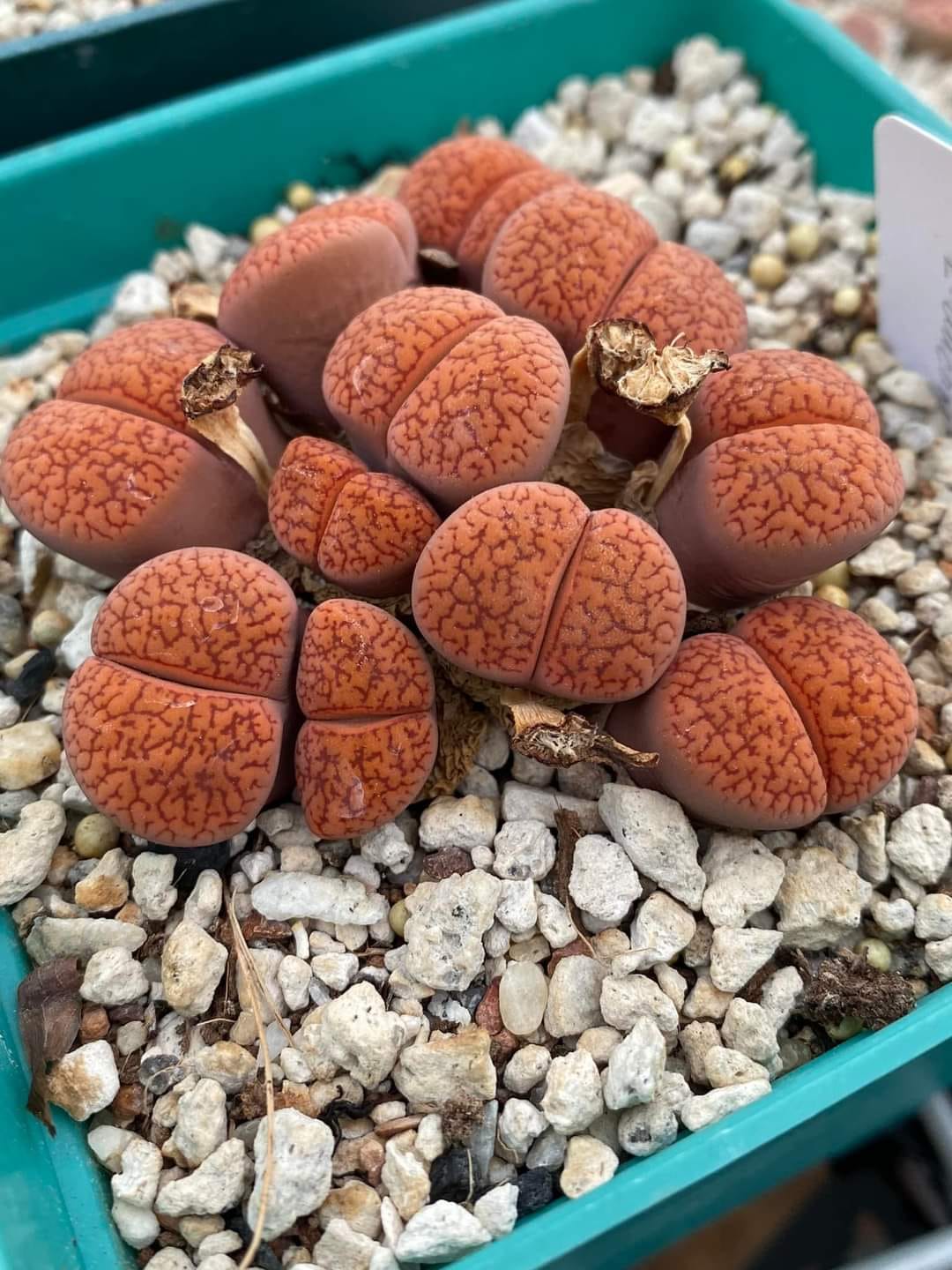
Body architecture is the standard Lithops form: a single pair of fused leaves forming an inverted cone that sits flush with or slightly below the soil surface, with only the flat to slightly convex dorsal face exposed. Koelemanii bodies are slightly smaller on average than the nominate aucampiae and the species typically tops out at two heads per rootstock, in contrast to the multi-headed clumping habit of the nominate. This two-headed maximum is consistent across both C-number populations and is recorded as a stable field character.
The diagnostic character is the dorsal face. Where the nominate L. aucampiae carries a continuous dark red-brown fenestral window panel that occupies most of the exposed surface, koelemanii has the window greatly reduced to a network of fine lines and dots, or absent entirely. The most reliable single diagnostic for the subspecies is this windowless or near-windowless face: the whole dorsal surface presents as a uniform dull matte brick-red or orange-red, with a texture that several specialist sources have compared to the pitting and surface of an old brick. The central groove between the two leaf lobes is also reduced relative to the prominent groove of the nominate, and the face texture is opaque rather than the semi-glossy reddish brown of standard aucampiae.
A minority of individuals within both C016 and C256 populations do show well-defined windows; this within-population variation was recorded by de Boer in the original 1960 description and confirmed by Cole. Identification therefore rests on the full character complex (dull face texture, reduced groove, two-headed clump habit, brick-red colouration) rather than the window character alone. Flowers are yellow, daisy-form, up to 52 mm in diameter, single per body, emerging from the central fissure in autumn; flower colour and structure are indistinguishable from the nominate, which produces the same striking visual contrast of a bright yellow disc against a near-featureless brick-red face. Compare against the smaller-bodied Lithops julii with its red-brown lip-smear face markings to place koelemanii in the genus context: where most Lithops are prized for window complexity, koelemanii is prized for window absence.
Locality detail
Two Cole-numbered field localities anchor the koelemanii range. C016 is the type locality 35 km northwest of Postmasburg, the site at which Art Koeleman collected the original material that de Boer described in 1960. C256 sits 35 km west-southwest of the same town and represents a second documented population, morphologically consistent with the type but slightly differently oriented relative to the Postmasburg ironstone belt. Both circulate as separately labelled seed and plant offerings from specialist suppliers; collectors who care about provenance distinguish them, with C016 the more commonly referenced when sources discuss koelemanii without specifying a collection number.
The two markers above are positioned at the documented directional offsets from Postmasburg town; precise GPS coordinates are not published for either locality, which is appropriate practice for a sub-population of a Vulnerable species in a region with documented illegal harvesting pressure on the genus. The map shows regional context rather than sharp coordinates. See the parent L. aucampiae page for the broader Postmasburg-Kuruman range distribution and the wider ironstone belt geography.
Lithops aucampiae subsp. koelemanii care and cultivation
Cultivation defers in nearly every detail to the parent L. aucampiae page. The subspecies shares the parent’s summer-rainfall Postmasburg climate, the same ironstone-adjusted substrate, the same inverted Lithops watering calendar, and the same dry winter cold floor. The subspecies is rated equally beginner-friendly to the nominate and offers a forgiving entry point to the genus.
Substrate
Koelemanii uses the same house mesemb formulation as the nominate species: 33% pumice (3–5 mm), 12% lava rock (5–10 mm, structural drainage aggregate), 10% zeolite (clinoptilolite, 4–6 mm), 20% granite grit (3–5 mm), 0% limestone, 20% coarse silica grit (1–3 mm angular crystalline quartz), and 5% worm castings as the sole organic component. No published source distinguishes cultivation practice at the subspecies level for Lithops: granite, lava, pumice and zeolite are declared house choices, and organic, limestone and silica stay at the genus continuity figures pending fresh evidence. Pot in unglazed terracotta, 10–12 cm deep; the two-headed clump habit means a wider pot is rarely necessary even for established plants.
All 16 Lithops on this site use one flat mineral formulation: the 95/5 mesemb baseline (95% inorganic, 5% organic), higher than the 90/10 cactus default used elsewhere on this site. No cultivation source at any tier distinguishes substrate practice between Lithops species, so every row below carries the same house formulation rather than sixteen separate findings. Silica sits at 20% and limestone at 0% as continuity conventions, not evidenced per-species figures.
| Species | Pumice | Lava | Zeolite | Granite | Limestone | Silica | Organic |
|---|---|---|---|---|---|---|---|
| L. lesliei | 33% | 12% | 10% | 20% | 0% | 20% | 5% |
| L. karasmontana | 33% | 12% | 10% | 20% | 0% | 20% | 5% |
| L. karasmontana subsp. bella | 33% | 12% | 10% | 20% | 0% | 20% | 5% |
| L. karasmontana subsp. amicorum | 33% | 12% | 10% | 20% | 0% | 20% | 5% |
| L. karasmontana ‘Top Red’ | 33% | 12% | 10% | 20% | 0% | 20% | 5% |
| L. burchellii | 33% | 12% | 10% | 20% | 0% | 20% | 5% |
| L. lesliei ‘Albinica’ | 33% | 12% | 10% | 20% | 0% | 20% | 5% |
| L. lesliei ‘Storm’s Albinigold’ | 33% | 12% | 10% | 20% | 0% | 20% | 5% |
| L. pseudotruncatella | 33% | 12% | 10% | 20% | 0% | 20% | 5% |
| L. dendritica | 33% | 12% | 10% | 20% | 0% | 20% | 5% |
| L. optica | 33% | 12% | 10% | 20% | 0% | 20% | 5% |
| L. optica ‘Rubra’ | 33% | 12% | 10% | 20% | 0% | 20% | 5% |
| L. aucampiae | 33% | 12% | 10% | 20% | 0% | 20% | 5% |
| L. aucampiae subsp. koelemanii (this page) | 33% | 12% | 10% | 20% | 0% | 20% | 5% |
| L. julii | 33% | 12% | 10% | 20% | 0% | 20% | 5% |
| L. julii subsp. fulleri | 33% | 12% | 10% | 20% | 0% | 20% | 5% |
Watering and light
The watering calendar is the standard inverted Lithops cycle, calibrated to the summer-rainfall Postmasburg origin. In Northern Hemisphere cultivation: full dormancy May through July (no water at all, wrinkled bodies are normal and not a watering cue), watch and wait through August, active watering September through November (the autumn flowering window), tapered watering December through February, final water March or April, then stop. Water thoroughly to runoff during the active phase, then let the mix dry completely over 10–14 days before the next application. Never water while the old leaf pair is mid-transfer to the new pair in January or February; water at this stage refills the old leaves, starves the new pair, and kills the plant from inside. The summer-rainfall origin gives the parent species a marginally wider tolerance window than the western winter-rainfall Lithops, and that tolerance carries to koelemanii.
Light requirements are the genus default: bright direct sun, minimum 5–6 hours daily. The opaque brick face of koelemanii holds its diagnostic colour and matte texture only under bright light; etiolation under low light stretches the fissure, washes out the brick-red ground colour, and leaves the face reading as dull and dirty rather than diagnostically opaque. The dry cold floor is −2°C and matches the parent species; the Postmasburg belt delivers cold dry winter nights, and the plant survives them only because it is bone dry across the cold months. Wet cold near freezing kills the plant from the collar regardless of the low-temperature tolerance recorded under dry conditions.
Comparison
The single most important comparison is against the nominate L. aucampiae. The two share substrate, climate, geography, body architecture, flower colour and form, and cultivation calendar; they differ in face character. The nominate carries a continuous dark red-brown fenestral window that occupies the centre of the dorsal face and a prominent central groove between the leaf lobes; koelemanii has the window reduced to a network of lines and dots or absent entirely, with a reduced groove and a uniform dull matte brick-red surface in place of the nominate’s semi-glossy windowed face. Both flower yellow, both share the parent species range across the Northern Cape ironstone belt, and both run on the same inverted summer-rainfall cultivation calendar. The differential is exclusively in the face character complex.
Across the broader genus, the koelemanii face character is near-unique. Most Lithops carry windows that are both present and visually defining; the genus name itself derives from the stone-faced appearance of the buried plant, and the translucent windows are the convergent adaptation that admits filtered light to the green tissue inside the body. Koelemanii is one of the few taxa in which the window is so reduced that the photosynthetic strategy appears to operate without an obvious external lens; the biological mechanism by which the subspecies maintains internal photosynthesis without a visible window is not well-resolved in published literature, but the trade-relevant fact is that the plant grows and flowers on the same care calendar as the nominate without external evidence of any compensating adaptation.
Within the wider eastern summer-rainfall arm of the genus, koelemanii sits alongside the nominate and L. lesliei among the most beginner-friendly Lithops. The cultivation profile is interchangeable with the parent species; the collector decision between nominate and subspecies turns on aesthetic preference for the windowed versus windowless face rather than on any difference in growing requirements. C016 (type locality) is the more commonly stocked provenance in the trade, with C256 carried as the specialist alternative for collectors building provenance-conscious collections.
Frequently asked questions
Is Lithops aucampiae subsp. koelemanii hard to grow?
Beginner. The subspecies inherits the cultivation profile of the parent L. aucampiae, which is rated among the most forgiving species in the genus and a recommended starting point for growers learning the Lithops calendar. The summer-rainfall Postmasburg origin gives the plant a marginally wider tolerance window than the western winter-rainfall Lithops. The single hardest thing is the inverted seasonal calendar: Lithops grow actively in autumn and winter and rest dry through summer, the opposite of every cactus on this site. Growers carrying their cactus watering instincts across to a Lithops pot kill plants in the first June. Learn the calendar on the parent species or on L. lesliei, then move to fussier western species.
Can Lithops aucampiae subsp. koelemanii be grown from seed?
Yes, and seed is the only standard propagation route. Seeds are widely available from specialist Lithops suppliers, with both C016 and C256 stocks carried as separately labelled provenance options. Germination is reliable at 20–25°C day with cooler nights around 10–15°C; seedlings appear within 3–7 days under good conditions. Time to first flower is 3–4 years under good cultivation. Plants are self-sterile, so seed production in cultivation requires hand pollination between two genetically distinct plants. Grafting is not standard practice for Lithops and the two-headed clump habit of koelemanii means vegetative propagation through division is naturally limited; the subspecies is grown almost exclusively from seed across the global trade.
Is Lithops aucampiae subsp. koelemanii legal to own?
Yes, with no CITES paperwork. The subspecies is not listed on any CITES appendix because the family Aizoaceae is not covered by the Cactaceae blanket Appendix II listing; the no-CITES status is the load-bearing legal distinction between Lithops and most of the other rare succulents on this site. Wild collection inside South Africa requires a TOPS permit under the National Environmental Management: Biodiversity Act (NEMBA, Act 10 of 2004) and conformance with provincial nature conservation ordinances; illegal harvesting of Lithops for the international trade has been documented and prosecuted, with confiscations recorded between 2019 and 2021. Nursery-propagated material with documented seed grown provenance from reputable specialist suppliers is the legally and ethically defensible source for collector specimens worldwide; international trade in nursery stock is unrestricted by CITES.
Where does Lithops aucampiae subsp. koelemanii grow in the wild?
On the Postmasburg ironstone belt of the Northern Cape Province, South Africa. Two documented populations anchor the range: the type locality 35 km northwest of Postmasburg (Cole field number C016) and a second population 35 km west-southwest of the same town (C256). Both sit within the broader L. aucampiae species range across the Postmasburg-Kuruman ironstone belt at approximately 1,100–1,300 m elevation. Habitat is reddish ferruginous laterite and quartzite, with plants growing in scattered colonies on hard ironstone fragments and surface gravel; the brick-red colouration of the subspecies provides camouflage against the ironstone substrate. The climate is summer-rainfall, with most of the annual 200–350 mm of precipitation arriving between October and April.
When does Lithops aucampiae subsp. koelemanii flower?
Autumn. In Northern Hemisphere cultivation the flowering window runs late October through December, corresponding to Southern Hemisphere April in habitat. Flowers are bright yellow, daisy-form, up to 52 mm in diameter, single per body, emerging from the central fissure between the two fused leaves. Flower colour and structure are indistinguishable from the nominate aucampiae, which produces the same striking visual contrast of a bright yellow disc against a near-featureless brick-red face. Individual flowers open in the late afternoon for a 2–4 hour window each day; individual blooms last 4–7 days. The subspecies is self-sterile, so cross-pollination between two genetically distinct plants is required for seed set. Plants must be at least three years old from seed before they flower reliably.
Sources & further reading
de Boer, H. (1960). Lithops koelemanii de Boer. Succulenta (Netherlands) 39(3): 28 · Cole, D.T. (1973). Lithops aucampiae var. koelemanii (de Boer) D.T.Cole. Excelsa 3: 55 · Cole, D.T. and Cole, N.A. (2005). Lithops: Flowering Stones (2nd ed.; first ed. Acorn Books 1988). Cactus & Co · Kew POWO. Lithops koelemanii de Boer, IPNI lsid urn:lsid:ipni.org:names:57590-1. powo.science.kew.org · Kew POWO. Lithops aucampiae L.Bolus, IPNI lsid urn:lsid:ipni.org:names:362411-1. powo.science.kew.org · llifle, Encyclopedia of Living Forms. Lithops aucampiae var. koelemanii C016 type locality, 35 km NW of Postmasburg. llifle.com · llifle, Encyclopedia of Living Forms. Lithops aucampiae var. koelemanii C256, 35 km WSW of Postmasburg. llifle.com · IUCN Red List. Lithops aucampiae Vulnerable, ID 46793. iucnredlist.org · SANBI Red List of South African Plants. Lithops aucampiae subsp. aucampiae Least Concern (2019). redlist.sanbi.org · rarepalmseeds.com. Lithops aucampiae var. koelemanii: Koeleman’s Pebble Plant. rarepalmseeds.com · Wikipedia. Lithops aucampiae; Lithops. en.wikipedia.org